Homogeneous Floquet time crystal protected by gauge invariance
Angelo Russomanno, Simone Notarnicola, Federica Maria Surace, Rosario, Fazio, Marcello Dalmonte, and Markus Heyl

TL;DR
This paper demonstrates that homogeneous lattice gauge theories can host long-range nonequilibrium phases like time crystals, protected by gauge invariance rather than disorder, with robustness confirmed through analytical and numerical methods.
Contribution
It introduces a novel mechanism for realizing and protecting time crystals in gauge theories, expanding the understanding of nonequilibrium phases beyond disordered systems.
Findings
Homogeneous gauge theories can exhibit time-crystal behavior.
The time crystal phase is robust against certain perturbations.
Analytical and numerical evidence supports long-range spatiotemporal order.
Abstract
We show that homogeneous lattice gauge theories can realize nonequilibrium quantum phases with long-range spatiotemporal order protected by gauge invariance instead of disorder. We study a kicked -Higgs gauge theory and find that it breaks the discrete temporal symmetry by a period doubling. In a limit solvable by Jordan-Wigner analysis we extensively study the time-crystal properties for large systems and further find that the spatiotemporal order is robust under the addition of a solvability-breaking perturbation preserving the gauge symmetry. The protecting mechanism for the nonequilibrium order relies on the Hilbert space structure of lattice gauge theories, so that our results can be directly extended to other models with discrete gauge symmetries.
Click any figure to enlarge with its caption.
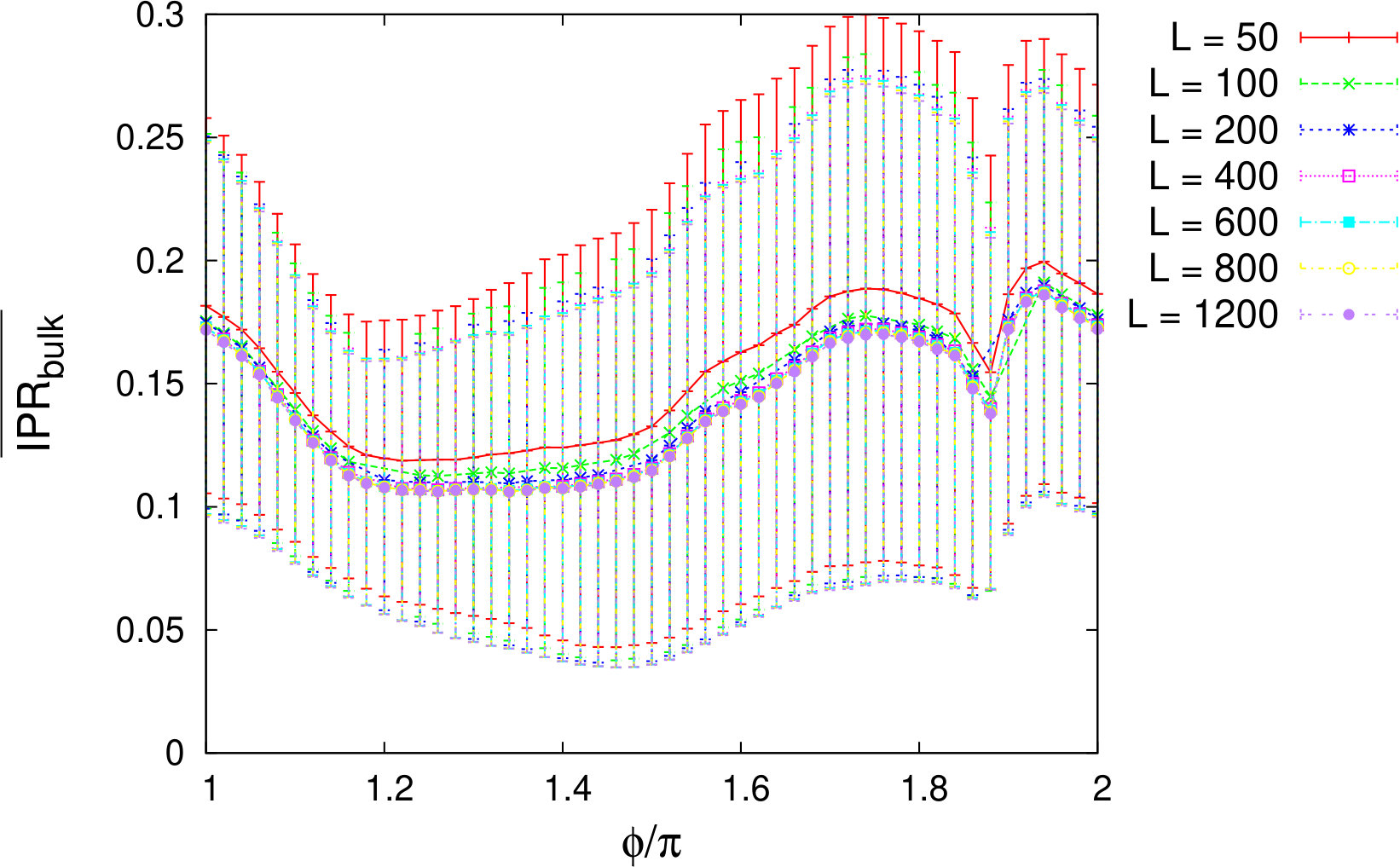 Figure 1
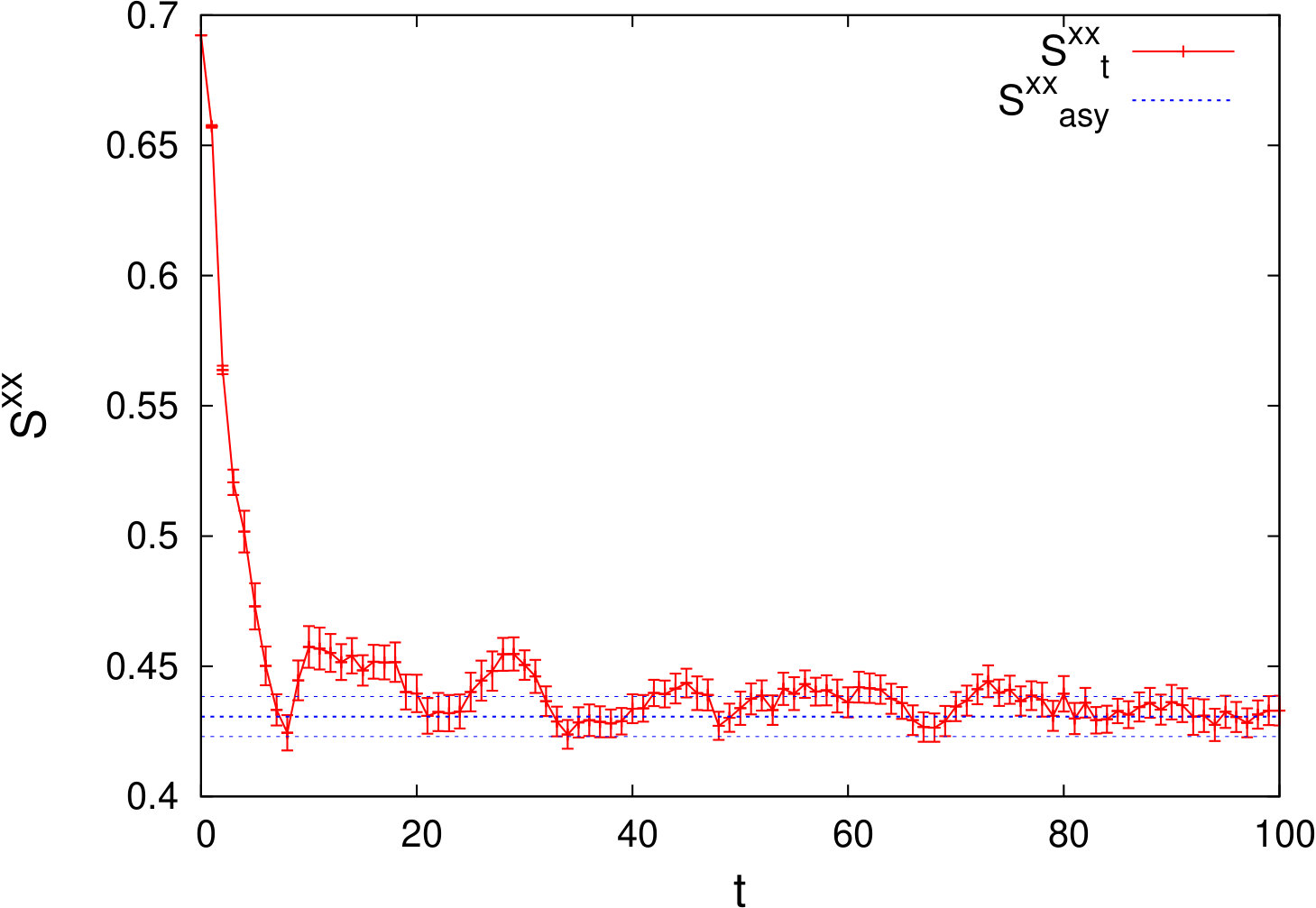 Figure 2
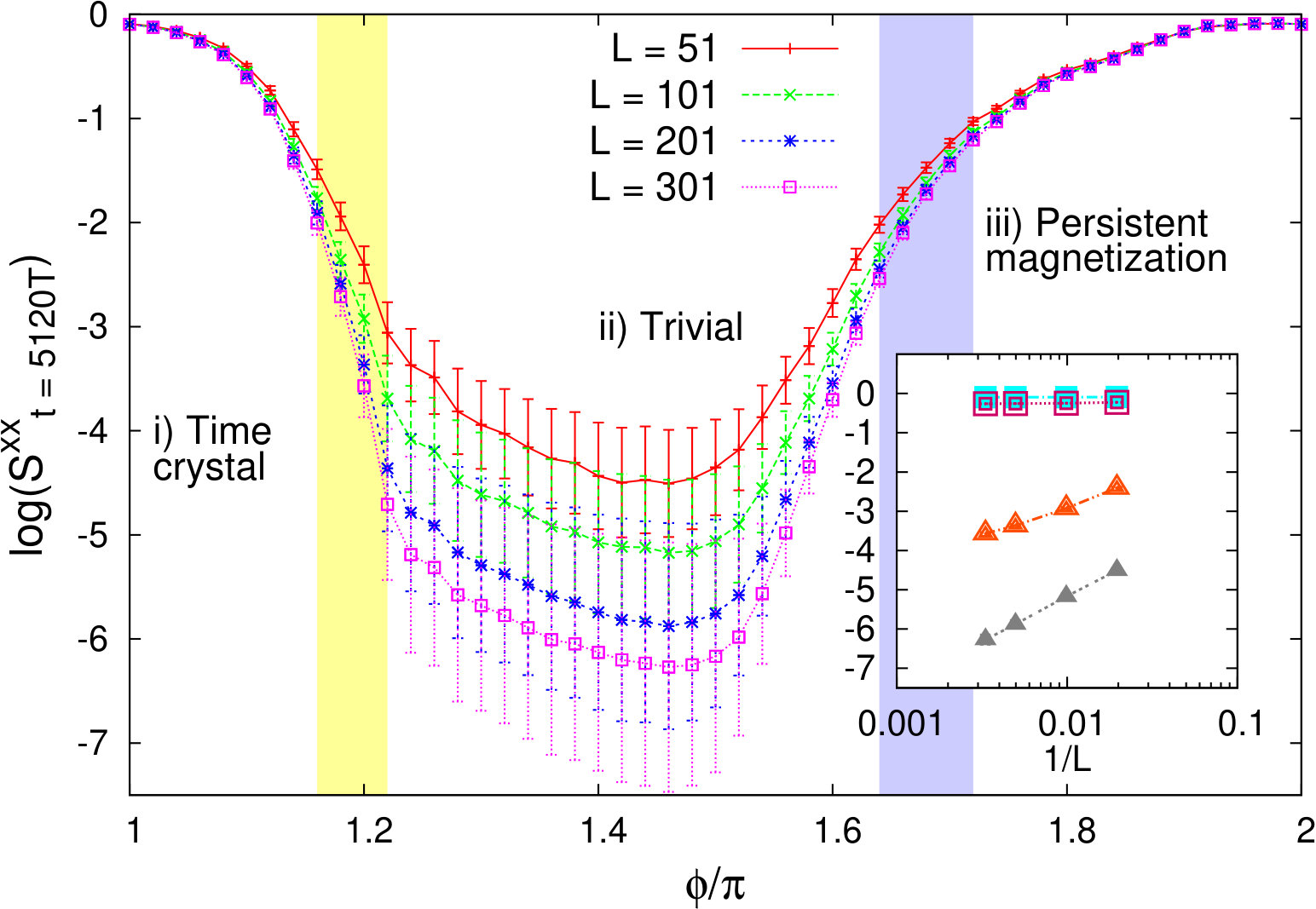 Figure 3
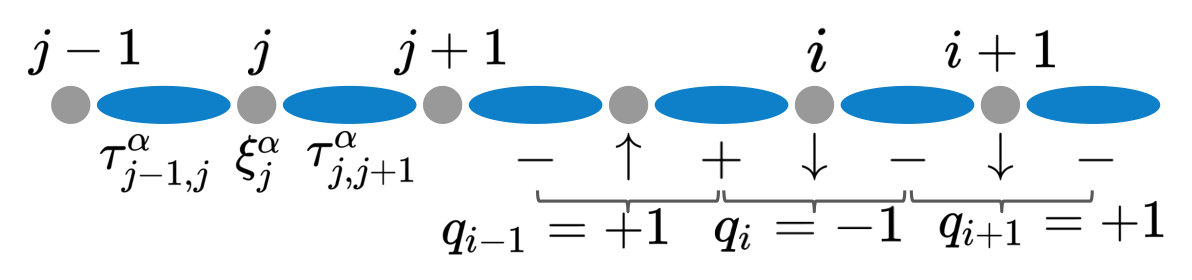 Figure 4
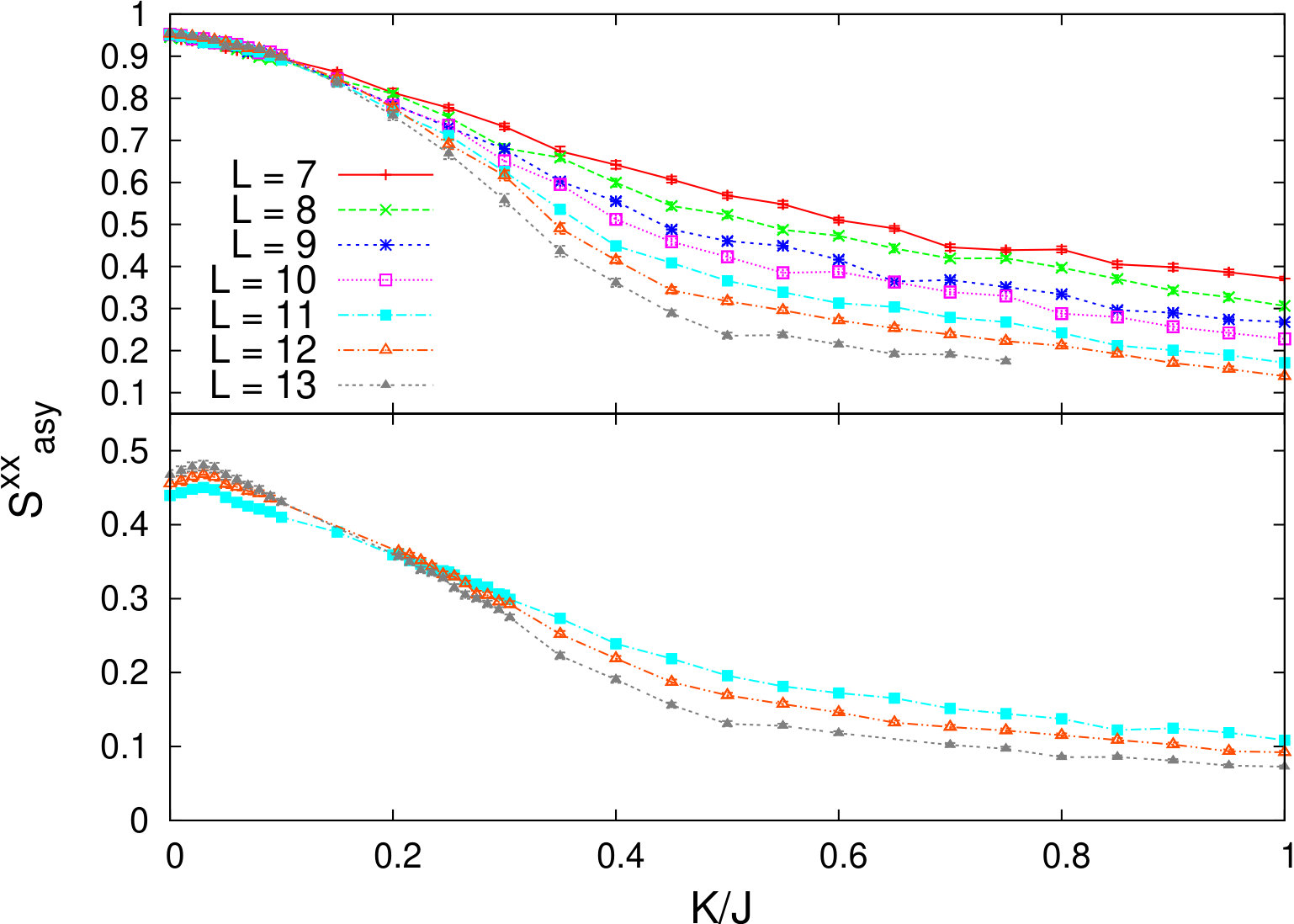 Figure 5
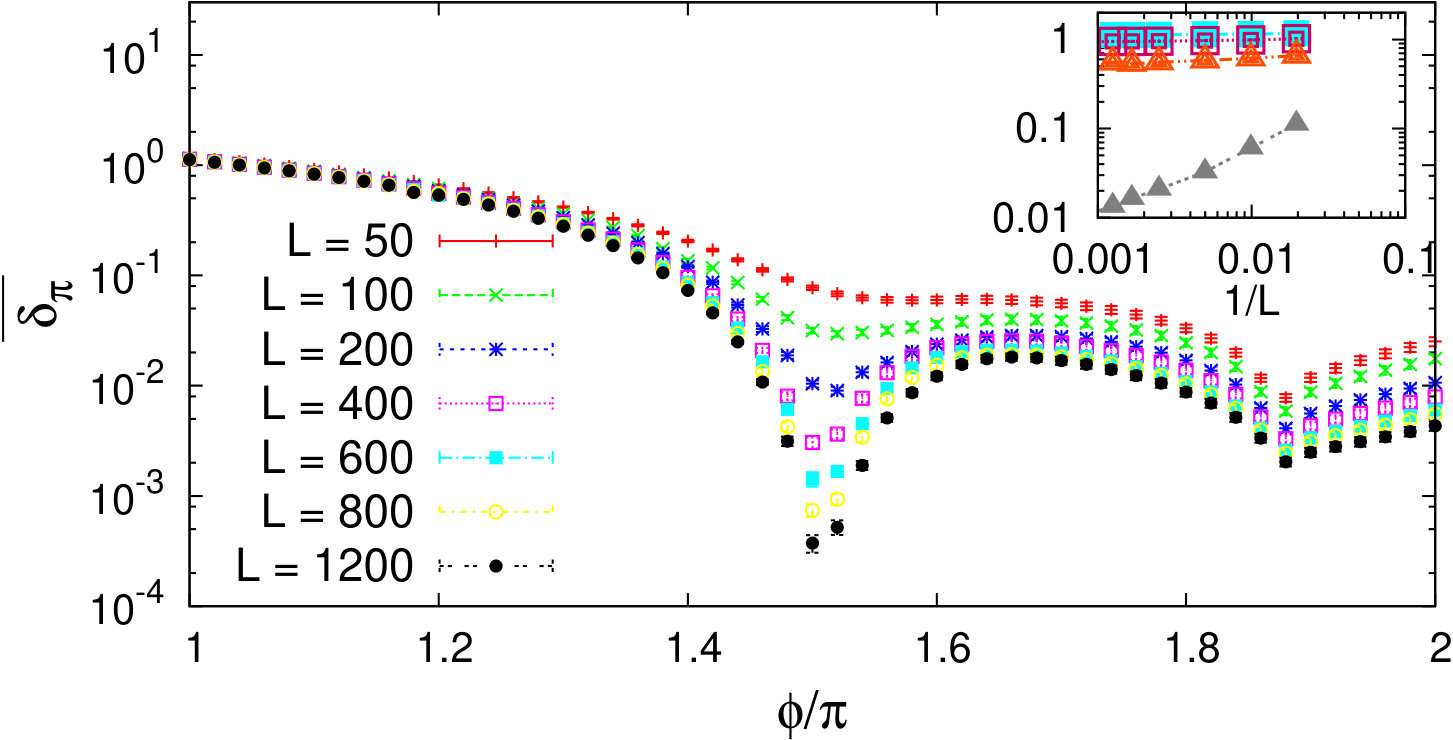 Figure 6
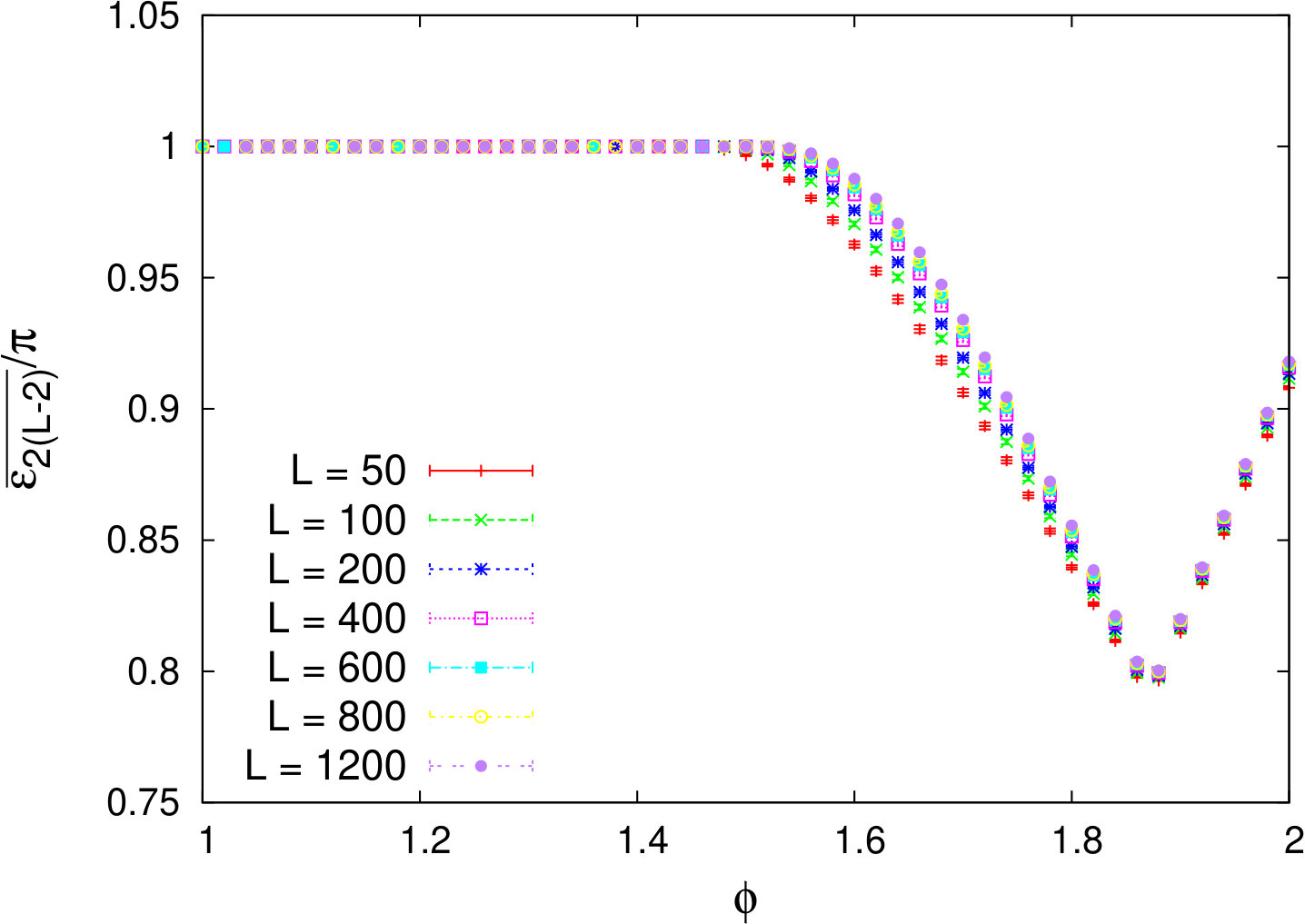 Figure 7
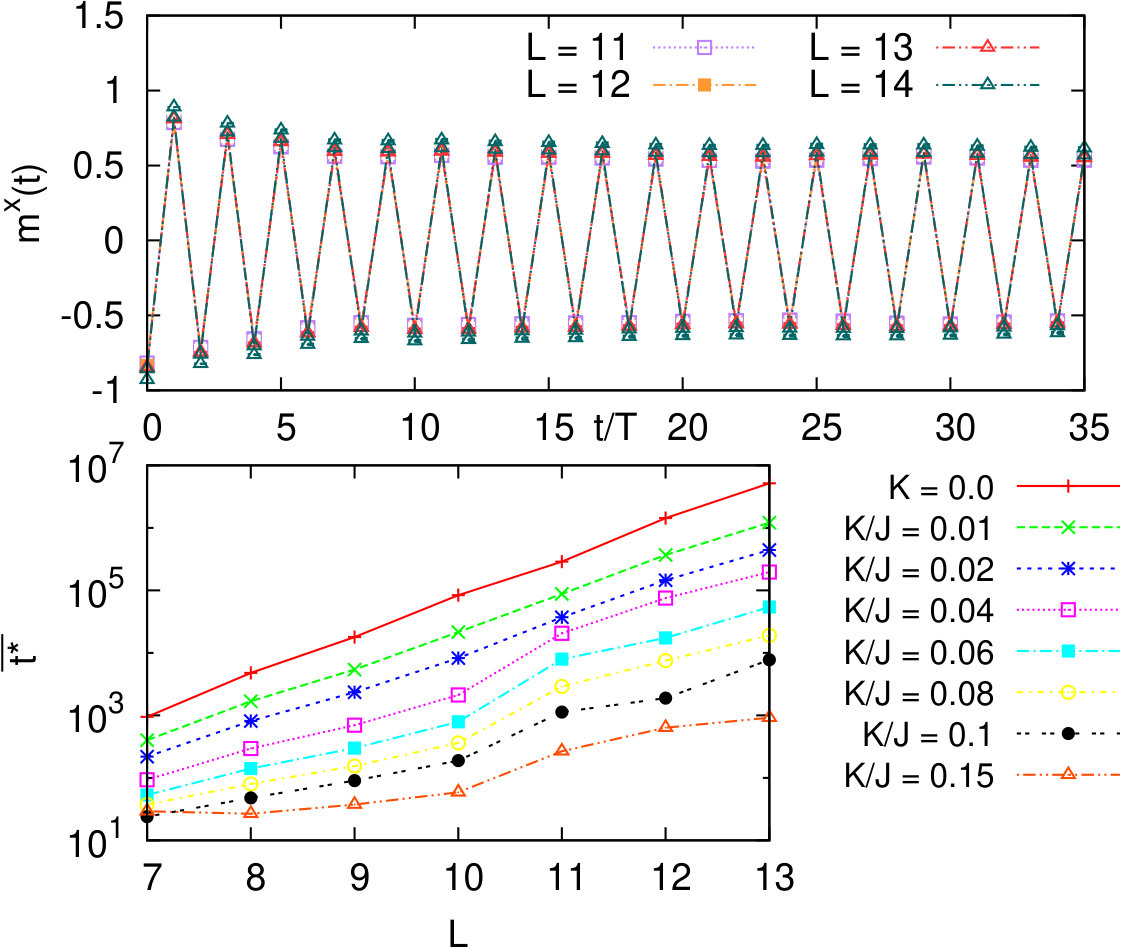 Figure 8
Peer Reviews
No public reviews on file for this paper yet. If you reviewed it on a platform where reviews are public (OpenReview, ICLR, NeurIPS, ICML), you can paste yours below so the community can read it here.
Videos
No videos yet. Explain this paper in a talk, walkthrough, or lecture? Add one.
Homogeneous Floquet time crystal protected by gauge invariance
Angelo Russomanno
Abdus Salam ICTP, Strada Costiera 11, I-34151 Trieste, Italy
NEST, Scuola Normale Superiore & Istituto Nanoscienze-CNR, I-56126 Pisa, Italy
Max-Planck-Institut für Physik Komplexer Systeme, Nöthnitzer Strasse 38, D-01187, Dresden, Germany
Simone Notarnicola
Dipartimento di Fisica e Astronomia “Galileo Galilei”, via Marzolo 8, I-35131, Padova, Italy
INFN, Sezione di Padova, via Marzolo 8, I-35131 Padova, Italy
Federica Maria Surace
Abdus Salam ICTP, Strada Costiera 11, I-34151 Trieste, Italy
SISSA, Via Bonomea 265, I-34136 Trieste, Italy
Rosario Fazio
Abdus Salam ICTP, Strada Costiera 11, I-34151 Trieste, Italy
Dipartimento di Fisica, Università di Napoli ”Federico II”, Monte S. Angelo, I-80126 Napoli, Italy
Marcello Dalmonte
Abdus Salam ICTP, Strada Costiera 11, I-34151 Trieste, Italy
SISSA, Via Bonomea 265, I-34136 Trieste, Italy
Markus Heyl
Max-Planck-Institut für Physik Komplexer Systeme, Nöthnitzer Strasse 38, D-01187, Dresden, Germany
Abstract
We show that homogeneous lattice gauge theories can realize nonequilibrium quantum phases with long-range spatiotemporal order protected by gauge invariance instead of disorder. We study a kicked -Higgs gauge theory and find that it breaks the discrete temporal symmetry by a period doubling. In a limit solvable by Jordan-Wigner analysis we extensively study the time-crystal properties for large systems and further find that the spatiotemporal order is robust under the addition of a solvability-breaking perturbation preserving the gauge symmetry. The protecting mechanism for the nonequilibrium order relies on the Hilbert space structure of lattice gauge theories, so that our results can be directly extended to other models with discrete gauge symmetries.
*Introduction.— * Isolated quantum matter can feature phases with long-range order in highly excited states that cannot be captured by thermodynamic ensembles 2013Huse ; 2015Nandkishore . This crucially relies on ergodicity breaking and a failure of the Eigenstate Thermalization Hypothesis (ETH) 2016AdPhyETH . One robust mechanism for achieving such nonergodic behavior is to impose strong disorder giving rise to the many-body localized (MBL) phase 2015Nandkishore ; 2015Altman ; Bloch1 ; 2017Smith ; 2018Brenes ; 2018Smith , which can host long-range ordered phases such as the MBL-spin glass 2013Huse ; Pollmann14 or Floquet time crystals vedika16 ; nayak ; 2017Zhang ; 2018Pal ; Barrett_prl18 ; Barrett_PRB18 . Recently, it has been realized that lattice gauge theories (LGTs) entail another robust mechanism for nonergodic dynamics in short-ranged systems protected by gauge invariance instead of disorder 2017Smith ; 2018Brenes ; 2018Smith due to the specific structure of their Hilbert spaces, which are built up of disconnected superselection sectors 2018Brenes . However, it has remained an open question to which extent they can also accommodate nonequilibrium phases with long-range order and therefore to which extent they can contribute to the open quest of realizing robust nonequilibrium ordered phases of homogeneous quantum many-body systems.
In this work we introduce a phase of quantum matter unique to LGTs that exhibits both spatial and temporal order thereby constituting a genuine nonequilibrium phenomenon. In particular, we show that homogeneous LGTs can feature robust time-crystalline phases in short-range systems protected by gauge invariance as opposed to previously studied cases that were relying on the presence of strong disorder. In order to realize such a ’gauge time crystal’, we introduce a periodically kicked LGT which, as we find, displays a sub-harmonic response to the external drive associated with a period doubling, see Fig. 1. We identify two necessary properties essential to realize a Floquet time crystal within the considered scheme: i) in a given superselection sector the LGT has to realize bond instead of field disorder in contrast to previously studied models of disorder-free localization 2017Smith ; 2018Brenes ; 2018Smith ; ii) the gauge symmetry has to be discrete and different from many previously studied nonergodic LGTs 2017Smith ; 2018Brenes . We solve the considered kicked LGT exactly by a mapping onto a free fermionic theory using a Jordan-Wigner (J-W) transformation, which allows us to explore the phase diagram for large system sizes. We observe that the Floquet states appear in pairs with a quasienergy difference of , so that our system shares many of the features of the -spin glass in a periodically kicked Ising chain with quenched disorder vedika16 . Importantly, we find that this gauge time crystal represents a robust phase which does not require fine tuning and persists over a wide range of parameters. In particular, we also study the influence of perturbations breaking the exact solvability and preserving the gauge symmetry, where we find numerical evidence for stability by means of exact diagonalization. We discuss how to extend our analysis to a -symmetric LGT along the lines of federica . The mechanism behind this time-crystalline phase relies on gauge invariance and can therefore be directly extended to other LGTs with discrete gauge symmetries. Importantly, our observation of a robust time-crystalline phase in a homogeneous short-ranged system goes beyond recent approaches which lead to prethermal spatiotemporal order 2017Else ; 2019Yu ; 2019Schaefer ; 2019Choi ; 2019Iadecola , and dissipative dynamics 2019Gambetta ; 2018WangPoletti ; 2018Tucker ; 2018GongUeda ; 2018OSullivan ; 2019Zhu ; 2019Lazarides .
*The model.— * We consider a Higgs-LGT in one spatial dimension. The theory describes the dynamics of Higgs fields - defined by Pauli-matrix operators at vertex on the lattice - coupled to gauge fields - defined by parallel transporters at the bond as illustrated in Fig. 1(a). The system Hamiltonian reads creutzbook ; fradkinbook
[TABLE]
The Higgs-field operators can also be interpreted as hard-core bosons with . The first two terms denote mass and gauge interactions, while the third describes the coupling between the Higgs and gauge fields. We drive the Higgs-LGT out of equilibrium by periodically kicking the strength of the Higgs-gauge coupling, leading to the following time-dependent Hamiltonian
[TABLE]
This system exhibits a local symmetry: commutes with the operators (which can be understood as the complex exponentials of the local Gauss’ operators). Thus, the Hilbert space of size is partitioned in superselection sectors, where all the states in a given sector are identified by the same set of local static charges via .
In the following we consider initial product states of the form where is a product state which satisfies for all and is the initial condition for the gauge degrees of freedom, that we will specify later in the text. Such initial conditions, which represent superpositions over many superselection sectors, can yield robust nonergodic behavior for LGTs and disorder-free localization 2017Smith ; 2017Smith2 ; 2018Brenes ; 2018Smith . Concretely, for our LGT the dynamics in a given superselection sector specified by the charges is determined by an effective Hamiltonian
[TABLE]
with , and the operators redefined with respect to Eqs. (1) and (2) (see Appendix A for details). This integration is related to the duality between Ising models and Ising LGTs Wegner1971 ; McCoy1983 . As a result the Hamiltonian becomes a kicked transverse-field Ising chain with binary bond disorder due to , which can be solved exactly via a J-W transformation for large systems. We emphasize that, due to the presence of degeneracies in the unperturbed Floquet spectrum, it is a priori less clear whether bond disorder - with respect to one with a continuous distribution - is able to induce MBL in order to get a time crystal. We will also study the influence of a perturbation of the form breaking the J-W solvability. After the integration it adds a transverse interaction term for the gauge fields
[TABLE]
We solve the dynamics of the LGT in a set of randomly chosen superselection sectors and finally perform an average when computing observables. In the shown data we include error bars resulting from the finiteness of . But let us emphasize again that the overall problem is homogeneous both in the initial condition and in the Hamiltonian.
*Initial conditions and observables.— * In order to reveal both the temporal and spatial order we use two complementary setups.
On the one hand, we take initial conditions which explicitly break the symmetry of the model yielding a nonzero magnetization for the gauge degrees of freedom which we then monitor in the subsequent evolution:
[TABLE]
where we have defined and the overline marks the average over the pseudo-disorder realizations media_not . In this way we obtain direct access to the time-crystalline period-doubling dynamics. In Fig. 1(b) we show results for in the fully interacting case obtained through exact diagonalization. We see the existence of period-doubling oscillations which are persistent for an infinite time in the thermodynamic limit. We show this fundamental property of persistence nayak in Fig. 1(c), where we see that the decay time of the period doubling oscillations exponentially scales to infinity with the system size. We determine as the time after which changes sign nayak1 ; federica averaged over disorder.
On the other hand we can choose initial conditions which are -symmetric with a vanishing magnetization , which allows us to address the spatial long-range ordering in the system. For that purpose we study the correlation parameter
[TABLE]
with defined as above. Whenever while at the same time , the system exhibits long-range spatial order.
*Exactly solvable case.— * Let us first focus on the case with , where the model can be mapped onto a system of non-interacting fermions by means of a J-W transformation. In each superselection sector we initialize the dynamics with the same initial state chosen as the ground state of the Hamiltonian . This state has a non-vanishing correlation parameter if and is symmetric under which allows us to address the long-range spatial ordering in the system; for a study of the temporal order we perform a spectral analysis, as we are going to detail below. In the J-W framework it is well known how to numerically study the dynamics and how to evaluate the correlation parameter as a Pfaffian (see lieber ; pfeuty ; russ1 ; santoro ; barouch ). Here it is enough to say that the dynamics is induced by an effective time-periodic single-particle Hamiltonian. This is important to mention because we can compute the single-particle Floquet states and the single-particle quasi-energies (see for instance emanuele ). These quantities will play an important role in what follows.
We find that the correlation order parameter reaches an asymptotic value after a transient (see the discussion below Eq. (7)). We plot the long-time value of as a function of kicking strength for different values of in the main panel of Fig. 2. We observe three regimes whose separating phase boundaries we indicate by the colored zones. In the regimes i) and iii) converges to a nonzero value as , while in regime ii) vanishes as the is increased (see also the inset of Fig. 2). Both regions i) and iii) mark the existence of an eigenstate phase 2013Huse ; 2015Nandkishore , where eigenstates exhibit long range spatial order (as in Pollmann14 , for instance). This eigenstate order is protected by disorder and MBL since in a clean short-range one-dimensional spin interacting thermalizing system with symmetry such order is impossible (this result is easily shown for clean one-dimensional spin chains scalettar , where long-range order is possible only in the ground state).
Although the behaviour of is qualitatively similar in both i) and iii), these two regions mark different phases since i) in addition also supports temporal order. An example of this property for can be seen in Fig. 1(c) (curve with ): The system is initialized in a state explicitly breaking the symmetry and the decay time exponentially increases with the system size. This fact can be understood by an analysis of the Floquet spectrum vedika16 . The presence of a temporal time-crystal ordering corresponds to spectral pairing, where each Floquet state has a partner with quasienergy shifted by . This situation is realized if there is a single-particle quasienergy exactly at with a marked gap separating it from the rest of the spectrum. In this way it does not hybridize with the bulk, and each many-body Floquet state has a -shifted partner obtained by adding the quasiparticle with quasienergy . We evaluate this gap as notquasi and plot it in Fig. 3. We see that it is non-vanishing in all the regime i). Moreover, as we show in Appendix B, in this regime averaged over the disorder is exactly equal to . In Appendix B we show also that the single-particle bulk Floquet states are always Anderson localized. This is very important, because without localization it is possible to have a gap in the Floquet spectrum at and still observe no time crystal (see for instance emanuele ): In the absence of localization, local operators expand in time obeying the Lieb-Robinson bound and no time-periodic behaviour whatsoever is possible vedika_K . Of course, the transition to localization and the one to glassy order of the excited eigenstates are independent Pollmann14 , and this is the reason why the transition from regime i) and ii) occurs at a value of different from the one where vanishes. In Fig. 2 we have initialized with a specific value of , but we have checked that the presented phenomenology doesn’t depend on this choice.
*General case.— * At this point we break J-W solvability by considering the term of Eq. (4), with . We consider a value of for which we see this phenomenon at ; then we take and we study the properties of the asymptotic correlation parameter. An interval of where this quantity does not scale with the size would mark the persistence of the time crystal. We now perform a conventional exact-diagonalization simulation of the system, up to size . To evaluate the asymptotic correlation parameter, we can resort to the FLoquet diagonal ensemble and we get
[TABLE]
where are the many-body Floquet states, is the dimension of the Hilbert space and denotes the overlap with the initial state. We remark that we can use Eq. (7) even if the many-body Floquet quasienergies appear in degenerate pairs, due to the symmetry. The point is that the operators commute with the same symmetry and hence have no matrix elements between states with different parity (the detailed demonstration along the lines of io is in Appendix C). We plot the dependence of versus for different in Fig. 4. We take two different initial conditions, in the upper panel we take the state with all the spins pointing down along the axis (), in the lower panel we take the uniform superposition of all the eigenstates of obeying the condition with . We see that for there is no decrease with , marking the persistence of the time-crystal behaviour. This persistence can be seen also in Fig. 1(c) where the introduced above exponentially increases with .
Time crystallinity in Abelian lattice gauge theories.—
We now investigate more generally if time crystallinity can appear in disorder-free Abelian LGTs in (1+1)-d. We consider the generic Hamiltonian coupling Higgs fields to Abelian gauge fields kogut1975hamiltonian :
[TABLE]
where is the Higgs occupation on site and are respectively the electric field and the parallel transporter, and is defined analogously to the case above. The electric-field interaction energy is local in these theories, differently from the term involving at least two neighboring sites. For a LGT (i.e. a theory where now and are not Pauli matrices but the more general clock operators), we can use a similar approach as the one used in the LGT. We consider an initial state where matter is in an equal-weight superposition of all possible eigenvalues of the Higgs number operator, and the gauge fields are in a generic state. The evolution of such states can be mapped exactly into the one of clock models under the effect of quasi-random local fields: since the latter class of models has been shown to display time-crystal behavior for small values of and random disorder federica , it is natural to expect that the mechanism discussed above holds true also for . This mechanism does not work for continuous LGTs (see Appendix D for details), which, however, doesn’t exclude other ones for the generation of time crystals in such theories.
Concluding discussion.— In this work we have demonstrated that homogeneous LGTs can realize time-crystal phases, where the protecting nonergodicity is enforced by the local constraints imposed by gauge invariance. In more general terms, our results show that homogeneous LGTs can realize eigenstate order, which naturally leads to the question to which extent also other eigenstate phases can occur in homogeneous LGTs, e.g., analogues of the MBL-spin glass 2013Huse ; Pollmann14 or topological order at elevated energy densities bahri2015localization . Our results are of immediate relevance to experiments realizing lattice gauge theory dynamics Wiese:2013kk ; Dalmonte:2016jk ; Zohar2015 in both trapped ions ExpPaper and cold atom systems Bernien2017 ; Surace:aa . In particular, scalable proposals have been formulated Zohar:2017aa ; Notarnicola:aa , and several experiments have already demonstrated the building blocks Anderlini_2007 ; Trotzky:2008aa ; Schweizer:aa ; Mil:aa for discrete lattice gauge theories of relevance to gauge time crystals.
Further, our results can be directly extended to LGTs which opens up the possibility, in principle, of generating period -tupling time-crystals. While our approach cannot be immediately applied to LGTs with continuous groups, it would be intriguing to see whether discrete non-Abelian symmetries can also support the formation of defect-free time crystals.
Acknowledgements.
We acknowledge fruitful discussions with R. Khasseh and M. Wauters. A. R. and R. F. thank the European Union for partial financial support through QUIC project (under Grant Agreement 641122). A. R. thanks the Max-Planck-Institut für Physik Komplexer Systeme for partial financial support and the warm hospitality received during the preparation of this work. S. N. and M. D. acknowledge partial support by the H2020 Project - QUANTUM FLAGSHIP - PASQUANS (2019-2022). We are indebted with G. E. Santoro for the subroutine performing the diagonalization of unitary operators. This work is partly supported by the ERC under grant number 758329 (AGEnTh) and by the QUANTERA project QTFLAG.
Appendix A Derivation of the effective Hamiltonian
The derivation of the effective Hamiltonian from , defined respectively in Eqs. (3) and (2) of the main paper, needs two steps. In the first, we restrict ourselves to one of the superselection sectors defined by a set of static charges . To do so, for a generic state , we consider its component on the chosen sector, defined as
[TABLE]
where is the projector on the chosen superselection sector and projects on the sector with static charge on site . It follows that for each state in the chosen sector we have
[TABLE]
In the second step, we exploit the above relation in order to cancel the matter field operators from the Hamiltonian . The derivation is now straightforward. First we have
[TABLE]
Then, we redefine the operators in order to cancel the matter field from the second part of
[TABLE]
Note that the proper commutation relations are still satisfied, in particular and . By applying this substitution to the Hamiltonian we have that
[TABLE]
where the prime will be henceforth omitted. The same substitution allows to cancel out the matter field in the term , which is introduced in Eq. (4) of the main paper as a function of the gauge field only. We thus obtain the effective Hamiltonian (Eq. (3) of the main text) for the superselection sector defined by the static charges . Gauge invariant observables can now be computed by summing over the sectors
[TABLE]
where gives the projective probability of the initial state on the sector , is the operator obtained from after integration of the matter field, and is the state of the gauge field evolved with the Hamiltonian . As stated in the main text, we can now treat the originally translation-invariant model by computing averages of an effective model with a quenched disorder characterized by a probability distribution . For simplicity (although not necessary), we choose a class of initial states with the property that , i.e. with uniform weights over all the sectors. We now prove that with the choice of initial states reported in the main text this property is indeed satisfied.
The state for the Higgs field is a product state of spins, each one living on the equator of the Bloch sphere ( for every ). For each we can find the unit vector giving its position on the Bloch sphere, such that
[TABLE]
We now consider a generic sector and we see that for every site we have
[TABLE]
where we used the fact that . From the unitarity of we derive the relation between the norms
[TABLE]
which implies that the projections on sectors which only differ for one local charge have equal norms. Since the last relation holds for every set of and for every , we find that all the probabilities have to be equal, with .
Appendix B Single-particle Floquet spectrum
Fig. 5 shows the average over pseudo-disorder realizations of . We can see that it stays at in an interval of larger than the one where is nonvanishing (see Fig. 3 of the main paper).
Fig. 6 shows the bulk-averaged single-particle Floquet inverse participation ratio defined as
[TABLE]
where we define as the average over the realizations of pseudo-disorder, {\bf w}_{\alpha}=\left(\begin{array}[]{cccccccccc}u_{1,\,\alpha}&\cdots&u_{L,\,\alpha}&|&v_{1,\,\alpha}&\cdots&v_{L,\,\alpha}\end{array}\right) are the single-particle Floquet states (see for instance emanuele for more details) and runs over the values corresponding to the bulk single-particle Floquet states (the ones with ). For all the considered values of we can clearly see that does not scale with the system size and the same occurs for the error bars (evaluated as the r. m. s. fluctuation over the pseudo-disorder realizations). This marks the fact that all the single-particle Floquet states are localized and therefore the model shows Anderson localization for all the considered values of .
Appendix C Convergence to the Floquet diagonal ensemble
In the text we have claimed that the correlation order parameter converges for long times towards the Floquet diagonal ensemble value given by Eq. 6 of the main text. We have numerically verified this point; we show an example of this convergence in Fig. 7.
We would like also to better discuss this point from the theoretical point of view. Let us expand in the Floquet basis, we find
[TABLE]
The indexes and can take values and and mark the symmetry sector. The system is symmetric under the symmetry, so the Floquet states are doubly degenerate . Moreover, also the operators are symmetric under this symmetry and we have therefore . We can therefore rewrite Eq. (19) as
[TABLE]
The off-diagonal term vanishes in the long time after the disorder average, due to the destructive interference between the oscillating phase factors. Only the block-diagonal term survives. Thanks to the degeneracy of the expectations with respect to the index , we can compute this term directly using the Floquet states given by the numerical diagonalization (which, for each , are in general superpositions of and ). Moreover, takes the same value whichever basis in the degenerate Floquet subspace is considered. That’s why in the main text we do not write the index .
Appendix D No time crystal for continuous gauge symmetry
Here we briefly discuss the case of a continuous gauge symmetry. In order to show that the time-crystal question in this case is very delicate (and most probably a discrete time-crystal behaviour in this form is impossible) let us consider the lattice Schwinger model in the Wilson formulation as an example. As discussed in Ref. heyl , this model displays an extremely slow dynamics, which is qualitatively less ergodic than conventional MBL - in particular, with entanglement entropy growing as . However, due to the absence of any periodicity in the gauge field Hilbert space, it is not possible to identify a clear time-dependent Hamiltonian whose dynamics could lead to a time crystal: for instance, applying the same recipe as above would lead to an infinite period. This case immediately illustrates that the absence of ergodic dynamics – typical of gauge theories due to superselection sectors – is by far not enough for engineering translation-invariant time crystals: Identifying the proper gauge symmetry is absolutely key and, in the present context, doable thanks to rather direct analogies with inhomogeneous clock models emerging from a specific class of initial states.
The reference list from the paper itself. Each links out to its DOI / PubMed record.
- 1(1) D. A. Huse, R. Nandkishore, V. Oganesyan, A. Pal, and S. L. Sondhi, Physical Review B 88 , 014206 (2013).
- 2(2) R. Nandkishore and D. A. Huse, Annual Review of Condensed Matter Physics 6 , 15 (2015).
- 3(3) L. D’Alessio, Y. Kafri, A. Polkovnikov, and M. Rigol, Advances in Physics 65 , 239 (2016), 1509.06411.
- 4(4) E. Altman and R. Vosk, Annual Review of Condensed Matter Physics 6 , 383 (2015).
- 5(5) D. A. Abanin, E. Altman, I. Bloch, and M. Serbyn, ar Xiv:1804.11065 (2018).
- 6(6) A. Smith, J. Knolle, D. L. Kovrizhin, and R. Moessner, Phys. Rev. Lett. 118 , 266601 (2017).
- 7(7) M. Brenes, M. Dalmonte, M. Heyl, and A. Scardicchio, Phys. Rev. Lett. 120 , 030601 (2018).
- 8(8) A. Smith, J. Knolle, R. Moessner, and D. L. Kovrizhin, Physical Review B 97 , 245137 (2018).