Space-Charge effect in electron time-of-flight analyzer for high-energy photoemission spectroscopy
G. Greco, A. Verna, F. Offi, G. Stefani

TL;DR
This paper investigates the space-charge effect in electron time-of-flight analyzers used in high-energy photoemission spectroscopy, comparing simulation methods and validating the accuracy of SIMION in predicting energy distortions.
Contribution
It introduces and compares two simulation methods for space-charge effects and verifies SIMION's reliability for modeling these effects in photoemission experiments.
Findings
SIMION accurately predicts energy distortions caused by space-charge effects.
Comparison of two simulation methods shows consistent results.
Validated simulation approach can improve interpretation of photoemission spectra.
Abstract
The space-charge effect, due to the instantaneous emission of many electrons after the absorption of a single photons pulse, causes distortion in the photoelectron energy spectrum. Two calculation methods have been applied to simulate the expansion during a free flight of clouds of mono- and bi-energetic electrons generated by a high energy pulse of light and their results have been compared. The accuracy of a widely used tool, such as SIMION(R), in predicting the energy distortion caused by the space-charge has been tested and the reliability of its results is verified. Finally we used SIMION(R) to take into account the space-charge effects in the simulation of simple photoemission experiments with a time-of-flight analyzer.
Click any figure to enlarge with its caption.
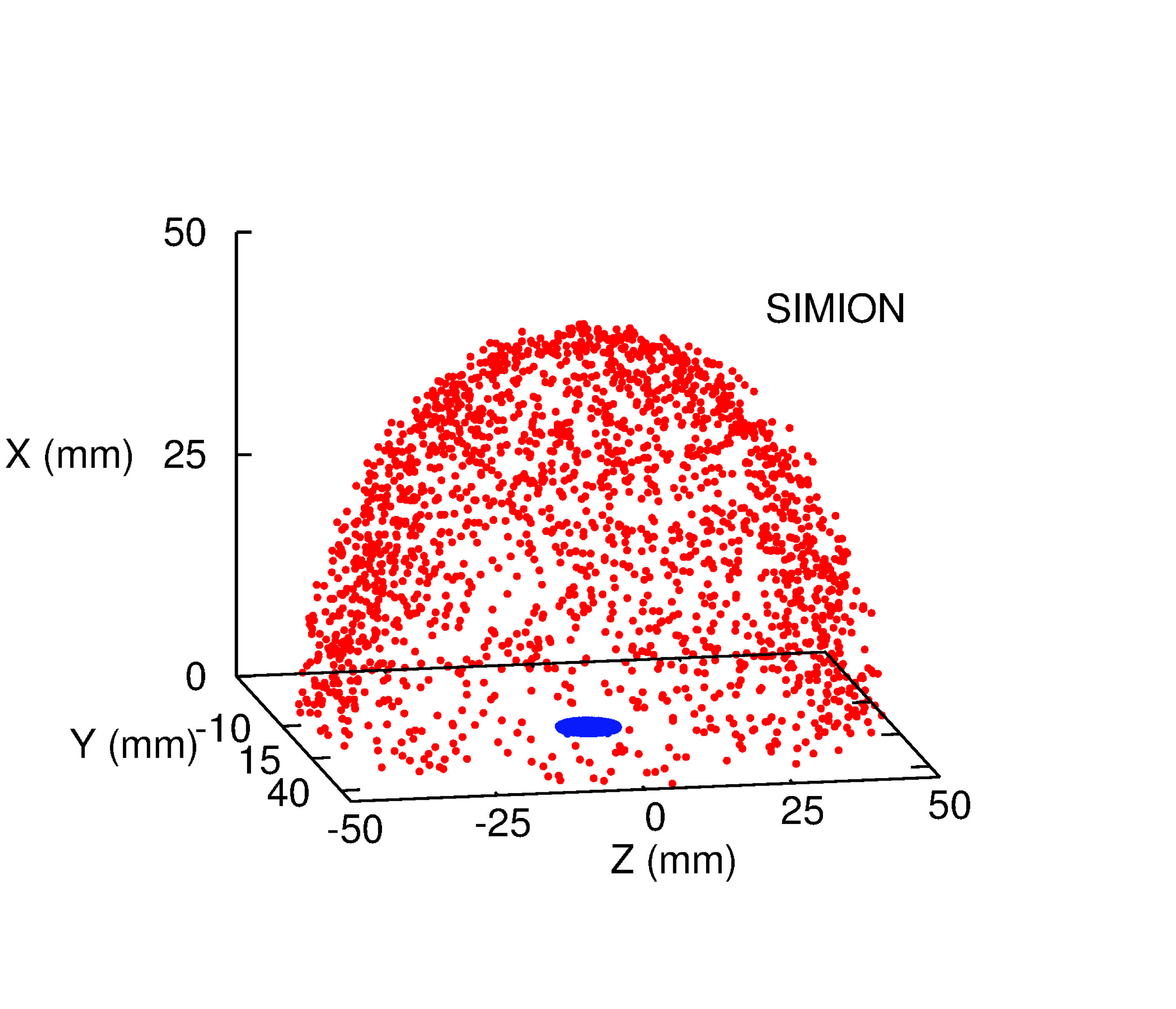 Figure 1
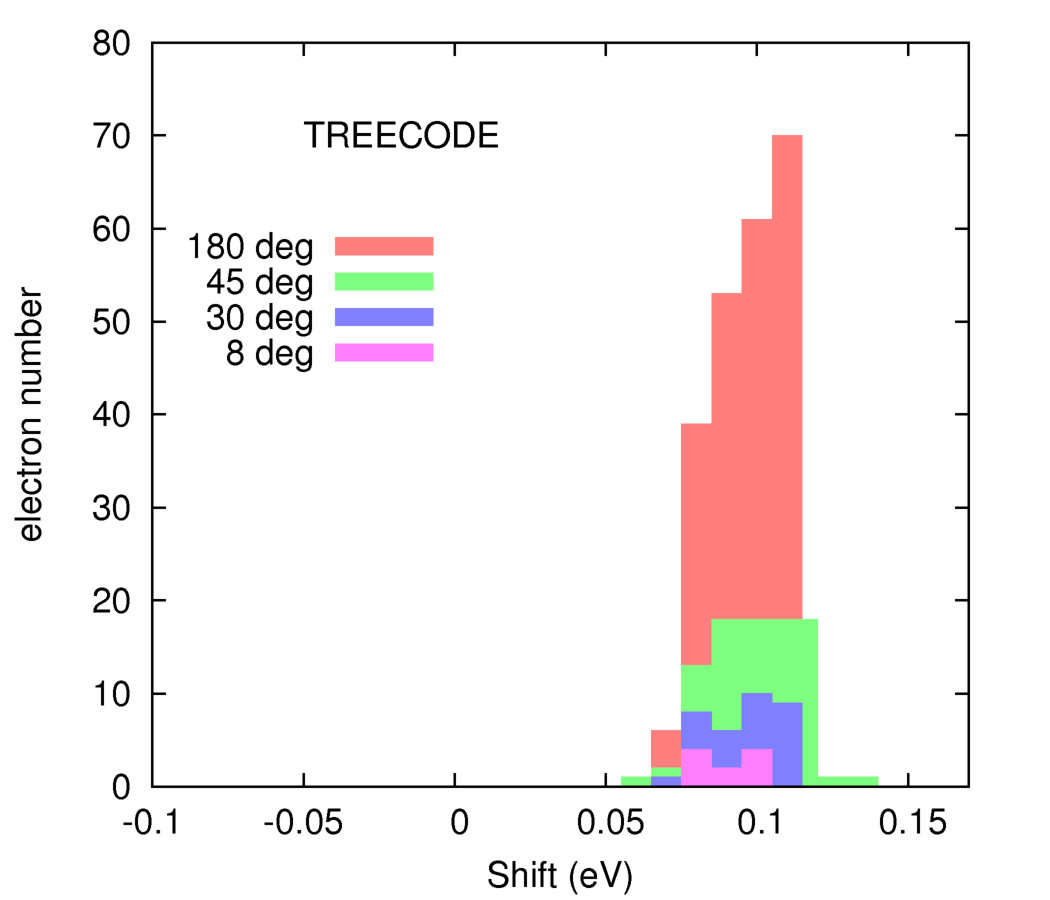 Figure 10
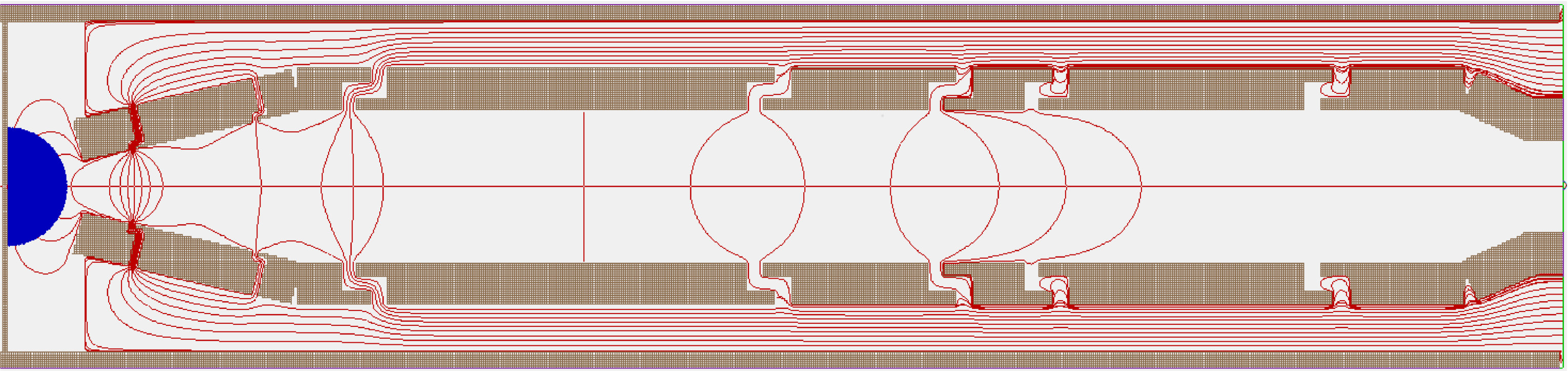 Figure 11
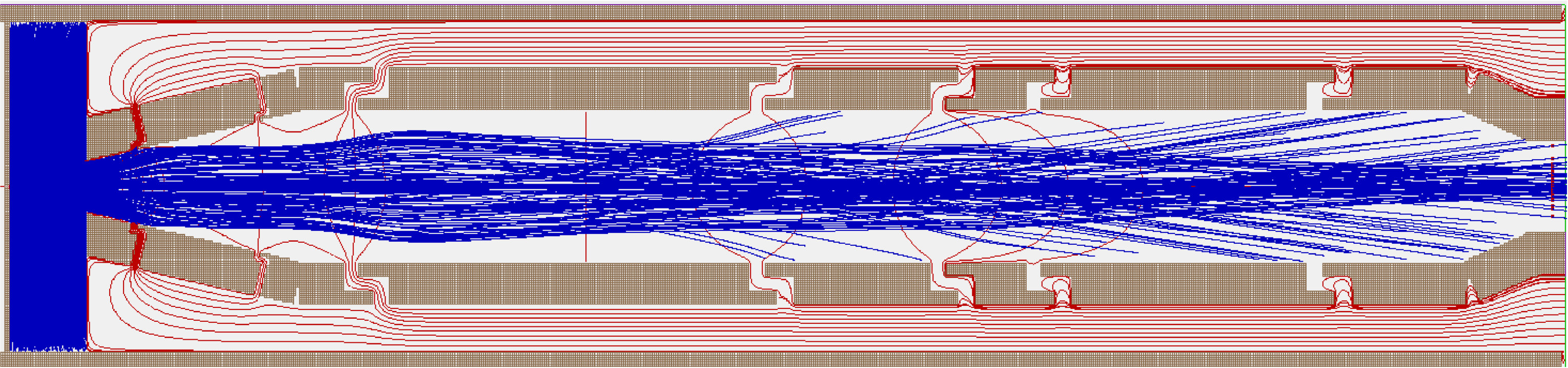 Figure 12
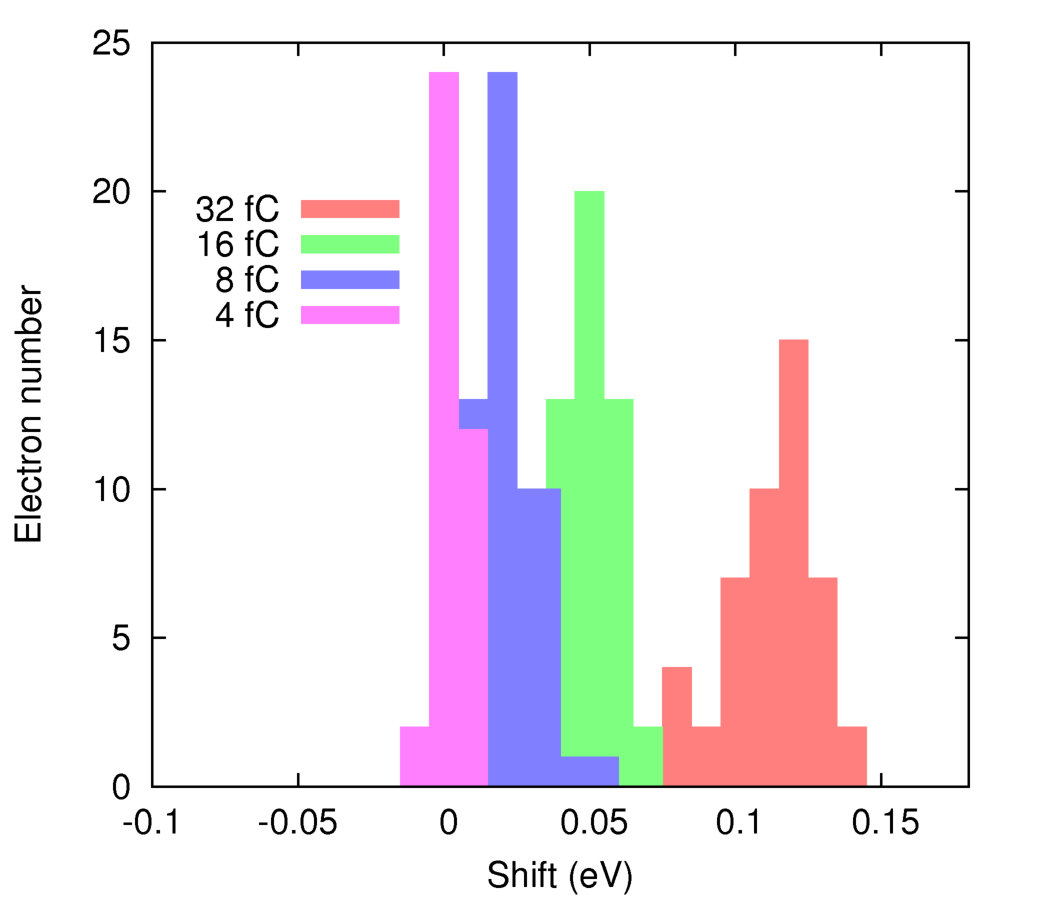 Figure 13
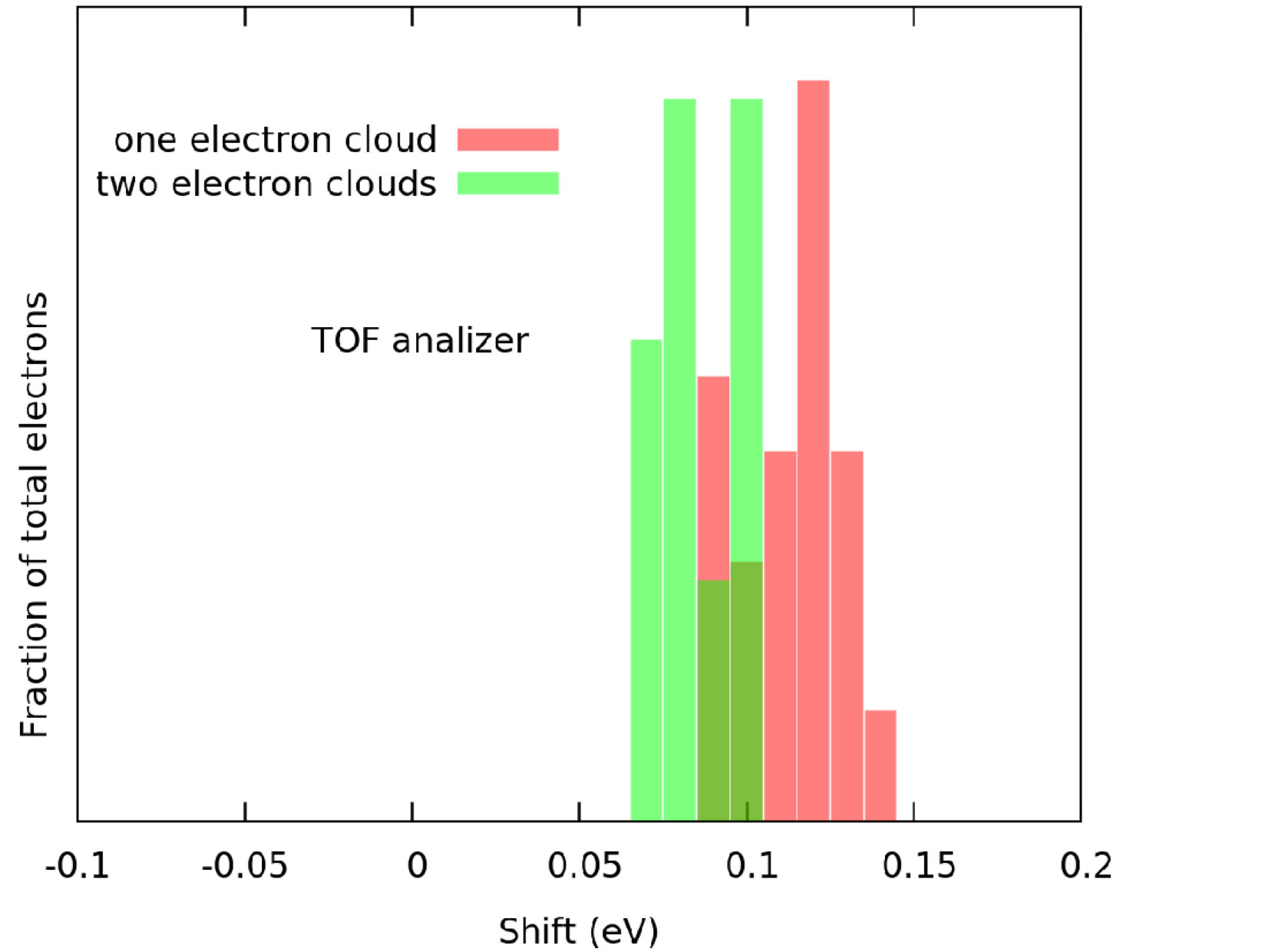 Figure 14
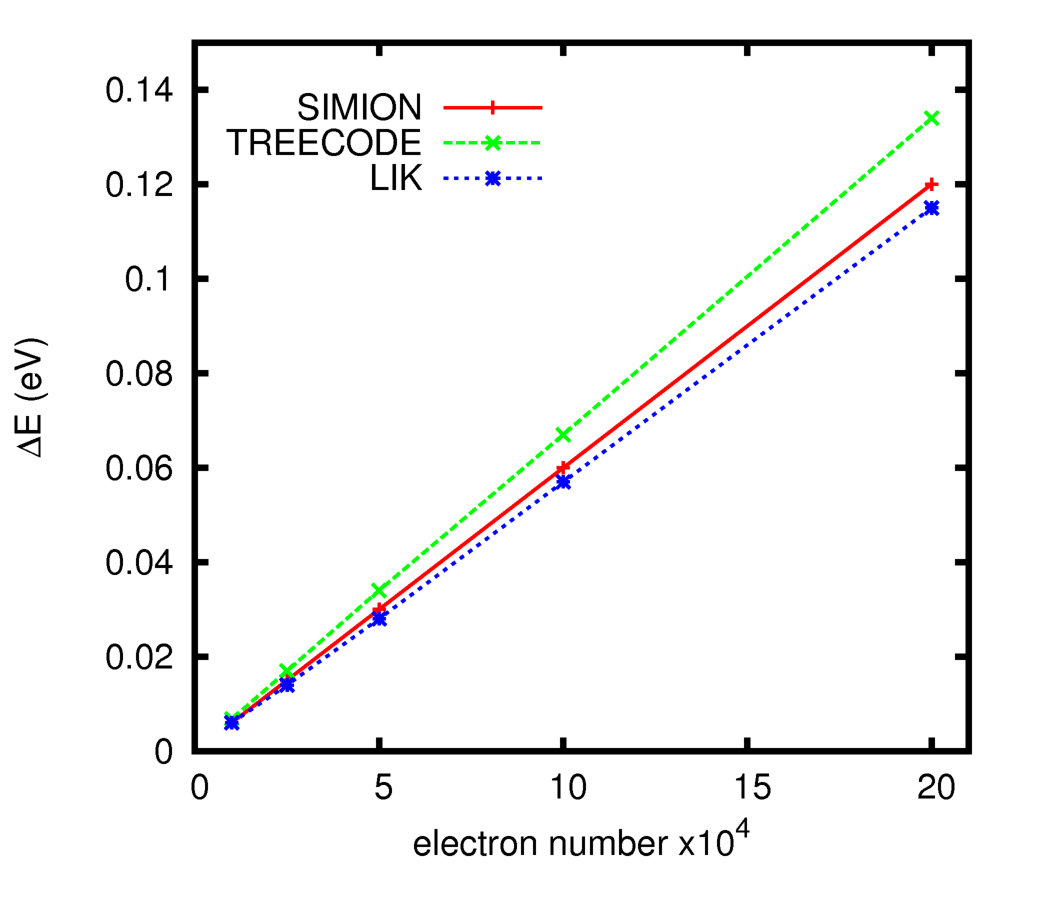 Figure 2
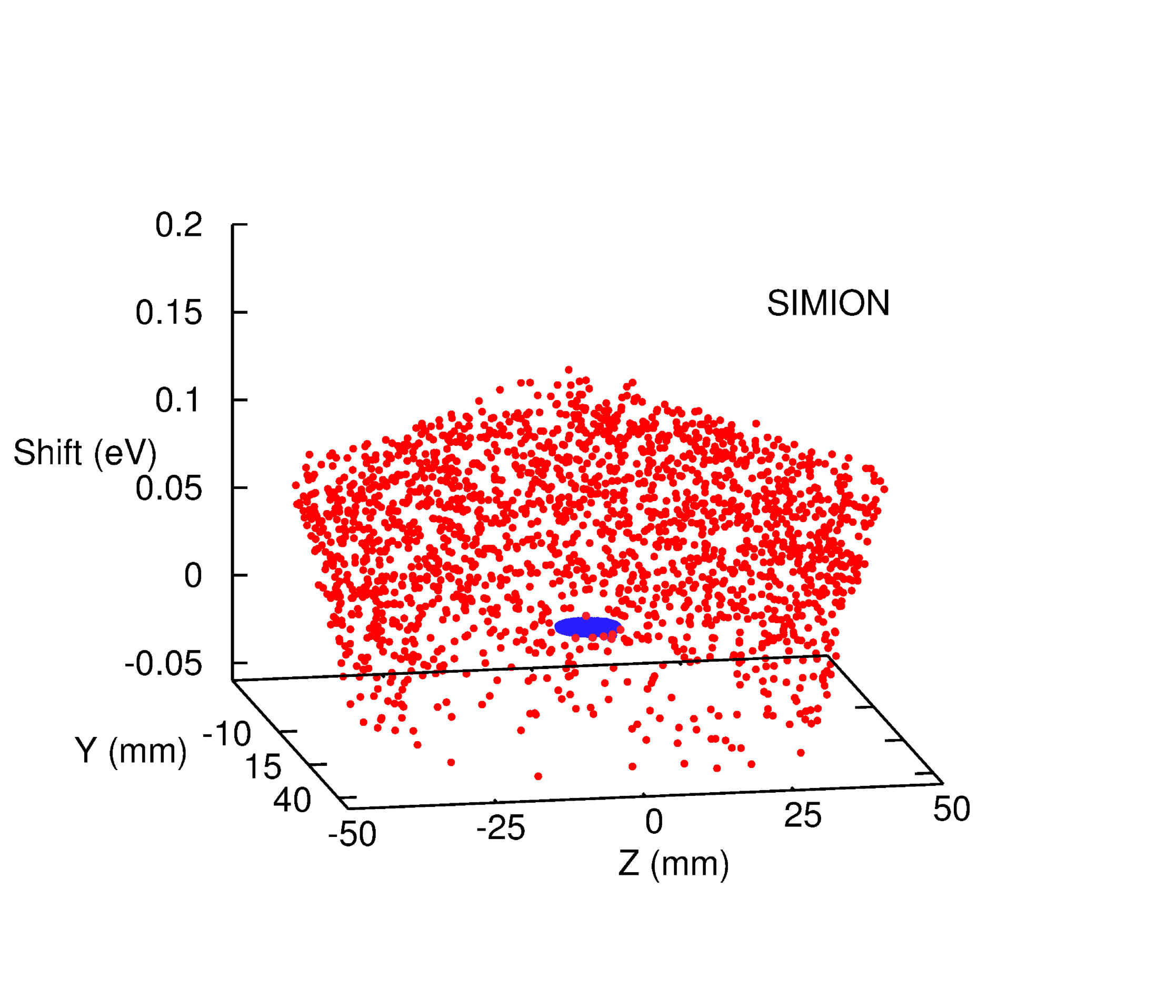 Figure 3
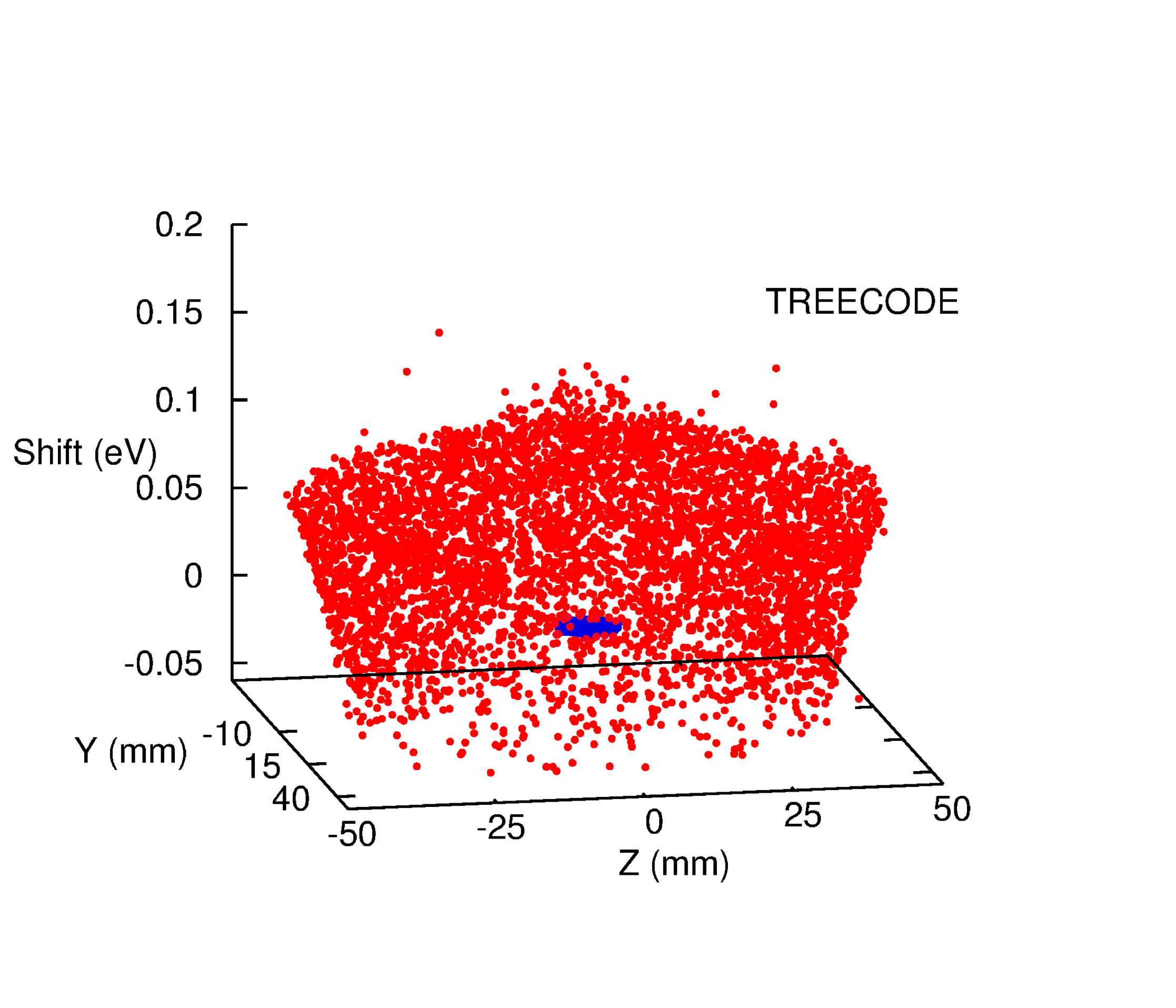 Figure 4
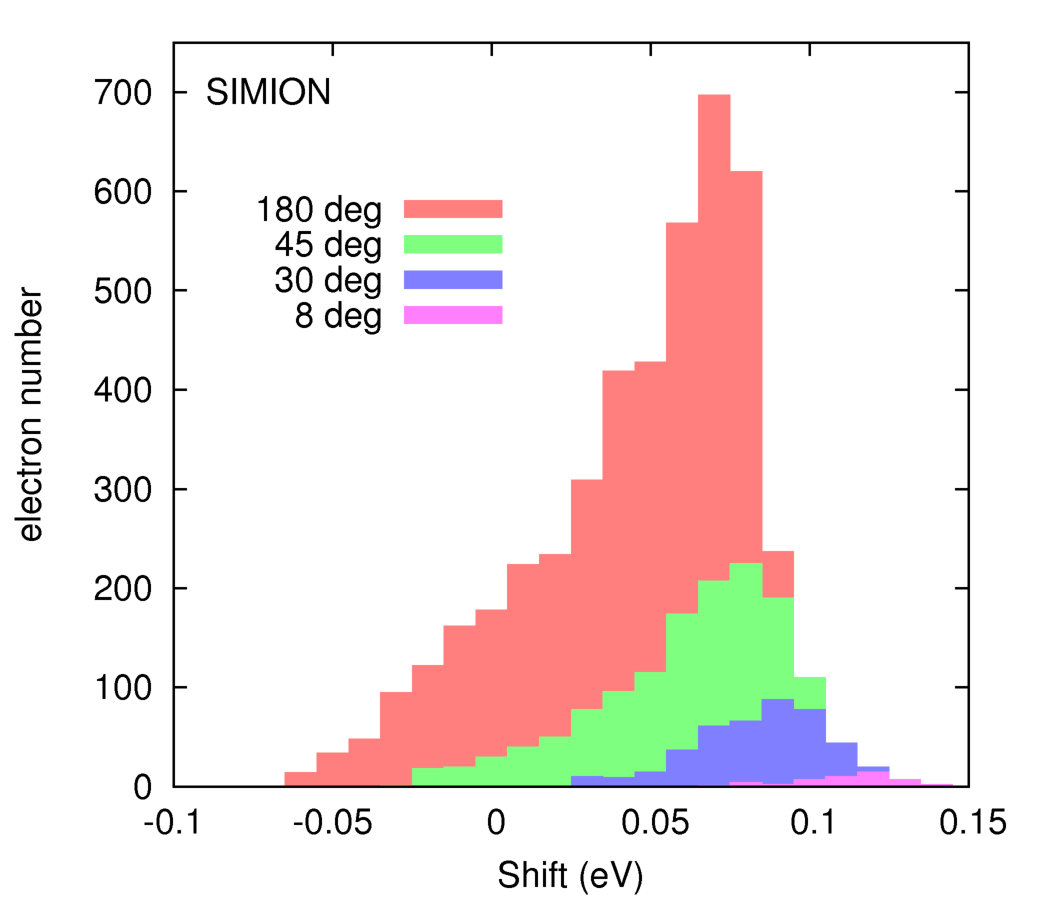 Figure 5
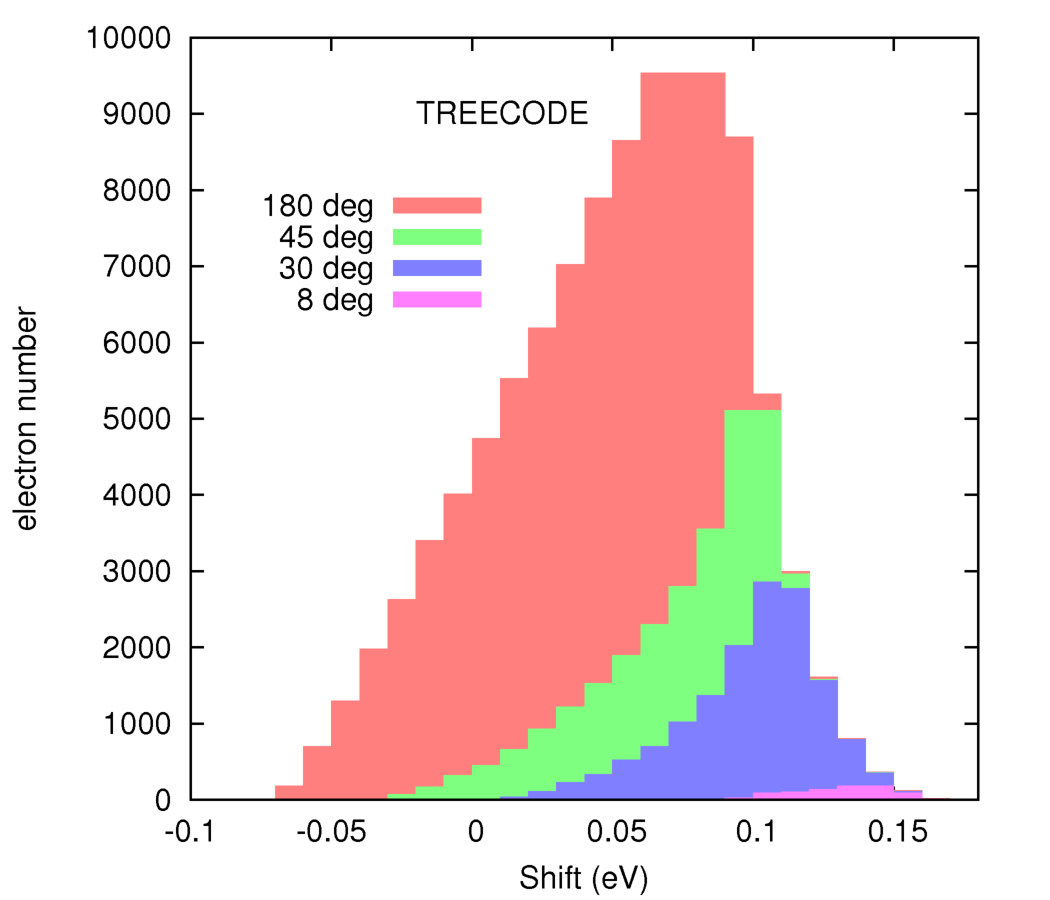 Figure 6
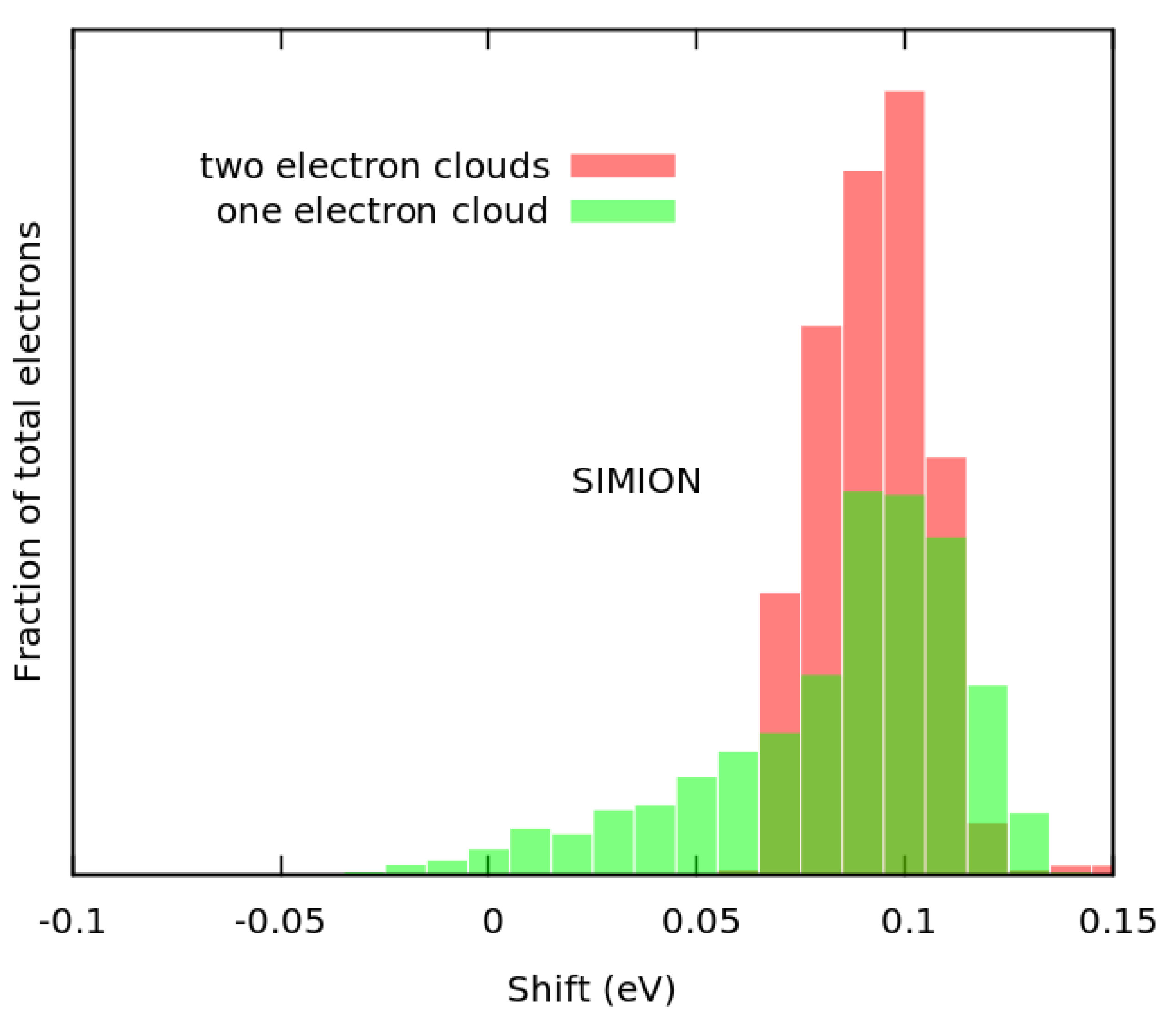 Figure 7
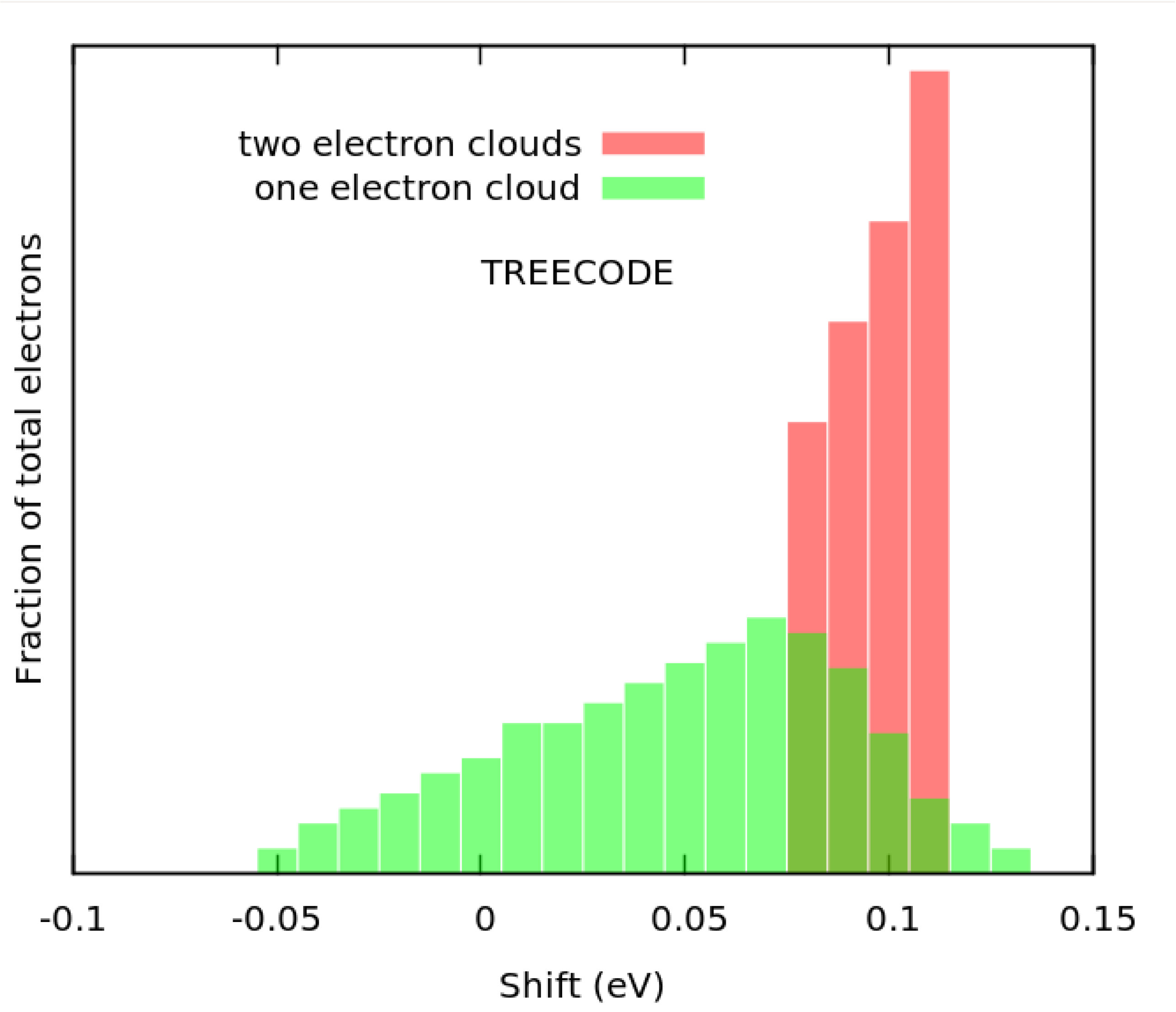 Figure 8
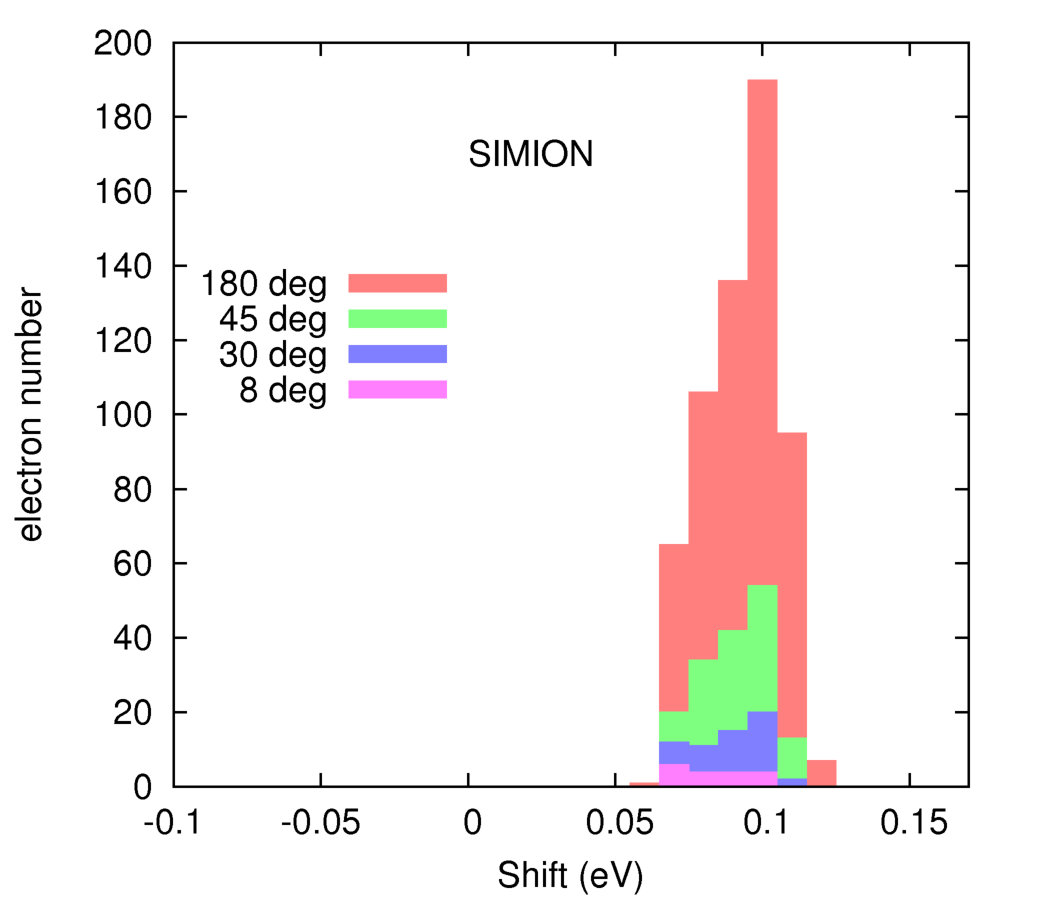 Figure 9
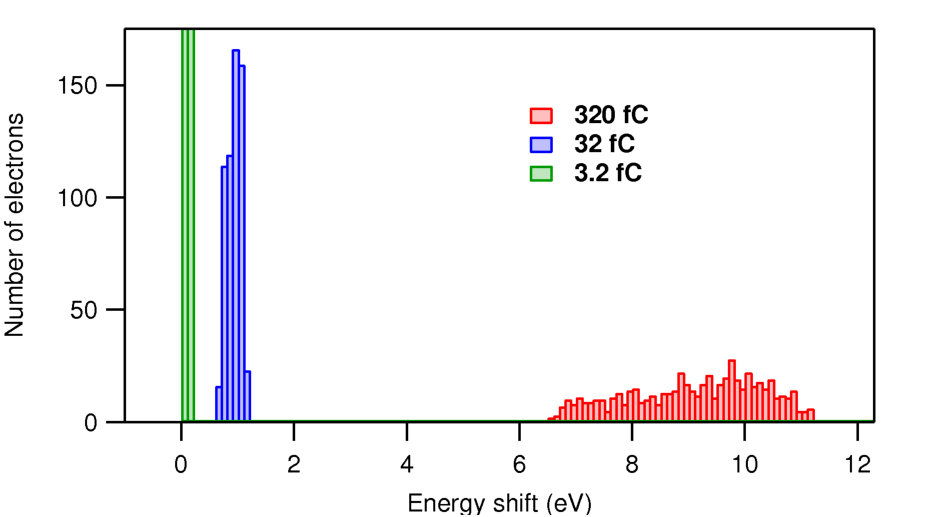 Figure 15
| Free flight | ||||||
| ESIM | ETRE | ELIK | ||||
| 104 | fC | eV | eV | eV | eV | eV |
| 0.120 | 0.05 | 0.115 | ||||
| 0.060 | 0.03 | 0.057 | ||||
| 0.030 | 0.01 | 0.028 | ||||
| 0.015 | 0.01 | 0.014 | ||||
| 0.006 | 0.00 | 0.006 |
| Free flight | ||||||
|---|---|---|---|---|---|---|
| NSIM | NTRE | ESIM | ETRE | |||
| deg. | eV | eV | eV | eV | ||
| 180 | 5000 | 200000 | 0.120 | 0.060 | 0.150 | 0.07 |
| 45 | 1700 | 58306 | 0.100 | 0.070 | 0.080 | 0.10 |
| 30 | 530 | 26619 | 0.070 | 0.085 | 0.074 | 0.11 |
| 8 | 50 | 1469 | 0.020 | 0.120 | 0.035 | 0.14 |
| Free flight | |||
|---|---|---|---|
| fC | eV | eV | |
| linear TOF | |||
|---|---|---|---|
| ESIM | |||
| 104 | fC | eV | eV |
| 20 | 32 | 0.05 | 0.12 |
| 10 | 16 | 0.04 | 0.08 |
| 5.0 | 8 | 0.02 | 0.05 |
| 2.5 | 4 | 0.00 | 0.04 |
| ESIM | ShiftSIM | |
|---|---|---|
| eV | eV | |
| TOF - one-energy cloud | 0.06 | 0.12 |
| TOF - two-energies cloud | 0.04 | 0.08 |
Peer Reviews
No public reviews on file for this paper yet. If you reviewed it on a platform where reviews are public (OpenReview, ICLR, NeurIPS, ICML), you can paste yours below so the community can read it here.
Videos
No videos yet. Explain this paper in a talk, walkthrough, or lecture? Add one.
Space-Charge effect in electron time-of-flight analyzer for high-energy photoemission spectroscopy
G. Greco
A. Verna11footnotemark: 1
F. Offi22footnotemark: 2
G. Stefani33footnotemark: 3
Dipartimento di Scienze, Università Roma Tre, Via della Vasca Navale 84, I-00146 Rome, Italy
(September 4, 2016)
Abstract
The space-charge effect, due to the instantaneous emission of many electrons after the absorption of a single photons pulse, causes distortion in the photoelectron energy spectrum. Two calculation methods have been applied to simulate the expansion during a free flight of clouds of mono- and bi-energetic electrons generated by a high energy pulse of light and their results have been compared. The accuracy of a widely used tool, such as SIMION®, in predicting the energy distortion caused by the space-charge has been tested and the reliability of its results is verified. Finally we used SIMION® to take into account the space-charge effects in the simulation of simple photoemission experiments with a time-of-flight analyzer.
keywords:
Space-charge effect , Time-of-flight analyzers , Time-resolved X-ray photoelectron spectroscopy , High-energy photoemission
††journal: Journal of Electron SpectroscopyCNISMCNISMfootnotetext: Also CNISM, Unità Roma Tre, Via della Vasca Navale 84, I-00146 Rome, Italy.
1 Introduction
New frontiers in solid state physics can be explored with the advent of the next generation synchrotron radiation and laser sources. For example, the new free electron laser (FEL) facilities provide high-energy photon beams with an unprecedented high power within ultra-short pulses, allowing to investigate electron dynamics with a time resolution up to femtosecond. Observing electron exchange during a redox process [1], melting of charge density waves [2] or tuning the electron spin arrangement in a ferromagnet [3] are just some examples of the applications of these sources.
One of the most effective tools to investigate the electronic properties of the materials is the photoelectron spectroscopy (PES), but the effectiveness of this technique in connection with high peak power sources is still questionable. High peak power implies having a very high number of the photoelectrons in very short time intervals and this may limit the use of this spectroscopic technique with the new pulsed sources. As a matter of fact, in a standard PES experiment at synchrotron radiation sources, the typical flux is of the order of 104 photons per pulse, while the femtosecond FEL pulses are several orders of magnitude more intense. This causes the emission of a large number of photoelectrons interacting with each other through the Coulomb repulsion and gives rise to the so called space-charge effect [4]. This effect may change the measured energy spectrum by introducing broadening and shift in the spectral feature to an extent that might obscure its physical meaning. For this reason it is of crucial importance to have an effective method capable of simulating this effect in order to find the optimal conditions to minimize it.
J.P. Long, B. S. Itchkawitz and M. N. Kabler (LIK) proposed in 1996 a very simple model to describe the broadening of photoemission peaks consequent to space-charge effect [5]. The LIK model predicts an energy broadening by the formula:
[TABLE]
where is the number of photoelectrons with charge emitted per pulse, is the radius of the radiation spot on the sample surface (expressed in m) and value is given in eV. The energy broadening does not depend on the initial kinetic energy of the electrons. Despite its strong approximations, and in particular the unrealistic hypothesis that all the photoelectrons have initially the same energy, the LIK model succeeds in predicting the order of magnitude of the energy broadening of the PES structures for low excitation energy, as pointed out by S. Hellmann et al. and Verna et al. [6, 7]. On the other hand, no simple model exists for quantifying the energy shift of the spectral features. Energy shifts have been reported to be of the same order of magnitude of the corresponding energy broadening [8].
Hellmann et al. [6] for the first time used the Treecode software [9, 10], a program for self-consistent N-body simulation, for calculating the effective coulomb repulsion among single electrons in a cloud during free flight. They obtained that an energy spread and a shift of the spectral features would result as a consequence of the space-charge effect.
This method based on deterministic calculation is effective in predicting values for energy broadening and shift, but the number of calculated trajectories must be equal to the number of electrons in the cloud. This could be a disadvantage when the number of electrons became very large (for examples 20,000 electrons). We would like to underline that Hellmann et al. treated only free-flying electrons while we want to understand how the space-charge affects the resolution of an electron analyzer. For evaluating the space-charge effect in an electron analyzer it can be useful a method where the number of calculated trajectories are limited and modifiable. Moreover it is also important to have the possibility to calculate trajectories in the presence of the electrostatic field generated by the electrodes of the spectrometric apparatus.
A different approach to the investigation of the space-charge effect can be performed via the determination of electron trajectories in an electron-optics simulator, such as the SIMION® software. SIMION® uses a ray-tracing method based on the finite difference method that solves the Laplace’s equation numerically [11, 12, 13]. Moreover the SIMION software is one of the most used tools to simulate photoelectron analyzers. In the latest versions of this software package (7.0, 8.0 and 8.1) there is the possibility to introduce the space-charge effect in the calculation of the trajectories, but the utilization of this tool is subject to various caveats. According to the warning of the SIMION manual [11], the computation methods can give only a qualitative description of the effect of charge repulsion whereas a quantitative analysis of heavily space-charged environments is not guaranteed. One of the limitations is that only interactions between charged particles are taken into account, while the effect of the charge density on the local electric field is not computed [14]. Thus it is important to verify the reliability of SIMION in predicting the shift and broadening of spectral feature in PES experiments. As we will see, while we cannot define the limit of this approach in terms of space charge amount, the results of our work suggest that in the regime her explored SIMION is suited to correctly predict charged particles effects. It is important to note that K. Saito et al. [15] have written a deterministic algorithm to simulate the space-charge in SIMION, but this algorithm is not integrated into the standard version of the software. The SIMBUCA package [16] is an alternative software for charged particle optics used in particular to simulate ions in Penning traps and it also allows to calculate the space-charge effects on the particle trajectories [17].
In the present work we will compare the energy broadening obtained by two different deterministic calculations considering that at high-energy the stochastic term of the space-charge effect is negligible because the electrons are so fast that the probability to have scattering among the electrons is low [18]. The two deterministic calculation methods are represented by the SIMION and Treecode softwares and they have been applied to the expansion in free flight of a cloud of mono- and bi-energetic electrons generated by the same high-energy pulse of light. Once confirmed the accuracy of the calculation methods of SIMION in the free flight case, we will present the results of the simulation of a linear time-of-flight (TOF) analyzer optimized for high-energy time-resolved photoemission spectroscopy that takes into account space-charge effects. The paper is organized as it follows: in section 2 the numerical methods at the base of the two programs are presented. In section 3.1 the results of the two methods for clouds of mono-energetic and bi-energetic electrons in free flight are compared and the simulation for a realistic photoemission from the Cu core level is also presented. The section 3.2 is devoted to the space-charge effect in a linear TOF analyzer and the conclusions are reported in section 4.
2 Methods
In this section the calculation methods at the base of Treecode and SIMION softwares are presented. Treecode software was initially implemented for the study of astronomical objects and can be modified to calculate the motion of N particles interacting through Coulomb forces, given their initial positions and velocities. This software finds an approximate solution of the N-body problem: in order to calculate the potential acting on the -th electrons for the interaction with the other electrons, the space is recursively divided into cubic cells [9]. For a given cell the position of the center of mass is calculated. If the distance between the center of mass and the -th electron is greater than the side of the cell, all the electrons in the cell are represented by an effective particle positioned in the center of mass and with a charge equal to , where is the number of electrons in the cell. If the side of the cell is greater than the distance between the center of mass and the -th electron, the smaller subcells composing the original cell are considered. Following this procedure, the number of mutual interactions between electrons to be taken into account decreases from to a value of the order of [9]. With this approximation, Treecode calculate all the trajectories for all the interacting electrons in the cloud in vacuum.
The first step in the SIMION way of working is to calculate the electric field in an array defined by the user (discretization of the space), by solving the Laplace’s equation ignoring space-charge, and then to determine particle trajectories within this field. In our work the space charge is taken into account with ion-cloud Coulombic repulsion method [11]. The program does an approximation to estimate Coulomb repulsion of a cloud of electrons, apportioning the total charge of the electron cloud among the considered trajectories, whose number can be defined by the user. For example, if we want to simulate an electron cloud of 200,000 electrons, using Treecode we have to consider all the 200,000 trajectories, every trajectory representing a point charge of . SIMION simulates a reduced number of trajectories, for example 5000, apportioning the total charge of 200,000 electrons (32 fC) among the considered trajectories [11] so that each trajectory contributes to the Coulomb repulsion with a charge of -40 .
For both methods, the initial positions of the electrons are randomly distributed in a circular photon spot on the sample surface. The direction of the initial directions are also randomly distributed in the 2 solid angle subtending the upper hemisphere.
3 Results and discussions
3.1 Free flight
3.1.1 Monoenergetic electron cloud
In this section we compare and discuss the simulated electron trajectories of electrons in free space expansion obtained by the two methods. We first considered simulation of an ideal situation in which a single-energy cloud of photoelectrons starts from a circular spot of 5 mm radius with the same initial kinetic energy of 10 keV, in order to perform a first simple comparison of the two methods. The obtained results will be also confronted with the LIK formula. In Fig. 1 the position of the electrons simulated by SIMION at time =0 and at =0.75 ns after pulse is reported. The plane contains the sample surface, where the electrons have origin. The initial directions of the electrons are randomly distributed within a solid angle of sr. In order to simulate a large number of electrons emitted at the same time and then to have a good statistics, we consider a particularly large photon spot on the sample surface (5 mm). According to the rough estimations of the LIK formula, this allows to simulate up to 200,000 electrons, corresponding to a total charge of 32 fC, with an expected moderate energy broadening (about 0.1 eV) [7].
In Fig. 2 we compare the energy spreads as a function of the number of photoelectrons per pulse obtained in the two simulations. The energy spread is defined as the difference between the and the percentile of the electrons energy distribution. The results of both methods are in good agreement with the LIK model (see also Tab. 1), that gives good prediction for experiments at lower energy [6, 7].
Fig. 3 shows the energy shift at =0.75 ns after pulse as a function of the electron and positions as obtained by SIMION (a) and Treecode (b). Qualitatively, the shape-distribution of the energy shifts in the plane of the sample is similar for both calculation methods and clearly departs from a Gaussian function. The results of the simulations of the space-charge effect in terms of energy spread (E) and average energy shift () for different electrons number and total charge are reported in Tab. 1. It has to be noted that the SIMION’s results for the energy spread are about 10% smaller and those for the energy shift about 4% smaller than what is obtained from Treecode calculations.
We can also investigate the dependence of the energy broadening and shift on the emission angles of the electrons. We define as the angle between the sample normal (the axis) and the velocity vector of the electrons. In Fig. 4 and in Tab. 2 the energy distributions and average energy shift and energy broadening for accepted , , , obtained by SIMION (a) and Treecode (b), are reported. The center of gravity of the electron energy distributions experiences net positive shift. This is explained by the fact that he electrostatic potential energy of the electrons at time zero, when they are distributed on the disk source, is transformed during the flight into kinetic energy when the particles drift apart. Looking at the Fig. 4 and Tab. 2, it is possible to note that selecting a smaller solid angle around the normal direction the energy shift increases while the energy spread decreases. Again this angle dependence predicted by SIMION is in good agreement with the deterministic Treecode simulation. This effect could be attributed to the fact that in a disk-shaped charge distribution (i.e. the configuration of the photoelectrons at =0) or in a hemisphere-like distribution (i.e. the shape of the photoelectron cloud during the free flight, see Fig. 1) the potential felt by each electron strongly depends on its position.
3.1.2 Bi-energetic electron cloud: Copper case
In the simulation of a physical spectrum we have to take into account that after the photon excitation of a solid sample at least two processes lead to electron emission in vacuum: the generation of the primary electrons, due to the photon absorption, and the emission of the so called secondary electrons, resulting from inelastic scattering processes within the solid. The latter have a typical energy less than 20 eV, and they are usually much more numerous than the primary ones emitted at higher kinetic energy. In this section we consider an electron cloud with two different energies, one representing the electrons of a core-level primary peak and the other representing the large number of secondary electrons. Because in this case we want to simulate a realistic experiment, we consider a smaller spot radius of 500 m a more typical value for photoelectron spectroscopy experiments. The total number of electrons is kept fixed at 20,000. In this way we expect from equation (1) an energy broadening similar to that obtained for the mono-energetic cloud with a spot radius of 5 mm and 200,000 photoelectrons per pulse.
For example, in case of excitation with radiation of = 8000 eV, the ratio between the number of primary and secondary electrons in the case of the Cu core level, with a kinetic energy of 7062.5 eV, can be estimated as 0.0117, where the peak energy for secondary is about 2 eV (details are in Ref. [7]).
In order to simulate this particular case, the photoelectron cloud with a total charge of 3.2 fC (20,000 electrons) is composed by 231 primary electrons with an initial kinetic energy of 8000 eV (ignoring the binding energy) and by 19769 secondary electrons with initial kinetic energy of 1.8 eV. The results reported below refer only to the primary electrons. In order to increase the number of trajectories of primary electrons calculated by SIMION (obtaining a better statistics) and to keep a fixed ratio between primary and secondary electrons, the trajectories of secondary electrons have a weight of 10, that is one trajectory of secondary electrons carries a charge ten times larger than the charge associated to the trajectory of primary electrons. In this case the trajectories calculated by SIMION are 600 for the primary electrons and 5000 for the secondary ones, keeping the exact proportion.
Figures 5 (a) and (b) show the histograms of the energy shifts obtained for the two simulations, SIMION and Treecode respectively, comparing the results of a monoenergetic cloud of 20,000 primary electrons with what obtained in the case of two-energy electron cloud. In the case of two-energy cloud we have to consider that the primary electrons are faster than the secondary ones and thus the duration of the Coulomb interactions between the two families of electrons is shorter, with a consequent smaller energy spread for primary electrons. Indeed, Figures 5 (a) and (b), reveal that the effect is taken into account by both simulations. The reduction of the energy spread in the two-energy cloud with respect to the mono-energetic case is 25% for SIMION and 40% for Treecode. The difference in energy shifts between the single- and two-energy cloud is zero for SIMION and 0.05 eV for Treecode. The secondary electrons ”push” the primary electrons, which should therefore have a greater energy shift compared with the case of the single-energy cloud. To better investigate this result, in figure 6 the energy shift histogram for different accepted angles is shown. In particular looking at the simulations obtained with SIMION and Treecode (figure 6 (a) and (b)) the energy spread and shift can be considered constant as a function of accepted angle. We remind that in the case of a single electron cloud there was a variation of the energy spread and shift for different accepted angles (see Fig. 4), but these effects are not observed in the case of the two-energy electron cloud.
For copper the quantum efficiency (i.e. the ratio between the number of the overall photoelectrons and the number of incident photons) results around 0.04 for photon energies around 8 keV. So in order to have 20,000 photoelectrons per shot about 500,000 photon per pulse are requested, implying a strong reduction of the beam intensity available at modern FEL facilities. We want to monitor the space-charge effect when a significantly higher number of photoelectrons are emitted after the same pulse. Using SIMION we repeated the simulation of the two-energy photolectron cloud in free space with a total charge =32 fC ( electrons) and =320 fC ( electrons). We do not perform the analogous simulations with Treecode because so a huge number of trajectories would require a very long computation time (some days) or the use of a mainframe computer. With SIMION we still use 600 trajectories of primary electrons (initial energy of 8000 eV) with a weight equal to 1 and 5000 trajectories of secondary electrons (initial energy of 1.8 eV) with a weight equal to 10. Also in this case the total charge is apportioned among the trajectories considering the relative weights so that the ratio 0.0117 between primary and secondary electrons is conserved. In Fig. 7 we report the histograms of energy distribution of primary electrons at the end of the simulation considering a total charge of photoelectron cloud of 3.2 fC, 32 fc and 320 fc. The bin-width in the histograms is 0.1 eV. In Tab. 3 we report the found values of energy shift and broadening as a function of the number of photoelectrons and the total charge. Both these quantities increase linearly as a function of the number of photoelectrons. The simulation with =320 fC (=2) present a photoelectron feature which is tremendously spread (=3.9 eV). A photoemission cloud with =2 electrons is obtained in an experiment with copper at a photon energy of 8 keV with a pulse of photons, a value easily achievable in modern FEL beamlines [19]. This populated photoemission cloud contains as many as 20000 primary electrons and, in principle, experiments with excellent statistics could be achieved. However, the interaction of the primary electrons with the secondary electrons of the cloud produces an energy broadening of the photoemission peak which is so large to prevent any effective measurement.
3.2 TOF analyzer
Taking into account the above considerations and verified the reliability of SIMION in evaluating energy broadening and shift as due to space-charge effect, we can present the simulation results in a linear Time of Flight (TOF) analyzer in order to quantify the energy distortions in a PES experiment at high energy. The investigated instrument is a linear time-of-flight spectrometer composed by six cylindrical electrodes, the entrance and the exit ones as truncated cones, with a total length of 100 cm and an internal diameter of 10 cm (see Fig. 8). This TOF geometry is optimized for decelerating high energy electrons of about 10 keV to few eV. The spectrometer resolving power obtained with optimized potential, and neglecting space-charge effect, is of the order of at 10 keV. Details are presented elsewhere [20].
3.2.1 Monoenergetic electron cloud
We first perform simulations for mono-energetic electrons with an initial kinetic energy of 10260 eV and emerging from a circular spot with 5 mm radius with the initial velocities distributed into the upper 2 solid angle. Fig. 8 shows 5000 trajectories into the TOF, the electron cloud possessing the total charge of 200,000 electrons. The trajectories are depicted from to ns (upper panel) and from =0 to ns (bottom panel). Due to the large source dimension and the wide emission solid angle, only about of the emitted electrons arrive to the end of the analyzer (Fig. 8 bottom panel). In particular, the accepted solid angle results to be about 80 msr.
In Tab. 4 we show the space-charge effect in terms of energy spread and shift at the end of the linear TOF for different numbers of photoemitted electrons and in Fig. 9 the corresponding histograms of energy are shown. As expected, the energy shift and spread increase with the total charge of the electrons. In these conditions the space-charge effect becomes negligible for 25000 electrons per cloud as also shown in Tab. 4.
3.2.2 Bi-energetic electron cloud: Copper 2 case
In this case we have simulated the two clouds of electrons described in details in section 3.1.2 during their propagation into a TOF analyzer. Again, this case mimics a realistic experiment of photoemission from the Cu core level. In Fig. 10 the obtained histograms of the energy shift for the single-energy and for the two-energies cloud are compared. It is possible to note that, as expected, for the two-energy cloud the energy spread is lower than in the case of mono-energetic cloud but the same does not occur fo the energy shift. Looking at the results reported in Tab. 5 the energy shift obtained for mono-energetic cloud of electrons is larger by 33% than the value obtained for the two-energy cloud. This is due to the accepted angular dependence of the single-energy cloud, in fact only electrons within an accepted angle of 8o can enter in the TOF analyzer here presented. As we have seen in the case of flight through free space, mono-energetic electrons emitted into a small accepted cone experience a larger energy shift (see Fig. 4 and Tab. 2. This larger positive shift is absent for primary electrons in the two-energy cloud (see Fig. 6) and this explains the difference in average energy with the monoenergetic case.
4 Conclusions
In this work we have compared two deterministic methods for calculating the space-charge effect: the first based on the SIMION software and the second exploiting the Treecode algorithm. From this comparison we want to control the effectiveness of the deterministic method used by SIMION for predicting this effect. The use of SIMION mainly presents two important advantages: 1) the calculation with a limited number of trajectories (suitably chosen by the user) representing a cloud with a much larger number of photoelectrons; 2) the chance to simulate the trajectories in presence of an external electric (and in perspective magnetic) field and then the possibility to calculate the energy distortions of spectra in an electron analyzer. The results obtained by the two methods of simulation are in good agreement for the different treated cases of a photoelectron cloud freely expanding in vacuum. In particular, we have simulated a single-energy cloud and a two-energy cloud composed by primary and secondary electrons closely resembling the realistic case of photoemission from the Cu 2 core level in free flight. We can conclude that the method used by SIMION is reliable and with this tool we have extended the in-vacuum calculations to the simulations of photoelectrons flying across a time-of-flight linear analyzer provided with decelarating electrostatic lenses [20].
Moreover we have found that for a monoenergetic electron cloud the energy spread depends on the final position and the emission angle of the photoelectrons. This could be very useful not only to diminish the distortions due to space-charge effect without decreasing the number of photoelectrons per pulse, but also to correct such distortions. It has to be underlined that this is valid only for the monoenergetic case while it appears to be absent for the small number of high-energy primary electrons in the two-energy cloud. Moreover we can conclude that a linear TOF is suitable for a PES experiment with a high-energy FEL source.
Acknowledgments
This work was partially supported by the ULTRASPIN and EX-PRO-REL Projects in kind (PIK), funded by Ministero dell’Istruzione, dell’Università e della Ricerca (MIUR) through Elettra Sincrotrone Trieste. G. G. is grateful to the PIK project EX-PRO-REL for financing her postdoctoral fellowship. V. L. acknowledges the PIK project ULTRASPIN for granting his fellowship. A. V. is thankful to Regione Lazio and CRUL for financial support.
The reference list from the paper itself. Each links out to its DOI / PubMed record.
- 1[1] M. Dell’Angela, T. Anniyev, M. Beye, R. Coffee, A. Föhlisch, J. Gladh, T. Katayama, S. Kaya, O. Krupin, J. La Rue, et al., Real-time observation of surface bond breaking with an x-ray laser, Science 339 (6125) (2013) 1302–1305.
- 2[2] F. Schmitt, P. S. Kirchmann, U. Bovensiepen, R. G. Moore, L. Rettig, M. Krenz, J.-H. Chu, N. Ru, L. Perfetti, D. Lu, et al., Transient electronic structure and melting of a charge density wave in Tb Te 3, Science 321 (5896) (2008) 1649–1652.
- 3[3] D. Ciudad, et al., Ferromagnetism: Ultrafast tunability, Nature Materials 14 (6) (2015) 556–556.
- 4[4] A. Pietzsch, A. Föhlisch, M. Beye, M. Deppe, F. Hennies, M. Nagasono, E. Suljoti, W. Wurth, C. Gahl, K. Döbrich, et al., Towards time resolved core level photoelectron spectroscopy with femtosecond x-ray free-electron lasers, New Journal of Physics 10 (3) (2008) 033004.
- 5[5] J. Long, B. Itchkawitz, M. Kabler, Photoelectron spectroscopy of laser-excited surfaces by synchrotron radiation, Journal of the Optical Society of America B 13 (1) (1996) 201–208.
- 6[6] S. Hellmann, K. Rossnagel, M. Marczynski-Bühlow, L. Kipp, Vacuum space-charge effects in solid-state photoemission, Physical Review B 79 (3) (2009) 035402.
- 7[7] A. Verna, G. Greco, V. Lollobrigida, F. Offi, G. Stefani, Space-charge effects in high-energy photoemission, Journal of Electron Spectroscopy and Related Phenomena 209 (2016) 14–25.
- 8[8] X. Zhou, B. Wannberg, W. Yang, V. Brouet, Z. Sun, J. Douglas, D. Dessau, Z. Hussain, Z.-X. Shen, Space charge effect and mirror charge effect in photoemission spectroscopy, Journal of Electron Spectroscopy and Related Phenomena 142 (1) (2005) 27–38.