Realization of Superadiabatic Two-qubit Gates Using Parametric Modulation in Superconducting Circuits
Ji Chu, Danyu Li, Xiaopei Yang, Shuqing Song, Zhikun Han, Zhen Yang,, Yuqian Dong, Wen Zheng, Zhimin Wang, Xiangmin Yu, Dong Lan, Xinsheng Tan,, Yang Yu

TL;DR
This paper demonstrates a fast, robust superadiabatic two-qubit gate in superconducting circuits using parametric modulation, achieving near-quantum-limit speed and low error rates, advancing scalable quantum computing.
Contribution
It introduces and experimentally implements superadiabatic two-qubit gates with parametric modulation, enhancing speed and robustness over traditional methods.
Findings
Achieved a CZ gate with 5.8% error rate.
Demonstrated preservation of adiabaticity at near-quantum-limit speeds.
Showed robustness against control instability.
Abstract
Fast robust two-qubit gate operation with low susceptibility to crosstalk are the key to scalable quantum information processing. Parametrically driven gate is inherently insensitive to crosstalk while superadiabatic control can speed up the gate without losing accuracy. We propose and experimentally implement superadiabatic two-qubit gates using parametric modulation on superconducting quantum circuits. Our results demonstrate the preservation of adiabaticity at a gate speed close to the quantum limit, in addition to robustness against control instability. We demonstrate a CZ gate with error rate of 5.8, limited largely by qubit decoherence, promising future improvement and scalable implementation.
Click any figure to enlarge with its caption.
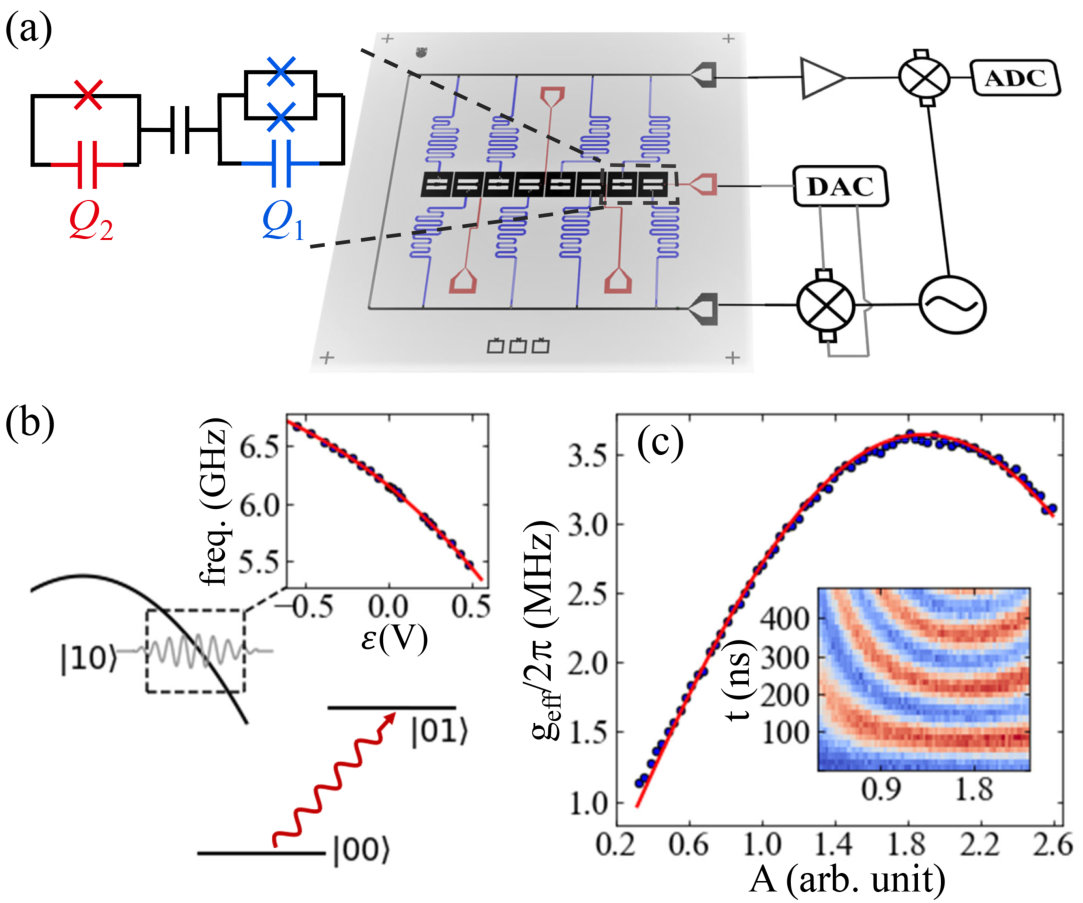 Figure 1
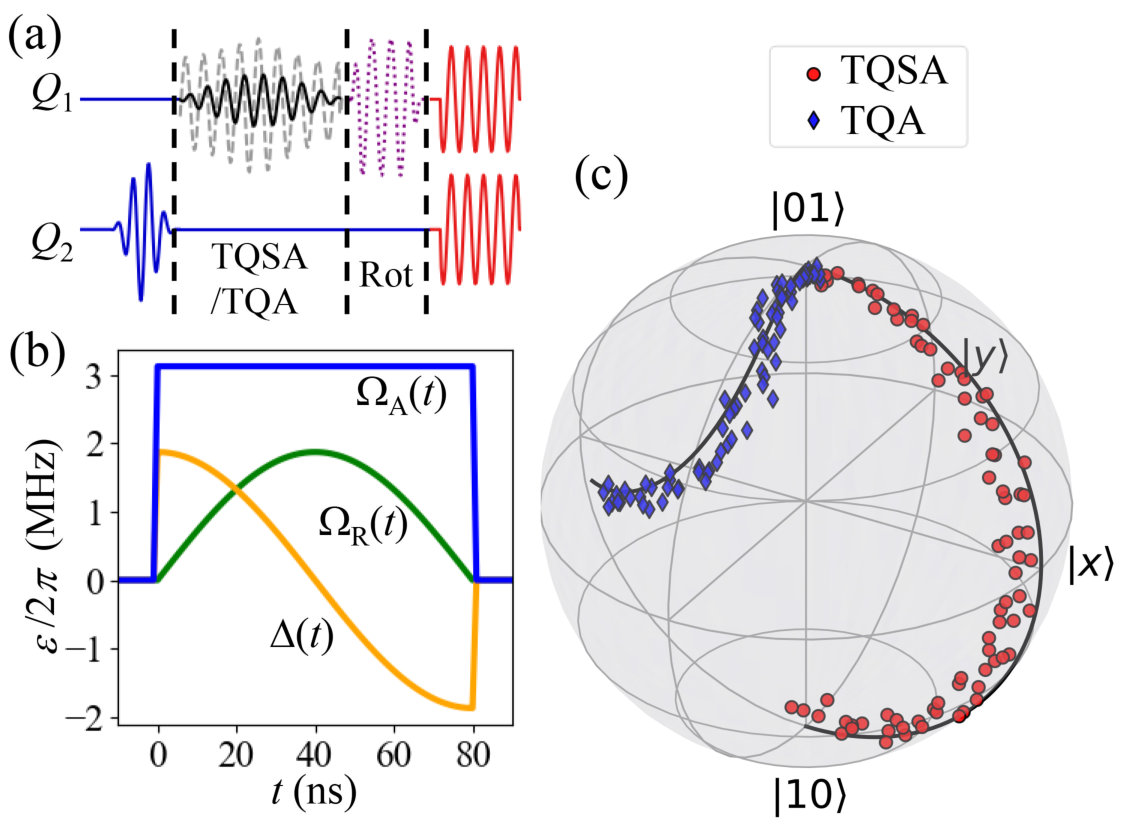 Figure 2
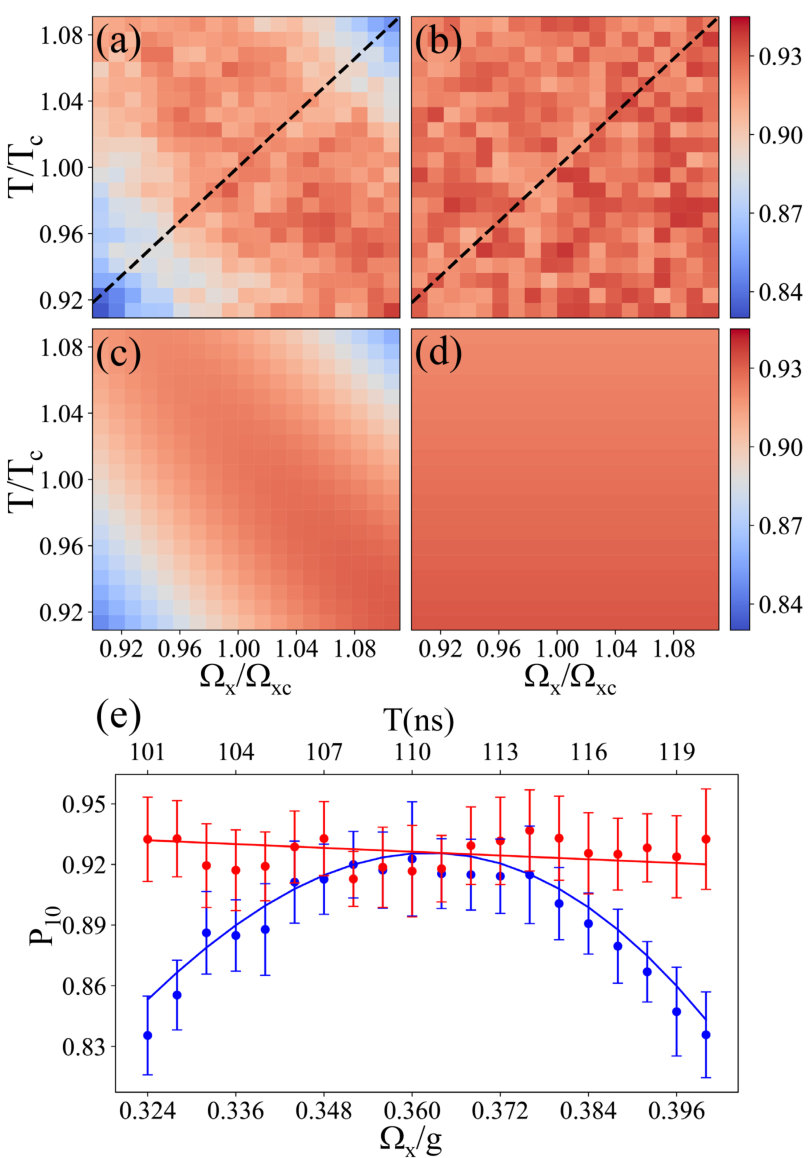 Figure 3
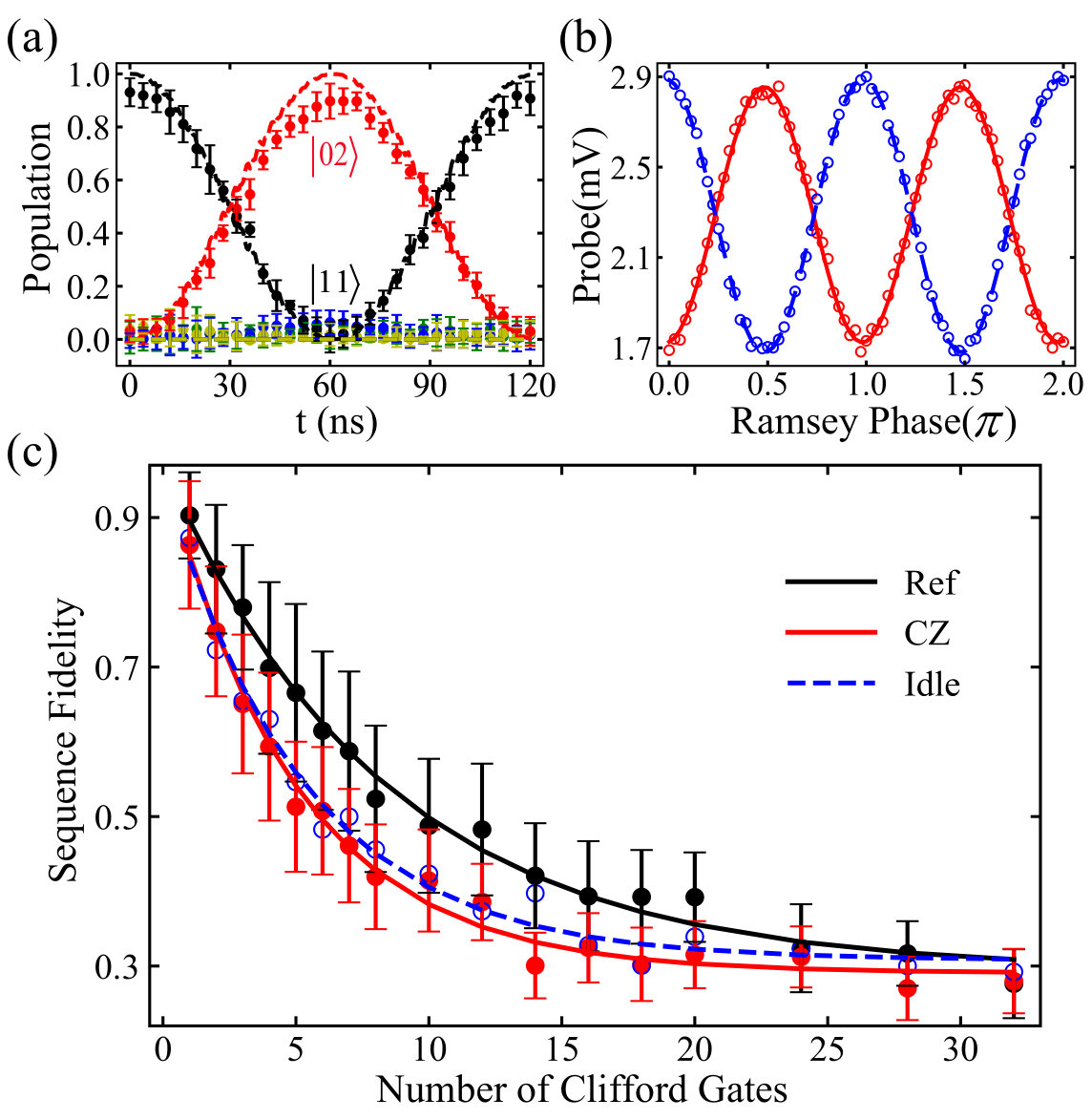 Figure 4
Peer Reviews
No public reviews on file for this paper yet. If you reviewed it on a platform where reviews are public (OpenReview, ICLR, NeurIPS, ICML), you can paste yours below so the community can read it here.
Videos
No videos yet. Explain this paper in a talk, walkthrough, or lecture? Add one.
††thanks: These authors contributed equally to this work.††thanks: These authors contributed equally to this work.††thanks: These authors contributed equally to this work.
Realization of Superadiabatic Two-qubit Gates Using Parametric Modulation in Superconducting Circuits
Ji Chu
National Laboratory of Solid State Microstructures, School of Physics, Nanjing University, Nanjing 210093, China
Danyu Li
National Laboratory of Solid State Microstructures, School of Physics, Nanjing University, Nanjing 210093, China
Xiaopei Yang
National Laboratory of Solid State Microstructures, School of Physics, Nanjing University, Nanjing 210093, China
Shuqing Song
National Laboratory of Solid State Microstructures, School of Physics, Nanjing University, Nanjing 210093, China
Zhikun Han
National Laboratory of Solid State Microstructures, School of Physics, Nanjing University, Nanjing 210093, China
Zhen Yang
National Laboratory of Solid State Microstructures, School of Physics, Nanjing University, Nanjing 210093, China
Yuqian Dong
National Laboratory of Solid State Microstructures, School of Physics, Nanjing University, Nanjing 210093, China
Wen Zheng
National Laboratory of Solid State Microstructures, School of Physics, Nanjing University, Nanjing 210093, China
Zhimin Wang
National Laboratory of Solid State Microstructures, School of Physics, Nanjing University, Nanjing 210093, China
Xiangmin Yu
National Laboratory of Solid State Microstructures, School of Physics, Nanjing University, Nanjing 210093, China
Dong Lan
National Laboratory of Solid State Microstructures, School of Physics, Nanjing University, Nanjing 210093, China
Xinsheng Tan
National Laboratory of Solid State Microstructures, School of Physics, Nanjing University, Nanjing 210093, China
Yang Yu
National Laboratory of Solid State Microstructures, School of Physics, Nanjing University, Nanjing 210093, China
Abstract
Fast robust two-qubit gate operation with low susceptibility to crosstalk are the key to scalable quantum information processing. Parametrically driven gate is inherently insensitive to crosstalk while superadiabatic control can speed up the gate without losing accuracy. We propose and experimentally implement superadiabatic two-qubit gates using parametric modulation on superconducting quantum circuits. Our results demonstrate the preservation of adiabaticity at a gate speed close to the quantum limit, in addition to robustness against control instability. We demonstrate a CZ gate with error rate of 5.8, limited largely by qubit decoherence, promising future improvement and scalable implementation.
††preprint: Physical Review Letters
High fidelity two-qubit quantum gates are a key component in quantum information processing Nielsen and Chuang (2002); Ladd et al. (2010); Bennett and Divincenzo (1995). The gate fidelity is damaged by both decoherence processes and control imperfections. While improving coherence is a long-term effort that requires upgrades in fabrication processes and extensive studies in materials, imperfect control due to crosstalk, instrumental instability, signal distortion, etc. is relatively remediable Strauch et al. (2003); Wendin (2017); Krantz et al. (2019). In fact, recent development shows that complex and exquisite calibration processes are critical to battle these hurdles when controlling even a medium-scale quantum processor Arute et al. (2019). To alleviate such humongous efforts, a more robust gate scheme is desirable for further scaling up the system.
Fast frequency modulation using flux pulse is widely used in superconducting qubit system DiCarlo et al. (2009); Martinis and Geller (2014). Such control signal, if coupled to other qubits, will erroneously tune other qubits as well. In addition, pulse distortion adds transients to the actual signal, causing further complication and sometimes even confusion in the calibration step. Parametric gates relying on sideband driving circumvent this problem by activating qubit-qubit interactions with microwave pulses, and have been demonstrated to be a viable technique McKay et al. (2016); Caldwell et al. (2018); Didier et al. (2018). These gates also help alleviate the frequency crowding problem by making the interactions frequency-selective. Also, superadiabatic control technique is a powerful tool to expedite gate operations without damaging the accuracy and at no additional hardware cost Born and Fock (1928); Berry (1990, 2009); An et al. (2016); Du et al. (2016); Wang et al. (2019). By taking advantage of both parametric gate and superadiabatic control, one expects to achieve better two-qubit gate performance.
In this work, we propose a protocol to implement two-qubit superadiabatic (TQSA) gates with a parametric modulation scheme. In our scheme, a parametric modulating field provides fully tunable coupling between two qubits Zhou et al. (2009); Liu et al. (2014); Wu et al. (2018); Caldwell et al. (2018); Reagor et al. (2018); Strand et al. (2013); Li et al. (2018), enabling us to construct a target superadiabatic Hamiltonian. We experimentally demonstrate TQSA gates in superconducting circuits consisting of multiple qubits. Using superadiabatic evolution we implement both SWAP gate and CZ gate. We track the state evolution in the {} subspace and find no nonadiabatic error during the SWAP operation. Then we investigate the robustness of TQSA gates against the variations of control parameters. A superadiabatic CZ gate is finally demonstrated with a fidelity of 94.2, which is mainly limited by decoherence. Using numerical simulation, we prove that gate fidelity can reach 99.9, which is promising for quantum information processing.
The principle of our protocol is as follows. We first introduce the target superadiabatic Hamiltonian. A two-level system coupled with a microwave field with frequency and phase can be generally expressed as
[TABLE]
where represents the detuning between energy gap of the two-level system and the frequency of the microwave field. is the Rabi frequency, which is proportional to the amplitude. The instantaneous eigenvalues are . For simplicity, we choose to be constant, and the auxiliary Hamiltonian in superadiabatic theory can be derived as
[TABLE]
where . Therefore, we obtain the Hamiltonian to implement a superadiabatic gate Liang et al. (2016); Zhang et al. (2017)
[TABLE]
where , and .
We use parametric modulation to construct in a subspace of a two-qubit system. Hamiltonian of two coupled qubits with one of them modulated by a longitudinal field can be written as
[TABLE]
where is the Pauli operators and () is the creation (annihilation) operator in the Hilbert space of th qubit . is the coupling strength between and . is the nonlinear frequency response to the modulation pulse, and can be determined experimentally sup . Here we choose as an adjustable sinusoidal function intentionally, where () is the energy level spacing of (), and are related to frequency detuning and phase of the longitudinal field, respectively. Applying unitary transformation sup , we can rewrite Eq. (4) as
[TABLE]
where is the first order Bessel function.
Combining Eq. (3) and Eq. (5), we can calculate the parameters in and the modulated pulse to implement arbitrary TQSA gates in {, } subspaces. Similarly, we can construct Hamiltonian using Eq. (5) with specific to realize two-qubit adiabatic (TQA) gates. It is worth emphasizing that if one considers the higher coupling energy level of transmons, such as and , a similar Hamiltonian can be constructed to realize a CZ gate, as discussed later.
We demonstrate our protocol using superconducting quantum circuits Clarke and Wilhelm (2008); You and Nori (2011); Gu et al. (2017). The chip contains eight transmons arranged in an array with nearest-neighbor coupling Koch et al. (2007). Each qubit can be readout with an individual resonator which is coupled to the transmission line on the chip. For four of the eight transmons we replace the Josephson junction with two junctions in parallel (DC SQUID). Therefore, the frequency of those transmons can be tuned by applying pulses through the Z control lines, represented by red lines in Fig. 1(a).
We demonstrate tunable coupling hence the TQSA quantum gate in two coupled qubits and . is a fixed frequency qubit with frequency = 5.9498 GHz. The frequency of can be tuned by combining static bias and fast flux pulse introduced through the Z control line [Fig. 1(a)]. In our protocol, energy spacing of qubit is statically set as = 6.1567 GHz. In Fig. 1(b) and (c) we show parametric control of the effective coupling strength between and . The intrinsic coupling strength between and is 6.26 MHz, determined by the capacity between the pads of transmons. We operate the system in the dispersive regime where , where and are detuning and coupling strength between cavity and qubit respectively Blais et al. (2004). Both and are coupled to the readout transmission line which is also used for delivering the microwave signal for control. The relaxation (dephasing) time of is = s ( = 620 ns) at operation points. For , = 3.98 s and = 6.1 s. From Fig. 1(c) we find that the maximum effective coupling is about 3.6 MHz, leading to a quantum limit = 69 ns. Therefore, the minimum SWAP gate time for the dynamical scheme is about 70 ns.
Having realized parametric tunable coupling, we can experimentally implement a specific TQSA gate and verify the acceleration of the superadiabatic scheme compared to the adiabatic process. We set the typical time dependent parameters of the TQSA gate as
[TABLE]
where is the gate duration time and (t) in Eq. (1) is set as zero. In order to maximize efficiency we chose = 80 ns, which is subjected to the limitation of the maximum effective coupling strength. Using Eq. (2), we obtain the auxiliary Hamiltonian , where is a constant value, as shown in Fig. 2(b). Using Eq. (3) and Eq. (5), we can calculate the specific form of for our experiment with the parameters of and sup .
We track the system trajectory to verify the adiabaticity of the evolution. Time profile of the experiments is shown in Fig. 2(a). We apply a microwave pulse to , preparing the system in . TQSA(TQA) gate is then performed. We use dynamic parametric gates to project system states to three axes in the subspace , . Finally we measure the system occupation probability of different states using two-qubit joint readout protocol Filipp et al. (2009); DiCarlo et al. (2009). The result is shown in a Bloch sphere of , , with states out of the subspace is small and neglected sup . By applying to the qubits we realize superadiabatic operation. In Fig. 2(c) we show the state evolution trajectory of the TQSA gate in the Bloch sphere spanned by and . The qubit state evolves precisely along the meridian predicted by the adiabatic theorem, proving the validity of the TQSA gate. It is noteworthy that the whole procedure time takes 80 ns, which is close to the quantum limit . The 10 ns extra time comes from the requirement of the protocol since we use a parametric pulse to control coupling strength. Furthermore, we compare our TQSA approach with the TQA routine with the same duration, as shown in Fig. 2(c). The TQA approach requires the fulfilling of adiabatic restriction, which is ns. Without auxiliary Hamiltonian , the evolution trajectory deviates dramatically from the designed adiabatic path, which is caused by unwanted transitions between eigenstates of . The experimental results indicate that our TQSA scheme successfully accelerates the adiabatic procedure.
Compared to traditional two-qubit gates based on the dynamical procedure Caldwell et al. (2018), TQSA gates possess the advantage of robustness against parameter fluctuations. The two important parameters for high fidelity gate operations are evolution time and Rabi frequency . Here corresponds to the amplitude of the parametric field . In dynamic parametric scheme, the accuracy of gate operation is determined by both and . Therefore, the fluctuations of system parameters will significantly affect gate fidelity. To quantify the robustness of gate operation, we performed a SWAP gate using both superadiabatic and dynamical protocols. The artificial perturbations and are intentionally added. We choose and . In experiments, we initialize the system state in , and set = 0.36 g and = 110 ns. With varying and , we measure the populations in state , which specify the gate fidelity. Fig. 3(a) and 3(b) show fidelity as functions of and with the superadiabatic and dynamical approaches respectively. Fidelity of the superadiabatic gate is more robust against the fluctuations of operation parameters, while the dynamical gate fidelity drops remarkably with increasing perturbations. In order to simultaneously display the influence of two parameters on fidelity, we show the cross section along the dashed line in Fig. 3(a) and 3(b). As expected, the 1D plot clearly indicates that TQSA gates are insensitive to control parameters compared to QDLG gates.
To prove the generality of our protocol, we extend TQSA gate to {} subspace, hence realize a superadiabatic-CZ (SA-CZ) gate. The SQUID is biased at 6.4873 GHz with MHz. The modulation frequency equals to . The coupling strength between and is = 9.14 MHz. We choose ns in Eq. (6) (the limit time is 47 ns). SA-CZ gate is realized by transferring to and back during a evolution time of 2, as shown in Fig. 4(a). This procedure accumulates a conditional -phase on state . A Ramsey type experiment is performed to verify the conditional phase, shown in Fig. 4(b). Fidelity of the SA-CZ gate is measured by interleaved random benchmarking (IRB) Barends et al. (2014); Knill et al. (2008); Magesan et al. (2012). The occupation probability of state , which determines sequence fidelity, is measured as a function of the number of Clifford gates. We use fitting function to extract the depolarizing parameter and . The error rate is calculated with , where is the Hilbert-space dimension of two-qubit system. We obtain a SA-CZ gate fidelity. The decoherence contribution to gate error is measured by interleaving an idle of same duration as the CZ gate Barends et al. (2014), as shown in Fig. 4(c). The idle fidelity is calculated to be . We can tell that gate error is mainly caused by decoherence. Using numerical simulation, we prove that the SA-CZ gate fidelity can reach 99.94 in absence of decoherence sup , limited by high order coupling in Jacobi-Anger expansion and small variation of coupling parameter g during frequency modulation of transmon qubits Didier et al. (2018).
In summary, we propose and demonstrate TQSA gates using a parametric modulation protocol in superconducting circuits. The parametric gates can alleviate frequency crowding problems and circumvent the calibrations for pulse distortion and flux crosstalk. Using the parametric field, we modulate the coupling strength and phase to construct a superadiabatic Hamiltonian. The superadiabatic gate follows the expected adiabatic trajectory at a speed close to the quantum limit, exhibiting robustness against system or random fluctuations. The combined high fidelity and fast gate speed makes this TQSA gate promising for quantum information research.
The authors thank H. Yu, Q. Liu and G. Xue for technical support. The authors also thank F. Yan for helpful discussion and improving the manuscript. This work was supported by the Key-Area Research and Development Program of GuangDong Province (Grant No. 2018B030326001), the NKRDP of China (Grant No. 2016YFA0301802), and the NSFC (Grants No.11604103, No. 11474153, and No. 91636218).
I references
The reference list from the paper itself. Each links out to its DOI / PubMed record.
- 1Nielsen and Chuang (2002) M. A. Nielsen and I. Chuang, Quantum computation and quantum information (2002).
- 2Ladd et al. (2010) T. D. Ladd, F. Jelezko, R. Laflamme, Y. Nakamura, C. Monroe, and J. L. O’Brien, Nature 464 , 45 (2010).
- 3Bennett and Divincenzo (1995) C. H. Bennett and D. P. Divincenzo, Nature 48 , 24 (1995).
- 4Strauch et al. (2003) F. W. Strauch, P. R. Johnson, A. J. Dragt, C. Lobb, J. Anderson, and F. Wellstood, Physical Review Letters 91 , 167005 (2003).
- 5Wendin (2017) G. Wendin, Reports on Progress in Physics 80 , 106001 (2017).
- 6Krantz et al. (2019) P. Krantz, M. Kjaergaard, F. Yan, T. P. Orlando, S. Gustavsson, and W. D. Oliver, Applied Physics Reviews 6 , 021318 (2019).
- 7Arute et al. (2019) F. Arute, K. Arya, R. Babbush, D. Bacon, J. C. Bardin, R. Barends, R. Biswas, S. Boixo, F. G. Brandao, D. A. Buell, et al., Nature 574 , 505 (2019).
- 8Di Carlo et al. (2009) L. Di Carlo, J. M. Chow, J. M. Gambetta, L. S. Bishop, B. R. Johnson, D. Schuster, J. Majer, A. Blais, L. Frunzio, S. Girvin, et al., Nature 460 , 240 (2009).