Perturbative approach to the entanglement entropy and the area law in Fock and polymer quantization
Subhajit Barman, Gopal Sardar

TL;DR
This paper investigates how entanglement entropy behaves in different quantization schemes, showing that polymer quantization alters entropy scaling at high frequencies but still follows an area law similar to Fock quantization.
Contribution
It introduces a perturbative approach to evaluate entanglement entropy in polymer quantization, revealing differences from Schrödinger quantization at high frequencies while confirming the area law.
Findings
Entanglement entropy decreases in polymer quantization at high frequencies.
Polymer quantization maintains the area law for entanglement entropy.
The perturbative method bridges the gap between Schrödinger and polymer quantizations.
Abstract
The area dependence of entanglement entropy of a free scalar field is often understood in terms of coupled harmonic oscillators. In Schrodinger quantization, the Gaussian nature of ground state wave-function for these oscillators is sufficient to provide the exact form of the reduced density matrix and its eigenvalues, thus giving the entanglement entropy. However, in polymer quantization, the ground state is not Gaussian and the formalism which can provide the exact analytical form of the reduced density matrix is not yet known. In order to address this issue, here we treat the interaction between two coupled harmonic oscillators in the perturbative approach and evaluate the entanglement entropy in Schrodinger and polymer quantization. In contrary to Schrodinger quantization, we show that in high frequency regime the entanglement entropy decreases for polymer quantization keeping the…
Click any figure to enlarge with its caption.
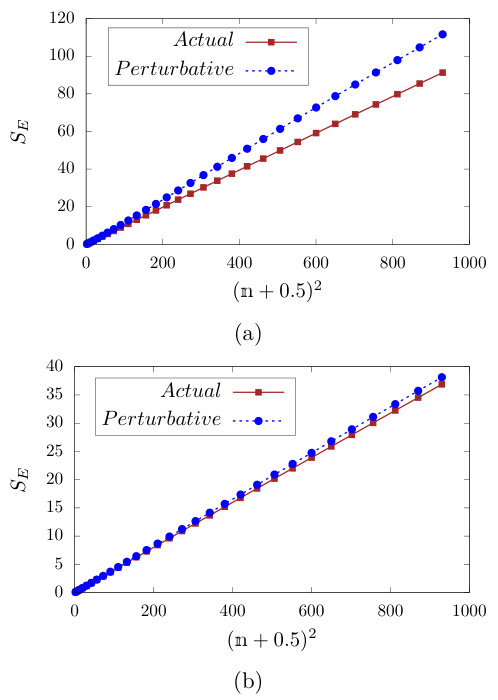 Figure 1
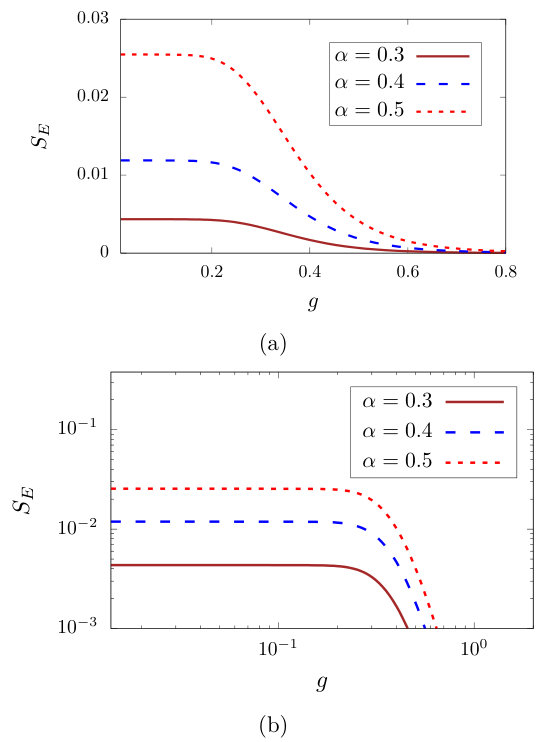 Figure 2
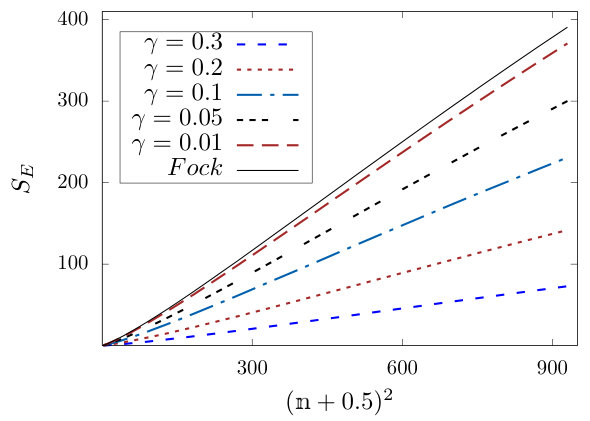 Figure 3
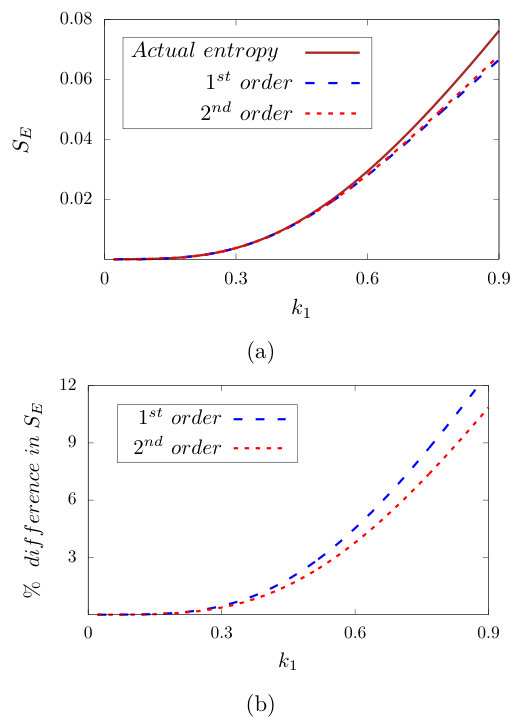 Figure 4
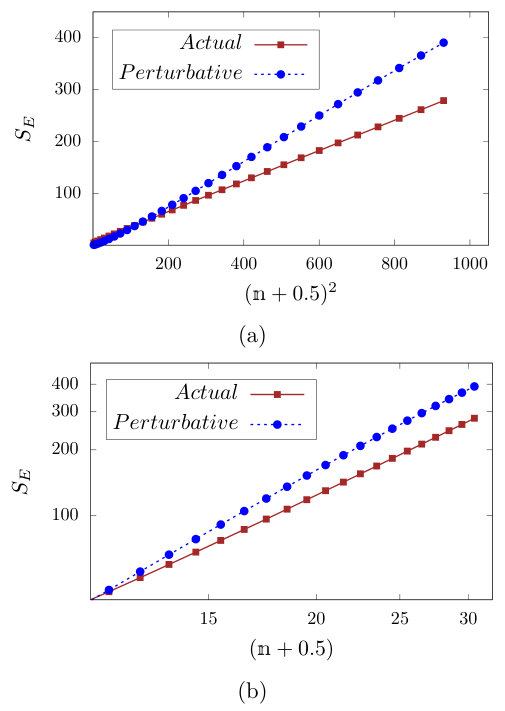 Figure 5
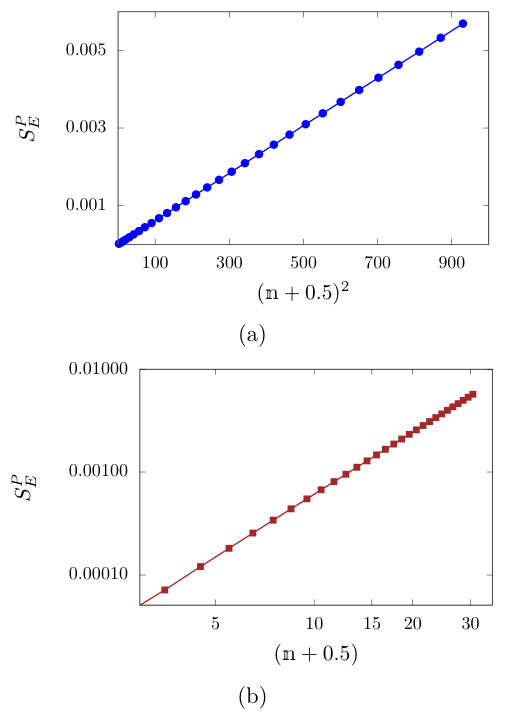 Figure 6
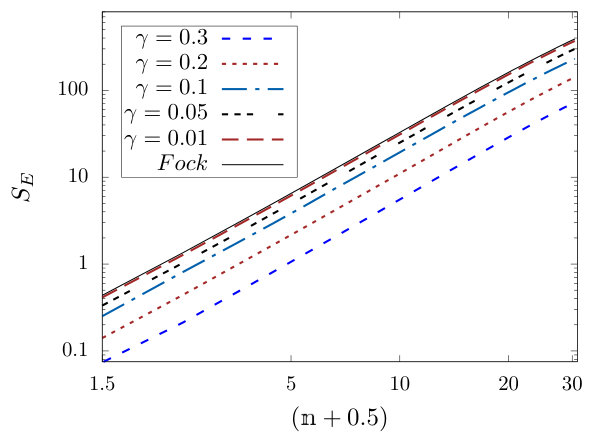 Figure 7
Peer Reviews
No public reviews on file for this paper yet. If you reviewed it on a platform where reviews are public (OpenReview, ICLR, NeurIPS, ICML), you can paste yours below so the community can read it here.
Videos
No videos yet. Explain this paper in a talk, walkthrough, or lecture? Add one.
Perturbative approach to the entanglement entropy and the area law in
Fock and polymer quantization
Subhajit Barman
Gopal Sardar
Department of Physical Sciences, Indian Institute of Science Education and Research Kolkata, Mohanpur - 741 246, WB, India
Abstract
The area dependence of entanglement entropy of a free scalar field is often understood in terms of coupled harmonic oscillators. In Schrodinger quantization, the Gaussian nature of ground state wave-function for these oscillators is sufficient to provide the exact form of the reduced density matrix and its eigenvalues, thus giving the entanglement entropy. However, in polymer quantization, the ground state is not Gaussian and the formalism which can provide the exact analytical form of the reduced density matrix is not yet known. In order to address this issue, here we treat the interaction between two coupled harmonic oscillators in the perturbative approach and evaluate the entanglement entropy in Schrodinger and polymer quantization. In contrary to Schrodinger quantization, we show that in high frequency regime the entanglement entropy decreases for polymer quantization keeping the ratio of coupling strength to the square of individual oscillator frequency fixed. Furthermore, for a free scalar field, we validate the area dependence of entanglement entropy in Fock quantization and demonstrate that polymer quantization produces a similar area law.
pacs:
04.62.+v, 04.60.Pp
I Introduction
The fact that one can incorporate thermodynamical attributes to a black hole was first introduced in the seminal work of Bekenstein Bekenstein (1972, 1973). In these articles and others Bekenstein (1974); Kallosh et al. (1993); Hawking (1975); Bekenstein (1975); Hawking (1976); Gibbons and Perry (1978); Davies (1977); Israel (2003); Ashtekar et al. (1998); Mukohyama et al. (1998); Bardeen et al. (1973) the authors demonstrated that intrinsic entropy of a black hole should be proportional to the area of its event horizon , where is the Planck mass. Then the natural question appeared is how to connect the concept of quantum states to this entropy of event horizon Frolov and Novikov (1993); Barvinsky et al. (1995); Kiefer (1998); Strominger and Vafa (1996) as horizon is not different than any other classical surface with no special local dynamics. To answer this question and to provide a more general realization of the entropy associated to a black hole the authors in Bombelli et al. (1986); Srednicki (1993) presented the idea in terms of entanglement entropy. Here it is shown that entanglement entropy of a free scalar field in a certain spatial region is proportional to its area. In these articles the reduced density matrix, essential for estimating the entanglement entropy, is obtained by tracing over the spatial degrees of freedom of the ground state density matrix residing inside the considered region.
In the regular formulation of entanglement entropy estimation Srednicki (1993) firstly the scalar field is partially Fourier transformed with respect to the angular coordinates. The resulting Fourier field Hamiltonian is still dependent on the radial coordinate and it is discretized by assuming a lattice of finite size and inter-atomic spacing. This discretization transforms the Fourier Hamiltonian to be a collection of coupled harmonic oscillators. The ground state wave-function for these coupled harmonic oscillators then provide the corresponding ground state density matrix for the field. Subsequently using the Gaussian nature of this ground state wave-function the reduced density matrix and its eigenvalues are obtained which would produce the entanglement entropy. However this Gaussian nature is a feature specific to the Schrodinger quantization. In polymer quantization Ashtekar et al. (2003); Halvorson (2004); Hossain et al. (2010), the quantization method used in loop quantum gravity Ashtekar and Lewandowski (2004); Rovelli (2004); Thiemann (2007), the ground state wave-functions are expressed in terms of Mathieu functions. Using these polymer wave-functions it is still unknown how to obtain the analytic form of reduced density matrix.
In this article we consider a perturbative approach to circumvent these difficulties and obtain the entanglement entropy for free scalar field using Fock and polymer quantization. We treat the interaction between coupled harmonic oscillators in perturbative manner to get the related ground state and eigen-values of the reduced density matrix. Firstly we use this procedure to evaluate the entanglement entropy for two coupled harmonic oscillators in Schrodinger and polymer quantization. Then by considering free scalar field we obtain the area law in Fock quantization. Furthermore we apply polymer quantization in this formulation and verify that the field theoretic entanglement entropy obeys a similar area law.
In section II we briefly review the procedures to derive the entanglement entropy in usual formulation. In this section the detailed description of the considered system is given. Following in section III we recall the perturbative formulation and construct the framework to estimate the entanglement entropy utilizing this technique. In the subsequent sections we use this formulation to obtain entanglement entropy for two coupled harmonic oscillators in Schrodinger and polymer quantization. Following parts include the realization of the area law of entanglement entropy in Fock and polymer quantization utilizing perturbative formulation. We argue on the implications of the obtained results and conclude with the discussion.
II Entanglement entropy and the area law
In the standard derivations of entanglement entropy Bombelli et al. (1986); Srednicki (1993); Das et al. (2008a); Das and Shankaranarayanan (2006); Ahmadi et al. (2006); Das et al. (2008b); Das and Shankaranarayanan (2007a); Muller and Lousto (1995); Das and Shankaranarayanan (2007b); Maxime Jonker and Stefan Vandoren (2016) one considers a system of coupled harmonic oscillators as a basis. In particular the eigen-values of the reduced density matrix for two coupled oscillators give the entanglement entropy corresponding to a single oscillator. These eigenvalues are used for a set of coupled harmonic oscillators, which are obtained from the discretized Hamiltonian of a free scalar field, to get the area law of entanglement entropy. In this section we briefly review the key aspects of these procedures and the considered systems, which will also be useful to construct the perturbative formulation.
II.1 Entanglement entropy for two coupled harmonic oscillators
In order to understand entropy from entanglement at first a system of two coupled harmonic oscillators Srednicki (1993); Das et al. (2008a) is considered. The two unit mass oscillators are denoted by their position and momentum and . The total system can be described by the Hamiltonian
[TABLE]
where the normal coordinates , and normal frequencies , are defined to make the Hamiltonian decoupled. In decoupled form the ground state wave-function becomes simplified and can be expressed in terms of the normal coordinates as
[TABLE]
From the expression (2) one can find out the ground state density matrix to be . To discuss about the entanglement entropy corresponding to a single oscillator one needs to find its associated reduced density matrix. The reduced density matrix is obtained by tracing out the density matrix with respect to the position degree of freedom of a single oscillator, expressed as
[TABLE]
The reduced density matrix describes whether the system is in mixed or pure state and the corresponding entanglement entropy is defined as . In a suitable basis one can evaluate the entanglement entropy by obtaining the eigenvalues of the reduced density matrix. In particular for two coupled harmonic oscillators the resulting reduced density matrix from equation (3) has eigenvalues
[TABLE]
Then the corresponding entanglement entropy Srednicki (1993); Das et al. (2008a); Chandran and Shankaranarayanan (2018) becomes
[TABLE]
II.2 Entanglement entropy for N-coupled harmonic oscillators
Now it is important to understand the entanglement entropy corresponding to coupled harmonic oscillators to get the area law of entanglement entropy for free scalar field. The general Hamiltonian for coupled harmonic oscillator is
[TABLE]
where the matrix describes the potential and interaction. The diagonal elements of give the frequency square of individual oscillator and symmetric off diagonal elements provide the interaction between two adjacent oscillators. With the help of a suitably chosen orthogonal matrix this interaction matrix is diagonalized to as . The ground state wave-function of this coupled harmonic oscillator (6) can be expressed as
[TABLE]
where . From this wave-function one can obtain the reduced density matrix when first of the total oscillators are traced out Srednicki (1993). The reduced density matrix is further evaluated using a general form of the matrix ,
[TABLE]
where is a matrix corresponding to the first oscillators, is a matrix and is a matrix. In terms of few newly defined quantities and the reduced density matrix becomes
[TABLE]
where and consist of the oscillators after the integration over the first degrees of freedom. is defined, where such that is diagonal and is orthogonal. Then one shall get , where . Now moving to the basis , such that is diagonalized as , one gets
[TABLE]
where are the eigenvalues of . Then the entanglement entropy Srednicki (1993) corresponding to oscillators turns out to be , with given by equation (5) and .
II.3 Entanglement entropy for free scalar field and area law
In order to discuss about the area law for entanglement entropy, a free massive scalar field is considered with mass and conjugate momenta . In Minkowski spacetime the Hamiltonian Peskin and Schroeder (2015); Das (2008); Padmanabhan (2016) corresponding to the scalar field is
[TABLE]
In terms of partial Fourier decomposition the field and the conjugate momentum are transformed with respect to the angular coordinates as
[TABLE]
where denotes real spherical harmonics and the Fourier field modes satisfy a commutation relation among themselves. With this definition of field decomposition from Eqn. (II.3) the Hamiltonian now becomes , where
[TABLE]
Next the radial coordinate is discretized forming a lattice with inter-atomic spacing and size . The inverse of the spacing signifies the ultraviolet cutoff while the inverse system size denotes infrared cutoff. This discretization makes the Hamiltonian look like a set of coupled harmonic oscillators
[TABLE]
such that and . Comparison of this Hamiltonian with the Hamiltonian for coupled harmonic oscillators from equation (6) gives Das et al. (2008a)
[TABLE]
The discretization of the radial coordinate enables one to get a finite expression of matrix denoting the potential energy and interaction. This in turn would enable one to obtain the entanglement entropy when a finite number of spatial points are traced out in total points. Then as one plots the entanglement entropy with respect to , one gets a straight line which represents the celebrated area law for entanglement entropy Srednicki (1993). We shall present the area curve of entanglement entropy coming from perturbative formulation along with the curve obtained from this usual formulation together in the next section.
III Entanglement entropy in perturbative approach
As discussed in previous section using Gaussian ground state-wave function of coupled harmonic oscillators from Schrodinger quantization Eqn. (2), one can easily evaluate the exact form of reduced density matrix in Eqn. (3). However, in polymer quantization, a quantization method used in loop quantum gravity, the ground state wave function is obtained in terms of Mathieu functions. To the best of our knowledge evaluation of exact analytical form of reduced density matrix is not possible even for two coupled oscillators using these polymer wave-functions. This constraint further debars one to obtain the eigen-values for coupled oscillators in polymer quantization and motivates us to take help of the perturbation technique.
In this section we are going to apply perturbation to describe entanglement entropy of coupled harmonic oscillators. We express the Hamiltonian corresponding to the coupled oscillators in terms of a non interacting free Hamiltonian and a net interaction term as
[TABLE]
When interaction strength is smaller than the strength of free Hamiltonian, which is obtained for small , one can express the ground state corresponding to the whole system in a perturbative manner as
[TABLE]
where denotes the ground state corresponding to the non-interacting Hamiltonian . On the other hand and denotes the first and second order perturbative corrections to the non-interacting ground state. From the time independent perturbation theory Sakurai and Tuan (1985); Griffiths and Schroeter (2018); Cohen-Tannoudji et al. (1991) one obtains the first order correction to the ground state as
[TABLE]
where denotes the energy of the excited state corresponding to the non interacting Hamiltonian. The second order correction to the ground state is expressed as
[TABLE]
We shall use these perturbative corrections to obtain the actual ground state upto certain perturbative order in the system of coupled harmonic oscillators. We mention that while discussing polymer quantization Hossain et al. (2010) we shall consider only the periodic sector for our calculations. In periodic sector, except for the ground state, the even and odd energies become degenerate in high energy regimes. Now as we are interested in the ground state density matrix it is convenient for us to consider the non-degenerate perturbation theory.
III.1 Entanglement entropy for two coupled harmonic oscillators
We begin with a system of two coupled harmonic oscillators. We recall the Hamiltonian from equation (1) and observe that it can be expressed in form of Eqn. (16) with and , where and . Perturbative methods can be applied when is smaller than , which is always true for nonzero . Then in this system of two coupled oscillators the correction to the ground state wave-function due to first order perturbation would be
[TABLE]
where in the second compact notation of the wave-function the first index corresponds to first oscillator and the second one corresponds to second oscillator. Here the operation of on the corresponding ground state is given by
[TABLE]
where in general the most dominating term comes from a single excitation . Then we get for two coupled oscillators
[TABLE]
Considering up to the order perturbation, the normalized ground state will be , where the normalization factor . The corresponding reduced density matrix for the first oscillator would be
[TABLE]
where the states now correspond to the first oscillator. This reduced density matrix has eigen-values and , and it would give the entanglement entropy
[TABLE]
Now we consider order perturbation and from Eqn. (19) we observe that the first quantity would vanish as , when discussing two coupled oscillators. Then second order correction to ground state can be expressed as
[TABLE]
We shall evaluate this quantity explicitly in Schrodinger quantization and compare the qualitative difference of resulting entanglement entropy with the result obtained from first order perturbation.
III.1.1 Schrodinger quantization
In Schrodinger quantization and , then we have and . Then and . The entanglement entropy would be given by Eqn. (24). When the interaction is very small compared to the frequency square of the individual oscillator, the expression of entanglement entropy from Eqn. (24) can be simplified to
[TABLE]
One can observe that in similar conditions an exactly same expression for entanglement entropy is obtained from equation (5) using (4). Thus at least for two coupled oscillators, when the interaction is comparatively much lower than the frequency square, the first order perturbation produces reasonable results in accordance with the results from actual formulation. This fact can also be verified from FIG. 1. Similarly in Schrodinger quantization the second order correction to the wave-function from Eqn. (25) becomes
[TABLE]
Then the normalized ground state wave-function would be
[TABLE]
where is the normalization constant. One obtains the reduced density matrix corresponding to the first oscillator as
[TABLE]
This reduced density matrix has eigenvalues
[TABLE]
which would give the entanglement entropy to be . This entanglement entropy and the entanglement entropy obtained from first order perturbation are plotted with the actual entropy in FIG. 1 with respect to a varying coupling between the two oscillators. The percentage difference of the obtained result using perturbative techniques from the actual entanglement entropy is plotted in FIG. 1. From these figures we observe that when the coupling is small compared to the individual frequency square of the oscillators, perturbation method is quite elegant to study entanglement entropy of coupled harmonic oscillators. Furthermore from these figures we also observe that the results from second order perturbation does not drastically improve compared to first order perturbation. On the other hand as our main objective is to understand the qualitative nature of entanglement entropy from perturbation, it is expected that first order perturbation would be good enough to satisfy our requirement.
III.1.2 Polymer quantization
In this part we are going to discuss about entanglement entropy for the system of two coupled harmonic oscillators in polymer quantization. Perturbation techniques will be used to obtain the entanglement entropy as the wave-functions arising from polymer quantization cannot be handled analytically like the Gaussian wave-functions. Here we start with a brief overview of the technical aspects of polymer quantization.
Polymer quantization Hossain et al. (2010) is a background independent quantization procedure arising from loop quantum gravity (LQG). In polymer quantization apart form the Planck constant a new dimension-full parameter is introduced. Here the elementary operators are configuration operator and translation operator and their actions are defined as
[TABLE]
These operators satisfy the basic commutator . Now with the definition of translation operator from Eqn. (31) and the inner product
[TABLE]
it is observed that a momentum operator cannot be defined as the translation operator is not continuous in its parameter. However to describe the kinetic energy part of the Hamiltonian one must have a suitable expression of the momentum operator. In this case the momentum operator should be dependent and to be given in terms of the translation operator. One simple definition of the momentum operator as considered in Hossain et al. (2010) is
[TABLE]
One can then express the eigen-value equation , where represents the Hamiltonian corresponding to a simple harmonic oscillator with mass , as
[TABLE]
which represents a Mathieu equation Abramowitz and Stegun (1964). Here , , and . The above differential equation has periodic solutions for representing the Mathieu characteristic value functions
[TABLE]
For , and represent the elliptic cosine and sine functions, where for even they are periodic and for odd they are antiperiodic functions. The corresponding energy eigen values are given by
[TABLE]
Using the asymptotic expansions of the Mathieu characteristic value functions and one can get in small limit, i.e. when
[TABLE]
On the other hand in high regimes, i.e. when , one gets
[TABLE]
From the asymptotic expression (III.1.2) we observe that when the energy levels corresponding to the periodic and antiperiodic sectors becomes degenerate among themselves. On the other hand from (III.1.2) we observe that for the energy levels within the separate periodic and antiperiodic sectors becomes degenerate. We shall consider only the periodic sector of the wave-functions, containing the non-degenerate ground state, to discuss about the corresponding entanglement entropy. We want to mention that the asymptotic expressions of the energy eigen-values from Eqn. (III.1.2, III.1.2) are also utilized in Hossain and Sardar (2016, 2015); Barman et al. (2017) to observe the Unruh and Hawking effect for polymer observer. One can also look into Kajuri (2016); Jaffino Stargen et al. (2017); Louko and Upton (2018); Kajuri and Sardar (2018) where polymer quantization is used in different systems to study particle creation.
Entanglement entropy in polymer quantization: In this part we evaluate the perturbative corrections to the ground state in polymer quantization, which basically requires the estimation of . The operation is already discussed in Eqn. (21) and in polymer quantization are given by
[TABLE]
where and is the polymer length scale, see Hossain et al. (2010). There are infinite number of non-zero in polymer quantization, where as in Schrodinger quantization there is only one . In order to compute polymer corrections we only consider the first and most dominating non-zero , which is . In small limit, i.e. when , these coefficients are given by
[TABLE]
and the corresponding energy correction is given by
[TABLE]
The expression of , now obtained as , is changed and using Eqn. (22) becomes
[TABLE]
One can observe from this expression of that as one takes , one gets back the result from Schrodinger quantization. We note that the sign of do not affect the end result as the entanglement entropy is obtained using . In the ultraviolet limit when , one has the expressions
[TABLE]
and
[TABLE]
Then the expression of is
[TABLE]
We know that the reduced density matrix in first order perturbation has eigenvalues and . Then for fixed as we take , we observe that and , because in this limit . Then the entanglement entropy evaluated from these eigenvalues would vanish, providing a very new feature in ultraviolet regime of energy in polymer quantization.
We now intent to express this result in a more general fashion without using asymptotic forms of the Mathieu functions. For this we shall need some numerical help. First the expression of general energy difference of our concern in polymer quantization is
[TABLE]
where and are the Mathieu characteristic value functions corresponding to even and odd Mathieu functions. The expressions of are obtained from Eqn. (39) with wave-functions represented in terms of Mathieu functions. Then we have
[TABLE]
and the corresponding eigen-values are
[TABLE]
and
[TABLE]
where . We have plotted this entanglement entropy coming from first order perturbation for different fixed values of with varying polymer parameter , in FIG. 2. Then the change of signifies the change in harmonic oscillator frequency for the fixed ratio and fixed polymer length scale . In these plots the fixed ratio is considered to be less than one. It implies that the interaction strength is less than one and permits the application of perturbation theory even for high regimes. We observe that at high frequency regime as increases the entanglement entropy decreases and becomes very low at large , see FIG. 2. This situation was not present in Schrodinger quantization as there the entanglement entropy is a function of and its value is fixed for fixed . We want to note that same phenomena can also be observed in polymer quantization using second order perturbation with very little quantitative difference. For a unit mass harmonic oscillator one can interpret the inverse square-root of it’s frequency to be a length scale characteristic of the harmonic oscillator. Now as the frequency increases this length decreases and even reaches polymer length scale when becomes very high. One then interprets the above deviation of entanglement entropy in polymer quantization from usual quantization, as a result of the physics in very high energy or in a very small length scale addressed by polymer quantization.
III.2 Area law for free scalar field
In this part we are going to use perturbation technique to evaluate the entanglement entropy corresponding to a massive free scalar field described by the Hamiltonian (11). We first provide a prescription for the eigen-values of the reduced density matrix corresponding to coupled oscillators. By considering only first order perturbation, one can express the ground state wave-function of weakly coupled harmonic oscillators as
[TABLE]
where are coefficients of the first order perturbative correction to wave-function and they are functions of the individual frequency and interaction between different oscillators. In both Fock and polymer quantization the state is obtained from , where we have omitted the sum on as the most dominating contribution comes from a single term. We first include appropriate normalization factor to the wave function from Eqn. (LABEL:eq:Gen_perturb_waveFn) and calculate the corresponding density matrix and its eigen-values for successively increasing number of coupled harmonic oscillators. Then the eigen-values, corresponding to the reduced density matrix after tracing over degrees of freedom out of total coupled harmonic oscillators, can be found by guessing from these consecutive eigen-value evaluation, as
[TABLE]
where and subscript denotes different eigenvalues which are three in number for any particular reduction . is the normalization factor corresponding to the perturbed ground state. As discussed earlier the entanglement entropy corresponding to these eigenvalues would be .
III.2.1 Area law in Fock quantization
In order to obtain the area law of entanglement entropy in Fock quantization we first consider the discrete Hamiltonian, formed out of partially Fourier transformed field Hamiltonian in a lattice of finite size, from Eqn. (14). With the help of Eqn. (15) one can get frequency of the oscillator and coupling between and oscillator. Now according to Eqn. (22) we want to find the expressions of the coefficients of first order perturbation , which are used in Eqn. (51) to get the eigen-values. We note that the perturbative coefficients are in principle functions of and and sums over these quantities are taken to evaluate the entropy, but for brevity we omitted their index from the notation. In Fock quantization they are evaluated using and . We have numerically computed the entanglement entropy using the obtained eigen-values. In FIG. 3 the entanglement entropy from perturbative and actual formulation are presented for a massless free scalar field. The entanglement entropy in actual formulation is obtained non perturbatively, utilizing the Gaussian nature of the ground state wave-functions. We have used the results from Eqn. (10) and the potential from Eqn. (15) to evaluate the entanglement entropy in actual formulation Srednicki (1993). FIG. 3 shows that first order perturbation is sufficient enough to provide an area law for entanglement entropy. We want to note that the slope from this area curve() is different than the one obtained from actual formulation(). One can notice from Eqn. (14, 15) that the ratio of the frequency square to interaction strength decreases when increases as we consider a larger system size. Thus perturbation theory becomes less effective and the results obtained from first order perturbation deviates more from the actual non perturbative result for large . We also want to note that as second order perturbation is employed in this formulation the area curve is quantitatively very little improved and gets closer to the area curve from actual formulation. Now as we consider a field with increasing mass, the ratio of the frequency square and coupling strength from Eqn. (15) increases and the perturbative formulation becomes more effective in describing the original system.
In addition to the massless case we have also considered massive scalar field with discretized Hamiltonian from Eqn. (14). We have taken different values for the parameter and for each value obtained the area law in both the actual and first order perturbation. Then the massless case becomes a special case when this parameter is taken to be zero. In particular we have observed that as we increase the value of this parameter the perturbation becomes stronger and the slopes of the two area curves corresponding to actual and perturbative formulation get closer. The plots corresponding to this feature are shown in FIG. 4.
III.2.2 Area law in polymer quantization
We take the Fourier Hamiltonian density for a massive free scalar field as according to equation (14). We note that the field modes and their conjugate momentums are dimensionless here. To consistently introduce polymer quantization in this formulation we make the transformations and such that the new field mode and the conjugate momentum become dimension full. Then the Fourier Hamiltonian density from Eqn. (14) will take the form
[TABLE]
This Hamiltonian also describes a system of coupled harmonic oscillators given by Eqn. (6). In polymer quantization a new dimension full parameter is introduced with dimension , inverse of the dimension of momentum. Here the basic variables are taken to be and with Poisson bracket . From the above system of coupled harmonic oscillators we observe that for a general oscillator the frequency is
[TABLE]
Now we want to get the expressions of perturbative coefficients used in Eqn. (51). They are constructed using expressions of and in polymer quantization from Eqn. (39) and (46), which are further given by the dimension less polymer parameter . We also want to note that the inter atomic distance and the polymer length scale both have same nature and should have same order as they signify the ultraviolet cutoff. Then we take their ratio to be unity, which adds further simplification to the evaluation of entanglement entropy. We have plotted the entanglement entropy from first order perturbative formulation in FIG. 5 considering massless free scalar fields in polymer quantum field theory. In these figures we observe that the area law is valid in polymer quantization too. However the corresponding slope is now very low compared to results from Fock quantization. One can also get the area law in polymer quantization for massive free scalar field with a further decreased slope.
Implication of the result: From Das et al. (2008a) we get to understand that the slope of the area curve for entanglement entropy can be different due to many reasons, such as due to different discretization procedures, inclusion of mass or taking excited states instead of the ground state. We want to mention here a consistency check to understand whether this result from polymer quantization is a plausible one or not. It is noted in Hossain et al. (2010) that in low energy regimes polymer quantization reproduces the results from usual Fock quantization. Now in this formulation of entanglement entropy evaluation we observe that one direct influence of polymer quantization over Fock is dictated by the factor . When this factor is unity the system is completely interpreted in terms of polymer quantization. On the other hand when the value of this quantity decreases the value of the dimensionless polymer frequency decreases and the system becomes more and more Fock like as the lower energy regimes of polymer quantization tends to contribute to the description of the system. We have plotted the entanglement entropy for different values of this factor and we observed that as the value decreases the area curve of entanglement entropy from polymer quantization approaches the one from Fock quantization, see FIG. 6 and FIG. 7. Thus the very low slope of the entanglement entropy can be described as a feature coming from the disentangling nature of polymer quantization at high energy regimes. We want to note that massive scalar fields also show disentangling nature and lowers the slope of the area curve Katsinis and Pastras (2018); Riera and Latorre (2006); Balasubramanian et al. (2012).
The entanglement entropy of free scalar field in polymer quantization gives rise to another question, which relates to the corrections to the area law as predicted by quantum gravity Pasqua et al. (2014); Sen (2012); El-Menoufi (2016); Pathak et al. (2017). In this manner we want to note that the slope of the entanglement entropy vs curve in Log-Log plot is , which automatically discards any possible departure from the area law. This area dependence of entanglement entropy in polymer quantization is enthralling in its own right since it validates the generality of the area law in quantizations other than Fock.
IV Discussion
In usual formulation, procurement of the area curve for entanglement entropy Bekenstein (1974); Kallosh et al. (1993); Hawking (1975); Bekenstein (1975); Hawking (1976); Gibbons and Perry (1978); Davies (1977) is simplified using the mathematical structure of Gaussian ground state wave-function from Schrodinger quantization. However not all quantization procedures provide this Gaussian nature of ground state and polymer quantization is one of them. We note that though entanglement entropy for two coupled harmonic oscillators are specifically evaluated for polymer quantization in Demarie and Terno (2013), the framework to obtain entanglement entropy for large number of coupled oscillators is not provided thus one can not obtain the area law. In this work we have treated the interaction between coupled harmonic oscillators in perturbative manner. Our procedure is different than the ones discussed in Katsinis and Pastras (2018); Riera and Latorre (2006); Balasubramanian et al. (2012); Kumar and Shankaranarayanan (2017), where the eigen-values of the reduced density matrix and momentum space entanglement are estimated using perturbation. For two coupled harmonic oscillators we noticed disentangling nature from polymer quantization at high frequency regime. We observed that in Schrodinger quantization the entanglement entropy is unchanged while in polymer quantization it decreases at high oscillator frequencies, keeping the ratio of interaction strength to frequency square fixed. We showed that in our formulation, by considering free scalar field, one obtains the area law of entanglement entropy for Fock quantization. As the mass of the scalar field increases the individual oscillator frequency increases, thus perturbation strength increases and the obtained area curve approaches the area curve from usual formulation. Furthermore we showed that in polymer quantization also this formulation provides a similar area law, but with a very decreased slope. We inferred that this decrease of slope is due to the disentangling nature of polymer quantization at higher energies. We further noticed that as the effect of polymer quantization becomes smaller, by lowering the value of the ratio of polymer length scale to inter-atomic distance , the area curve from polymer quantization using first order perturbation tends to approach the area curve from Fock quantization. This phenomena is not quite surprising as in the limit , the physical result from polymer quantization would converge to the result obtained from the standard Fock quantization. The disentangling nature of polymer quantization is very intriguing in its own right as it is known that usual quantization looses its predictability in trans-Planckian energy regimes Cohen et al. (1999); Carmona and Cortes (2002). We note that this disentangling phenomena in polymer quantization is analogous to the suppression of propagation at large energies. We mention that there are other derivations to obtain the area law and harvest entanglement entropy for scalar field Calabrese and Cardy (2004); Callan and Wilczek (1994); Calabrese and Cardy (2006); Solodukhin (2011); Van Raamsdonk (2009); Casini and Huerta (2009); Cramer et al. (2006); Page (1983); Kabat and Strassler (1994); Plenio et al. (2005); Solodukhin (1995); Holzhey et al. (1994); Das et al. (2002); Allouche and Dou (2018); Pagani and Reuter (2018); Henderson et al. (2018); Reznik (2003) and it would be interesting to see whether an exact form of the entanglement entropy can be found using these derivations in polymer quantization. In conclusion we address that our formulation opens up an avenue to understand entanglement entropy in terms of perturbative corrections.
Acknowledgements.
We would like to thank Golam Mortuza Hossain, Narayan Banerjee, Ritesh K. Singh and Ananda Dasgupta for discussions. We would also like to thank Sumanta Chakraborty, Abhishek Majhi and Sudipta Saha for useful suggestions. S.B. would like to thank IISER Kolkata for supporting this work through a doctoral fellowship.
The reference list from the paper itself. Each links out to its DOI / PubMed record.
- 1Bekenstein (1972) J. D. Bekenstein, Lett. Nuovo Cim. 4 , 737 (1972).
- 2Bekenstein (1973) J. D. Bekenstein, Phys. Rev. D 7 , 2333 (1973).
- 3Bekenstein (1974) J. D. Bekenstein, Phys. Rev. D 9 , 3292 (1974).
- 4Kallosh et al. (1993) R. Kallosh, T. Ortin, and A. W. Peet, Phys. Rev. D 47 , 5400 (1993), eprint ar Xiv:hep-th/9211015.
- 5Hawking (1975) S. W. Hawking, Comm. Math. Phys. 43 , 199 (1975).
- 6Bekenstein (1975) J. D. Bekenstein, Phys. Rev. D 12 , 3077 (1975).
- 7Hawking (1976) S. W. Hawking, Phys. Rev. D 13 , 191 (1976).
- 8Gibbons and Perry (1978) G. W. Gibbons and M. J. Perry, Proc. Roy. Soc. Lond. A 358 , 467 (1978).