Robustness of Dicke subradiance against thermal decoherence
P. Weiss, A. Cipris, M. O. Ara\'ujo, R. Kaiser, W. Guerin

TL;DR
This study demonstrates that Dicke subradiance remains surprisingly robust against thermal decoherence in cold atomic ensembles, with subradiant decay times only slightly decreasing as temperature increases.
Contribution
The paper provides experimental and numerical evidence that subradiance persists at higher temperatures than previously thought, extending understanding of cooperative emission effects.
Findings
Subradiant decay times decrease slightly with temperature increase.
Subradiant decay rates are much smaller than Doppler broadening.
Numerical simulations agree with experimental results.
Abstract
Subradiance is the cooperative inhibition of the radiation by several emitters coupled to the same electromagnetic modes. It was predicted by Dicke in 1954 and only recently observed in cold atomic vapors. Here we address the question to what extent this cooperative effect survives outside the limit of frozen two-level systems by studying the subradiant decay in an ensemble of cold atoms as a function of the temperature. Experimentally, we observe only a slight decrease of the subradiant decay time when increasing the temperature up to several millikelvins, and in particular we measure subradiant decay rates that are much smaller than the Doppler broadening. This demonstrates that subradiance is surprisingly robust against thermal decoherence. The numerical simulations are in good agreement and allow us to extrapolate the behavior of subradiance at higher temperatures.
Click any figure to enlarge with its caption.
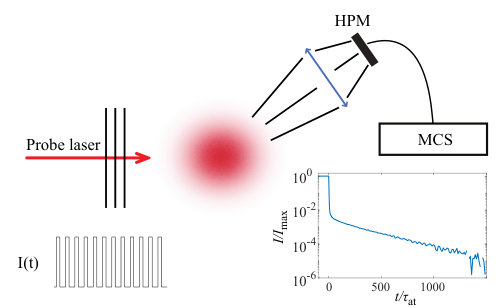 Figure 1
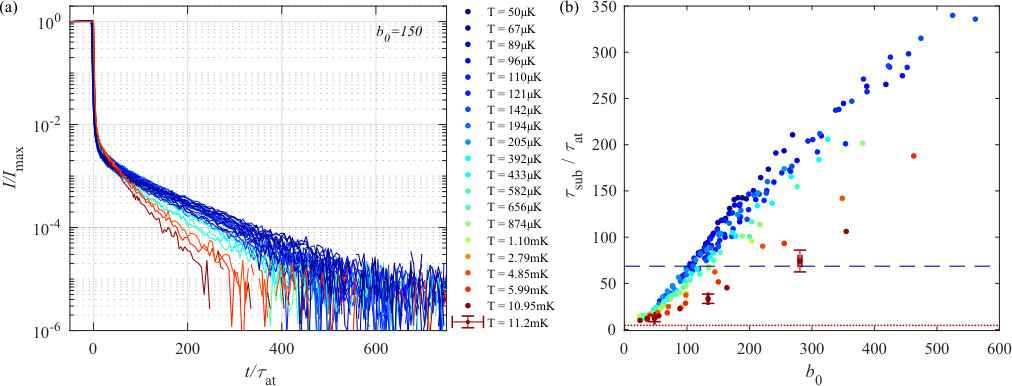 Figure 2
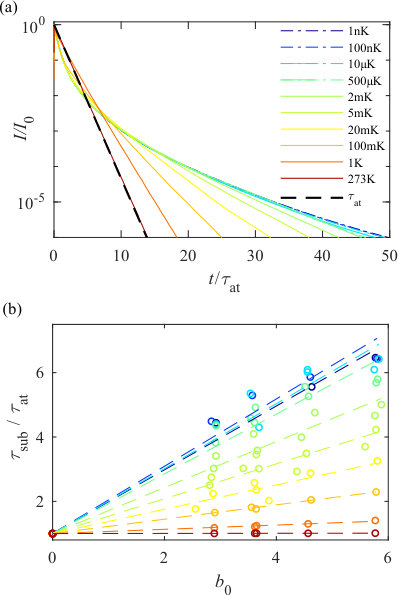 Figure 3
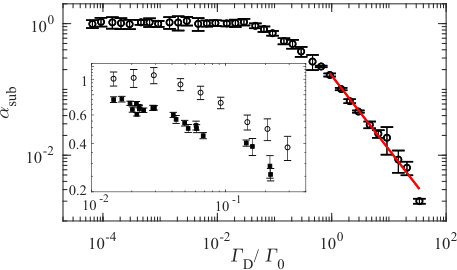 Figure 4
Peer Reviews
No public reviews on file for this paper yet. If you reviewed it on a platform where reviews are public (OpenReview, ICLR, NeurIPS, ICML), you can paste yours below so the community can read it here.
Videos
No videos yet. Explain this paper in a talk, walkthrough, or lecture? Add one.
Robustness of Dicke subradiance against thermal decoherence
P. Weiss
Université Côte d’Azur, CNRS, Institut de Physique de Nice, France
A. Cipris
Université Côte d’Azur, CNRS, Institut de Physique de Nice, France
M. O. Araújo
Université Côte d’Azur, CNRS, Institut de Physique de Nice, France
CAPES Foundation, Ministry of Education of Brazil, Brasília – DF 70040-020, Brazil
R. Kaiser
Université Côte d’Azur, CNRS, Institut de Physique de Nice, France
W. Guerin
Université Côte d’Azur, CNRS, Institut de Physique de Nice, France
Abstract
Subradiance is the cooperative inhibition of the radiation by several emitters coupled to the same electromagnetic modes. It was predicted by Dicke in 1954 and only recently observed in cold atomic vapors. Here we address the question to what extent this cooperative effect survives outside the limit of frozen two-level systems by studying the subradiant decay in an ensemble of cold atoms as a function of the temperature. Experimentally, we observe only a slight decrease of the subradiant decay time when increasing the temperature up to several millikelvins, and in particular we measure subradiant decay rates that are much smaller than the Doppler broadening. This demonstrates that subradiance is surprisingly robust against thermal decoherence. The numerical simulations are in good agreement and allow us to extrapolate the behavior of subradiance at higher temperatures.
I Introduction
Understanding the influence of decoherence or dephasing processes in cooperative effects such as super- and subradiance Dicke (1954); Scully and Svidzinsky (2009); Goban et al. (2015); Guerin et al. (2016); Araújo et al. (2016); Roof et al. (2016); Solano et al. (2017) is not only interesting from a fundamental point of view, but it is also important for the possible developments of photonic device exploiting cooperativity in the classical or quantum regime Ostermann et al. (2013); Scully (2015); Facchinetti et al. (2016); Asenjo-Garcia et al. (2017); Facchinetti and Ruostekoski (2018); Guimond et al. (2019). This is especially true if one wants to use solid-state devices Mlynek et al. (2014); Jenkins et al. (2017), which are subject to phonon-induced decoherence. Previous theoretical studies of various toy models in the framework of open quantum systems have predicted some robustness of superradiance to noise and dephasing Celardo et al. (2014a, b); Tayebi et al. (2016); Damanet et al. (2016).
In this article, we report an experimental study of thermal decoherence of subradiant Dicke states in a large ensemble of cold atoms Guerin et al. (2016). Indeed, even if laser-cooled atoms are not coupled to phonons, they are not completely frozen. Atomic motion has been shown to be a source of decoherence for coherent back scattering Labeyrie et al. (2006) and, to suppress the effect of recurrent scattering on the refractive index of dense atomic media Javanainen et al. (2014); Jenkins et al. (2016). Since subradiance is an interference effect involving very long time scales, it is expected to be particularly fragile. The lifetime of subradiant states can exceed several hundred times the single atom life-time . An intuitive guess how residual atomic motion due to finite temperature should limit this lifetime is given by the restriction that the atoms should not move during this life time farther than the wavelength to not change the interference condition. Taking the rms velocity of a Maxwell-Boltzmann distribution , subradiance would require , where is the Doppler width.
Contrary to that, and quite surprisingly, we show here that subradiance in the linear-optics regime is robust against thermal motion. We observe only a slight decrease of the subradiant decay time when increasing the temperature up to several millikelvins, and in particular we measure subradiant decay rates that are much smaller than the Doppler broadening . We also perform numerical simulations showing that the breakdown of subradiance only occurs when the Doppler broadening is on the same order of magnitude as the natural lifetime of the atomic transition . In practice, this means that subradiance can be observed and used at any “cold-atom” temperature and even beyond.
II Experimental setup
The experimental setup is based on a cloud of cold 87Rb atoms prepared in a magneto-optical trap (MOT). After of loading from the background vapor and a stage of compressed MOT () we obtain a sample of atoms at a temperature with a Gaussian density distribution (peak densities and rms size ). A more detailed description of the setup as well as the procedure to observe and analyze subradiance can be found in Guerin et al. (2016); Weiss et al. (2018). For this new series of experiments we now add an optical molasses in order to vary the temperature in a controlled manner. To do so, we varied the detuning of the cooling laser in a range between to the atomic resonance. We also use the molasses duration () as a parameter to tune the final temperature, which is between and , corresponding to between and .
After this preparation the cloud expands ballistically. During the expansion the atoms are first optically pumped to the hyperfine ground state and then excited by a series of 12 weak laser pulses with a duration of (Fig. 1). The pulses are separated by either or depending on the temperature. The time shaping of the pulses is done with two acousto-optical modulators, achieving a faster switch-off ( ) than the natural lifetime , and at the same time providing an extinction ratio better than . The probe beam is large compared to the cloud size ( radius ) to ensure a homogeneous driving and is linearly polarized. In previous experiments it has been shown that subradiance is independent of the detuning as long as multiple scattering is negligible Guerin et al. (2016); Weiss et al. (2018). As a consequence we have chosen here to work with a constant detuning , with the laser frequency, the frequency of the atomic transition , and the natural linewidth. The intensity of the probe is chosen such that the saturation parameter is
[TABLE]
well in the linear-optics regime, with the degeneracy factor of the transition for equally populated Zeeman states and the saturation intensity. The scattered light is collected by a two-inch lens and detected with a hybrid photon multiplier under an angle of to the probe beam (see Fig. 1). The signal is then sent to a multichannel scaler for averaging over typically more than 400 000 cycles with a time resolution of .
Because of the ballistic expansion during the pulse series the cloud size increases and the cooperativity parameter that controls super- and subradiance effects Guerin et al. (2016, 2017), , decreases (here and is the wavelength of the transition). For simplicity, we call this parameter the on-resonance optical depth although the actual optical depth is
[TABLE]
which can be measured by absorption imaging. This measurement is interlaced with the data acquisition by changing one out of 750 cycles. For those special cycles, the measurement sequence with the pulse series is replaced by an absorption imaging procedure. The time of flight before imaging is varied over the data acquisition such that the temperature and the optical depth for each pulse are measured several times during an acquisition run. This improved calibration procedure gives us access to any drift that might occur during the data acquisition.
III Subradiant decay for different ensemble temperatures
We report in Fig.2 the results of our systematic experimental study of the subradiant decay as a function of the temperature of the sample. In panel (a) we show the decay curves of the scattered light. The intensity is normalized to its steady-state value just before the switch-off at . All curves are recorded for an on-resonant optical depth and the temperature is encoded in the color scale, from (dark blue) to (dark red). The first observation is that subradiance is clearly visible in all curves, even in the mK range, which demonstrates its robustness against thermal motion. The second is that we do observe a reduction of the subradiant decay time when the temperature increases.
To study this effect more precisely we fit all decay curves by an exponential decay at late time (the fitting range is taken as one decade above the noise floor, to cover the longest-lived visible mode). The obtained subradiant time is reported in Fig.2(b) as a function of the on-resonance optical depth for each temperature (same color code). Note that the number of data points is reduced for the highest temperatures because of the fast ballistic expansion of the cloud. The linear scaling of with , as previously reported Guerin et al. (2016); Weiss et al. (2018), is observed at all temperatures; however, the slope is reduced when the temperature increases.
For each temperature we fit this linear trend as to obtain the slope of the subradiant enhancement. In the inset of Fig. 4 we plot the slope as a function of the ratio between the Doppler broadening , with the rms width of the atomic velocity distribution ( is the Boltzmann constant and the atomic mass), and the natural decay rate . Although the temperature is varied by more than two orders of magnitude, the slope only changes by a factor . Within this limited range the decrease fits best with a logarithmic function of .
For almost all our data we have . The characteristic time corresponding to the Doppler width, , is shown in dashed lines in Fig.2(b) for the lowest and highest temperatures. Since it is not surprising that thermal motion affects subradiance, which is built up by the interference of light scattered by many atoms. However, it is a nonintuitive result that subradiant modes with lifetimes long compared to the typical atomic motion survive. A possible explanation for this apparent robustness is the large number of subradiant modes. As the atoms move and the eigenmodes of the system are modified, the excitation contained in a subradiant mode has a larger probability to stay in the subradiant manifold because, at large , there are much more subradiant modes than superradiant ones 111H. Ritsch, Workshop “strongly disordered optical systems: from the white paint to cold atoms”, Cargèse (France), Sep. 2016. In the extreme case of the Dicke limit (), there is only one superradiant mode in the low excitation limit, while subradiant modes are present.
IV Temperature effects in the Coupled-Dipole model
To provide a comparable numerical study of the decay dynamics of the interacting atomic ensemble, as well as to explore the regimes of parameters that we cannot reach experimentally, i.e. and , we now turn to numerical simulations of an adapted version of the coupled-dipole (CD) model, which includes atomic motion Bienaimé et al. (2012); Eloy et al. (2018).
The CD model provides a well-suited description in the context of cooperative effects, especially for super- and subradiance in the linear optics regime Javanainen et al. (1999); Svidzinsky et al. (2010); Courteille et al. (2010); Bienaimé et al. (2011, 2012); Guerin et al. (2016); Araújo et al. (2016); Roof et al. (2016); Araújo et al. (2018). The model consists of two-level atoms randomly distributed in space at position . The atoms are driven with an incident laser field with a Rabi frequency and a detuning . For the low excitation limit, which is considered here, the only relevant states are the ground state and the single-excited states . One can then obtain an effective Hamiltonian for the time evolution of the atomic wave function
[TABLE]
Since we are in the low excitation limit () the time evolution of the system is described by the time evolution of the excitation probabilities
[TABLE]
The first term represents the single-atom decay dynamics, the second term the driving field for the excitation, and the last term the dipole-dipole interaction containing the cooperative effects. We use a scalar model to describe the dipole-dipole interaction, neglecting any polarization effect as well as near-field terms, which is a good approximation for a very dilute gas, as used in our experiment. In this case the dipole-dipole interaction term is
[TABLE]
with the relative distances between the atoms. Since the provide the time evolution of the excitation probability one can then calculate the emitted light intensity as a function of time. A more detailed description can be found in Refs. Bienaimé et al. (2011); Araújo et al. (2018).
In order to include the effect of temperature, we include atomic motion by assigning to each atom a velocity following a normal distribution of rms width in each direction of space and let the space vector be time dependent. At low temperature we use a ballistic motion for each atom, as in the experiment. However this turned out to be problematic with increasing temperatures, since it comes along with a non-negligible increase of size (and correspondingly a drop of the optical depth) of the sample during the subradiant decay time 222This problem affects the results presented in the Fig. 3 of Ref. Bienaimé et al. (2012). This effect is negligible in the experiment, where the spatial width of the distribution , but can become important in simulations, where one needs to use smaller values of to simulate large values of , as the number of atoms in the simulations is limited to a few 1000. To avoid this and keep a well-defined optical depth during the simulation, for temperatures larger than , we simulate the atomic motion with a harmonic trapping. By choosing the oscillation frequency as the ratio between the rms widths of the velocity and space distributions, , the sample keeps its Gaussian density distribution with a constant size. The initial position and velocity of each atom are drawn independently in their respective normal distributions. We have checked that the two ways of including atomic motion (ballistic or harmonic) give the same results around , the temperature beyond which we use the harmonic motion.
V Scaling-law of the temperature dependence
Solving Eqs.(4) for different temperatures ranging from to with an atom number and computing the total scattered intensity, we obtain the decay curves shown in Fig. 3(a). The long-lived subradiant states decay faster when the temperature increases; however, it reaches the single-atom decay only close to room temperature (). As in the experiment, we extract the subradiant decay time by an exponential fit of the slow decay at late time and low level (we choose the fitting range between and for the relative intensity). The results are reported in Fig. 3(b) as a function of the on-resonance optical depth . The linear trend of as a function of is well visible at all temperatures, which is consistent with the experimental observations.
Note that, at large temperature, the Doppler broadening becomes comparable to, or larger than, the detuning (we used in all simulations), such that the driving laser is de facto on resonance, which may introduce radiation trapping Labeyrie et al. (2003). However, as studied in detail in Ref. Weiss et al. (2018), radiation trapping dominates the slow decay only when the actual optical depth is larger than at zero temperature, and is even less visible with Doppler-induced frequency redistribution. In our simulations, the Doppler-broadened optical depth is at most , such that the observed slow decays in Fig. 3 can be safely attributed to subradiance.
To provide a more quantitative study on the impact of temperature on the subradiant decay times, we show in Fig. 4 the slopes extracted from the linear fit of the data of Fig. 3(b), as a function of the Doppler width in units of the natural linewidth. For the lowest temperatures a plateau is visible, i.e. becomes independent of for low enough temperature, the atoms are quasistatic. When the Doppler broadening becomes nonnegligible, starts to slowly decrease. This is the range we experimentally explore, as seen in the insets of Figs. 2(b) and 4. When the Doppler broadening reaches the single atom decay rate, , the decrease of subradiance follows a power law. A power-law fit gives and , compatible with . This exponent can be interpreted as follows. In the regime when , the convolution of the scattering cross-section with the Doppler broadening leads to a reduced center of line scattering cross section scaling as and, for a given atomic density and sample size, the optical depth is also proportional to . The observed scaling of the subradiant decay rates as shown in Fig. 4 is thus primarily consistent with a Doppler-broadened resonant optical depth in the limit of . Note that a simple selection of slow atoms up to a certain cutoff velocity inside the Maxwell-Boltzmann distribution would lead to a different scaling, with a more drastic decrease as .
We finally show in the inset of Fig. 4 the direct comparison (without any free parameter) of the measured and computed slopes as a function of the temperature. Although we do not expect any quantitative agreement on the precise values of , even at zero temperature, because of the complex level structure of rubidium that is not taken into account in the model, the behaviors of with are in remarkable agreement. This validates a posteriori our way of introducing the atomic motion in the coupled-dipole model.
VI Conclusion and Outlook
In summary, we have demonstrated that for a large temperature range of the atomic cloud the subradiant decay is robust against thermal decoherence. In particular, the time scale corresponding to the Doppler broadening, , does not directly introduce a limit for the subradiant lifetime, but merely provides a rescaling of the subradiant enhancement factor () in the high temperature regime. This rescaling can be interpreted as a modification of the resonant optical depth, which is reduced by the Doppler broadening but remains the cooperativity parameter controlling subradiance.
These results open up the prospect of observing and using subradiance at room temperature or with hot atomic vapors. Indeed, an extrapolation of the scaling laws discovered in this work predicts subradiance with with a Rb cell at (with these parameters, and Baudouin et al. (2014)). Similar to room-temperature atomic quantum memories, which have already reached excellent performances Katz and Firstenberg (2018); Guo et al. (2019), subradiance could be more broadly used for quantum-optics or quantum-metrology applications Ostermann et al. (2013); Scully (2015); Facchinetti et al. (2016); Asenjo-Garcia et al. (2017); Facchinetti and Ruostekoski (2018); Guimond et al. (2019) at room temperature. This robustness may also be applied to other interference effects in light scattering, such as coherent back scattering Cherroret et al. (2019).
Acknowledgements.
Acknowledgments
The authors thank Romain Bachelard for useful discussions and advice on the numerical simulations. This work was supported by the ANR (project LOVE, Grant No. ANR-14-CE26-0032), the European Training Network ColOpt (European Union Horizon 2020 program under the Marie Skodowska-Curie action, Grant agreement No. 721465), the Brazilian Coordenação de Aperfeiçoamento de Pessoal de Nível Superior (CAPES), and the Deutsche Forschungsgemeinschaft (Grant No. WE 6356/1-1).
The reference list from the paper itself. Each links out to its DOI / PubMed record.
- 1Dicke (1954) R. H. Dicke, “Coherence in spontaneous radiation processes,” Phys. Rev. 93 , 99–110 (1954).
- 2Scully and Svidzinsky (2009) M. O. Scully and A. A. Svidzinsky, “The super of superradiance,” Science 325 , 1510–1511 (2009).
- 3Goban et al. (2015) A. Goban, C.-L. Hung, J. D. Hood, S.-P. Yu, J. A. Muniz, O. Painter, and H. J. Kimble, “Superradiance for atoms trapped along a photonic crystal waveguide,” Phys. Rev. Lett. 115 , 063601 (2015).
- 4Guerin et al. (2016) W. Guerin, M. O. Araújo, and R. Kaiser, “Subradiance in a large cloud of cold atoms,” Phys. Rev. Lett. 116 , 083601 (2016).
- 5Araújo et al. (2016) M. O. Araújo, I. Krešić, R. Kaiser, and W. Guerin, “Superradiance in a large cloud of cold atoms in the linear-optics regime,” Phys. Rev. Lett. 117 , 073002 (2016).
- 6Roof et al. (2016) S. J. Roof, K. J. Kemp, M. D. Havey, and I. M. Sokolov, “Observation of single-photon superradiance and the cooperative Lamb shift in an extended sample of cold atoms,” Phys. Rev. Lett. 117 , 073003 (2016).
- 7Solano et al. (2017) P. Solano, P. Barberis-Blostein, F. K. Fatemi, L. A. Orozco, and S. L. Rolston, “Super-radiance reveals infinite-range dipole interactions through a nanofiber,” Nature Comm. 8 , 1857 (2017).
- 8Ostermann et al. (2013) L. Ostermann, H. Ritsch, and C. Genes, “Protected state enhanced quantum metrology with interacting two-level ensembles,” Phys. Rev. Lett. 111 , 123601 (2013).