Unavoidable disorder and entropy in multi-component systems
Cormac Toher, Corey Oses, David Hicks, and Stefano Curtarolo

TL;DR
This paper investigates the balance between enthalpy and entropy in multi-component materials, revealing a threshold where disorder becomes unavoidable as the number of species increases.
Contribution
It provides a statistical analysis identifying a critical number of species beyond which disorder dominates in multi-component systems.
Findings
Entropy gain surpasses enthalpy gain at a specific number of species.
Disorder becomes unavoidable in systems with many components.
Ordered compounds are rare beyond four or more species.
Abstract
The need for improved functionalities is driving the search for more complicated multi-component materials. Despite the factorially increasing composition space, ordered compounds with 4 or more species are rare. Here, we unveil the competition between the gain in enthalpy and entropy with increasing number of species by statistical analysis of the AFLOW data repositories. A threshold in the number of species is found where entropy gain exceeds enthalpy gain. Beyond that, enthalpy can be neglected, and disorder - complete or partial - is unavoidable.
Click any figure to enlarge with its caption.
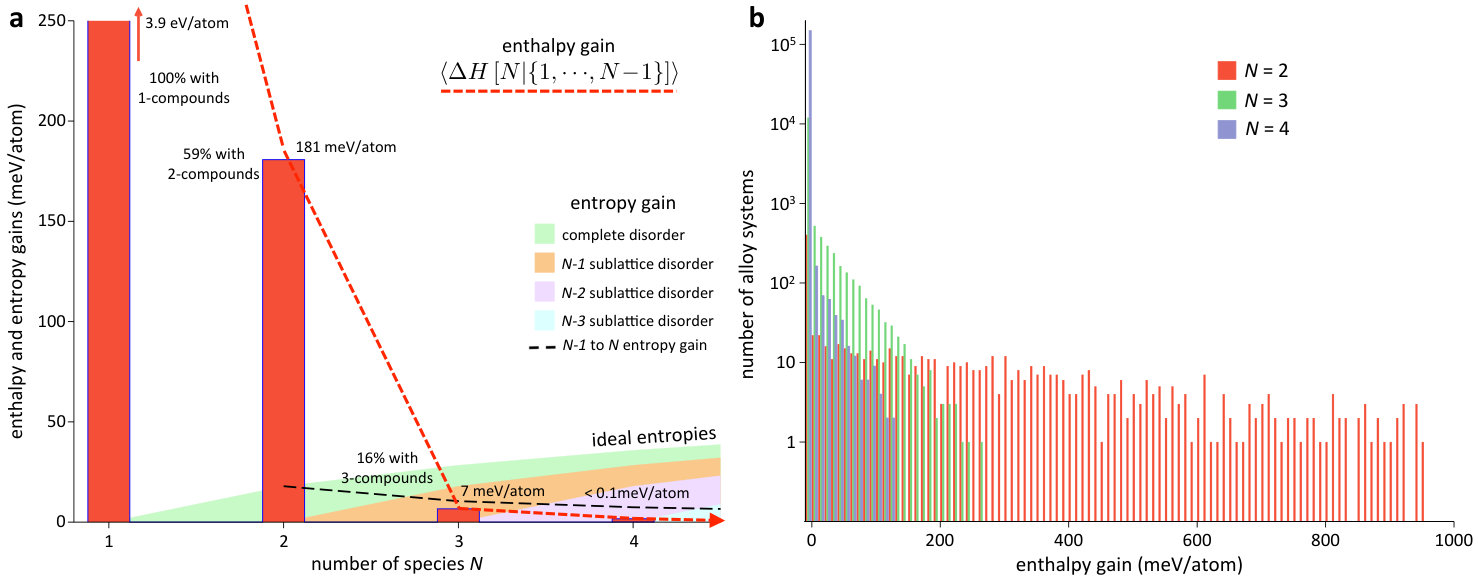 Figure 1
Peer Reviews
No public reviews on file for this paper yet. If you reviewed it on a platform where reviews are public (OpenReview, ICLR, NeurIPS, ICML), you can paste yours below so the community can read it here.
Videos
No videos yet. Explain this paper in a talk, walkthrough, or lecture? Add one.
Unavoidable disorder and entropy in multi-component systems
Cormac Toher
Dept. Mechanical Engineering and Materials Science, Duke University, Durham NC, 27708, USA
Corey Oses
Dept. Mechanical Engineering and Materials Science, Duke University, Durham NC, 27708, USA
David Hicks
Dept. Mechanical Engineering and Materials Science, Duke University, Durham NC, 27708, USA
Stefano Curtarolo
Dept. Mechanical Engineering and Materials Science, Duke University, Durham NC, 27708, USA
Abstract
The need for improved functionalities is driving the search for more complicated multi-component materials. Despite the factorially increasing composition space, ordered compounds with 4 or more species are rare. Here, we unveil the competition between the gain in enthalpy and entropy with increasing number of species by statistical analysis of the AFLOW data repositories. A threshold in the number of species is found where entropy gain exceeds enthalpy gain. Beyond that, enthalpy can be neglected, and disorder — complete or partial — is unavoidable.
The formation of materials in the tangible world, enjoying easy-life at room temperature and pressure, is governed by the Gibbs free energy. Enthalpy usually makes up a large part of it, and, for the last two decades, the search for new materials has mostly focused on enthalpy optimization. A plethora of methods were proposed: e.g. cluster expansion deFontaine_ssp_1994 , genetic- Bush_JMC_GA_1995 and combinatorial algorithms nmatHT . In trying to cure the Maddox curse 111Maddox Maddox : “One of the continuing scandals in the physical sciences is that it remains in general impossible to predict the structure of even the simplest crystalline solids from a knowledge of their chemical composition”., these approaches were all somewhat successful in predicting and discovering systems made up of few species. At least this was the impression: polymorphs were still able to escape from the enthalpic jail! While the need for functionalities was driving the search for more complicated materials, something unexpected happened: the discovery of high-entropy alloys Gao2015highdesign ; Widom_Multicomponent_JSP_2017 . The ideal scenario of phase transitions — in which precursors constantly seek the most stable configuration — was shattered by the acceptance that disorder is useful. Skeptics considered high-entropy alloys only a remake of solid-solutions. In the meantime, new families appeared: entropy-stabilized oxides, high-entropy carbides and borides. Each carrying a panoply of unexpected properties.
Are entropic materials the exception? The question requires the disentanglement of the “enthalpy versus entropy” dichotomy. Big-data statistical analysis gives the answer. Let us consider the AFLOW.org ab-initio materials repository aflowMRS and analyze its compounds’ energies with the associated tools aflux ; aflowCHULL . The recursive formation enthalpy “gain” of an -species ordered compound (called -compound) with respect to combinations of -species ordered sub-components, , is defined as the energetic distance of the enthalpy of the -compound, , below the convex-hull hyper-surface generated from its -species components: if 222 For binary compounds, is equivalent to the usual formation enthalpy. For , the formation enthalpies can be written as sums of the recursive gains. and zero otherwise 333 is conceptually similar to the stability criterion described in Ref. aflowCHULL, , except with all -species entries removed from the pseudo-hull.. Physically, represents the enthalpy gain to create an ordered -compound out of all the combinations of ordered -ones. Gain expectations can be obtained by the analysis of metal alloy phase diagrams “constructible” out of the AFLOW.org data. is shown in Figure 1(a) for , and as cohesive energy for .
**Finding new -compounds becomes difficult. ** While 59% (588) of the binaries show enthalpy gain by forming a total of 1995 2-compounds, only 16% (2237) of ternaries produce 3040 3-compounds and just 426 (0.3%) quaternaries form 4-compounds. Phase separation is overwhelming. Contrary to common belief, the trend indicates that despite the combinatorially-growing number of potential configurations, finding accommodating prototypes becomes harder with increasing .
Entropy takes over. The surviving combinations of species forming new compounds become vulnerable with increasing . The expectation of is 181 meV/atom for binaries. It drastically reduces to 7 meV/atom for ternaries, practically disappearing ( meV/atom) for quaternaries. 434 binary, 192 ternary but only 10 quaternary systems have a large enthalpy gain (defined as exceeding 100 meV/atom): the frequency distributions of enthalpy gains for all systems are displayed in Figure 1(b). The numbers are compared to disorder promotion where the ideal scenario is considered for simplicity McQuarrie . Figure 1(a) shows the ideal entropic contribution at room temperature for the fully () and partially disordered (, , ) systems. Since the component systems could also feature disorder, i.e. the component system could phase-separate into multiple disordered phases, the entropy gain is also plotted (black dashed line). Note that the latter already exceeds the enthalpy gain for . The reducing probability of having -compounds — also recursively applying to sub-components — compounded with the drastically decreasing enthalpic gain and the monotonic entropic promotion, indicates that around the threshold , entropy takes over the stability of the system.
Beyond metals. The analysis focuses on the extensive AFLOW set of metallic compounds; a similar analysis for non-metals requires formation enthalpy corrections Friedrich_CCE_2019 . Mixing different types of bonding can change the entropy threshold by adding additional enthalpic stabilization, leading to a shift of the onset of the entropic promotion ( increases). It is not a coincidence: entropy stabilized oxides were discovered with 5 metallic species mixed with oxygen curtarolo:art99 , and high-entropy-carbides and borides were also synthesized with 5 metallic species plus carbon curtarolo:art140 or boron Gild_borides_SciRep_2016 . There, oxygen, carbon and boron are “spectator” species. The devil is in the details: reciprocal systems might be able to reduce the number of the mixing species, thanks to the additional entropic stabilization of every equivalent sublattice.
The future. Ramifications of the analysis are intriguing. Disordered systems can lead to remarkable properties Gludovatz_hea_mech_properties ; HEAprop2 ; Braun_ESO_AdvMat_2018 — unexpected from the homologous crystalline counterparts — enabling revolutionary technologies. We just need to search for materials with a different mindset. I. The search for multi-component systems, performed with enthalpy optimization, is futile. With increasing , the discovery probability decreases, and, even if an ordered material is found, it would be overwhelmed by engulfing disorder. High-entropy promotion occurs at 4 mixing species (5+ with different bond types). II. Sluggish kinetics at low temperatures can be a blessing BaluffiAllenCarter_book . Disorder is hard to cure, and high entropy solid-solutions synthesized at high-temperature can survive low-temperature phase separation curtarolo:art140 ; BaluffiAllenCarter_book while providing valuable technological applications Gludovatz_hea_mech_properties . III. Maddox’s scandal was only an apparent curse. It was actually a blessing as it forced statistical analysis of the enthalpy versus entropy interplay. Modeling can no longer ignore disorder — often neglected due to compelling difficulties. Advances in complex multi-component materials research will be driven by embracing disorder. It is unavoidable.
I Methods
Calculations of the enthalpy gain are performed using the AFLOW-CHULL module, using the command: aflow --chull --alloy=<system> --print=json, where <system> is a comma-separated list of the elements in the alloy system. The enthalpy gain is contained in the JSON output file under the keyword N+1_energy_gain. To enhance statistical significance, only metallic alloy systems composed of the elements Ag, Al, Au, Ba, Be, Bi, Ca, Cd, Co, Cr, Cu, Fe, Ga, Hf, Hg, In, Ir, K, La, Li, Mg, Mn, Mo, Na, Nb, Ni, Os, Pb, Pd, Pt, Re, Rh, Ru, Sc, Sn, Sr, Ta, Tc, Ti, Tl, V, W, Y, Zn, Zr are considered as AFLOW data is much richer in that material domain. A total of 990 , 14,190 and 148,675 phase diagrams are generated, with 202,261, 974,808 and 432,840 ab-initio entries respectively.
Acknowledgments. The authors thank Ohad Levy for fruitful discussions. Research sponsored by DOD-ONR (N00014-15-1-2863, N00014-16-1-2326, N00014-17-1-2876).
**Competing interests: The authors declare no competing interests. **
**Author contributions. S.C. proposed the species-stabilization mechanism. C.T. and C.O. developed the recursive stability codes. D. H. generated the library of compounds. All authors discussed the results and contributed to the writing of the article. **
Data availability. All the ab-initio data used in this analysis are freely available to the public as part of the AFLOW online repository and can be accessed through AFLOW.org following the REST-API interface curtarolo:art92 and AFLUX search language aflux . The AFLOW source code is available for download at http://aflow.org/ under GNU GPL version 3.
The reference list from the paper itself. Each links out to its DOI / PubMed record.
- 1(1) D. de Fontaine, Cluster Approach to Order-Disorder Transformations in Alloys , in Solid State Physics , edited by H. Ehrenreich and D. Turnbull (Academic Press, New York, 1994), vol. 47, pp. 33–176.
- 2(2) T. S. Bush, C. R. A. Catlow, and P. D. Battle, Evolutionary programming techniques for predicting inorganic crystal structures , J. Mater. Chem. 5 , 1269–1272 (1995).
- 3(3) S. Curtarolo, G. L. W. Hart, M. Buongiorno Nardelli, N. Mingo, S. Sanvito, and O. Levy, The high-throughput highway to computational materials design , Nat. Mater. 12 , 191–201 (2013).
- 4(4) J. Maddox, Crystals from first principles , Nature 335 , 201 (1988).
- 5(5) Maddox Maddox : “One of the continuing scandals in the physical sciences is that it remains in general impossible to predict the structure of even the simplest crystalline solids from a knowledge of their chemical composition”.
- 6(6) M. C. Gao, Design of High-Entropy Alloys , in High-Entropy Alloys: Fundamentals and Applications , edited by M. C. Gao, J.-W. Yeh, P. K. Liaw, and Y. Zhang (Springer, Cham, Switzerland, 2016), chap. 11, pp. 369–398, doi: 10.1007/978-3-319-27013-5 .
- 7(7) M. Widom, Frequency Estimate for Multicomponent Crystalline Compounds , J. Stat. Phys. 167 , 726–734 (2017).
- 8(8) C. Oses, C. Toher, and S. Curtarolo, Data-driven design of inorganic materials with the Automatic Flow Framework for Materials Discovery , MRS Bull. 43 , 670–675 (2018).