Dynamic Adaptation of Software-defined Networks for IoT Systems: A Search-based Approach
Seung Yeob Shin, Shiva Nejati, Mehrdad Sabetzadeh, Lionel C., Briand, Chetan Arora, Frank Zimmer

TL;DR
This paper presents a search-based method for dynamically adapting software-defined networks in IoT systems to effectively resolve congestion, reduce delays, and improve data transmission during emergencies.
Contribution
It introduces a novel real-time adaptive SDN configuration approach for IoT, leveraging search-based techniques to optimize multiple quality of service criteria.
Findings
Efficiently resolves network congestion in real time.
Increases data transmission rate by at least 3 times.
Reduces data loss by at least 70%.
Abstract
The concept of Internet of Things (IoT) has led to the development of many complex and critical systems such as smart emergency management systems. IoT-enabled applications typically depend on a communication network for transmitting large volumes of data in unpredictable and changing environments. These networks are prone to congestion when there is a burst in demand, e.g., as an emergency situation is unfolding, and therefore rely on configurable software-defined networks (SDN). In this paper, we propose a dynamic adaptive SDN configuration approach for IoT systems. The approach enables resolving congestion in real time while minimizing network utilization, data transmission delays and adaptation costs. Our approach builds on existing work in dynamic adaptive search-based software engineering (SBSE) to reconfigure an SDN while simultaneously ensuring multiple quality of service…
Click any figure to enlarge with its caption.
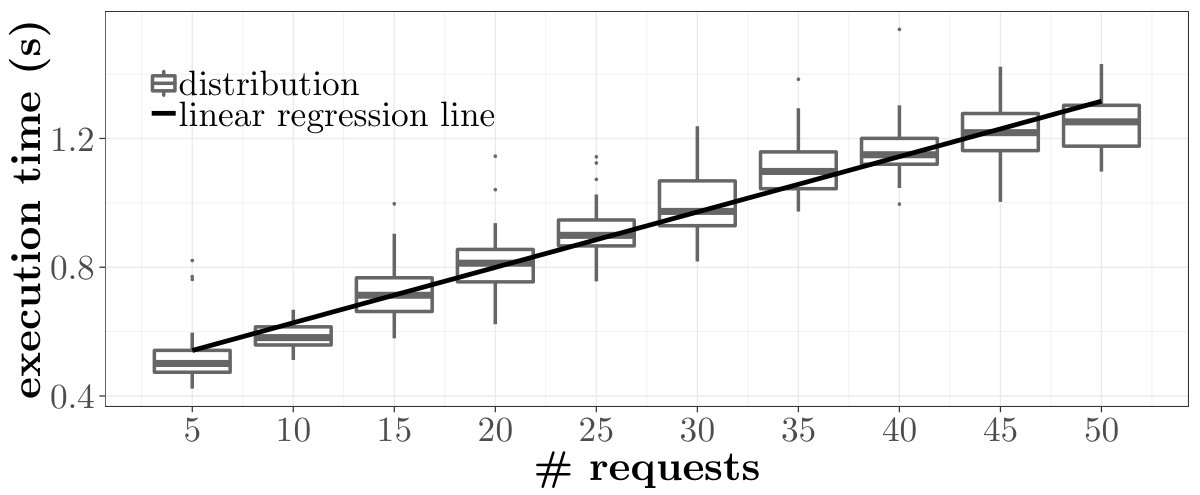 Figure 1
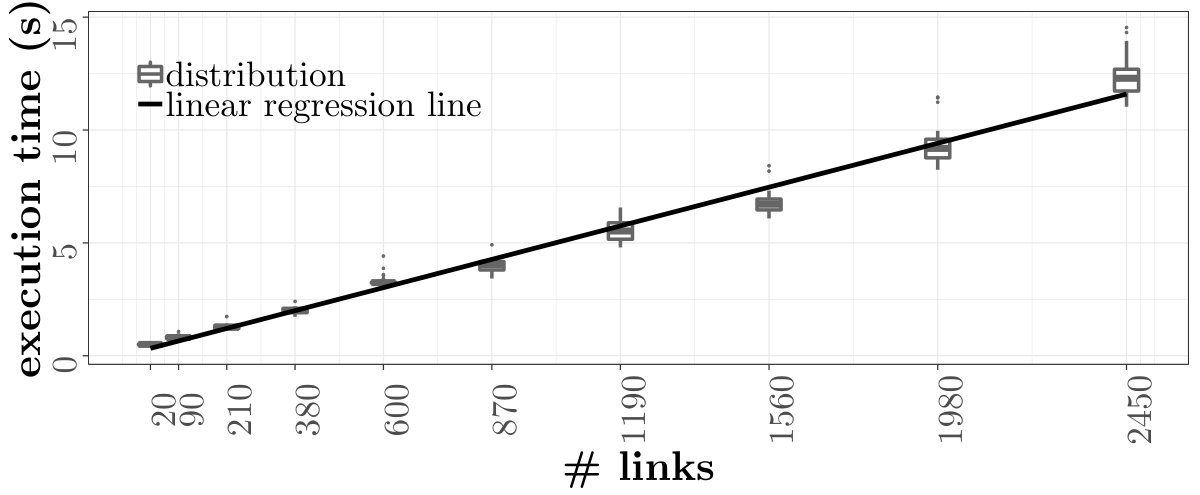 Figure 2
 Figure 3
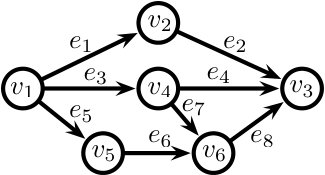 Figure 4
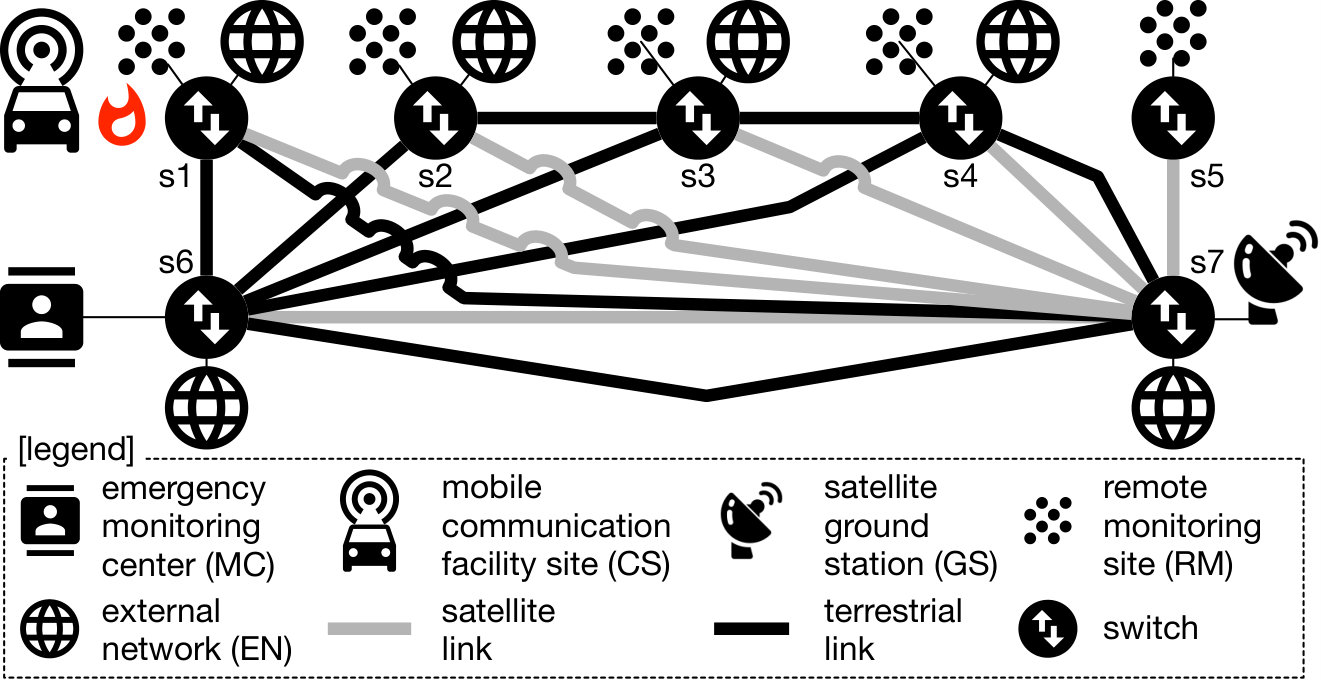 Figure 5
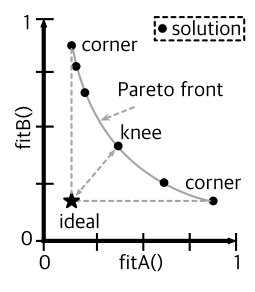 Figure 6
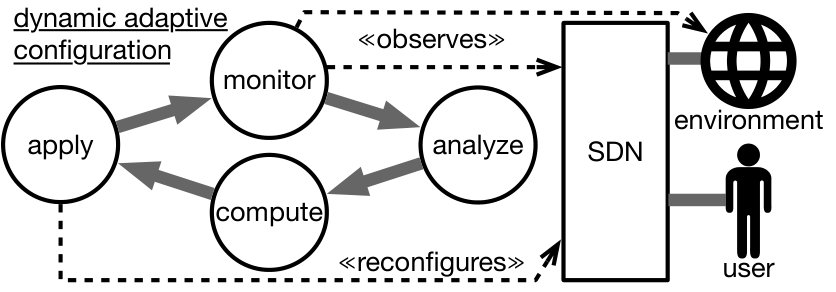 Figure 7
| RFWD | OSPF | DICES | |||||
| Receiver | Type | Delay (s) [] | Packet loss (%) [] | Delay (s) [] | Packet loss (%) [] | Delay (s) | Packet loss (%) |
| Emergency monitoring center | Sensor | 0.10 [0.00] | 0.00 [1.00] | 0.09 [0.00] | 0.00 [1.00] | 0.13 | 0.00 |
| Audio | 0.03 [0.00] | 0.17 [0.00] | 0.03 [0.49] | 0.20 [0.02] | 0.07 | 0.23 | |
| Video | 0.03 [0.00] | 0.02 [0.03] | 0.03 [0.30] | 0.02 [0.02] | 0.04 | 0.08 | |
| Mobile communication facility site | Audio | 0.03 [0.00] | 0.17 [0.01] | 0.06 [0.02] | 0.38 [0.00] | 0.08 | 0.18 |
| Video | 0.03 [0.00] | 0.06 [0.53] | 0.06 [0.00] | 0.32 [0.00] | 0.04 | 0.27 | |
| Map | 0.23 [0.00] | 0.00 [1.00] | 1.13 [0.00] | 0.00 [1.00] | 0.10 | 0.00 | |
| External network | External | 0.35 [0.00] | 29.55 [0.00] | 0.05 [0.00] | 0.14 [0.00] | 0.06 | 0.02 |
| Weighted average | Overall | 0.29 | 21.81 | 0.17 | 0.13 | 0.06 | 0.04 |
Peer Reviews
No public reviews on file for this paper yet. If you reviewed it on a platform where reviews are public (OpenReview, ICLR, NeurIPS, ICML), you can paste yours below so the community can read it here.
Videos
No videos yet. Explain this paper in a talk, walkthrough, or lecture? Add one.
Dynamic Adaptation of Software-defined Networks for
IoT Systems: A Search-based Approach
Seung Yeob Shin
University of Luxembourg, Luxembourg
,
Shiva Nejati
University of Ottawa, Canada
University of Luxembourg, Luxembourg
,
Mehrdad Sabetzadeh
University of Ottawa, Canada
University of Luxembourg, Luxembourg
,
Lionel C. Briand
University of Ottawa, Canada
University of Luxembourg, Luxembourg
,
Chetan Arora
SES Networks, Luxembourg
University of Luxembourg, Luxembourg
Deakin University, Australia
and
Frank Zimmer
SES Networks, Luxembourg
(2020)
Abstract.
The concept of Internet of Things (IoT) has led to the development of many complex and critical systems such as smart emergency management systems. IoT-enabled applications typically depend on a communication network for transmitting large volumes of data in unpredictable and changing environments. These networks are prone to congestion when there is a burst in demand, e.g., as an emergency situation is unfolding, and therefore rely on configurable software-defined networks (SDN). In this paper, we propose a dynamic adaptive SDN configuration approach for IoT systems. The approach enables resolving congestion in real time while minimizing network utilization, data transmission delays and adaptation costs. Our approach builds on existing work in dynamic adaptive search-based software engineering (SBSE) to reconfigure an SDN while simultaneously ensuring multiple quality of service criteria. We evaluate our approach on an industrial national emergency management system, which is aimed at detecting disasters and emergencies, and facilitating recovery and rescue operations by providing first responders with a reliable communication infrastructure. Our results indicate that (1) our approach is able to efficiently and effectively adapt an SDN to dynamically resolve congestion, and (2) compared to two baseline data forwarding algorithms that are static and non-adaptive, our approach increases data transmission rate by a factor of at least 3 and decreases data loss by at least 70%.
Search-based Software Engineering, Dynamic Adaptive Systems, Internet of Things, Software-defined Networks
††journalyear: 2020††copyright: acmcopyright††conference: IEEE/ACM 15th International Symposium on Software Engineering for Adaptive and Self-Managing Systems; October 7–8, 2020; Seoul, Republic of Korea††booktitle: IEEE/ACM 15th International Symposium on Software Engineering for Adaptive and Self-Managing Systems (SEAMS ’20), October 7–8, 2020, Seoul, Republic of Korea††price: 15.00††doi: 10.1145/3387939.3391603††isbn: 978-1-4503-7962-5/20/05
1. Introduction
The recent proliferation of sensors, actuators and inexpensive network-enabled devices in homes, workplaces, public spaces and nature provides several opportunities to build intelligent systems that can improve our lives in many different ways. These devices, when used in combination with wired and wireless connectivity, have created a surge of interest in the concept of Internet of Things (IoT). Systems enabled by IoT perform a task by connecting sensors and actuators and many previously unconnected things through the Internet (Al-Fuqaha et al., 2015; Atzori et al., 2010). A notable example of an IoT-enabled system is an emergency management system that monitors a large geographical area through a network of sensors to detect potential disasters (e.g., fire, floods, hurricanes, earthquakes) as early as possible and to provide a communication platform between the responsible organizations and people to enable quick action and minimize loss of life and damages.
Successful IoT systems necessarily depend on an underlying communication system that can transmit large volumes of data in an efficient, effective and flexible way. Such a communication system should, in particular, be able to adapt to changes in the environment and maintain a reasonable quality of service when, for example, the traffic for a particular network route increases dramatically due to a massive demand from system users. Recently, software-defined networks (SDN) (Haleplidis et al., 2015) have started to enable such flexible and effective communication systems. The idea behind SDN is to transfer the control of networks from localized fixed-behavior controllers distributed over a set of switches to a centralized and programmable software controller that can react to environment changes in a timely fashion by efficiently reconfiguring the entire network. With software being an integral part of SDN, developing network controllers needs interdisciplinary considerations which include not only network engineering, but also software engineering (Lopes et al., 2016).
For an IoT system that builds on SDN, the controller is responsible for ensuring that the network is configured in such a way as to maintain the quality of service at a desired level. In this paper, we focus on developing effective reconfiguration techniques for SDN to improve the quality of service in IoT systems. Such techniques should be able to continuously monitor environment changes and dynamically reconfigure the system accordingly in order to optimize multiple quality of service criteria such as minimizing data loss, communication delays and reconfiguration costs. There are a number of existing research threads on ensuring the quality of service for traditional networks (Mathis and Mahdavi, 1996; Alizadeh et al., 2010; Ferlin et al., 2016; He et al., 2016; Betzler et al., 2016). Some more recent approaches study dynamic reconfiguration of SDN to maximize quality of service (Chiang et al., 2018; Gay et al., 2017; Huang et al., 2016). None of these lines of work, however, consider or optimize the configuration of an SDN for multiple quality of service criteria simultaneously. The problem of configuration for the purpose of optimizing multiple criteria has been studied in prior research threads for design-time software development (Zoghi et al., 2016; Andrade and de A. Macêdo, 2013; Ramirez et al., 2009). These studies, however, are geared toward offline optimization of system design or architecture, and cannot address the challenge of online and dynamic SDN reconfiguration.
In this paper, we propose a dynamic adaptive configuration technique to resolve congestion in SDN in an online manner, while minimizing data transmission delays and reconfiguration costs. We refer to our approach as Dynamic adaptIve CongEstion control algorithm for SDN (DICES). Inspired by feedback-loop control systems (Kephart and Chess, 2003), DICES realizes the control loop shown in Fig. 1 and consisting of the following steps: (1) monitor the SDN to collect network information, (2) analyze the network to determine whether it is congested, (3) compute a reconfiguration if congestion is detected, and (4) apply the new configuration to the actual SDN. The control loop is executed periodically and may reconfigure the SDN at each period if congestion is detected. The “compute” step of DICES uses a tailored multi-objective search algorithm to optimize multiple quality of service criteria simultaneously. Specifically, the algorithm minimizes the following three objectives: network-link utilization, transmission delay and reconfiguration cost. In order to be executed in a real-time manner, DICES has to be efficient. Hence, instead of searching for the very best reconfiguration option, the approach aims to find good-enough solutions sufficiently quickly. Consistent with this goal, we build on the research field of dynamic adaptive search-based software engineering (SBSE) (Harman et al., 2012) to enable the computation component in charge of the reconfiguration of an SDN.
DICES has to be integrated and executed together with an actual SDN control platform. We develop DICES as an application within ONOS (Berde et al., 2014) – a widely used open-source SDN control platform. To evaluate DICES, we rely on an open-source network emulator, Mininet (Lantz et al., 2010). Mininet enables us to create and emulate realistic virtual networks with different topologies and characteristics. Alongside Mininet, we employ an open-source network traffic flow generator, D-ITG (Botta et al., 2012), to generate IoT traffic scenarios by combining sensor, video, audio and data streams. Our implementation of DICES can be integrated in a straightforward way into an actual network system. Nevertheless, we elect to evaluate our approach based on emulation through Mininet. This choice, which follows standard engineering practice, is motivated by two main factors: First, the large-scale and systematic experiments that we perform would be prohibitively expensive to set up using real hardware. Second, we need to evaluate our approach on varying networks with different sizes and properties. With real hardware, we would not have the required flexibility.
We assess the performance of DICES on ten synthetic and one industrial SDN. The industrial SDN is a national emergency management system in Luxembourg. The information about the topology and the IoT traffic scenarios for this SDN is provided by SES, a leading satellite operator, which is in charge of assessing the infrastructure for the national emergency management system. Our results show that: (1) DICES efficiently and effectively adapts an SDN to resolve congestion, (2) the execution time of DICES scales linearly with the network size and the number of traffic flows, and (3) compared to two baseline solutions commonly used in practice (Poularakis et al., 2019; Amin et al., 2018; Bianco et al., 2017; Rego et al., 2017; Caria et al., 2015; Bianco et al., 2015; Agarwal et al., 2013), DICES leads to data transmissions that are at least 3 times faster while reducing data loss by at least 70%. Our case study data is available online (Shin et al., 2020).
Organization. The rest of this paper is organized as follows. Section 2 motivates the paper. Section 3 describes DICES. Section 4 evaluates DICES. Section 5 compares with related work. Section 6 concludes this paper.
2. Motivating Case Study
We motivate our work with an IoT-enabled national emergency management system, currently under study by SES, for public protection and disaster relief. We refer to this system as EMS in the rest of the paper. EMS is responsible for generating early warnings about potential disasters, detecting natural or man-made emergencies, and facilitating response/recovery operations by providing emergency workers or governmental bodies with a reliable and efficient communication and data transfer infrastructure.
Fig. 2 shows a conceptual view of EMS for an example topology suggested by SES. EMS employs SDN to interconnect four types of sites, namely remote monitoring site, emergency monitoring center, satellite ground station, and mobile communication facility site. The interconnections are realized using SDN switches (s1–s7), terrestrial links (e.g., optical fiber links) and satellite links. The key characteristics of the four EMS sites are described below.
Remote monitoring sites (RM) continuously monitor and gather environment data using sensor networks. In Fig. 2, switches s1–s5 are connected to remote monitoring sites.
Emergency monitoring centers (MC) control and monitor the entire EMS by aggregating data from the remote sites. They further facilitate decision making for emergency handling by controlling the entire network and by processing the aggregated data. EMS has one emergency monitoring center attached to s6, as depicted in Fig. 2.
Satellite ground stations (GS) are responsible for routing data streams transmitted by satellites. All satellite connections need to pass through a satellite ground station. EMS has one satellite ground station attached to s7, as shown in Fig. 2.
Mobile communication facility sites (CS) are used by emergency workers and first responders for communication during an actual emergency. Unlike the other EMS sites that are operational at all times, the mobile communication facility comes into play only during or after an emergency. The mobile facility site is primarily used as a communication hotspot for audio and video transmission between a remote monitoring site and the emergency monitoring center. In our case study, we assume that an emergency situation, e.g., a natural disaster, occurs in the area close to s1. Hence, in Fig. 2, the mobile communication facility site is located at s1.
Finally, as shown in Fig. 2, the EMS network can further be connected to external (legacy) networks (EN) to allow access to remote monitoring sites.
During an emergency, the EMS data traffic volume increases by many folds. The remote monitoring sites transmit monitored data streams to the emergency monitoring center. The mobile communication facility site and the emergency monitoring center exchange high-bandwidth demanding streams such as high definition video and audio for real-time updates. The emergency monitoring center sends earth-observation images (i.e., maps) to the mobile communication facility site in order to help plan an appropriate recovery strategy.
EMS is highly prone to congestion during emergencies due to the increased volume of demand. Such congestion leads to increased latency, information loss and inability to communicate with one or more sites. While such congested networks are common during emergencies, critical systems such as EMS are expected to be resilient and find ways to avoid or mitigate congestion. Failing to do so can have dire consequences. EMS is thus subject to strict quality of service requirements so that it will operate through network issues without intolerable delays or information loss. To this end, SES is interested in DICES as a way to ensure that EMS can sustain emergency situations and satisfy its quality of service requirements.
3. Approach
The separation between software-defined data control and the physical aspects of network systems is a key feature of SDN (Haleplidis et al., 2015). The SDN architecture is composed of three layers: infrastructure, control, and application. The infrastructure layer is comprised of physical entities such as links and switches that enable data flows based on forwarding rules instructed by the control layer. The control layer hosts one or multiple SDN controllers distributed across the network. This layer is responsible for managing infrastructure entities, e.g., switches and links, based on algorithms provided by the application layer. In Section 3.1, we provide an abstract formalization of SDN concepts and use them to define the problem of network congestion.
The behavior of the control layer can be modified and extended by the application layer. Users can develop their own applications to apply domain-specific data forwarding, security or failure management algorithms. Specifically, the SDN application layer includes a data-forwarding algorithm that directs data flows between any pair of switches through the weighted shortest path between the switches. This default data-forwarding algorithm is described in Section 3.2. Since SDN controller behavior is programmable through applications, we can enhance the data-forwarding function of SDN using DICES as described in Section 3.3.
3.1. Problem Description
In this section, we describe SDN topologies using directed graphs and formalize SDN traffic concepts. We then define the problem of network congestion. We define an SDN network as a tuple , where is a set of switches, is a set of directed links between switches, is a bandwidth function assigning a positive integer value to every link , and is a delay function assigning a positive integer value to every link . For example, Fig. 3(a) presents an example SDN topology with six switches, , and eight directed links ; and, Fig. 3(b) shows the bandwidth and delay values of each link in Fig. 3(a). The network of EMS in Fig 2 could be represented using a graph similar to that in Fig. 3(a) where every node in Fig. 3(a) corresponds to a switch in EMS and every link in Fig. 3(a) corresponds to a terrestrial or satellite link in EMS. Note that EMS terrestrial and satellite links are bidirectional and thus have to be represented as two directed graph links.
A network request specifies a data stream that should be sent by a source switch to a terminal switch . Each network request has a source switch , a terminal switch and a data stream of size (or bandwidth) . Note that may vary over time, but, for notational simplicity, we capture as a constant. We produce a different request if changes and remove the old one. To process each request , a flow is created. A flow describes a directed path, i.e., a sequence of links, in that is used to transmit the data stream of . We denote by the request related to a flow , and by the directed path that is used to carry the data of from to . Let be a set of flows. We denote by the set of links on the directed path and by the set of all the links of the flows in . Finally, we denote the subset of flows in going through link by .
The bandwidth of a network link is a (limited) resource shared by different flows. A flow going through a link consumes the link’s bandwidth by the flow size . Hence, the total size of flows going though , i.e., the throughput of , should be less than or equal to the bandwidth . Given a set of flows, we define the throughput of for as follows: .
We say a network is congested by a given set of flows if there is some link such that . Given a network congested by the set of flows, we address the problem of network congestion by finding a new set of flows where (1) each processes the same request as that of the flow , i.e., , and thus and have the same cardinality, i.e., , and (2) is not congested by , i.e., for all . The problem of resolving network congestion is NP-hard (Amiri et al., 2018; Brandt et al., 2016). Note that may not exist when, for example, all the links in are overutilized by network requests. In this case, we aim to compute such that the maximum link throughput is minimized even if it is still congested (see Section 3.3).
3.2. SDN Data Forwarding
We assume that an SDN data forwarding algorithm is executed whenever a new request arrives, i.e., the data forwarding is an event-driven (aperiodic) process. In order to handle the continuous stream of requests from network users, which are not a-priori-known, a network system must continuously respond to new requests arriving at any time – even in the middle of addressing a congestion problem. Our data forwarding algorithm, which is similar to existing baselines (Bianco et al., 2017), uses weight parameters assigned to network links and computes the weighted shortest path between a pair of switches to determine the route for carrying a data stream of between the switches. Specifically, we denote by the weight value of a link . The default weights are one (i.e., for all the links in ). The weights are configurable and can be modified by application layer algorithms. In Section 3.3.2, we discuss how DICES modifies the weight parameters after detecting congestion so that the data forwarding algorithm does not send new requests through the overutilized links.
3.3. Dynamic Adaptive Congestion Control
DICES runs in parallel with the SDN data forwarding algorithm described in Section 3.2. In contrast to the SDN data forwarding algorithm, DICES is designed to execute periodically with a time period . To detect congestion, DICES has to poll the network state periodically as the state is always changing due to the unpredictable environment. In addition, DICES has to ensure, when congestion happens, that the subsequent steps for congestion resolution are always deterministically executed. Therefore, we chose to design DICES as a periodic process instead of an event-driven (aperiodic) one. The period should be chosen such that it is small enough to allow DICES to detect and handle congestion as quickly as possible, and at the same time, large enough for executions of DICES not to cause too much overhead and interfere with other SDN operations, e.g., the execution of the SDN data forwarding algorithm.
Let be the time duration during which we observe the network traffic. We assume the network is fixed over time, but the network traffic, i.e., the set of requests and the set of flows handling , vary over time. We denote by the set of network requests received at the beginning of the time step , and by the set of flows corresponding to . At each time step , DICES starts running by executing its “monitor” step (Fig. 1). It receives and and uses these two sets in its subsequent steps, i.e., “analyze”, “compute”, and “apply”. Requests that arrive within the interval of or the flows generated within this interval are included in and , but not in and .
The “analyze” step is in charge of determining whether, or not, the network is congested. In practice, a link is considered congested if it is utilized above a certain threshold (e.g., 80% of the link bandwidth) (Lin et al., 2016; Akyildiz et al., 2014). We denote by the utilization of link by the flow set and define it as follows: . The “analyze” step deems to be congested if , where is the utilization threshold.
If the network is congested as determined by the “analyze” step, the “compute” step addresses the congestion problem by performing the following two tasks: First, it resolves the congestion by computing a new set of that can handle the requests without congestion (see the congestion problem definition in Section 3.1). If congestion cannot be resolved, it ensures that minimizes the maximum link utilization by . Second, it computes a set of weights for network links based on their utilization. These weights are passed to the SDN data forwarding algorithm (Section 3.2) so that the algorithm does not send new requests arriving after through the overutilized links. The “apply” step reconfigures flows and applies the new weights computed by the “compute” step.
In the remainder of this section, we present two algorithms addressing the two tasks of the “compute” step: A search-based congestion control algorithm for the first task, and a utilization-aware weight control algorithm for the second task.
3.3.1. Search-based Congestion Control Algorithm
Our search-based congestion control algorithm attempts to resolve an identified congestion, and if the congestion cannot be resolved, the algorithm minimizes the maximum link utilization. Specifically, given a network congested by the set of flows addressing the set of requests, our aim is to generate the set of flows to resolve or minimize the congestion while addressing the requests in . To do so, we minimize the maximum link utilization across all the links in (objective O1 or Utilization). In addition to minimizing utilization, we aim to optimize two more objectives that are important for quality of service in network systems: We minimize the number of link updates, i.e., insertions and deletions, required to reconfigure the network flows (objective O2 or Cost) and the overall data transmission delays induced by the new set of flows (objective O3 or Delay). By minimizing the cost, we ensure that we manipulate a small number of elements at the infrastructure layer and require a small amount of time to apply . Minimizing the network delay is critical for emergency systems to ensure that data streams are transmitted on time. Note that we have to optimize these three objectives explicitly and simultaneously since optimizing the utilization objective, O1, is likely to negatively impact the cost of flow reconfiguration, O2, or the overall delay, O3. This is because if the new flow paths of are very different from those of or if uses longer but less utilized paths than those of , the reconfiguration cost and the overall delay may increase. In addition, the reconfiguration cost, O2, and the overall delay, O3, are independent objectives.
Following standard practice (Ferrucci et al., 2013), we describe our algorithm by defining the representation, the initial population, the fitness functions, and the computational search algorithm. We then discuss the output flow set that we report as the optimal solution to be used in the “apply” step of DICES.
Representation. Given a network and a set of requests, a feasible solution is a set of flows where for every we have , for every there is some such that , and .
Initial population. Recall that the input to our search algorithm is a set of flows at time and its corresponding set of requests. We create an initial population by randomly modifying individual flows in while ensuring that the generated flow sets are able to handle the requests in .
Fitness. For the three objectives O1, O2, and O3 described above, we formulate three quantitative fitness functions , , and , respectively, where is the set of flows given as input and is a candidate flow set generated during the search.
The fitness function is defined by equation (1) as the maximum link utilization across all the links used in . Our approach aims to minimize equation (1).
[TABLE]
The fitness function is defined by equation (2). In this paper, we compute the distance between a pair and of flows, denoted by , as the edit distance between the path of () and the path of (). Our notion of edit distance is the same as computing the longest common subsequence (LCS) distance of two paths (Cormen et al., 2009) and counts the number of link insertions and link deletions required to transform into . This metric matches our definition of the cost objective described earlier in this section. Our approach minimizes equation (2).
[TABLE]
The fitness function is defined by equation (3) which sums the delay values of all the links used in a candidate solution . Note that the delay objective can be estimated for a flow set only if does not give rise to congestion, i.e., only when , where is a utilization threshold. This is because, when a network is congested, actual delay values depend on various factors such as the underlying network protocol (e.g., TCP or UDP) that are not studied here. Hence, when leads to congestion, we assign an undefined value (i.e., a large number) to . Our approach minimizes equation (3).
[TABLE]
Recall from Section 3.1, that congestion may not be resolved by our approach which is based on reassigning the flows. In this case, the objective is excluded since it is undefined and returns a large number for all the congested solutions. But the search still minimizes and and returns a solution that is minimally congested and its implementation incurs minimal cost.
Computational search. We use the Non-dominated Sorting Genetic Algorithm version 2 (NSGAII) algorithm (Deb et al., 2002) to find a near-optimal solution. NSGAII outputs a set (Pareto front) of non-dominated solutions which are equally viable and the best tradeoffs found among the given fitness functions. The dominance relation over solutions is defined as follows (Knowles and Corne, 2000): “A solution dominates another solution if is not worse than in all fitness values, and is strictly better than in at least one fitness.”
Fig. 4 presents our NSGAII-based congestion control algorithm. As shown in lines 12–16, we first create an initial population based on the input . Lines 19–26 of the algorithm compute the fitness functions. Lines 27–36 describe how NSGAII selects best solutions (lines 27–28), sorts non-dominated fronts (line 29), and assigns crowding distance (line 32) to introduce diversity among non-dominated solutions (Deb et al., 2002).
As per line 36 of the listing in Fig. 4, the algorithm breeds the next population by using the following genetic operators: (1) Selection. We use the binary tournament selection based on non-domination ranking and crowding distance as typically used by NSGAII (Deb et al., 2002). (2) Crossover. We use the standard single-point crossover which has been applied in many problems (Andrade and de A. Macêdo, 2013; Hemmati et al., 2011; Deb et al., 2002). (3) Mutation. We use the mutation algorithm in Fig. 5. It replaces a randomly selected flow in (lines 8–9) with an alternative flow for such that (lines 10–11).
Choosing an optimal solution. The output of NSGAII is a set of equally viable solutions (line 28 in Fig. 4). But we have to select only one solution to be used for reconfiguring the network (lines 37–38). Researchers have proposed various alternatives for selecting an optimal solution among all the solutions on an optimal Pareto front, such as a knee solution (Branke et al., 2004) or the corner solution (Panichella et al., 2015) for an objective. In our work, we use a knee solution.
Fig. 6 illustrates the knee point on a two-objective Pareto front. Specifically, a knee point is the closest point on a Pareto front to the ideal point, a hypothetical solution with the best values for all the objectives. A knee solution is often preferred in SBSE studies (Chen et al., 2018; Branke et al., 2004) because a small improvement in one objective by selecting other solutions on the front would lead to a large deterioration in at least one other objective (Branke et al., 2004). In our work, we choose a knee solution because we do not want the selected flow set to be biased toward any objective; instead, we prefer a flow set that is equally optimized for all the objectives.
3.3.2. Utilization-aware Weight Control
As described in Section 3.2, the SDN data forwarding algorithm constructs a flow that always routes a data stream along the weighted shortest path. A network system that uses static link weights, e.g., for all the links in , may remain congested even after applying our search-based solution in Section 3.3.1. This occurs when a highly utilized link keeps being used by the SDN data forwarding algorithm to carry new data requests because the link is located on a weighted shortest path. Note that, in general, links located on the shortest paths are more likely to be highly utilized or congested when we use the SDN data forwarding algorithm with fixed weight values. To avoid this problem, we update link weights in a way that forces the SDN data forwarding algorithm to prioritize less utilized links over highly utilized ones.
Fig. 7 describes our utilization-aware link weight adjustment algorithm. The algorithm modifies the link weights based on the statement on line 9. Specifically, it adjusts the weights such that of a link is proportional to link delay , but is inversely proportional to the remaining (available) bandwidth of the link , i.e., . Note that the bandwidth is computed after applying the new optimized flows generated by the search-based algorithm in Fig. 4. The weight computation thus assigns a large value to a highly utilized but lower-speed link (i.e., a link with large delay). The SDN data forwarding algorithm (see Section 3.2) then selects less utilized and higher-speed links when it creates flows to address new requests arriving after the weight adjustment, i.e., after .
4. Empirical Evaluation
In this section, we present an evaluation of DICES. Our full evaluation package is available online (Shin et al., 2020).
4.1. Research Questions (RQs)
RQ1 (efficiency and effectiveness): Can our approach resolve congestion caused by changes in network requests over time? In RQ1, we examine the efficiency and effectiveness of DICES by investigating whether it is able to detect congestion as we increase network requests, and whether it can compute and apply an adequate reconfiguration in a timely manner.
RQ2 (scalability): Can our approach resolve congestion promptly for large-scale networks? In RQ2, we investigate the scalability of DICES by studying the relation between its execution time and the network size and number of requests.
RQ3 (comparison with baselines): How does our approach perform compared with baseline approaches? With RQ3, we investigate whether our approach can outperform two existing packet forwarding algorithms: a reactive forwarding algorithm (RFWD) (Bianco et al., 2017) and an open shortest path first algorithm (OSPF) (Coltun et al., 2008). RFWD and OSPF, discussed in Section 4.5, are commonly used for optimal data forwarding and congestion avoidance, respectively, and as baselines in recent SDN research strands (Poularakis et al., 2019; Amin et al., 2018; Bianco et al., 2017; Rego et al., 2017; Caria et al., 2015; Bianco et al., 2015; Agarwal et al., 2013).
4.2. Simulation Platform
We implemented DICES as an application for an SDN testbed at SES. Specifically, we use an open-source SDN control platform known as ONOS (Open Network Operating System) (Berde et al., 2014). ONOS has been used extensively in research and practice (Bianco et al., 2017; Bakhshi, 2017), in particular for large-scale network systems. To simulate networks, we use Mininet (Lantz et al., 2010) and D-ITG (Botta et al., 2012). Mininet is a network emulator that creates a virtual network, running real SDN-switch and application programs, on a single machine to ease prototyping and testing. D-ITG (Distributed Internet Traffic Generator) is a traffic generation and monitoring tool that supports various network protocols and traffic distributions for replicating realistic network traffic. We ran all our experiments on a computer equipped with an Intel i7 CPU with 8GB of memory.
4.3. Study Subjects
We use two types of study subjects: (1) some synthetic networks, and (2) EMS – a large-scale industrial system under study by SES (see Section 2). The synthetic networks are used to evaluate efficiency, effectiveness and scalability since, in these networks, we can freely change the size and traffic, while EMS is used to evaluate the execution time of DICES and to compare it with baselines in a realistic setting.
Our synthetic networks are characterized by two parameters: the number of network switches and the number of network requests. We assume complete graph topologies, i.e., all the switches are connected to one another using links with 100Mbps bandwidth and 25ms delay. Hence, the number of links is not an open parameter for our synthetic networks. This choice was made to reduce unnecessary complexity in our analysis. The network bandwidth and delay values and network-request profiles were suggested by SES based on the typical characteristics of terrestrial links and their data streams. We use UDP and TCP – typical protocols for Internet applications – for transmitting data. Note that graph topologies, which contain only one path from a sender to receiver, e.g., star and line topologies, are not considered in our experiments. Congestion for such topologies can only be handled by decreasing the network traffic. In contrast, DICES requires multiple flow paths from a sender to a receiver for rerouting. A partially complete graph topology is considered in the EMS network (Fig. 2).
As discussed in Section 2, the EMS network contains seven SDN switches, four site types (denoted RM, MC, CS, and GS in Fig. 2). The network further contains both terrestrial and satellite links and is connected to external (legacy) networks (EN). The characteristics of the terrestrial and satellite links are as follows: 100 Mbps bandwidth, 25ms delay for terrestrial links, and 10 Mbps bandwidth, 275ms delay for satellite links.
4.4. Evaluation Metrics
To answer the RQs, we measure the following network performance metrics: link utilization, packet loss, and packet delay. In addition, we measure the execution time of DICES. The link utilization metric is the maximum link utilization across all the links in a network since a single overutilized link can create congestion. Specifically, given a set of flows, we compute this metric as the maximum of for every link (see Section 3.3 for the definition of ).
To measure the packet loss and delay metrics, we rely on an existing network monitoring tool, D-ITG, described in Section 4.2. Briefly, the packet loss metric for a flow measures the number of packets dropped associated with the flow over a time period, e.g., time interval . The delay metric for a flow measures each individual packet delivery time from the sender to the receiver of the flow.
Due to random variation in DICES and the traffic generator (D-ITG), we repeat our experiments 50 times. To statistically compare our results, we use Mann-Whitney U-test (Mann and Whitney, 1947) which determines whether two independent samples are likely or not to belong to the same distribution. We set the level of significance, , to 0.05.
To determine correlations between the execution time of DICES and the network parameters in our study, i.e., network size and the number of requests, we use regression analysis (Mosteller and Tukey, 1977). We use (Wright, 1921) to evaluate the goodness of fit for our regression analysis, providing the proportion of the variance in execution time that can be explained by a regression model.
4.5. Experimental Setup
EXP1. To answer RQ1, we create a synthetic network with five switches and generate two network requests between a fixed pair of switches every 10s. Each request transmits 30Mbps of data. Hence, the volume of data that the network transmits increases over time, i.e., 60Mbps initially, 120Mbps after 10s, 180Mbps after the next 10s, and so on.
EXP2. To answer RQ2, we perform two analyses: (1) To study the correlation between the execution time of DICES and the network size, we create ten synthetic networks with 5, 10, …, 50 SDN switches, and for each network, we generate five requests simultaneously to transmit a total of 150Mbps data. (2) To study the correlation between the execution time of DICES and the number of requests, we use a network with five switches, and perform ten different experiments by issuing 5, 10, …, 50 requests simultaneously to transmit, each time, a total of 150Mbps. We also compute the execution time of DICES over the EMS network.
EXP3. To answer RQ3, we use the data traffic profile shown in Table 1 and defined by SES for the EMS network of Fig. 2. The profile characterizes anticipated traffic at the time of a disaster. It includes 28 requests which transmit sensor, audio, video, map, and external data where TCP is used for sensor and map data and UDP for the rest. In this experiment, we assume a disaster occurs in the area near the s1 switch in Fig. 2. Thus, the mobile communication facility site is connected to s1.
We compare DICES with a reactive forwarding algorithm (RFWD) (Bianco et al., 2017) and an open shortest path first forwarding algorithm (OSPF) (Coltun et al., 2008). RFWD, which is the only predefined reactive data forwarding application in ONOS, routes requests through the shortest paths between the requests’ ending points. It is the same as the SDN data forwarding algorithm in Section 3.2 when link weights are all equal to one and are fixed all the time. OSPF is commonly used as a baseline for SDN-based network solutions (Poularakis et al., 2019; Amin et al., 2018; Rego et al., 2017; Caria et al., 2015; Agarwal et al., 2013). It is a prevalent protocol in legacy (non-SDN) networks while SDN is still an emerging area in both research and practice. OSPF computes weighted shortest paths to route network requests, but it does not provide the flexibility to update the link weights dynamically. We compare DICES with OSPF when the link weights for OSPF are inversely proportional to the bandwidths of the links. This is a typical use case of OSPF and can reduce the possibility of congestion since high-bandwidth links tend to be more used to carry data. To our knowledge, DICES is the first SDN application available online which addresses a congestion problem while accounting for minimizing multiple objectives: transmission delays and reconfiguration costs (Shin et al., 2020).
4.6. Parameter Tuning and Setting
We set , i.e., the time period for executing DICES, to 1s since this is the minimum monitoring time period allowed by ONOS. Following the guidelines in the literature (Arcuri and Fraser, 2011), we set the NSGAII parameters as follows: the population size = 100, the crossover probability = 0.8, and the mutation probability = . We set the utilization threshold to 0.8, as instructed by SES. We set the total number of fitness evaluations to 10,000 because our initial experiments, performed on EMS, showed that, after 10,000 fitness evaluations, there is no notable improvement in the optimal solution.
4.7. Experiment Results
RQ1. Fig. 8 shows the network utilization over time when DICES is used to resolve congestion for the synthetic network described in EXP1 (see Section 4.5). As shown in the figure, network requests cause congestion after 20s, 30s and 40s. Note that the requests arriving around 10s do not lead to any congestion and they can be handled by the network. DICES is able to resolve every congestion since utilization always comes back down to around 65% after the sudden increase caused by each congestion. DICES is further able to resolve congestion in a timely manner. Specifically, it takes DICES, on average, 439ms to execute all the four steps in its control loop. We note that it takes, on average, 2.68s for the network utilization to settle back to a desired value below the utilization threshold (i.e., 0.8) after congestion. This is due to the additional internal processing time required by ONOS to monitor the network and reconfigure the SDN control and infrastructure layers.
As suggested by its low utilization average in Fig. 8, the second occurrence of congestion around 30s is observed only in 17 out of 50 runs of DICES. More precisely, in the other 33 runs, the link weight adjustment performed by DICES at 20s is able to handle the requests at 30s without leading to any congestion. This is because the link weights adjusted by DICES at 20s can sometimes, due to luck, help the SDN data forwarding algorithm (Section 3.2) handle the requests arriving at 30s using less utilized links, hence preempting congestion. Note that Fig. 8 shows the results for UDP packet transmission. The results for TCP packet transmission are consistent with those in Fig. 8 and not shown due to space.
The answer to RQ1 is that DICES efficiently and effectively resolves congestion. In particular, experiments performed on a realistic network transmitting large and increasing volumes of data over time show that DICES is able to maintain, most of the time, the network utilization at 65%, which is well below the utilization threshold of 80%. Further, DICES takes, on average, 439ms to execute and resolve congestion.
RQ2. Fig. 9(b) reports the results obtained by EXP2. Specifically, Fig. 9(a) shows the relation between the execution time of DICES versus network size specified as the number of links (i.e., the first study of EXP2), and Fig. 9(b) shows the relation between the execution time of DICES versus the number of requests (i.e., the second study of EXP2). Note that the -axis of Fig. 9(a) shows the number of links instead of the number of switches since DICES mainly manipulates links, and its execution time depends on the number of links and not the number of switches (see the algorithm in Fig. 4). The linear regression lines in both Fig. 9(a) and Fig. 9(b) fit well the actual execution time of DICES with high goodness of fit (i.e., for Fig. 9(a) and for Fig. 9(b)). Hence, the execution time of DICES is linear both in the number of links and in the number of requests. Therefore, we expect DICES to scale well as the numbers of network links and requests increase. Finally, for our industrial EMS, which contains seven switches and 30 links, and has to handle 28 requests (see Section 4.5), DICES, on average, takes 1.74s to resolve congestion. This shows that DICES is able to scale to real-world systems and can resolve congestion caused by high network demands due to an emergency.
We note that our analysis above is concerned with the relation between the execution time of DICES and the number of requests, rather than the data size of network requests. Since DICES resolves congestion by rerouting requests and never modifies the data size of a request, the execution time of DICES is not impacted by data size. We have confirmed this through experiments that we cannot report due to space.
The answer to RQ2 is that the execution time of DICES is linear in the network size and in the number of requests. Further, DICES scales to real-world systems: it takes an average of 1.74s to resolve congestion caused by an emergency situation in our industrial case study.
RQ3. Table 2 shows the average delay and packet loss values for EMS when one uses DICES, RFWD and OSPF for handling the requests described in Table 1. As discussed in Section 4.5, each experiment was repeated 50 times. The table statistically compares DICES against RFWD and OSPF with respect to delay and packet loss by reporting -values.
In the table, we have highlighted in gray two specific delay values of DICES and OSPF, and two specific packet loss values of DICES and RFWD. These two pairs are particularly interesting because they show significant differences between DICES and OSPF in terms of delay and between DICES and RFWD in terms of packet loss (-value 0.05 in both cases). These differences are significant, not just statistically but also practically. Specifically, the difference in delay values shows that the EMS network with OSPF transmits map data with a 1.13s delay on average. In contrast, with DICES, the network transmits the map data with a 0.1s delay on average. In other words, for map-data transmission, the network with DICES is 11 times faster than the network with OSPF. The difference in packet loss values shows that the EMS network with RFWD drops, on average, 29.55% packets while exchanging data between external networks (see Table. 1). When DICES is used, the network drops only 0.02% of those packets on average. This shows that DICES is considerably more effective than RFWD in transmitting external data through the EMS network during an emergency situation. We note that the behavior of DICES is independent of traffic types – sensor, audio, video, map, and external. As shown in Table 2, DICES maintains a practically acceptable level of delay and packet loss for all types of traffic even when the EMS network is congested. In contrast, the two baselines, i.e., RFWD and OSPF, fail to maintain the level of delay and packet loss at an acceptable level.
To compare the overall performance of RFWD and OSPF with DICES, we compute weighted averages of delay and packet loss. Specifically, the weighted average delay (resp., packet loss) for each algorithm is computed by multiplying the average delay (resp., packet loss) of that algorithm for each network request type with the total throughput of that request type (see the request types and throughputs in Table. 1). The weighted averages, given in the last row of Table 2, show that DICES yields lower overall delay and packet loss compared to both RFWD and OSPF. That is, the overall delay of DICES is almost five and three times better than the overall delays of RFWD and OSPF, respectively. Further, DICES loses almost 99% and 70% less packets compared to RFWD and OSPF, respectively.
We note that the improvements brought about by DICES come at the expense of reconfiguring some flows to resolve congestion, while RFWD and OSPF do not require any reconfiguration. SES found the minimized reconfiguration cost of DICES to be an acceptable tradeoff for the substantial benefits of the approach over RFWD and OSPF in terms of delay and packet loss.
The answer to RQ3 is that DICES significantly outperforms the baseline algorithms: RFWD and OSPF. Specifically, results obtained by simulating emergency traffics over the EMS network show that the overall network delay of DICES is almost five and three times better than those of RFWD and OSPF, respectively. Further, DICES loses almost 99% and 70% less packets compared to RFWD and OSPF, respectively.
4.8. Threats to Validity
We evaluated DICES using both synthetic networks and an industrial IoT system. Since our current evaluation uses a network emulator (Mininet), future case studies and experiments on physical networks remain necessary for a more conclusive evaluation of DICES. In particular, there is the possibility that the physical network in our industrial case study system may sustain damage during natural disasters. DICES can operate properly as long as the underlying SDN provides accurate topology and traffic data. How accurate this data would be in the presence of network damage, and how one can counteract potential inaccuracies need to be further investigated. In addition, while motivated by IoT-enabled emergency management systems, DICES is a general congestion-control approach for SDN. Case studies in other domains, e.g., SDN-based data centers, are required in order to assess the usefulness of DICES in a broader context.
5. Related Work
This section compares DICES with related work in the areas of communication protocols, SDN, IoT, self-adaptive systems and dynamic adaptive SBSE.
Standard communication protocols have been widely studied for resolving network congestion (Mathis and Mahdavi, 1996; Alizadeh et al., 2010; Ferlin et al., 2016; He et al., 2016; Betzler et al., 2016). For example, the TCP congestion control algorithm is prevalently used over the Internet and has been addressed by many prior research threads (Mathis and Mahdavi, 1996; Alizadeh et al., 2010; Ferlin et al., 2016; He et al., 2016). More recent work in this direction includes new application-layer protocols such as CoAP (Shelby et al., 2014) and its congestion control algorithm, CoCoA (Betzler et al., 2016). These congestion control algorithms, in general, work by adjusting data transmission rates in an interconnected set of network hosts. In contrast, DICES works by controlling the data flow paths and link weights in a network.
SDN has received considerable attention in the recent literature on networks. The problem of flow reconfiguration has been already studied for SDN with the objective of exploiting the additional flexibility offered by software (Brandt et al., 2016; Jin et al., 2014; Wang et al., 2016; Hong et al., 2013; Chiang et al., 2018; Agarwal et al., 2013; Gay et al., 2017; Huang et al., 2016). Chiang et al. (Chiang et al., 2018) formulate a new optimization problem to find optimal routing paths for group communication traffic. Gay et al. (Gay et al., 2017) propose a local search-based segment routing method for networks with unexpected failures. Huang et al. (Huang et al., 2016) present a dynamic routing algorithm to maximize network throughput under link-capacity and user-demand constraints. Agarwal et al. (Agarwal et al., 2013) present a single-objective linear programming method for improving network utilization. None of the above work strands account for the tradeoffs among the three objectives that DICES minimizes, i.e., maximum link utilization, number of link configurations, and delay. Further, unlike the above, DICES supports simultaneous dynamic control of data flow paths and link weights to both deal with the current congestion and also plan for handling future requests in a congestion-free manner. Finally, DICES is evaluated through a real case study on an emergency management system.
IoT may be realized through a variety of technologies and applied in many application domains (Al-Fuqaha et al., 2015; Taivalsaari and Mikkonen, 2017). The research topics related to IoT are numerous, e.g., data models to capture highly volatile IoT data (Moawad et al., 2015), model-based code generation for heterogeneous things (Harrand et al., 2016), model-based testing of IoT communications (Tappler et al., 2017), IoT architectures (Koziolek et al., 2018; Pötter and Sztajnberg, 2016), and self-adaptive IoT systems (Iftikhar et al., 2017; do Nascimento and de Lucena, 2017; Beal et al., 2017; Chen et al., 2016; Oteafy and Hassanein, 2017; Weyns et al., 2018). Among these, an architecture-based adaptation framework by Weyns et al. (Weyns et al., 2018) is the most related to our work. This prior work accounts for multiple quality of service criteria and represents them as quality constraints using state machines. In contrast, we formulate quality objectives as quantitative functions, thus enabling Pareto (tradeoff) analysis. Further, we use a multi-objective search algorithm to find practically acceptable solutions for dynamically reconfiguring an IoT system.
Self-adaptive systems have been studied in many domains (Krupitzer et al., 2018; Coker et al., 2015). DICES relates to work on self-adaptation in the network domain, e.g., adaptive network anomaly detection (Ippoliti et al., 2016), adaptive network monitoring (Bhuiyan et al., 2017; Anaya et al., 2014), self-adaptive multiplex networking (Pournaras et al., 2018), and network topology adaptation (Stein et al., 2016). Among these, the most pertinent thread is by Stein et al. (Stein et al., 2016), where the authors propose a topology adaptation model alongside a language to specify the adaptation logic of a set of network applications. This prior work aims to adapt a topology to a set of network applications, e.g., a video streaming source and a peer. In contrast, DICES adapts the network upon which the applications rely. Further, DICES uses multi-objective search to account for optimization tradeoffs.
Dynamic adaptive SBSE (Harman et al., 2012), as noted in Section 1, is the main research field upon whose principles we build. Prior research in this field has employed search for various purposes, e.g., improving the design and architecture of self-adaptive systems (Menascé et al., 2011; Andrade and de A. Macêdo, 2013; Ramirez and Cheng, 2010) and configuring such systems (Ramirez et al., 2009; Zoghi et al., 2016). To our knowledge, we are the first to have addressed the problem of congestion control in the context of dynamic adaptive SBSE.
6. Conclusions
We developed a search-based approach, named DICES, to dynamically mitigate network congestion in IoT systems via network reconfiguration. Our approach is realized through a control feedback loop, whereby the traffic on an IoT network is periodically monitored and corrective action is taken at run-time when congestion is detected. The corrective action to take (i.e., the reconfiguration) is computed using a multi-objective search algorithm that simultaneously minimizes: (1) the maximum link utilization across all the links in the network, (2) the number of link updates for reconfiguration, and (3) the overall data transmission delays. We evaluated DICES on a number of synthetic networks as well as an industrial IoT-enabled emergency management system. The results indicate that DICES is able to efficiently and effectively adapt an IoT network to resolve congestion. Further, compared to two common data forwarding algorithms which we use as baselines, DICES yields data transmission rates that are at least 3 times faster while reducing data loss by at least 70%.
Acknowledgements.
This project has received funding from SES, the Luxembourg National Research Fund under the grant C-16PPP/IS/11270448 and the European Research Council (ERC) under the European Union’s Horizon 2020 research and innovation programme (grant agreement No 694277).
The reference list from the paper itself. Each links out to its DOI / PubMed record.
- 1(1)
- 2Agarwal et al . (2013) Sugam Agarwal, Murali S. Kodialam, and T. V. Lakshman. 2013. Traffic Engineering in Software Defined Networks. In Proceedings of the 2013 Annual IEEE International Conference on Computer Communications (INFOCOM’13) . 2211–2219.
- 3Akyildiz et al . (2014) Ian F. Akyildiz, Ahyoung Lee, Pu Wang, Min Luo, and Wu Chou. 2014. A Roadmap for Traffic Engineering in SDN-Open Flow Networks. Computer Networks 71 (2014), 1–30.
- 4Al-Fuqaha et al . (2015) Ala Al-Fuqaha, Mohsen Guizani, Mehdi Mohammadi, Mohammed Aledhari, and Moussa Ayyash. 2015. Internet of Things: A Survey on Enabling Technologies, Protocols, and Applications. IEEE Communications Surveys Tutorials 17, 4 (2015), 2347–2376.
- 5Alizadeh et al . (2010) Mohammad Alizadeh, Albert G. Greenberg, David A. Maltz, Jitendra Padhye, Parveen Patel, Balaji Prabhakar, Sudipta Sengupta, and Murari Sridharan. 2010. Data Center TCP (DCTCP). In Proceedings of the 2010 ACM Conference on Special Interest Group on Data Communication (SIGCOMM’10) . 63–74.
- 6Amin et al . (2018) Rashid Amin, Martin Reisslein, and Nadir Shah. 2018. Hybrid SDN Networks: A Survey of Existing Approaches. IEEE Communications Surveys and Tutorials 20, 4 (2018), 3259–3306.
- 7Amiri et al . (2018) Saeed Akhoondian Amiri, Szymon Dudycz, Stefan Schmid, and Sebastian Wiederrecht. 2018. Congestion-Free Rerouting of Flows on DA Gs. In Proceedings of the 45th International Colloquium on Automata, Languages, and Programming (ICALP’18) . 143:1–143:13.
- 8Anaya et al . (2014) Ivan Dario Paez Anaya, Viliam Simko, Johann Bourcier, Noël Plouzeau, and Jean-Marc Jézéquel. 2014. A Prediction-driven Adaptation Approach for Self-Adaptive Sensor Networks. In Proceedings of the 9th International Symposium on Software Engineering for Adaptive and Self-Managing Systems (SEAMS’14) . 145–154.