Non-Fermi-liquid Kondo screening under Rabi driving
Seung-Sup B. Lee, Jan von Delft, Moshe Goldstein

TL;DR
This paper explores how Rabi driving in a two-channel quantum dot induces a two-stage, non-Fermi-liquid Kondo effect, revealing complex screening phenomena through theoretical and numerical analysis.
Contribution
It introduces a Rabi-Kondo model demonstrating non-Fermi-liquid behavior in a driven quantum dot, combining bosonization and numerical renormalization group methods.
Findings
Observation of two-stage Kondo screening with non-Fermi-liquid properties
Identification of residual entropy indicating complex quantum states
Analysis of emission spectrum revealing non-Fermi-liquid features
Abstract
We investigate a Rabi-Kondo model describing an optically driven two-channel quantum dot device featuring a non-Fermi-liquid Kondo effect. Optically induced Rabi oscillation between the valence and conduction levels of the dot gives rise to a two-stage Kondo effect: Primary screening of the local spin is followed by secondary nonequilibrium screening of the local orbital degree of freedom. Using bosonization arguments and the numerical renormalization group, we compute the dot emission spectrum and residual entropy. Remarkably, both exhibit two-stage Kondo screening with non-Fermi-liquid properties at both stages.
Click any figure to enlarge with its caption.
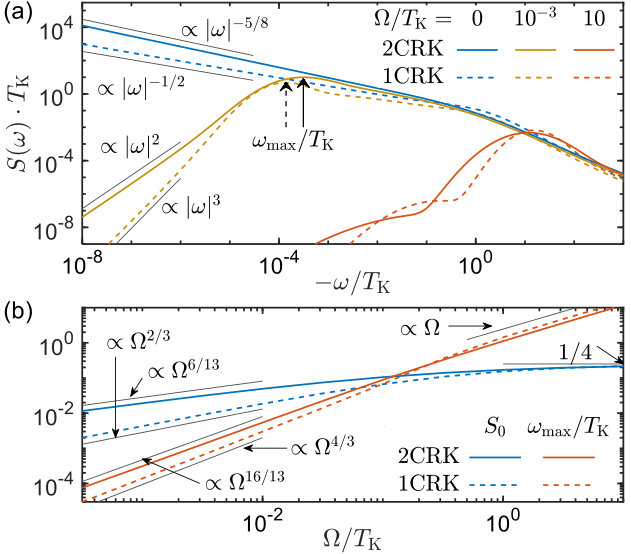 Figure 1
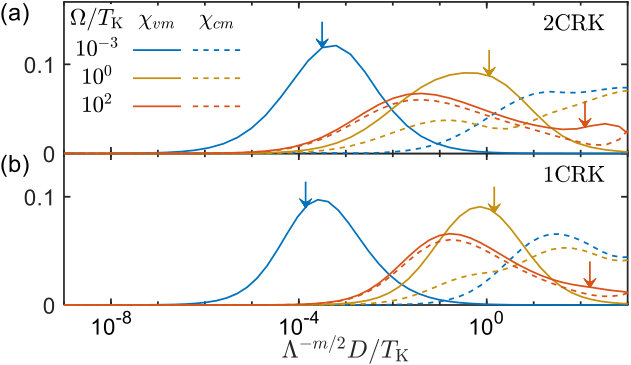 Figure 2
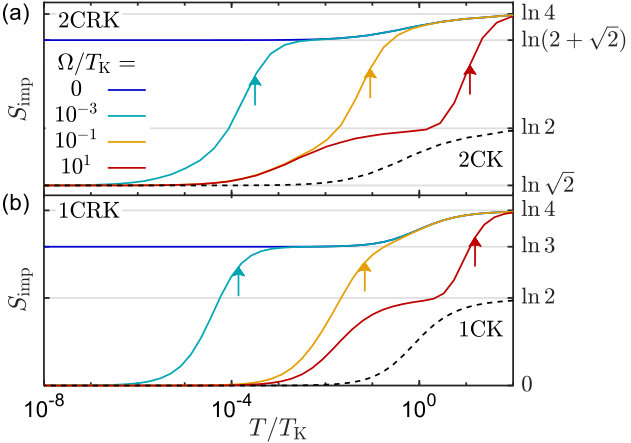 Figure 3
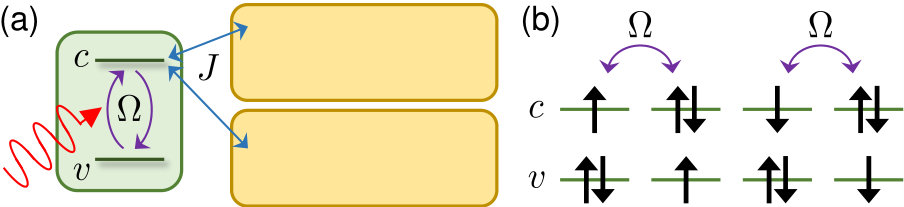 Figure 4
Peer Reviews
No public reviews on file for this paper yet. If you reviewed it on a platform where reviews are public (OpenReview, ICLR, NeurIPS, ICML), you can paste yours below so the community can read it here.
Videos
No videos yet. Explain this paper in a talk, walkthrough, or lecture? Add one.
Non-Fermi-liquid Kondo screening under Rabi driving
Seung-Sup B. Lee
Jan von Delft
Faculty of Physics, Arnold Sommerfeld Center for Theoretical Physics, Center for NanoScience, and Munich Center for Quantum Science and Technology, Ludwig-Maximilians-Universität München, Theresienstraße 37, 80333 München, Germany
Moshe Goldstein
Raymond and Beverly Sackler School of Physics and Astronomy, Tel Aviv University, Tel Aviv 6997801, Israel
Abstract
We investigate a Rabi-Kondo model describing an optically driven two-channel quantum dot device featuring a non-Fermi-liquid Kondo effect. Optically induced Rabi oscillation between the valence and conduction levels of the dot gives rise to a two-stage Kondo effect: Primary screening of the local spin is followed by secondary nonequilibrium screening of the local orbital degree of freedom. Using bosonization arguments and the numerical renormalization group, we compute the dot emission spectrum and residual entropy. Remarkably, both exhibit two-stage Kondo screening with non-Fermi-liquid properties at both stages.
I Introduction
The Kondo effect, involving a local spin entangled with a bath of delocalized electrons, has been studied extensively in bulk systems and in transport through quantum dots. Some years ago, a landmark experiment Latta et al. (2011) showed that it can also be probed optically: A weakly driven optical transition between the valence and conduction levels of the dot was used to abruptly switch the Kondo effect on or off, leaving telltale power-law signatures Türeci et al. (2011) in the dot emission spectrum. The case of strong spin-selective optical driving was subsequently studied theoretically within the context of a single-channel Rabi-Kondo (1CRK) model Sbierski et al. (2013), involving Rabi oscillations between the dot valence and conduction levels. This was predicted to lead to a novel nonequilibrium quantum-correlated state featuring two-stage Kondo screening: The local spin is screened by a primary screening cloud via the single-channel Kondo (1CK) effect, then the Rabi-driven levels by a larger, secondary screening cloud. Despite its nonequilibrium nature, this state has a simple Fermi-liquid (FL) description in terms of scattering phase shifts, since only a single screening channel is involved.
This raises an intriguing question: What type of nonequilibrium state will arise when the Rabi-driven dot couples to two spinful channels, described by a two-channel Rabi-Kondo (2CRK) model? Without Rabi driving, it reduces to the standard two-channel Kondo (2CK) model, known to have a non-Fermi liquid (NFL) ground state Nozières and Blandin (1980), describable by Bethe Ansatz Tsvelick and Wiegmann (1985); Tsvelick (1985); Andrei and Destri (1984), conformal field theory (CFT) Affleck and Ludwig (1991a, b, 1993) or bosonization Emery and Kivelson (1992, 1993); von Delft et al. (1998); Zaránd and von Delft (2000). However, NFL physics is known to be very sensitive to perturbations such as channel asymmetry or a magnetic field. Do the NFL properties survive under Rabi driving? If so, what are their fingerprints? In this paper, we answer these questions. We use a combination of bosonization arguments and numerical renormalization group (NRG) Wilson (1975); Bulla et al. (2008); Weichselbaum (2012a) calculations to compute the 2CRK emission spectrum and impurity entropy. We find that NFL behavior survives, and, remarkably, leaves clear fingerprints in the emission in both the primary and secondary screening regimes.
The rest of this paper is organized as follows. In Sec. II, we introduce our system, the 2CRK model. In Sec. III, we provide a qualitative description of the screening processes in the 2CRK model. In Secs. IV and V, we study the impurity contribution to the entropy and the Kondo cloud, respectively. In Sec. VI, the main points of our bosonization approach are outlined. In Sec. VII, we analyze the emission spectrum. We conclude in Sec. VIII. App. A offers the details of our bosonization approach.
II Two-channel Rabi-Kondo model
In this section, we first introduce the system in the lab frame, and then derive the effective Hamiltonian in the rotating frame to be treated by NRG and bosonization.
We consider a small quantum dot () with a conduction () and a valence () level as the impurity, and two large dots as the bath [Fig. 1(a)]. The small dot is modelled by the Hamiltonian
[TABLE]
where denotes the particle number operator for the level (), and annihilates spin- electron at the level of energy . , , and are the Coulomb interaction strengths. The level separation is of the order of the semiconductor band gap . We consider the parameter regime in which the ground states of the small dot have in the absence of the Rabi driving to be introduced next.
We introduce a laser applied to the small dot, which induces Rabi oscillation between the and levels. A circularly polarized laser would have coupled to one spin species due to an optical selection rule Sbierski et al. (2013); Imamoḡlu et al. (1999). In the following we will consider the case of linearly polarized light, which symmetrically couples to both spin states. The laser frequency is chosen to be close to the bare dot transition between states and states, i.e., . (We set .) Hence the states are accessed via the Rabi oscillation from the states [see Fig. 1(b)]. The other states of can be accessed only via virtual processes due to the energy cost of the Coulomb interaction.
Since the optical transition is close to the material’s bandgap, that is, of order 1 eV, and much larger than all the other energy scales (which are typically not more than a few tens of meV), one could make the rotating wave approximation, under which a transfer of electron from the to the level involves the absorption of a photon and vice versa. We will further assume that the laser can be described as a classical field, and hence that spontaneous emission could be neglected. Then the light-induced Hamiltonian term in the lab frame is given by
[TABLE]
where is the Rabi frequency.
In addition, the level of the small dot is symmetrically tunnel-coupled to two identical large dots (channels ). These are assumed large enough to have essentially continuous excitation spectra, yet small enough that their charging energies suppress inter-channel charge transfer. That is, and do not fluctuate, where means the particle number at the large dot . Under these conditions, the whole system Hamiltonian in the lab frame can be approximated, via the Schrieffer-Wolff transformation Oreg and Goldhaber-Gordon (2003) and up to an overall constant, by
[TABLE]
where the Hilbert space for the small dot is restricted to the four-dimensional subspace of shown in Fig. 1(b). Here and are -level and -channel spin operators, respectively. describes the large dots with half-bandwidth , and annihilates channel- electron of energy and spin . The coupling strength is proportional to .
We will now go to the the rotating frame with respect to the laser-mode Hamiltonian, via the transformation . The rotating-frame Hamiltonian will become time-independent,
[TABLE]
where is the detuning of laser frequency from the bare dot transition. This is the 2CRK Hamiltonian to be studied in the rest of this paper. For reference, we also include some results for the analogous 1CRK model ( only), and the standard 2CK and 1CK models (without level).
Since the coupling to the fermionic bath is assumed to be the main relaxation mechanism and dominates over spontaneous emission, the system would relax to an electronic equilibrium state in the rotating frame, which corresponds to a time-dependent state in the lab frame. Thus we can analyze the system in the rotating frame employing equilibrium concepts such as entropy.
Note that our setup, which is driven optically, is different from previous setups driven by ac magnetic field Zvyagin and Makarova (2005); Zvyagin et al. (2009), in two key aspects. First, the laser can be focused within the length scale of optical wavelength, so one can selectively drive the small dot only. This selectivity has been demonstrated in experiments Latta et al. (2011). Second, the rotating wave approximation works very well for our system, since the energy scale of the laser frequency is larger than the other energy scales in the system by at least two orders of magnitudes. The selectivity and the rotating wave approximation are, however, unlikely for the systems driven by ac magnetic field that are in the microwave or rf regime.
III Qualitative considerations
Without Rabi driving, , the “trion” and “Kondo” sectors, with and level occupancies and , respectively, are decoupled, and the level is inert. The trion sector is a trivial FL, with the doubly occupied level forming a local spin singlet. The Kondo sector constitutes a standard Kondo model, involving the spin of the singly-occupied level. Below a characteristic Kondo temperature , it will be screened by bath electrons. For the 2CRK model, it is overscreened, leading to NFL behavior characteristic of the 2CK model. For the 1CRK model, it is fully screened, showing standard 1CK FL behavior.
For weak driving, , Rabi oscillations between the and levels couple the Kondo and trion sectors. Then primary screening of the -level spin, occurring at energies , will be followed by secondary screening of - transitions at the renormalized Rabi coupling (as in Ref. Sbierski et al. (2013)), provided that the ground state energies of the two (decoupled) sectors differ by less than . (A precise definition of will be given later.) We thus fine-tune such that for the Kondo and trion ground states are degenerate, following a strategy discussed in the Supplemental Fig. S2 of LABEL:Sbierski2013.
Finally, for strong driving, , the Rabi coupling generates a strong splitting of bonding and anti-bonding states built from the and levels. The local spin of the bonding state will then undergo single-stage screening, as for the standard 2CK or 1CK models.
These qualitative arguments will be substantiated quantitatively below by NRG calculations and bosonization arguments. For the former, we use throughout, leading to and when . The bath discretization grid is set by and , and no -averaging is used. We use the QSpace tensor library Weichselbaum (2012b) to exploit the SU(2) symmetries of spin and channel where applicable.
IV Entropy
Figure 2(a,b) shows our NRG results for the impurity contribution to the entropy Bulla et al. (2008), , which quantifies the effective degrees of freedom of the dot at different temperatures. At high temperatures, , the entropy simply counts all four configurations of the dot [Fig. 2(b)] for both the 2CRK and 1CRK models. At lower temperatures, the behavior of the entropy depends on the relation of and .
For strong driving , only two bonding states with different spins are accessible for . Hence shows a plateau at , followed by a single crossover to value of or for the 2CRK or 1CRK models, respectively. These values are the same as in the standard 2CK or 1CK models Tsvelick (1985); Andrei and Destri (1984); Affleck and Ludwig (1991a) (shown as dashed lines), respectively. They reflect overscreening of a local spin by two spinful channels (resulting in a decoupled local Majorana mode Emery and Kivelson (1992, 1993); von Delft et al. (1998); Zaránd and von Delft (2000)), or its complete screening by a single spinful channel Nozières (1974) (resulting in a spin singlet), respectively.
In contrast, for weak driving , two-stage screening occurs. For intermediate temperatures shows a primary-screening plateau at or for the 2CRK or 1CRK models: the NFL- or FL-screened local spin contributes or 1 to the local degeneracy count, with another 2 from the two trion () states. At the lowest temperatures, , the - transitions lead to a secondary-screening limiting value of or [math] for the 2CRK and 1CRK models, respectively, as for the standard 2CK and 1CK models. Finally, for (i.e., ), the primary-screening plateau in persists down to .
V Kondo clouds
To further study the nature of the screening clouds involved in primary and secondary screening, we have computed spin-spin correlation functions between the impurity and bath spin operators, see Fig. 3. As described in the caption thereof, for weak driving we find a nested, two-stage cloud, screening the -level spin at energies , and - transitions at energies . In contrast, for strong driving we find just a single screening cloud.
VI Bosonization
We proceed to a more detailed analysis the weak driving case, , using bosonization (since the methods of LABEL:Sbierski2013 do not easily generalize to the 2CRK model). Here we outline the main points, relegating further details to App. A. With uniaxial anisotropy, the bosonized form Emery and Kivelson (1992, 1993); von Delft et al. (1998); Zaránd and von Delft (2000) of 2CRK Hamiltonian is:
[TABLE]
where , while , , and are Pauli matrices in the orbital - (Kondo-trion) pseudo-spin space, and is a projector onto the Kondo sector. In addition, and are the Fermi velocity and lattice spacing (inverse momentum cutoff), and is the chiral (unfolded) bosonic spin field (the charge sector decouples). It obeys the commutation relation , where is the density of the -component of the channel- electron spin density at the dot site.
VI.1 1CRK
Let us start from the single-channel case, where [ does not exist]. The unitary transformation with eliminates the term at the cost of modifying the term by a shift to the coefficient of in the exponent.
At energies we may ignore the Rabi term, and follow the usual perturbative renormalization group (RG) flow of the 1CK problem. flows since it has a nontrivial scaling dimension, set by the corresponding bosonic exponent (after the above-mentioned transformation). In addition, second-order spin-flip () processes revive the non-spin-flip term, which may then be transformed away as above. thus flows to a fixed point value, , corresponding to the Kondo fixed-point phase shift, while grows until it becomes of the order of the reduced cutoff, which could serve to define the primary -spin Kondo scale . The -type transformations applied throughout the RG flow modify the Rabi term. Thus, below we obtain the following intermediate-scale effective Hamiltonian:
[TABLE]
where is a projector into the subspace , and . The latter large coupling fixes the dot spin to , which corresponds, in the original basis, to an entangled state of the impurity and bath spins, i.e., the primary Kondo singlet. Thus are replaced by their expectation values . The resulting model describes the hybridization between the pseudo-spin (- or Kondo-trion) degree of freedom and the channel, which is equivalent (up to a transformation similar to but involving instead of ) to an anisotropic Kondo model for the pseudo-spin space. The Rabi coupling is relevant, with scaling dimension , determined by the corresponding bosonic exponent in Eq. (6), or, within CFT, from its role as boundary condition changing operator, turning on and off 1CK screening Affleck and Ludwig (1994). Hence, flows to strong coupling, creating a new scale, the renormalized Rabi frequency (secondary Kondo temperature), , where one expects a peak in the dot emission spectrum to occur, instead of the more usual peak at for strong driving . Below this scale, the pseudo-spin is screened by the creation of a secondary “Kondo singlet”.
VI.2 2CRK
Let us now perform a similar analysis of the 2CRK model. Defining the fields , only the former couples to , and could be eliminated by a transformation similar to defined with instead of . For one may proceed with the primary 2CK RG flow, which drives to , corresponding to a phase shift, and to . At the same time, the Rabi coupling gets modified. On the scale of we thus arrive at:
[TABLE]
The first line describes the 2CK fixed point, at which the remains coupled: assumes a definite value , and correspondingly is locked to a minimum or maximum of the cosine function. Refermionizing the local spin- system, the term couples a local Majorana fermion () to the lead, leaving another local Majorana () unscreened Emery and Kivelson (1992, 1993).
We now turn to the second line. Since , we may again set . The remaining term is a product of with bosonic exponents. The exponents contribute to the scaling dimension of , while turns on or off the term, which is equivalent to turning on or off a local backscattering impurity in a Luttinger liquid, with scaling dimension 1/16 Gogolin (1993); Prokof’ev (1994). Thus, the overall scaling dimension of is . This matches the corresponding CFT analysis of its role as a boundary-condition changing operator Affleck and Ludwig (1994). Thus, is relevant, flowing to strong coupling and generating a new scale , below which secondary screening of the - (Kondo-trion) fluctuations is achieved. Importantly, since the Rabi term is spin symmetric, it does not interfere with the primary NFL 2CK screening, and leaves the decoupled Majorana () unscreened: While the Rabi term contains , the corresponding processes are suppressed by the dominant term, and all higher order (in ) processes which leave the system within the low-energy manifold of term do not couple to .
VII Emission spectrum
Having established the general picture of the two-stage NFL screening, we can now analyze its effect on the main experimental observable, the dot emission spectrum. The emission spectrum of linear polarization at detuning from the driving laser frequency is proportional to the spectral function Sbierski et al. (2013),
[TABLE]
where and are energy eigenstates and eigenvalues of the Rabi-Kondo Hamiltonian, and . This is the spectral function of the Rabi term with itself. At temperature , the emission spectrum has weight only for . Without Rabi driving, shows a power-law divergence. For weak driving, the divergence is cut off, giving way to a power-law decrease. Accordingly a wide peak at and a delta-function peak of weight at emerge. We identify with the renormalized Rabi frequency .
Figure 4(a) shows a log-log plot of the emission spectrum, revealing its various power laws. For weak driving, there are two distinct regimes: (i) The intermediate-detuning regime, , is dominated by the Kondo exchange coupling and reflects primary screening. Here the correlations of the Rabi term with itself are governed by its scaling dimension , giving with and for the 1CRK or 2CRK models, respectively. Thus, this part of the spectrum reveals the scaling of 1CK vs. 2CK boundary condition changing operators Affleck and Ludwig (1994). (ii) The small-detuning regime, , is dominated by the Rabi coupling and reflects secondary - screening. In this regime, corresponds to the correlation function of the exchange interaction with itself in the standard Kondo models, which yields and for the 1CRK and 2CRK models, respectively. The power is reduced in the 2CRK case, as the unscreened Majorana appearing in the Rabi term in Eq. (7) (through ) reduces the corresponding scaling dimension by . Thus, the -behavior is a clear fingerprint of the NFL nature of the nonequilibrium secondary screening nature in the 2CRK system.
Figure 4(b) shows that and increase as power laws in . For weak driving, our previous analysis shows that, in accordance with the numerical data, or , and moreover (as we will momentarily explain), or for the 2CRK or 1CRK models, respectively. Indeed, takes up the spectral weight missing at small detuning due to cutting off the intermediate detuning behavior. Hence, . Alternatively, by Eq. (8) is the square of the expectation value of (before transformations) in the ground state. But is the Rabi term divided by , and the Rabi term should scale as , leading to , as before. Thus, the Kondo boundary condition changing operators governs both and . For strong driving, corresponds to the transition energy between the bonding and anti-bonding states of and levels.
VIII Conclusions
We have identified a two-stage NFL screening process in a Rabi driven quantum dot. The NFL nature survives in nonequilibrium as the Rabi driving respects both spin and channel symmetries. We have developed a new bosonization approach that explains the power-law exponents obtained numerically. The distinct power laws in the emission spectra should motivate optical spectroscopy studies on the multi-channel quantum dot devices. The case of non-negligible spontaneous emission, which goes beyond the description of the time-independent Hamiltonian in the rotating frame, would be an interesting question for future study. We envision our findings to also be relevant for higher-dimensional driven strongly-correlated materials.
Acknowledgements.
We thank E. Sela for useful discussions. This joint work was supported by German Israeli Foundation (Grant No. I-1259-303.10). S.-S.B.L. and J.v.D. are supported by the Deutsche Forschungsgemeinschaft (DFG, German Research Foundation) under Germany’s Excellence Strategy – EXC-2111 – 390814868; S.-S.B.L. further by Grant No. LE 3883/2-1. M.G. acknowledges support by the Israel Science Foundation (Grant No. 227/15), the US-Israel Binational Science Foundation (Grant No. 2016224), and the Israel Ministry of Science and Technology (Contract No. 3-12419).
Appendix A Bosonization details
In this Appendix, we develop in details the theory of the multichannel Kondo effect, by first reviewing the bosonization description of the ordinary single- and two-channel Kondo (1CK, 2CK), then going on to their Rabi-Kondo versions, without and with spin rotation symmetry (the latter being the case considered in the main text).
We note that the Yuval-Anderson (YA) Coulomb gas approach Anderson and Yuval (1969); Yuval and Anderson (1970); Anderson et al. (1970); Vigman and Finkel’Shteǐn (1978); Fabrizio et al. (1995); Goldstein et al. (2009) is known to give equivalent results to the bosonization approach for all universal (i.e., cutoff-independent) quantities, such as critical dimensions. Meanwhile, the Coulomb gas approach provides more accurate microscopic expressions for the phase shifts that are cutoff-dependent. We have verified that the same is true for the systems discussed in this work. However, in this paper we employ the bosonization approach, since it is more succinct than the Coulomb gas approach.
A.1 Ordinary Kondo
First, we review the ordinary (equilibrium) 1CK and 2CK effects from the bosonization perspective.
A.1.1 Single-channel ordinary Kondo
Let us start from the ordinary single-channel Kondo effect. Using a bosonic description of the channel, the charge sector decouples, while the spin sector can be written in terms of a single right-moving chiral boson over the entire 1D line (instead of a single non-chiral boson on the 1D half-line), leading to the following Hamiltonian Emery and Kivelson (1992); Gogolin et al. (2004):
[TABLE]
where , are the impurity spin-1/2 operators, and are the Fermi velocity and lattice spacing (inverse momentum cutoff), the bosonic field obeys the commutation relation , and is the conduction electron spin density at the dot site. Applying the transformation where with , the term is eliminated, at the cost of modifying the exponent in the term:
[TABLE]
We now proceed with perturbative RG, using Cardy’s operator product expansion (OPE) version Cardy (1996). flows because it has a nontrivial scaling dimension (due to the corresponding nontrivial bosonic exponent), whereas the OPE of the two terms reintroduces the term. This can be transformed again into the bosonic exponent. Defining the dimensionless exchange couplings , and denoting the energy cutoff by , we thus obtain Anderson’s well-known RG equations:
[TABLE]
Thus, flows to the strong-coupling fixed point value ( phase shift). At that point the impurity spin becomes decoupled from the bath — the exchange term becomes simply (where at strong coupling , the Kondo temperature), and seemingly polarized the impurity spin in the direction. Recalling that the operator has undergone a succession of transformations dressing it with the bosonic field, we recognize that, in terms of the original fields, this actually signifies (an anisotropic version of) the Kondo singlet. Indeed, the fact that the spin flip terms in the original Hamiltonian, , have been renormalized to means that the renormalized versions of the original operators are . The correlation function of these two operators decays in time as (due to the bosonic factor), in accordance with Fermi liquid theory (in which one posits that at the fixed point the impurity spin “merges” with the Fermi sea, so its correlator behaves like the correlation function of the lead fermion density). Another way to get this result is to notice that, generically (that is, in a higher order RG than what we considered), could get dressed by the lead spin density at the impurity site, , hence its correlation would decay as . Using similar arguments, the connected correlation function of the exchange terms in the original Hamiltonian turns into a connected correlator of two lead spin operators with two lead spin operators, decaying as , translating into an behavior of the corresponding spectral function at low frequencies. Finally, since the impurity Hamiltonian reduces to at the fixed point, if a magnetic field in the direction is introduced, the impurity susceptibility becomes . This will also give a finite expectation value to the lead spin correlators, making the leading contribution (at long time) to the exchange-exchange correlation function decay as , or in the frequency domain. Finally, the impurity entropy is at , and goes to zero at , due to the Kondo screening.
A.1.2 Two-channel ordinary Kondo
Now the starting Hamiltonian is:
[TABLE]
where labels the two conduction electron channels, gives their respective spin densities at the dot site, and we assume channel symmetry. Here it is useful to define the symmetric and antisymmetric combinations, , which keep the commutation relations the same. We now apply the transformation with to eliminate the term and get
[TABLE]
The RG equations are similar to the 1CK case, but with . Hence, flows to a value of 1/2 ( phase shift), at which point the impurity remains coupled only to . continues to flow to strong coupling, where it becomes (this strong coupling bosonic description corresponds to the intermediate coupling non-Fermi-liquid fixed point in the traditional description in terms of the original fermions). If one refermionizes the local spin and the bosonic subsystem , the term becomes a coupling of a local Majorana operator () to a Majorana field density in the lead at the adjacent site, namely , while becomes a local decoupled Majorana. This is the famous Emery-Kivelson point. Therefore, the low-temperature impurity entropy is . Since , its correlator with itself is a convolution of the correlators of a localized Majorana fermion () and a propagating one (), and decays in time as , as that of one free fermion times one localized fermion, leading to a logarithmic divergence of the susceptibility with the largest cutoff energy (magnetic field, temperature, or frequency). For a similar reason, the original non-spin-flip exchange term, , has correlations decaying as , implying a low-frequency power-law behavior of , in the absence of a magnetic field (a magnetic field suppresses the non-Fermi-liquid 2CK physics, and restores the Fermi-liquid 1CK behavior). If we look at correlators of (with its conjugate), we can use the fact that the series of transformations map it to , leading to a behavior, similar to .
One can recover the behavior of the susceptibility using purely bosonic language Gogolin and Prokof’ev (1994); Fabrizio and Gogolin (1994, 1995); Goldstein and Berkovits (2010). At the strong fixed point, picks a value , and then is pinned to either a minimum or a maximum of the cosine function, respectively. With that one can calculate the susceptibility, that is, the retarded correlator of with itself. Indeed, anticommutes with , hence with the spin-flip exchange term. Since the spin-flip exchange term modifies by unity the spin of one of the leads, the operator , where is the difference between the refermionized populations of the two leads (corresponding to of the original electrons, since the bosonic fields are all related to the original electronic spin degrees of freedom), also anticommutes with the spin-flip exchange term. Hence, the correlator of could be replaced by a correlator of . Conservation of the overall refermionized population, allows one to write replace . Remembering that at the fixed point the two leads are effectively well-coupled, behaves as the population of one half of an infinite lead. With this, the correlation function of with itself decays in time as , again leading to a logarithmic divergence of the susceptibility with the largest cutoff energy (magnetic field, temperature, or frequency).
A.2 Spin-asymmetric Rabi-Kondo
We now add to the Kondo effect a laser, which tries to Rabi-flip the electron constituting the impurity spin into a level decoupled from the leads. We will introduce a corresponding two-level degree of freedom, with Pauli matrices , whose two states correspond to the electron in the coupled conduction () level (Kondo) and in the valence () level (trion), respectively. The Rabi flopping () is induced by a laser with amplitude . If the laser has a proper circular polarization, it only couples to a spin-up electron, .
A.2.1 Single-channel spin-asymmetric Rabi-Kondo
Let us start from the single-channel spin-asymmetric Rabi-Kondo (1CARK) case, analyzed in our previous work Sbierski et al. (2013). Based on all the above considerations, the Hamiltonian is:
[TABLE]
Here acts as a local projector onto the level (i.e., the Kondo sector), and as a local projector onto the spin-up subspace. We will concentrate on the case where the Kondo temperature is much larger than the Rabi frequency, . Then, at energy scales larger than , we can ignore the Rabi term. The transformations and RG flow are as above, with the only difference that every transformation should be replaced by . The series of transformations on the way to the Kondo fixed point at then modifies the Rabi term, giving
[TABLE]
where , as mentioned above. Thus, the corresponding Kondo term is much larger than the Rabi term, and effectively eliminates the part of (the eliminated part breaks the symmetry under on the scale introduced below, as a local magnetic field would do, but this has a negligible effect in the current 1CK physics, since ). With this the Rabi term looks exactly like the spin-flip exchange term in the pure Kondo problem, Eq. (10), demonstrating that the Rabi term leads to a secondary Kondo screening process. The scaling dimension, say , of the 1CRK term is dictated by the bosonic exponent, giving , reflecting the Anderson orthogonality catastrophe with a phase shift change of in each spin channel caused by a Rabi flop. It can also be thought of as a boundary condition changing operator (from Kondo to non-Kondo), and CFT analysis Affleck and Ludwig (1994) gives the same result for its scaling dimension. As a result, for frequencies in the range (where the new low-energy scale will be defined shortly), the emission spectrum (imaginary part of the retarded correlator of the Rabi term with itself) scales as . Moreover, the RG equation for is Cardy (1996)
[TABLE]
with solution , where we have taken into account that the RG flow of starts at the scale of . Therefore flows to strong coupling. The scale at which becomes of order unity defines the renormalized Rabi frequency (secondary Kondo temperature), . Thus, the impurity entropy starts with the value at (the four possible values of and , except the excluded possibility of and ), then decreases to for (due to the Kondo screening of the sector), and then goes to zero for , due to the secondary Kondo screening.
Below , secondary Kondo screening (of the degree of freedom) sets in. The emission spectrum, which corresponds to a correlator of the Rabi term with itself, becomes the spectral function of the correlator of the secondary Kondo exchange term with itself. Our previous analysis for the single-channel case shows that this leads to an behavior, or, in the presence of detuning (which adds to the Hamiltonian a term proportional to , that is, a magnetic field in the secondary Kondo language), to an scaling. Also, at zero frequency a delta function appears in the emission spectrum. Its amplitude can be calculated in two ways. One is to note that the spectral weight missing by the emergence of and the corresponding change of the spectral function from to a positive power should go into the delta function, giving it a weight scaling as . The other argument is that the coefficient of the delta function is , the square of the matrix element of (before the transformations) between the ground state and itself, and this matrix element is the ground-state expectation value of the Rabi term divided by . The expectation value of the Rabi term scales as , giving again an scaling of the weight of the delta function.
A.2.2 Two-channel spin-asymmetric Rabi-Kondo
We will now consider the analogous two-channel spin-asymmetric Rabi-Kondo (2CARK) setup. Now the starting Hamiltonian is:
[TABLE]
At energies larger than , we can use similar steps to the above, and arrive at:
[TABLE]
For the 2CRK model, the scaling dimension, say , of the Rabi term, seen as a boundary condition changing operator, is given by Affleck and Ludwig (1994). One could arrive at this value using also our abelian bosonization language: The exponent contributes 1/8 to the scaling dimension of the Rabi term. Beyond that, the operators turn on or off the transformed Kondo exchange term involving . Now, turning on and off such a cosine appears in the problem of the Fermi edge singularity, that is, turning on and off backscattering by impurity, in a Luttinger liquid. This problem was analyzed in Refs. Gogolin (1993); Prokof’ev (1994). They showed that, at long times, the cosine can be replaced by a quadratic term (since it is relevant), which allows one to find its contribution to the long time behavior of the correlation function of . This contribution scales as , corresponding to a scaling dimension of 1/16. Adding this to the contributed by the exponential of , we recover the CFT result . Thus, for the emission spectrum behaves as . The RG equation for is the same as above, with taking the place of , reflecting the different scaling dimension of the Rabi term. Then we get a low-enegry scale , and the weight of the delta peak at zero frequency scales as . The impurity entropy will be for , (2CK partial screening + exciton state) for , and zero for .
As for the behavior of the emission spectrum at , one could argue that the Rabi term, with its explicit dependence, breaks the symmetry for flipping and has similar effects to a local magnetic field on the physical spin. Thus, below the 2CK physics should be suppressed, and one should recover the 1CK behavior of or in the absence or presence of detuning, respectively.
A.3 Spin-symmetric Rabi-Kondo
Finally we arrive at the spin-symmetric version of the Rabi-Kondo problem, where the applied laser features the two circular polarizations with the same amplitude (i.e., a linear polarization), and thus couples equally to both spin states.
A.3.1 Single-channel spin-symmetric Rabi-Kondo
We start from the single-channel spin-symmetric Rabi-Kondo (1CSRK) problem. Now the Hamiltonian is:
[TABLE]
Here on the scale of we obtain:
[TABLE]
which is invariant under flipping of , together with the lead (integrated) spin density . However, this symmetry is not essential in the 1CK case, and the analysis goes basically the same as in the spin-asymmetric case (at least as long as one considers the spin-symmetric emission spectrum).
Let us note that one could formally map the secondary screening problem to an anisotropic spin-1 Kondo problem. Indeed, since is large, we can discard the state in the basis of Eq. (21), and be left with three states: the Kondo state ( and ) and the two spin states of the exciton ( and arbitrary spin). Introducing corresponding spin-1 operators, the Hamiltonian would look like the single-channel spin-1 Kondo problem, after the non-spin-flip term has been eliminated by a transformation like those above, that modifies the exponents of the spin-flip term. However, this implies that the secondary is of order 1, i.e., the spin-1 problem is strongly spin-anisotropic. Now, any spin exchange anisotropy would cause the creation of impurity-spin terms proportional to the square of the component of the effective spin 1, which amounts to detuning the exciton and primary-Kondo states. For weak anisotropy, it is sufficient to add a corresponding compensating term to restore the degeneracy and hence the spin-1 Kondo physics. However, in our case, where the bare secondary exchange anistropy is very large, the physics never reaches the underscreened spin-1 Kondo regime. Thus, the impurity entropy goes from to and then to zero as is lowered through and .
A.3.2 Two-channel spin-symmetric Rabi-Kondo
The last case is the two-channel symmetric Rabi-Kondo (2CSRK) model, with Hamiltonian
[TABLE]
which becomes on the scale of :
[TABLE]
Again the analysis parallels the spin-asymmetric case, except that now flipping together with remains a symmetry, so the 2CK physics is not destroyed at low energies, and a decoupled Majorana zero mode remains. Indeed, while the Rabi term contains , the corresponding processes are suppressed by the dominant term, and all higher order processes (in terms of ) which leave the system within the low-energy manifold of term do not couple to . It should show up in the correlation function of the Rabi term with itself, which depends on , and reduce one power of from the power-law dependence of the emission spectrum on for , that is, make it go as instead of (in the absence of detuning). Correspondingly, the impurity entropy goes from to to as is decreased through and .
The reference list from the paper itself. Each links out to its DOI / PubMed record.
- 1Latta et al. (2011) C. Latta, F. Haupt, M. Hanl, A. Weichselbaum, M. Claassen, W. Wuester, P. Fallahi, S. Faelt, L. Glazman, J. von Delft, H. E. Türeci, and A. Imamoglu, Nature 474 , 627 (2011) . · doi ↗
- 2Türeci et al. (2011) H. E. Türeci, M. Hanl, M. Claassen, A. Weichselbaum, T. Hecht, B. Braunecker, A. Govorov, L. Glazman, A. Imamoglu, and J. von Delft, Phys. Rev. Lett. 106 , 107402 (2011) . · doi ↗
- 3Sbierski et al. (2013) B. Sbierski, M. Hanl, A. Weichselbaum, H. E. Türeci, M. Goldstein, L. I. Glazman, J. von Delft, and A. İmamoğlu, Phys. Rev. Lett. 111 , 157402 (2013) . · doi ↗
- 4Nozières and Blandin (1980) P. Nozières and P. Blandin, J. Phys. 41 , 193 (1980).
- 5Tsvelick and Wiegmann (1985) A. M. Tsvelick and P. B. Wiegmann, J. Stat. Phys. 38 , 125 (1985).
- 6Tsvelick (1985) A. M. Tsvelick, J. Phys. C: Solid St. Phys. 18 , 159 (1985) . · doi ↗
- 7Andrei and Destri (1984) N. Andrei and C. Destri, Phys. Rev. Lett. 52 , 364 (1984) . · doi ↗
- 8Affleck and Ludwig (1991 a) I. Affleck and A. W. W. Ludwig, Phys. Rev. Lett. 67 , 161 (1991 a) . · doi ↗