Nonlinear Dynamics of Preheating after Multifield Inflation with Nonminimal Couplings
Rachel Nguyen, Jorinde van de Vis, Evangelos I. Sfakianakis, John T., Giblin, Jr., and David I. Kaiser

TL;DR
This paper investigates the nonlinear dynamics of preheating in multifield inflation models with nonminimal couplings, revealing efficient particle production and strong attractor behavior that preserve predictions consistent with observations.
Contribution
It provides the first lattice simulation analysis of nonlinear effects in multifield inflation with nonminimal couplings, highlighting the persistence of single-field attractor behavior.
Findings
Efficient particle production leads to nearly instantaneous preheating.
Strong single-field attractor behavior persists, suppressing multifield signatures.
Predictions for primordial observables remain consistent with current measurements.
Abstract
We study the post-inflation dynamics of multifield models involving nonminimal couplings using lattice simulations to capture significant nonlinear effects like backreaction and rescattering. We measure the effective equation of state and typical time-scales for the onset of thermalization, which could affect the usual mapping between predictions for primordial perturbation spectra and measurements of anisotropies in the cosmic microwave background radiation. For large values of the nonminimal coupling constants, we find efficient particle production that gives rise to nearly instantaneous preheating. Moreover, the strong single-field attractor behavior that was previously identified persists until the end of preheating, thereby suppressing typical signatures of multifield models. We therefore find that predictions for primordial observables in this class of models retain a close match…
Click any figure to enlarge with its caption.
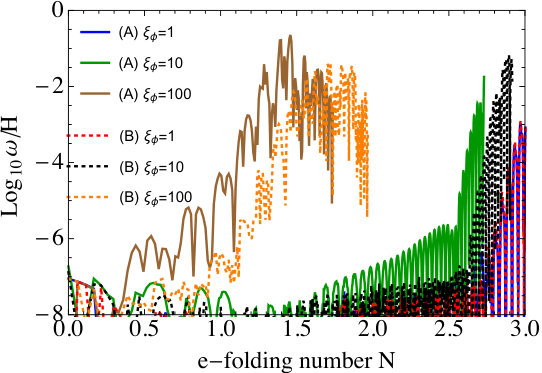 Figure 1
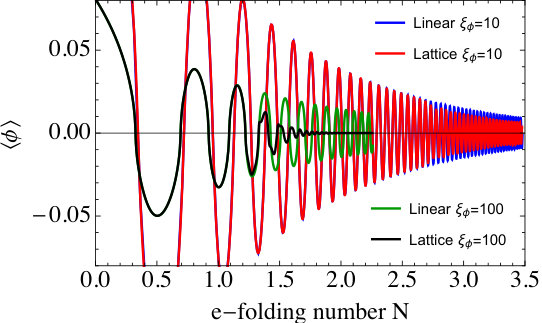 Figure 2
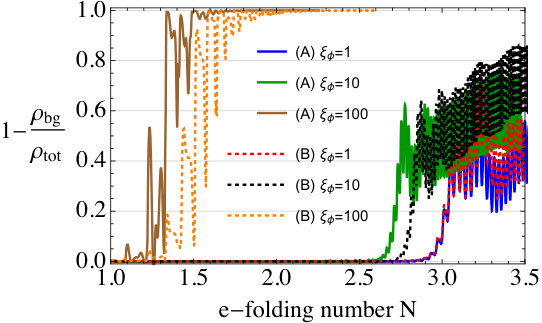 Figure 3
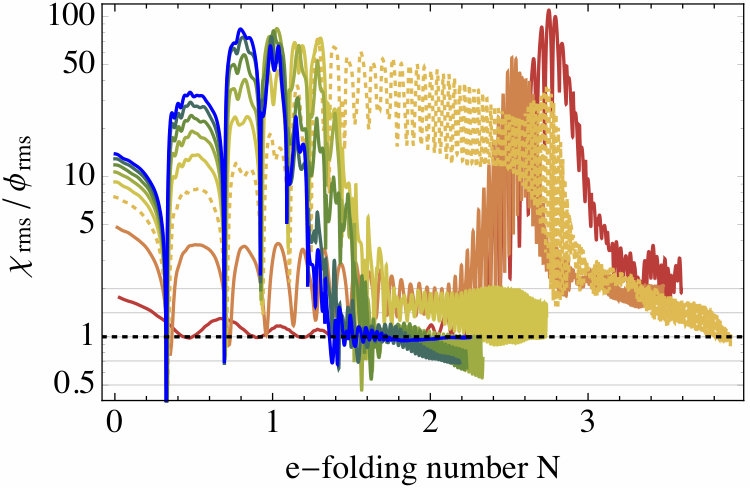 Figure 4
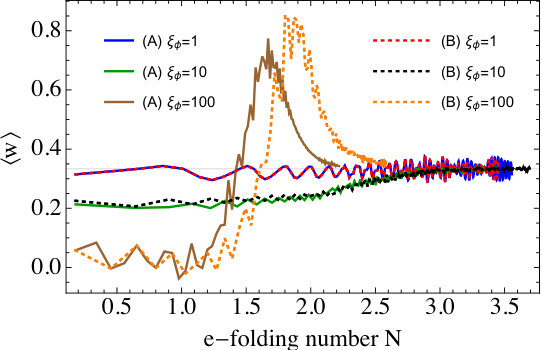 Figure 5
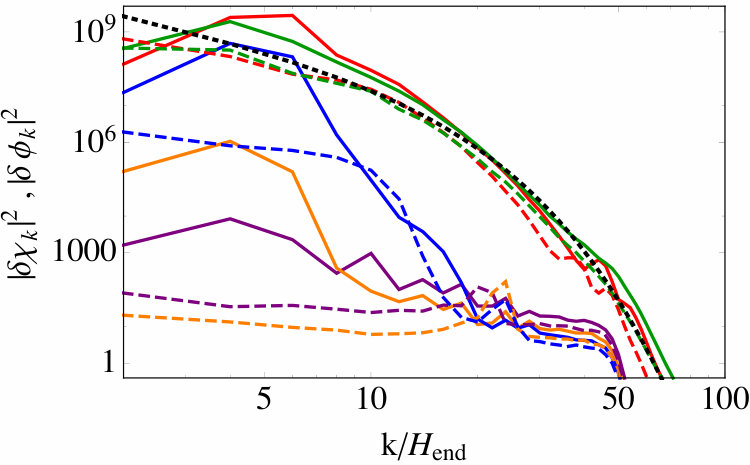 Figure 6
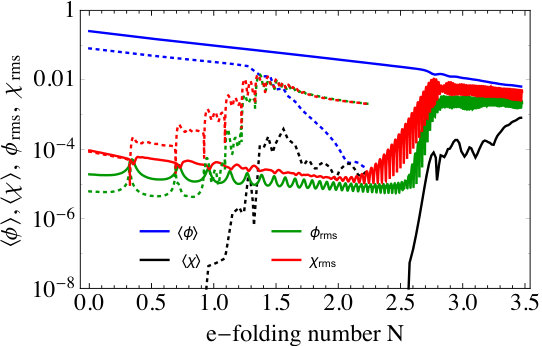 Figure 7
Peer Reviews
No public reviews on file for this paper yet. If you reviewed it on a platform where reviews are public (OpenReview, ICLR, NeurIPS, ICML), you can paste yours below so the community can read it here.
Videos
No videos yet. Explain this paper in a talk, walkthrough, or lecture? Add one.
Nonlinear Dynamics of Preheating after Multifield Inflation
with Nonminimal Couplings
Rachel Nguyen
Department of Physics, Kenyon College, Gambier, Ohio 43022, USA
Jorinde van de Vis
Nikhef, Science Park 105, 1098XG Amsterdam, The Netherlands
Evangelos I. Sfakianakis
Nikhef, Science Park 105, 1098XG Amsterdam, The Netherlands
Lorentz Institute for Theoretical Physics, Leiden University, 2333CA Leiden, The Netherlands
John T. Giblin, Jr
Department of Physics, Kenyon College, Gambier, Ohio 43022, USA
CERCA/ISO, Department of Physics, Case Western Reserve University, 10900 Euclid Avenue, Cleveland, OH 44106
David I. Kaiser
Department of Physics, Massachusetts Institute of Technology, Cambridge, Massachusetts 02139, USA
Abstract
We study the post-inflation dynamics of multifield models involving nonminimal couplings using lattice simulations to capture significant nonlinear effects like backreaction and rescattering. We measure the effective equation of state and typical time-scales for the onset of thermalization, which could affect the usual mapping between predictions for primordial perturbation spectra and measurements of anisotropies in the cosmic microwave background radiation. For large values of the nonminimal coupling constants, we find efficient particle production that gives rise to nearly instantaneous preheating. Moreover, the strong single-field attractor behavior that was previously identified persists until the end of preheating, thereby suppressing typical signatures of multifield models. We therefore find that predictions for primordial observables in this class of models retain a close match to the latest observations.
Introduction. Post-inflation reheating plays a critical role in our understanding of the very early Universe (see Ref. Amin et al. (2014) for a recent review). By the end of the reheating phase — and before big-bang nucleosynthesis (BBN) can commence Cyburt et al. (2016) — the Universe must achieve a radiation-dominated equation of state and become filled with (at least) a thermal bath of Standard Model particles at an appropriately high temperature. Although the earliest stages of reheating can be studied within a linearized approximation, some of the most critical processes arise from nonlinear physics, including backreaction and rescattering among the produced particles.
In addition to setting appropriate conditions for BBN, the reheating phase plays a critical role in comparisons between inflationary predictions and recent high-precision measurements of the cosmic microwave background (CMB). In particular, if there were a prolonged period after inflation before the Universe attained a radiation-dominated equation of state (EOS), that would impact the mapping between perturbations on observationally relevant length-scales and when those scales first crossed outside the Hubble radius during inflation Adshead et al. (2011); Dai et al. (2014); Vennin et al. (2015); Lozanov and Amin (2017). Residual uncertainty on the duration of reheating, , is now comparable to statistical uncertainties in measurements of CMB spectral observables. Hence understanding the time-scale is critical for evaluating observable predictions from inflationary models.
In this Letter we study the nonlinear dynamics of the early preheating phase of reheating in a well-motivated class of models. These models include multiple scalar fields, as typically found in realistic models of high-energy physics Mazumdar and Rocher (2011); Baumann and McAllister (2015); and each scalar field, , has a nonminimal coupling to the spacetime Ricci curvature scalar, , of the form . Such nonminimal couplings are quite generic: they are induced by quantum corrections for any self-interacting scalar field in curved spacetime, and they are required for renormalization Callan et al. (1970); Bunch et al. (1980). Moreover, the dimensionless coupling constants, , grow with energy-scale under renormalization-group flow, with no UV fixed point Odintsov (1991). Hence they can attain large values at inflationary energy scales. Upon transforming to the Einstein frame, such models feature curved field-space manifolds Kaiser (2010).
Multifield models with nonminimal couplings naturally yield a plateau-like phase of inflation at large field values, of the sort most favored by recent observations Akrami and Planck Collaboration . During inflation the fields generically evolve within a single-field attractor, thereby suppressing typical multifield effects that could spoil agreement with observations, such as large primordial non-Gaussianities and isocurvature perturbations Kaiser et al. (2013); Kaiser and Sfakianakis (2014); Schutz et al. (2014).
Previous work, which studied the onset of preheating in this class of models semi-analytically, identified three regimes that yielded qualitatively distinct behavior: , , and DeCross et al. (2018a, b, c). In this Letter we significantly expand this work, employing lattice simulations to study the complete preheating phase, deep into the nonlinear regime. We restrict attention to coupled scalar fields, and neglect the production of Standard Model particles such as fermions or gauge fields Greene and Kofman (1999, 2000); Peloso and Sorbo (2000); Tsujikawa et al. (2000); Davis et al. (2001); Garcia-Bellido et al. (2004); Bezrukov et al. (2009); Garcia-Bellido et al. (2009); Dufaux et al. (2010); Allahverdi et al. (2011); Deskins et al. (2013); Adshead and Sfakianakis (2015); Adshead et al. (2017); Sfakianakis and van de Vis (2019). Nonetheless, we are able to analyze the typical time-scales required for the Universe to achieve a radiation-dominated EOS; for the produced particles to backreact on the inflaton condensate, ultimately draining away its energy; and for rescattering among the particles to yield a thermal spectrum. For large couplings, , of the sort encountered in Higgs inflation Bezrukov and Shaposhnikov (2008), we find very efficient preheating, typically completing within the first two -folds after the end of inflation, thereby protecting the close match between predictions for primordial observables and the latest CMB measurements.
Model. In the Jordan frame, the nonminimal coupling between the scalar fields and the spacetime Ricci scalar remains explicit in the action through the term . Upon rescaling , with , we transform the action into the Einstein frame. (Here GeV is the reduced Planck mass.) The Einstein-frame potential is stretched by the conformal factor, , compared to the Jordan-frame potential . Taking canonical scalar fields in the Jordan frame, the nonminimal couplings induce a curved field-space manifold in the Einstein frame, with field-space metric given by Kaiser (2010). The equation of motion for the fields in the Einstein frame is then
[TABLE]
where is the Christoffel symbol constructed from . We consider an unperturbed, spatially flat Friedmann-Lemaître-Robertson-Walker (FLRW) spacetime metric, so the Einstein field equations yield , where is the total energy density of the system, , and overdots denote derivatives with respect to cosmic time.
We consider two-field models, , with
[TABLE]
The topography of the Einstein-frame potential generically includes “ridges” and “valleys” along certain directions . For non-fine-tuned parameters, the fields quickly fall to a local minimum (valley) of the potential, and the background dynamics obey a strong “single-field attractor” Kaiser and Sfakianakis (2014); Schutz et al. (2014); DeCross et al. (2018a). For symmetric couplings, with and , any initial angular motion within field space damps out within a few -folds after the start of inflation, and the system flows toward the minimum of the potential along a single-field trajectory Greenwood et al. (2013). Within a single-field attractor, the predictions for the spectral index , the tensor-to-scalar ratio , the running , primoridal non-Gaussianities , and isocurvature perturbations remain consistent with the latest observations across large regions of phase space and parameter space Kaiser and Sfakianakis (2014); Schutz et al. (2014); DeCross et al. (2018a).
Field fluctuations in these models are sensitive to the curvature of the field-space manifold, which is greatest near the origin. During preheating, as the inflaton condensate oscillates through zero, the effective mass for the fluctuations receives quasi-periodic “spikes” proportional to a component of the field-space Riemann tensor. In the limit , these scale as . These large “spikes” lead to sharp violations of the adiabatic condition for those modes, driving efficient particle production DeCross et al. (2018a, b, c); Ema et al. (2017).
Within the single-field attractor, the amplitude of primordial perturbations scales as Kaiser and Sfakianakis (2014). Present constraints on the tensor-to-scalar ratio therefore require . We fix and consider various values for , , and . We consider two typical cases: (A) , , and ; and (B) , . For the “generic” case (A) the single-field attractor lies along , while we are free to choose the same attractor direction for the symmetric case (B). Once the ratios of couplings are fixed, the dynamics of the system change as we vary across , and .
Results. We employ a modified version of GABE (Grid and Bubble Evolver) GAB to evolve the fields and the background, according to Eq. (1) and the Friedmann equation. Whereas the original software was used to simulate nonminimally coupled degrees of freedom Child et al. (2013), we have modified the code significantly to allow for a curved field-space metric in both the dynamics of the fields as well as the initial conditions. We start the simulations when inflation ends, defined by where ; the Hubble scale at this time is . We use a grid with points and a comoving box size so that the longest wavelength in our spectra corresponds to . We match the two-point correlation functions of and to corresponding distributions for quantized field fluctuations. Fourier modes of the quantized fluctuations evolving during inflation within the single-field attractor may be parameterized as (no sum on ), where is conformal time DeCross et al. (2018a). Near the end of inflation, we use the Wentzel-Kramers-Brillouin (WKB) approximation to estimate amplitudes , where . The effective masses include distinct contributions from the curvature of the potential and from the curvature of the field-space manifold, and are analyzed in detail in Refs. DeCross et al. (2018a, b, c). (Here we neglect contributions from coupled metric perturbations.) The initial spectra of the fields are subject to a window function that suppresses high-momentum modes above some UV suppression scale, .
Figs. 1 and 2 show results for Case A with . In Fig. 1, we plot the evolution of the inflaton condensate after the end of inflation as calculated in a linearized treatment (akin to Ref. DeCross et al. (2018c)), and as calculated from the spatial average on the lattice. Backreaction of produced particles — which is absent in linearized analyses — becomes significant beginning around -folds after the end of inflation for . For backreaction is strong enough to completely drain the inflaton condensate within the first -folds. Fig. 2 shows the evolution of the peak values of the spatial averages and as well as the growth of fluctuations, characterized by and . (Growth of field fluctuations corresponds to particle production Amin et al. (2014).) We have confirmed that the early growth of and fluctuations in our lattice simulations closely matches the behavior calculated via Floquet analysis in Ref. DeCross et al. (2018b). Beginning around 2.6 -folds, nonlinear rescattering among the fluctuations drives rapid growth of the fluctuations for . For the same effect occurs within the first -fold. Backreaction and rescattering generally become significant at distinct times as one varies couplings Nguyen et al. .
The dynamics of the and fluctuations vary with coupling , as shown in Fig. 3. For parametric resonance due to the contribution from the potential to leads to a slow growth of fluctuations; these eventually rescatter, leading to the growth of fluctuations and lowering the ratio. For the “Ricci spike” DeCross et al. (2018a); Ema et al. (2017) leads to a fast growth of fluctuations. This is seen in Fig. 3 as an early rise of the ratio. When grows enough it rescatters with fluctuations, eventually leading to . The case of is the most interesting, since it displays several distinct phases. The initial growth occurs due to adiabaticity violation caused by the Ricci spike. After -folds the height of the Ricci spike has redshifted, making it comparable to the potential contribution to the effective mass, thereby shutting off particle production DeCross et al. (2018a). When the Ricci spike redshifts even more, around -folds, a second stage of parametric resonance commences, due to the potential term alone. Subsequently, rescattering enhances the fluctuations, lowering the ratio. The situation is qualitatively similar for the symmetric case (B) Nguyen et al. .
The rapid growth of fluctuations yields an efficient transfer of energy from the inflaton condensate into radiative degrees of freedom. Within the single-field attractor, we may approximate the energy density in the inflaton condensate as DeCross et al. (2018a)
[TABLE]
where we evaluate with and . Fig. 4 shows that across Cases A and B the fraction of energy density in the inflaton condensate falls sharply within the first few -folds after the end of inflation; for , virtually all of the energy density has been transferred out of the inflaton condensate within the first -folds.
The rapid transfer of energy to radiative degrees of freedom is similarly reflected in Fig. 5, which shows the evolution of the EOS, , where and are the total energy density and pressure for the system, respectively. In this case, the system approaches rapidly for small couplings , because in that regime the Einstein-frame potential for the inflaton approximates a quartic form, so that even the condensate’s oscillations correspond to DeCross et al. (2018a). As increases, the Einstein-frame potential for approaches a quadratic form, for which the condensate’s oscillations behave like DeCross et al. (2018a); but in that case, the stronger coupling yields more efficient particle production, so that the system eventually becomes dominated by radiative degrees of freedom. For , we find a transient phase with a stiff EOS, , which likely arises because typical momenta for the fluctuations are comparable to , and the contributions to and from kinetic and spatial-gradient terms are weighted by components of , which are significant for . At later times, as , the system relaxes to a gas of massless particles with . Across a wide range of couplings for this family of models, we therefore find that the Universe rapidly achieves a radiation-dominated EOS within -folds after the end of inflation. Preheating in -attractor models with , in contrast, can lead to a prolonged period with Iarygina et al. (2019), shifting the pivot-scale accordingly and thereby offering a means to empirically distinguish between such models and the family we consider here.
The strong rescattering among fluctuations yields an efficient start to the process of thermalization, by transferring power between particles of different momenta. In Fig. 6 we show the spectra in field fluctuations and for Case A with . Although the spectra are dominated at early times by increased power in distinct resonance bands, by later times rescattering has flattened out the distributions for both and . By -folds after the end of inflation, both fields have attained a spectrum consistent with a thermal distribution, , at a temperature . We find comparable behavior across Cases A and B for Nguyen et al. .
The rapid thermalization means that the system reaches the adiabatic limit soon after the end of inflation. We denote , where is the time by which super-Hubble coherence of the inflaton condensate is lost, indicated by . Any significant turning of the system within the field space between the end of inflation and could amplify non-Gaussianities and isocurvature perturbations, thereby threatening the close agreement between predictions in these models and measurements of the CMB Elliston et al. (2011, 2014); Meyers and Tarrant (2014); Renaux-Petel and Turzynski (2015). In Fig. 7, we plot across cases of interest, where is the covariant turn-rate tur . Even as the Hubble rate falls over time, we nonetheless find through , indicating minimal turning of the system within field space.
Our late-time results were unchanged as we varied the initial UV suppression scale between , , and , and the number of grid-points between , and . We discuss this and related numerical convergence tests in Ref. Nguyen et al. .
Conclusions. Multifield models of inflation with nonminimal couplings generically yield predictions for primordial observables in close agreement with the latest observations, deriving from the strong single-field attractor behavior of these models Kaiser and Sfakianakis (2014); Schutz et al. (2014); DeCross et al. (2018a). Throughout the cases we have examined and across parameter space, we find that this single-field attractor behavior remains robust until the system reaches the adiabatic limit after inflation, with no significant turning in field space even in the midst of strongly nonlinear dynamics.
Preheating in this class of models is efficient, draining the energy density from the inflaton condensate within -folds in the limit of strong couplings, . The system typically reaches a radiation-dominated equation of state within , while rescattering yields a rapid onset of thermalization within , thereby fulfilling several of the most critical requirements of the reheating phase. We defer to future work such questions as possible impact of coupled metric perturbations on the fully nonlinear preheating dynamics, and the coupling of the scalar fields and to Standard Model particles.
Acknowledgements. RN received support from a Clare Booth Luce Undergraduate Research Award, Grant #9601. RN and JTG are supported by the National Science Foundation Grant No. PHY-1719652. JvdV and EIS acknowledge support from the Netherlands Organisation for Scientific Research (NWO). RN, JvdV, and JTG would also like to thank the MIT Center for Theoretical Physics for its warm and generous hospitality. Portions of this work were conducted in MIT’s Center for Theoretical Physics and supported in part by the U.S. Department of Energy under Contract No. DE-SC0012567.
The reference list from the paper itself. Each links out to its DOI / PubMed record.
- 1Amin et al. (2014) M. A. Amin, M. P. Hertzberg, D. I. Kaiser, and J. Karouby, “Nonperturbative Dynamics Of Reheating After Inflation: A Review,” Int. J. Mod. Phys. D 24 , 1530003 (2015) , ar Xiv:1410.3808 [hep-ph] . · doi ↗
- 2Cyburt et al. (2016) R. H. Cyburt, B. D. Fields, K. A. Olive, and T.-H. Yeh, “Big Bang Nucleosynthesis: Present status,” Rev. Mod. Phys. 88 , 015004 (2016) , ar Xiv:1505.01076 [astro-ph.CO] . · doi ↗
- 3Adshead et al. (2011) P. Adshead, R. Easther, J. Pritchard, and A. Loeb, “Inflation and the scale dependent spectral index: prospects and strategies,” JCAP 2011 , 021 (2011) , ar Xiv:1007.3748 [astro-ph.CO] . · doi ↗
- 4Dai et al. (2014) L. Dai, M. Kamionkowski, and J. Wang, “Reheating Constraints to Inflationary Models,” Phys. Rev. Lett. 113 , 041302 (2014) , ar Xiv:1404.6704 [astro-ph.CO] . · doi ↗
- 5Vennin et al. (2015) V. Vennin, K. Koyama, and D. Wands, “Encyclopædia curvatonis,” JCAP 2015 , 008 (2015) , ar Xiv:1507.07575 [astro-ph.CO] . · doi ↗
- 6Lozanov and Amin (2017) K. D. Lozanov and M. A. Amin, “Equation of State and Duration to Radiation Domination after Inflation,” Phys. Rev. Lett. 119 , 061301 (2017) , ar Xiv:1608.01213 [astro-ph.CO] . · doi ↗
- 7Mazumdar and Rocher (2011) A. Mazumdar and J. Rocher, “Particle physics models of inflation and curvaton scenarios,” Phys. Rept. 497 , 85–215 (2011) , ar Xiv:1001.0993 [hep-ph] . · doi ↗
- 8Baumann and Mc Allister (2015) D. Baumann and L. Mc Allister, Inflation and String Theory (Cambridge University Press, Cambridge, 2015).