Forward-backward asymmetry in the gauge-Higgs unification at the International Linear Collider
Shuichiro Funatsu

TL;DR
This paper investigates how the gauge-Higgs unification model affects fermion pair production asymmetries at the ILC, highlighting observable deviations from the Standard Model predictions due to Kaluza-Klein modes.
Contribution
It provides the first detailed analysis of forward-backward asymmetry deviations in the gauge-Higgs unification model at the ILC with polarized beams.
Findings
Deviations in asymmetries are significant and detectable.
Differences depend on quark bulk mass parameters.
Predictions for two quark mass parameter cases.
Abstract
The signals of the SO(5) \times U(1) gauge-Higgs unification model at the International Linear Collider are studied. In this model, Kaluza-Klein modes of the neutral gauge bosons affect fermion pair productions. The deviations of the forward-backward asymmetries of the , processes from the standard model predictions are clearly seen by using polarised beams. The deviations of these values are predicted for two cases, the bulk mass parameters of quarks are positive and negative case.
Click any figure to enlarge with its caption.
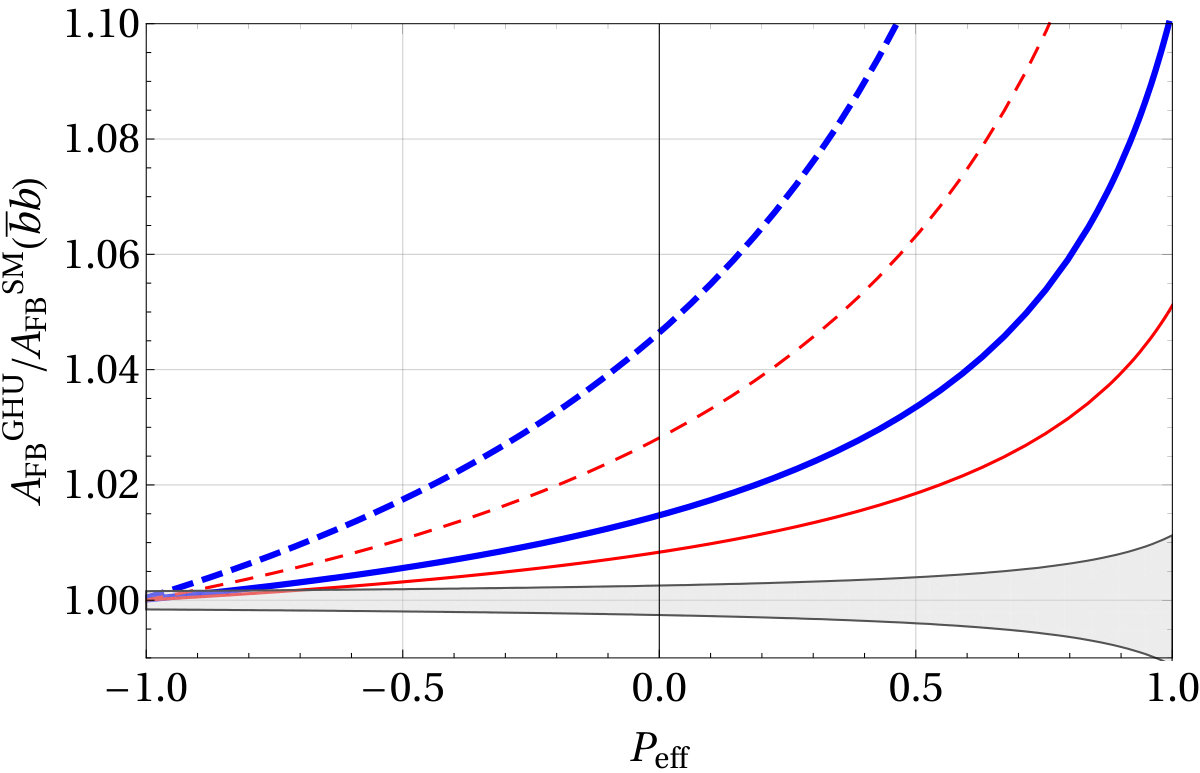 Figure 1
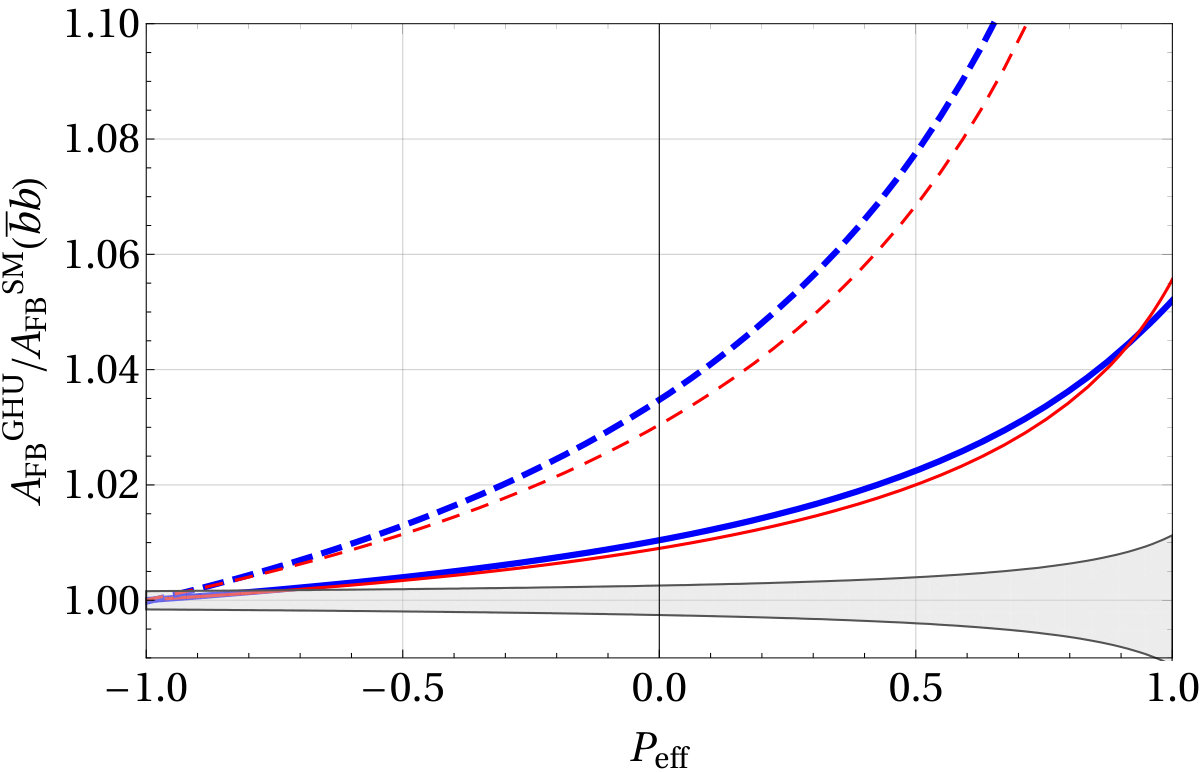 Figure 2
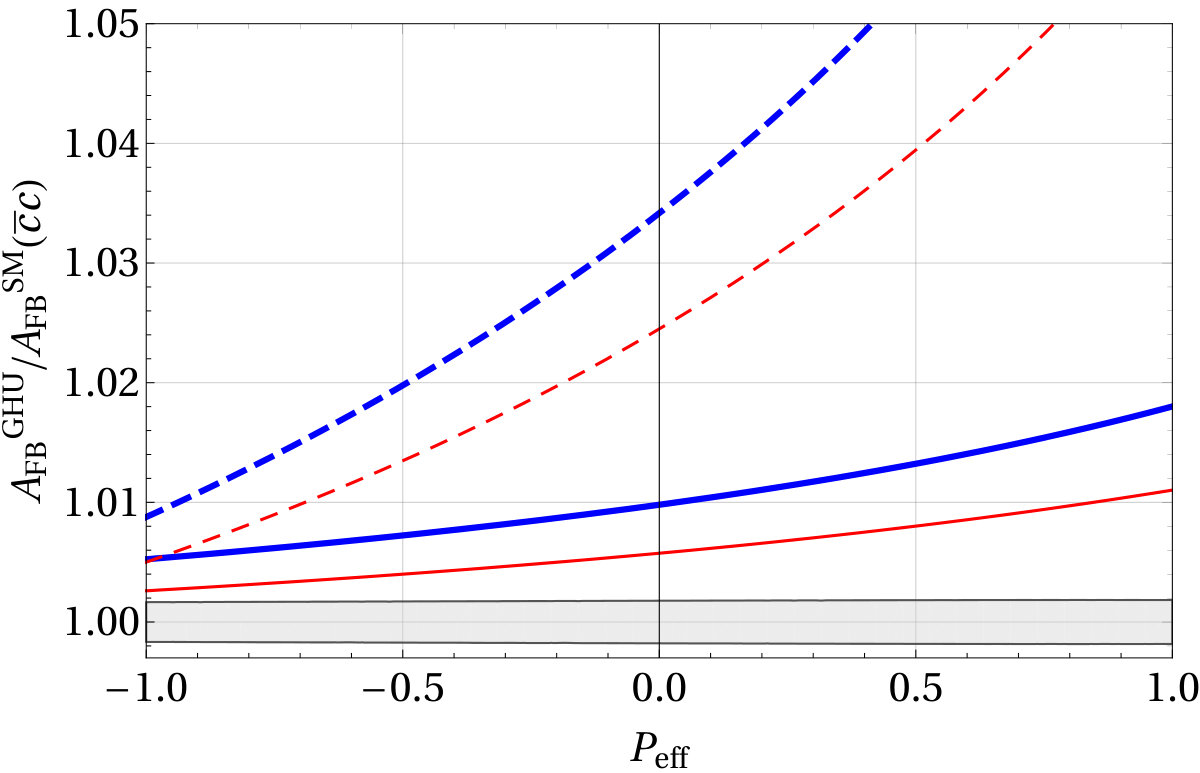 Figure 3
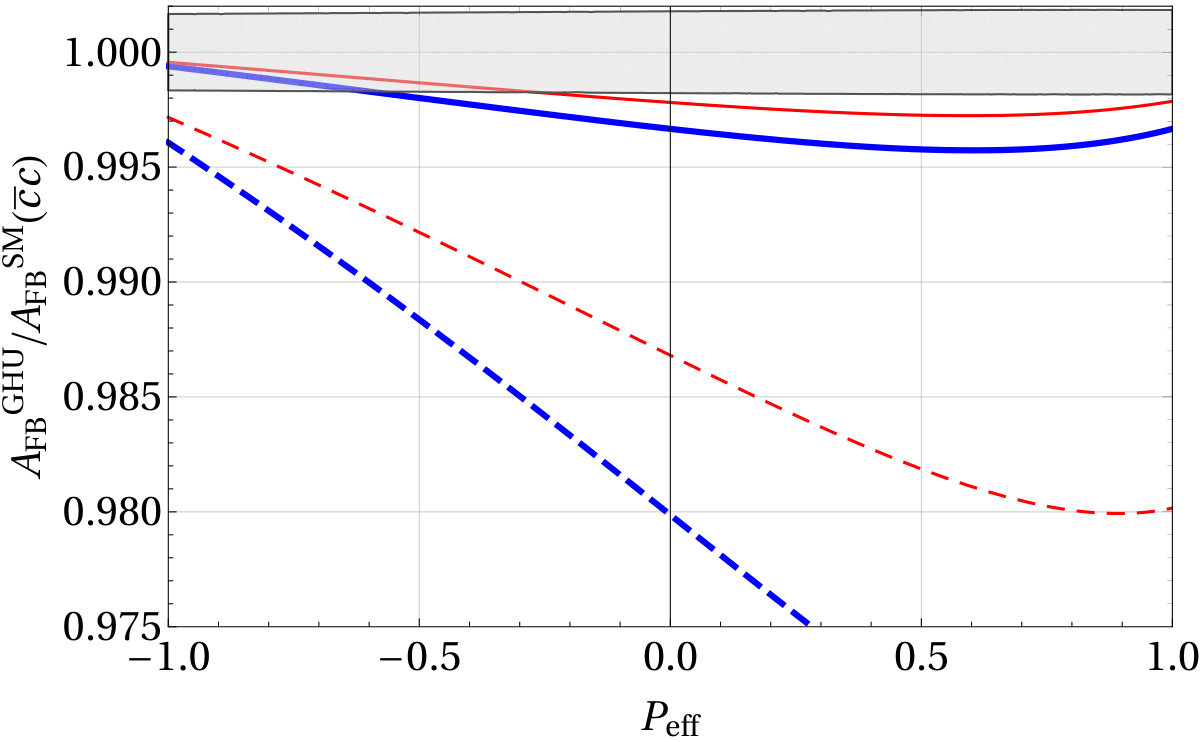 Figure 4
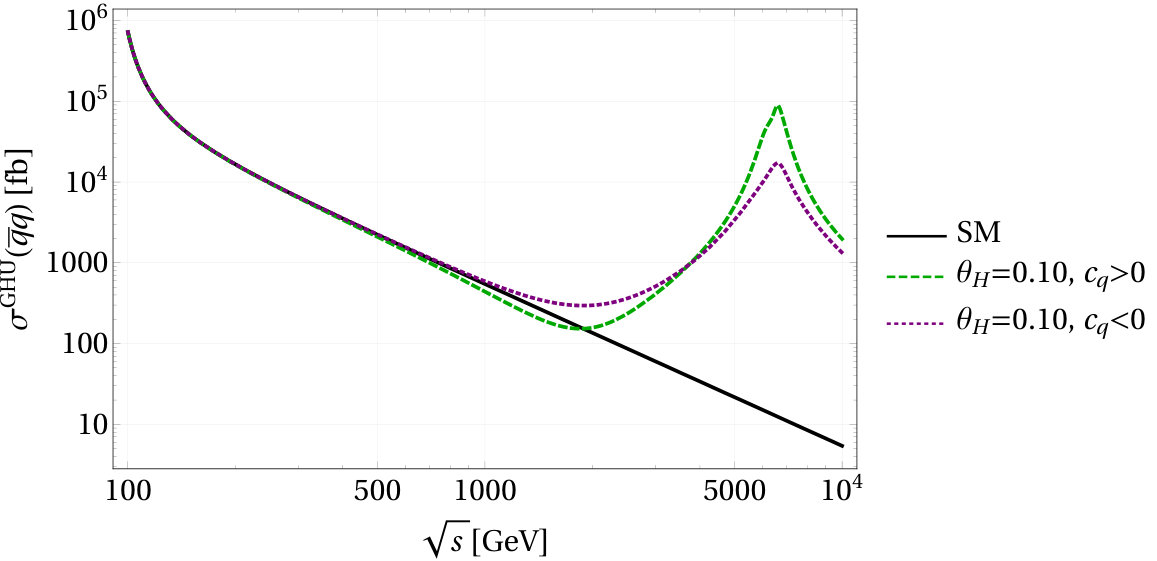 Figure 5
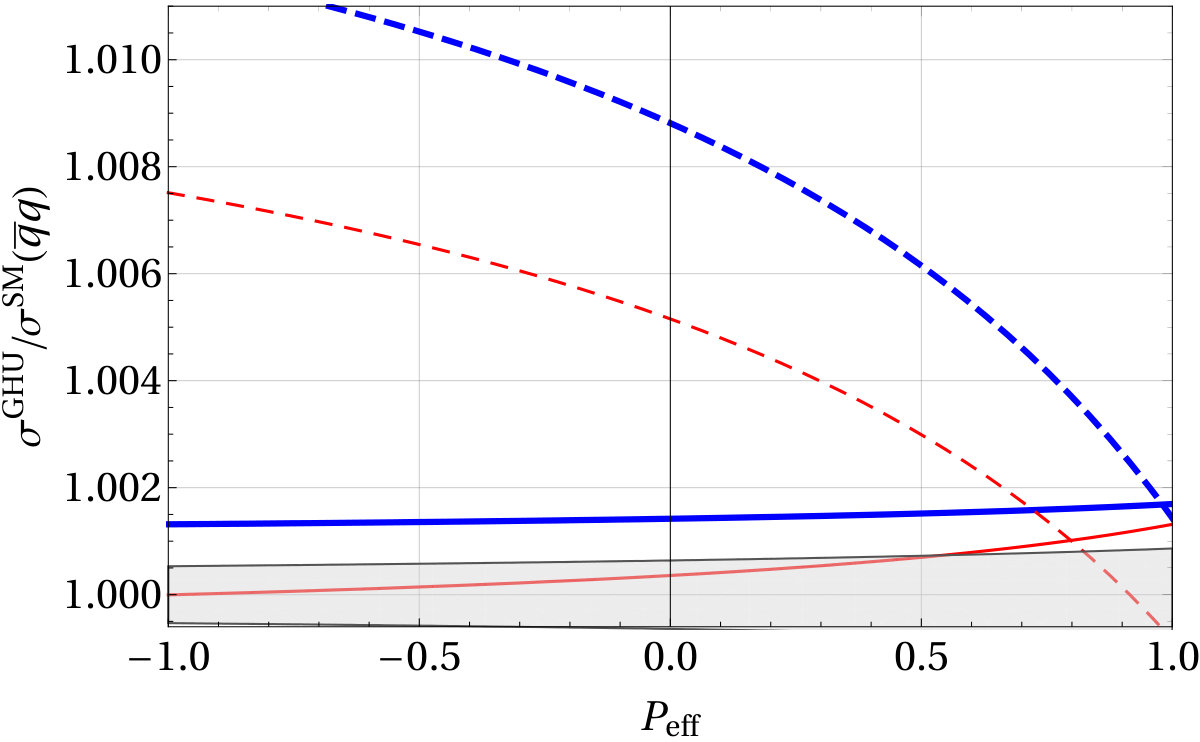 Figure 6
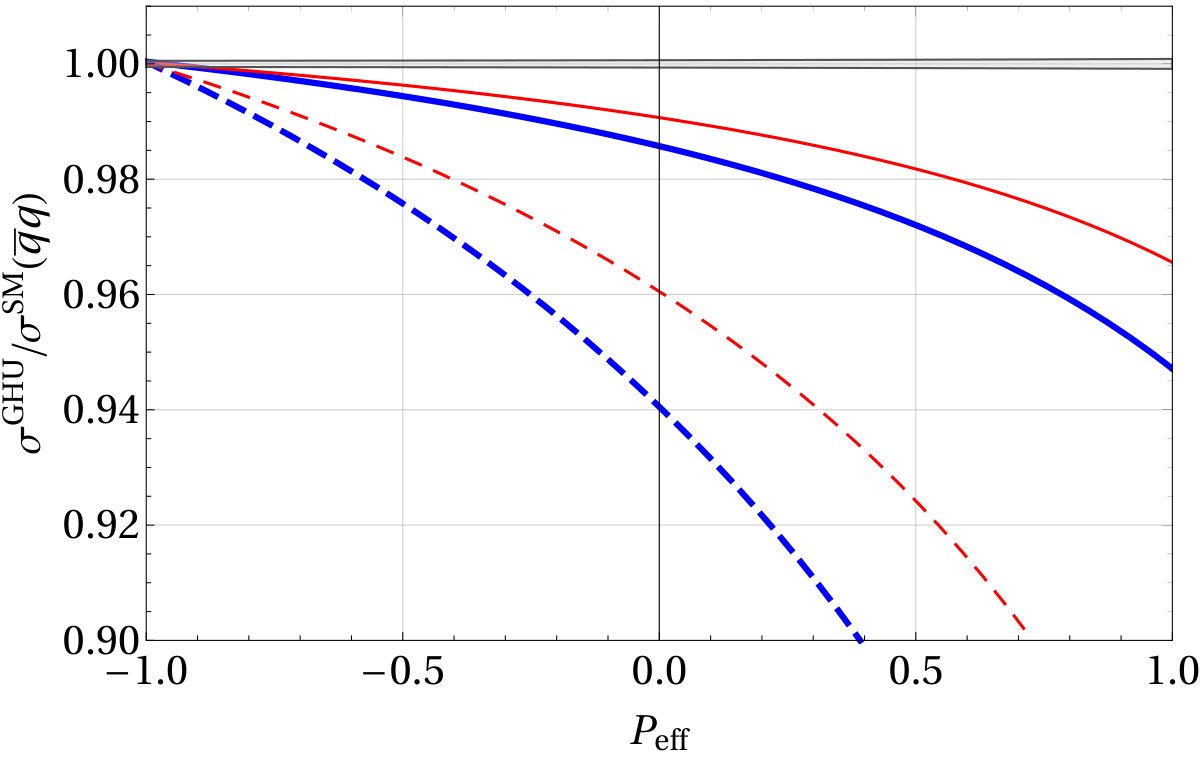 Figure 7
| (GeV) | (GeV) | (GeV) | (GeV) | |||
| () | () | |
| () | () | |
| () | () | |
| () | () | |
| () | () | |
| () | () |
Peer Reviews
No public reviews on file for this paper yet. If you reviewed it on a platform where reviews are public (OpenReview, ICLR, NeurIPS, ICML), you can paste yours below so the community can read it here.
Videos
No videos yet. Explain this paper in a talk, walkthrough, or lecture? Add one.
9th March 2024
**Forward-backward asymmetry
in the gauge-Higgs unification
at the International Linear Collider**
Shuichiro Funatsu
*Institute of Particle Physics and Key Laboratory of Quark and Lepton Physics (MOE),
Central China Normal University, Wuhan, Hubei 430079, China*
Abstract
The signals of the gauge-Higgs unification model at the International Linear Collider are studied. In this model, Kaluza-Klein modes of the neutral gauge bosons affect fermion pair productions. The deviations of the forward-backward asymmetries of the , processes from the standard model predictions are clearly seen by using polarised beams. The deviations of these values are predicted for two cases, the bulk mass parameters of quarks are positive and negative case.
1 Introduction
After the discovery of the Higgs boson, search for new physics in the electroweak sector is one of the most important topics of the particle physics. For this purpose, high-precision measurements of the electroweak sector are necessary. The International Linear Collider (ILC) has the capabilities for the high-precision measurements and enables us to test the standard model (SM) [1, 2, 3, 4]. New physics at the ILC are predicted by many alternative models such as the Higgs portal dark matter models [5, 6, 7], two-Higgs doublet models [8, 9, 10], Georgi-Machacek model [11], supersymmetric models [12, 13, 14, 15], littlest Higgs model [16, 17], universal extra dimensional model [18], warped extra dimensional models [19, 20, 21], composite Higgs models [22, 23, 24] and other models [25].
The gauge-Higgs unification (GHU) models [26, 27, 28, 29, 30, 31, 44, 32, 45, 46, 35, 47, 36, 38, 41, 42, 43, 33, 37, 48, 49, 39, 40, 34, 50, 51, 52, 53] are alternative models of the SM, in which the Higgs boson appears as an extra-dimensional component of the higher-dimensional gauge boson. Hence the Higgs sector is governed by the gauge principle and the Higgs boson mass is protected against the radiative corrections in the GHU models. The Higgs boson is massless at the tree-level and acquires the finite mass by the radiative corrections [26, 27, 28]. Note that also the Yukawa interactions in the GHU models are the gauge interactions of the extra-dimensional component of the gauge boson and the fermions. The phenomenologically most well-studied GHU model is the GHU models [31, 41, 42, 43, 44, 45, 46, 47, 48, 49, 50, 51, 52, 53], which are defined on the warped metric [60]. In the GHU models, the Higgs boson mass is protected by the custodial symmetry and the Higgs boson potential is calculable. One of the features of the warped extra dimensional models is that the first Kaluza-Klein (KK) excited states of the gauge bosons have the large asymmetry between the couplings with the left-handed and the right-handed fermions. The GHU models have the same feature.
There are several kinds of the GHU models depending on symmetry breaking patterns and the embedding patterns of the quarks and leptons. In the GHU model discussed here, the quarks and leptons are embedded in the 5 representation of . Then the Yukawa, and couplings are suppressed by from the SM values, where is the Wilson line phase. The KK excited states of the neutral gauge bosons appear as the so-called bosons. Besides the KK excited states of the photon and that of the boson , that of the gauge boson , which does not have a zero mode, exist as the neutral gauge bosons. Therefore the , and appear as the bosons. From the result at the Large Hadron Collider, the parameter region is constrained to be , where TeV [48]. For this region, the contributions of the KK excited states to the decay widths, and are less than 0.2%, thus negligible [44, 47]. The decay widths , , , , and are approximately suppressed by the common factor at the leading order. Hence the branching ratio of the Higgs boson in this model is almost equivalent to that in the SM. At the ILC 500 GeV, the branching ratios of the processes , , , and are measured at the accuracy [2]. The branching ratios of the Higgs boson are consistent between the GHU model and the SM at the ILC.
At the ILC, it is possible to measure effects of new physics on the the cross sections and the forward-backward asymmetries of the processes [16, 17, 19, 20, 54, 55, 56, 57]. The forward-backward asymmetries are important observables for indirect search of physics beyond the SM as shown in the studies of that of top quark production at the Tevatron and Large Hadron Collider [58, 59]. In this paper, the effects of bosons in the GHU model on these values are shown. The same topic is studied previously [49] and clear signals are predicted although masses are much larger than the centre-of-mass of the ILC. However in the previous study, the bulk mass parameters are assumed to be positive although negative values are also allowed. Thus the negative region of the bulk mass parameters is also checked in this study. The following calculations are done at the tree-level without the one-loop effective potential of the Higgs boson, so the corrections from the strong interaction are not included.
This paper is constructed as follows. In Section 2, the model is shortly introduced. In Section 3, the parameters and the couplings and decay widths of the bosons are shown. The bulk mass parameter dependence of the fermion mode functions are also shortly reviewed. In Section 4, the cross sections and the forward-backward asymmetries at the ILC are shown. In section 5, the results are summarised.
2 Model
There are several types of the GHU models depending on the symmetry breaking patterns and the embedding patterns of the quarks and leptons. The GHU model discussed in this paper is constructed as follows. The model is defined on the warped spacetime [60]. The metric is
[TABLE]
() where is the AdS curvature. The action has the local symmetry. The bulk action is given by
[TABLE]
where and are the , and gauge fields, , and , , and are the five-dimensional gauge couplings of , and . , and are gauge-fixing functions and , and are gauge parameters. , and denote ghost Lagrangians, respectively. ( and ) are the four -vector (5 representation) fermions for each generation and () are the number of -spinor (4 representation) fermions, which exist in the bulk space. The colour indices are not shown. The gauge fields are decomposed as
[TABLE]
where and are the generators of and , respectively. For the fermion Lagrangian, denotes 5D gamma matrices which is defined by (),
[TABLE]
and . is an inverse fielbein and is the spin connection. is the sign function and are the bulk mass parameters. The bulk mass parameters are set as and .
The -vector fermions are decomposed to the bidoublet and singlet. The multiplet of the third generation are denoted as
[TABLE]
The first and second generation quarks and leptons are abbreviated.
The orbifold boundary conditions at and are given by
[TABLE]
By these boundary conditions, the symmetry is broken to . For quarks and leptons, the bidoublets have the left-handed zero modes and the singlets have the right-handed zero modes.
The brane action is given by
[TABLE]
where
[TABLE]
are the right-handed fermions localised on . , , and are the brane Yukawa couplings. The brane scaler breaks the symmetry to the symmetry spontaneously by acquiring the vacuum expectation value,
[TABLE]
The details of the brane interactions are shown in Ref. [41, 42]. The formulae of the KK expansion, the mass spectrum of the KK modes and the couplings are shown in Ref [48].
3 Parameters, couplings and decay widths
3.1 Bulk mass parameter dependence
I would like to emphasize the parameter dependence of fermion mode functions and fermion couplings with the KK gauge boson in this subsection. Generally, fermion with the bulk mass parameter on the warped metric is expanded as [61]
[TABLE]
where is the normalisation factor defined as
[TABLE]
and is expressed as
[TABLE]
where and are constants determined by boundary conditions. The upper and lower sign of and correspond to the left- and right-handed fermions, respectively. Therefore the left-handed zero-mode is localised towards and for and . In contrast, the right-handed zero-mode is localised towards for . These behaviour of the left- and right-handed fermions are reversed for .
From (13) and (14), it is straightforwardly derived that the product of the left- and right-handed fermion mode functions with the same KK number and the bulk mass, is invariant under changing the sign of the bulk mass parameter . Consequently, the Yukawa couplings and the fermion masses obtained from the Higgs boson vacuum expectation value are independent of the sign of the bulk mass parameters in the case that the left- and right- handed quarks have the same bulk mass. In this model, the above arguments are applicable.
Considering gauge boson, mode function of zero-mode is independent of -coordinate and 1st KK gauge bosons have peaks near [62]. Therefore the right-handed fermions with , the left-handed fermions with and the left-handed fermions with couple to bosons rather largely. As shown in the next subsection, the bulk mass parameter of the third generation quarks is . Therefore the left-handed third generation quarks couplings with bosons are large.
3.2 Parameters
The free parameters of this model are the warp factor and which is ’s degrees of the freedom, so once the and are set, is determined. The physics of the quarks and leptons are almost independent of and determined by [44, 45]. The input parameters and the model parameters to realise the input parameters at the tree level are listed in Table 1 and Table 2 respectively, where , , , , , and are the bulk mass parameters of leptons and quarks for the each generations and . As explained in previous subsection, the sign of the bulk mass parameter doesn’t affect the fermion mass in this model. Therefore only the absolute values of is determined from the input values. In the following, the bulk mass parameters of leptons and quarks are abbreviated as . The resultant -boson mass at the tree-level calculated by the boundary condition is GeV. To realise the input parameters, the parameter region of is found to be . The lower limit of becomes slightly smaller for . In case, lower limit of .
3.3 Couplings and decay widths
The fermion couplings to s are listed in the Table 5, 5, 5, 8, 8 and 8. The 1st KK photon couplings to the left- and right-handed fermions for is equal to the left- and right-handed fermions for within 5 digits, respectively. The coupling with (, ) for is negative, although the couplings with (, ) and (, ) for are positive. This behaviour comes from the mass ratio of up-type and down-type quarks. In this model, left-handed top-quark is the mixing state of the (, , ) in (6) and their mixing ratio is
[TABLE]
where in good accuracy. Their isospins are
[TABLE]
Therefore up-type quark coupling with the gauge boson is proportional to
[TABLE]
up-type quark coupling with the neutral gauge boson is proportional to
[TABLE]
and up-type quark coupling with the neutral gauge boson is proportional to
[TABLE]
For small , the sign of the last one depends on the ratio of the up- and down-type quarks. Thus the couplings with the up-quark have different sign with that of the charm- and top-quarks The behaviour of the couplings with the down-type quarks are derived by the same reason.
The masses obtained by the boundary conditions and the decay widths calculated from the couplings shown in Table 5, 5, 5, 8, 8 and 8 are summarized in Table 9. The 1st KK photon decay width is independent of the sign of the bulk fermion parameters.
4 Cross section and forward-backward asymmetry
The parameters are constrained by the experimental results of the forward-backward asymmetry at the -pole. For , the deviations of the -boson couplings are . In contrast, for , their deviations are . Thus the forward-backward asymmetry of process at the -pole in the GHU model deviate nearly 10 % from the observed value for . Consequently, the value is not valid and the value of which consistently explain the experimental results at the -pole must be searched. In this paper, case is not considered further.
The longitudinal polarisation () is introduced, where the electron and positron is purely right-handed when . The cross section of at the centre-of-mass frame is given by
[TABLE]
where () is cross section. The formula (20) is rewritten by using as , then the ratio of is parametrised by one polarisation parameter . Typical values of polarisation parameters are ().
Considering the process, the difference of the cross sections between case () and case () arises from only the decay widths. Consequently the deviation of from is small. As shown in [49], at GeV with 250 unpolarised beam, events are expected in the SM. Therefore the statistical uncertainty is 0.15 %. The difference of the cross sections of the two cases over the SM value, is less than 0.11% at GeV with unpolarised beam. For the forward-backward asymmetry, is less than 0.04 % at GeV with unpolarised beam. Thus the two cases are difficult to distinguish at the process. The detailed analysis of the process in the GHU model is shown in [49].
For the process, the cross section in the SM is = 9.75 pb and 7.26 pb at GeV with unpolarised and polarised ( and ) beams, respectively. For GeV region, the cross section in the GHU model with are smaller than that in the SM. In contrast, that in the GHU model with are larger than that in the SM as shown in figure 1. In figure 2, the ratio of cross sections in the GHU model to that in the SM with polarised beams are plotted. At GeV with and 250 fb*-1* luminosity, the event number of the SM is and the statistical uncertainty over the event number is . in the GHU model deviates from the that in the SM larger than 3 % for at GeV with and 250 fb*-1* luminosity. The deviations at GeV are summarised in Table 10.
For the final state, the forward-backward asymmetry is also measured. The decrease from the for . In contrast, increase from the for . At GeV with polarised beam, and with 250 luminosity, the statistical uncertainty is 0.16%. The deviations of the from are , and for and , and at GeV with . For and , and at GeV with , the deviations are , and . The polarisation dependence of the ratio are plotted in figure 3 and the deviations at GeV, 500 GeV and 1 TeV are summarised in Table 11, Table 12 and Table 13, respectively.
For the process, the cross section in the SM is = 1.77 pb and 1.02 pb at GeV with unpolarised and polarised ( and ) beams, respectively. The statistical uncertainty at GeV and 250 fb*-1* luminosity with and beam are 0.20 %. For this process, the cross sections in the GHU model with and cases both decrease from that in the SM. The deviations at GeV are summarised in Table 10. The deference between the and cases more obviously appear at the forward-backward asymmetry. In the SM, and at GeV with unpolarised and beams, respectively. In the GHU model the increase from the SM value, increase , , and increase , , at GeV with for , and . In figure 4, the ratio of the in the GHU model to that in the SM with polarised beams are plotted. The case predicts larger deviation than the case for and . At GeV with and 250 fb*-1* luminosity, the statistical uncertainty of the in the SM is 0.70%. in the GHU model deviates from the that in the SM larger than . The deviations at GeV, 500 GeV and 1 TeV are summarised in Table 11, Table 12 and Table 13, respectively.
The forward-backward asymmetry of the process is measured at GeV. The polarisation dependence of is qualitatively similar to that of , which also increase from that in the SM. , , and , , at GeV with for , and . At GeV with and 500 fb*-1* luminosity, , and the uncertainty of the is 0.538 %. The deviations of the forward-backward asymmetries of the processes at GeV and 1 TeV are summarised in Table 12 and Table 13.
5 Summary
In the above calculations, the quark bulk mass parameters are assumed to be all positive or all negative. It is also allowed to be only one of them is positive or negative. In the case, the decay widths change from the values shown in Table 9, therefore the cross sections and the forward-backward asymmetries slightly change from the results in this paper. Neglecting the difference arising from the decay widths, the sign of the is determined by measuring the and the sign of the is determined by the and at GeV. It is difficult to determine the sign of the by measuring and . At the ILC 250 GeV, the case predicts larger deviation of the than the case for , and at the ILC 500 GeV larger deviation for . For , to clearly determine the sign of by observing the , higher energy and luminosity such as the ILC 1 TeV are necessary.
In this paper, the forward-backward asymmetry of the processes in the GHU model are studied for two cases where all of the quark bulk mass parameters are positive or negative. The GHU model predicts large deviations at the GeV with polarised beams. Therefore the GHU model is testable at the ILC 250 GeV. The signs of the bulk mass parameters are distinguished at the ILC 500 GeV or ILC 1 TeV. For the case where the lepton bulk mass parameters are negative, detail is going to be analysed in near future.
Acknowledgements
I thank Yutaka Hosotani, Hisaki Hatanaka, Yuta Orikasa and Naoki Yamatsu for many advices and important discussions. This work is supported by the National Natural Science Foundation of China (Grant Nos. 11775092, 11675061, 11521064 and 11435003), and the International Postdoctoral Exchange Fellowship Program (IPEFP).
The reference list from the paper itself. Each links out to its DOI / PubMed record.
- 1[1] H. Baer et al. , “The International Linear Collider Technical Design Report - Volume 2: Physics”, ar Xiv:1306.6352 [hep-ph].
- 2[2] D. M. Asner et al. , “ILC Higgs White Paper”, ar Xiv:1310.0763 [hep-ph].
- 3[3] H. Aihara et al. , “The International Linear Collider. A Global Project”, ar Xiv:1901.09829 [hep-ex].
- 4[4] P. Bambade et al. , “The International Linear Collider: A Global Project”, ar Xiv:1903.01629 [hep-ex].
- 5[5] S. Kanemura, S. Matsumoto, T. Nabeshima and H. Taniguchi, “Testing Higgs portal dark matter via Z 𝑍 Z fusion at a linear collider”, Phys. Lett. B 701 , 591 (2011).
- 6[6] P. Ko and H. Yokoya, “Search for Higgs portal DM at the ILC”, JHEP 1608 , 109 (2016).
- 7[7] T. Kamon, P. Ko and J. Li, “Characterizing Higgs portal dark matter models at the ILC”, Eur. Phys. J. C 77 , no. 9, 652 (2017).
- 8[8] V. Barger, L. L. Everett, H. E. Logan and G. Shaughnessy, “Scrutinizing the 125 Ge V Higgs boson in two Higgs doublet models at the LHC, ILC, and Muon Collider”, Phys. Rev. D 88 , no. 11, 115003 (2013).