
TL;DR
This paper develops a thermal gas model of 2-2-holes in quadratic gravity, exploring their thermodynamics and geometry as potential black hole mimickers, with implications for observational tests of strong gravity.
Contribution
It introduces a tractable thermal gas model of 2-2-holes, analyzing their thermodynamic and geometric properties, and distinguishes behaviors at different size limits.
Findings
Large 2-2-holes have minimal exterior deviations and squeezed interiors.
Anomalous thermodynamic features emerge from the gas model.
Small 2-2-holes behave like normal thermodynamic systems.
Abstract
We are entering a new era to test the strong gravity regime around astrophysical black holes. The possibility that they are actually horizonless ultracompact objects and then free from the information loss paradox can be examined more closely with observational data. In this paper, we systematically develop a thermal gas model of the 2-2-hole in quadratic gravity, as one step further to look for more tractable models of black hole mimickers. Concrete predictions for departures from black holes are made all the way down to the high curvature interior. The simple form of matter further enables an explicit study of the relation between geometry and thermodynamics. Within this unified framework, we identify notably different behaviors at two limits. On one side is the astrophysically large 2-2-hole, as characterized by a minuscule deviation outside the would-be horizon and a highly squeezed…
Click any figure to enlarge with its caption.
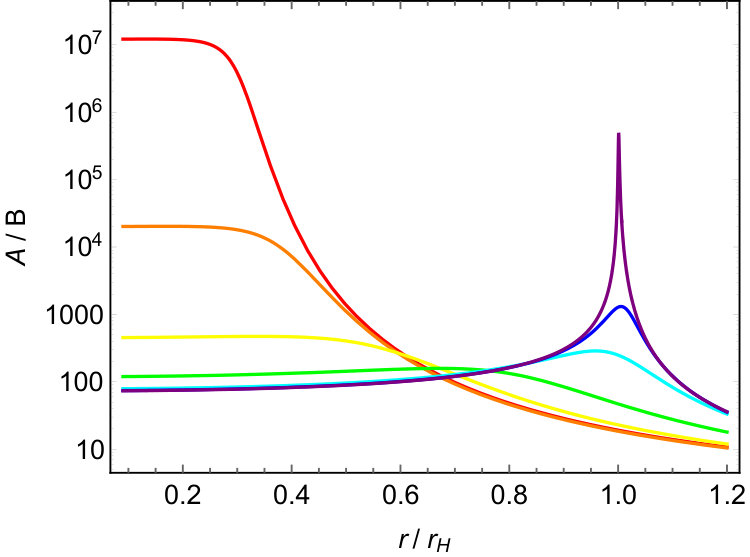 Figure 1
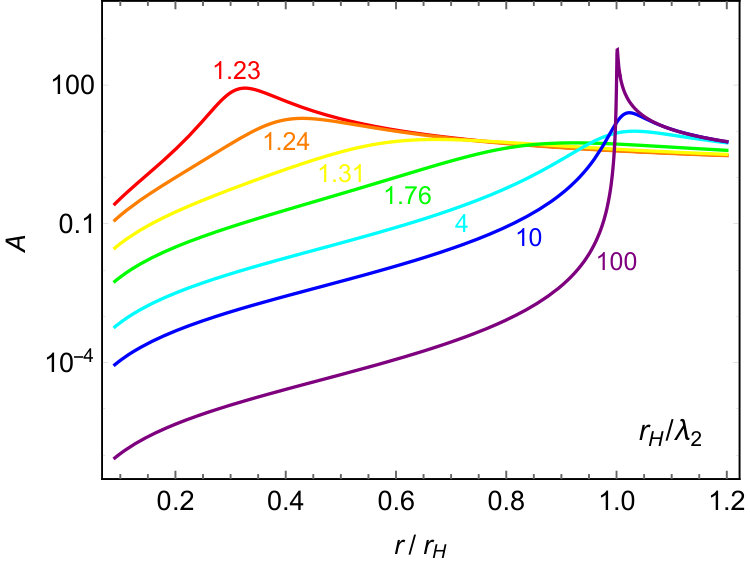 Figure 2
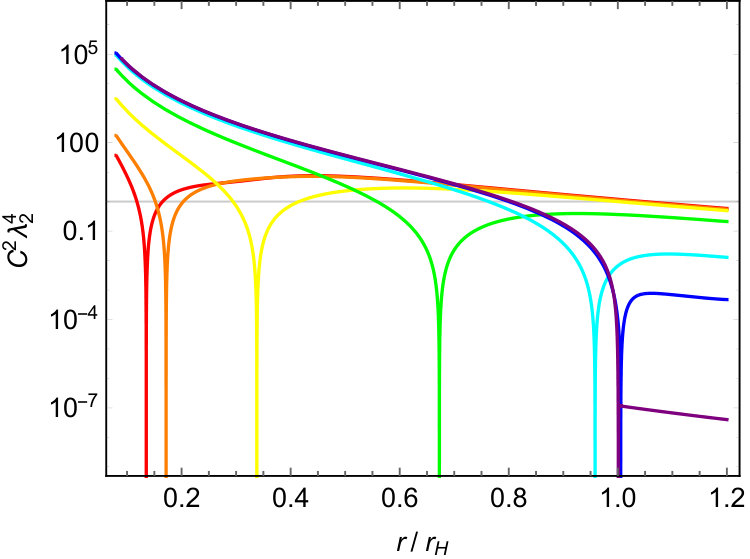 Figure 3
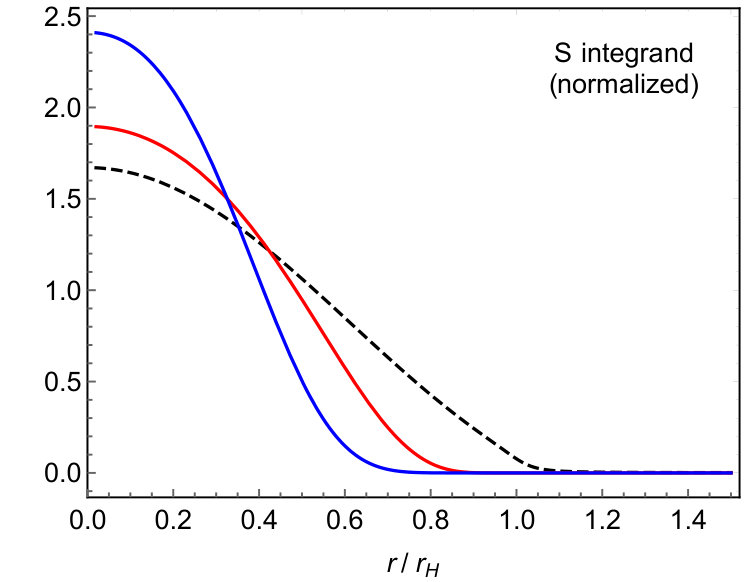 Figure 4
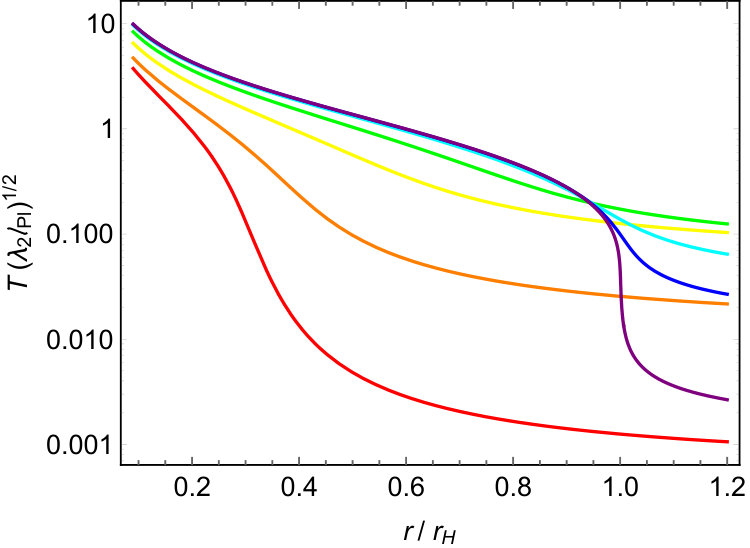 Figure 5
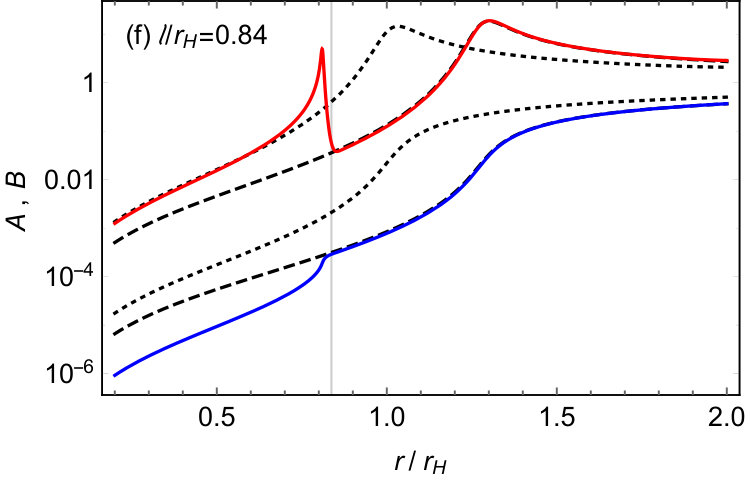 Figure 6
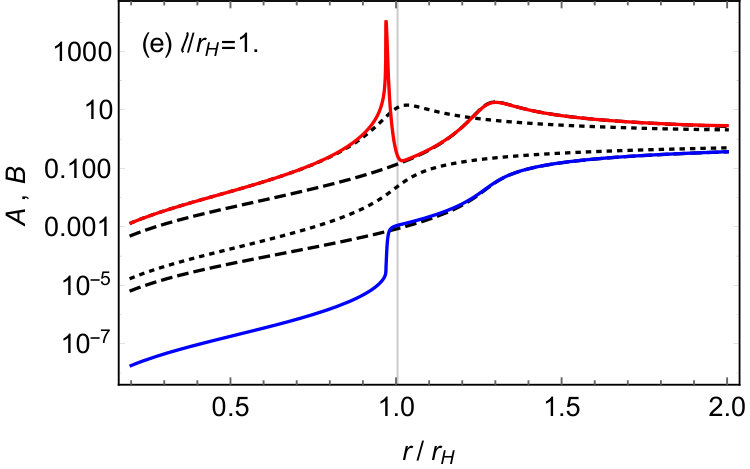 Figure 7
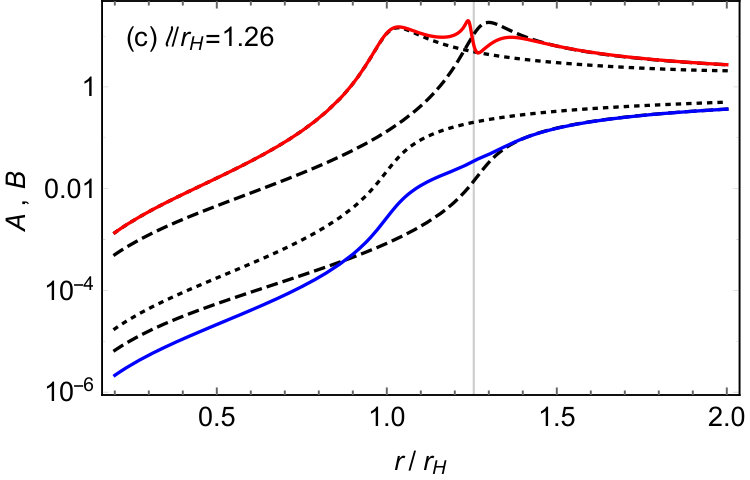 Figure 8
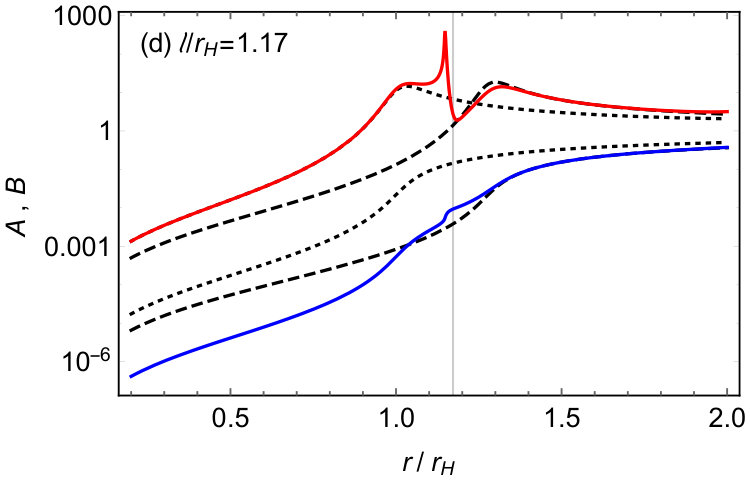 Figure 9
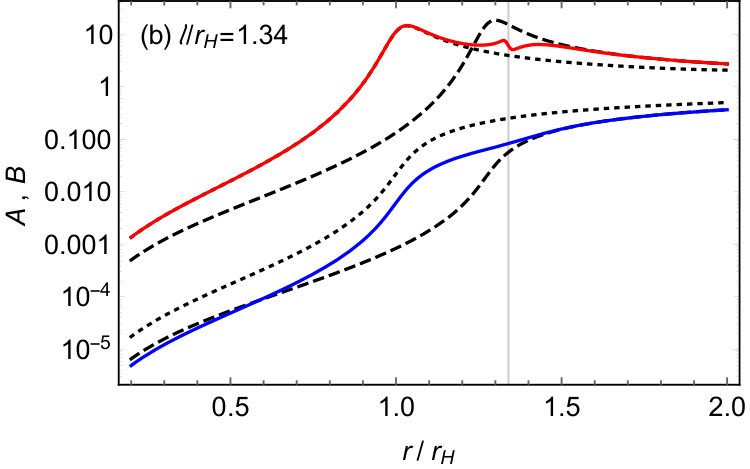 Figure 10
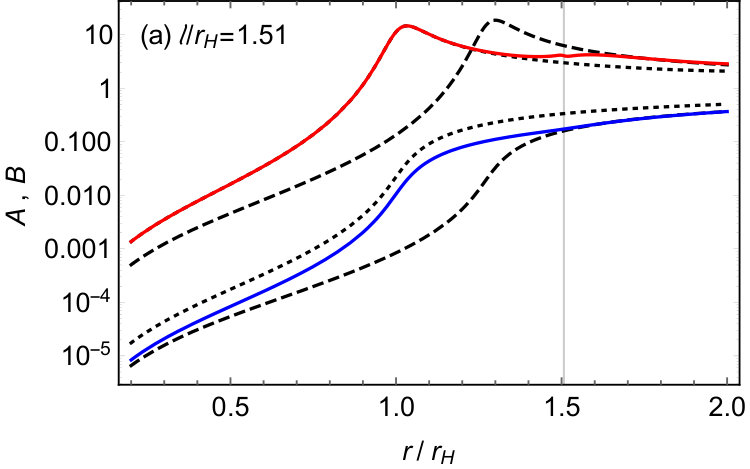 Figure 11
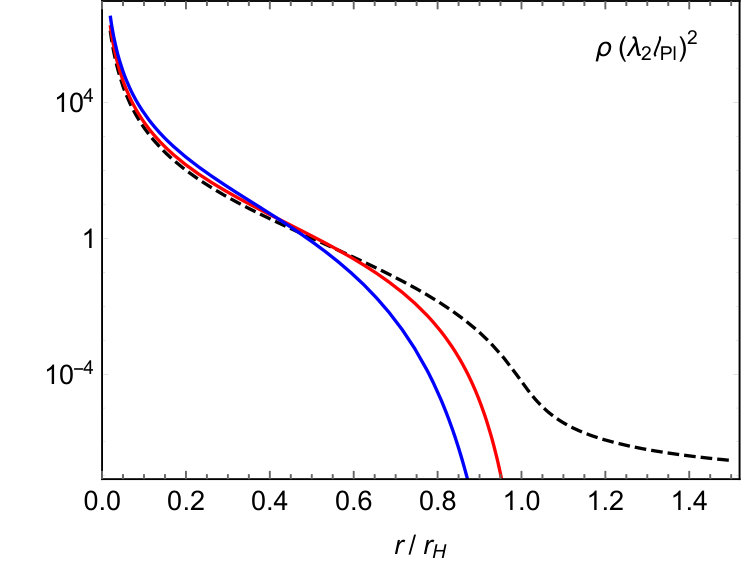 Figure 12
| Scales relation | Metric | Curvature | Temperature | ||||
|---|---|---|---|---|---|---|---|
| Large mass | , | ||||||
| Small mass | , | ||||||
| Naive scaling | / | , |
Peer Reviews
No public reviews on file for this paper yet. If you reviewed it on a platform where reviews are public (OpenReview, ICLR, NeurIPS, ICML), you can paste yours below so the community can read it here.
Videos
No videos yet. Explain this paper in a talk, walkthrough, or lecture? Add one.
Anatomy of a thermal black hole mimicker
Jing Ren
Institute of High Energy Physics, Chinese Academy of Sciences,
Beijing 100049, China
Abstract
We are entering a new era to test the strong gravity regime around astrophysical black holes. The possibility that they are actually horizonless ultracompact objects and then free from the information loss paradox can be examined more closely with observational data. In this paper, we systematically develop a thermal gas model of the 2-2-hole in quadratic gravity, as one step further to look for more tractable models of black hole mimickers. Concrete predictions for departures from black holes are made all the way down to the high curvature interior. The simple form of matter further enables an explicit study of the relation between geometry and thermodynamics. Within this unified framework, we identify notably different behaviors at two limits. On one side is the astrophysically large 2-2-hole, as characterized by a minuscule deviation outside the would-be horizon and a highly squeezed interior along the radial direction. Anomalous features of black hole thermodynamics emerge from the ordinary gas. On the other side is the minimal 2-2-hole with an isotropic and shrinking interior, which behaves more like a normal thermodynamic system. This brings a new perspective to the related theoretical questions as well as phenomenological implications.
I Introduction
Until very recently, we learned about the strong gravity regime around astrophysical black holes mainly through extrapolation from the observation at rather large distance, given that ultracompact objects in general relativity (GR) can only be black holes as described by the Kerr-Newman metric. The detections of gravitational waves from compact binary mergers for stellar-mass black holes LIGOScientific:2019fpa and the first image of a supermassive black hole with the shadow Akiyama:2019cqa open new windows for the exploration at horizon scales. The consistency of current measurements with GR predictions pushes the constraint down to the photon sphere outside the horizon, while little can be said about the plausible departures at a much closer distance.
Theoretically near horizon modifications are expected to resolve the long-standing black hole information loss paradox tHooft:2016fzb . One extreme possibility is that the horizon formation might be halted due to some new physics, and gravitational collapse actually ends up with a horizonless ultracompact object that deviates from a black hole only at a minuscule distance outside the would-be horizon. Many candidates are proposed along this line, such as fuzzballs Mathur:2005zp and gravastars Mazur:2004fk . Some of them make intriguing connections to quantum gravity. 111Macroscopic quantum gravity effects at the wound-be horizon are also possible, as discussed in Dvali:2011aa ; Giddings:2012bm . However, given the large hierarchy between the Planck scale and the curvature scale around a macroscopic horizon, quantum gravity effects are normally not expected at the horizon scales. Not much insight has been provided for this question yet. Moreover, well-motivated and concrete predictions for departures from black holes are still lacking. The new era of observational astronomy provides us a great chance to look for the related new phenomena, e.g. gravitational wave echoes Cardoso:2016oxy , tidal love number Cardoso:2017cfl and so on. Developing more tractable models for horizonless ultracompact objects is then strongly motivated. See Cardoso:2019rvt for a status report on horizonless ultracompact objects, including relevant observational constraints and existing theoretical models.
Quantum quadratic gravity was known to be a renormalizable and asymptotically free quantum field theory of gravity for decades Stelle:1976gc ; Voronov:1984kq ; Fradkin:1981iu ; Avramidi:1985ki . The notorious ghost problem as related to the higher derivative terms nonetheless prevents it to be accepted as a UV completion to GR. Although the critique based on the classical picture seems quite convincing, quantum mechanism might be crucial for the final words.222In the path integral formulation of quantum field theory, the measure could be as important as the classical Hamiltonian, and the physical spectrum shall be determined by the dressed-propagator. There is an ongoing effort to resolve the problem by taking quantum corrections seriously. Solutions depend on the strength of running gravitational couplings for quadratic curvature terms at the mass scale of classical modes. If couplings remain weak, the ghost pole may be removed systematically by modifying the quantum prescription Lee:1969fy ; Tomboulis:1977jk ; Grinstein:2008bg ; Anselmi:2017yux ; Donoghue:2018lmc or the probability interpretation Bender:2007wu ; Salvio:2015gsi . If couplings already become strong at some higher scale, say for a pure quadratic action defined at the UV, there is the possibility that the strong gravity dynamically generates the Planck scale and removes the would-be ghost simultaneously Holdom:2015kbf ; Holdom:2016xfn . More discussions of the theory can be found in Salvio:2018crh ; Holdom:2019 .
In comparison to other candidates of quantum gravity, quadratic gravity provides a weakly coupled field theory description for gravity at the high energy scale, and so a more tractable framework to study high curvature effects around macroscopic black holes. To be specific, a classical action (classical quadratic gravity) is used to find nontrivial background solutions as approximations to configurations in the quantum theory,
[TABLE]
The dimensionless couplings determine the mass scale and for the new spin-2 and spin-0 modes respectively. In the weak couplings scenario, where and , eq.(1) shows the action when the Planck mass has been generated by the scalar vacuum expectation value Salvio:2014soa . It is also a good approximation at super-Planckian curvature. A smaller upper bound TeV is further motivated by the Higgs boson hierarchy problem. To not ruin the precision test of GR in the solar system, it is safe to have eV, for which the Compton wavelength is no larger than . In the strong coupling scenario, there is only one mass scale in the theory, so we have and . The classical action (1) has the same limit as the quantum theory for both small and large curvatures Holdom:2015kbf ; Holdom:2016xfn ; Holdom:2016nek . 333The logarithmic running of dimensionless couplings at high energy is a subleading effect and ignored here.
As been found in our earlier work Holdom:2016nek , a compact matter distribution doesn’t necessarily lead to the formation of horizon in classical quadratic gravity (1). Actually, a new family of horizonless solution appears when matter distribution shrinks within the would-be horizon . We called this new type of solutions the 2-2-hole, given that the metric vanishes as when approaching the origin. 444The black hole solutions still exist Lu:2015psa , which go to the GR limit when the quadratic curvature terms are turned off. Here we focus on the new family of horizonless solution that has no analogue in GR. Focusing on the strong gravity scenario Holdom:2016nek , we found that an astrophysical 2-2-hole closely resembles the Schwarzschild metric at large distance with exponentially small corrections from new massive modes. Drastic deviations occur at about Planck distance outside the would-be horizon, as determined by the unique scale in the action. Inside a narrow transition region, the metric quickly approaches the characteristic behavior without changing the sign. This implies a rather deep gravitational potential for the interior, the radial proper length of which shrinks to be only the order of Planck length. The curvatures also quickly become super-Planckian and reach a curvature singularity at the origin. This may cause the geodesic incompleteness problem for point particles. But given the quantum nature of particles, waves with finite energy might be more appropriate to consider as probes for such extreme conditions. We found that the 2-2-hole time-like singularity can appear regular for the wave. With a unique boundary condition automatically imposed at the origin, there is no ambiguity of its time evolution. This boundary condition is furthermore of a perfectly reflecting type and plays an essential role for generating gravitational wave echoes and for the microscopic state counting Holdom:2016nek ; Holdom:2019 . As a candidate for horizonless ultracompact objects, the 2-2-hole then stands out for two reasons. Instead of what the naive dimensional analysis suggests, microscopic deviations around a macroscopic would-be horizon are shown to be possible, as driven by the new quadratic curvature terms. Also it features a novel interior as compared to a star.
Our previous study found 2-2-holes sourced by a thin-shell of matter with exotic equation of state at a small shell radius . This helps identify crucial properties of 2-2-holes as described above, but less can be learned for the relation between geometry and matter properties. If 2-2-holes serve as a general description for the endpoint of gravitational collapse, it shall not depend that much on the explicit form of matter. Moreover, with the high curvature inside, infalling matter shall be easily disrupted by the tidal force. The gas particles are further thermalized and reach equilibrium after a certain time. Recently 2-2-holes sourced by the relativistic thermal gas have been found numerically Holdom:2019 . This provides an interesting physical model of 2-2-holes with a quite simple matter source. In particular, it enables the study of 2-2-hole thermodynamics as an ordinary system, similar to that for self-gravitating radiation in GR Sorkin:1981wd . The difference is that now radiation is able to support an ultracompact configuration in equilibrium without collapsing into a black hole due to the extra quadratic curvature terms. It is then natural to make comparison with black hole thermodynamics, the origin of which is still mysterious and is thought to be closely related to the information loss paradox Harlow:2014yka ; Polchinski:2016hrw .
In this paper, we systematically study the thermal gas model for 2-2-holes. The Weyl tensor term turns out to be essential for the existence of 2-2-holes, while the term plays little role. So we focus on 2-2-holes in the Einstein-Weyl theory with in (1). The spin-2 mass (or its Compton wavelength ) is then the only free parameter, which we allow to vary in a wide range to account for both the weak and strong coupling scenarios of the quantum theory. The thermal gas in equilibrium entails a quite compact matter distribution and can always source a 2-2-hole. The solution is determined by the relative difference between the object’s size and the Compton wavelength . A 2-2-hole always exists in the large mass limit . It is characterized by a quite narrow transition region and a highly curved interior squeezed along the radial direction as described above. Some intriguing features of black hole thermodynamics can be reproduced in this limit. When becomes comparable to , the 2-2-hole has a much broader transition region and a rapidly shrinking interior. The resemblance to black hole thermodynamics ceases to apply. The solution no longer exists when , as we might expect from the uncertainty principle. This paints a more complete picture for 2-2-holes, with rich implications for phenomenology.
The rest of the paper is organized as follows. The 2-2-hole sourced by the relativistic thermal gas is studied in Sec. II, where we thoroughly explore the solution space by keeping the full dependence on all relevant scales. Their properties in the large and small mass limits are discussed in Sec. II.1 and Sec. II.2 respectively, including the interior scaling behaviors for the metric and thermodynamic variables, and also the physical implications. In Sec. III we study some variations of the relativistic thermal gas model. A generalization to the thermal gas with nonzero particle mass is discussed in Sec. III.1, where we check how thermodynamic variables change with matter properties. Sec. III.2 considers a 2-2-hole perturbed by a matter shell. It serves as a toy model to see how 2-2-holes grow slowly with matter accretion. We conclude in Sec. IV. The field equations in the Einstien-Weyl theory are summarized in Appendix. A. The series expansions for 2-2-holes in the thermal gas model are presented in Appendix. B.
II Relativistic thermal gas model
The endpoint of gravitational collapse in quadratic gravity could be a 2-2-hole filled with hot gas particles in thermal equilibrium. For a static and spherically symmetric spacetime, we can always choose a coordinate system with the following line element
[TABLE]
The metric functions are determined by two field equations, i.e. (24) in the Einstein-Weyl gravity. In this coordinate system, a 2-2-hole is defined by the following characteristic leading order behavior of the metric under the series expansion around the origin,
[TABLE]
The metric is vanishing at the origin and it has no analog in GR.
The stress tensor of a thermal gas is described by the proper energy density and the isotropic pressure,
[TABLE]
where and is the locally measured temperature. denotes the number of particle species. is for boson and fermion respectively. The total energy and entropy of the thermal gas are,555As mentioned in Sec. I, the quantum nature of particles shall be taken into account, and they are neither emitted nor absorbed by the singularity Holdom:2016nek ; Holdom:2019 .
[TABLE]
The stress tensor has to satisfy the momentum conservation law: . For (II), it is
[TABLE]
where the derivative is with respect to .
In this section we focus on the relativistic limit, where the thermal gas particle mass is negligible. The stress tensor is then traceless , with the simple equation of state,
[TABLE]
For simplicity we use the numerical coefficients for here and absorb the small difference for cases into . The conservation law can be solved analytically, and the matter profile is determined up to a constant with , where . This corresponds to the Tolman’s law for the local temperature . The total entropy and energy of the relativistic thermal gas are then,
[TABLE]
As we will see below, the gas outside a 2-2-hole can be quite thin and cold. It then will be easily driven away from the equilibrium due to interaction with the environment. For such case, can be viewed as the temperature measured by an observer near infinity.
The field equations are greatly simplified for a traceless stress tensor. Substituting the conservation law, (24) becomes
[TABLE]
Without the Birkhoff’s theorem, the 2-2-hole solution can only be found numerically. Here the relevant scales are: the Planck length , the Compton wavelength for the new spin-2 mode , the would-be horizon size ( is the physical mass), a new emerging scale related to the interior , and the source property . The numerical solutions are found in the following way. For a given pair of , we do shooting from inside with the series expansion in (B) slightly away from the origin. The characteristic transition region can be seen at some radius. A unique is found by requiring the numerical solution to approach an asymptotically flat behavior. The would-be horizon size is further obtained from a fit of the solution with a Schwarzschild metric at large . 666We do the fit at a large enough , where the exponentially small corrections from are negligible.
To have a better idea about the solution space, we can rewrite the metric as functions of a dimensionless ratio , where denotes some typical size. As we will see below, a convenient choice of is the size of the 2-2-hole interior, which is or in different regions of the parameter space. The two field equations then become
[TABLE]
where denotes dimensionless quantities. This shows that a class of 2-2-hole solutions for as functions of is defined by and . Since the two constants are related by the asymptotic flatness condition, the relativistic thermal gas model is described by a one-parameter family of solutions.
Fig. 1 presents metric and matter properties as functions of for selected solutions in the one-parameter family, as labelled by the value of . There is also a one to one correspondence to the value of that increases with respect to . In the large mass limit, and , the solution has a narrow transition region around the would-be horizon, as characterized by the peak sitting slightly outside . The ratio denotes the radial speed of light and determines the time delay for external probes of the 2-2-hole interior Holdom:2016nek . The peak position is also where the Weyl tensor square vanishes, given that for the Einstein-Weyl theory with . The transition region connects the low curvature exterior as closely resembled by the Schwarzschild metric with the high curvature interior where quickly approaches a constant. With the object’s size more comparable to the Compton wavelength , there are larger corrections around , and drops rapidly. In the small mass limit, and , the peak is pushed well within the would-be horizon, and we see a broader transition region stretching roughly from to . The interior shrinks drastically in all directions and the radial speed of light falls even faster. No solutions are found for . Therefore, unlike many other ultracompact objects, a 2-2-hole can be arbitrarily heavy, but it has a minimum mass with and .
For the thermal gas, its local temperature grows at smaller radius and reaches infinity at the origin. This corresponds to a quite compact matter distribution and naturally guarantees a 2-2-hole solution. If to compare with the thin-shell model Holdom:2016nek , it is similar to the case where the shell is deep inside. Although the temperature blows up at the origin, the integrand in (8) approaches a finite constant with . The total entropy and energy for 2-2-holes, which shall be defined from the origin up to somewhere close to the would-be horizon, then remain finite. As mentioned before, can be viewed as the temperature measured at infinity no matter whether the gas remains in equilibrium or not outside the object. When is higher than that of the cosmic microwave background, the 2-2-hole will radiate like a normal object. For decreasing , we see first increases and then decreases, in contrast to a monotonic behavior for a black hole.
Apparently 2-2-holes in the large and small mass limits are qualitatively different. Moreover they are governed by distinct scaling behaviors at the leading order, which relate the interior solutions at different . Tab. 1 summarizes some essential properties of spacetime and matter under two different scalings. Basically four (five) length scales are relevant. In the large mass limit, the 2-2-hole is characterized by the would-be horizon size and the Compton wavelength . In the small mass limit, the behavior is controlled by the new scale instead (and the normalization scale ). For both cases, matter properties depend on the Planck length in addition. For comparison, we also include the naive scaling for self-gravitating radiation in a box of radius of order . In the following, we discuss the features in Fig. 1, the meaning of Tab. 1 and their physical implications in detail for these two limits respectively.
II.1 Large mass limit
The novel scaling behavior for large 2-2-holes with has already been noticed before Holdom:2016nek . Here we generalize previous results by keeping the full dependence on all dimensional scales, without assuming . This limit also applies to a given size 2-2-hole when , i.e. the decoupling limit of the massive mode. 777In the quantum theory, implies large quantum corrections from strong gravitational couplings, and the decoupling limit in the classical theory might be irrelevant. The typical size is identified with for the 2-2-hole interior. At the leading order, the following dimensionless quantities are found to be only functions of ,
[TABLE]
where denotes some curvature invariant of dimension . That is, for different 2-2-holes in the one-parameter family with , these combinations as functions of appear the same for the interior to a very good approximation. This corresponds to for the expansion coefficients, and the scales relation . So the metric falls rapidly in the large mass limit, and the radial proper length for the interior scaling region reduces dramatically in comparison to the angular one . actually becomes decoupled from at the leading order and is only of the order of . The curvature invariants at the interior boundary are fixed by as well. These novel properties of interior geometry result from the interplay between its size and the external scale . The scaling of is determined by the normalization rather than field equations, and it turns out to be the same as . The radial speed of light in the interior then doesn’t change for different .
With increasing , the boundary of the interior scaling region moves towards and the transition region becomes narrower. The later is characterized by the peak at (also roughly the place that a significant deviation from Schwarzschild metric can be seen) that is slightly outside the would-be horizon, with . From numerical solutions we find a rapidly growing peak with and Holdom:2016nek . This implies a dip of the radial speed of light, and the transition region gives the dominant contribution to the time delay for an external probe. Fortunately the time delay only has a logarithmic dependence on the large ratio, . For an astrophysically large 2-2-hole, it remains quite accessible, i.e. . There is then the hope to detect a Planckian distance deviation outside a macroscopic horizon by gravitational wave echoes.
For the relativistic thermal gas, its interior local temperature is a function of . With metric properties in (11), we find the following scalings for the temperature at infinity and the interior contribution to the total entropy and energy,
[TABLE]
Some familiar properties of black holes thermodynamics, , , , now arise as a result of classical thermodynamics of ordinary matter source for the 2-2-hole background. To see the difference more clearly, it is useful to make comparison with the naive expectation. Imagine a black hole formed by compressing a relativistic thermal gas into a volume as defined by the horizon size. With the naive scaling, the gas contribution to the black hole energy and entropy has: and . To have , we find and then Sorkin:1981wd . When , this is apparently too small to account for the Bekenstein-Hawking entropy for the black hole. While for the 2-2-hole, the novel scaling leads to quite different expressions: , , and the enormous entropy scaled with the area and can be realized simultaneously as in (12). Two factors play the role here. Firstly, large gravitational redshift in the interior gives additional suppression to energy in comparison to entropy. As a result, the hot gas temperature doesn’t decrease with the object’s large size . Secondly, with , the squeezed interior volume receives the dominant contribution from the region close to the boundary and scales effectively as the area. Therefore, we see an intriguing connection to the original attempts that attribute the black hole entropy to its thermal atmosphere around the horizon. In contrast to the old proposals, such as the brick wall model tHooft:1984kcu and the stretched horizon Price:1986yy , the thermal gas responsible for entropy here is exactly the matter source for the background spacetime, with the distribution fully determined by the conservation law. Many problems are then avoided.
With explicit dependence on the ratio and the number of particle species , the numerical values of thermodynamic variables are different from black holes in general. The 2-2-hole entropy and energy can be defined by the integration in (8) up to , and it is still dominated by the interior contribution. Including numerical factors, we find
[TABLE]
is the Hawking temperature and is the Bekenstein-Hawking entropy. Although depend on , explicitly, their product , which sources the background spacetime, does not. The scaling law in the large mass limit further indicates . Interestingly, the numerical value is found to approach that for the black hole with precision,
[TABLE]
This leads to the same as in the brick wall model, where the UV cutoff is chosen to reproduce the Bekenstein-Hawking entropy tHooft:1984kcu . Therefore, the physical mass of a large 2-2-hole has a sizable fraction from the gas energy , with the gravitational field contribution being comparable. The numerical coincidence (14) is also related to the first law of thermodynamics,
[TABLE]
This is expected given that is no different from a normal entropy. 888In principle there shall be the work term from the gas in (15). But with the boundary in the exterior region, is highly suppressed when and is negligible. Similarly a configuration with larger entropy shall be more stable from the second law of thermodynamics. In the strong coupling scenario , the entropy of a 2-2-hole can easily surpass that of the same mass black hole with a reasonable , say for the Standard Model particles. So a 2-2-hole rather than a black hole, which is still a solution in classical quadratic gravity, is more likely to be the endpoint of gravitational collapse.999Here we restrict to 2-2-holes with only even power terms in the series expansion. More general solutions could have a larger entropy, but still with similar features.
Given the absence of a horizon, we shall also expect the generalized second law of thermodynamics for the 2-2-hole. It is nonetheless interesting to see how the general argument used for black holes works here Wald:1995yp ; Wald:1999vt . Imagine lowering a box of matter with entropy toward the ultracompact object and allowing matter fall into the object at some point. A distant observer has to hold the box (say with a rope) to make this an quasi-static process. Assuming no generation of entropy, the optimal place to release the matter is to have the minimal energy deposit to the object and then the minimal entropy increase. Considering also the pressure from the thermal gas, this place is found somewhere outside the would-be horizon, with the minimal mass increase , where is the local entropy density for the thermal gas and is the box volume. With the first law (15), the minimal entropy increase remains the same as that for the black hole Wald:1995yp . Given that the relativistic thermal gas has the maximum entropy at a given energy and volume, the minimal change of total entropy stays positive.
So far all discussions of thermodynamics are for the classical source of the 2-2-hole. Once including quantum corrections, the renormalized vacuum energy density normally gives additional contribution to the stress tensor. For a horizonless and static spacetime, the Boulware vacuum is a natural choice. It is defined with respect to the Killing time, and has growing negative vacuum energy density in the high redshift region. To have negligible backreaction to the metric, a “topped-up" Boulware state with hot quantum fields excitations is constructed, where the field temperature is roughly Mukohyama:1998rf . The thermodynamics of hot quantum fields is very similar to what we derived here for the thermal gas Holdom:2016nek . With this additional contribution, shall be larger than what we found above for the classical gas source.
II.2 Small mass limit
When becomes comparable to , the metric grows large in the interior and we see significant deviation from the large mass behavior in Fig. 1. In this small mass limit, the 2-2-hole interior size is characterized by the decreasing scale instead. As we can see from the series expansion in (B), contribution from becomes negligible when . So a different scaling law emerges, with the only essential scale. At the leading order, we find following dimensionless quantities being functions of ,101010The Weyl tensor square is one exception. With a cancellation at the leading order, is a function of .
[TABLE]
The radial proper length for the interior now scales the same as the angular one. The curvature invariant at the interior boundary is characterized by as well. Except for the normalization as defined by , (16) is quite similar to the naive scaling that is governed by a unique length scale, and it can be deduced from (11) with both identified as . The normalization scale is found to increase exponentially for smaller , with . This implies an extremely deep gravitational potential in the small 2-2-hole interior and a tremendous redshift.
We find that the would-be horizon is quite insensitive to in the small mass limit. As less compact objects, visible deviations from the Schwarzschild metric occur at a distance of the order of outside the would-be horizon. With the peak pushed further from and more towards , the broad transition region stretches roughly from to , and the curvature is characterized by . As shown in Fig. 1, the transition region has a quite asymmetric shape. The ratio still quickly approaches a constant in the interior, but its value now grows together with the large peak due to different scalings of . This corresponds to an exponentially falling radial speed of light. A significant amount of time delay for an external probe then comes from the interior. Since it scales exponentially with the large ratio , as opposed to the large mass limit, the time delay will soon surpass the age of the universe.
The interior temperature for relativistic thermal gas remains high, with the combination a function of . The scalings for the temperature at infinity and the interior contribution to entropy and energy now go like,
[TABLE]
Due to the large redshift, drops dramatically for smaller objects. This leads to a positive heat capacity, , as classical thermodynamic systems. For the entropy, the interior contribution still dominates over the transition region. Since the radial and angular proper lengths both scale with , the area law no longer applies. Actually, the entropy appears just like what we naively expect and falls rapidly with the size of small objects. Given the discrete nature of particles, might not approach zero continuously. The minimum 2-2-hole with nonvanishing entropy shall have . The product now almost decouples from and becomes far smaller than the physical mass . In other words, the gravitational field energy dominates in this limit and the gas contribution is almost negligible. The first law of thermodynamics is still approximately true. 111111The work term is even more suppressed in the small mass limit and totally negligible. Given the exponentially falling and numerical errors in fitting , the first law can only be confirmed at a much worse precision. But assuming its validity, , we can find as a function of . When approaches zero, does vary extremely slow with .
A large 2-2-hole hotter than the cosmic microwave background will radiate like a black hole. The evaporation becomes faster for smaller objects due to the negative heat capacity. The behavior changes at and , when reaches a maximum around . Below this temperature, the heat capacity turns positive, and both the evaporation rate and the temperature drop significantly. So instead of an explosion in the standard picture for black holes, a small 2-2-hole becomes colder and evaporate slower at the late time. At certain point, it appears stable for the age of the universe. The cold remnant with mass could then serve as a dark matter candidate. In the strong coupling scenario of quantum theory, and , this naturally gives rise to a Planck-sized remnant. While in the weak coupling case with , the remnant could be much larger and heavier. Different thermodynamic behaviors for small 2-2-holes may have interesting implications for dark matter phenomenology. 121212Primordial black hole mimickers as dark matter candidates are also discussed for nonlocal stars Buoninfante:2019swn and wormholes Damour:2007ap ; Berthiere:2017tms .
The existence of a lower mass bound for 2-2-holes may have some relation to the uncertainty principle. As a familiar candidate for exotic compact objects, a boson star is commonly viewed as a macroscopic quantum state controlled by the uncertainty principle revBS1 ; revBS2 . The simplest case is a mini-boson star composed of free massive scalar bosons, which reaches the minimal radius at the maximal mass (the stable branch) with . The fact that the object size is no smaller than the Compton wavelength of the massive modes then implies . A 2-2-hole reaches the minimal radius at the minimal mass instead. A similar form of mass then suggests a direct connection between the lower bound and the uncertainty principle.
III Variations
III.1 General thermal gas model
The most straightforward generalization of the relativistic thermal gas model with is to include nonzero particle mass. The energy density and pressure in (II) are then
[TABLE]
As before we approximate by expressions for case,
[TABLE]
with small difference for absorbed in . is modified Bessel function of the second type. In the zero mass or infinite temperature limit, and is recovered.
Since the ratio is dependent for nonzero mass, three variables need to be simultaneously solved from field equations (24) and the conservation law (6), with and defined by in (18). As long as the temperature blows up at the origin, the leading order behavior of the series expansion remains the same as the massless case,
[TABLE]
and mass corrections only enter at subleading orders. For a given and , we find the numerical solution in a similar way by shooting from inside, and is fixed by the demanding asymptotic behavior. If all variables are written as functions of , field equations would have similar structure as (10), with replaced by . A class of solutions for as functions of is then defined by three dimensionless constants and . With the asymptotic flatness condition, the 2-2-hole sourced by a general thermal gas is a two parameters family of solutions.
Nonzero mass corrections become important when is comparable to the gas temperature at some radius in the interior. Outside this radius, the gas becomes non-relativistic and the ratio drops significantly. To reach the same physical mass, a higher interior temperature (a larger ) is needed, and a larger density in the relativistic region compensates the declining contribution from the non-relativistic region, as in Fig. 2. We note that the relation remains a very good approximation for a general . This can be seen by solving the conservation law in the opposite limit . At the leading order, with and , (6) is reduced to too. The Tolman’s law then applies at both small and large radii. Since the mass dependence comes mainly through the ratio in the interior, there are the same scaling behaviors as in Tab. 1 for a given and in the large and small mass limits respectively.
We can calculate the total entropy for the general thermal gas model with the same formula (II). There is still the area law in the large mass limit . As shown in Fig. 2, with increasing , the contribution from the relativistic region goes up and the one from the non-relativistic region drops down. The total entropy results from their competition. Within numerical errors, we find that various thermodynamic variables remain quite close to their values for the massless case (13).131313We have checked this for and . It is harder to find numerical solutions for a large because the shrinking relativistic region requires a smaller starting point and a higher accuracy for the shooting method. For example, , increase very slowly with , while decreases with a similar speed if to satisfy the first law of thermodynamics. It is safe to say that thermodynamic variables for the 2-2-hole is quite insensitive to the particle mass, although the interior matter distributions do vary drastically. In reality a thermal gas may include particles of different masses. The Standard Model particles can be treated as massless if TeV. New heavy particles that are inaccessible with the existing experimental techniques might be trapped in the 2-2-hole interior, but have little impact for the outside.
As a final remark, the 2-2-holes can be sourced by more general matter distributions. For a spherically symmetric configuration, the stress tensor may naturally have anisotropic pressure as in (28). As long as the stress tensor is traceless, we find the same leading order behavior for the series expansion as the thermal gas model, i.e. . A larger corresponds to a more compact matter distribution. When is not too small, we do find 2-2-hole solutions. Various parameters can change by some amount, but crucial features like the scaling behavior remain similar as for the thermal gas model. A more physical model of anisotropic pressure is a complex scalar theory with revBS2 . Solving the scalar field equation of motion under series expansion, the leading order behavior for the stress tensor can only be or . The former is too singular to maintain the original expansion for the metric. While the later seems too soft and we fail to find numerical solutions by the shooting method. It seems the behavior is crucial for the existence of 2-2-holes for continuous matter sources. More details on the anisotropic stress tensor can be found in Appendix. C.
III.2 Perturbation from a matter shell
Once a 2-2-hole has been formed, it can grow with matter accretion. It has been argued that the compactness of horizonless objects can be constrained in some rather model-independent way from its response to matter accretion Carballo-Rubio:2018vin . We want to see how a 2-2-hole will grow, and the relevance of these general arguments.
For this purpose, we perturb a 2-2-hole sourced by the relativistic thermal gas by a matter shell at some radius , to model a slow accretion of matter. Since the perturbed configuration receives the dominant contribution from the relativistic thermal gas, we can find a series of static 2-2-hole solutions for a wide range of as long as the thin-shell mass remains subdominant. This is in contrast to our previous thin-shell model, where 2-2-holes only exist when Holdom:2016nek .
For simplicity, we consider a narrow width perturbation with vanishing radial pressure, i.e. , which satisfies the momentum conservation law: . The field equations (24) then become,
[TABLE]
Here the perturbation is assumed to be a Gaussian density profile with some small width , , which approaches a thin-shell when . Assuming negligible interaction between the relativistic thermal gas and the shell, we keep the same as the original unperturbed 2-2-hole with the would-be horizon . For each and , we then find the solution by tuning for the demanding asymptotic behavior, and the perturbed size is found from the numerical fit.
For a given pair , there is then a unique static perturbed 2-2-hole at each . We use this to model a quasi-static process of a matter shell slowly falling into a large 2-2-hole. Fig. 3 shows of perturbed 2-2-holes for decreasing , in comparison to the original and new unperturbed 2-2-holes with the would-be horizon and respectively. For illustration we choose a large shell perturbation with the fraction a few ten percent. For realistic cases, the fraction could be much smaller and the transition region is much narrower. When , we see relatively small impact from the matter shell. The transition region agrees with the original 2-2-hole around , while at large radius it is well approximated by the Schwarzschild metric with . When , the transition region is significantly deformed by the matter shell. We see deviation from the original 2-2-hole around and recovery of the new 2-2-hole around . When , the solution becomes indistinguishable from the new 2-2-hole outside the shell, while it is more similar to the original 2-2-hole inside the shell. With the shell moving inwards, the scales related to the interior also change.
This shows explicitly the response of a 2-2-hole to a matter shell, in particular the change of the transition region. In some toy models of horizonless ultracompact objects, the transition region is simply assumed to be a matter surface close to the would-be horizon. Given the causality constraint on the growth rate of the matter surface, an upper limit on the compactness of horizonless object is derived in Carballo-Rubio:2018vin . Basically, if matter accretion proceeds too fast, the surface expansion in the large redshift region cannot catch up with the growth rate of the would-be horizon, and the object will turn to a black hole. The perturbed 2-2-hole as shown in Fig. 3 provides a counter-example for such arguments. Instead of an expanding surface, the transition region of the 2-2-hole varies in a rather complicated way for a series of . Since the thermal gas density drops dramatically outside , the change is mainly for the background spacetime, which shall be free from the causality constraint. As is well known in cosmology, the expansion of universe could safely be superluminal.
The matter shell perturbation for fixed has similar properties to the thin-shell model Holdom:2016nek . The equation of state , as determined by the momentum conservation law , increases with respect to and violates the dominant energy condition at some intermediate radius. It reaches a maximum around and then declines as for the Schwarzschild metric. If the shell moves from one radius to another with time-dependent , we have also checked that the stress tensor satisfies the energy conservation law 141414The law is for the properly normalized density . within numerical errors.
Given the special equation of state for the matter shell, we cannot directly calculate its entropy. However it shall be smaller than entropy of the relativistic thermal gas with the same energy density, i.e. . This can provide a loose upper bound on the total entropy for the perturbed 2-2-hole. With decreasing , the thermal gas contribution declines from the original 2-2-hole value due to the shell’s backreaction on the spacetime, while the maximal contribution from the shell grows. The upper bound for the total entropy turns out to increase, with at and at some small , where denotes entropy of the new unperturbed 2-2-hole. Notice that we ignore interaction between the matter shell and the relativistic thermal gas in above discussion. In a more physical scenario, the interaction may become significant when the shell falls into the 2-2-hole interior filled with the high temperature gas. The shell then gets burned up and reaches thermal equilibrium with the gas after some time. The configuration ends up to approach the new 2-2-hole. This process shall respect the generalized second law of thermodynamics, and for is expected.151515In the limit of negligible interaction, for the shell deep inside implies an upper bound for its entropy.
IV Conclusion
The new era of observational astronomy provides a great opportunity to test horizonless ultracompact objects as black hole mimickers. Among all, the 2-2-hole in quadratic gravity is an interesting candidate. In this paper, we drew an overall picture for 2-2-holes as sourced by the thermal gas, which might more appropriately describe the final form of infalling matter during gravitational collapse. The metric and matter properties in the relativistic thermal gas model are illustrated in Fig. 1. The essential features are captured by the large mass and small mass limits, with different scaling behaviors summarized in Tab. 1.
As departures from black holes are restricted to be small in the exterior, astrophysical 2-2-holes are probably in the large mass limit . Their properties are determined by the macroscopic size as well as the microscopic scale . Black hole thermodynamics, such as the area law for entropy and the inverse mass dependence for temperature in (12), becomes an emergent phenomenon in this limit. The area law in particular results from the large hierarchy between the small radial proper length and the large angular one for the interior. The numerical values of thermodynamic variables are nonetheless different. A 2-2-hole can easily be entropically preferred over a comparable black hole and may serve as the endpoint of gravitational collapse. As a reference value, for stellar mass objects. So the astrophysical 2-2-hole interior literally approaches a firewall of negligible width, which is filled with the extremely hot gas. The singularity is sitting almost right at the would-be horizon. When the size of 2-2-holes becomes comparable to with , the behavior is governed by the other length scale , which describes its shrinking interior (and also the normalization scale ). As a result, the entropy scales more like what we may naively expect for the self-gravitating radiation inside a box, and the heat capacity turns positive as in (17). The departure from black hole thermodynamics suggests that a small 2-2-hole will become colder and radiate slower at the later stage of evaporation. Instead of an explosion, a burning 2-2-hole ends up with a small remnant with , which may naturally serve as dark matter. The first law of thermodynamics is realized differently in the two limits, with quite distinct energy budgets.
Note that the main discussion of 2-2-hole thermodynamics here is in the context of classical physics. It has nothing to do with quantum effects or specialties of the horizon as for the black hole. The fact that black hole thermodynamics emerges from that of ordinary matter at certain limit may shed a fresh light on the relation between geometry and thermodynamics. For example, it would be interesting to study the relevance of the entropy bound and the holographic principle in the context of horizonless objects.
As variations of the simplest model, we explored the impact of the gas particle mass on the solution. A large mass can significantly change the interior matter distribution as in Fig. 2, but the explicit values of thermodynamic variables such as gas temperature, entropy and energy are found to be quite insensitive to such details of matter. So the formation of a highly curved but horizonless region scrambles initial information of infalling matter to some extent and makes it less accessible from the outside. Unlike the black hole, there is no information loss. We also studied a series of configurations with a matter shell perturbation at different radii, as snapshots of a 2-2-hole with a slow accretion of matter. Fig. 3 provides an explicit picture for how the 2-2-hole spacetime (in particular the transition region) expands. In contrast to a hard surface as employed in some toy models, this is not subjected to the causality constraint. And there is no need to form a black hole.
We haven’t checked the radial stability for the thermal gas model in this work. Given that the 2-2-hole mass increases monotonically with the gas central density (say the term coefficient), it is tempting to speculate that all 2-2-holes stay at the same stability branch. Nonetheless, the commonly used variation principle for stability might not apply here. The characteristic frequencies of oscillation need to be checked explicitly. The instability as associated with the classical ghost mode on the other hand might be an artifact of the classical approximation, and shall be accounted for by quantum corrections in the full theory. The study of stability and dynamics is crucial for the question about the endpoint of a gravitational collapse in quadratic gravity. There are interesting phenomenological implications to explore. For gravitational wave echoes, the thermal gas in the 2-2-hole interior can lead to the damping of gravitational wave. This may provide a benchmark for the echo study, and possibly a resolution to the ergoregion instability for rotating horizonless objects. For the dark matter physics, primordial 2-2-holes in the small mass limit have very different thermodynamic behaviors. If they are the dominant dark matter constituent, current observational constraints can be changed and a new window may open.
Acknowledgements.
We would like to thank Bob Holdom for early collaboration and valuable discussions. This research is supported in part by the Institute of High Energy Physics under Contract No. Y8515560U1.
Appendix A Field equations in the Einstein-Weyl theory
The field equation in the Einstein-Weyl theory is Lu:2015psa ,
[TABLE]
is the traceless and symmetric Bach tensor,
[TABLE]
Since satisfies the Bianchi identity, there are only two independent equations from (22) for a static and spherically symmetric spacetime (2). And we choose the following two combinations,
[TABLE]
The first equation is the trace of (22). It depends only on the Einstein term and trace of the stress tensor,
[TABLE]
The derivatives are all with respect to . includes the essential contribution from the Weyl tensor term,
[TABLE]
where . The stress tensor is also more complicated
[TABLE]
is of second differential order in and first order in , while is of second order in and first order in . Such a symmetric pattern makes it easier to find numerical solutions Lu:2015psa .
With the spherical symmetry, a general stress tensor for matter is
[TABLE]
where are proper energy density and pressure. The stress tensor satisfies the momentum conservation law ,
[TABLE]
To solve the whole system, two more equations of state are needed to specify the relation of . The conservation law is of first differential order in matter properties.
For a given matter source, we then combine two field equations (24) and the conservation law (29) to find , where denotes one matter function after the other two eliminated by equations of states. Note that all equations are independent of a constant rescaling of (or equivalently a rescaling of ), corresponding to in the series expansion. For asymptotically flat solutions, this rescaling is fixed by the normalization . So in general the system can be solved with four initial conditions at some .
Appendix B Series expansion for the thermal gas model
The solutions in classical quadratic gravity can be classified by the series expansion around the origin ,
[TABLE]
There are three families of solutions as characterized by the powers of the first nonvanishing terms Stelle:1977ry . The family is nonsingular at the origin. The family includes the Schwarzschild solution as a special case. The family with vanishing metric at the origin is a new type of solution and also the most generic family in quadratic gravity Holdom:2002xy .
Here we focus on a subclass of 2-2-holes that has only even power terms in the series expansion. For the thermal gas model, the series expansion is governed by four quantities: the Compton wavelength for the new spin-2 mode , the gas particle mass , the new scale and the coefficient for the gas temperature . We list the first few terms in the following
[TABLE]
The parameter , as related to the normalization of , is determined by matching with the asymptotically flat solution at large radius with . We can see that the particle mass only enters at the subleading order. In the massless limit, we have
[TABLE]
where . The last two expressions satisfy the conservation law: .
In the large mass limit, (B) can be simplified by only keeping the leading order terms for
[TABLE]
where is the Euler constant. According the scaling behavior in the large mass limit in Tab. 1, we rearrange various scales into dimensionless quantities as , , , . The metric and temperature are then expansions of the small parameter , and agree at the leading order at different for a given set of .
In the small mass limit, we instead keep the leading order terms for in (B),
[TABLE]
Similarly we rearrange various scales into dimensionless quantities as , , , according the scaling behavior in the small mass limit in Tab. 1. Note the different definitions of in this case. It is simpler than (B) since the dependence is now reduced to dependence.
Appendix C Anisotropic fluid model
Under the spherical symmetry, a general stress tensor might be anisotropic as in (28). The momentum conservation law is then,
[TABLE]
Around the origin, with , the conservation law at the leading order is: . So the traceless condition directly gives rise to , the same leading order behavior as the thermal gas model. Implementing the traceless condition, the conservation law becomes,
[TABLE]
where is some function of . For smaller (larger) than 1, the matter distribution is less (more) compact than the relativistic thermal gas.
The complex scalar theory with revBS2 provides a concrete realization of the anisotropic stress tensor. Assuming , the stress tensor has
[TABLE]
where anisotropic pressure is related to the spatial variation of the scalar field . The momentum conservation law of stress tensor is equivalent to the scalar field equation of motion,
[TABLE]
Around the origin, it becomes at the leading order, and so . The solution implies . It turns out to be too singular and is no longer a solution. So only is allowed, with . For this more regular case, we haven’t found 2-2-hole solutions with the right transition region and asymptotic behavior by the shooting method. The lack of solution for the complex scalar field might be related to the fact that both field equations receive a dominant contribution from the nonzero trace.
The reference list from the paper itself. Each links out to its DOI / PubMed record.
- 1(1) B. P. Abbott et al. [LIGO Scientific and Virgo Collaborations], ar Xiv:1903.04467 [gr-qc].
- 2(2) K. Akiyama et al. [Event Horizon Telescope Collaboration], Astrophys. J. 875 , no. 1, L 1 (2019).
- 3(3) See a panel discussion and references therein, G. ’t Hooft, S. B. Giddings, C. Rovelli, P. Nicolini, J. Mureika, M. Kaminski and M. Bleicher, Springer Proc. Phys. 208 , 13 (2018) [ar Xiv:1609.01725 [hep-th]].
- 4(4) S. D. Mathur, Fortsch. Phys. 53 , 793 (2005) [hep-th/0502050].
- 5(5) P. O. Mazur and E. Mottola, Proc. Nat. Acad. Sci. 101 , 9545 (2004) [gr-qc/0407075].
- 6(6) G. Dvali and C. Gomez, Fortsch. Phys. 61 , 742 (2013) doi:10.1002/prop.201300001 [ar Xiv:1112.3359 [hep-th]].
- 7(7) S. B. Giddings, Phys. Rev. D 85 , 124063 (2012) doi:10.1103/Phys Rev D.85.124063 [ar Xiv:1201.1037 [hep-th]].
- 8(8) V. Cardoso, S. Hopper, C. F. B. Macedo, C. Palenzuela and P. Pani, Phys. Rev. D 94 , no. 8, 084031 (2016) [ar Xiv:1608.08637 [gr-qc]].