On some generalized Fermat curves and chords of an affinely regular polygon inscribed in a hyperbola
Herivelto Borges, Mariana Coutinho

TL;DR
This paper establishes bounds on the number of rational points on certain algebraic curves over finite fields, improving known bounds for chords of polygons inscribed in a hyperbola when specific linear series are Frobenius classical.
Contribution
It provides new upper bounds for rational points on generalized Fermat curves, linking algebraic geometry with combinatorial properties of polygons inscribed in hyperbolas.
Findings
Derived upper bounds for rational points on the curves.
Improved bounds for the number of chords passing through a point in polygons.
Established conditions under which the bounds are tighter.
Abstract
Let be the projective plane curve defined over given by where , and for each , let be the base-point-free linear series cut out on by the linear system of all curves of degree passing through the singular points and of . The present work determines an upper bound for the number of -rational points on the nonsingular model of in cases where is -Frobenius classical. As a consequence, when is a prime field, the bound obtained for improves in several cases the known bounds for the number of chords of an affinely regular polygon inscribed in a hyperbola passing through a given…
Click any figure to enlarge with its caption.
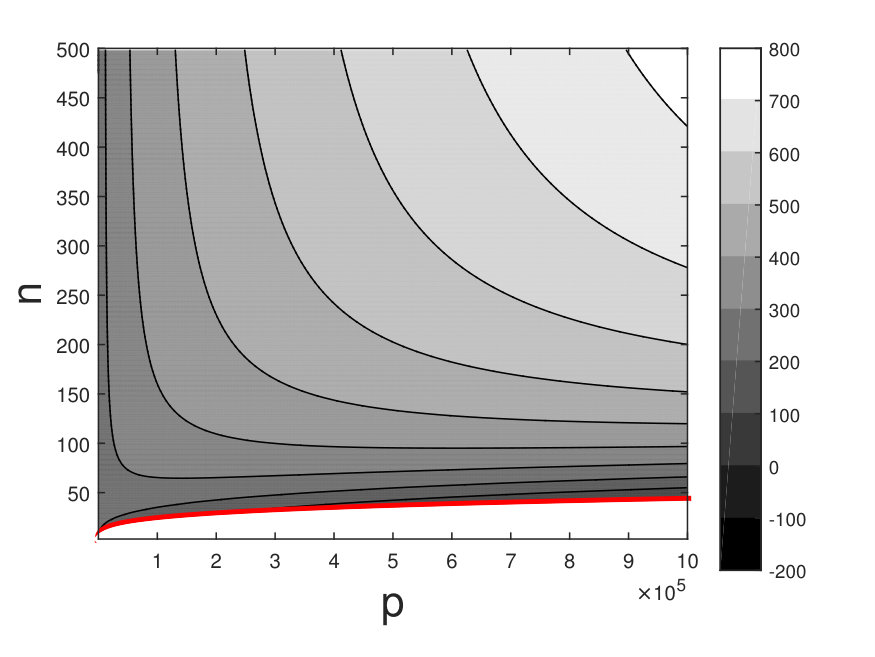 Figure 1
Peer Reviews
No public reviews on file for this paper yet. If you reviewed it on a platform where reviews are public (OpenReview, ICLR, NeurIPS, ICML), you can paste yours below so the community can read it here.
Videos
No videos yet. Explain this paper in a talk, walkthrough, or lecture? Add one.
On some generalized Fermat curves and chords of an affinely regular polygon inscribed in a hyperbola
Herivelto Borges and Mariana Coutinho Email address: [email protected]Email address: [email protected]
Abstract
Let be the projective plane curve defined over given by
[TABLE]
where , and for each , let be the base-point-free linear series cut out on by the linear system of all curves of degree passing through the singular points and of . The present work determines an upper bound for the number of -rational points on the nonsingular model of in cases where is -Frobenius classical. As a consequence, when is a prime field, the bound obtained for improves in several cases the known bounds for the number of chords of an affinely regular polygon inscribed in a hyperbola passing through a given point distinct from its vertices.
Mathematics Subject Classifications (2010): 11G20, 14G05, 51E15.
1 Introduction
Let be the finite field with elements, where is a prime number, and let be a (projective, nonsingular, geometrically irreducible, algebraic) curve of genus defined over . A fundamental problem in the theory of curves over finite fields is estimating the number of -rational points on . Apart from a few classes of curves (see [2], [13]), there is usually no explicit formula for . Nevertheless, some effective upper bounds for this number can be found in the literature. A famous example, given by the Hasse-Weil Theorem, is
[TABLE]
Another noteworthy approach to bound was established by Stöhr and Voloch in [14]. Their method, more geometric in nature, provides bounds that are dependent on the choice of an embedding of the curve in some , and which improve (1) in several circumstances (see [6], [14]).
For satisfying , let be the projective plane curve with affine equation given by
[TABLE]
This provides an example of a generalized Fermat curve, having recently been studied from the point of view of its automorphism group [3].
The number of -rational points on the nonsingular model of was first investigated in the context of Finite Geometry to study the number of chords of an affinely regular polygon in passing through a given point (see [1], [7]).
A nondegenerate -gon in the affine plane is a set of pairwise distinct points arranged in a cyclic order in such a way that no three vertices are collinear. Here every -gon is considered nondegenerate. If is a regular -gon in the Euclidean plane, then a -gon in the affine plane is affinely regular if the bijection preserves all parallelisms between chords (sides and diagonals).
It is well-known that every affinely regular -gon is inscribed in a conic, and for , either , or , or , according to whether the circumscribed conic is an ellipse, hyperbola, or parabola (see [4], [8], [11]). Moreover, if is large enough with respect to , then the chords of any affinely regular -gon cover most points of . The uncovered points are those remaining of the circumscribed conic and, in some cases, the center of the conic when this is either an ellipse or hyperbola (see [9], [10], [15]). This raises a natural question: what is the number of chords of an affinely regular -gon of passing through a given point distinct from its vertices?
In the particular case of such a -gon being inscribed in an ellipse (resp. hyperbola), it was shown that determining is equivalent to determine the number of rational affine points (resp. the number of rational affine points lying in an appropriate subset of the plane) of a curve of the form of curve (see [1], [7]). These relations give a connection between the problem of determining and that of studying .
The primary method used in [1] and [7] to give an upper bound for the number was the Stöhr-Voloch Theory. More precisely, in [1] Abatangelo and Korchmáros provided an upper bound for based on the choice of an embedding of in , and then on the study of its -Frobenius (non)classicality. Later on, Giulietti remarkably improved Abatangelo and Korchmáros’ bound by considering a suitable embedding of in [7]. Further, more recently, and also using the Stöhr-Voloch Theory, the number was investigated in [5] in the context of generalized Fermat curves.
Accordingly, in terms of the Stöhr-Voloch Theory, for and , the present work determines an upper bound for with respect to the morphism
[TABLE]
with integers satisfying , , and , in cases where it is -Frobenius classical.
Further, based on techniques developed by Garcia and Voloch in [6, Section 3], and improved by Mattarei in [12], we focus our attention on the case where is prime. In particular, if is a proper divisor of , and , for an affinely regular -gon inscribed in a hyperbola, we obtain that is bounded roughly by
[TABLE]
which improves in several cases the upper bound for given in [7, Theorem 4.1]:
[TABLE]
This paper is organized as follows. In Section 2, based on results of [14], elements of the Stöhr-Voloch Theory are recalled. In Section 3, the number is studied. For each , an upper bound for is given in cases where the morphism (3) is -Frobenius classical. Further, the case where is the prime field is addressed in Section 3.1. Finally, the bound given in (4) is presented in Section 4.
Notation
The following notation is used throughout this text.
- •
is the finite field with elements, with a prime number.
- •
is the algebraic closure of .
- •
and are the points and of , respectively.
- •
Unless otherwise stated, a curve denotes a projective, geometrically irreducible, algebraic curve.
- •
For plane curves and , where is not necessarily irreducible and does not contain as a component,
[TABLE]
is the intersection divisor cut out on by , where is the nonsingular model of , and for each , is the corresponding branch of . Further, if is defined over , then is the number of -rational points on .
- •
For a nonsingular curve defined over , is its function field, is its -rational function field, is the set of its -rational points, and is its number of -rational points.
2 Preliminaries
In this section, some elements of the Stöhr-Voloch Theory based on [14] are recalled.
Let be a nonsingular curve of genus defined over . For a nondegenerate morphism
[TABLE]
where are functions in , let be the corresponding base-point-free linear series of degree and dimension
[TABLE]
where
[TABLE]
[TABLE]
and is the discrete valuation associated to the point .
If , then
[TABLE]
where and for exactly one . Further, for almost all points
[TABLE]
where . The sequences and are called the -order sequence and the -order sequence, respectively, with being also defined as the minimal sequence in the lexicographic order for which
[TABLE]
where is a separable variable and is the -th Hasse derivative with respect to . Additionally, (or ) is called classical if , and nonclassical otherwise.
If is defined over , and , another important sequence related to is the -Frobenius order sequence
[TABLE]
which is the minimal sequence in the lexicographic order such that
[TABLE]
This sequence satisfies
[TABLE]
for some . In this context, (or ) is called -Frobenius classical if . Otherwise, it is called -Frobenius nonclassical.
The following result establishes an useful condition for the classicality and -Frobenius classicality of .
Corollary 2.1** ([14], Corollaries 1.8 and 2.7).**
If , then is classical and -Frobenius classical.
In light of the previous considerations, this section ends with the following upper bound for the number , which is a refinement of [14, Theorem 2.13] obtained from remarks at the beginning of [14, Section 3].
Theorem 2.2** (Stöhr-Voloch).**
[TABLE]
where
[TABLE]
3 The curve
For satisfying , let be the plane curve defined over , with affine equation given by
[TABLE]
The following result, which provides basic information about curve , can be found in [1, Proposition 3.3].
Proposition 3.1**.**
Let be a divisor of . Then, the following holds:
* is geometrically irreducible.* 2. 2.
The genus of is . 3. 3.
The only singular points of are and , and each singularity is ordinary with multiplicity . Also, the tangent lines to at and are given by the affine equations and , respectively, where , and those tangent lines intersect at the corresponding points with multiplicity . 4. 4.
The intersection multiplicity of a branch centered at or with its tangent line is . 5. 5.
The points and , with , are inflection points of . Further, the tangent lines to at and are given by the affine equations and , respectively, and those tangent lines intersect at the corresponding points with multiplicity .
Let be the nonsingular model of and . For each , consider the nondegenerate morphism
[TABLE]
with integers satisfying and , which corresponds to the base-point-free linear series of dimension cut out on by all curves (not necessarily irreducible) of degree passing through the singularities and of .
The following proposition presents some important facts related to the linear series .
Proposition 3.2**.**
For each , the following occurs:
* has degree .* 2. 2.
For corresponding to a point of of the form or , with , the -order sequence is given by the elements of
[TABLE] 3. 3.
For corresponding to a branch of centered at or , the -order sequence is given by the elements of
[TABLE]
Proof.
For each , let be the linear system of all curves (not necessarily irreducible) of degree passing through the singularities and of , and let
[TABLE]
be the linear series cut out on by the linear system . By Bézout’s Theorem, has degree .
The base locus of is the divisor
[TABLE]
of degree , where the ’s are all the distinct points on for which the corresponding branches are centered at , for and , and is the line given by the equation .
Therefore,
[TABLE]
has degree , which proves statement 1.
To prove statement 2, let be a point corresponding to , where is equal to or , with , and let , for . One can verify that none of the lines and is equal to , and exactly one of them is the tangent line to at . Further, from Proposition 3.1, the -order sequence is , where is the linear series cut out on by the linear system of lines. Therefore, considering the reducible curves given by the union of lines chosen (with multiplicity) in the set , the -order sequence is given by the elements of
[TABLE]
Finally, if corresponds to a branch of centered at or , from Proposition 3.1, the -order sequence is . Thus, considering the reducible curves passing through and , and given by the union of lines (possibly chosen with multiplicity), equation (7) shows that the -order sequence is given by the elements of
[TABLE]
which completes the proof. ∎
Based on Theorem 2.2 and Proposition 3.2, the following result gives an upper bound for the number in cases where is -Frobenius classical.
Corollary 3.3**.**
Let . If is -Frobenius classical, then
[TABLE]
where
- •
* and are the number of roots in of the polynomials and , respectively*
- •
**
- •
**
- •
.
Proof.
The part
[TABLE]
of (8) follows directly from Theorem 2.2, since the genus of is by Proposition 3.1.
Further, let be a point corresponding to or , with , and let be a point corresponding to a branch of centered at or . Using the notation as in Theorem 2.2, from Proposition 3.2, the numbers and are given by the following expressions:
[TABLE]
and
[TABLE]
since
[TABLE]
and
[TABLE]
Therefore,
[TABLE]
where
and are the number of roots in of the polynomials and , respectively
. ∎
3.1 The case
Hereafter, let be the prime field . For each and , let us consider
[TABLE]
and
[TABLE]
An important step in the proof of Theorem 3.5 is the following lemma, whose proof is straightforward.
Lemma 3.4**.**
Let . For ,
[TABLE]
Theorem 3.5**.**
Let be a proper divisor of and . If p-1\leqslant n\cdot\bigg{(}\frac{(n+3)\cdot(n+4)\cdot(3n-1)}{12}-3\bigg{)}, then
[TABLE]
Proof.
From Corollary 3.3 and its proof,
[TABLE]
for each satisfying , since the latter condition, together with Corollary 2.1 and Proposition 3.2, implies that is -Frobenius classical. Hence, defining , it follows that
[TABLE]
for all satisfying , and
[TABLE]
One can check that , for all integers . Thus, an iterated application of Lemma 3.4 yields
[TABLE]
Likewise, from the assumption , we further have
[TABLE]
The objective is to determine a suitable function such that , for all prime numbers and for all proper divisors of , where . Then, defining for each
[TABLE]
Lemma 3.4 implies that
[TABLE]
and that
[TABLE]
Thus one may choose a convenient concave function such that for all , and such that , for all integers . Indeed, fixed , if , for some , let , where and . Then
[TABLE]
Let us consider the family of concave functions defined in by
[TABLE]
where is a constant.
Direct computation shows that the smallest such that for all , and such that for all integers , is
[TABLE]
Therefore, the proof completes considering in defined as ∎
4 Number of chords of an affinely regular polygon inscribed in a hyperbola passing through a given point
Let be an affinely regular polygon with vertices inscribed in a hyperbola of . Changing variable, one may consider given by the equation .
For satisfying , let be the plane curve defined over , with affine equation
[TABLE]
The following result provides a relation between the number of chords of passing through the point and the number .
Proposition 4.1** ([7], Proposition 2.1).**
Let be the number of -rational affine points of not lying in the coordinate axes or the line of equation . Then .
Therefore, from Theorem 3.5 and Proposition 4.1, the following upper bound for is obtained.
Corollary 4.2**.**
If is a proper divisor of such that p-1\leqslant n\cdot\bigg{(}\frac{(n+3)\cdot(n+4)\cdot(3n-1)}{12}-3\bigg{)}, then
[TABLE]
Remark 4.3**.**
One can check that bound (16) improves that given in (5) for . On the other hand, for each , bounds (5) and (16) effectively differ by at most one unit. Moreover, considering the definition of as given in the proof of Theorem 3.5, for , we obtain that , with as in (5). For an illustration of the region where (16) is better than the bound for derived from the Hasse-Weil bound, see also Figure 1.
Aknowlegments
The first author was supported by FAPESP (Brazil), grant 2017/04681-3. The study of the second author was financed in part by the Coordenação de Aperfeiçoamento de Pessoal de Nível Superior - Brasil (CAPES) - Finance Code 001, and CNPq (Brazil), grant 154359/2016-5.
The reference list from the paper itself. Each links out to its DOI / PubMed record.
- 1[1] ABATANGELO, V.; KORCHMÁROS, G. Una generalizzazione di un teorema di B. Segre sui punti regolari rispetto ad una ellisse di un piano affine di Galois. Annali di Matematica Pura ed Applicata , v. 172, p. 87–102, 1997.
- 2[2] ARAKELIAN, N.; BORGES, H. Frobenius nonclassicality of Fermat curves with respect to cubics. Israel Journal of Mathematics , v. 218, p. 273–297, 2017.
- 3[3] ARAKELIAN, N.; SPEZIALI, P. On generalizations of Fermat curves over finite fields and their automorphisms. Communications in Algebra , v. 45, p. 4926–4938, 2017.
- 4[4] VAN DE CRAATS, J.; SIMONIS, J. Affinely regular polygons. Nieuw Archief voor Wiskunde , v. IV, p. 225–240, 1986.
- 5[5] FANALI, S.; GIULIETTI, M. On the number of rational points of generalized Fermat curves over finite fields. International Journal of Number Theory , v. 8, p. 1087–1097, 2012.
- 6[6] GARCIA, A.; VOLOCH, J. F. Fermat curves over finite fields. Journal of Number Theory , v. 30, p. 345–356, 1988.
- 7[7] GIULIETTI, M. On the number of chords of an affinely regular polygon passing through a given point. Acta Scientiarum Mathematicarum (Szeged) , v. 74, p. 901–913, 2008.
- 8[8] KORCHMÁROS, G. Poligoni affini regolari dei piani di Galois di ordine dispari. Atti della Accademia Nazionale dei Lincei. Classe di Scienze Fisiche, Matematiche e Naturali. Rendiconti Lincei , v. 56, p. 690–697, 1974.