Topological Hall Effect and Emergent Skyrmion Crystal in Manganite-Iridate Oxide Interfaces
Narayan Mohanta, Elbio Dagotto, Satoshi Okamoto

TL;DR
This study demonstrates the emergence of a skyrmion crystal phase and the associated topological Hall effect at manganite-iridate interfaces, revealing new magnetic and transport phenomena in oxide heterostructures.
Contribution
It introduces a theoretical model showing the formation of skyrmion crystals driven by Dzyaloshinskii-Moriya interactions at manganite-iridate interfaces, linking magnetic textures to Hall effects.
Findings
Identification of a skyrmion-crystal phase at low temperatures.
Observation of a topological Hall effect in the skyrmion phase.
Discovery of a skyrmion-gas phase at higher temperatures.
Abstract
Scalar spin chirality is expected to induce a finite contribution to the Hall response at low temperatures. We study this spin-chirality-driven Hall effect, known as the topological Hall effect, at the manganite side of the interface between LaSrMnO and SrIrO. The ferromagnetic double-exchange hopping at the manganite layer, in conjunction with the Dzyaloshinskii-Moriya (DM) interaction which arises at the interface due to broken inversion symmetry and strong spin-orbit coupling from the iridate layer, could produce a skyrmion-crystal (SkX) phase in the presence of an external magnetic field. Using the Monte Carlo technique and a two-orbital spin-fermion model for manganites, supplemented by an in-plane DM interaction, we obtain phase diagrams which reveal at low temperatures a clear SkX phase and also a low-field spin-spiral phase. Increasing temperature, a…
Click any figure to enlarge with its caption.
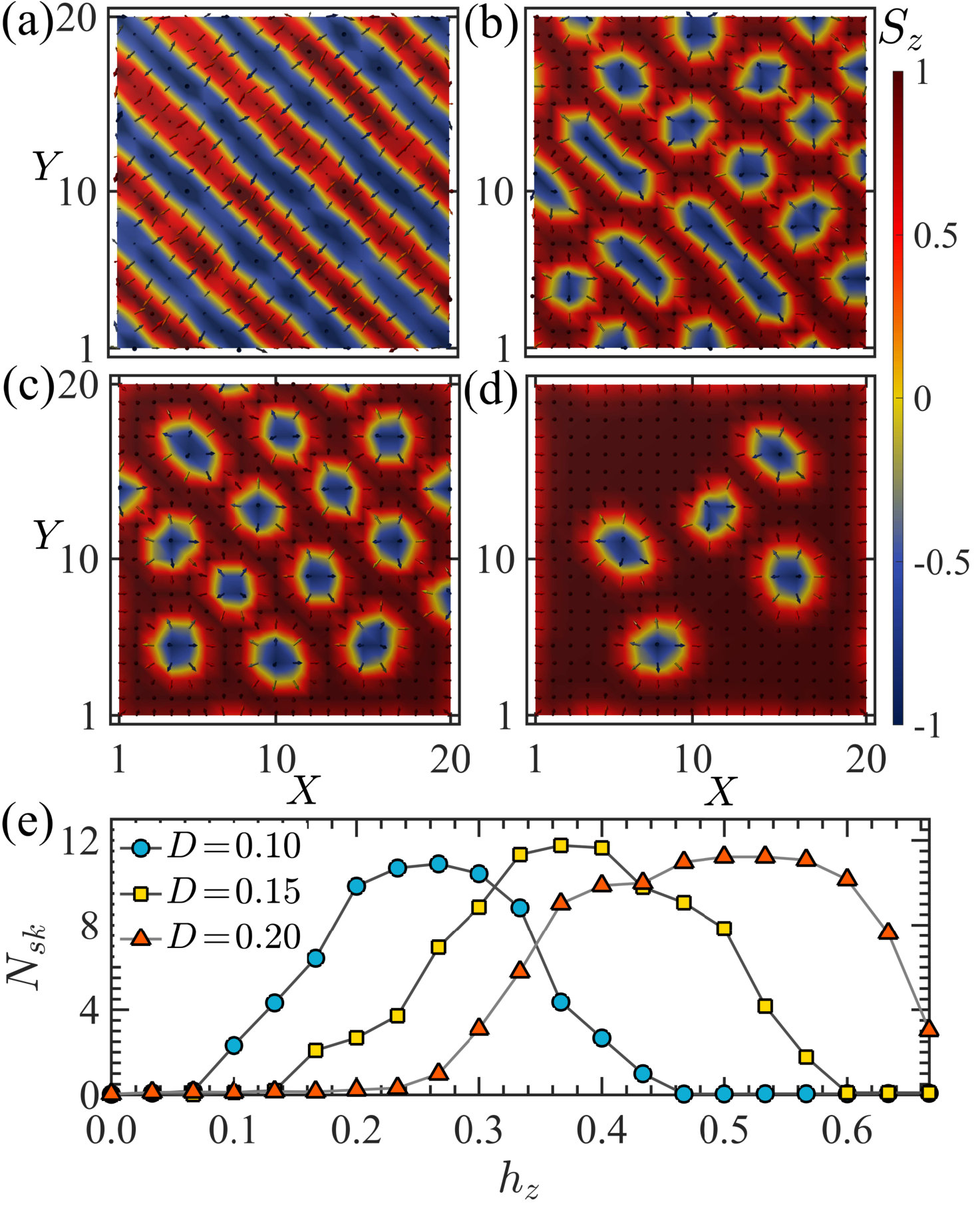 Figure 1
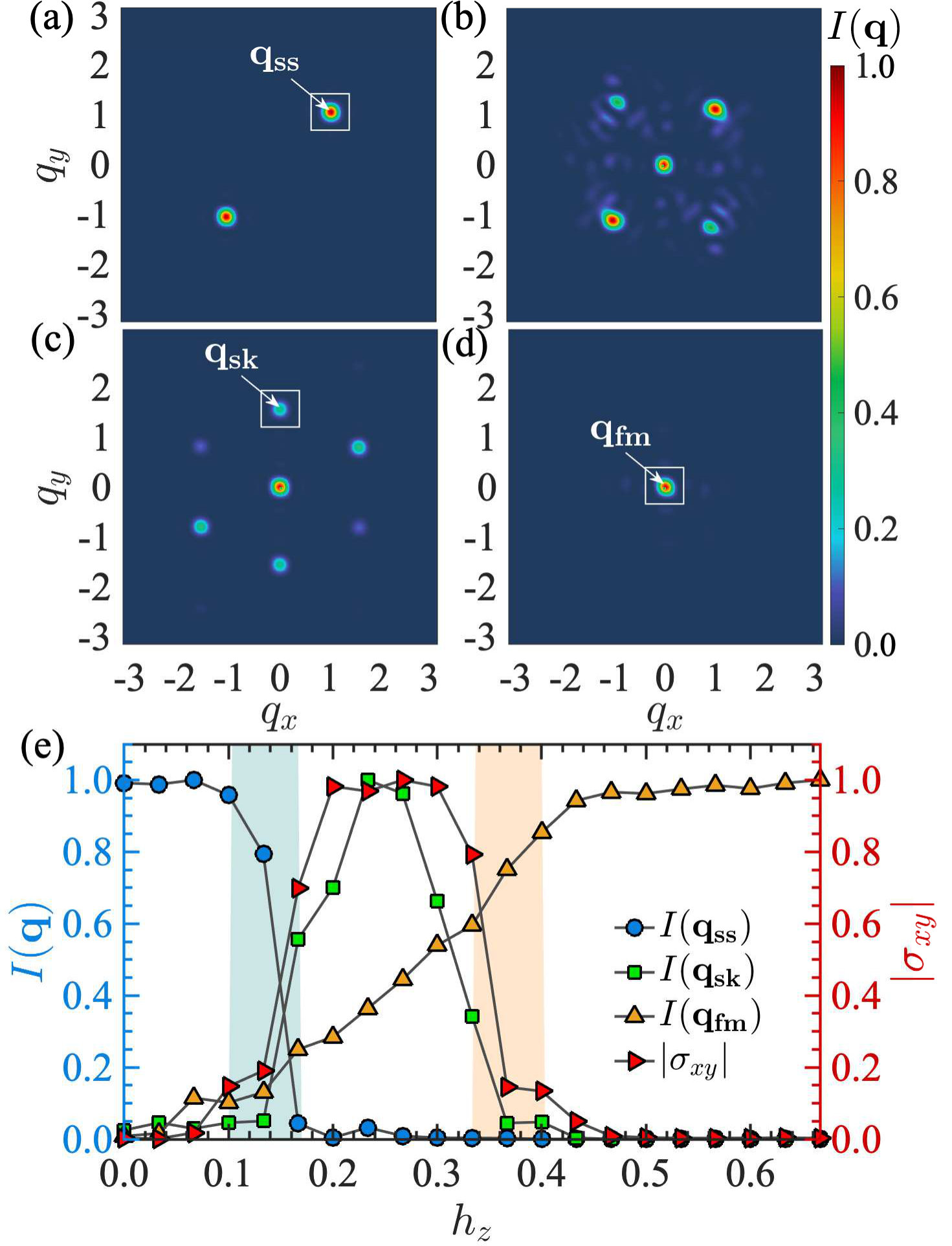 Figure 2
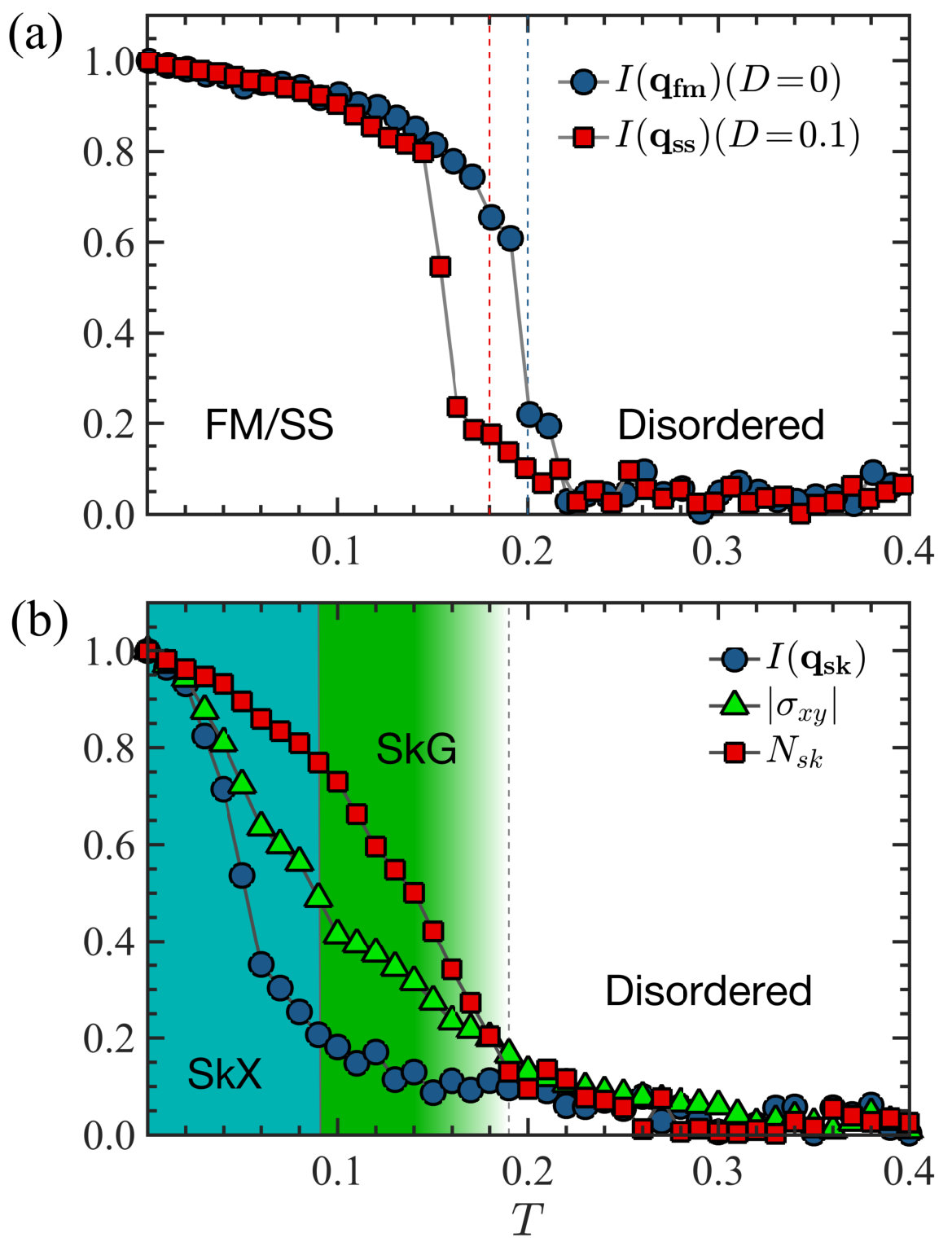 Figure 3
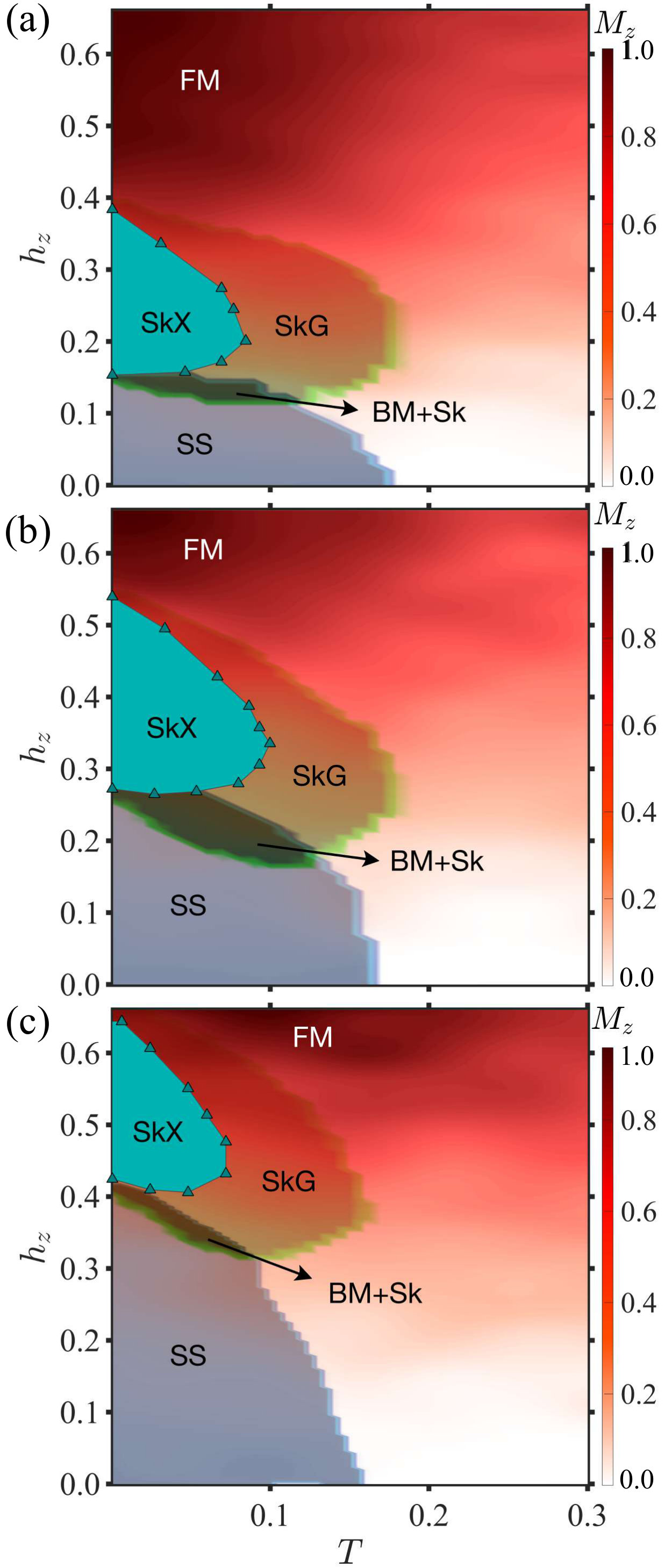 Figure 4
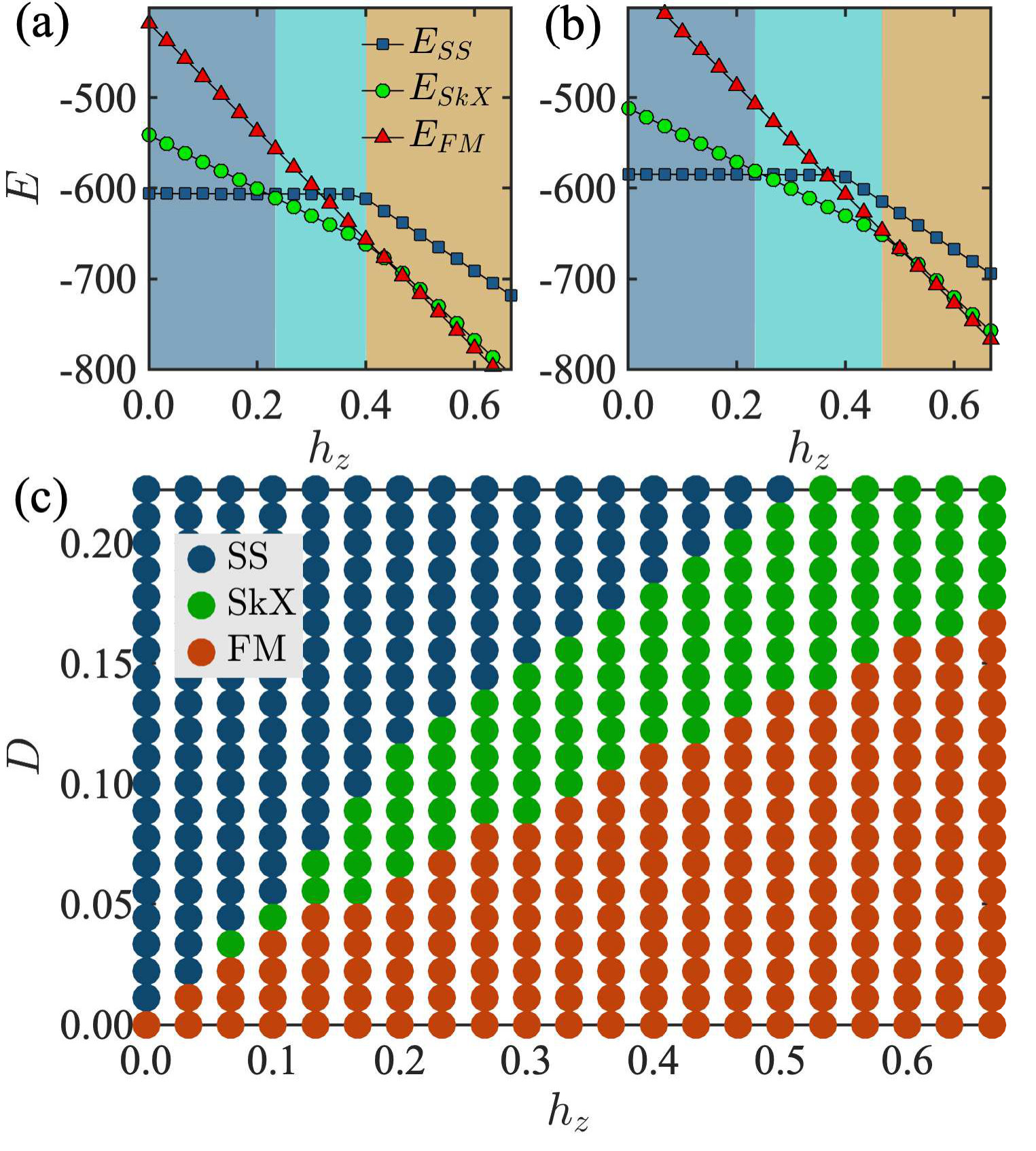 Figure 5
Peer Reviews
No public reviews on file for this paper yet. If you reviewed it on a platform where reviews are public (OpenReview, ICLR, NeurIPS, ICML), you can paste yours below so the community can read it here.
Videos
No videos yet. Explain this paper in a talk, walkthrough, or lecture? Add one.
\newcites
SuppSupplementary References
††thanks: Copyright notice: This manuscript has been authored by UT-Battelle, LLC under Contract No. DE-AC05-00OR22725 with the U.S. Department of Energy. The United States Government retains and the publisher, by accepting the article for publication, acknowledges that the United States Government retains a non-exclusive, paid-up, irrevocable, world-wide license to publish or reproduce the published form of this manuscript, or allow others to do so, for United States Government purposes. The Department of Energy will provide public access to these results of federally sponsored research in accordance with the DOE Public Access Plan (http://energy.gov/downloads/doe-public-access-plan).
Topological Hall Effect and Emergent Skyrmion Crystal
in Manganite-Iridate Oxide Interfaces
Narayan Mohanta1, Elbio Dagotto1,2, Satoshi Okamoto
*Materials Science and Technology Division, Oak Ridge National Laboratory, Oak Ridge, Tennessee 37831, USA
2Department of Physics and Astronomy, The University of Tennessee, Knoxville, TN 37996, USA
Abstract
Scalar spin chirality is expected to induce a finite contribution to the Hall response at low temperatures. We study this spin-chirality-driven Hall effect, known as the topological Hall effect, at the manganite side of the interface between La1-xSrxMnO3 and SrIrO3. The ferromagnetic double-exchange hopping at the manganite layer, in conjunction with the Dzyaloshinskii-Moriya (DM) interaction which arises at the interface due to broken inversion symmetry and strong spin-orbit coupling from the iridate layer, could produce a skyrmion-crystal (SkX) phase in the presence of an external magnetic field. Using the Monte Carlo technique and a two-orbital spin-fermion model for manganites, supplemented by an in-plane DM interaction, we obtain phase diagrams which reveal at low temperatures a clear SkX phase and also a low-field spin-spiral phase. Increasing temperature, a skyrmion-gas phase, precursor of the SkX phase upon cooling, was identified. The topological Hall effect primarily appears in the SkX phase, as observed before in oxide heterostructures. We conclude that the manganite-iridate superlattices provide another useful platform to explore a plethora of unconventional magnetic and transport properties.
I Introduction
The interplay between spin-orbit coupling and magnetism has led to the emergence of several novel properties at the interface between distinct transition-metal oxides, such as the anomalous Hall effect Nagaosa et al. (2010); Onoda et al. (2006); Nichols et al. (2016) and the anisotropic magnetoresistance Diez et al. (2015). Another source of the Hall effect in a heterointerface with both time-reversal and mirror symmetries broken is provided by real-space non-collinear magnetic textures with a finite scalar spin chirality \mathbf{S}_{i}$$\cdot(\mathbf{S}_{j}$$\times$$\mathbf{S}_{k}) Onoda et al. (2004); Yi et al. (2009); Hamamoto et al. (2015); Ishizuka and Nagaosa (2018). This spin chirality generates an effective electromagnetic field for electrons through the spin Berry phase mechanism. The resulting Hall effect, known as the Topological Hall (TH) effect, has been observed in perovskite oxides Matsuno et al. (2016); Wang et al. (2018); Nakamura et al. (2018); Vistoli et al. (2019), chiral magnets Neubauer et al. (2009); Kanazawa et al. (2011), frustrated magnets Taguchi et al. (2001), and Heusler alloys Rana et al. (2016); Swekis et al. (2019); Vir et al. (2019).
In compounds with heavy elements and without inversion symmetry, the antisymmetric spin exchange such as the Dzyaloshinskii-Moriya (DM) interaction \mathbf{D}_{ij}$$\cdot(\mathbf{S}_{i}$$\times$$\mathbf{S}_{j}), coexisting with a ferromagnetic (FM) exchange \mathbf{S}_{i}$$\cdot$$\mathbf{S}_{j}, favors a spin-spiral (SS) phase (characterized by a single wave number ) Banerjee et al. (2013); Li et al. (2014). In the presence of an external magnetic field or an easy-plane anisotropy, the SS competes with ferromagnetism, and a skyrmion-crystal (SkX) phase (with three characteristic values) emerges at intermediate field strengths Mühlbauer et al. (2009); Ezawa (2011); Huang and Chien (2012); Yu et al. (2014). Another possible route to the SkX phase, with higher topological quantum numbers, is to realize a Kondo-type exchange coupling between itinerant electrons and localized spins, instead of the DM interaction Ozawa et al. (2017); Hayami and Motome (2019).
An interface between the ferromagnetic metal La1-xSrxMnO3 (LSMO) with active orbitals and the paramagnetic semimetal SrIrO3 (SIO) with active orbitals, is expected to possess a strong DM interaction arising from the spin-orbit coupling in SIO and broken structural inversion symmetry at the interface. The DM interaction, in bilayers of SIO and SrRuO3, also has been found to appear primarily near the interface Matsuno et al. (2016). The presence of an interface DM interaction is supported by the small lattice mismatch at the interface (lattice constants of SIO and LSMO are nm Zhao et al. (2008) and nm Jalili et al. (2010), respectively) and a strain-dependent charge transfer Okamoto et al. (2017). Because of two approximate in-plane mirror symmetries, one mirror plane involves two Mn sites and another reflects two Mn sites, it is reasonable to expect that this DM vector lies in the plane of the interface Banerjee et al. (2014); Dong et al. (2019). Having an in-plane DM vector excludes the possibility of stabilizing a conical phase which typically appears in cubic systems such as MnSi Buhrandt and Fritz (2013); Wilson et al. (2014). On the other hand, LSMO, which is well-known to contain several fascinating magnetic phases varying the electronic concentration Dagotto et al. (2001); Moreo et al. (2000); Yunoki et al. (2000a); Hotta et al. (2003), here is considered to be optimally doped with regards to the FM phase. The LSMO-SIO interface is, therefore, a promising platform to search for exotic magnetic textures such as the SkX phase.
In this paper, we investigate the formation of the SkX crystal phase at the LSMO-SIO interface and the influence of the non-collinear spin textures on the transverse Hall conductance. We use a spin-fermion model, where itinerant electrons and localized spins are coupled via a Hund interaction, and employ a numerically-exact Monte Carlo (MC) method Dagotto et al. (2001). In order to handle large systems, we employ the traveling-cluster approach Kumar and Majumdar (2006); Mukherjee et al. (2015) that allows us to explore the finite-temperature behavior of the SS and the SkX phases. Indeed, one of the main results of the present study is that we observed a SkX phase with Néel-type skyrmions within a range of magnetic fields at low temperatures. Thermal fluctuations give rise to a related phase with spatially disordered nucleated skyrmions, a skyrmion gas (SkG), that prevails outside of the SkX phase at higher temperatures and acts as a precursor of the SkX phase upon cooling. Also a metastable phase with mixed bimerons and skyrmions (BM+Sk) Iakovlev et al. (2018) appears at finite temperatures between the SS and SkX phases. We construct phase diagrams in the temperaturemagnetic field plane which describe the parameter regimes where the Topological Hall effect dominantly appears.
The strength of the DM interaction depends crucially on several geometrical parameters, such as the thickness of the SIO layer Matsuno et al. (2016). This offers an external tunability of the interfacial DM interaction and the resulting TH effect. The phase diagrams, obtained at different strengths of the DM interaction, thus, serve as a guidance to the DM interaction-control of the TH effect. In addition, we also compute the =[math] phase diagram by comparing the total energies of ideal SS, SkX and FM phases and found a reasonable agreement with the low- properties, obtained using the MC method.
The paper is organized as follows: in Sec. II, a lattice model is defined, containing the two-orbital double-exchange model to describe a manganite region, supplemented by the DM interaction and the easy-plane anisotropy. We also outline the methodology of MC annealing and computation of physical quantities. In Sec. III, we present the MC results, revealing the emergence of the SkX phase and its consequences on the transverse Hall conductance. In Sec. IV, we show the finite-temperature behavior of different phases, obtained using Monte Carlo calculations and discuss the magnetic field vs temperature phase diagrams. Section V describes the =[math] phase diagram obtained from the total energy calculation using ideal spin configurations. In Sec. VI, we discuss the relevance of the present results to possible experiments on LSMO-SIO films and superlattices, and summarize our results.
II Model and Method
II.1 Spin-fermion Hamiltonian
We consider a square lattice which hosts the essential features of LSMO at the two-dimensional interface with SIO i.e. the intrinsic magnetism of the manganite layer, supplemented by the induced DM interaction due to the spin-orbit coupling at the iridate layer. To describe the hopping of electrons, we use a two-orbital double-exchange Hamiltonian at infinite Hund’s coupling. As explained, the DM interaction arises from the influence of the iridate layer. Then, the resulting spin-fermionic Hamiltonian for the LSMO-SIO interface is given by
[TABLE]
where () is the fermionic creation (annihilation) operator at site with position and orbital , denotes the nearest-neighbor hopping amplitudes between orbitals and along the hopping direction =,, and is given by ==3=3=====; and represent the Mn orbitals, and , respectively Dagotto et al. (2001); the DM vector, acting between nearest-neighbor lattice sites and , is given by =D(\mathbf{r}_{i}-\mathbf{r}_{j})$$\times$$\hat{z}/|\mathbf{r}_{i}-\mathbf{r}_{j}| with being the strength of the DM interaction; is the external magnetic field, applied perpendicular to the interface plane; is the strength of the easy-plane anisotropy, originating from interfacial strain and Rashba spin-orbit coupling Banerjee et al. (2014), which is not explicitly included in Eq. (1); is the effective hopping at infinite Hund’s coupling Müller-Hartmann and Dagotto (1996), which in terms of the polar and azimuthal spin angles and (assuming the electron spin to be described by a classical vector in three-dimensions with amplitude =) is given by =. We use a square lattice of dimension N_{x}$$\times$$N_{y} and numerically solve Hamiltonian (1) using the MC technique to study the spin configuration and transport properties at different sets of parameters. We set the hopping amplitude to = and the anisotropy parameter to = throughout the MC analysis.
II.2 Monte Carlo annealing
To obtain the spin configuration at a particular set of parameters, we start at a high temperature = and slowly cool the system down to a desired . In each annealing session, temperature steps were employed and at each , 2$$\times$$10^{5} number of MC steps were used for the spin-configuration update according to the Metropolis algorithm. In each MC step, the spin angle or was changed randomly to \theta$$\pm$$\Delta\theta or \phi$$\pm$$\Delta\phi, respectively, where and are the step sizes of the angles, set to 5 degrees throughout the paper. The diagonalization of the fermionic part of the Hamiltonian is numerically expensive and to alleviate this problem, we used the traveling-cluster update scheme Kumar and Majumdar (2006); Mukherjee et al. (2015), in which a smaller cluster of size N_{xc}$$\times$$N_{yc} is used for the MC spin update. The results presented here were obtained using a 20$$\times$$20 lattice and 5$$\times$$5 traveling cluster, with open-boundary conditions. We checked, with a larger lattice of size 32$$\times$$32 and a larger traveling cluster of size 10$$\times$$10, for any finite-size effects and obtained a consistent description. The observables were calculated from the thermalized spin configurations and were MC averaged, at each and , with different realizations.
II.3 Calculation of observables
Skyrmion number. A magnetic skyrmion has a distinct topological structure and when the underlying lattice is transformed from a torus to a sphere, the skyrmion gives a full coverage of the sphere. This unique feature enables skyrmions to be classified by a topological index, called the skyrmion number, which is expressed as Heinze et al. (2011); Nagaosa and Tokura (2013)
[TABLE]
In practice for a square lattice with discrete points, the integration in Eq. (2) has been performed by using a summation over the underlying lattice sites and the partial derivatives have been calculated using a central-difference scheme within the five-point stencil method Ding and Shu (2006).
Spin correlation function. An important quantity to identify magnetic phases and track thermodynamic phase transitions is the spin correlation function. We take the Fourier transform of the real-space spin-spin correlation function as follows
[TABLE]
where denotes the localized spin at site , is the distance between sites and , is the radius of a circle around site within which all sites are considered to calculate the correlation function, and is the total number of lattice sites. We use the radius up to . If some sites landed outside the full cluster, they were discarded. The quantity in Eq. (3) can be compared to intensity measured in neutron-scattering experiments and, therefore, we use the Bragg intensity as =.
Hall conductance. The transverse Hall conductance is obtained by the current-current correlation function, described by the Kubo formula Yi et al. (2009), as given below
[TABLE]
where is the Fermi function at temperature and energy , = is the current operator along the direction, and is the relaxation rate which is kept fixed at a value .
III Emergence of skyrmion crystal
We started our effort by confirming the well-known fact that the double-exchange hopping term in the absence of the DM interaction and magnetic field, yields a FM phase at low temperatures T$$\lesssim$$0.2 Yunoki et al. (2000b). Then, after incorporating a finite DM interaction, a single- SS phase appears at low temperatures, as shown in Fig. 1(a) at =. With increasing the DM strengh , the period of the spiral decreases gradually. There are two degenerate, diagonally-opposite spiral solutions which often merge together to form a labyrinth-like metastable spin configuration. This type of metastable spin configuration can be avoided by re-annealing the spin configuration obtained at low from the previous MC annealing process. To perform the re-annealing process, we take the previous annealed spin configuration to a temperature = and slowly cool down to the lowest temperature =. We considered 20 re-annealing sessions to obtain a stable spin configuration.
Following this multiple-annealing process, in the presence of an external magnetic field we observed that, beyond a critical field , the SS phase is transformed into a SkX phase where the skyrmions arrange themselves in a nearly-triangular crystal, as depicted in Fig. 1(c) at = and =. Thermal fluctuations or disorder introduce a metastable regime, a mixed bimeron+skyrmion (BM+Sk) phase, between the SS and the SkX phase, as shown in Fig. 1(b) at = and =. The bimerons are extended skyrmions and have finite contributions to the scalar spin chirality, similar to the skyrmions. With a further increase in , the SkX phase melts into the SkG phase which is a gas of nucleated skyrmions, and finally transforms into a fully-polarized FM phase. The SkG phase appears within a very narrow range of at low temperatures and further work is needed to confirm its presence at those temperatures. But SkG is robust and primarily dominates at higher temperatures. For example, a typical spin configuration of the SkG phase, obtained at = and =, is shown in Fig. 1(d).
The variation of the skyrmion number with is depicted in Fig. 1(e) for three different values of , revealing a clear enhancement within a range of . At =[math], should exhibit sharp first-order transitions at two critical values of , clearly distinguishing the SkX phase from others. But here due to thermal fluctuations, the expected sharp first-order jumps are replaced by smooth crossovers as in Fig. 1(e). Increasing , the range where the SkX phase appears is enhanced. This is an anticipated behavior, since a stronger DM interaction helps to stabilize the SkX phase.
In Fig. 2(a)-(d), we plot the MC-averaged Bragg intensity profile for the four different phases discussed in Fig. 1, viz. the SS, BM+Sk, SkX, and SkG. The SS and the SkX phases show, respectively, the single- (Fig. 2(a)) and triple- (Fig. 2(c)) structures of the spin configuration. Figure 2(b), for the BM+Sk phase, interestingly, displays a double- spin configuration which is absent at =[math]. Because of the large FM fraction, the SkG phase is dominated by the Bragg intensity at = but with non-zero intensities at \mathbf{q}$$\neq$$\mathbf{0} due to the randomly distributed skyrmions. Thus, in the SkG phase is not fully developed while is suppressed. The Bragg intensity at different characteristic momenta, reveal a sequence of phase transitions, as shown in Fig. 2(e) where the transverse Hall conductance is also plotted. Evidently, (and also in Fig. 1(e)) become enhanced within a broader range of than , where = is the characteristic momentum for the SkX phase (as defined in Fig. 2(c)). The SS and SkX phases can, therefore, be identified using and , respectively, whereas, and are suitable to extract the BM+Sk and the SkG phases.
IV Temperature evolution
Having identified the phases appearing at various values of the external magnetic field at low temperatures, we explore the finite-temperature behavior of these phases. In Fig. 3(a), we show the temperature variation of the Bragg intensities and for the FM and SS phases in the absence of external magnetic fields at =[math] and =, respectively. The critical temperature T_{c}^{SS}$$\simeq$$0.18 for the SS phase appears to be rather close to that of the FM phase (T_{c}^{FM}$$\simeq$$0.2) which exists at the two-dimensional interface in the absence of DM interaction and external magnetic fields. For the phases associated with the skyrmions, we plot the Bragg intensity , Hall conductance , and skyrmion number vs. in Fig. 3(b) at a field =. Evidently, drops faster with than the other two observables, indicating that the SkX phase (here determined by an 80 drop in , but other conventions lead to similar conclusions) exists at much lower temperatures than the SkG phase (determined by an 80 drop in ). The critical temperatures for the SkX and the SkG phases at = are roughly T_{c}^{SkX}$$\simeq$$0.09 and T_{c}^{SkG}$$\simeq$$0.19, respectively. The TH effect, although strongest at the SkX phase, exists at temperatures much above the SkX phase. There could be other contributions to the TH effect, and one potential origin is the skew scattering induced by the scalar spin chirality Ishizuka and Nagaosa (2018). The skew-scattering induced TH effect appears near the transition to the SkX phase and is reflected by a change in the sign of the Hall conductance. In addition to the SkG phase, the BM+Sk phase also yields a finite contribution to the TH effect, as we shall discuss below.
We constructed the phase diagrams for the manganite-iridate single interface in the temperature vs. magnetic field plane. Results are depicted in Fig. 4 for three different values of the DM strength . The phase diagrams show five different phases already discussed before viz. SS, SkX, BM+Sk, SkG and FM. Note the BM+Sk and SkG regions are suppressed at very low temperatures. The FM phase, identified by both the Bragg intensity and the average out-of-plane magnetization , does not have any phase boundary in the - plane and prevails in the high-field regime. The BM+Sk phase is identified by the overlap of the SS and the SkG phases, obtained, respectively, by and .
Increasing , the SS phase expands towards larger fields, which is expected since the DM interaction helps in stabilizing this SS phase. However, the critical temperature tends to decrease at very large (noticeable in Fig. 4(c) for =). Very large values of results in a SS phase with a spiral of short wavelength which makes the SS phase less susceptible to thermal fluctuations, accounting for the slow decrease in with increasing . The SkX phase also moves towards higher-fields with increasing and is the largest in size (among the three plots shown in Fig. 4) for =. For very large , the skyrmion sizes are much smaller, comparable to the square lattice spacing, and, thus, the resulting SkX phase is vulnerable to thermal fluctuations and disorder. The results suggest that both the SS and the SkX phases are strongest at an optimal value of the DM interaction strength.
The results presented thus far are for a fixed value of the easy-plane anisotropy parameter =. We have verified that a low-to-moderate value of the easy-plane anisotropy stabilizes the SkX phase, as found in a previous study Banerjee et al. (2014).
V Phase diagram
In the MC analysis discussed above, the lowest temperature accessed was =. Below this temperature the MC procedure is less accurate because it is difficult to evolve away from nearly-frozen metastable states. To complement the MC analysis with zero temperature results, we performed calculations of total energies of the three phases SS, SkX, and FM, by considering ideal spin configurations. We consider a 20$$\times$$20 lattice with open boundary conditions, same as in above MC analysis, to compute the total energies of the three phases using the Hamiltonian Eq.(1), after optimizing the period of the spiral in the SS phase and the skyrmion radius and skyrmion-skyrmion separation in the SkX phase.
The variation of the total energies , and for the SS, SkX and the FM phases, respectively, with respect to at fixed DM interaction = is shown in Fig. 5, for two different values of the anisotropy parameter = and =. By the minimum energy criterion, we can identify the most favorable spin configurations. For =, we find that in the low-field regime h_{z}$$\lesssim$$0.23, the SS phase has the lowest energy, while for h_{z}$$\geq$$0.4, the FM phase has the lowest energy. Remarkably, the SkX phase wins within an intermediate field range 0.23$$<$$h_{z}$$<$$0.4, which is close to the field range predicted by the MC simulations. The transitions from the SS phase to the SkX phase and that from the SkX phase to the FM phase are first order at =[math] (level crossing). With =, we clearly observe that the SkX phase becomes wider with regards to the field range. It is interesting to note that is quite insensitive to the change in in the SS phase and changes slope towards the second critical field value near the boundary between the SkX and the FM phases. also changes its slope at the transition to the FM phase, because of the drastic enhancement of the optimal radius of the skyrmions beyond a critical , as noted before Banerjee et al. (2014). We tune and plot the =[math] phase diagram in Fig. 5(c) which reveals that, in general, the SkX phase becomes stronger with higher DM interaction and higher magnetic field.
VI Discussion and Conclusion
The experimental critical temperature for the FM phase of a manganite-iridate interface appears within a range , depending upon the thickness of the manganite layer Nichols et al. (2016). From the MC analysis, we find T_{c}^{FM}$$\approx$$0.2t_{0} (with anisotropy parameter =), which gives our hopping energy scale (=) as . For a purely classical spin model with Heisenberg exchange term -J\sum_{\langle ij\rangle}\mathbf{S}_{i}$$\cdot$$\mathbf{S}_{j}, instead of the double-exchange term, we obtain T_{c}^{FM}$$\simeq$$7.5J with an anisotropy parameter = (results gathered using a 2020 cluster and MC simulations, not shown). By comparing the critical temperatures for the FM phase, obtained separately from the double-exchange model and classical spin model, we find the effective Heisenberg-exchange parameter for the considered double-exchange model to be J$$\approx$$0.03t_{0}. The easy-plane anisotropy for LSMO films has been found to be AS^{2}$$\approx$$0.21 meV Boschker et al. (2011) which gives A$$\approx$$0.09 meV with =. Therefore, the critical DM interaction strength to realize the skyrmion crystal D_{c}$$\sim$$\sqrt{JA} Hervé et al. (2018); Rößler et al. (2006); Rohart and Thiaville (2013) appears in a range meV. LSMO also has a weak antiferromagnetic coupling Dagotto et al. (2001) which has not been included in our description. Such a competing antiferromagnetic coupling will reduce the MC-estimated and, in turn, enhance .
We have realized skyrmions of radius approximately unit cells with =. Increasing further will reduce the size of the skyrmions and when is comparable to the hopping energy scale , the skyrmion size will become too small to be studied within the MC method. Conversely, very small values of make the skyrmion size very large compared to the lattice size. We, therefore, have considered intermediate values of for which the skyrmion size is optimal for studying the SkX phase in the finite clusters where the spin-fermion model can be studied numerically. For similar reasons, the critical magnetic fields, obtained from the MC analysis, are unrealistically large. The main purpose here is to provide the qualitative variations of the skyrmion phases with D. In reality, we anticipate similar behavior in smaller energy scales.
To summarize, we have investigated the Topological Hall effect arising from the scalar spin chirality of an emergent skyrmion crystal using a spin-fermionic model for a manganite-iridate interface. Using Monte Carlo calculations, we realized a nearly-triangular crystal of Néel-type skyrmions, arising within a finite range of external magnetic fields. A gas phase of well-formed independent skyrmions was also observed primarily at higher temperatures above the skyrmion crystal phase. Also, a mixed bimeron+skyrmion phase appears at finite temperatures between the spin-spiral phase and the skyrmion crystal phase. Topological Hall measurements, together with neutron-scattering experiments, can detect these complex phases.
We conclude that manganite-iridate interfaces offer a unique platform to explore unconventional magnetic and transport properties. We have focused on the doping range in which LSMO is in its FM phase. Proximity effect from other types of magnetic phases, such as the antiferromagnetic phase or CE states, along with the large DM interaction, can lead to interesting phenomena Dong et al. (2009). The easy-plane anisotropy, which stabilizes the skyrmion crystal phase, can be modified using epitaxial strain, providing a useful knob to tune the TH effect. The DM interaction can be controlled by changing the thickness of the iridate layer, while the manganite layer thickness governs the level of spin polarization at the interface, opening a novel path towards efficient control of the TH effect by engineering multi-layer heterostructures.
acknowledgments
The authors gratefully acknowledge John Nichols, Elizabeth M. Skoropata, and Ho Nyung Lee for discussions on their related experiments. All members of this collaboration were supported by the U.S. Department of Energy (DOE), Office of Science, Basic Energy Sciences (BES), Materials Sciences and Engineering Division. This research used resources of the Compute and Data Environment for Science (CADES) at the Oak Ridge National Laboratory, which is supported by the Office of Science of the U.S. Department of Energy under Contract No. DE-AC05-00OR22725.
The reference list from the paper itself. Each links out to its DOI / PubMed record.
- 1Nagaosa et al. (2010) N. Nagaosa, J. Sinova, S. Onoda, A. H. Mac Donald, and N. P. Ong, “Anomalous Hall effect,” Rev. Mod. Phys. 82 , 1539 (2010) .
- 2Onoda et al. (2006) S. Onoda, N. Sugimoto, and N. Nagaosa, “Intrinsic versus extrinsic anomalous Hall effect in ferromagnets,” Phys. Rev. Lett. 97 , 126602 (2006) .
- 3Nichols et al. (2016) J. Nichols, X. Gao, S. Lee, T. L. Meyer, J. W. Freeland, V. Lauter, D. Yi, J. Liu, D. Haskel, J. R. Petrie, E.-J. Guo, A. Herklotz, D. Lee, T. Z. Ward, G. Eres, M. R. Fitzsimmons, and H. N. Lee, “Emerging magnetism and anomalous Hall effect in iridate-manganite heterostructures,” Nat. Commun. 7 , 12721 (2016) . · doi ↗
- 4Diez et al. (2015) M. Diez, A. M. R. V. L. Monteiro, G. Mattoni, E. Cobanera, T. Hyart, E. Mulazimoglu, N. Bovenzi, C. W. J. Beenakker, and A. D. Caviglia, “Giant negative magnetoresistance driven by spin-orbit coupling at the La Al O 3 /Sr Ti O 3 interface,” Phys. Rev. Lett. 115 , 016803 (2015) .
- 5Onoda et al. (2004) M. Onoda, G. Tatara, and N. Nagaosa, “Anomalous Hall effect and skyrmion number in real and momentum spaces,” J. Phys. Soc. Jpn. 73 , 2624 (2004) . · doi ↗
- 6Yi et al. (2009) S. D. Yi, S. Onoda, N. Nagaosa, and J. H. Han, “Skyrmions and anomalous Hall effect in a Dzyaloshinskii-Moriya spiral magnet,” Phys. Rev. B 80 , 054416 (2009) .
- 7Hamamoto et al. (2015) K. Hamamoto, M. Ezawa, and N. Nagaosa, “Quantized topological Hall effect in skyrmion crystal,” Phys. Rev. B 92 , 115417 (2015) .
- 8Ishizuka and Nagaosa (2018) H. Ishizuka and N. Nagaosa, “Spin chirality induced skew scattering and anomalous Hall effect in chiral magnets,” Sci. Adv. 4 , eaap 9962 (2018) .