BPS states in the Minahan-Nemeschansky $E_7$ theory
Qianyu Hao, Lotte Hollands, Andrew Neitzke

TL;DR
This paper employs spectral networks to compute BPS degeneracies in the Minahan-Nemeschansky $E_7$ theory, revealing patterns in BPS indices related to charge multiples and extending previous calculations in the $E_6$ theory.
Contribution
It introduces a spectral network method to calculate BPS states in the $E_7$ theory and uncovers a recurring pattern in BPS indices across different charges.
Findings
BPS degeneracies follow a specific pattern related to charge multiples.
Extended calculations of BPS states in the $E_6$ theory for larger charges.
Confirmed the pattern of BPS indices in the $E_7$ theory.
Abstract
We use the method of spectral networks to calculate BPS degeneracies in the Minahan-Nemeschansky theory, as representations of the flavor symmetry. Our results provide another example of a pattern noticed earlier in the Minahan-Nemeschansky theory: when the electromagnetic charge is times a primitive charge, the BPS index is a positive integer multiple of . We also calculate BPS degeneracies in the Minahan-Nemeschansky theory for larger charges than were previously computed.
Click any figure to enlarge with its caption.
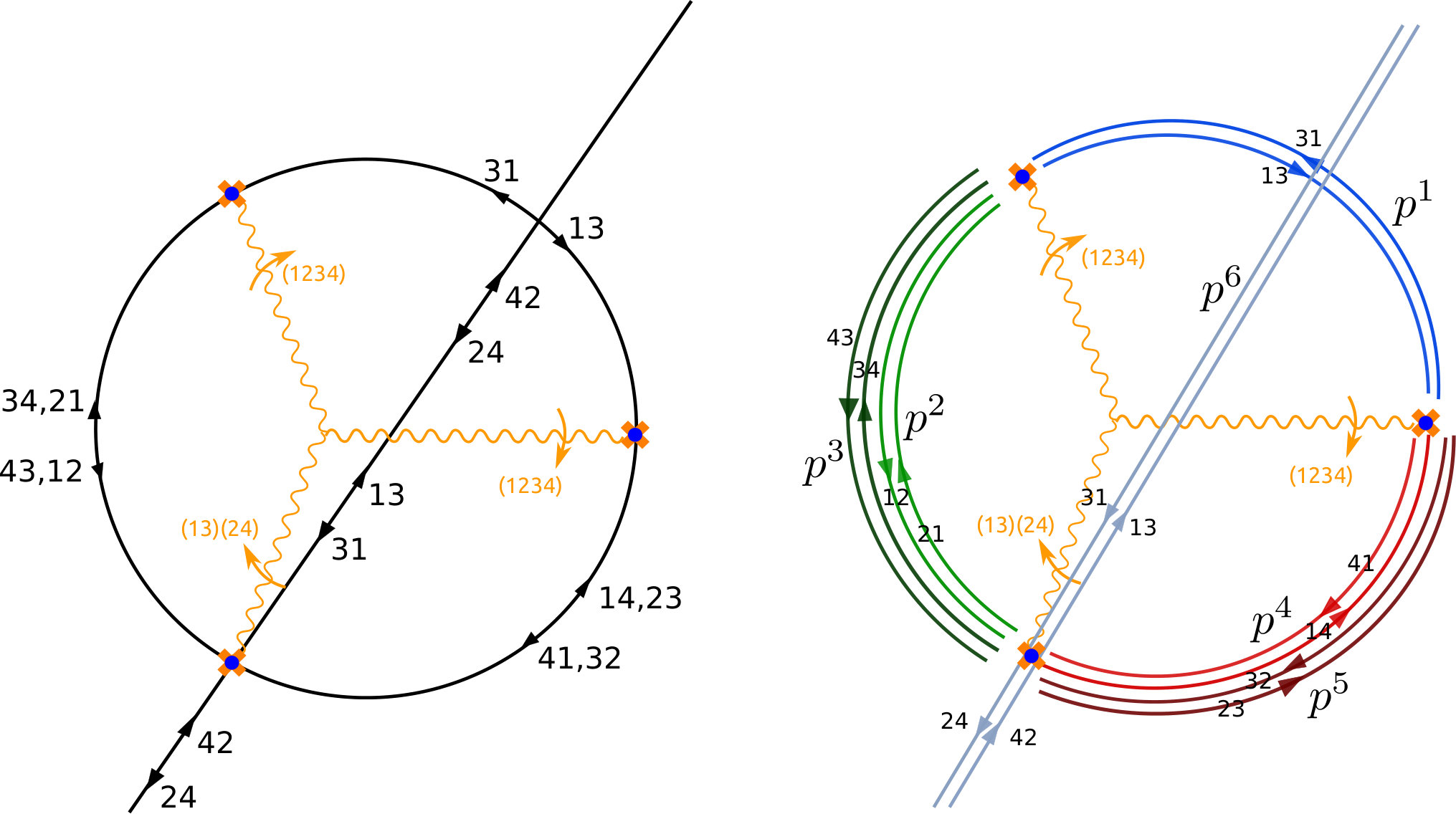 Figure 1
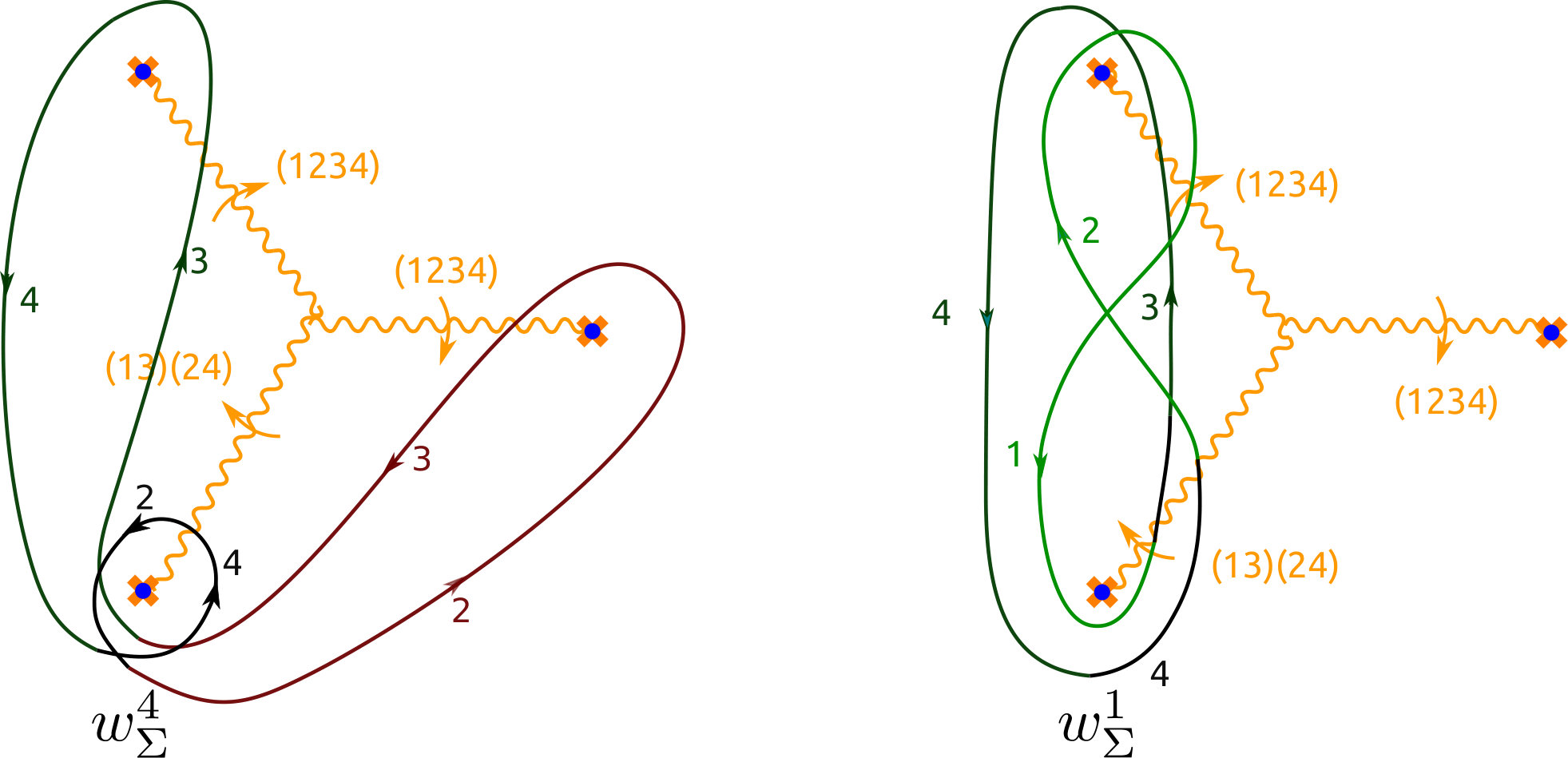 Figure 2
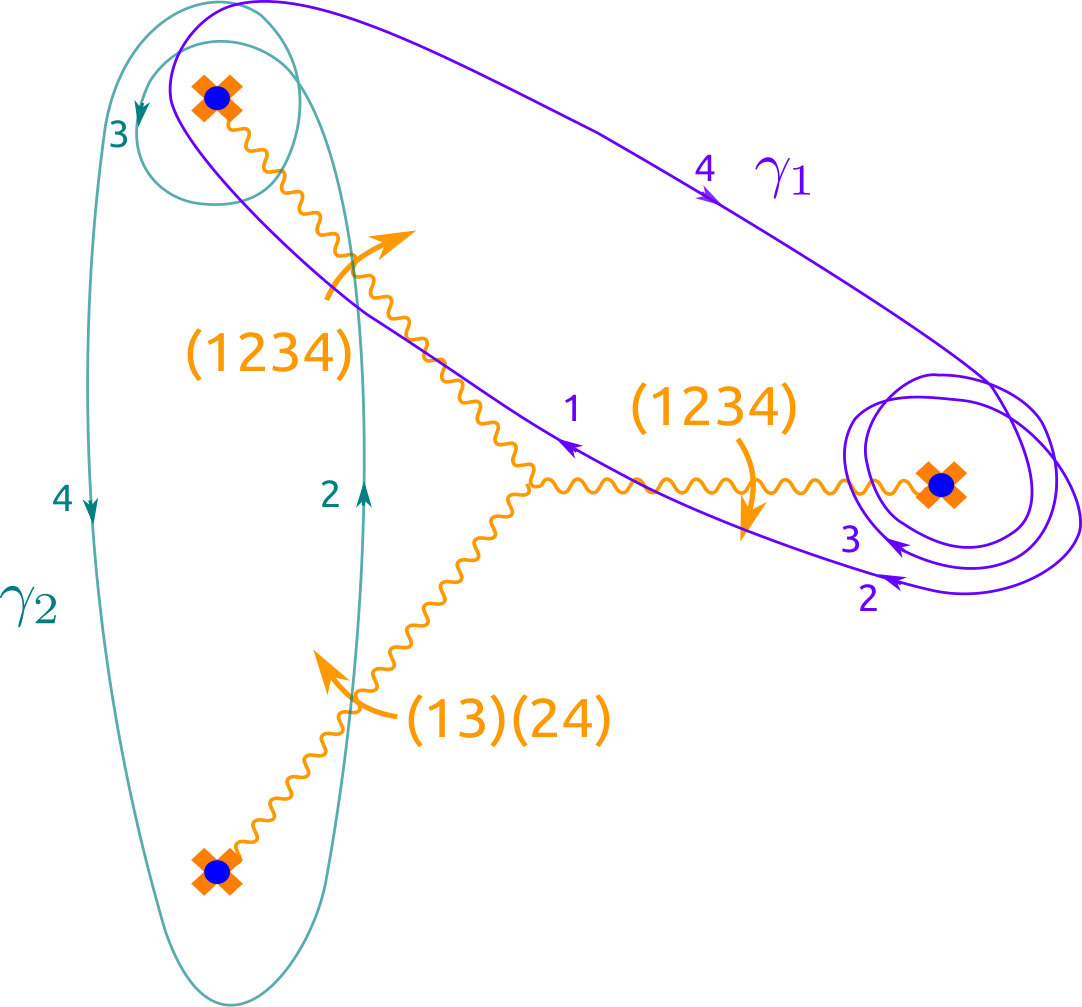 Figure 1
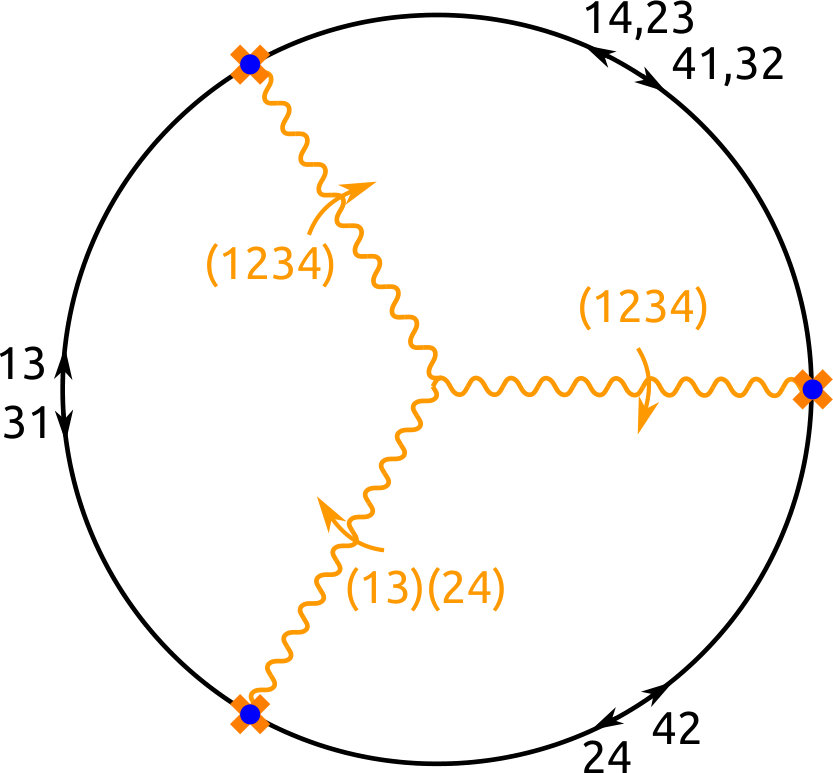 Figure 2
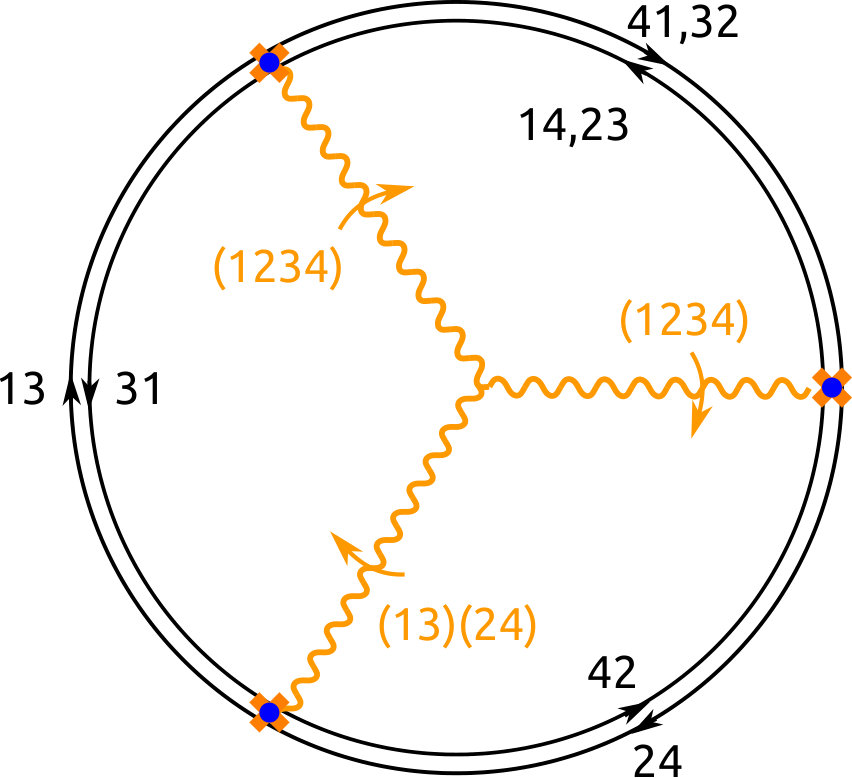 Figure 2
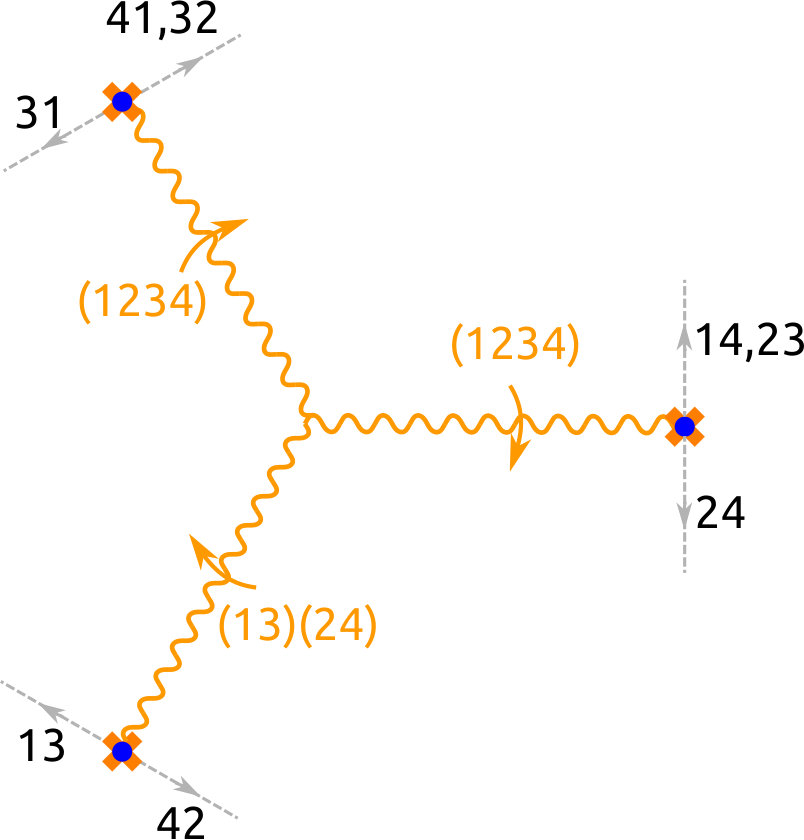 Figure 2
 Figure 3
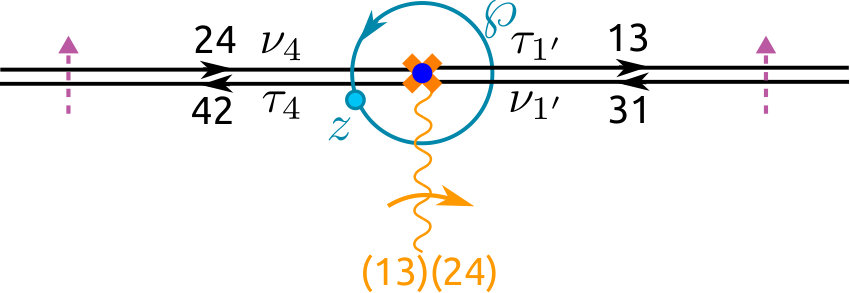 Figure 4
| 1 | |
| 2 | |
| 3 | |
| 4 | |
| 5 | |
| 6 | |
| 7 | |
| 8 | |
| 9 | |
| 10 | |
| 11 | |
| 1 | 56 |
|---|---|
| 2 | 135 |
| 3 | 1024 |
| 4 | 12528 |
| 5 | 193536 |
| 6 | 3455104 |
| 7 | 68179968 |
| 8 | 1447549920 |
| 9 | 32495488000 |
| 10 | 762222261888 |
| 11 | 18524656253952 |
| 1 | |
| 2 | |
| 3 | |
| 4 | |
| 5 | |
| 1 | |
| 2 | |
| 3 | |
| 4 | |
| 5 | |
| 6 | |
| 7 | |
| 8 | |
| 9 | |
| 10 | |
| 11 | |
| 12 | |
| 13 | |
| 14 | |
Peer Reviews
No public reviews on file for this paper yet. If you reviewed it on a platform where reviews are public (OpenReview, ICLR, NeurIPS, ICML), you can paste yours below so the community can read it here.
Videos
No videos yet. Explain this paper in a talk, walkthrough, or lecture? Add one.
Taxonomy
TopicsBlack Holes and Theoretical Physics · Quantum Chromodynamics and Particle Interactions · Particle Accelerators and Free-Electron Lasers
\WarningFilter
gitinfo2I can’t find
11institutetext: Department of Physics, University of Texas at Austin 22institutetext: Department of Mathematics, Heriot-Watt University 33institutetext: Department of Mathematics, University of Texas at Austin
BPS states in the Minahan-Nemeschansky theory
Qianyu Hao 2
Lotte Hollands 3
Andrew Neitzke
Abstract
We use the method of spectral networks to calculate BPS degeneracies in the Minahan-Nemeschansky theory, as representations of the flavor symmetry. Our results provide another example of a pattern noticed earlier in the Minahan-Nemeschansky theory: when the electromagnetic charge is times a primitive charge, the BPS index is a positive integer multiple of . We also calculate BPS degeneracies in the Minahan-Nemeschansky theory for larger charges than were previously computed.
††preprint:
UTTG–02–19
\gitAuthorIsoDate\gitAbbrevHash
1 Introduction
Minahan and Nemeschansky discovered superconformal theories in four dimensions with flavor symmetry , and Minahan:1996fg ; Minahan:1996cj . These remarkable theories have been studied extensively since then. In this paper we study the BPS spectrum of the theory.
We consider the class construction Gaiotto:2009we ; Gaiotto:2009hg , applied with Lie algebra and Riemann surface , where , are full punctures and is a puncture of type . This construction produces a superconformal theory with manifest flavor symmetry .111 does not have a subgroup isomorphic to , but has subgroup isomorphic to . The is the subgroup , , , , where is a primitive fourth root of unity. Thus the enhancement of symmetry requires that this acts trivially. Already in Gaiotto:2009we , Gaiotto proposed that in this class theory the manifest should actually be enhanced to an flavor symmetry, and indeed the theory should be the Minahan-Nemeschansky theory. Some checks of this proposal are given by Benini, Benvenuti and Tachikawa in Benini:2009gi and by Tachikawa in Tachikawa:2013kta .
Having this class realization of the Minahan-Nemeschansky theory allows us to study its BPS states using the method of spectral networks Gaiotto:2012rg , and this is what we do in this paper. Our approach is mostly parallel to what was done for the theory in Hollands:2016kgm , and thus we are rather brief, focusing mainly on those points which are different for the theory; see Hollands:2016kgm for more background and explanations of the method.
On the Coulomb branch, the Hilbert space is graded by electromagnetic charge corresponding to the gauge symmetry. The electromagnetic charge lattice has rank , and can be identified with the homology where is the Seiberg-Witten curve, given below as (8). We introduce a basis for this charge lattice, where ; we call the primitive electric charge, and the primitive magnetic charge. A general charge can be written as . The theory has a symmetry, induced from the symmetry of which exchanges the two full punctures; this symmetry swaps the charges .
The main new result in this paper is the computation of BPS indices for various charges, of the form and , as we now describe.
The spectral network relevant for computing BPS indices for particles with charges looks like a circle; it is shown in Figure 3 below. Using this spectral network we have computed the indexed counts of 4d BPS states for ; for the results are given in Table 2. For example, we find
[TABLE]
We also show that the BPS index has asymptotic exponential growth
[TABLE]
Our computation has manifest flavor symmetry, so the integers admit an “upgrade” to characters of representations of . Since the flavor symmetry is predicted to be enhanced to , these characters should a posteriori assemble into characters of representations of . We compute for , and find that indeed they are characters of , as predicted. For example, we find
[TABLE]
The full results are given in LABEL:table:electric-indices below.
We also calculate the BPS index for the charges with ; this involves a different spectral network, shown in Figure 7. We obtain, for example,
[TABLE]
The full results are in LABEL:table:11-indices below.
Our results exhibit the same pattern observed in the Minahan-Nemeschansky theory Hollands:2016kgm : BPS states carrying electromagnetic charges which are times a primitive charge always come with index a positive integer multiple of . For example, in (3) above, the multiplicities of irreducible representations of are and , which are positive integer multiples of ; similarly in (4) above, all the multiplicities are positive integer multiples of .
BPS states for rank 1 Minahan-Nemeschansky theories were recently studied in Distler:2019eky , using string junctions in the -theory realization. In that paper the precise BPS multiplicities were not computed; rather, what was computed is a list of which representations of the flavor symmetry group can occur in the spectrum, for each electromagnetic charge. Our results for the theory are all in agreement with the lists of representations given in Distler:2019eky .
Finally, we revisit the BPS states of the Minahan-Nemeschansky theory, extending the results of Hollands:2016kgm to higher charges: see LABEL:table:electric-indices-e6 below.
Acknowledgements
We thank Jacques Distler and Mario Martone for helpful discussions. LH’s work on this paper is supported by a Royal Society Dorothy Hodgkin Fellowship. QH’s and AN’s work on this paper is supported by NSF grant DMS-1711692.
2 Seiberg-Witten curve
The IR gauge theory of the theory on its Coulomb branch is described by the Seiberg-Witten curve, which takes the form
[TABLE]
where is the Higgs field in the corresponding Hitchin system. (5) can also be written as
[TABLE]
where are meromorphic differentials on , degree- invariant polynomial combinations of the eigenvalues of . As discussed in Gaiotto:2009we , and reviewed e.g. in Chacaltana:2012zy , the form of around a puncture is , where is constrained to lie in a specific nilpotent orbit of , determined by a partition of . determines the Jordan block structure of , which in turn determines the form of the meromorphic differentials ; has a pole of order at most at a puncture with partition .
In our case the two full punctures have and for the third puncture ; the two full punctures have and the other puncture has .
Using these constraints, the only nonzero differential in the Minahan-Nemeschansky theory turns out to be . Using the symmetry of , the three punctures can be fixed to , where . Then the differentials are concretely
[TABLE]
The free parameter parameterizes the 1-complex-dimensional Coulomb branch. By the scale invariance and symmetry of the theory, all points with are equivalent, so from now on we set . We also write . Then the Seiberg-Witten curve (6) becomes
[TABLE]
By filling in the punctures, we get a smooth compact genus 1 curve . The projection is a degree covering, branched over the punctures on .
The electromagnetic charge lattice of the IR theory on the Coulomb branch is
[TABLE]
Two basis charges and are sketched in Figure 1; by convention we call “electric” and “magnetic.” The central charge corresponding to the EM charge is given by the integral .
For the primitive electric charge this gives
[TABLE]
and for the primitive magnetic charge
[TABLE]
Notice that the curve given in (8) has symmetry, generated by the transformation . This generator permutes the primitive electric and magnetic charges: it maps and .
3 Computing the BPS states
We use the same spectral network technique for computing BPS states as was used for the Minahan-Nemeschansky theory in Hollands:2016kgm . The surface is a parameter space for surface defects; the spectral network consists of the points such that the surface defect with parameter supports a BPS soliton of central charge with phase . To study the bulk BPS states of charge , we must choose the phase of the spectral network to be .
3.1 Building the spectral network
We comment briefly on how we compute the spectral network . The network is made up of “-walls” which obey differential equations. In addition to its parameterization , each wall carries a pair of labels and two auxiliary functions and : if the wall is labeled then gives the -th sheet of over the wall, and the -th sheet. The condition translates into differential equations which control the dependence of each wall:222Alternatively one could say that only is determined by a differential equation, while , are just solutions of the algebraic equation which move continuously with . This continuity condition is hard to implement in practice, because of the branch cut of the fourth-root function. The advantage of writing differential equations for , as well as for is that it automatically enforces the continuity, thus avoiding having to deal with cuts. This method is implemented in swn-plotter .
[TABLE]
where
[TABLE]
Next we need to explain the initial conditions: where do new walls originate? There are a few possibilities: either branch points of the covering , or from places where existing walls intersect one another. In the example we consider here, we will only have to deal with the case of walls originating from branch points. In this theory the branch points coincide with the punctures. Thus we need to study solutions of (12) originating at a puncture. Integrating (12) from the puncture to some nearby point gives the constraint . For small , and a wall of type , this integral is proportional to for a full puncture, or to for a type puncture; thus, in either case, this constraint singles out distinguished directions and sheet labels . We also impose the additional constraint that at the puncture. See Figure 2 for the resulting distinguished directions and sheet labels, at the phase . (Note that two different walls emerging from a puncture can be exactly degenerate: e.g. emanating from the puncture at there is a wall labeled which is exactly degenerate with a wall labeled .)
We then choose initial points very close to the punctures, and initial values determined by the sheet labels, and numerically integrate the equations (12)-(13) to determine the full -walls. After finite time, we find that the -walls emerging from one puncture run into a neighboring puncture; at that point we just terminate them.
We make the most conservative possible assumption, that any -wall allowed by this analysis indeed exists. (This assumption will be verified in the next section when we compute the soliton counts on the walls and see that they are nonzero.)
The outcome of this process at the phase is the very simple spectral network shown in Figure 3.
3.2 Finding the solitons
In order to determine the bulk BPS indices, following the strategy in Hollands:2016kgm , we first deform infinitesimally to get a resolution of the spectral network, as shown in Figure 4.
Next we apply the constraints of homotopy invariance for 2d-4d framed BPS spectra, as described in Section 4.3 of Hollands:2016kgm , to the resolved spectral network. This involves studying the generating functions of 2d-4d framed BPS states associated to three different interfaces, associated to loops around the three punctures. See Figure 5 and Figure 6 for the loops we consider, and Appendix A for more details about the generating functions and formal variables we use below.
The generating functions of 2d-4d framed BPS states associated to these three loops have the form:
[TABLE]
Here in each case and denote two semicircles on , making up a circular loop around a puncture; is the top half and the bottom half. does not cross a branch cut, while does cross a cut, thus going from one sheet to the next according to the permutation attached to the cut. The generating function is the sum of formal variables associated to the four lifts of to , and similarly . Finally, or denote the soliton generating functions. Each of these functions counts BPS solitons with charges of the form , , where is a basic soliton charge; thus the function is of the form , where is the formal variable standing in for soliton charge , and is the formal variable standing in for 4d particle charge (see Appendix A for more details on this tricky sign.) These functions are the main undetermined quantities which we need to find. As it happens, the spectral network in Figure 4 contains at most one wall of any type ; thus we can distinguish the various by labeling them , and our job is to determine the eight functions , , , , , , , .
The , , are naturally viewed as matrices, since they contain counts of solitons going from vacuum to vacuum with . Moreover, since the solitons are charged under the flavor symmetry, the can be promoted from numbers to characters depending on a flavor parameter . As in Hollands:2016kgm , we impose the constraint that the characteristic polynomial of equals the characteristic polynomial of acting in a representation . is the representation of which is the fundamental for the -th factor, and the trivial representation of the other two factors. Explicitly, for the full punctures, this characteristic polynomial can be written as
[TABLE]
where are the eigenvalues of acting in , obeying . Combinations of their products give characters of other representations of , which we denote by bold numbers: e.g. . So, explicitly, our constraint at each full puncture is
[TABLE]
For the type puncture, we impose a stronger constraint:
[TABLE]
where is the character of the fundamental representation of . Since the monodromy matrix has determinant , and (19) requires the diagonal elements to be either or , it implies that the eigenvalues are . However, (19) is stronger than just fixing the eigenvalues: it also rules out nontrivial Jordan blocks.
Using the constraints (18), (19) for all three punctures simultaneously we obtain a system of equations for the . We have not found a closed solution, but making the assumption that all of the have series expansions in nonnegative powers of , we can solve the equations iteratively in powers of . For example, we find:
[TABLE]
As we will see explicitly below, finding the up to order is sufficient to determine the BPS indices up to charge .
3.3 The bulk BPS indices
Once the have been determined, the next step in determining the spectrum of bulk BPS states with phase is to construct a generating function attached to each double -wall . As explained in gaiotto2013framed ; Gaiotto:2012rg , is a generating function determining the jumping behavior of the framed BPS spectrum attached to an interface between surface defects, when the phase of the interface crosses . It is given by Gaiotto:2012rg ; Hollands:2016kgm
[TABLE]
In our case there are four double -walls , , , , and thus four functions , which are explicitly
[TABLE]
The extra factor of appearing in (23) is the product of the basic soliton factors in and .
is the character of a representation of , where the keeps track of the electric charge (exponent of ) and the rest keeps track of the flavor charge. This representation is a Fock space built from basic fermionic and bosonic constituents (fermionic for odd electric charge, bosonic for even charge), and what we need to do is to extract those constituents. We define to be the constituent vector space with electric charge , so that has an expansion of the form
[TABLE]
There is a straightforward algorithm to compute the order by order in . The coefficient of in gives . We then formally divide by the fermionic Fock space generated by . The remaining terms of order give . We then formally divide out by the bosonic Fock space generated by , and so on. For example, the expansion of to order is
[TABLE]
Its expansion in terms of constituents is
[TABLE]
From this expansion we now read off the characters of the constituent vector spaces,
[TABLE]
We record here the answers to first order for all of the double walls, obtained by expanding the corresponding to first order in :
[TABLE]
Next, as in Hollands:2016kgm , we define
[TABLE]
The sum in (33) runs over the double -walls , each of which lifts to a chain on . is a 1-cycle on valued in representations of . Its homology class is necessarily a multiple of .
For example, for we have
[TABLE]
Happily, this is the decomposition of the representation of . For this spectral network, each is in fact a closed chain, in the class , so (33) becomes
[TABLE]
Finally, as in Gaiotto:2012rg ; Hollands:2016kgm , the BPS index is computed as the ratio:
[TABLE]
Thus we find
[TABLE]
and by similar computations we can compute for larger . The fact that these BPS indices turn out to be characters of representations of , not only , constitutes evidence for the expected enhancement of flavor symmetry in this theory.
4 Results
Up to , the multiplicity for each representation in turns out to be a positive integer multiple of (and up to , the unflavored is a positive integer multiple of ). This continues the pattern observed in Hollands:2016kgm for the theory. It is convenient to define a reduced index by dividing out this common factor:
[TABLE]
Our results for for are shown in LABEL:table:electric-indices.
We make a few comments about these results:
- •
The result can be compared with Huang:2013yta , which gives refined BPS states of a 5d theory with flavor symmetry obtained by compactifying M-theory on a CY manifold which is a bundle over a del Pezzo surface. It is natural to suspect that further compactifying this theory on to four dimensions would give the Minahan-Nemeschansky theory. As far as the BPS states go, the precise relation between the 5d and 4d theories is not clear; but following Hollands:2016kgm we can find a surprisingly close match by the following ad hoc procedure. We sum the 5d results over spins and , i.e. we just count the total number of multiplets, and compare that with the reduced index in 4d. For charges and , the 4d and 5d results match exactly. However, for charge the 4d result contains one more than the 5d, and for the 4d result has an extra . For charge , the results are different by in size. It would be natural to try to identify this mismatch as coming from the multiplets , but comparing our result with the decompositions given in Huang:2013yta , it seems that the mismatch is actually worse: the representations given in Huang:2013yta in 5d are not a subset of the representations we have computed in 4d. For charge , we only looked at the difference in sizes: it is . It would be very interesting to understand better what the precise relation between the 5d and 4d results should be.
- •
If we omit the flavor information, replacing representations by their dimensions, then we can actually solve for the generating functions in closed form, assuming the symmetries . Building the corresponding we obtain:
[TABLE]
[TABLE]
The ’s satisfy algebraic equations:
[TABLE]
The discriminants both vanish at . Using the technique in Mainiero:2016xaj and Hollands:2016kgm , these algebraic equations determine the asymptotic behavior of the BPS degeneracies as
[TABLE]
for some constant . Using (41)-(42) it becomes possible to compute the for much larger , e.g. , and compare with these asymptotics; the agreement is very good.
5 BPS states with charge
The circular spectral network is the simplest case, but we can use the same method for other charges, at the price of dealing with more complicated spectral networks. In this paper we limit ourselves to briefly considering the next simplest case, the BPS states of charge . The spectral network for charge is shown in Figure 7; it can be computed by the methods we reviewed in subsection 3.1.
In this case there are six double walls, shown in Figure 7, which we label . Carrying out the computations of soliton degeneracies and plethystic logarithms as in section 3 above, we obtain at leading order
[TABLE]
The lifts of paths and are cycles in the class . However, the lifts of paths and do not form closed loops individually. Instead, we get closed cycles with charge as combinations of these lifts:
[TABLE]
As defined above,
[TABLE]
which gives
[TABLE]
This is the decomposition of the representation of , so altogether we have found
[TABLE]
With computer assistance we calculated the BPS index , where . The results are given in LABEL:table:11-indices below. As before, the results are consistent with the string-network analysis of Distler:2019eky , and as before, they continue the pattern of being divisible by : thus, as before, we give the results for the reduced BPS index (38).
6 Minahan-Nemeschansky theory revisited
As we have mentioned, the Fock space decomposition method for extracting the from is a bit more efficient than the method used in Hollands:2016kgm . Thus we revisited the theory using the Fock space decomposition method. We were able to compute for . Our results are presented in LABEL:table:electric-indices-e6 below. For the results agree with those in Hollands:2016kgm ; we include them here just for convenience.
Appendix A Sign rules
In this appendix we address a tricky question of signs which arises in the computation of the BPS indices.
We need to recall a few details from Gaiotto:2012rg . In that paper, the generating function of framed 2d-4d BPS states for a given interface is written as an expansion in formal variables, of the form
[TABLE]
Here the index runs roughly over possible charges for a BPS state of the interface , and is roughly the BPS index counting states of charge . However, the precise meaning is a bit subtler, because of ambiguity in defining the fermion number in a system with only two-dimensional Poincare invariance. We parameterize our ignorance by saying is valued in a extension of the naive space of charges for the interface, and letting denote the generator of the extension, we have . To compensate this we further define , so that the product appearing in (57) is well defined and independent of how we lift the charge to this extension.
The soliton generating functions and on an -wall of type - are similarly written in terms of formal variables , which also lie in extensions of the naive space of soliton charges: in the extended charges which appear are charges of solitons from vacuum to vacuum , while in the extended charges are solitons from vacuum to vacuum . Given such an and , there is also a charge , which is an extended 4d charge: it lives in a extension of the lattice of charges for 4d particles. We introduce the notation . Then the generating functions
[TABLE]
are functions in the formal variables . Once we consider purely 4d particles, there is no fermion number ambiguity, and thus it is possible to choose a canonical extended for each ordinary charge .
In Gaiotto:2012rg a specific geometric realization of the extended charges is chosen. The key technical device is to consider paths on the unit tangent bundle , instead of on itself. Then:
- •
All extended charges are homology classes of paths in , considered modulo the relation , where represents a loop winding once around a fiber of .
- •
The extended charges of states of an interface are realized as homology classes of paths on , ending on the preimages of the tangent vectors to at its endpoints.
- •
The extended soliton charges on a wall of the spectral network are realized as homology classes of paths on , whose endpoints are tangent vectors pointing in opposite directions along the wall: the initial vector points in the direction of decreasing soliton mass, while the final vector points in the direction of increasing mass.
- •
The extended 4d charges are realized as homology classes of closed paths on .
- •
A closed path realizing is obtained by gluing open paths realizing and at their endpoints to make a closed loop on .
- •
A canonical lift of a homology class is obtained as follows. Represent by an oriented submanifold . The oriented unit tangent vector field to gives a lift to a submanifold . Finally where is the number of connected components of .
Although this realization is canonical and theoretically convenient, keeping track of lifts to the unit tangent bundle can be annoying, so it is sometimes useful to switch to an alternate realization of the extended charges. In this alternate realization, which we call the “untwisted formalism,” instead of we consider , where is the branch locus of the covering . Then:
- •
Extended charges are represented by homology classes of paths on plus multiples of a formal variable , where we impose , and also the following relation: if is a loop around a branch point with ramification index , then .
- •
The extended charges of states of an interface are realized as homology classes of open paths on , ending on the preimages of the endpoints of .
- •
Given a soliton associated to a wall of a spectral network, its extended charge is a homology class of paths on . The charge depends on a choice of a co-orientation of the wall; if we reverse the co-orientation then the charge is replaced by . In practice, we generally fix once and for all a co-orientation for each wall.
- •
The extended 4d charges are realized as homology classes of closed paths on .
- •
A closed path realizing is obtained by gluing open paths representing and . The result of this process is independent of the co-orientation we choose on the wall, since reversing the co-orientation changes both and , thus changes by .
- •
If obeys , then a canonical lift of is obtained as follows. Represent by an oriented submanifold , such that has only transverse self-intersections. Then , where is the number of self-intersections of . (For which do not necessarily obey we cannot get a canonical lift for free, but we can get one after making a choice of a spin structure on .)
The two formalisms are equivalent; however, to construct an explicit equivalence between them, one needs to use a spin structure on .
In this paper, as well as in Hollands:2016kgm , we work in the untwisted formalism. We choose once and for all a co-orientation on each wall. Thus all the formal variables which we use concretely represent homology classes of paths on , and the product of formal variables is induced from concatenation or addition of homology classes. For concrete computations we make a choice of a basic soliton charge along each wall, and, as indicated in (23), we define a formal variable by , where and are the two solitons along the wall. After so doing, we have to check carefully whether or . According to the rules above, this means we have to draw a loop representing , and count how many self-intersections its projection to has: calling this number , we have . In the computations described in section 3 of this paper, as well as in the main example described in Hollands:2016kgm , we chose the basic charges in such a way that . This minus sign is ultimately responsible for the fact that when we decompose we use fermionic constituents for odd charges and bosonic for even charges; if instead then we would use bosonic constituents for all charges.
The reference list from the paper itself. Each links out to its DOI / PubMed record.
- 1(1) J. A. Minahan and D. Nemeschansky, “An N = 2 𝑁 2 N=2 superconformal fixed point with E 6 subscript 𝐸 6 E_{6} global symmetry,” Nucl. Phys. B 482 (1996) 142–152, hep-th/9608047 .
- 2(2) J. A. Minahan and D. Nemeschansky, “Superconformal fixed points with E n subscript 𝐸 𝑛 E_{n} global symmetry,” Nucl. Phys. B 489 (1997) 24–46, hep-th/9610076 .
- 3(3) D. Gaiotto, “ N = 2 𝑁 2 N=2 dualities,” JHEP 08 (2012) 034, 0904.2715 .
- 4(4) D. Gaiotto, G. W. Moore, and A. Neitzke, “Wall-crossing, Hitchin Systems, and the WKB Approximation,” 0907.3987 .
- 5(5) F. Benini, S. Benvenuti, and Y. Tachikawa, “Webs of five-branes and N = 2 𝑁 2 N=2 superconformal field theories,” JHEP 09 (2009) 052, 0906.0359 .
- 6(6) Y. Tachikawa, N = 2 𝑁 2 N=2 supersymmetric dynamics for pedestrians , vol. 890. 2014.
- 7(7) D. Gaiotto, G. W. Moore, and A. Neitzke, “Spectral networks,” Annales Henri Poincare 14 (2013) 1643–1731, 1204.4824 .
- 8(8) L. Hollands and A. Neitzke, “BPS states in the Minahan-Nemeschansky E 6 subscript 𝐸 6 {E_{6}} theory,” Commun. Math. Phys. 353 (2017), no. 1, 317–351, 1607.01743 .