Can three-body recombination purify a quantum gas?
Lena H. Dogra, Jake A. P. Glidden, Timon A. Hilker, Christoph Eigen,, Eric A. Cornell, Robert P. Smith, Zoran Hadzibabic

TL;DR
This paper demonstrates that three-body recombination can act as a purification mechanism in a quantum Bose gas, increasing the condensed fraction and reducing entropy, contrary to traditional views.
Contribution
It reveals that three-body loss can enhance condensation and entropy reduction, showing a novel dynamical behavior in quantum gases.
Findings
Three-body recombination can increase the condensed fraction in a Bose gas.
The evolution of the condensate fraction depends on initial conditions, showing bifurcation behavior.
The predicted effects are observable under realistic experimental conditions.
Abstract
Three-body recombination in quantum gases is traditionally associated with heating, but it was recently found that it can also cool the gas. We show that in a partially condensed three-dimensional homogeneous Bose gas three-body loss could even purify the sample, that is, reduce the entropy per particle and increase the condensed fraction . We predict that the evolution of under continuous three-body loss can, depending on small changes in the initial conditions, exhibit two qualitatively different behaviours - if it is initially above a certain critical value, increases further, whereas clouds with lower initial evolve towards a thermal gas. These dynamical effects should be observable under realistic experimental conditions.
Click any figure to enlarge with its caption.
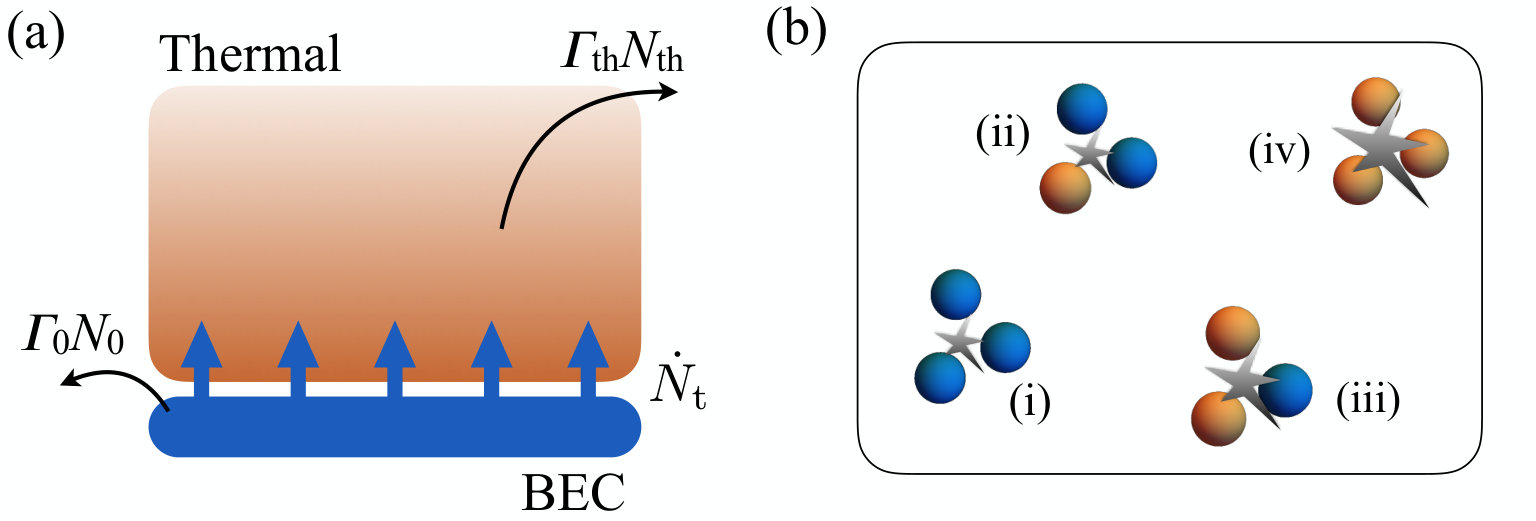 Figure 1
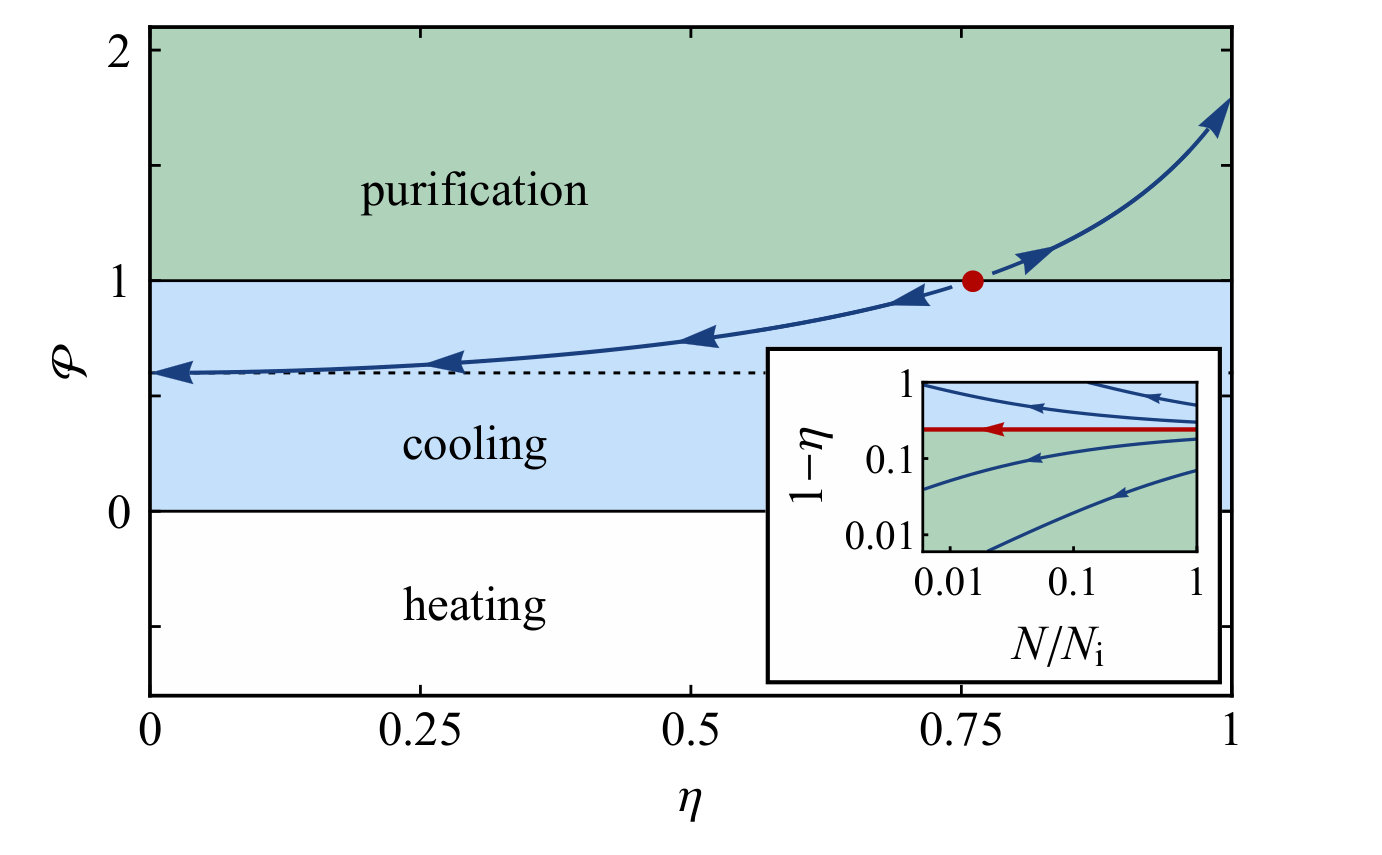 Figure 2
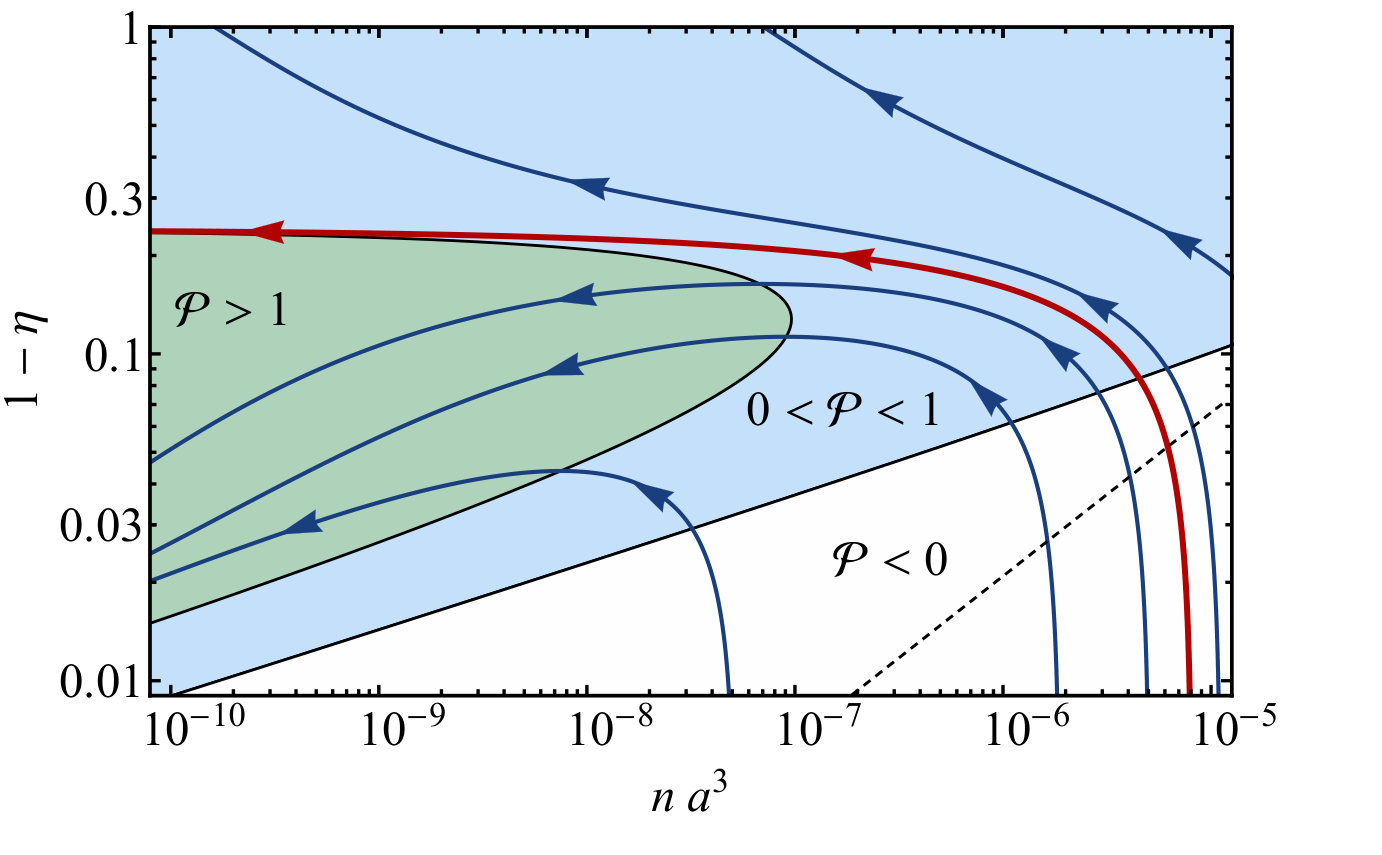 Figure 3
Peer Reviews
No public reviews on file for this paper yet. If you reviewed it on a platform where reviews are public (OpenReview, ICLR, NeurIPS, ICML), you can paste yours below so the community can read it here.
Videos
No videos yet. Explain this paper in a talk, walkthrough, or lecture? Add one.
Can three-body recombination purify a quantum gas?
Lena H. Dogra
Cavendish Laboratory, University of Cambridge, J. J. Thomson Avenue, Cambridge CB3 0HE, United Kingdom
Jake A. P. Glidden
Cavendish Laboratory, University of Cambridge, J. J. Thomson Avenue, Cambridge CB3 0HE, United Kingdom
Timon A. Hilker
Cavendish Laboratory, University of Cambridge, J. J. Thomson Avenue, Cambridge CB3 0HE, United Kingdom
Christoph Eigen
Cavendish Laboratory, University of Cambridge, J. J. Thomson Avenue, Cambridge CB3 0HE, United Kingdom
Eric A. Cornell
JILA, National Institute of Standards and Technology and University of Colorado, and Department of Physics, Boulder, Colorado 80309-0440, USA
Robert P. Smith
Clarendon Laboratory, University of Oxford, Parks Road, Oxford OX1 3PU, United Kingdom
Zoran Hadzibabic
Cavendish Laboratory, University of Cambridge, J. J. Thomson Avenue, Cambridge CB3 0HE, United Kingdom
Abstract
Three-body recombination in quantum gases is traditionally associated with heating, but it was recently found that it can also cool the gas. We show that in a partially condensed three-dimensional homogeneous Bose gas three-body loss could even purify the sample, that is, reduce the entropy per particle and increase the condensed fraction . We predict that the evolution of under continuous three-body loss can, depending on small changes in the initial conditions, exhibit two qualitatively different behaviours - if it is initially above a certain critical value, increases further, whereas clouds with lower initial evolve towards a thermal gas. These dynamical effects should be observable under realistic experimental conditions.
In ultracold atomic gases, uncontrollable particle loss is usually associated with mundane and adverse effects, such as increase of temperature and entropy per particle. However, it can also have more interesting consequences. In a 3D weakly interacting homogeneous Bose gas, one-body loss due to collisions with the background gas in the vacuum chamber results in the quantum analogue of Joule-Thomson cooling Kothari and Srivasava (1937); Schmidutz et al. (2014). This is a purely quantum-statistical effect, with the only role of weak interactions being to ensure thermalisation of the gas. Recently, it was also observed that in interaction-dominated 1D Bose gases atom loss led to cooling even though its origin was three-body recombination, which is traditionally associated with heating Schemmer and Bouchoule (2018). In these experiments Schmidutz et al. (2014); Schemmer and Bouchoule (2018), losses reduced the gas temperature, but they still made the samples less degenerate, because the fractional drop of the degeneracy temperature, set by the gas density, was even larger.
In this Letter, we show that in a partially condensed, weakly interacting homogeneous 3D Bose gas, three-body recombination can result in an intricate dynamical phase diagram; under certain conditions it can both cool and purify the gas, i.e. reduce the entropy per particle and increase the condensed fraction . An ideal-gas thermodynamic calculation gives that the evolution of the system depends on whether is above or below a critical value . For , the gas cools but . However, for the gas undergoes self-purification and . This behaviour is a consequence of the interplay of two quantum-statistical effects – saturation of the thermal cloud Pethick and Smith (2002); Schmidutz et al. (2014) and preferential loss of thermal atoms due to boson bunching Kagan et al. (1985); Burt et al. (1997); Söding et al. (1999); Haller et al. (2011) (see Fig. 1). Purification occurs not just despite the three-body nature of the loss, but specifically because of it. Considering the effects of weak two-body interactions on the thermodynamics, we find a more complex phase diagram, but qualitatively similar behaviour for , where is the gas density and the -wave scattering length.
These effects could be observed in a homogeneous Bose gas, produced in an optical box trap Gaunt et al. (2013), near a zero-crossing of associated with a Feshbach resonance Chin et al. (2010). For both the saturation of the thermal component and the beneficial effects of boson bunching for purification, it is important that the gas is homogeneous, with the condensed and thermal components completely spatially overlapped 111Due to geometric effects, in a harmonic trap the thermal atom number is not saturated even for very weak interactions Tammuz et al. (2011), whereas in a box-trapped gas it is Schmidutz et al. (2014).. The gas homogeneity also eliminates the problem of ‘anti-evaporation’ heating present in harmonic traps Weber et al. (2003), where the density dependent recombination preferentially removes atoms with below-average energy. We assume that three-body recombination is the dominant loss process and that loss products leave the box without undergoing secondary collisions. At the end of the paper we discuss how these requirements can be fulfilled.
To elucidate the key physics, we start with an ideal-gas calculation, assuming that continuous thermalisation is the only effect of two-body interactions.
In Fig. 1(a) we outline the idea of saturation-driven cooling. In a partially condensed ideal Bose gas of atoms at temperature , the thermal atom number is saturated at the critical value for condensation , with , and there are zero-energy atoms in the Bose-Einstein condensate (BEC). The total energy is and the entropy per particle is proportional to the thermal fraction Pethick and Smith (2002). Removing BEC atoms through some loss process, at a rate we write as , although may not be a constant, does not change , or . However, removing thermal atoms through some (same or different) loss process, at a rate , reduces the energy according to . Since and depend only on , we get
[TABLE]
Note that . To maintain equilibrium, with saturated, atoms transfer between the BEC and the thermal cloud, at a rate , so the net rates of change of and are and . Specifically, for every 5 atoms lost from the thermal cloud, 2 are replenished from the BEC. This injection of zero-energy particles into the thermal cloud is the microscopic origin of the cooling.
These arguments are not specific to any particular loss process. They apply to the three-body loss discussed here and the one-body loss that drives the quantum Joule-Thomson effect observed in Schmidutz et al. (2014), and are also at the heart of the decoherence-driven cooling observed in Lewandowski et al. (2003); Olf et al. (2015), although in that case the atoms were not lost, but transferred to a different spin state.
To see whether atom loss can purify the gas, we calculate
[TABLE]
where is the thermal fraction, is the total per-particle loss rate, and we have introduced a dimensionless purification coefficient
[TABLE]
For the gas purifies (), whereas for it cools without purifying. From Eq. (1), for an ideal gas
[TABLE]
so purification requires . Here the nature of the loss process is crucial. One-body losses do not distinguish BEC and thermal atoms, so and . However, for three-body loss can be larger than .
In general, the local three-body loss rate is given by
[TABLE]
where is the zero-distance three-body correlation function and is the three-body loss coefficient. In terms of local condensate and thermal density, and respectively Kagan et al. (1985),
[TABLE]
For a uniform gas, where , with being the gas volume, this corresponds to
[TABLE]
For the same and , the loss rate in a pure BEC () is 6 times smaller than in a thermal gas (), due to suppression of boson bunching Kagan et al. (1985); Burt et al. (1997). More generally, the four terms on the r.h.s. of Eq. (6) correspond, left to right, to the four loss processes (i) - (iv) in Fig. 1(b). Considering how many thermal and BEC atoms are lost in each process and keeping the same order of terms as in Eq. (6):
[TABLE]
corresponding to
[TABLE]
Finally, inserting and into Eqs. (1, 2, 4), we obtain:
[TABLE]
We see that depends only on the condensed fraction . As shown in Fig. 2, it monotonically grows from at to at 222One can repeat an analogous calculation for two-body losses due to, e.g., spin-changing collisions. In that case , with . This gives , which can also be larger than 1.. For very small , from it directly follows that and . In this regime also . Microscopically, in this regime the two dominant processes in Fig. 1(b) are (iii) for the loss of BEC atoms and (iv) for the loss of thermal ones. These involve at most one BEC atom and hence have the same combinatorial factors, so , and we essentially get the quantum Joule-Thomson effect Schmidutz et al. (2014), although driven by three-body loss. In the opposite limit , where and , the two relevant processes in Fig. 1(b) are (i) and (ii), which have different combinatorial factors, such that , giving .
Crucially, changes sign at a critical condensed fraction , which is a solution to the cubic equation , see Eq. (Can three-body recombination purify a quantum gas?). As indicated by the arrows in Fig. 2, for the gas cools but , while for the gas keeps self-purifying and . This is illustrated in the inset of Fig. 2, where we show the evolution of the thermal fraction for different initial condensed fractions. On this log-log plot, gives the slope of the trajectories; see Eq. (3).
These ideal-gas effects should play a dominant role if the interaction energy is small compared to the thermal one. Within mean-field theory (see below), for small thermal fraction the ratio of thermal to interaction energy is Pethick and Smith (2002), so the two are comparable for .
We now quantitatively assess the effects of weak two-body interactions on three-body cooling and purification, for (see Fig. 3). In this regime, to a good approximation, interaction energy is mean-field like, is ideal-gas like Kagan et al. (1985); Haller et al. (2011), and the saturation picture holds Smith (2017). We also assume that the thermal excitations are particle-like, which is a good approximation for most of the range of system parameters we consider (see dashed line in Fig. 3). The total energy is now
[TABLE]
Here , where is the Riemann function, and , where is the atom mass.
A subtle question is how much interaction energy is removed from the gas through atom loss. Let us first consider an initially pure BEC, with . For the BEC to stay pure after removal of a particle, the energy removed would have to be . This would correspond to removing a particle adiabatically from a delocalised wavefunction. In contrast, a sudden local atom loss should simply remove the average energy per particle, . The gas is then left with total energy larger, by , than that of a pure BEC with atoms, so this loss leads to heating. The next conceptual step is to extend this analysis to nonzero . We rewrite Eq. (10) as
[TABLE]
and interpret the terms in square brackets as the energy per BEC atom, (left bracket), and the energy per thermal atom, (right bracket), in the sense that the rate of energy change should be
[TABLE]
Under continuous equilibration it must also be
[TABLE]
where is such that remains saturated, and it can now in general be of either sign. Combining these equations gives the purification coefficient , a generalisation of Eq. (Can three-body recombination purify a quantum gas?), which now depends on two dimensionless parameters, and :
[TABLE]
where and , with .
In Fig. 3 we show examples of trajectories for fixed (arbitrary) . The red-coloured trajectory separates those that flow to and . The background shading indicates whether the gas instantaneously purifies (), cools but does not purify (), or heats () 333One can obtain identical results by iteratively removing, in small steps, particles according to Eq. (8) and energy according to Eq. (11), and then solving for the new equilibrium state under the constraints of the new total and ..
At low thermal fraction , the constant- contours in Fig. 3 follow the scaling , meaning that is determined by the ratio of thermal and interaction energies. Qualitatively, affinity between particles (due to quantum statistics) leads to cooling, while aversion (due to repulsive interactions) leads to heating, similarly to how Joule-Thomson rarefaction leads to cooling of attractive classical gases and non-interacting bosons, and heating of repulsive classical gasses and non-interacting fermions Kothari and Srivasava (1937); Schmidutz et al. (2014); here, each of the two opposing effects dominates in a different regime. The contour is all the way to , while the purification effect is less robust in presence of two-body repulsion, but is still possible for . Also note that a system trajectory cannot leave the purification region , but can enter it because losses reduce . We have considered particle-like excitations, while phononic excitations will dominate the system’s evolution for small , below the dashed line in Fig. 3.
Our theory could be tested near a zero-crossing of , associated with a Feshbach resonance, where is nonzero and nearly -independent. For illustration, we assume {10}^{-29}\text{,}\mathrm{c}\mathrm{m}^{6}\mathrm{/}\mathrm{s}, as observed in, *e.g.*, ${}^{7}{\rm Li}$ Shotan *et al.* ([2014](#bib.bib19)) and ${}^{39}{\rm K}$ Fattori *et al.* ([2008](#bib.bib20)), initial $n=${10}^{14}\text{\,}{\mathrm{cm}}^{-3} and , and , where is the Bohr radius. For these parameters, 1.5\text{\times}{10}^{-8}, our calculation gives $\mathcal{P}>1$ (see Fig. [3](#S0.F3)), and $\Gamma\approx$0.1\text{\,}{\mathrm{s}}^{-1} would be sufficiently large to dominate over the one-body loss rate, which is in many experiments 0.01\text{,}{\mathrm{s}}^{-1}. The healing length would be $\xi=1/\sqrt{8\pi n_{0}a}\approx$1\text{\,}\mathrm{\SIUnitSymbolMicro m}, so in a box of size 10\text{,}\mathrm{\SIUnitSymbolMicro m} the BEC would be essentially homogeneous and occupy the same volume as the thermal gas. The mean free path would be $\ell=1/(8\pi na^{2})\approx$1\text{\,}\mathrm{mm}, so secondary collisions of the loss products should be negligible. Finally, for continuous thermalisation we want Monroe et al. (1993), where (for small ) is the per-particle rate of elastic two-body collisions, and from Eqs. (3, 13). This final requirement would be marginally satisfied in a gas, and very comfortably in a one. We note that the initial we assume is a few times larger than what was already achieved in box traps, but is not unrealistic.
In conclusion, we have shown that, under realistic experimental conditions, three-body recombination can both cool and purify a homogeneous Bose gas. We have calculated a dynamical phase diagram which shows that the behaviour of the system can be qualitatively altered by small changes in the initial conditions. An interesting extension of this work would be to investigate the regimes of stronger interactions and/or very low thermal fractions, where the phonon nature of the excitations plays a role, thus connecting our study with the analysis performed in Refs. Schemmer and Bouchoule (2018); Bouchoule et al. (2018).
We thank Jean Dalibard for helpful discussions. This work was supported by ERC (QBox), EPSRC [Grants No. EP/N011759/1 and No. EP/P009565/1], QuantERA [NAQUAS, EPSRC Grant No. EP/R043396/1], AFOSR, and ARO. T. A. H. acknowledges support from the EU Marie Skłodowska-Curie program [Grant No. MSCA-IF-2018 840081]. R. P. S. acknowledges support from the Royal Society. E. A. C. acknowledges hospitality and support from Trinity College, Cambridge.
The reference list from the paper itself. Each links out to its DOI / PubMed record.
- 1Kothari and Srivasava (1937) D. S. Kothari and B. N. Srivasava, “Joule–Thomson Effect and Quantum Statistics,” Nature 140 , 970 (1937) . · doi ↗
- 2Schmidutz et al. (2014) T. F. Schmidutz, I. Gotlibovych, A. L. Gaunt, R. P. Smith, N. Navon, and Z. Hadzibabic, “Quantum Joule–Thomson Effect in a Saturated Homogeneous Bose Gas,” Phys. Rev. Lett. 112 , 040403 (2014) . · doi ↗
- 3Schemmer and Bouchoule (2018) M. Schemmer and I. Bouchoule, “Cooling a Bose Gas by Three–Body Losses,” Phys. Rev. Lett. 121 , 200401 (2018) . · doi ↗
- 4Pethick and Smith (2002) C. J. Pethick and H. Smith, Bose–Einstein Condensation in Dilute Gases (Cambridge University Press, 2002).
- 5Kagan et al. (1985) Y. Kagan, B. V. Svistunov, and G. V. Shlyapnikov, “Effect of Bose condensation on inelastic processes in gases,” JETP Lett. 42 , 209 (1985) .
- 6Burt et al. (1997) E. A. Burt, R. W. Ghrist, C. J. Myatt, M. J. Holland, E. A. Cornell, and C. E. Wieman, “Coherence, Correlations, and Collisions: What One Learns about Bose–Einstein Condensates from Their Decay,” Phys. Rev. Lett. 79 , 337–340 (1997) . · doi ↗
- 7Söding et al. (1999) J. Söding, D. Guéry-Odelin, P. Desbiolles, F. Chevy, H. Inamori, and J. Dalibard, “Three-body decay of a rubidium Bose–Einstein condensate,” Appl. Phys. B 69 , 257 (1999) . · doi ↗
- 8Haller et al. (2011) E. Haller, M. Rabie, M. J. Mark, J. G. Danzl, R. Hart, K. Lauber, G. Pupillo, and H.-C. Nägerl, “Three–Body Correlation Functions and Recombination Rates for Bosons in Three Dimensions and One Dimension,” Phys. Rev. Lett. 107 , 230404 (2011) .