Current-Induced Dynamics and Chaos of Antiferromagnetic Bimerons
Laichuan Shen, Jing Xia, Xichao Zhang, Motohiko Ezawa, Oleg A., Tretiakov, Xiaoxi Liu, Guoping Zhao, Yan Zhou

TL;DR
This paper investigates the dynamics of antiferromagnetic bimerons driven by spin currents, revealing their creation, steady motion, nonlinear behavior, and chaos, which are crucial for future spintronic applications.
Contribution
It provides the first analytical and numerical analysis of antiferromagnetic bimeron dynamics under spin currents, including chaotic behavior and nonlinear motion modeling.
Findings
Spin current can create isolated bimerons in antiferromagnetic films.
Antiferromagnetic bimerons can move steadily without transverse drift.
Chaotic behavior of bimerons is characterized by Lyapunov exponents.
Abstract
A magnetic bimeron is a topologically non-trivial spin texture carrying an integer topological charge, which can be regarded as the counterpart of skyrmion in easy-plane magnets. The controllable creation and manipulation of bimerons are crucial for practical applications based on topological spin textures. Here, we analytically and numerically study the dynamics of an antiferromagnetic bimeron driven by a spin current. Numerical simulations demonstrate that the spin current can create an isolated bimeron in the antiferromagnetic thin film via the damping-like spin torque. The spin current can also effectively drive the antiferromagnetic bimeron without a transverse drift. The steady motion of an antiferromagnetic bimeron is analytically derived and is in good agreement with the simulation results. Also, we find that the alternating-current-induced motion of the antiferromagnetic…
Click any figure to enlarge with its caption.
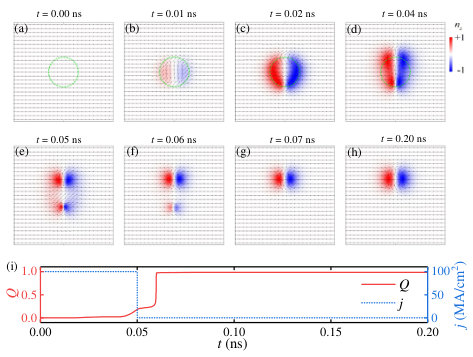 Figure 1
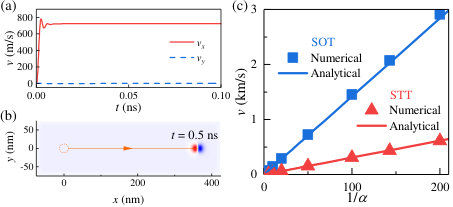 Figure 2
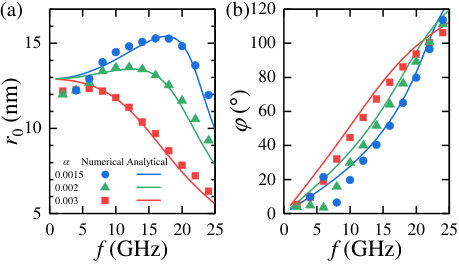 Figure 3
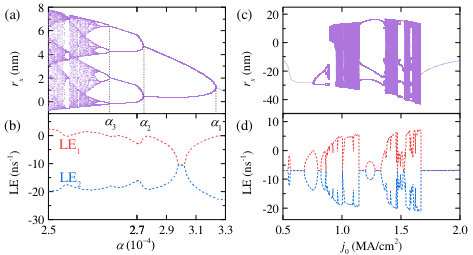 Figure 4
Peer Reviews
No public reviews on file for this paper yet. If you reviewed it on a platform where reviews are public (OpenReview, ICLR, NeurIPS, ICML), you can paste yours below so the community can read it here.
Videos
No videos yet. Explain this paper in a talk, walkthrough, or lecture? Add one.
††thanks: These authors contributed equally to this work.††thanks: These authors contributed equally to this work.
Current-Induced Dynamics and Chaos of Antiferromagnetic Bimerons
Laichuan Shen
School of Science and Engineering, The Chinese University of Hong Kong, Shenzhen, Guangdong 518172, China
College of Physics and Electronic Engineering, Sichuan Normal University, Chengdu 610068, China
Jing Xia
School of Science and Engineering, The Chinese University of Hong Kong, Shenzhen, Guangdong 518172, China
Xichao Zhang
School of Science and Engineering, The Chinese University of Hong Kong, Shenzhen, Guangdong 518172, China
Motohiko Ezawa
Department of Applied Physics, The University of Tokyo, 7-3-1 Hongo, Tokyo 113-8656, Japan
Oleg A. Tretiakov
School of Physics, The University of New South Wales, Sydney 2052, Australia
Xiaoxi Liu
Department of Electrical and Computer Engineering, Shinshu University, 4-17-1 Wakasato, Nagano 380-8553, Japan
Guoping Zhao
College of Physics and Electronic Engineering, Sichuan Normal University, Chengdu 610068, China
Yan Zhou
School of Science and Engineering, The Chinese University of Hong Kong, Shenzhen, Guangdong 518172, China
(December 24, 2019)
Abstract
A magnetic bimeron is a topologically non-trivial spin texture carrying an integer topological charge, which can be regarded as the counterpart of skyrmion in easy-plane magnets. The controllable creation and manipulation of bimerons are crucial for practical applications based on topological spin textures. Here, we analytically and numerically study the dynamics of an antiferromagnetic bimeron driven by a spin current. Numerical simulations demonstrate that the spin current can create an isolated bimeron in the antiferromagnetic thin film via the damping-like spin torque. The spin current can also effectively drive the antiferromagnetic bimeron without a transverse drift. The steady motion of an antiferromagnetic bimeron is analytically derived and is in good agreement with the simulation results. Also, we find that the alternating-current-induced motion of the antiferromagnetic bimeron can be described by the Duffing equation due to the presence of the nonlinear boundary-induced force. The associated chaotic behavior of the bimeron is analyzed in terms of the Lyapunov exponents. Our results demonstrate the inertial dynamics of an antiferromagnetic bimeron, and may provide useful guidelines for building future bimeron-based spintronic devices.
skyrmion, bimeron, antiferromagnet, spintronics, micromagnetics
pacs:
75.50.Ee, 75.78.Fg, 75.78.-n
Introduction. Topologically protected magnetic textures, such as magnetic skyrmions Roszler_NATURE2006 ; Nagaosa_NNANO2013 ; Finocchio_JPD2016 ; Kang_PIEEE2016 ; Fert_NATREVMAT2017 ; ES_JAP2018 ; Zhou_NSR2018 , have attracted a lot of attention, because they have small size and can be used as non-volatile information carriers in future spintronic devices Zhang_SciRep2015 ; Prychynenko_PRApplied2018 ; Nozaki_APL2019 . The existence of magnetic skyrmions has been experimentally confirmed in many systems with bulk or interfacial Dzyaloshinskii-Moriya interaction (DMI) Nagaosa_NNANO2013 ; Finocchio_JPD2016 ; Fert_NATREVMAT2017 ; ES_JAP2018 . In addition, various topological structures, such as antiferromagnetic (AFM) skyrmions Zhang_SREP2016A ; Barker_PRL2016 , ferrimagnetic skyrmions Woo_NATCOM2018 , antiskyrmions Nayak_Nature2017 , biskyrmions Yu_NATCOM2014 , bobbers Rybakov_PRL2015 , and bimerons Ezawa_PRB2011 ; Zhang_SciRep2015 ; Lin_PRB2015 ; Heo_SciRep2016 ; Leonov_PRB2017 ; Kharkov_PRL2017 ; Kolesnikov_SciRep2018 ; Chmiel_NatMater2018 ; Yu_Nat2018 ; Woo_Nat2018 ; Gobel_PRB2019 ; Fernandes_SSC2019 ; Murooka2019 ; Kim2019 ; Gao_NatCom2019 , are also current hot topics. In particular, a bimeron consists of two merons, which can be found in easy-plane magnets Zhang_SciRep2015 ; Lin_PRB2015 ; Leonov_PRB2017 ; Murooka2019 , frustrated magnets Kharkov_PRL2017 , and magnets with anisotropic DMI Gobel_PRB2019 . The bimeron is a localized spin texture similar to magnetic skyrmion, which can be constructed by rotating the spin direction of a skyrmion by . Magnetic bimerons can also be used as information carriers for spintronic devices made of in-plane magnetized thin films Zhang_SciRep2015 ; Gobel_PRB2019 ; Murooka2019 .
On the other hand, AFM materials are promising for building advanced spintronic devices due to their zero stray fields and ultrafast spin dynamics Baltz_RMP2018 ; Jungwirth_NNANO2016 ; Smejkal_NATP2018 . Several theoretical studies Zhang_SREP2016A ; Barker_PRL2016 ; Khoshlahni_PRB2019 ; Yang_PRL2018 predict that skyrmions may exist in AFM systems, which can be manipulated by spin currents Zhang_SREP2016A ; Barker_PRL2016 and magnetic fields Khoshlahni_PRB2019 . Compared to ferromagnetic (FM) skyrmions, AFM skyrmions do not show the skyrmion Hall effect Jiang_NatPhys2017 ; Litzius_NatPhys2017 due to zero net Magnus force, so that they can move perfectly along the driving force direction with ultrahigh speed Zhang_SREP2016A ; Barker_PRL2016 ; Shen_PRB2018 ; Zhang_NATCOM2016 . Various methods have been proposed to control the AFM textures, such as by using spin currents Hals_PRL2011 ; Shiino_PRL2016 ; Velkov_NJP2016 , magnetic anisotropy gradients Shen_PRB2018 , temperature gradients Selzer_PRL2016 ; Khoshlahni_PRB2019 , and spin waves Qaiumzadeh_PRB2018 .
For AFM systems, the motion equation of the AFM order parameter (Néel vector) is related to the second derivative with respect to time, whereas the FM Landau-Lifshitz-Gilbert (LLG) equation Gilbert_IEEE2004 is of the first order Baltz_RMP2018 . Therefore, the dynamics of AFM spin textures are different from that of FM spin textures. For example, the oscillation frequency of AFM skyrmion-based spin torque nano-oscillators (STNOs) is higher than that of FM skyrmion-based STNOs as AFM skyrmions obey the inertial dynamics Shen_APL2019 . In addition, the motion equation of the systems, such as the LLG equation, is usually nonlinear, resulting in the dynamic behavior being complex or even chaotic. Moon_SciRep2014 ; Yang_PRL2007 Note that for the chaos, the nonlinearity is a necessary condition rather than a sufficient condition, so that not all nonlinear systems will exhibit the chaotic behavior. In nanoscale spintronic devices, spin torque nano-oscillators are interesting candidates for chaotic systems Devolder_PRL2019 ; Matsumoto_PRApplied2019 ; Petit-Watelot_NatPhys2012 , which are promising for various applications Fukushima_APE2014 ; Ditto_Chaos2015 ; Wang_IEEE1999 . For the AFM bimeron, however, its dynamics induced by a spin current still remain elusive.
In this Letter, we report the dynamics of an AFM bimeron induced by the spin current. Our theoretical and numerical results show that an isolated bimeron can be created and driven in the AFM thin film by spin currents. Furthermore, when an alternating current is applied to drive the AFM bimeron, the motion of the bimeron in a nanodisk can be described by the Duffing equation, which describes the oscillation of an object with a mass under the action of nonlinear restoring forces. The chaotic behavior associated is also analyzed in terms of the Lyapunov exponents.
Model and theory. We consider a G-type AFM film with sublattice magnetization and . By linearly combining the reduced magnetizations and ( with the saturation magnetization ), we obtain the staggered magnetization (or Néel vector) and the total magnetization , where the former could be used to describe the AFM order, while the latter is related to the canting of magnetic moments. Here we are interested in most realistic cases where the AFM exchange interaction is significantly strong, so that Dasgupta_PRB2017 ; Zarzuela_PRB2018 . and obey the following two coupled equations Hals_PRL2011 ; Shiino_PRL2016 ; Velkov_NJP2016 ; Tveten_PRB2016
[TABLE]
where and are the gyromagnetic ratio and the damping constant respectively, and is the higher-order nonlinear term Hals_PRL2011 . and are damping-like spin-orbit torques (SOTs), where is the polarization vector and relates to the applied current density , defined as with the reduced Planck constant , the spin polarization rate , the vacuum permeability constant , the elementary charge , and the layer thickness . and stand for spin-transfer torques (STTs) with the adiabatic (nonadiabatic) parameter (). In our simulations, and are adopted. and are the effective fields. From a classical Heisenberg Hamiltonian Tveten_PRB2016 , the AFM energy can be written as , where with the homogeneous exchange constant , parity-breaking constant Tveten_PRB2016 ; Shiino_PRL2016 ; Qaiumzadeh_PRB2018 , inhomogeneous exchange constant and magnetic anisotropy constant . stands for the direction of the anisotropy axis and is the DMI energy density, with the DMI constant Gobel_PRB2019 ; Velkov_NJP2016 ; Zarzuela_PRB2018 ; Rohart_PRB2013 . Such a DMI energy can stabilize the bimeron, which can be induced at the antiferromagnet/heavy metal interface Gobel_PRB2019 . In addition, to form the bimeron, antiferromagnets with in-plane easy-axis anisotropy, such as NiO Baltz_RMP2018 , are favorable.
Based on Eqs. (1a) and (1b), one can simulate the evolution of the staggered magnetization, and also derive the steady motion equations for a rigid AFM bimeron by using Thiele (or collective coordinate) approach Thiele_PRL1973 ; Tveten_PRL2013 ; Tretiakov_PRL2008 ; Clarke_PRB2008 (see Ref. Shen_SI for details), written as
[TABLE]
where is the acceleration, and is the effective AFM bimeron mass, which is defined as with the dissipative tensor . The effective AFM texture mass originates from the existence of two sublattices, Baltz_RMP2018 and it is intrinsic. The components of the dissipative tensor are and . In Eq. (2), the forces induced by the surrounding environment (e.g., the boundary effect) are not taken into account, represents the dissipative force with the velocity , and and are the forces induced by SOTs and STTs, respectively.
Creation of an AFM bimeron by a spin current. Creating an isolated AFM bimeron is essential for practical applications. Here we employ a current to create an AFM bimeron via SOTs. As shown in Fig. 1, when a vertical current of MA/cm2 is injected into the central circular region with a diameter of nm, the Néel vector is continuously flipped and then a bimeron-like magnetic structure is formed. At ns, the current is turned off. Since the DMI energy density of the lower half of the magnetic texture has a positive value Shen_SI , the lower half of the magnetic texture is unfavorable and gradually recovers to the AFM ground state, while the upper half evolves into a metastable bimeron. The current-induced process from the AFM ground state to the metastable bimeron takes only tens of picoseconds, as shown in Fig. 1. Such an ultrafast process also exists in the generation of the AFM skyrmions under the action of time-dependent magnetic fields Khoshlahni_PRB2019 , where the force induced by time-dependent magnetic fields has a similar form to that of damping-like spin torques Tveten_PRL2013 ; Gomonay_APL2016 . Similar to the AFM skyrmion, the AFM bimeron is a topologically protected magnetic texture with AFM topological charge , [see Fig. 1(i)] where the topological charge is defined as Barker_PRL2016 ; Lin_PRB2015 ; Tretiakov_PRB2007 . On the other hand, when the opposite DMI constant is adopted, the AFM bimeron is created in the lower plane (the result is given in Ref. Shen_SI ). In addition, for the creation of the AFM bimeron, increasing the injected region can effectively reduce the time and current density, and multiple bimerons will be generated when a small damping is adopted (see Ref. Shen_SI ). Note that the bimeron created here is symmetric, while it may deform under the effect of thermal fluctuations Shen_SI .
Current-induced motion of an AFM bimeron. Manipulating magnetic textures is indispensable in information storage and logic devices. The current, which is a common method to manipulate magnetic materials, is employed to drive the AFM bimeron via SOTs and STTs. Taking the current density MA/cm2 and the damping , we simulate the motion of an AFM bimeron, where the initial state is a metastable AFM bimeron. In order to track the AFM bimeron, the guiding center (, ) of the bimeron is defined, described as
[TABLE]
and the velocity . As shown in Figs. 2(a) and (b), considering the damping-like SOTs, the steady motion speed reaches 725 m/s at ns and the transmission path of the AFM bimeron is parallel to the racetrack, so that the fast-moving AFM bimeron will not be destroyed by touching the racetrack edge due to the cancellation of the Magnus force. Therefore, in addition to the AFM skyrmions, the AFM bimerons are also ideal information carriers in racetrack-type memory.
Figure 2(c) shows the relation between the speed and the damping , where the speed of the AFM bimeron is inversely proportional to the damping constant for SOTs and STTs. In order to test the simulated speeds, we derived the steady motion speed from Eq. (2) (see Ref. Shen_SI for details)
[TABLE]
where is the bimeron radius, which corresponds to the skyrmion radius. The first and second terms on the right side of Eq. (4) are the SOT- and STT-induced speeds, respectively. We can see from Fig. 2(c) that the analytical speed given by Eq. (4) is in good agreement with the results of the numerical simulations. It is worth mentioning that Eq. (4) is also applicable to AFM skyrmions. Namely, the AFM bimeron and skyrmion have the same motion speed under the same driving force.
Dynamics of the AFM bimeron induced by the alternating current. Next, we discuss the forced oscillation of the AFM bimeron induced by the alternating current sin(), where and are the amplitude and frequency of the applied currents. As shown in Ref. Shen_SI , due to the harmonic current-induced driving force, the guiding center of the AFM bimeron exhibits a stable oscillation with amplitude nm and phase difference between and , where , = 20 GHz and MA/cm2 are adopted. By changing the frequency of the applied currents, the different values of and are obtained by numerical simulations and are shown in Fig. 3, where three damping constants (, and ) are considered. We can see that the phase difference becomes larger with the increasing frequency, and interestingly, for the amplitude , there are current-induced resonance phenomena. To analyze such resonance phenomena, we return to Eq. (2) and focus on the motion in the direction, so that the Thiele equation becomes a scalar equation
[TABLE]
where and is the force induced by the alternating current with . is the boundary-induced force, which can be described as with N/m and N/m3 for the nanodisk with a diameter of nm studied here (see Ref. Shen_SI for details). Note that, for other nanodisks, the form of may change, resulting in other types of AFM-bimeron-based nonlinear oscillators,
Since contains a cubic term, Eq. (5) is called the Duffing equation Novak_PRA1982 ; Moon_SciRep2014 , which describes a nonlinear system. Therefore, the AFM bimeron can be used as a Duffing oscillator, which is promising for various applications, such as in weak signal detection Almog_PRL2007 ; Wang_IEEE1999 . We assume that the solution of Eq. (5) satisfies this form , and then substituting it into Eq. (5) gives the amplitude as
[TABLE]
and the phase
[TABLE]
where has been used. As shown in Fig. 3, the results given by Eqs. (6) and (7) are consistent with the numerical simulations for all damping constants. We can see from Eqs. (6) and (7) that the frequency response depends on the physical quantities of antiferromagnets, such as the damping and the effective mass, so that they may be measured by applying alternating currents. It should be noted that, due to the existence of the nonlinear term (), Eq. (6) indicates that an alternating current may induce multiple values of , resulting in the frequency response showing a jump phenomenon. For the nonlinear oscillator based on other types of AFM textures, such as AFM skyrmion and domain wall, one can obtain a similar frequency response. If the nonlinear term and the damping are small, from Eq. (6), the resonance frequency is given by, , which equals to GHz for the parameters used here. On the other hand, as mentioned earlier, nm and for = 20 GHz. Eq. (7) indicates that when is equal to , . Taking nm, GHz is obtained, which is consistent with the simulation result. In addition, for the case of , and , i.e., there are no boundary effect and effective mass, Eq. (7) also gives the phase , which is independent of the damping and the frequency.
For a nonlinear system, taking certain parameter values, it shows chaotic behavior. The Lyapunov exponents (LEs) are usually used to judge whether there is chaos, given as Yang_PRL2007 ; Souza-Machado_AmJP1990
[TABLE]
where is the distance between two close trajectories at initial time, and is the distance between the trajectories at time . If the largest LE is positive, it means that two close trajectories will be separated. Therefore, a small initial error will increase rapidly, resulting in the evolution of being sensitive to initial conditions and its value cannot be predicted for a long time, i.e., the AFM bimeron shows chaotic behavior. Based on Eq. (5), we calculate the bifurcation diagram and LEs (see Ref. Shen_SI for details), and the results are given in Fig. 4, showing that the periodic and chaotic windows appear at intervals. We find that a small damping can lead to the chaotic behavior. The sum of LEs, which equals to , agrees with the above result. On the other hand, the value of the damping at the period-doubling bifurcation should satisfy the universal equation, i.e., the Feigenbaum constant . Yang_PRL2007 ; Souza-Machado_AmJP1990 For the case of Fig. 4(a), is equal to 4.64, from which we estimate that chaos will occur at . In addition, the current density is also of great importance to induce the occurrence of the chaos, as it can be easily tuned in experiment. Figures 4(c) and (d) show that for small currents, the system exhibits a periodic movement. With increasing currents, the period-doubling phenomenon takes place and then the system shows chaotic behavior. It is worth mentioning that the chaotic behavior studied here is subject to the boundary-induced force , which depends on both the geometric and magnetic parameters. The effects of on chaos are discussed in Ref. Shen_SI .
Conclusions. In summary, we have studied the dynamics of an isolated AFM bimeron induced by spin currents. We demonstrate that a spin current can create an isolated bimeron in the AFM film, and drive the AFM bimeron at a speed of a few kilometers per second. Based on the Thiele approach, the steady motion speed is derived, which is in good agreement with the simulation results. Also, we find that the AFM bimeron can be used as the Duffing oscillator. Furthermore, we study the chaotic behavior by calculating the Lyapunov exponents. Our results are useful for the understanding of bimeron physics in AFM systems and may provide guidelines for building spintronic devices based on bimerons.
*Acknowledgments. * X.Z. acknowledges the support by the Presidential Postdoctoral Fellowship of The Chinese University of Hong Kong, Shenzhen (CUHKSZ). M.E. acknowledges the support by the Grants-in-Aid for Scientific Research from JSPS KAKENHI (Grant Nos. JP18H03676, JP17K05490, and JP15H05854) and also the support by CREST, JST (Grant Nos. JPMJCR16F1 and JPMJCR1874). O. A. T. acknowledges support by the Cooperative Research Project Program at the Research Institute of Electrical Communication, Tohoku University and by UNSW Science International Seed grant. X.L. acknowledges the support by the Grants-in-Aid for Scientific Research from JSPS KAKENHI (Grant Nos. 17K19074, 26600041 and 22360122). G.Z. acknowledges the support by the National Natural Science Foundation of China (Grant Nos. 51771127, 51571126 and 51772004) of China, the Scientific Research Fund of Sichuan Provincial Education Department (Grant Nos. 18TD0010 and 16CZ0006). Y.Z. acknowledges the support by the President’s Fund of CUHKSZ, Longgang Key Laboratory of Applied Spintronics, National Natural Science Foundation of China (Grant Nos. 11974298 and 61961136006), Shenzhen Fundamental Research Fund (Grant No. JCYJ20170410171958839), and Shenzhen Peacock Group Plan (Grant No. KQTD20180413181702403).
The reference list from the paper itself. Each links out to its DOI / PubMed record.
- 1(1) U. K. Rößler, A. N. Bogdanov, and C. Pfleiderer, Nature 442 , 797 (2006).
- 2(2) N. Nagaosa and Y. Tokura, Nat. Nanotechnol. 8 , 899 (2013).
- 3(3) G. Finocchio, F Büttner, R. Tomasello, M. Carpentieri and M. Kläui, J. Phys. D: Appl. Phys. 49 , 423001 (2016).
- 4(4) A. Fert, N. Reyren and V. Cros, Nat. Rev. Mat. 2 , 17031 (2017).
- 5(5) K. Everschor-Sitte, J. Masell, R. M. Reeve, and M. Kläui, J. Appl. Phys. 124 , 240901 (2018).
- 6(6) W. Kang, Y. Huang, X. Zhang, Y. Zhou, and W. Zhao, Proc. IEEE 104 , 2040 (2016).
- 7(7) Y. Zhou, Natl. Sci. Rev. 6 , 210 (2019).
- 8(8) X. Zhang, M. Ezawa, and Y. Zhou, Sci. Rep. 5 , 9400 (2015).