Whistler wave generation by halo electrons in the solar wind
Yuguang Tong, Ivan Y. Vasko, Marc Pulupa, Forrest S. Mozer, Stuart D., Bale, Anton V. Artemyev, Vladimir Krasnoselskikh

TL;DR
This study shows that quasi-parallel whistler waves in the solar wind are generated locally by halo electrons through a heat flux instability, with growth influenced by electron temperature anisotropy, affecting heat flux regulation.
Contribution
It provides the first direct observational evidence linking halo electron anisotropy to the generation of whistler waves via heat flux instability in the solar wind.
Findings
Whistler waves are observed with electron distributions of counter-streaming core and halo populations.
Linear stability analysis confirms the instability growth time matches observations.
Electron temperature anisotropy critically influences the onset and growth of whistler waves.
Abstract
We present an analysis of simultaneous particle and field measurements from the ARTEMIS spacecraft which demonstrate that quasi-parallel whistler waves in the solar wind can be generated locally by a bulk flow of halo electrons (whistler heat flux instability). ARTEMIS observes quasi-parallel whistler waves in the frequency range simultaneously with electron velocity distribution functions that are a combination of counter-streaming core and halo populations. A linear stability analysis shows that the plasma is stable when there are no whistler waves, and unstable in the presence of whistler waves. In the latter case, the stability analysis shows that the whistler wave growth time is from a few to ten seconds at frequencies and wavenumbers that match the observations. The observations clearly demonstrate that the temperature anisotropy of halo electrons…
Click any figure to enlarge with its caption.
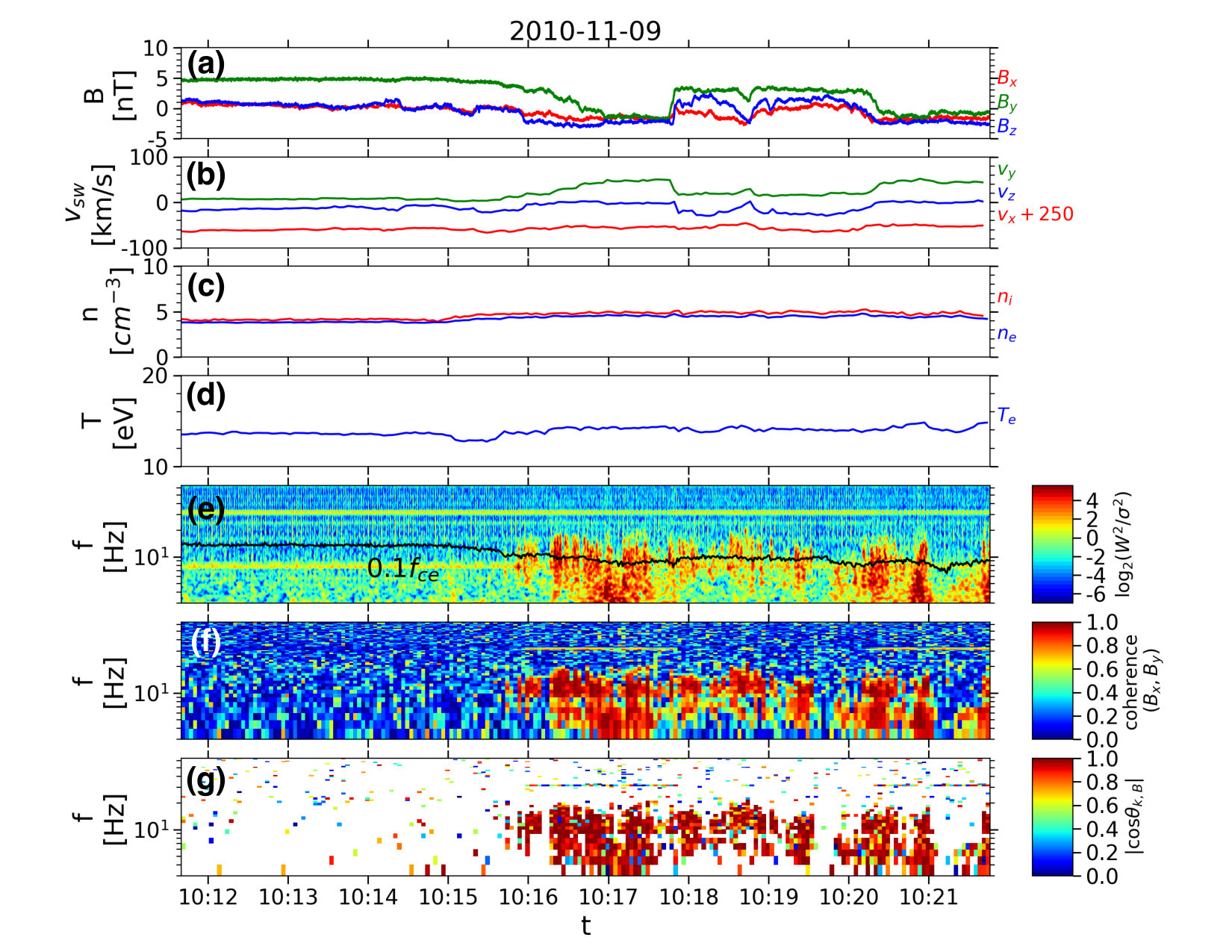 Figure 1
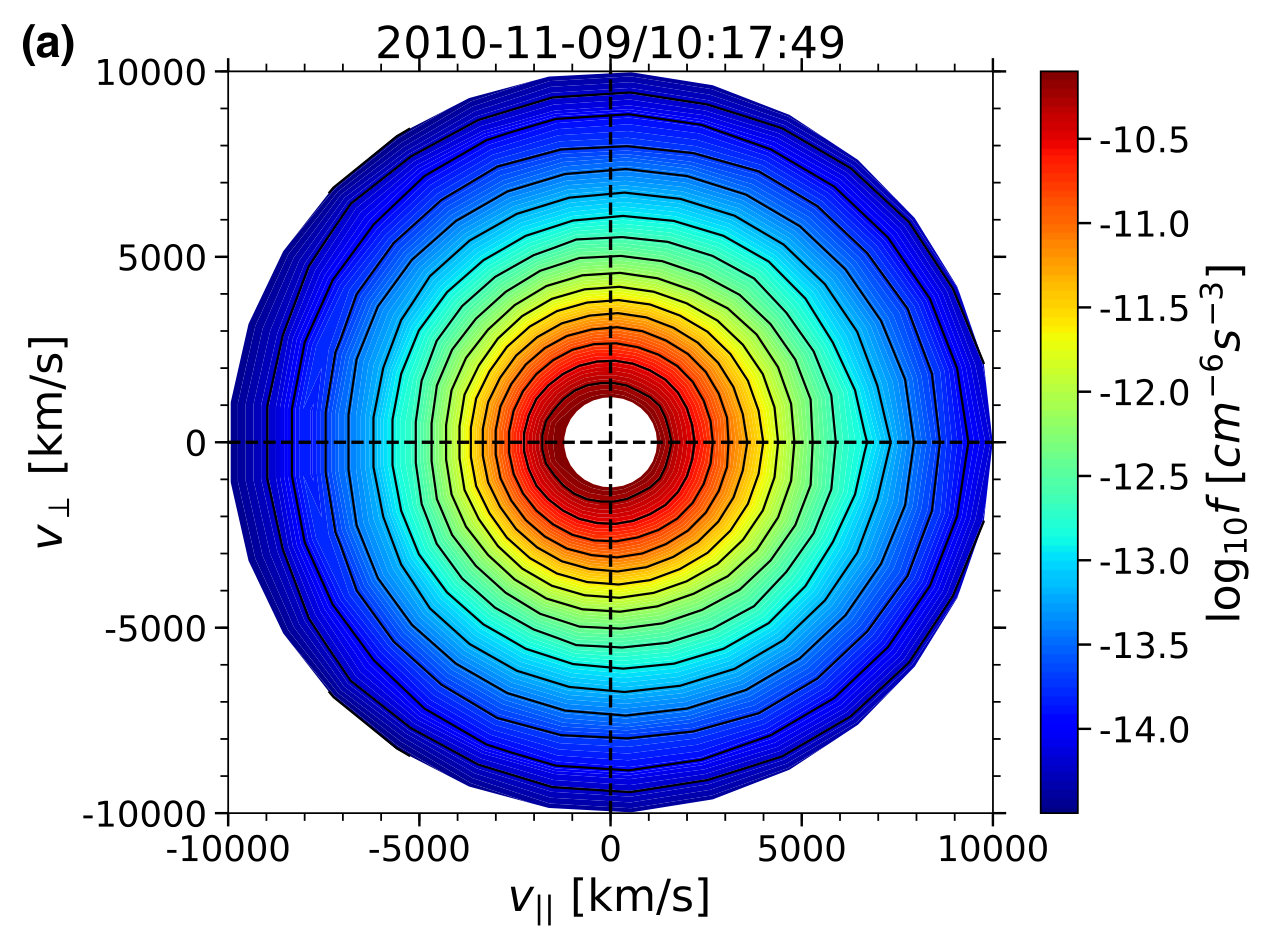 Figure 2
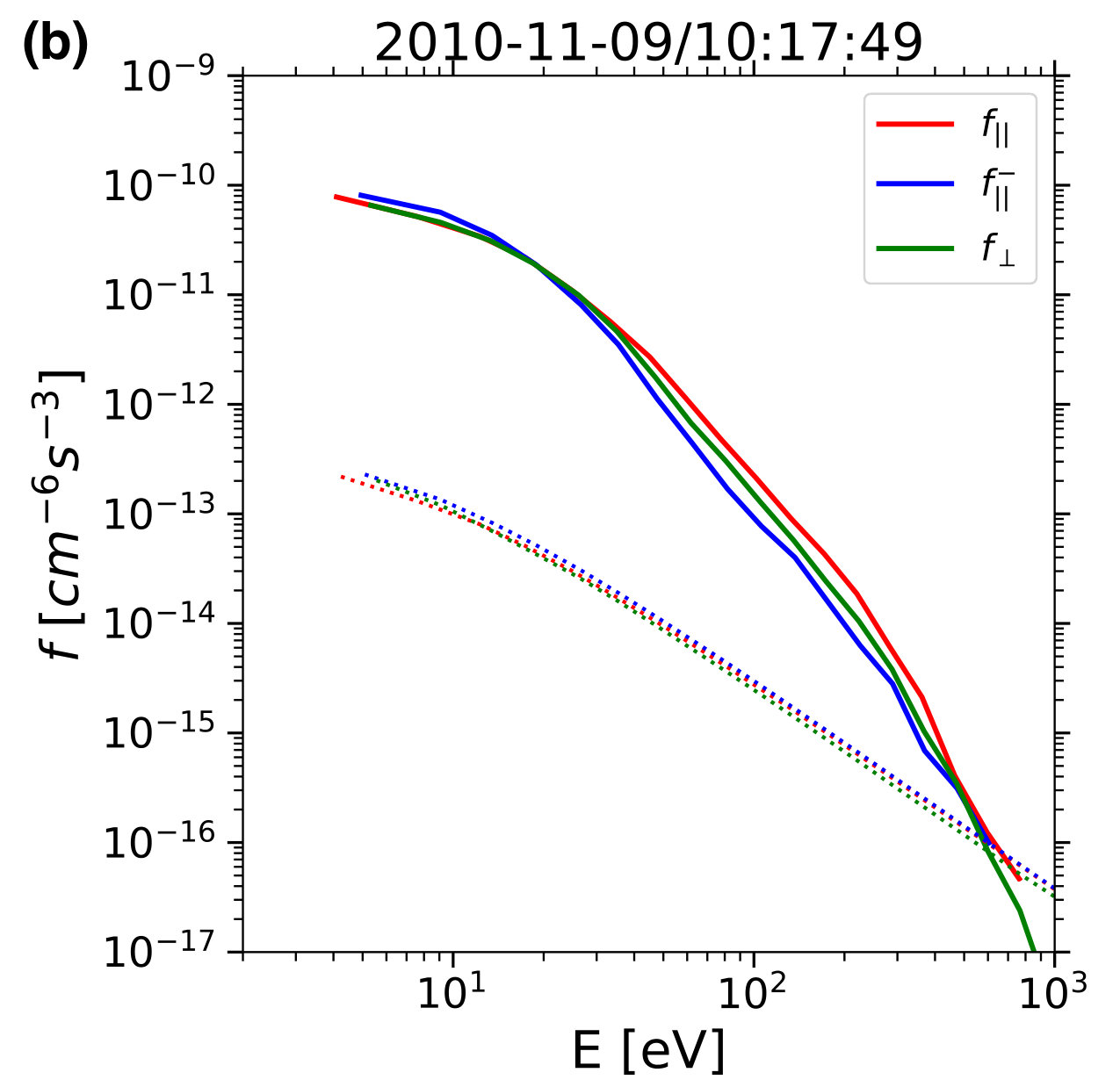 Figure 2
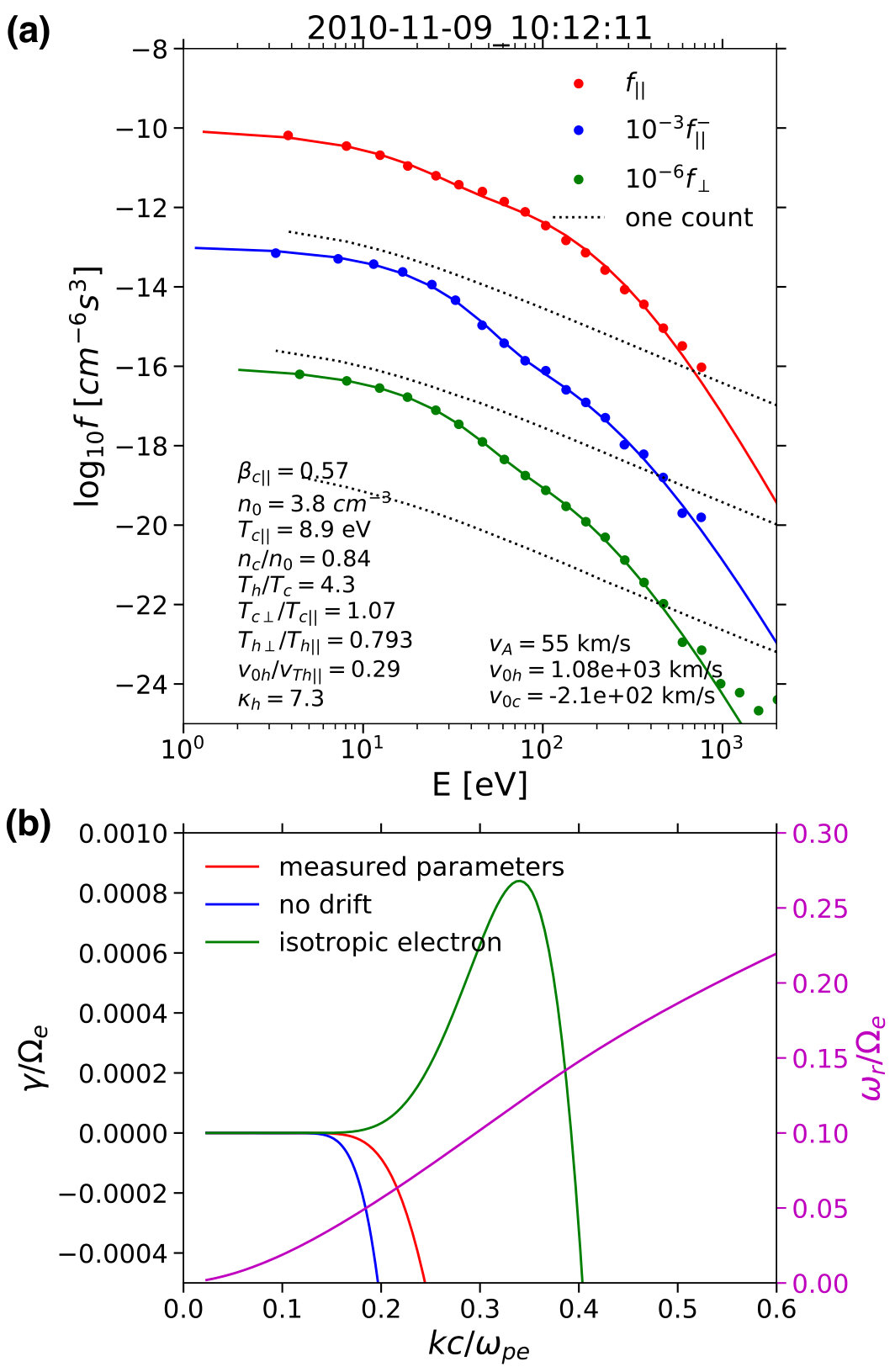 Figure 3
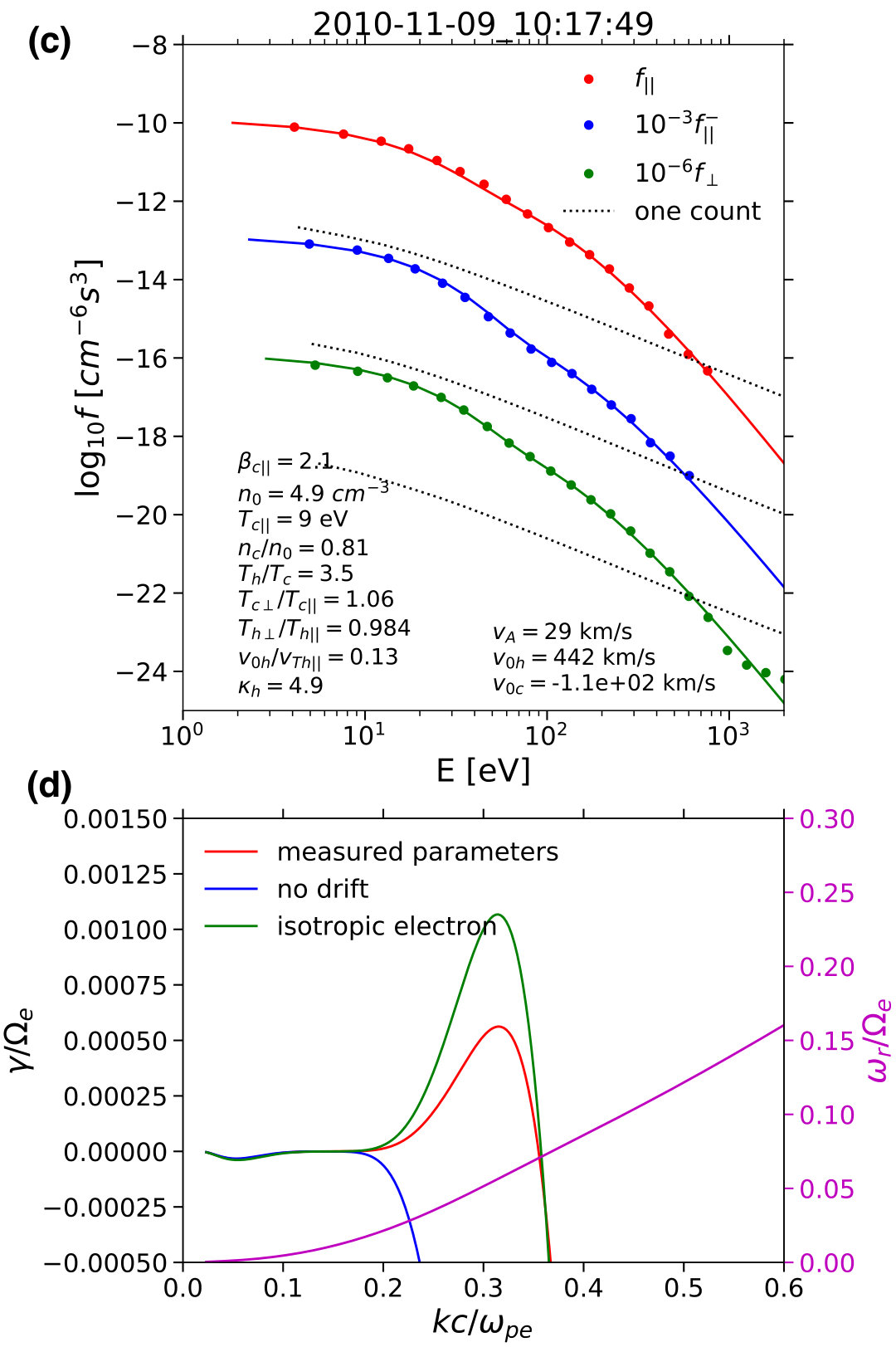 Figure 3
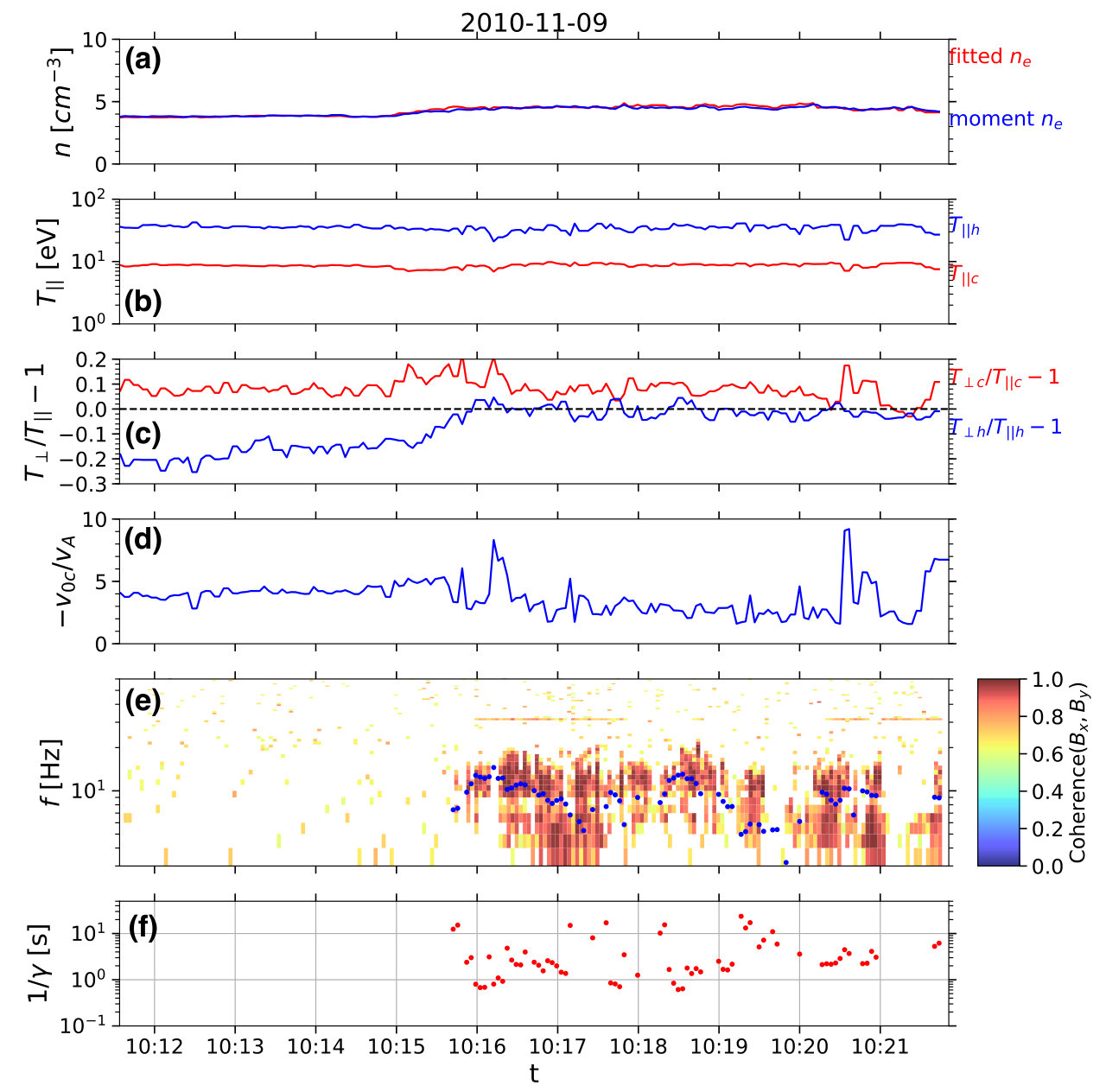 Figure 4
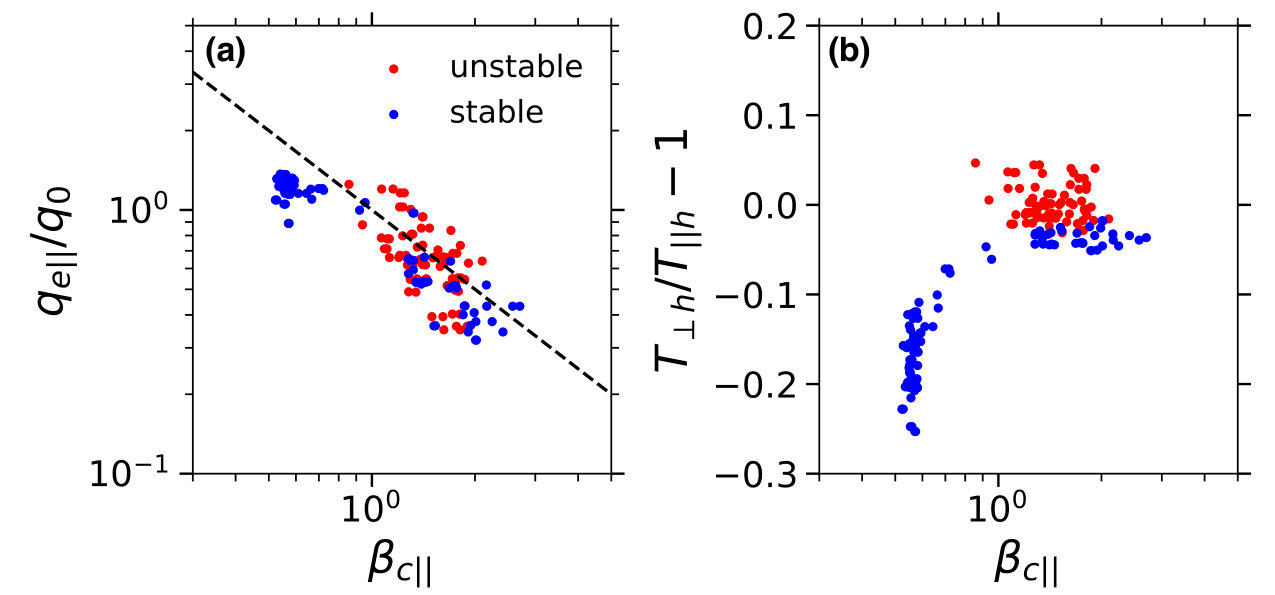 Figure 5
Peer Reviews
No public reviews on file for this paper yet. If you reviewed it on a platform where reviews are public (OpenReview, ICLR, NeurIPS, ICML), you can paste yours below so the community can read it here.
Videos
No videos yet. Explain this paper in a talk, walkthrough, or lecture? Add one.
Whistler wave generation by halo electrons in the solar wind
Yuguang Tong
Space Sciences Laboratory, University of California, Berkeley, CA 94720
Physics Department, University of California, Berkeley, CA 94720
Ivan Y. Vasko
Space Sciences Laboratory, University of California, Berkeley, CA 94720
Marc Pulupa
Space Sciences Laboratory, University of California, Berkeley, CA 94720
Forrest S. Mozer
Space Sciences Laboratory, University of California, Berkeley, CA 94720
Stuart D. Bale
Space Sciences Laboratory, University of California, Berkeley, CA 94720
Physics Department, University of California, Berkeley, CA 94720
Anton V. Artemyev
nstitute of Geophysics and Planetary Sciences, University of California, Los Angeles, USA
Vladimir Krasnoselskikh
University of Orleans, Orlean, France
Abstract
We present an analysis of simultaneous particle and field measurements from the ARTEMIS spacecraft which demonstrate that quasi-parallel whistler waves in the solar wind can be generated locally by a bulk flow of halo electrons (whistler heat flux instability). ARTEMIS observes quasi-parallel whistler waves in the frequency range simultaneously with electron velocity distribution functions that are a combination of counter-streaming core and halo populations. A linear stability analysis shows that the plasma is stable when there are no whistler waves, and unstable in the presence of whistler waves. In the latter case, the stability analysis shows that the whistler wave growth time is from a few to ten seconds at frequencies and wavenumbers that match the observations. The observations clearly demonstrate that the temperature anisotropy of halo electrons crucially affects the heat flux instability onset: a slight anisotropy may quench the instability, while a slight anisotropy may significantly increase the growth rate. These results demonstrate that heat flux inhibition is strongly dependent on the microscopic plasma properties.
solar wind — plasmas — instabilities — waves
††journal: ApJL
1 Introduction
The mechanisms controlling the heat flux in collisionless or weakly-collisional plasmas are of high interest in astrophysics (Cowie & McKee, 1977; Pistinner & Eichler, 1998; Roberg-Clark et al., 2018a). In-situ measurements in the solar wind indicate that the heat flux is generally different from the classical Spitzer-Härm prediction (Feldman et al., 1975; Scime et al., 1994; Bale et al., 2013) and apparently constrained by a threshold dependent on local plasma parameters (Gary et al., 1999b; Gary & Li, 2000; Tong et al., 2018). Such observations have motivated many studies on the detailed physics of heat flux inhibition in the solar wind.
In the slow solar wind ( km/s) the electron velocity distribution function can often be approximated by a bi-Maxwellian thermal dense core and a tenuous, suprathermal halo (Feldman et al., 1975; Maksimovic et al., 1997). The heat flux is predominantly parallel to the magnetic field and carried by suprathermal electrons. Linear stability analysis shows that the counter-streaming core and halo electrons are capable of driving whistler waves propagating quasi-parallel to the bulk flow of the halo population via the so-called heat flux instability (Gary et al., 1975, 1994; Gary & Li, 2000). The quasi-linear theory (Gary & Feldman, 1977; Pistinner & Eichler, 1998) and numerical simulations (Roberg-Clark et al., 2018a; Komarov et al., 2018; Roberg-Clark et al., 2018b) suggest that the scattering of halo electrons by the whistler waves should suppress the heat flux below some threshold value that is in general agreement with the heat flux constraints observed in the solar wind (Gary et al., 1994, 1999b; Tong et al., 2018). However, the aforementioned experimental studies did not provide measurements of whistler waves accompanying the electron heat flux measurements, and are therefore insufficient to firmly establish the heat flux inhibition by whistler waves in the solar wind.
It is not until recently that careful studies of whistler waves presumably generated by the heat flux instability in freely expanding solar wind have been reported with measurements on Cluster and ARTEMIS spacecraft. Lacombe et al. (2014) reported whistler waves observed along with the heat flux values close to the theoretical threshold given by Gary et al. (1999b). Stansby et al. (2016) presented observations of similar whistler waves on ARTEMIS and determined the dependence of the whistler wave dispersion relation on . However, neither study showed that the whistler waves were indeed generated by the heat flux instability in the local plasma, leaving the possibility that whistler waves were generated in a very different plasma by an alternative mechanism and propagated to the spacecraft location. We note that whistler waves in the solar wind can be associated with shocks and stream interaction regions (Lengyel-Frey et al., 1996; Lin et al., 1998; Breneman et al., 2010; Wilson et al., 2013), while we focus on whistler waves in the freely expanding solar wind.
In this study we analyze simultaneous particle and wave measurements for data intervals presented by Stansby et al. (2016) and carry out linear stability analysis on electron velocity distribution functions. We find that the observed whistler waves are indeed generated locally by the heat flux instability on a time scale of a few seconds. In this letter we present one of those events, which also demonstrates crucial features of the heat flux instability.
2 Observations
We consider observations of ARTEMIS (Angelopoulos, 2011) on November 9, 2010 for ten minutes around 10:17:00 UT as the spacecraft was in the pristine solar wind about 40 Earth radii upstream of the Earth’s bow shock. We use measurements of the following instruments aboard ARTEMIS: the magnetic fields with 3 second resolution provided by the Flux Gate Magnetometer (Auster et al., 2008), the electron velocity distribution function (32 log-spaced energy bins from a few eV up to 25 keV and 88 angular bins) and particle moments (density, bulk velocity and temperatures) with 3 second time resolution provided by the Electrostatic Analyzer (McFadden et al., 2008), measurements of three magnetic and electric field components at 128 Hz sampling rate provided by the Search Coil Magnetometer (Le Contel et al., 2008) and Electric Field Instrument (Bonnell et al., 2008).
Figure 1 shows that the solar wind was streaming at about km/s, the quasi-static magnetic field was gradually decreasing from nT to 3 nT, the plasma density was cm*-3*, and the electron temperature was eV. The ion temperature was eV (from the OMNI dataset and not shown). The electron cyclotron frequency was varying from 150 to 90 Hz, the Alfvén speed from 90 to 30 km/s, while . Over the ten minute interval, continuous electric and magnetic field measurements at 128 samples per second were available. Panel (e) presents the wavelet power spectrum of one of the magnetic field components perpendicular to the quasi-static magnetic field. The enhancement of spectral power density from a few Hz up to about 0.2 corresponds to whistler waves (Stansby et al., 2016). Since the power spectra above 64 Hz cannot be obtained from the search coil magnetic field time series, we also checked the on board FFT power spectra of search coil magnetic fields (not shown) covering 8 Hz-4 kHz and verified that there was no significant power between 64 Hz and . Panel (f) presents the spectral coherence between the two magnetic field components perpendicular to the quasi-static magnetic field and indicates a high coherence of the whistler waves. We carry out a spectral polarization analysis following Santolik et al. (2003) to determine the obliqueness of whistler waves to the quasi-static magnetic field. Panel (g) presents the cosine of the propagation angle and confirms that whistler waves propagate almost parallel or anti-parallel to the quasi-static magnetic field in accordance with the conclusions of Stansby et al. (2016).
Figure 2 presents an example of the processed electron velocity distribution function (VDF). The raw electron VDF measured around 10:17:49 UT is corrected for the effect of spacecraft potential and transformed from the spacecraft frame into the solar wind frame using the ion bulk velocity measurements. Panel (a) shows the processed VDF averaged over the gyrophase, where and correspond to velocities parallel and perpendicular to the background magnetic field. The VDF is asymmetric in the direction parallel to the magnetic field with opposite asymmetries below and above a few thousand km/s, indicating counter-streaming of cold and hot electrons. Panel (b) shows VDF cuts , and corresponding to electrons streaming parallel (pitch angles ), perpendicular () and anti-parallel () to the quasi-static magnetic field. Below 30 eV, , consistent with core electrons streaming anti-parallel to the magnetic field. At higher energies, shows that the hotter electrons are streaming in the opposite direction.
The counter-streaming cold and hot electrons persist through the whole ten minutes in Figure 1. Is this plasma indeed capable of generating the observed whistler waves? How fast is the instability? What controls the absence of whistler waves before 10:16:00 UT and their later appearance? To address these questions we fit the processed electron VDFs and carry out a linear kinetic stability analysis using the previously developed numerical code (Tong et al., 2015).
3 Analysis
During this slow solar wind interval, the electron VDFs are well described by a combination of core and halo populations . The core and halo are modelled respectively with drifting bi-Maxwellian and bi-kappa distributions
[TABLE]
where , and , , , are densities, bulk velocities and temperatures (parallel and perpendicular to the quasi-static magnetic field ) of the core and halo populations (). These parameters are estimated by fitting the model to VDF cuts , and using the standard minimization method. Following Feldman et al. (1975) the electron current in the solar wind frame is kept zero by restricting the parameters to .
Figures 3 (a) and (c) illustrate the fitting procedure, using an electron VDF measured in absence of whistler wave activity at 10:12:11 UT and another VDF in presence of whistler waves at 10:17:49 UT. Panels (a) and (c) present the VDF cuts, the model fits and the best fit parameters. Only data points above the one count level have been used in the fitting procedure. Core electrons make up about 80-85% of the total electron density, the bulk velocity is 100-200 km/s (anti-parallel to in the solar wind frame), or about four times larger than the local Alfvén speed, the temperature is around 9 eV, and the parallel and perpendicular temperatures are slightly different, . The halo bulk velocity is about 500-1000 km/s (parallel to ) and the temperature is about 30 eV. The halo population is rather anisotropic in (a) with and essentially isotropic in (c) with .
We address the whistler wave generation by carrying out a linear stability analysis. In the computations we use the model electron VDF with the best fit parameters and isotropic Maxwellian protons with a temperature of 5 eV. The precise shape of the ion distribution function is not critical, because thermal ions do not interact resonantly with the observed whistler waves. We have restricted computations to parallel propagating whistler waves, because counter-streaming core and halo electrons with parameters realistic to the solar wind are known to generate whistler waves propagating only quasi-parallel to the bulk flow of the halo population (Gary et al., 1975, 1994), which is parallel to in our case.
Figures 3 (b) and (d) present growth rates and dispersion curves of parallel propagating whistler waves computed for electron VDFs in (a) and (c). In agreement with observations we find whistler waves to be stable for VDF (a), but unstable for VDF (c). In the latter case the linear stability analysis predicts the fastest growing whistler waves at the frequency of 0.05 . Although it is in general agreement with the whistler wave spectrum in Figure 1e, a careful comparison requires Doppler shifting the plasma frame frequency of 0.05 into the spacecraft frame (see below). Panel (d) shows that the maximum growth rate is about 10 or s*-1* in physical units, which corresponds to an e-folding time of about a second. During this time, whistler waves can only propagate a few hundred kilometers, because the phase velocity of the whistler waves is about 500 km/s, where and are whistler and plasma frequencies (see also Stansby et al. (2016)). This indicates that the observed whistler waves were likely generated locally.
In order to uniquely identify the free energy source driving the whistler waves, we computed growth rates for electron VDFs (a) and (c), but with either 1) core and halo bulk velocities set to zero or 2) temperature-isotropic core and halo. Panels (b) and (d) show that the electron VDFs with zero bulk velocities (blue curves) are stable and can not generate whistler waves. The free energy driving the observed whistler waves is hence provided by the bulk motions of the core and halo or, in other words, by the electron heat flux. The assumption of isotropic core and halo makes VDF (a) unstable, demonstrating thereby that acts to suppress and possibly quench the instability (Gary & Feldman, 1977).
Figures 4 (a)-(d) summarize the results of the fitting of all 183 electron VDFs available over the ten-minute interval. Panel (a) demonstrates that the total electron density derived from the fitting matches (within 5%) the calibrated electron moment densities shown previously in Figure 1 (a). Panel (b) shows that the core and halo parallel temperatures are steady. Panel (c) demonstrates that the core temperature anisotropy is steady and around 1.1, while the halo is temperature-anisotropic with before 10:15:00 UT, gradually becoming isotropic at 10:16:00 UT, and remaining nearly isotropic until the end of the interval. Panel (d) shows that the bulk velocity of the core population varies between 2 and 7. We perform the linear stability analysis on every electron VDF and determine the growth rate , frequency and wavenumber of the fastest growing whistler wave. In the spacecraft frame the whistler wave will be observed at a Doppler-shifted frequency , where is parallel to the quasi-static magnetic field .
Panel (e) demonstrates that the Doppler-shifted frequency of the fastest growing whistler wave indeed traces the observed whistler waves. There are no whistler waves before about 10:16:00 UT, while the plasma is stable. Whistler waves suddenly appear around 10:16:00 UT, when the plasma becomes unstable. Around 10:21:00 UT the plasma is stable for a short time interval, and the coherent whistler waves disappear over this interval. The strong correlation between whistler waves and the local plasma stability/instability indicates that the whistler waves are indeed generated locally. Panel (f) strengthens this conclusion by demonstrating that the e-folding time of the fastest growing whistler wave is from 1 to 10 seconds.
The abrupt transition from stable to unstable plasma around 10:16:00 UT coincides with the halo population becoming more isotropic. As we demonstrated in Figure 3, the reason is that the halo temperature anisotropy quenches the whistler heat flux instability. The crucial role of the temperature anisotropy is further demonstrated in Figure 5. Panel (a) presents the electron heat flux normalized to the free streaming heat flux versus . At any given the heat flux is clearly below a threshold given by , that is similar to the marginally stable values in literature (Gary et al., 1999a; Pistinner & Eichler, 1998; Roberg-Clark et al., 2018a; Komarov et al., 2018; Roberg-Clark et al., 2018b). However, at a given both stable and unstable VDFs are observed, indicating thereby that some other parameter controls the onset of the whistler wave generation. Panel (b) shows that the halo temperature anisotropy separates stable and unstable VDFs with a similar heat flux value. This re-emphasizes the crucial effect of the halo temperature anisotropy on the heat flux constraints in the solar wind.
4 Discussion and Conclusion
In-situ observations indicated that whistler waves generated by the heat flux instability highly likely constrain the heat flux in the solar wind (Feldman et al., 1975; Gary et al., 1999b; Tong et al., 2018). However, there have been no previous analyses that would prove that whistler waves in the solar wind are actually produced locally by the whistler heat flux instability. In this letter we have presented a careful analysis of simultaneous particle and wave measurements for one of the time intervals in Stansby et al. (2016). We have performed similar analysis for other Stansby et al. (2016) time intervals and confirmed that whistler waves are generated locally by the heat flux instability in those intervals as well. The presented event has shown that the e-folding growth time of whistler waves can be as short as one second and clearly demonstrated the crucial effect of the halo temperature anisotropy . In some of the Stansby et al. (2016) events the halo population has . The linear stability analysis has shown that even a slight significantly enhances the growth rate of the heat flux instability, but we stress that the observed temperature anisotropies are insufficient to drive whistler waves purely via the temperature-anisotropy (without core and halo bulk motion) (Sagdeev & Shafranov, 1960; Kennel & Petschek, 1966).
The presented analysis indicates that the sporadic occurrence of whistler waves in the solar wind pointed out by Lacombe et al. (2014) may be due to an interplay between the electron heat flux and the halo temperature anisotropy that may easily quench or enhance the instability. Future statistical studies should carefully address the halo temperature anisotropy in any analysis of the source of whistler waves in the solar wind.
Up to this point we have been focused on the electron heat flux constrained by wave-particle interactions. In fact, Coulomb electron-electron collisions can also affect solar wind electrons and constrain the electron heat flux (Salem et al., 2003; Bale et al., 2013; Pulupa et al., 2014; Landi et al., 2014). The Knudsen number for the observed solar wind falls into the collisionless regime (c.f. Figure 2 in Bale et al., 2013). Consistently, the observed heat flux is 30-50% lower than the Spitzer-Härm prediction. This implies that the observed heat flux constraint and deviation from the Sptizer-Härm prediction are due to electron scattering by the whistler waves.
Finally, the presented whistler waves are observed in the slow solar wind, where the electron VDF is satisfactorily described by counter-streaming core and halo (Feldman et al., 1975; Maksimovic et al., 1997). In the fast solar wind there is an additional anti-sunward propagating strahl population (Pilipp et al., 1987; Štverák et al., 2009) that do not directly interact with parallel whistler waves driven by whistler heat flux instabilities. Hence we expect the whistler heat flux instabilities to operate in the fast wind as well.
We acknowledge the THEMIS team for the use of data. We thank T. A. Bowen, J. W. Bonnel, J. M. McTiernan and A. Hull for useful discussions. Y. T. and S. D. B. were supported in part by NASA contract NNN06AA01C. I. V. and F. M. were supported by Johns Hopkins University/Applied Physics Lab Contract No. 922613 (Radiation Belt Storm Probes-Electric Fields and Waves).
The reference list from the paper itself. Each links out to its DOI / PubMed record.
- 1Angelopoulos (2011) Angelopoulos, V. 2011, Space Sci. Rev., 165, 3, doi: 10.1007/s 11214-010-9687-2 · doi ↗
- 2Auster et al. (2008) Auster, H. U., Glassmeier, K. H., Magnes, W., et al. 2008, Space Sci. Rev., 141, 235, doi: 10.1007/s 11214-008-9365-9 · doi ↗
- 3Bale et al. (2013) Bale, S. D., Pulupa, M., Salem, C., Chen, C. H. K., & Quataert, E. 2013, Ap J, 769, L 22, doi: 10.1088/2041-8205/769/2/L 22 · doi ↗
- 4Bonnell et al. (2008) Bonnell, J. W., Mozer, F. S., Delory, G. T., et al. 2008, Space Sci. Rev., 141, 303, doi: 10.1007/s 11214-008-9469-2 · doi ↗
- 5Breneman et al. (2010) Breneman, A., Cattell, C., Schreiner, S., et al. 2010, Journal of Geophysical Research (Space Physics), 115, A 08104, doi: 10.1029/2009 JA 014920 · doi ↗
- 6Cowie & Mc Kee (1977) Cowie, L. L., & Mc Kee, C. F. 1977, Ap J, 211, 135, doi: 10.1086/154911 · doi ↗
- 7Feldman et al. (1975) Feldman, W. C., Asbridge, J. R., Bame, S. J., Montgomery, M. D., & Gary, S. P. 1975, J. Geophys. Res., 80, 4181, doi: 10.1029/JA 080i 031p 04181 · doi ↗
- 8Gary & Feldman (1977) Gary, S. P., & Feldman, W. C. 1977, J. Geophys. Res., 82, 1087, doi: 10.1029/JA 082i 007p 01087 · doi ↗