Kaon form factor in holographic QCD
Zainul Abidin, Parada T. P. Hutauruk

TL;DR
This paper uses a holographic QCD model to calculate the kaon form factor, showing good agreement with experimental data at low momentum transfer and predicting a $1/Q^2$ behavior at high $Q^2$, consistent with QCD.
Contribution
It presents a novel holographic QCD calculation of the kaon form factor that aligns with experimental data and extends predictions to high momentum transfer regions.
Findings
Kaon form factor agrees with data at low $Q^2$
Charge radius and decay constant match experiments
Predicted $1/Q^2$ behavior at high $Q^2$
Abstract
The kaon form factor in the spacelike region is calculated using a holographic QCD model with the "bottom-up" approach. We found that our result for the kaon form factor in low has a remarkable agreement with the existing data, where is the four-momentum transfer squared. The charge radius of the kaon, as well as the kaon decay constant, are found to be in a good agreement with the experiment data. We then predict the kaon form factor in the asymptotic region (larger ) showing behavior, which is consistent with the perturbative QCD prediction.
Click any figure to enlarge with its caption.
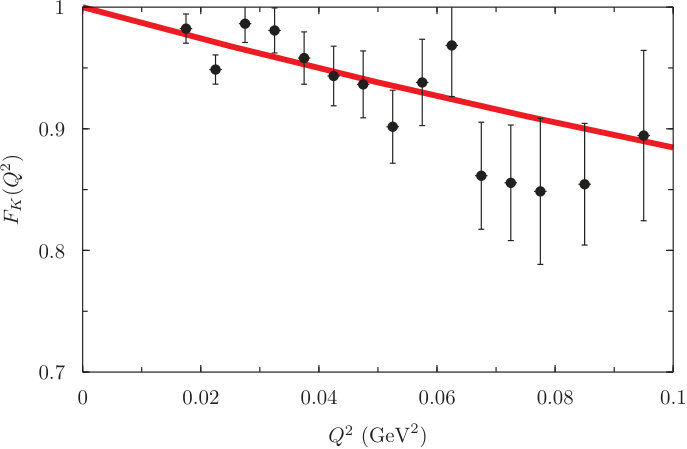 Figure 1
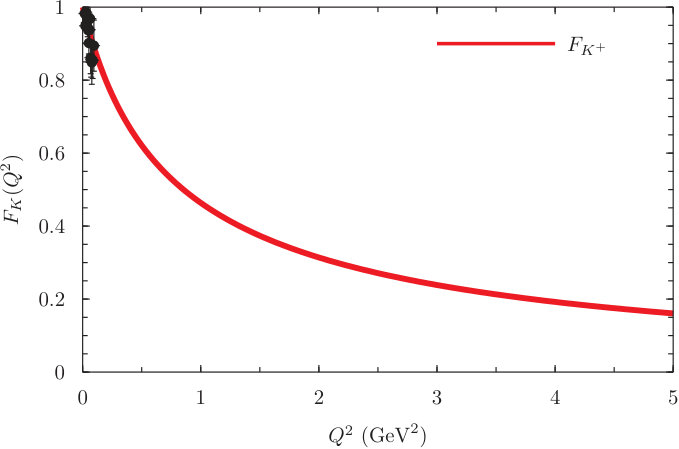 Figure 2
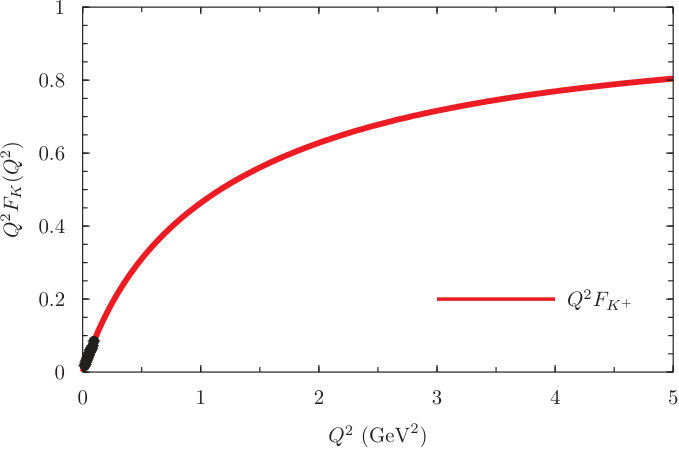 Figure 3
Peer Reviews
No public reviews on file for this paper yet. If you reviewed it on a platform where reviews are public (OpenReview, ICLR, NeurIPS, ICML), you can paste yours below so the community can read it here.
Videos
No videos yet. Explain this paper in a talk, walkthrough, or lecture? Add one.
APCTP Pre2019-010
Kaon form factor in holographic QCD
Zainul Abidin
Sekolah Tinggi Keguruan dan Ilmu Pendidikan Surya, Tangerang, Jawa Barat 15115, Indonesia
Parada T. P. Hutauruk
Asia Pacific Center for Theoretical Physics, Pohang, Gyeongbuk 37673, Korea
Abstract
The kaon form factor in the spacelike region is calculated using a holographic QCD model with the “bottom-up” approach. We found that our result for the kaon form factor in low has a remarkable agreement with the existing data, where is the four-momentum transfer squared. The charge radius of the kaon as well as the kaon decay constant are found to be in a good agreement with the experiment data. We then predict the kaon form factor in the asymptotic region (larger ) showing behavior, which is consistent with the perturbative QCD prediction.
I Introduction
A theory of quantum chromodynamics (QCD), which is a non-Abelian gauge theory, is believed so far as a correct theory of hadrons, where hadrons are the composite particles made of quarks and gluons CDG77 . QCD has the essential features, namely, confinement and chiral symmetry breaking CDG77 ; MP77 . However, the form factor, which is one of the nonperturbative quantities, is very difficult to compute directly from QCD. Several theoretical and phenomenological models HCT16 ; BWI94 ; Tandy97 ; SMBF12 ; KTT16 as well as a lattice QCD calculation KSDLL17 have been used to calculate this nonperturbative quantity of QCD.
Apart from those models, during the past few years, holographic QCD models, which are the complementary model of QCD, have also been applied to describe the structure of hadrons, namely, meson KL07 ; GR07 ; GR07m ; BEEGK03 ; GLSV11 ; AC08 and nucleon GLSV11 form factors as well as charmed meson BKM17 , in order to gain a deep understanding of the structure of hadrons, from a different substantially point of view. Surprisingly, these holographic models work well in predicting other hadron observables, namely the decay constant and mass spectrum. Also, one can argue that QCD approximately behaves as a conformal over a particular kinematic region AC08 ; TB05 . Those holographic QCD models are able to preserve confinement GR07m ; SS03 ; Polyakov97 and chiral symmetry breaking GKK09 ; SS04 ; BEEGK03 ; GY04 , which is in many ways similar to the main properties of QCD in low energy, after a few years since the holographic model was proposed Maldacena97 ; Witten98 .
The original AdS/CFT correspondence Maldacena97 has been first used to connect a strongly coupled 4D conformal theory for large , where is the color number, and a weakly coupled gravity theory on AdS space. It then has been reconstructed starting from QCD and its 5D gravity dual theory to reproduce the properties of QCD KSS05 ; RP05 ; TB05 ; BT06 .
However, among those holographic models with various approaches KL07 ; GR07 ; GR07m ; BEEGK03 ; GLSV11 ; AC08 ; BKM17 ; GR07m ; SS03 ; Polyakov97 ; GKK09 ; SS04 ; BEEGK03 ; GY04 ; Maldacena97 ; Witten98 , only a few models have been used to calculate the kaon form factor in a holographic QCD model with different approaches BKM17 . is a very interesting object, because it consists of a strange quark, beside an up quark, where the mass of the strange quark is heavier than the quark. Experimentally, the existing data on the kaon form factor are very poor in higher , only old data for low are available Amendolia86 , where is the four-momentum transfer squared. In the future, experiments will measure the kaon form factor in higher Carmignotto18 ; Horn017 . It would be interesting to see how our complementary model, which is inspired by this AdS/CFT correspondence, predicts the kaon form factor in higher . This work may pave the way to understand the strange quark properties as well as the strange quark form factor.
In the present paper, we calculate the kaon form factor in holographic QCD, which is a complementary approach of QCD. In this work, we adopt a “bottom-up” approach of the AdS/CFT correspondence, instead of a “top-down” approach, where we employ the properties of QCD to construct its 5D gravity dual theory as performed in Refs. AC209 ; KSS05 ; RP05 . We begin to describe the AdS/CFT correspondence formalism, describing a correspondence between 4D operators (x) and fields in the 5D bulk (x,z). We then calculate the kaon form factor in holographic QCD. We find the result on the kaon form factor is in good agreement compared to the existing data in low Amendolia86 . We then predict the kaon form factor in higher . Experimentally, the experimental data are really poor in higher . We find that the kaon form factor in higher is consistent with the perturbation QCD prediction LB80 . Next, we calculate the charge radius of the kaon in holography. We find that our result on the charge radius is an excellent agreement with the data Amendolia86 as well as the Particle Data Group (PDG) Agashe14 .
This paper is organized as follows. In Sec. II, we briefly review the AdS/CFT correspondence, two- and three-point functions, and how to extract the form factor of the kaon from holographic QCD in Sec. III. In Sec. IV, we present the calculation of the charge radius of the kaon. In Sec. V, numerical results are presented and their implications are discussed. Section VI is devoted to a summary.
II Formalism
II.1 The AdS/QCD correspondence
In this section, we briefly review the calculation of the vacuum expectation values of the operators based on a generating function in the 4D space, which is defined by
[TABLE]
where is the action for the theory and is a source function together with a specific operator (x), which corresponds to the expectation value. It then can be written by
[TABLE]
The following AdS/CFT correspondence provides the equivalence between the generating functional of the connected correlation for the 4D theory and the effective partition function for the 5D theory:
[TABLE]
where is a solution of the 5D equation of motion with a boundary, as defined in Eq. (5).
We consider only the tree-level diagram on the 5D theory, and we choose the following metric for the 5D space-time:
[TABLE]
where is the 4D space-time coordinate, is the flat space metric, and is the fifth coordinate, which corresponds to the energy scale (). We set for the ultraviolet boundary of the 5D space that relates with the UV limit of QCD, and the hard-wall cutoff at is the infrared boundary, which is used for the conformal symmetry breaking of QCD.
The UV boundary value of the 5D field is the source of the corresponding 4D operator . One can write the classical solution of the 5D field as
[TABLE]
The value of (or, in general, it goes to ). Hence, is identified as the UV-boundary value of the field.
II.2 The 5D AdS model
The action in 5D theory is written as
[TABLE]
where is the determinant of metric tensor, is a gauge coupling parameter, which is fixed by the QCD operator product expansion, and the bifundamental scalar field in Eq. (6) is expressed by
[TABLE]
where are the SU() generators with , where are the Pauli matrices. The covariant derivative is defined as
[TABLE]
where the 5D space-time is denoted by the lowercase index of and is written as
[TABLE]
Analogously for .
The and the fields can be written as vector field and the axial-vector field :
[TABLE]
In this work, we consider the following 4D operators that are defined by the current operators and that correspond to the gauge fields and in the 5D theory, respectively. The operator of corresponds to a bifundamental scalar field in Eq. (7), where the index for SU(3) flavor symmetry, and index for the space-time. Note that the gauge invariance in the 5D theory is related with the global current conservation in the 4D theory.
II.3 Two-point functions
Here we consider only the scalar parts of the action , up to second order, it gives
[TABLE]
where is defined in Eq. (4), which is the nontrivial 5D metric.
The UV boundary of the scalar field is proportional to the quark mass matrix , which can be considered as the source for the operator of . Solving the equation of motion for the scalar field, it then gives
[TABLE]
where is defined as in Ref. AC209 by
[TABLE]
where we consider the SU(2) isospin symmetry, where the mass for the up and down quarks are identical.
Using the AdS/CFT correspondence, we then calculate the quark condensate by performing a functional derivative of the action in Eq. (12), evaluated on the classical solution, over and identify
[TABLE]
We also assume that and define and .
II.4 Transverse vector
We now consider only vector parts of the action up to second order. It gives
[TABLE]
A contraction over 5D metric is implied. We then define
[TABLE]
We have gauge choice to set except for because of the nonzero (“mass term”) of the second term in the action of Eq.(22). The equation of motion for the 4D Fourier transform of the transverse part of the gauge field is written as
[TABLE]
where when for .
One writes the transverse part of the vector field as with the so-called bulk-to-boundary propagator , which is normalized to at the boundary condition , and is the Fourier transform of the source of the vector current at the UV boundary . We also impose a Neumann boundary condition . The solution for the bulk-to-boundary propagator is written as
[TABLE]
where , and and are the Bessel functions, respectively.
For spacelike four-momentum transferred , the solution in Eq. (28) can be written as
[TABLE]
where , and and are the modified Bessel functions, respectively.
The action on the solution in Eq. (29) is evaluated with applying transverse projector , since , one has the form
[TABLE]
After solving the differential part, by the AdS/CFT correspondence, we obtain the current-current two-point functions
[TABLE]
where
[TABLE]
and this leads to
[TABLE]
where is the time-ordering operator.
The bulk-to-boundary propagator can be written as
[TABLE]
where the wave function of satisfies the eigenvalue equation
[TABLE]
which is normalized as
[TABLE]
with boundary condition and the solution is
[TABLE]
where the eigenvalues of (Kaluza-Klein tower of the mass of the vector mesons: meson for , meson for , and meson for ) are obtained from .
Using Eqs. (27), (34), and (35), we obtain
[TABLE]
Since
[TABLE]
where the definition of is given by the matrix element of current, . We identify . Also, the parameter is fixed from the quark bubble diagram in the leading order, with the number of color.
II.5 Axial-vector and pseudoscalar
The action for the axial-vector and pseudoscalar sector parts up to second order is written as
[TABLE]
A contraction over 5D metric is implied. We have gauge choice , and and are imposed. We define
[TABLE]
For the field that comes from the longitudinal part, we define . We then write the Fourier transform of the fields in terms of the bulk-to-boundary propagators that gives
[TABLE]
where is the Fourier transform of the source function of the 4D axial current operator and is the Fourier transform of the source function of the 4D axial current operator .
We obtain the coupled differential equations for the longitudinal part of the axial-vector and pseudoscalar fields as follows
[TABLE]
with the boundary conditions , and . The expression for the transverse part of the axial-vector field is analogous to the vector field. It then gives
[TABLE]
We then substitute the coupled differential in Eqs. (46) and (47) into a second-order equation, and we obtain
[TABLE]
where . In this form the boundary condition is and . We then have the solution as
[TABLE]
where is a normalized solution of the eigenvalue in Eq. (49) with , boundary conditions , and . The normalization is
[TABLE]
The eigenvalues of are the Kaluza-Klein (KK) masses for the pseudoscalar mesons: the pions for , kaons for , and ’s for . The eigenvalues are obtained from the transverse part of the axial vector in Eq. (48), giving us the KK mass of the and mesons.
As noted above, for the vector sector, we do not have the freedom to set , for . However, if we define , , we obtain analogous equations as in Eqs. (46) and (47) with in place of . We may proceed as above to obtain the eigenvalues of the KK mass of the scalar mesons .
A current-current correlator for the axial sector is written as
[TABLE]
where . Using the completeness relation into the correlators in Eq. (II.5), then multiplying , and taking a limit , one identifies the decay constant of the pseudoscalar mesons from AdS/QCD correspondence:
[TABLE]
where the decay constants are defined by
[TABLE]
where the states of |\pi^{b}_{n}(q)\big{>} are also considered for the pions () as well as the kaons ().
III Kaon electromagnetic form factor
The electromagnetic form factors of the pion and kaon are presented in this section. The relevant parts of the action are
[TABLE]
where the first term in Eq. (55) that contains arises from the gauge part of the original action and other terms come from the chiral part. We then define
[TABLE]
If and in Eq. (III) do not have , , or , which do not equal “”, it then gives
[TABLE]
where for , the is defined as
[TABLE]
where and are the structure constants of the SU() algebra.
For three-point functions, we calculate three current operators by taking the functional derivative of Eq.(55). One has the form
[TABLE]
From Eq. (61), we then extract the form factor using the following matrix element
[TABLE]
We then obtain
[TABLE]
For three quark flavors, the electromagnetic current operator is defined as
[TABLE]
The current matrix element for the kaons is written as
[TABLE]
where and a final expression for the kaon form factor is obtained by
[TABLE]
IV Kaon charge radius
In this section, we present the charge radius of the kaon in low as well as in higher . For doing so, we recall the kaon form factor in Eq. (III) that is
[TABLE]
where , , and is defined by
[TABLE]
In the limit of , the bulk-to-boundary propagator in Eq.(29) is written as,
[TABLE]
Using the expansion of Eq.(29), we obtain the radius of the kaon as follows
[TABLE]
V Numerical Results
Our numerical results for the kaon masses, decay constants, and kaon form factors are presented in this section. Following Ref. AC08 , we fix the parameter values of the hard-wall cutoff at , which is chosen to fit the lightest meson mass MeV for . Parameters and is chosen to reproduce the pion mass and decay constant, respectively. Given the values of the pion mass MeV, and decay constant MeV for , respectively, we obtain the light current quark mass MeV and condensate . We then fix . The strange current quark mass MeV is chosen to fit the kaon mass MeV for (the masses for the , , , and , respectively). We simply consider , , and as model parameters, not the (realistic) physical values of the quark mass and quark condensate. For getting a better connection between the light current quark mass and condensate, we redefine the parameters by taking , and without modifying the above results for the two-point and three-point functions. With this redefinition, we obtain MeV, MeV, and .
Using the obtained parameters above, we determine the decay constant of the lightest KK of the kaons MeV, and the mass and decay constant of the are MeV and MeV, respectively. The decay constant of the meson MeV. The mass and decay constant of the lightest KK of the vector mesons are MeV, and MeV, respectively. For the axial vector mesons, the mass and decay constant of the are MeV, and MeV, respectively. For the , we obtain MeV, and MeV. The values of the decay constant and the mass of the kaon obtained are consistent with PDG Agashe14 .
Results for the kaon form factor are shown in Figs. 1- 3. Figure 1 shows our prediction for the kaon form factor compared to the existing data Amendolia86 in low . We find that our prediction is in excellent agreement with the data Amendolia86 . We then calculate the kaon form factor up to 5 GeV to anticipate the higher data which will collect soon Carmignotto18 ; Horn017 , as in Fig. 2, however, experimentally, the kaon form factor is poorly known.
Figure 3 shows the same results as in Fig. 2, but for . For larger (asymptotic region), the bulk-to-boundary propagator is written as
[TABLE]
which goes to zero unless is infinitesimal, . Note that the first term in Eq. (68) goes to when , while the second term goes like . The quantity behaves like a delta function picking up at . The upper limit of the form factor integral can be set to infinity as the integrated vanish at large . Then, the kaon form factor in higher is defined by
[TABLE]
We find that the kaon form factor for larger agrees well with the perturbative QCD prediction LB80 .
Using Eq. (70), we obtain the charge radius for the lightest kaon 0.56 fm. We find that our result is in excellent agreement with the experimental data Amendolia86 and PDG Agashe14 .
We also compare our model approach with the work of Ref. Ahmady:2018muv , which uses a light-front (LF) holographic approach, where the holographic expression in 5D AdS space is matched to QCD in the LF frame. In this approach, to incorporate the quark mass, the “effective potential” in the AdS space is modified by adding a term to obtain the meson mass expression matches with the quark mass contribution in LF QCD. Contrary to this approach, we introduce the quark mass parameter, as a source of the quark bilinear operator in the AdS boundary, which is consistent with the AdS/CFT rule, and it appears as a coefficient in the background field, . Consequently, the quark mass parameter appears differently in the effective potential, compared to the work of Ref. Ahmady:2018muv . In addition, they identify the light-front wave function, where hadron properties are encoded, by comparing the electromagnetic form factor in AdS and the LF QCD form factor.
In comparing our obtained results with their results on the kaon form factors, their results for the charge radius of the are slightly larger than our result in the low regime, where the charge radius is fm for the dynamical spin parameter and even larger for . However, the behavior prediction of the kaon form factor in the large regime, which goes like , is similar to our obtained result.
We note that, in this paper, we started with an AdS Lagrangian that has symmetry and it reproduces a chiral symmetry breaking of QCD. An approximate relation due to a chiral-symmetry-breaking-like, Gell-Mann-Oakes-Renner relation is preserved in our approach.
VI Summary
In summary, we have computed the kaon form factor in holographic QCD, which is a complementary approach of QCD. We adopt a “bottom-up” approach of the AdS/CFT correspondence, instead of a “top-down” approach, where we employ the properties of QCD to construct its 5D gravity dual theory. We begin to describe the AdS/CFT correspondence formalism, describing a correspondence between 4D operators (x) and fields in the 5D bulk (x,z). We calculate the kaon form factor in holographic QCD.
The result for the kaon form factor is in good agreement with the existing data in low . We then predict the kaon form factor in higher . We found that the kaon form factor in higher is consistent with the perturbation QCD prediction.
We finally calculate the charge radius of the kaon in holography QCD. We obtained 0.56 , which is in excellent agreement with the data as well as the Particle Data Group. In the future, it would be interesting to extend the calculation of the form factor and gravitational form factor of the B and D mesons, which contain the bottom and charm quarks, respectively, using the holographic QCD model.
Acknowledgements.
The work of P.T.P.H. was supported by the Ministry of Science, Information Communication and Technology and Future Planning, Gyeongsangbuk-do and Pohang City through the Young Scientist Training Asia-Pacific Economic Cooperation program of Asia Pacific Center for Theoretical Physics (APCTP).
The reference list from the paper itself. Each links out to its DOI / PubMed record.
- 1(1) C. G. Callan, Jr., R. F. Dashen and D. J. Gross, Toward a theory of the strong interactions, Phys. Rev. D 17 , 2717 (1978).
- 2(2) W. J. Marciano and H. Pagels, Quantum chromodynamics: A review, Phys. Rep. 36 , 137 (1978).
- 3(3) P. T. P. Hutauruk, I. C. Cloet and A. W. Thomas, Flavor dependence of the pion and kaon form factors and parton distribution functions, Phys. Rev. C 94 , 035201 (2016).
- 4(4) W. W. Buck, R. A. Williams and H. Ito, Elastic charge form-factors for K mesons, Phys. Lett. B 351 , 24 (1995).
- 5(5) P. C. Tandy, Hadron physics from the global color model of QCD, Prog. Part. Nucl. Phys. 39 , 117 (1997).
- 6(6) E. O. da Silva, J. P. B. C. de Melo, B. El-Bennich and V. S. Filho, Pion and kaon elastic form factors in a refined light-front model, Phys. Rev. C 86 , 038202 (2012).
- 7(7) A. F. Krutov, S. V. Troitsky and V. E. Troitsky, The K 𝐾 K -meson form factor and charge radius: Linking low-energy data to future Jefferson Laboratory measurements, Eur. Phys. J. C 77 , 464 (2017).
- 8(8) J. Koponen, A. Zimermmane-Santos, C. Davies, G. P. Lepage and A. Lytle, Light meson form factors at high Q 2 superscript 𝑄 2 Q^{2} from lattice QCD, EPJ Web Conf. 175 , 06015 (2018).