Anomaly of the Electromagnetic Duality of Maxwell Theory
Chang-Tse Hsieh, Yuji Tachikawa, Kazuya Yonekura

TL;DR
This paper investigates the electromagnetic duality anomaly in 3+1D Maxwell theory, revealing it is 56 times that of a Weyl fermion, with implications for string theory consistency.
Contribution
It provides two independent derivations of the Maxwell duality anomaly magnitude, linking it to topological phases and superconformal field theories.
Findings
Anomaly is 56 times that of a Weyl fermion.
Derived using bulk SPT phases in 4+1D.
Connected to properties of 5+1D E-string theory.
Abstract
We consider the ()-dimensional Maxwell theory in the situation where going around nontrivial paths in the spacetime involves the action of the duality transformation exchanging the electric field and the magnetic field, as well as its generalizations. We find that the anomaly of this system in a particular formulation is 56 times that of a Weyl fermion. This result is derived in two independent ways: one is by using the bulk symmetry protected topological phase in dimensions characterizing the anomaly, and the other is by considering the properties of a ()-dimensional superconformal field theory known as the E-string theory. This anomaly of the Maxwell theory plays an important role in the consistency of string theory.
Click any figure to enlarge with its caption.
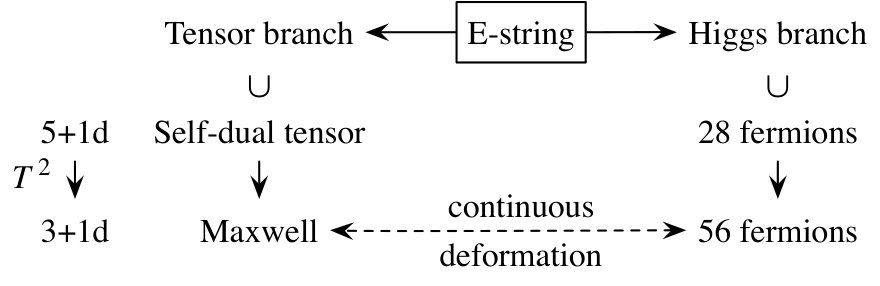 Figure 1
Peer Reviews
No public reviews on file for this paper yet. If you reviewed it on a platform where reviews are public (OpenReview, ICLR, NeurIPS, ICML), you can paste yours below so the community can read it here.
Videos
No videos yet. Explain this paper in a talk, walkthrough, or lecture? Add one.
Anomaly of the Electromagnetic Duality of Maxwell Theory
Chang-Tse Hsieh
Kavli Institute for the Physics and Mathematics of the Universe (WPI),
University of Tokyo, Kashiwa, Chiba 277-8583, Japan
Institute for Solid State Physics, University of Tokyo, Kashiwa, Chiba 277-8581, Japan
Yuji Tachikawa
Kavli Institute for the Physics and Mathematics of the Universe (WPI),
University of Tokyo, Kashiwa, Chiba 277-8583, Japan
Kazuya Yonekura
Department of Physics, Tohoku University, Sendai 980-8578, Japan
Abstract
We consider the ()-dimensional Maxwell theory in the situation where going around nontrivial paths in the spacetime involves the action of the duality transformation exchanging the electric field and the magnetic field, as well as its generalizations. We find that the anomaly of this system in a particular formulation is 56 times that of a Weyl fermion. This result is derived in two independent ways: one is by using the bulk symmetry protected topological phase in dimensions characterizing the anomaly, and the other is by considering the properties of a ()-dimensional superconformal field theory known as the E-string theory. This anomaly of the Maxwell theory plays an important role in the consistency of string theory.
††preprint: IPMU-19-0068††preprint: TU-1088
I Introduction
Every physicist knows that the electromagnetic field is described classically by the Maxwell equation, and that it is invariant under the electromagnetic duality .111For some of the early contributions to the study of the duality transformation, see e.g., Deser:1976iy ; Deser:1981fr .
The properties of the electromagnetic duality in quantum theory might not be as well known to physicists in general and, in fact, are not very well understood in the literature. This is particularly true when going around a nontrivial path in the spacetime results in a duality transformation.222One example is a periodic boundary condition twisted by duality: and . This particular setup was studied by O. Ganor and his collaborators Ganor:2008hd ; Ganor:2010md ; Ganor:2012mu ; Ganor:2014pha , but what happens in a more general situation remains unanswered, to the authors’ knowledge. There is also a series of interesting papers on the flux sectors of the Maxwell theory by G. W. Moore and his collaborators Freed:2006ya ; Freed:2006yc ; Kitaev:2007ed , which are related to the inherent self-dual nature of the Maxwell theory. Another intriguing scenario is to consider a Maxwell theory with dynamical “duality gauge fields”, which might be thought of as a generalization of the Alice electrodynamics Schwarz:1982 ; Bucher:1992 where the charge conjugation is gauged.
In this Letter, we focus on a feature of the Maxwell theory and its duality symmetry in such a situation, namely the fact that it has a quantum anomaly Kravec:2013pua ; Seiberg:2018ntt , which we explicitly determine.
We recall that a quantum theory in dimensions with a symmetry group can have a quantum anomaly, in the sense that its partition function has a controllable phase ambiguity. Our modern understanding is that such a theory is better thought of as living on the boundary of a symmetry protected topological (SPT) phase in the -dimensional bulk. It was noticed in the last few years in Wang:2013zja ; Kravec:2013pua ; Kravec:2014aza ; Thorngren:2014pza ; Wang:2018qoy that a version of the Maxwell theory (often called the all-fermion electrodynamics, where all particles of odd charge are fermions) has a global gravitational anomaly and lives on the boundary of a certain bulk SPT phase. As we will see, this result is a special case of the anomaly and the corresponding bulk SPT phase that we find for the duality symmetry.
We study the anomaly and the bulk SPT phase by imitating the relationship between the -dimensional chiral boson and the -dimensional Chern-Simons theory and its generalization to the -dimensional self-dual form field and the -dimensional bulk theory studied, e.g., in Gukov:2004id ; Belov:2006jd ; Monnier:2016jlo ; Monnier:2017klz ; Monnier:2017oqd ; Monnier:2018nfs ; Monnier:2018cfa . The essential point is that the -dimensional Maxwell theory with a nontrivial background for its duality symmetry is a self-dual field, and we can utilize the techniques developed in the papers listed above to study it. One of our main messages is that the subtle and interesting issues concerning the self-dual fields studied in the past already manifest themselves in the case of the Maxwell theory once the non-trivial background for its duality symmetry is turned on.
Before proceeding, we note that the electromagnetic duality group in the quantum theory is, in fact, the 2-dimensional special linear group over the integers acting on the lattice of the electric and magnetic charges. Its effect on the Maxwell theory on a curved manifold was carefully analyzed in Witten:1995gf ; Verlinde:1995em and it was interpreted as a mixed -gravitational anomaly in Seiberg:2018ntt . Our result in this Letter can be considered as the determination of the pure part of the anomaly.
Our computation shows that the anomaly of the Maxwell theory is 56 times that of a Weyl fermion in a certain precise formulation of the duality. Where does this number 56 come from? We will provide an answer using the property of a -dimensional superconformal field theory originally found in Ganor:1996mu ; Seiberg:1996vs and known as the E-string theory; the name comes from the fact that it has global symmetry. The E-string theory has two branches of vacua, called the tensor branch and the Higgs branch. On the Higgs branch the symmetry is Higgsed to , which acts on 28 fermions via its 56-dimensional fundamental representation; this is possible since a pseudo-real representation with can act on fermions in dimensions because the spin representation in dimensions is pseudo-real and we can impose the Majorana condition on . When one moves to the tensor branch, the symmetry is restored and a self-dual tensor field appears. By compactifying this system on , one finds that one Maxwell field is continuously connected to 56 Weyl fermions, showing that they should have the same anomaly. The electromagnetic duality is formulated as the acting on this torus , and therefore is geometrized in this formulation. This means that both the purely part and the mixed gravitational- part of the -dimensional anomaly come from the purely gravitational anomaly of the -dimensional theory. These statements about the anomaly are valid if the background field is turned off.
The rest of the Letter is organized as follows. We start by recalling how the anomaly of a -dimensional chiral boson is captured by the phase of the partition function of the -dimensional U(1) Chern-Simons theory at level 1. We outline the path integral computation of its phase, as well as how this can be matched with the anomaly of a -dimensional chiral fermion. We then adapt this discussion to the anomaly of the -dimensional Maxwell theory and the corresponding -dimensional bulk theory. We will see that the anomaly computed in this way reproduces the known anomaly when the background is trivial. We then consider the case of nontrivial backgrounds on , for , and , and we note that the resulting phase is equal to 56 times that of a charged Weyl fermion. This plays an important role in the consistency of the O-plane and its generalizations. Finally, we explain why the anomaly of the Maxwell theory has to be 56 times that of a charged Weyl fermion, in terms of the six-dimensional superconformal field theory known as the E-string theory. More details will be provided in a longer version of the Letter CTYtoappear .
II Warm-up: Anomaly of -dimensional chiral boson in terms of -dimensional U(1) Chern-Simons
We start by recalling the well-understood case of the anomaly of the -dimensional chiral boson at the free fermion radius. This theory naturally lives at the boundary of the -dimensional U(1) Chern-Simons theory at level , for which the Euclidean action is Witten:1988hf ; Bos:1989wa ; Gukov:2004id . The anomaly is then characterized by the partition function of this Chern-Simons theory on closed 3-dimensional manifolds .
Let us recall that the action at level 2, , is well-defined modulo when the manifold is oriented. However, there is a problem in dividing it by two. To make the action well-defined modulo , it is known that we need to pick a spin structure Belov:2005ze . Once this is done, the path integral can be performed explicitly, because the theory is free. The details are given e.g. in Witten:1988hf ; Manoliu:1996fx ; Jeffrey:2009vp ; JeffreyBrendan2 . Very roughly, we split the gauge field into a sum of the flat but topologically nontrivial part and the topologically trivial but non-flat part. Assuming, for simplicity, that flat connections on are isolated, we have
[TABLE]
Let us rewrite its phase.
The phase of the first term can be written in terms of the eta invariant of the signature operator :
[TABLE]
Here and below, the equality of the phase is modulo one and is simply denoted by the equal sign (). The phase of the second term can be rewritten as
[TABLE]
where is the first Chern class of the gauge bundle and .
We note that is simply the exponentiated level-1 classical action evaluated at a flat . As recalled above, defining it requires something more than an oriented manifold and the integration on it. Mathematically, is known as a quadratic refinement of the torsion pairing on . The Arf invariant is defined by the equation above and is known to take values in one eighth of an integer. We end up with the formula
[TABLE]
Let us now recall that a chiral boson can be fermionized. Then the bulk theory can be taken to be the -dimensional fermion with infinite mass, for which the partition function has the phase AlvarezGaume:1984nf
[TABLE]
The values of and on lens spaces are known in the literature, e.g., GilkeyOdd . For example, on , , whereas and can be either or , depending on the spin structure. On , , , and , as there is a unique spin structure. We indeed confirm
[TABLE]
which can be proved using a mathematical result BrumfielMorgan . We note that is independent of the spin structure but does depend on the spin structure. In other words, the spin structure provides us the quadratic refinement.
III The anomaly of the Maxwell theory
The analysis of the anomaly of the -dimensional chiral boson we recalled above was generalized to the -dimensional self-dual form fields in AlvarezGaume:1983ig at the perturbative level. The study of the corresponding -dimensional theory in the bulk, generalizing the -dimensional Chern-Simons theory, was carried out in detail in Belov:2006jd ; Monnier:2016jlo ; Monnier:2017klz ; Monnier:2017oqd ; Monnier:2018nfs ; Monnier:2018cfa . The bulk theory has the action , where is now a -form gauge field. Assuming , the phase of the partition function still has the form of Eq. (4), where is now a quadratic refinement of the torsion pairing on , and its choice is not obviously related to the choice of the spin structure.
Here, we are more interested in the -dimensional Maxwell theory. The natural generalization in this case is to consider the bulk theory with the action , where and are two 2-form gauge fields to be path-integrated over Kravec:2013pua . This action has the symmetry acting on , which corresponds to the duality symmetry of the Maxwell theory Kravec:2013pua . We can and will introduce the background gauge field for this symmetry, which means that there is a nontrivial duality transformation when going around a nontrivial loop in spacetime. The phase of the partition function is then
[TABLE]
where the eta invariant is now for the signature operator acting on the differential forms tensored with , and is now the quadratic refinement of the natural torsion pairing on . Here, signifies the coefficient system twisted by the bundle . The eta invariant of the signature operator with such a twist and its reduction from higher dimensions were considered earlier in the mathematical literature; see, e.g., BismutCheeger .
Let us first consider the case where we do not have the background. In this case, the signature eta invariant simply vanishes, and only the Arf invariant contributes. Recall that a quadratic refinement is simply the classical action evaluated on flat and . Then a general quadratic refinement can be written as
[TABLE]
where are the background fields for the electric and magnetic 1-form symmetry of the Maxwell theory Gaiotto:2014kfa , which we chose to be flat. Its Arf invariant is computed to be where is the Bockstein homomorphism ; the Bockstein homomorphism can roughly be regarded as the exterior derivative when it acts on torsion elements of cohomology groups. The end result is that
[TABLE]
This reproduces a known result. Indeed, the mixed anomaly is known to be of the form , for which the mathematically precise formulation CS reduces to Eq. (9) when we only consider flat fields. Furthermore, we can take , where is the Stiefel-Whitney class of the spacetime and regarded as an element of by using . The Maxwell theory with this coupling is also known as the all-fermion electrodynamics, and it has the gravitational anomaly Thorngren:2014pza ; Wang:2018qoy .
Let us next consider the case when a nontrivial background is present. We can choose the symmetry structure on to consider, such as or spin- [], distinguished by whether or . Here, is the charge conjugation , and the metaplectic group is the double cover of the group . We will focus on the latter case in this Letter, as it has a natural connection to the-dimensional theory on a spin 7-manifold as we will see. Canonical examples of associated with this symmetry structure are , , and , where going around the generator of comes with the duality action by an element of order in . While is not spin for even , it has a natural spin- structure for any by embedding . Then, we get the spin- structure by embedding . The results of explicit computations for Eq. (7) are tabulated in Table 1. When there are multiple choices for or , we choose a particular one. Other quadratic refinements correspond to different background fields for electromagnetic 1-form symmetries.
When , the relevant element in is just the charge conjugation symmetry . This case has the anomaly on . This is responsible for the difference of the Ramond-Ramond (RR) charges of the O-plane and O-plane in Type-IIB string theory Witten:1998xy . As explained in Tachikawa:2018njr , for the consistency of the theory, the fractional part of the RR charge must be exactly negative of the anomaly of a D3-brane living on . The background produced by O is such that only the O leads to the anomaly of the Maxwell theory, explaining the difference of the RR charges; we note that the charge of the O-plane was already explained by the fermion anomaly Tachikawa:2018njr . We can also check that the resulting for other is exactly what is necessary to reproduce the RR charge of the S-fold Garcia-Etxebarria:2015wns ; Aharony:2016kai .
Let us now consider the infinitely massive fermions encoding the anomaly of a -dimensional Weyl fermion of unit charge under , which was studied in Garcia-Etxebarria:2018ajm ; Hsieh:2018ifc ; Guo:2018vij . The corresponding eta invariants on are also tabulated in Table 1. We can check that the relation
[TABLE]
holds for the choices of the Arf invariants given in Table 1.
IV Why 56?
Relation (10) about the anomaly of the Maxwell theory and 56 Weyl fermions in dimensions reminds us of the relation Eq. (6) about the anomaly of a chiral boson and a chiral fermion in dimensions. In the latter case, the equality should evidently hold because a chiral fermion can be bosonized to a chiral boson in dimensions. It also explained the reason how and why the spin structure could be used to define the quadratic refinement necessary to formulate the integrand of the Chern-Simons theory. In dimensions, however, the Maxwell theory and 56 Weyl fermions are two clearly different theories. What is the relation? How and why does the spin (or, more precisely, the spin-) structure provide the necessary quadratic refinement? One explanation is provided, somewhat surprisingly, by supersymmetric physics in dimensions.
Consider a self-dual tensor field in dimensions. Its dimensional reduction on gives rise to the Maxwell theory in dimensions, geometrizing the duality symmetry of the Maxwell theory. Correspondingly, the -dimensional theory on coupled to an bundle is the dimensional reduction of the -dimensional theory on , which is the bundle over .
We now embed this theory of a self-dual tensor field into the tensor branch of the E-string theory Ganor:1996mu ; Seiberg:1996vs . The E-string theory is a -dimensional theory realized in M-theory, with two continuous families of vacua. One family of vacua is called the tensor branch, which describes an M5-brane close to the spacetime boundary of M-theory carrying the gauge symmetry Horava:1995qa ; Horava:1996ma . On the tensor branch, the low energy theory consists of the self-dual tensor field with some additional fields. The other family of vacua is called the Higgs branch, which describes an instanton of the gauge symmetry. The instanton breaks to , producing some chiral fermions as zero modes of the instanton. A nontrivial fact in M-theory is that these two families of vacua are continuously connected; an M5-brane put on the spacetime boundary can become an instanton. The transition point is a strongly coupled conformal field theory.
We start from the M5-brane close to the spacetime boundary and transform it into an instanton of nonzero size. In this process, the low energy theory is changed from that of the tensor branch, containing the self-dual tensor field, into that of the Higgs branch, containing chiral fermions in dimensions transforming under the fundamental 56-dimensional representation of . Because this is a continuous process, the anomaly at the start and the anomaly at the end should be the same; previously the same argument was used to compute the anomaly polynomial of the E-string theory in Shimizu:2017kzs (which reproduced earlier results in Ohmori:2014pca ; Ohmori:2014kda ; Intriligator:2014eaa ), but the same statement is true even for the subtler anomalies we are discussing now. There are also some additional fields on the tensor and Higgs branches, but their anomalies are manifestly the same on both sides, so we can match the anomaly of the self-dual tensor field and the chiral fermions.
Since one chiral fermion in dimensions gives rise to two chiral fermions in dimensions, we conclude that the anomaly of the Maxwell theory, formulated as the compactification of the -dimensional self-dual field with the trivial background, should be equal to that of the 56 Weyl fermions. See Fig. 1 for a summary of what we have described.
If we turn on a nontrivial background on the fermion side, the data are translated on the self-dual tensor side into the background 3-form field which couples to the dynamical self-dual tensor field, which is basically given by the Chern-Simons term constructed from . When is flat, this determines a quadratic refinement required to define the 6+1d theory. In particular, the trivial background, which is available on any manifold, provides a canonical quadratic refinement for the -dimensional theory, and this construction only requires the spin structure. This point was already essentially made in Witten:1996md .
Since this explanation of Eq. (10) requires a lot of information from string and M-theory, it would be of independent interest to check the equality (10) by a direct analysis in and dimensions. To translate the analysis in dimensions to the study of the Maxwell theory, we need to require that the bundle over specified by the background is equipped with a spin structure. This means that the symmetry structure we consider is a spin- structure. According to the cobordism classification theorem Kapustin:2014tfa ; Kapustin:2014dxa ; Freed:2016rqq ; Yonekura:2018ufj , the anomaly of any system with this symmetry is classified by the dual of \Omega^{\text{spin-\mathop{\mathrm{Mp}}(2,\mathbb{Z})}}_{5}=\mathbb{Z}_{9}\oplus\mathbb{Z}_{32}\oplus\mathbb{Z}_{2}, which is the bordism group for closed 5-manifolds with spin- structures and is generated by , , and , respectively, where and both have the spin- structure coming from the embedding but with different actions of given by . We have not directly determined which quadratic refinement comes from the trivial field, but we have checked that, for a suitable choice, we have the equality (10) for each case, providing a strong check of our identification of Eq. (10).
V Acknowledgments
The authors thank Nati Seiberg for useful comments on a draft of this Letter. Y. T. also thanks Yu Nakayama for pointing out the relevance of papers by Ganor and collaborators Ganor:2008hd ; Ganor:2010md ; Ganor:2012mu ; Ganor:2014pha to the authors. C.-T. H. and Y. T. are in part supported by WPI Initiative, MEXT, Japan at IPMU, the University of Tokyo. C.-T. H. is also supported in part by JSPS KAKENHI Grant-in-Aid (Early-Career Scientists) No. 19K14608. Y. T. is also supported in part by JSPS KAKENHI Grant-in-Aid (Wakate-A) No. 17H04837 and JSPS KAKENHI Grant-in-Aid (Kiban-S) No. 16H06335. K. Y. is supported by JSPS KAKENHI Grant-in-Aid (Wakate-B) No. 17K14265.
The reference list from the paper itself. Each links out to its DOI / PubMed record.
- 1(1) S. Deser and C. Teitelboim, Duality Transformations of Abelian and Nonabelian Gauge Fields, Phys. Rev. D 13 (1976) 1592–1597 . · doi ↗
- 2(2) S. Deser, Off-Shell Electromagnetic Duality Invariance, J. Phys. A 15 (1982) 1053 . · doi ↗
- 3(3) O. J. Ganor and Y. P. Hong, Selfduality and Chern-Simons Theory, ar Xiv:0812.1213 [hep-th] .
- 4(4) O. J. Ganor, Y. P. Hong, and H. S. Tan, Ground States of S-Duality Twisted 𝒩 = 4 𝒩 4 {\mathcal{N}}\!=4 Super Yang-Mills Theory, JHEP 03 (2011) 099 , ar Xiv:1007.3749 [hep-th] . · doi ↗
- 5(5) O. J. Ganor, Y. P. Hong, R. Markov, and H. S. Tan, Static Charges in the Low-Energy Theory of the S-Duality Twist, JHEP 04 (2012) 041 , ar Xiv:1201.2679 [hep-th] . · doi ↗
- 6(6) O. J. Ganor, N. P. Moore, H.-Y. Sun, and N. R. Torres-Chicon, Janus configurations with SL(2, ℤ ℤ \mathbb{Z} )-duality twists, strings on mapping tori and a tridiagonal determinant formula, JHEP 07 (2014) 010 , ar Xiv:1403.2365 [hep-th] . · doi ↗
- 7(7) D. S. Freed, G. W. Moore, and G. Segal, The Uncertainty of Fluxes, Commun. Math. Phys. 271 (2007) 247–274 , ar Xiv:hep-th/0605198 . · doi ↗
- 8(8) D. S. Freed, G. W. Moore, and G. Segal, Heisenberg Groups and Noncommutative Fluxes, Annals Phys. 322 (2007) 236–285 , ar Xiv:hep-th/0605200 . · doi ↗