Shortest-Path-Preserving Rounding
Herman Haverkort, David K\"ubel, and Elmar Langetepe

TL;DR
This paper investigates the complexity of rounding real edge weights in graphs to integers while preserving shortest paths within a specified error, proving NP-hardness in general but providing efficient solutions for trees.
Contribution
It establishes NP-hardness for the general problem and offers a polynomial-time algorithm for trees, advancing understanding of weight rounding in graph algorithms.
Findings
NP-hardness of the general problem via reduction from 3-SAT
Polynomial-time algorithm for trees with O(n^2) complexity
Clarifies the computational limits of shortest-path-preserving rounding
Abstract
Various applications of graphs, in particular applications related to finding shortest paths, naturally get inputs with real weights on the edges. However, for algorithmic or visualization reasons, inputs with integer weights would often be preferable or even required. This raises the following question: given an undirected graph with non-negative real weights on the edges and an error threshold , how efficiently can we decide whether we can round all weights such that shortest paths are maintained, and the change of weight of each shortest path is less than ? So far, only for path-shaped graphs a polynomial-time algorithm was known. In this paper we prove, by reduction from 3-SAT, that, in general, the problem is NP-hard. However, if the graph is a tree with vertices, the problem can be solved in time.
Click any figure to enlarge with its caption.
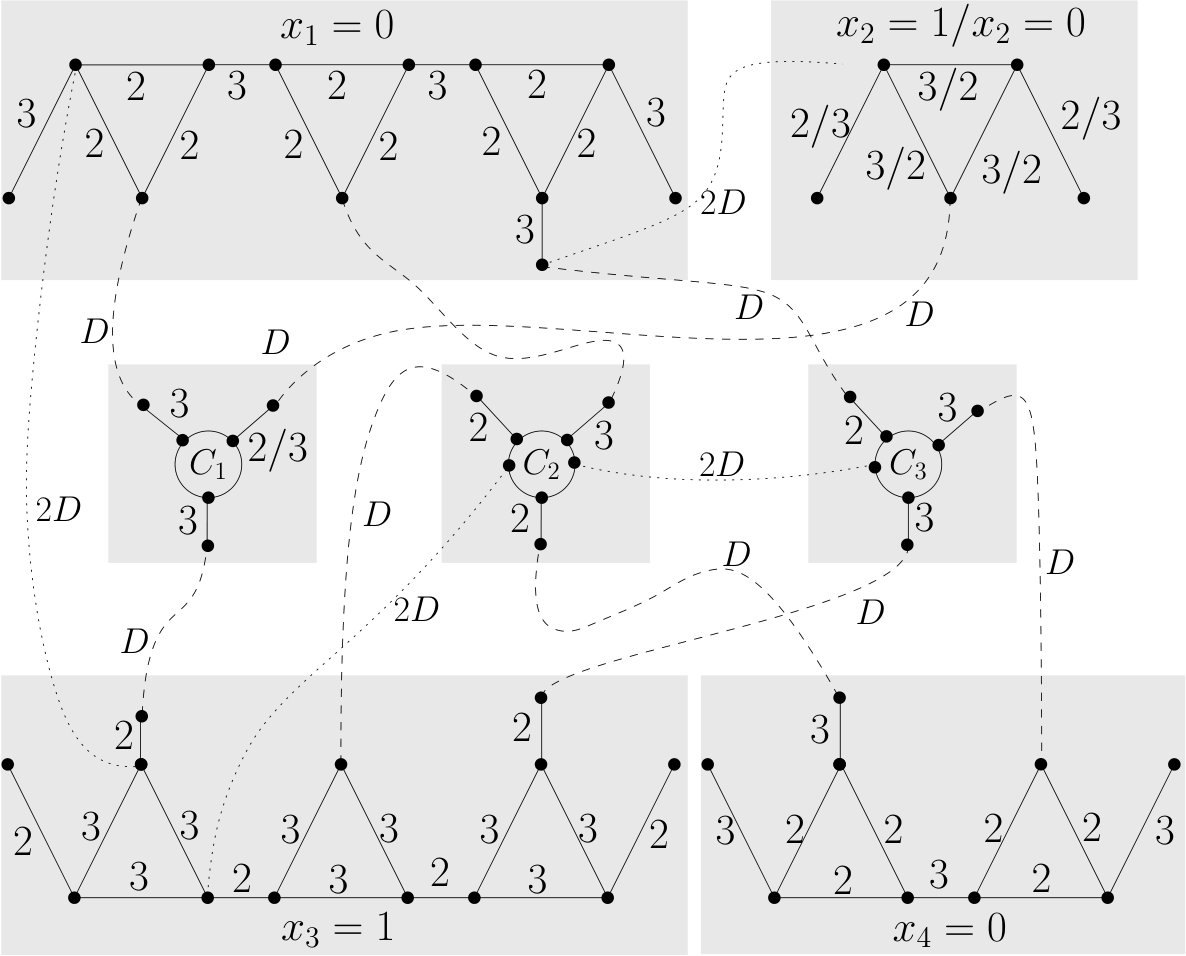 Figure 1
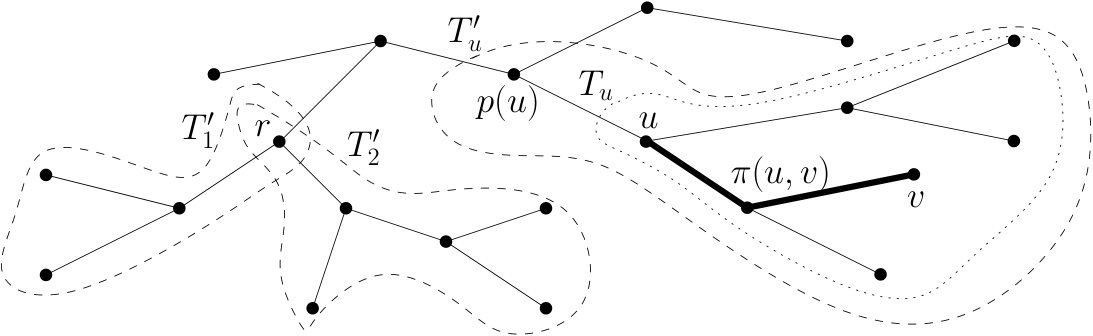 Figure 2
Peer Reviews
No public reviews on file for this paper yet. If you reviewed it on a platform where reviews are public (OpenReview, ICLR, NeurIPS, ICML), you can paste yours below so the community can read it here.
Videos
No videos yet. Explain this paper in a talk, walkthrough, or lecture? Add one.
Taxonomy
TopicsAlgorithms and Data Compression · Digital Image Processing Techniques · Complexity and Algorithms in Graphs