Experimental investigation of nonlocal advantage of quantum coherence
Zhi-Yong Ding, Huan Yang, Hao Yuan, Dong Wang, Jie Yang, Liu Ye

TL;DR
This paper experimentally investigates the nonlocal advantage of quantum coherence (NAQC) in Bell-diagonal states, demonstrating its potential as a resource linked to entanglement in quantum information processing.
Contribution
The study provides the first experimental verification of NAQC in Bell-diagonal states using high-fidelity optics-based methods, linking NAQC to entanglement.
Findings
NAQC can be accurately detected via coherence measures.
Experimental results align with theoretical predictions.
States with NAQC exhibit higher entanglement.
Abstract
Nonlocal advantage of quantum coherence (NAQC) based on coherence complementarity relations is generally viewed as a stronger nonclassical correlation than Bell nonlocality. An arbitrary two-qubit state with NAQC must be an entangled state, which demonstrates that the criterion of NAQC can also be regarded as an entanglement witness. In this paper, we experimentally investigate the NAQC for Bell-diagonal states with high fidelity in an optics-based platform. We perform local measurements on a subsystem in three mutually unbiased bases and reconstruct the density matrices of the measured states by quantum state tomography process. By analyzing characteristic of the norm, relative entropy and skew information of coherence with parameters of quantum states, NAQC for the quantum states is accurately captured, and it shows that our experimental results are well compatible with the…
Click any figure to enlarge with its caption.
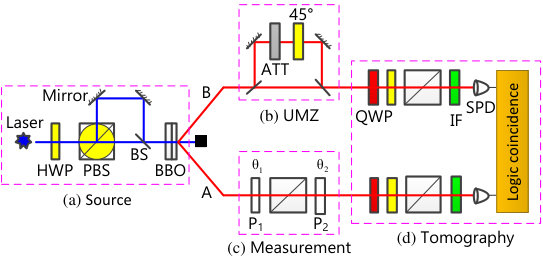 Figure 1
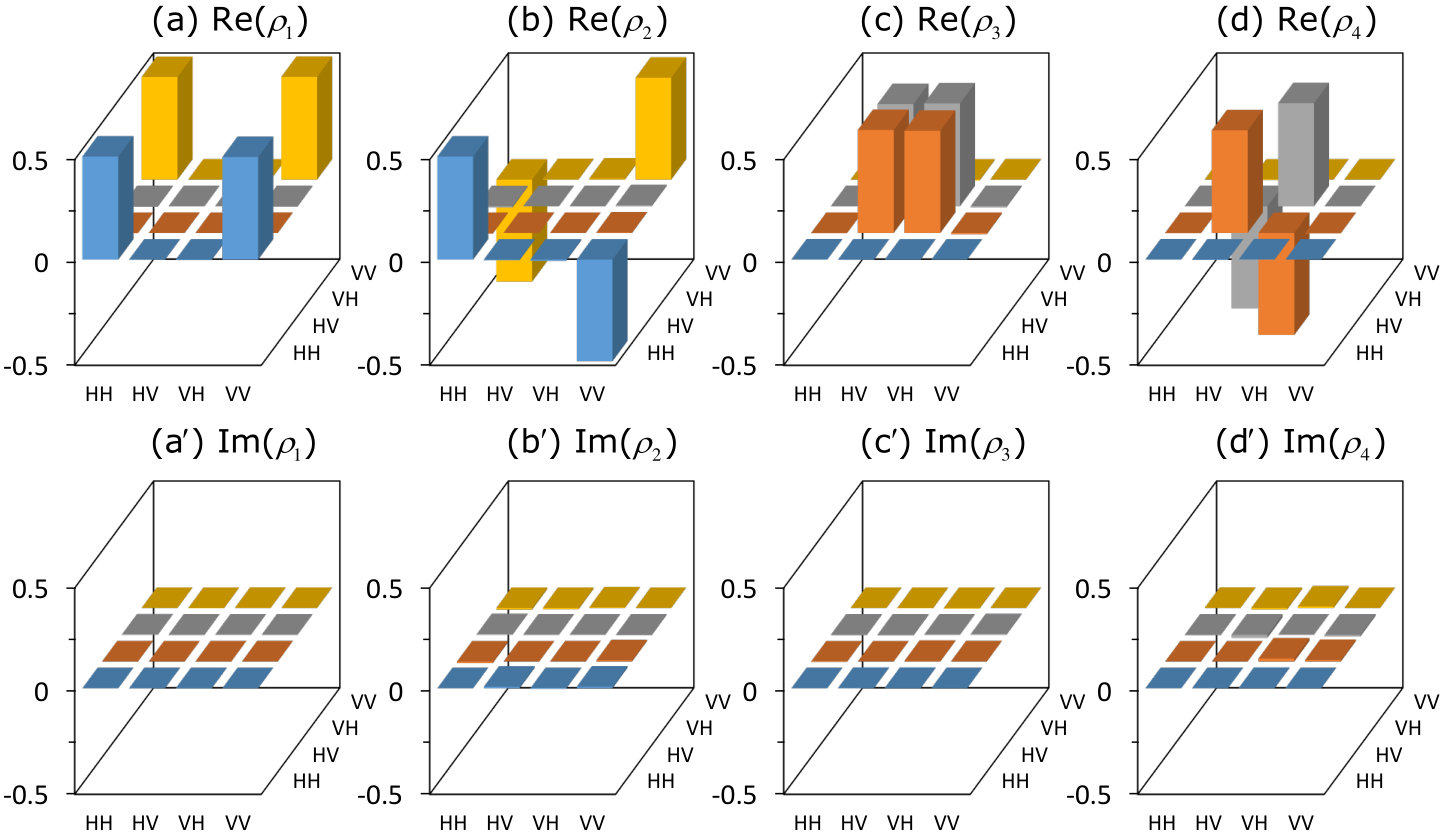 Figure 2
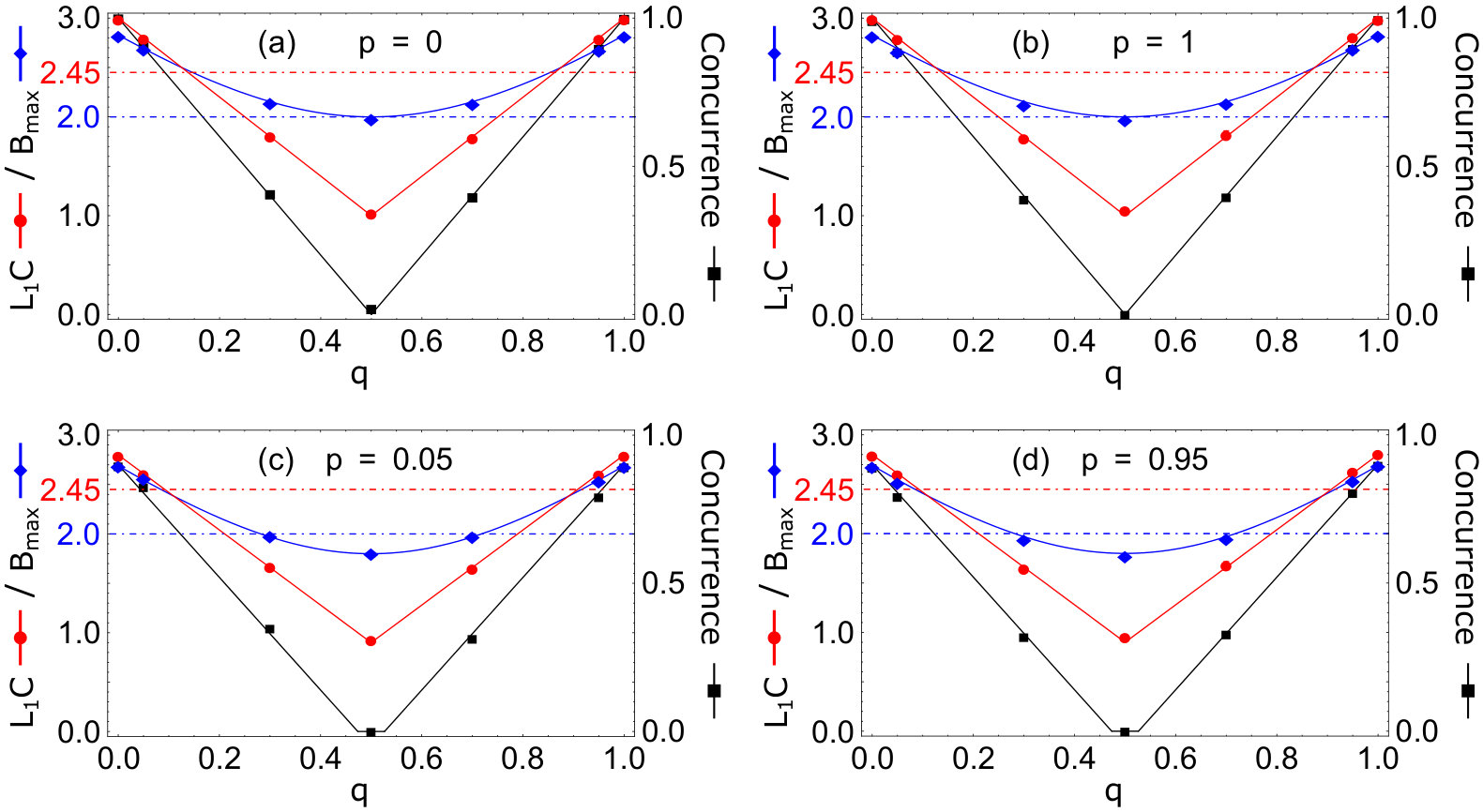 Figure 3
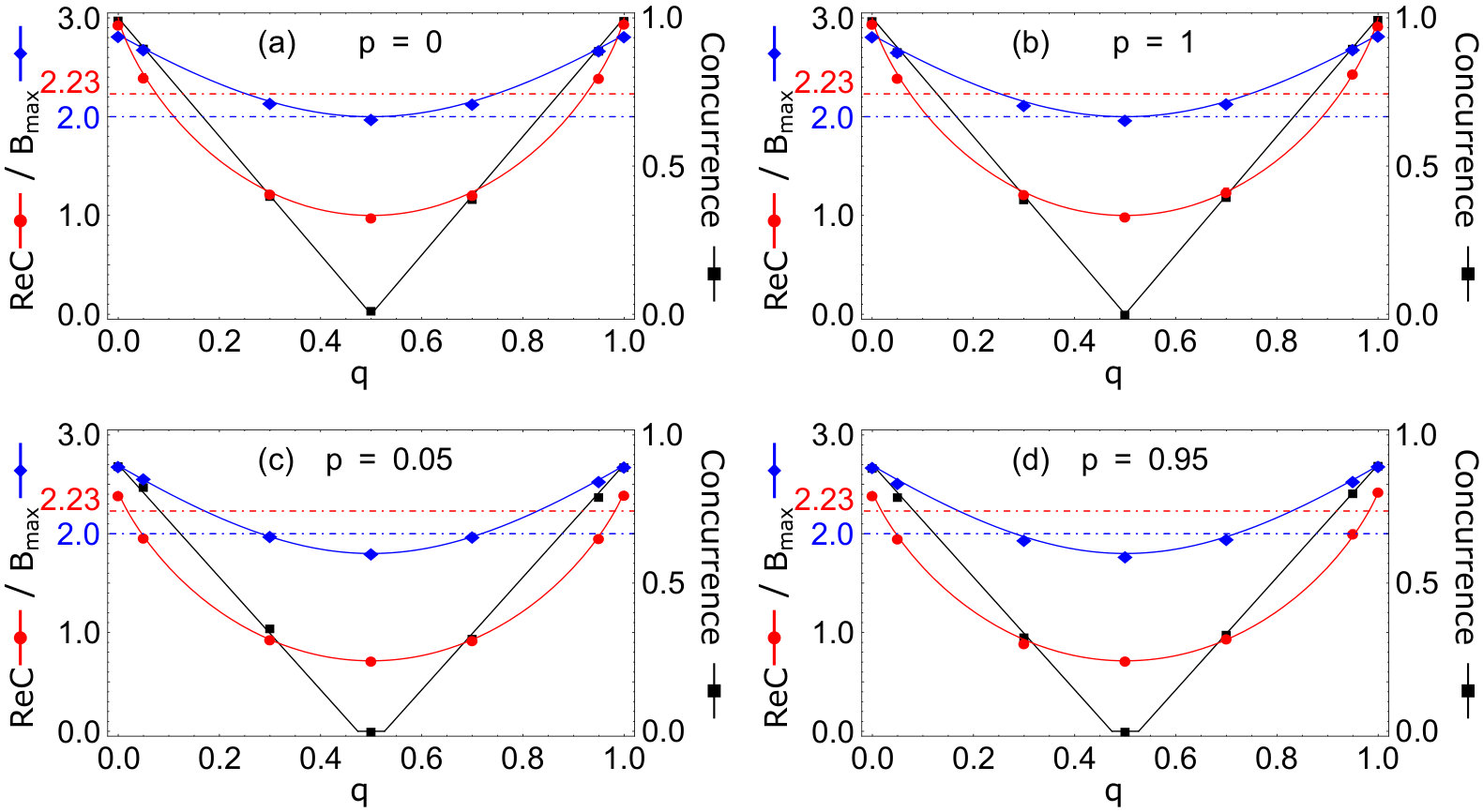 Figure 4
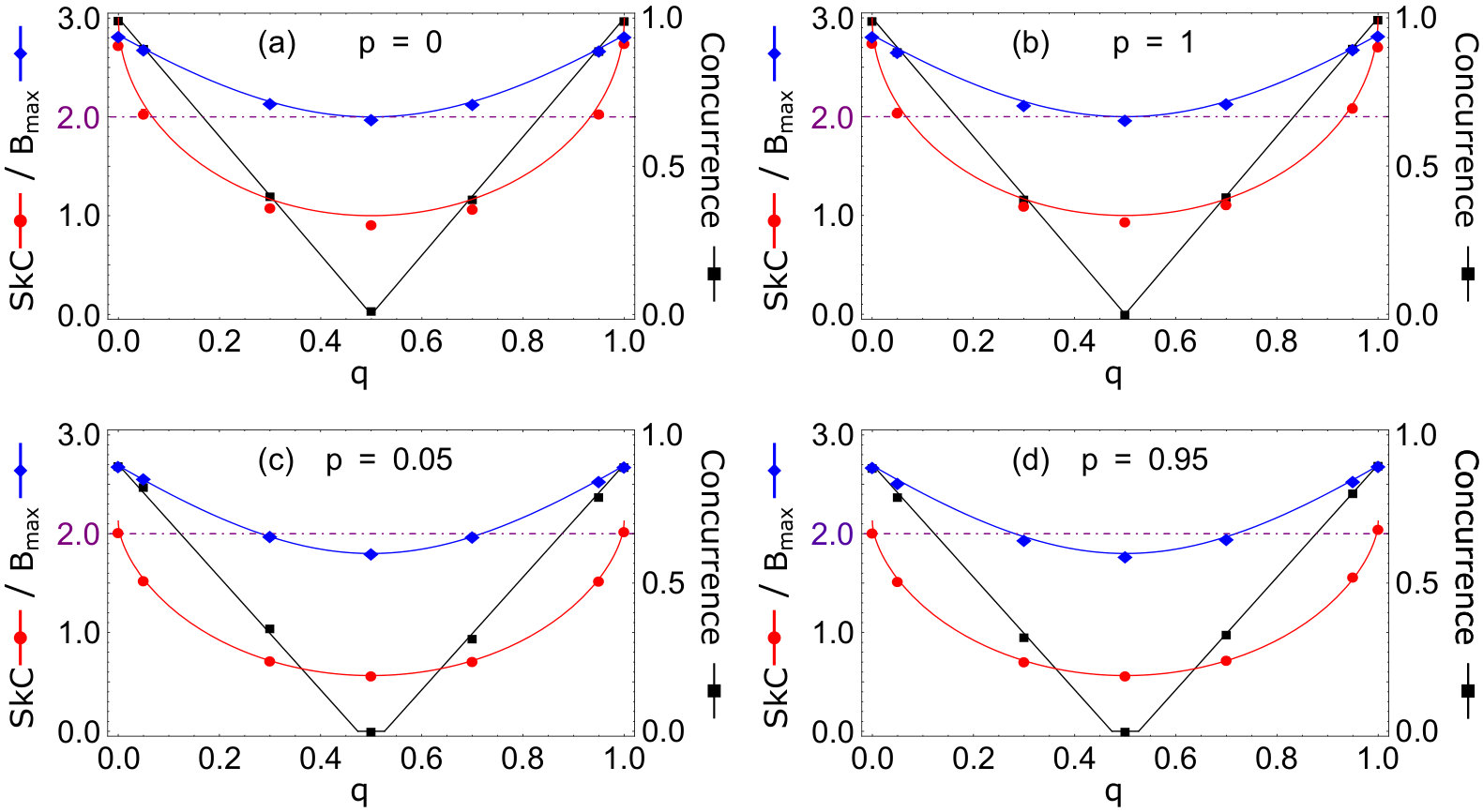 Figure 5
| Measurement | ||||
|---|---|---|---|---|
| HWP | HWP | |||
| HWP | HWP | |||
| QWP | QWP | |||
| QWP | QWP | |||
| HWP | HWP | |||
| HWP | HWP |
| Fidelity | = 0 | = 0.05 | = 0.3 | = 0.5 | = 0.7 | = 0.95 | = 1 |
|---|---|---|---|---|---|---|---|
| = 0 | 0.9979 0.0006 | 0.9967 0.0013 | 0.9969 0.0013 | 0.9970 0.0014 | 0.9970 0.0011 | 0.9968 0.0014 | 0.9975 0.0003 |
| = 0.05 | 0.9993 0.0001 | 0.9952 0.0012 | 0.9981 0.0007 | 0.9984 0.0008 | 0.9981 0.0015 | 0.9986 0.0003 | 0.9995 0.0001 |
| = 0.95 | 0.9992 0.0001 | 0.9992 0.0008 | 0.9998 0.0002 | 0.9998 0.0003 | 0.9997 0.0003 | 0.9990 0.0008 | 0.9994 0.0001 |
| = 1 | 0.9975 0.0007 | 0.9944 0.0024 | 0.9953 0.0019 | 0.9960 0.0017 | 0.9967 0.0018 | 0.9971 0.0021 | 0.9986 0.0012 |
Peer Reviews
No public reviews on file for this paper yet. If you reviewed it on a platform where reviews are public (OpenReview, ICLR, NeurIPS, ICML), you can paste yours below so the community can read it here.
Videos
No videos yet. Explain this paper in a talk, walkthrough, or lecture? Add one.
Experimental investigation of nonlocal advantage of quantum coherence
Zhi-Yong Ding
School of Physics and Material Science, Anhui University, Hefei 230601, China
School of Physics and Electronic Engineering, Fuyang Normal University, Fuyang 236037, China
Key Laboratory of Functional Materials and Devices for Informatics of Anhui Educational Institutions, Fuyang Normal University, Fuyang 236037, China
Huan Yang
School of Physics and Material Science, Anhui University, Hefei 230601, China
Department of Experiment and Practical Training Management, West Anhui University, Lu’an 237012, China
Hao Yuan
School of Physics and Material Science, Anhui University, Hefei 230601, China
CAS Key Laboratory of Quantum Information, University of Science and Technology of China, Hefei 230026, China
Dong Wang
School of Physics and Material Science, Anhui University, Hefei 230601, China
CAS Key Laboratory of Quantum Information, University of Science and Technology of China, Hefei 230026, China
Jie Yang
School of Physics and Material Science, Anhui University, Hefei 230601, China
Liu Ye
School of Physics and Material Science, Anhui University, Hefei 230601, China
Abstract
Nonlocal advantage of quantum coherence (NAQC) based on coherence complementarity relations is generally viewed as a stronger nonclassical correlation than Bell nonlocality. An arbitrary two-qubit state with NAQC must be an entangled state, which demonstrates that the criterion of NAQC can also be regarded as an entanglement witness. In this paper, we experimentally investigate the NAQC for Bell-diagonal states with high fidelity in an optics-based platform. We perform local measurements on a subsystem in three mutually unbiased bases and reconstruct the density matrices of the measured states by quantum state tomography process. By analyzing characteristic of the norm, relative entropy and skew information of coherence with parameters of quantum states, NAQC for the quantum states is accurately captured, and it shows that our experimental results are well compatible with the theoretical predictions. It is worth mentioning that quantum states with NAQC would have higher entanglement, and thus NAQC could be expected to be a kind of useful physical resource for quantum information processing.
I INTRODUCTION
Nonclassical correlations, being the most incredible feature of the quantum world, can enable classically impossible tasks w01 . So far, for two-qubit states, a distinct hierarchy of these typical correlations, including Bell nonlocality w02 , quantum entanglement w03 , quantum steering w04 , and quantum discord w05 has been gradually clarified w06 ; w07 ; w08 ; w09 ; w10 . From the application perspective, these correlations can also be regarded as valuable physical resource applied to quantum information processing tasks w11 ; w12 , such as device-independent quantum cryptography w13 ; w14 ; w15 ; w16 ; w17 , quantum teleportation and dense coding w18 ; w19 ; w20 ; w21 , quantum metrology w22 ; w23 ; w24 and so on. These abundant applications not only deepen our understanding of quantum information theory, but also become an important motivation for making efforts to facilitate the advance of this field. On the other hand, coherence w25 ; w26 , as one of the most fundamental features of quantum system, originates from the superposition principle in quantum mechanics. To quantify coherence of quantum states, Baumgratz et al. w27 formulated a rigorous groundbreaking framework for defining a valid coherence measure and proposed two distance-based coherence measures, i.e., the norm and relative entropy of coherence. In addition, other faithful coherence measures have been proposed, such as the entanglement-based measure of coherence w28 , the intrinsic randomness of coherence w29 , the robustness of coherence w30 ; w31 , and the skew information of coherence w32 ; w33 ; w34 , etc.
Although coherence is usually considered as be one of the characteristics of the whole physical system, it can be associated with other nonclassical correlations based on resource theory. Even conceptually, coherence is more fundamental than other correlations w26 . For a bipartite quantum system, coherence between subsystems can be deemed as its ability to create entanglement w28 . It means that coherence can be converted to entanglement by incoherent operations applied to the system and an incoherent ancilla. Furthermore, it has been proved that coherence and quantum discord can be transformed into each other in theoretical and experimental aspects w35 ; w36 .
Recently, Mondal et al. w37 established a connection between quantum steering and coherence based on coherence complementarity relations. They showed that, for a bipartite qubit state , the average coherence of the conditional states of subsystem after performing local measurements on qubit may break through the coherence limit of a single-qubit state measured on mutually unbiased bases. Typically, Mondal et al. called this interesting effect as “nonlocal advantage of quantum coherence” (NAQC), and formulated the criterion for achieving NAQC by using different coherence measures. To reveal the relationship between NAQC and other quantum correlation measures, Hu et al. w38 investigated the hierarchy of NAQC and Bell nonlocality, and testified that NAQC is a new nonclassical correlation which is stronger than Bell nonlocality. Any bipartite qubit state with NAQC must be an entangled state, which demonstrates that the criterion of NAQC can also be regarded as an entanglement witness. Further, Hu et al. w39 generalized the framework of NAQC from two qubit states to high-dimensional states. Datta et al. w40 provided a scenario for sharing of NAQC by sequential observers. Such studies have deepened our understanding of the quantum resource theories w11 ; w25 , and NAQC is expected to be a kind of useful physical resource for quantum information processing. Nevertheless, the investigations of NAQC still remain theoretical, and there is few experimental investigation of NAQC up to now.
We herein report an experimental investigation of NAQC for two-qubit states in an all-optical setup. By using quantum state tomography process to reconstruct the initial states and measured states, we capture NAQC for the quantum states based on the norm, relative entropy and skew information of coherence, respectively. It can be found that NAQC depends not only on the form of quantum states, but also on the choice of coherence measures. Note that, our experimental results coincide with the theoretical predictions very well.
II PRELIMINARIES
For a single qubit state described by density operator , three widely established coherence measures: the norm w27 , relative entropy w27 and skew information w34 of coherence in the basis of eigenvectors of the Pauli spin observable are given by
[TABLE]
respectively, where are the eigenvectors of , denotes the von Neumann entropy, and is the completely decohered state of . Specially, the complementarity relation of coherence under mutually unbiased bases has been derived in Ref. w37 ,
[TABLE]
where are state-independent upper bound and their values are , and . The equality is hold for a special pure state , where is the identity operator.
Based on the above coherence measures, we briefly introduce the “steering game” w37 proposed by Mondal et al. and give the criterion for achieving NAQC. Assuming that Alice and Bob share a bipartite qubit state . Alice then performs a local measurement on her side (qubit ) in the eigenbasis of and obtains an outcome with probability . Then the measured states of the bipartite system can be expressed as , and the ensemble of conditional state on Bob’s side becomes , where . Alice informs Bob of her choice of measurement and the corresponding outcome, and then Bob measures the coherence of his side (qubit ) randomly in the eigenbasis of either or (). Since Alice can choose any of the six local measurement settings, and Bob chooses the corresponding possible reference eigenbases, the criterion for achieving NAQC can be obtained by all possible probabilistic averaging w37 ,
[TABLE]
Basically, NAQC can be seen as a stronger nonclassical correlation than Bell nonlocality w38 . To detect Bell nonlocality of a two-qubit state , we can use the well-known Clauser-Horne-Shimony-Holt (CHSH) inequalitie w41 , where denotes the Bell operator. Violation of CHSH inequality means that the quantum state is Bell nonlocalized. The maximum violation of CHSH inequality can be represented as w42
[TABLE]
where , is the eigenvalue of ( stands for transposition of ), and is the correlation tensor in the Bloch representation with elements .
Furthermore, any bipartite quantum state with NAQC is an entangled state, thus the criterion of NAQC can also be regarded as an entanglement witness w39 . It is known that entanglement measure can be quantified conveniently by concurrence w43 . For a two-qubit state , the concurrence is defined as
[TABLE]
where are the square roots of the eigenvalues of the non-Hermitian matrix . The variable is the complex conjugate of in the fixed basis .
III EXPERIMENTS
To experimentally investigate NAQC shown in Eq. (3), we first need to prepare a bipartite qubit state with high fidelity and then perform six different measurement settings on qubit in the eigenbasis of . In this paper, we choose a Bell-diagonal state (BDS) w44 ; w45 as the initial state with form of,
[TABLE]
where and denote four Bell states and the coefficients satisfy the normalization condition .
Technically, the polarizations of photons can be encoded as information carriers in the experimental investigation of quantum information processing tasks w12 . In the current experiment, we encode the horizontal polarization state as and the vertical polarization state as . Explicitly, the optical experimental setup has been illustrated in Fig. 1. The design consists of four modules represented by the purple dotted frames, respectively: (a) Source module, (b) Unbalanced Mach-Zehnder device (UMZ) module, (c) Measurement module and (d) Tomography module. The function of module (a) is to generate mixed polarization-based entangled photon pairs. A high-power linearly polarized pumped beam (130mW, 405nm) emitted by the tunable diode laser is divided into two parts by the polarization beam splitter (PBS). The transmitted beam is linearly polarized , and the reflected beam is linearly polarized . The relative power between these two parts can be easily adjusted by changing the angle of optical axis of the half-wave plate (HWP), and the corresponding proportional coefficient is expressed by parameter . Time difference between them can be eliminated by adjusting the time-delay. The transmitted beam and reflected beam recombine by a beam splitter (BS). Then the mixed polarization-entangled photon pairs are generated by the spontaneous parametric down-conversion (SPDC) process of the pumped beam passing through two type-I -barium borate (BBO) crystals (mm) with optic axis cut at w46 . In order to achieve the mixing of four Bell states as Eq. (6), we pass parametric photons in the -path through the UMZ module w47 . The attenuator (ATT) is used to control the proportionality coefficient in the state. Finally, the initial BDS can be prepared as
[TABLE]
In module (c), two wave plates ( and ) and a PBS, and it is use to realize local measurement on the photon . Six different measurement settings can be achieved by choosing the type of wave plates and rotating the angles ( and ) of optical axis of wave plates (see Table I for details). The function of module (d) is to realize the tomography of quantum states. Each path of this module includes a quarter-wave plate (QWP), a HWP, a PBS, a 3-nm interference filter (IF) and a single-photon detector (SPD). The photons detected by the SPDs are sent to the coincidence meter for logic coincidence calculation. By changing angles of the QWPs and HWPs and recording the measured coincidence counts under at least 16 typical measurement bases w48 , the density matrix of the prepared state can be reconstructed. With the tomography module, both the initial BDS and the measured states can be reconstructed faithfully. In particular, the probability of the measured states is also calculated by the measured coincidence counts w48 .
In the following experiments, we choose different state parameters ( = 0, 0.05, 0.95, 1) and keep them unchanged. By adjusting another state parameter ( = 0, 0.05, 0.3, 0.5, 0.7, 0.95, 1), we can prepare various initial BDSs with different entanglement. Usually, the preparation quality of a quantum state can be measured by the fidelity of it and the goal state , i.e., w12 . To ensure the high fidelity of the prepared initial BDSs, according to the designed experimental scheme, we need to adjust the parameters and for preparing four groups of 28 initial states (see Table II for specific parameter settings). We reconstruct their density matrices by quantum state tomography process w48 and calculate the fidelity, respectively. The average fidelity is , where the errorbar is estimated according to the Poisson distribution characteristics of the laser. Table II shows the fidelity of the prepared states and the goal states with the different state parameters and .
In order to visualize the tomographic results for the initial BDSs, we provide graphical representation of the reconstructed density matrix of the the four maximally entangled states: , , , and . Fig. 2 shows the real and imaginary parts of the four maximally entangled states, respectively. From the figure, one can see that they are four Bell states with high fidelity. Tomographic results for all the initial BDSs we have prepared are shown in the Supplemental Material.
The experimental results and the corresponding theoretical predictions have been shown in Figs. 3-5. The horizontal axis represents the parameter of the initial BDS in Eq. (7). The vertical axis on the right represents concurrence, the vertical axis on the left represents coherence and the maximum violation of CHSH inequality. The black squares and blue rhombus denote the experimental results of and , which are calculated from the quantum states reconstructed by tomography. The red circles in Figs. 3-5 represent the experimental results of , and for the conditional state on Bob’s side in Eq. (3), respectively. It should be noted that every experimental point in the figures has an error bar, but most of them are too small to display. The solid lines in different colors are the corresponding theoretical predictions. The red horizontal dot dash lines in Figs. 3-5 represent state-independent upper bound , and . The experimental points above this horizontal line implies that the corresponding quantum states achieve NAQC. The blue horizontal dot dash lines represent the upper bound of Bell nonlocality. From these figures, the following conclusions can be obtained:
(i) We capture NAQC for the initial BDSs based on the norm, relative entropy and skew information of coherence, and our experimental results coincide well with the theoretical predictions. NAQC is not only related to the form of quantum states, but also to the choice of coherence measures. For example, if we choose the norm as coherence measure, can achieve NAQC (see Fig. 3c), but if we choose the other two coherence measure, this state cannot achieve NAQC (see Fig. 4c and Fig. 5c).
(ii) It is obvious that quantum states with NAQC must violate the CHSH inequality, but not vice versa, which demonstrate that NAQC is a stronger nonclassical correlation than Bell nonlocality.
(iii) It is worth mentioning that quantum states with NAQC would have higher entanglement, and the criterion of NAQC can also be considered as an indicator of entanglement. Therefore, NAQC is expected to be a kind of useful physical resource for quantum information processing.
IV CONCLUSIONS
In this paper, we have experimentally observed the NAQC for Bell-diagonal states with high fidelity in a completely optical setup. We perform local measurements on qubit in the three mutually unbiased bases and reconstruct the density matrices of the measured states by quantum state tomography process. And we also prepare the quantum states that hold inequality (3) based on the norm, relative entropy and skew information of coherence, respectively, which means that we prove the existence of NAQC by experimental methods. It can be seen that our experimental results coincide well with the theoretical predictions. It reveals that quantum states with NAQC would have higher entanglement. Thus, the criterion of NAQC can be regarded as a good candidate of achieving entanglement witness. From the perspective of hierarchical relations, the NAQC can be considered as a stronger nonclassical correlation than Bell nonlocality, and thus can be expected to be a a useful physical resource in the regime of quantum information processing.
ACKNOWLEDGMENTS
This work was supported by the National Science Foundation of China (Grant Nos. 11575001, 11405171, 61601002 and 11605028), the Natural Science Research Project of Education Department of Anhui Province of China under Grant No. KJ2018A0343, the Key Program of Excellent Youth Talent Project of the Education Department of Anhui Province of China under Grant Nos. gxyqZD2018065 and gxyqZD2019042, the Key Program of Excellent Youth Talent Project of Fuyang Normal University under Grant No. rcxm201804, the Open Foundation for CAS Key Laboratory of Quantum Information under Grant Nos. KQI201801 and KQI201804, the Research Center for Quantum Information Technology of Fuyang Normal University under Grant No. kytd201706.
Zhi-Yong Ding and Huan Yang contributed equally to this work.
The reference list from the paper itself. Each links out to its DOI / PubMed record.
- 1[1] G. Adesso, T. R. Bromley, and M. Cianciaruso, J. Phys. A 49 , 473001 (2016).
- 2[2] N. Brunner, D. Cavalcanti, S. Pironio, V. Scarani, and S. Wehner, Rev. Mod. Phys. 86 , 419 (2014).
- 3[3] R. Horodecki, P. Horodecki, M. Horodecki, and K. Horodecki, Rev. Mod. Phys. 81 , 865 (2009).
- 4[4] R. Uola, A. C. S. Costa, H. C. Nguyen, and O. Gühne, ar Xiv: 1903. 06663 v 1.
- 5[5] K. Modi, A. Brodutch, H. Cable, T. Paterek, and V. Vedral, Rev. Mod. Phys. 84 , 1655 (2012).
- 6[6] K. Modi, T. Paterek, W. Son, V. Vedral, and M. Williamson, Phys. Rev. Lett. 104 , 080501 (2010).
- 7[7] H. M. Wiseman, S. J. Jones, and A. C. Doherty, Phys. Rev. Lett. 98 , 140402 (2007).
- 8[8] S. J. Jones, H. M. Wiseman, and A. C. Doherty, Phys. Rev. A 76 , 052116 (2007).