Spectra of protons and nuclei in the energy range of ${10^{10}\div10^{20}}$ eV in the framework of Galactic cosmic ray origin
Nikolay Volkov, Anatoly Lagutin, Alexander Tyumentsev, Roman Raikin

TL;DR
This paper models the Galactic cosmic ray spectrum from 10^10 to 10^20 eV using anomalous diffusion, successfully explaining key spectral features and composition variations observed locally.
Contribution
It introduces a novel application of anomalous diffusion equations to reproduce cosmic ray spectral features across a wide energy range.
Findings
Reproduces the spectral 'knee' and flattening at high energies.
Explains the difference in spectral exponents between protons and nuclei.
Predicts the behavior of mass composition at ultra-high energies.
Abstract
We consider the problem of the cosmic ray spectrum formation assuming that cosmic rays are produced by Galactic sources. The anomalous diffusion equation proposed in our recent papers is used to describe cosmic ray propagation in the interstellar medium. We show that in the framework of this approach and with generation spectrum exponent it is possible to reproduce locally observed basic features of cosmic rays in the energy region of eV: difference between spectral exponents of protons and other nuclei, mass composition variation, `knee' problem, flattening of the primary spectrum at eV. The crucial model predictions for the mass composition behaviour in the ultra-high energy region are discussed.
Click any figure to enlarge with its caption.
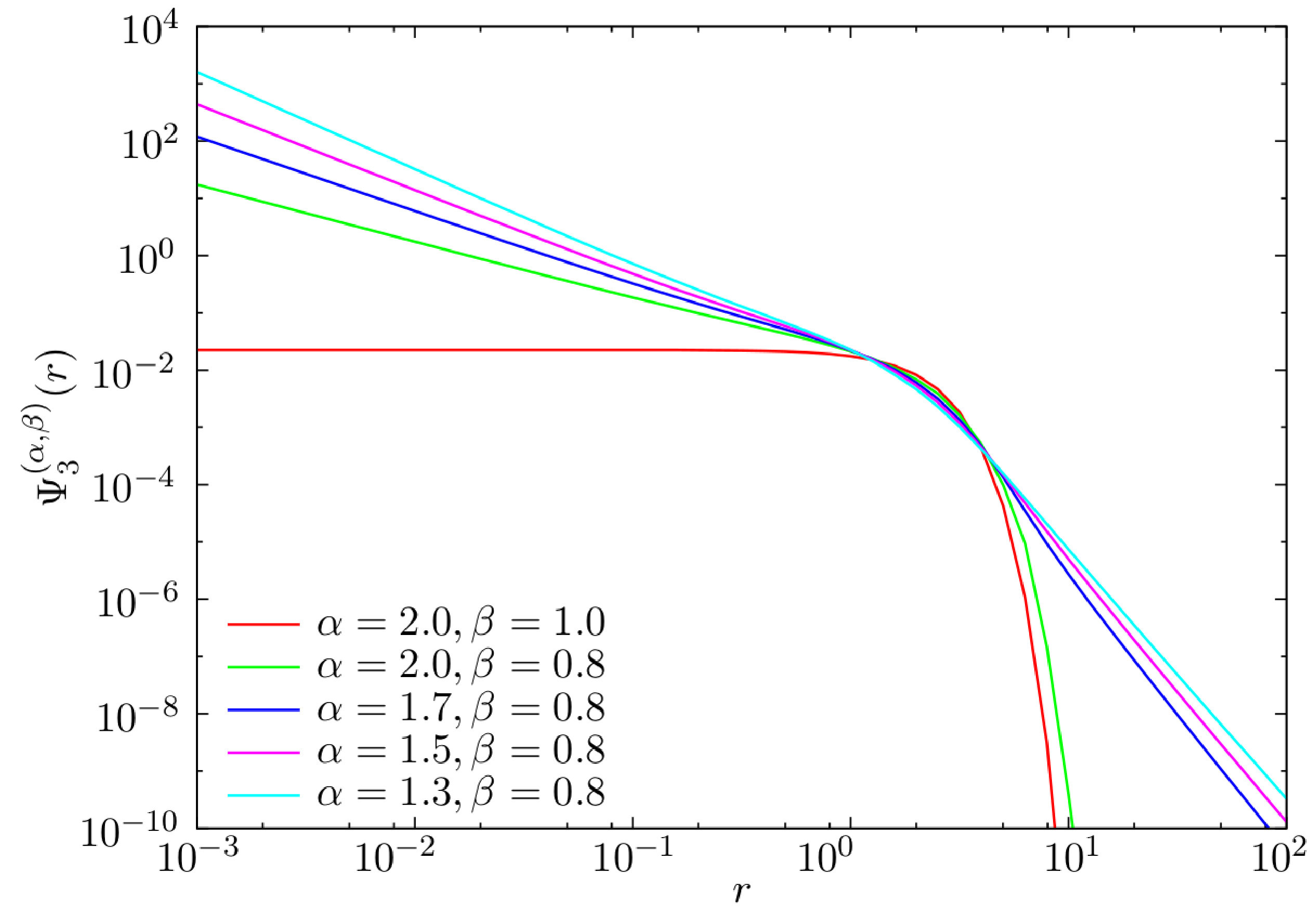 Figure 1
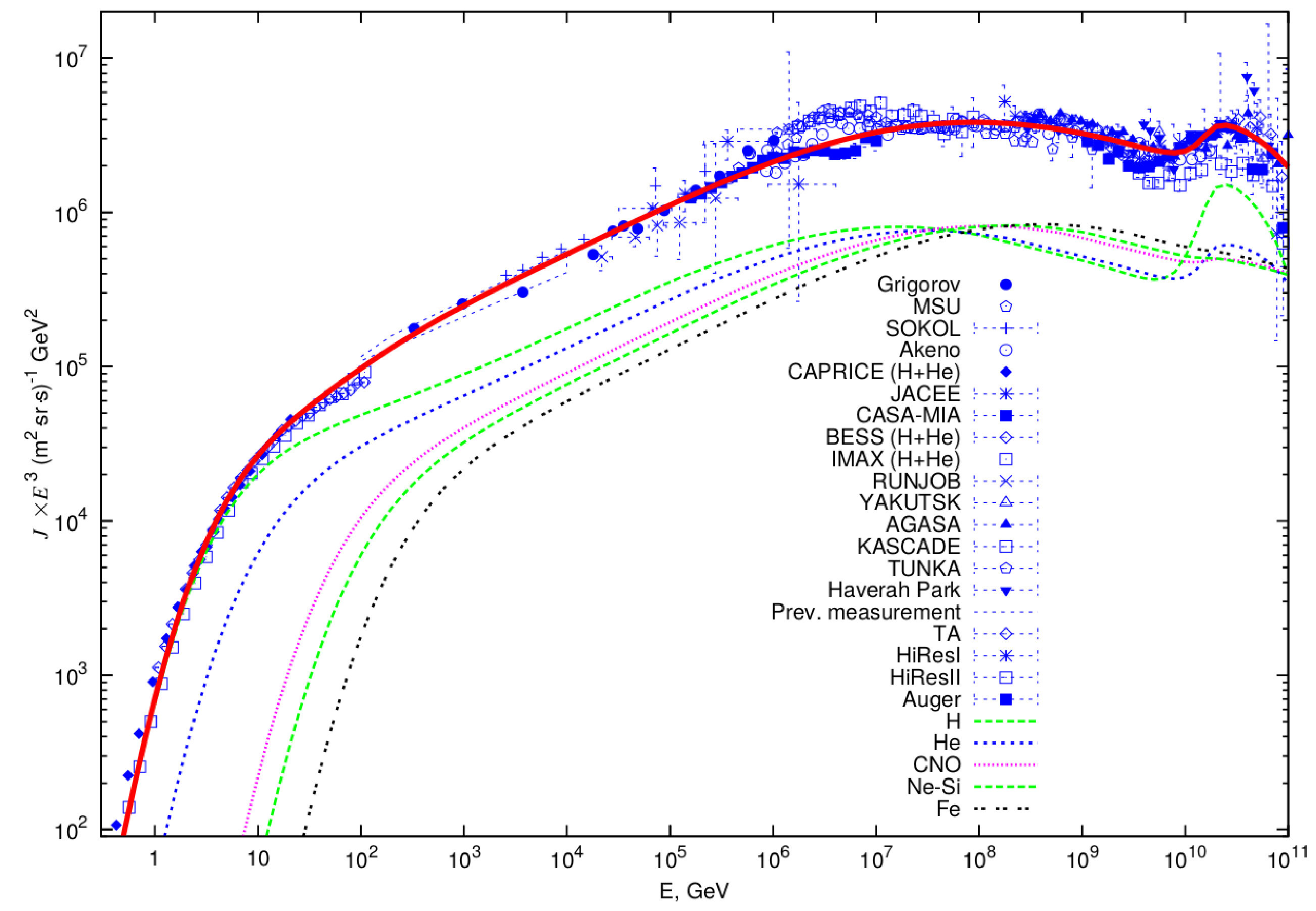 Figure 2
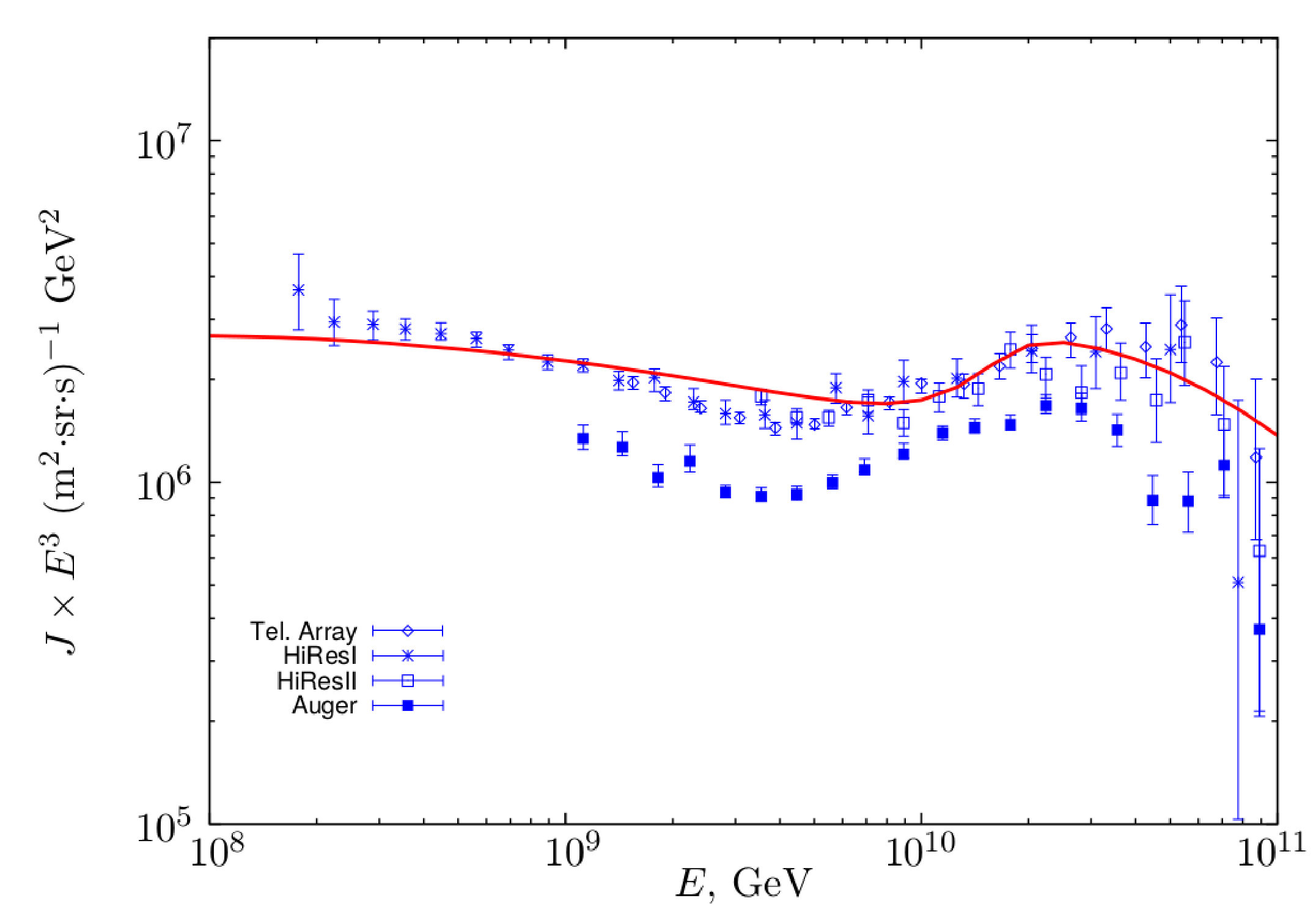 Figure 3
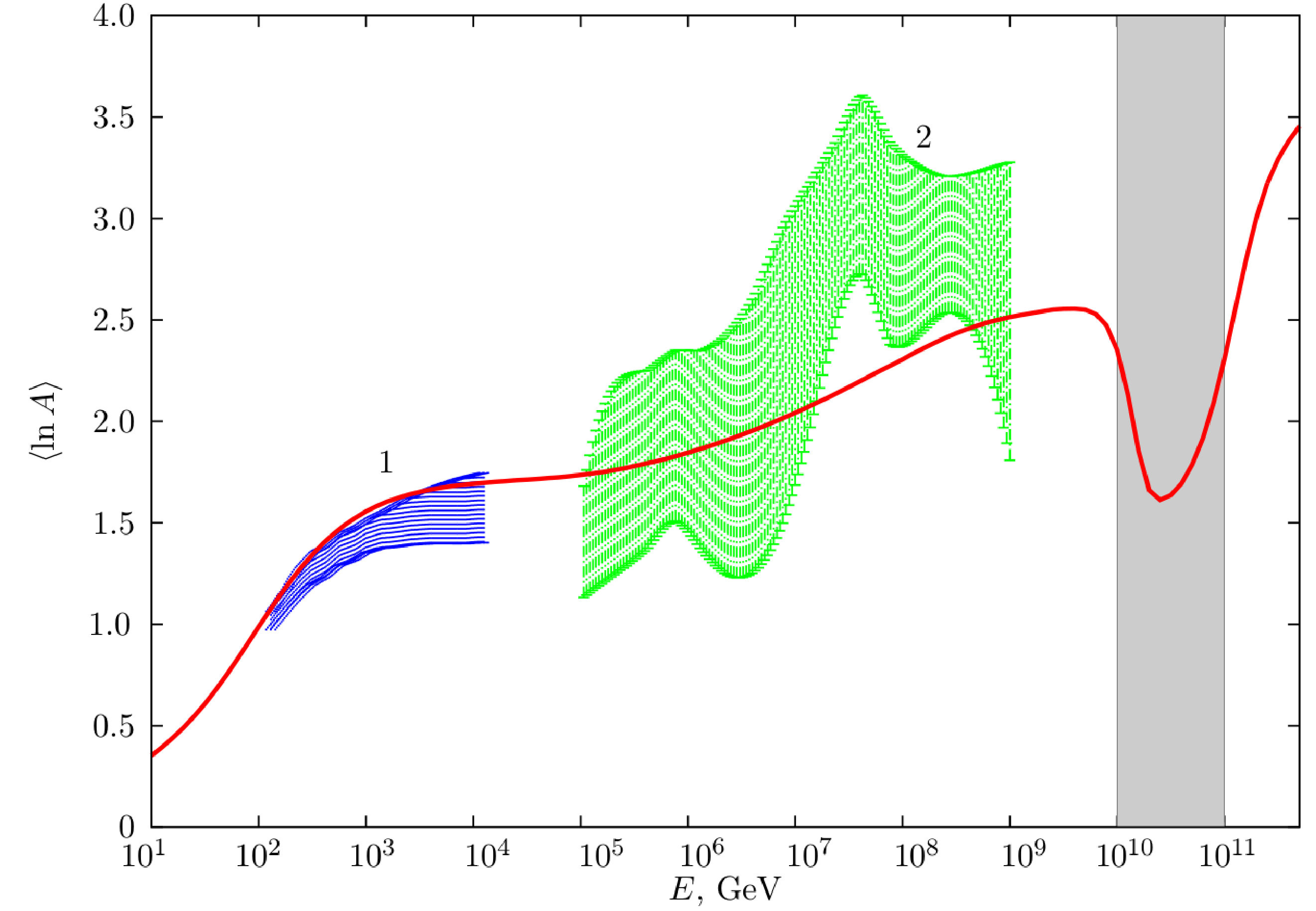 Figure 4
Peer Reviews
No public reviews on file for this paper yet. If you reviewed it on a platform where reviews are public (OpenReview, ICLR, NeurIPS, ICML), you can paste yours below so the community can read it here.
Videos
No videos yet. Explain this paper in a talk, walkthrough, or lecture? Add one.
Spectra of protons and nuclei in the energy range of eV in the framework of Galactic cosmic ray origin
Nikolay Volkov
Anatoly Lagutin
Alexander Tyumentsev
Roman Raikin
Altai State University, Radiophysics and Theoretical Physics Department. 61 Lenin ave., Barnaul, 656049, Russia. [email protected], [email protected], [email protected], [email protected]
Abstract
We consider the problem of the cosmic ray spectrum formation assuming that cosmic rays are produced by Galactic sources. The anomalous diffusion equation proposed in our recent papers is used to describe cosmic ray propagation in the interstellar medium. We show that in the framework of this approach and with generation spectrum exponent it is possible to reproduce locally observed basic features of cosmic rays in the energy region of eV: difference between spectral exponents of protons and other nuclei, mass composition variation, “knee” problem, flattening of the primary spectrum at eV. The crucial model predictions for the mass composition behaviour in the ultra-high energy region are discussed.
1 Introduction
The problem of ultra-high energy cosmic ray (UHECR) origin remains unsolved, despite significant progress made in recent years. The suppression of the cosmic ray flux at energy of eV being established unambiguously can not be reliably identified as GZK-cutoff due to the apparent differences between Telescope Array/HiRes and Auger mass composition results [1, 2]. As the Auger data indicated a nuclear UHECR composition becoming heavier with energy in the region of EeV, different models assuming that the UHECR spectra cutoff is not an extragalactic GZK feature are considered [3, 4, 5].
In this paper we examine the possibility for self-consistent description of all the basic features of the observed cosmic ray spectrum in the energy range of eV within the Galactic origin scenario. We assume the existence of Galactic sources that accelerate particles up to eV and take into account highly inhomogeneous (fractal-like) distribution of matter and magnetic fields in the Galaxy that leads to extremely large free paths of particles (“Levy flights”), along with an overwhelming contribution to the cosmic ray fluxes observed above eV from particles reaching the Solar System without scattering. The crucial model predictions for the mass composition behaviour in the ultra-high energy region are presented.
2 Anomalous diffusion model
In our recent papers an anomalous diffusion (AD) model for solution of the “knee” problem in primary cosmic-rays spectrum was proposed [6, 7, 8, 9]. The “anomaly” in this model results from the presence of extremely large free paths (Levy flights) of particles between Galactic inhomogeneities and also the long-lasting trapping of particles in very strong magnetic field regions (Levy traps). Thus the following asymptotic behaviour of the probabilities of free paths () and time, during which particles are caught in magnetic traps (), takes place:
[TABLE]
The cosmic rays propagation in the fractal-like interstellar Galactic medium without energy losses and nuclear interactions can be described by the anomalous diffusion equation. The equation for the concentration of particles with an energy , generated in a fractal medium by Galactic sources with a distribution density can be written as
[TABLE]
Here denotes the Riemann-Liouville fractional derivative [10] and is the fractional Laplacian (‘Riesz operator’) [10]. The anomalous diffusivity .
The Green’s function , corresponding to (2), can be found from the equation
[TABLE]
With the use of the Laplace-Fourier transformations and formulae [10]
[TABLE]
[TABLE]
we obtain
[TABLE]
Then the inverse transform yields
[TABLE]
where
[TABLE]
is the density of fractional stable distribution [11], the three-dimensional spherically-symmetrical stable distribution and is the one-sided stable distribution with characteristic exponent [11]. The probability densities of are shown in figure 1.
Using the Green’s function (4), we can write a solution of the anomalous diffusion equation for a point pulse source with emission time and an exponential cutoff at energy
[TABLE]
3 Energy spectrum of cosmic rays
Types of sources and their distribution in space suggest their separation into three parts as follows.
[TABLE]
Here
- •
is the global spectrum component determined by the multiple old ( yr) distant ( kpc) sources;
- •
is the local component, i.e. the contribution nearby ( kpc) young ( yr) sources;
- •
is the flux of non-scattered particles.
The flux of non-scattered particles is determined by the injected flux
[TABLE]
and the Levy flight probability . Taking into account that for a particle with energy the probability , , we have
[TABLE]
We assume that this component is also formed by nearby ( kpc) sources, defining the spectrum in ultrahigh energy region, and provides the observed flattening of the spectrum at eV.
Finally, for the global stationary component formed by old distant sources and the local component from the nearest sources the expression obtained by the solution of anomalous diffusion equation is as follows.
[TABLE]
In (5) the first term is the contribution from the multiple old distant sources, the second term is the contribution from nearby young sources and the third term is the flux of non-scattered particles. To calculate the energy spectrum from nearby young sources, simulation of the Poisson ensemble of sources was carried out [14]. The Poisson distribution parameter (average number of sources in the local region) was chosen . This estimation corresponds to number of the well-known nearest supernova remnants and pulsars with yr. Coordinates and times of birth of the sources were generated randomly and uniformly in the space region pc and in the time interval yr.
The parameters of the model are , as it was established earlier [6], . The cut-off energy was fixed on the basis of comparisons with experimental data. To assess parameters , , which are specific for our model, the results of studies of particles diffusion in cosmic and laboratory plasma have been used [15, 16]. Finally, for the anomalous diffusivity we get the value of [9]. The emission time yr.
Our results of calculations of energy spectra of cosmic rays are shown in figures 2, 3. Note, that the “fine structure” of spectrum around the knee can be described satisfactorily in the framework of the model with two types of sources (see [17]).
An average mass number variation with energy according to our model is shown in figure 4. It was established that in the region of eV the fraction of protons is , while the fraction of iron is . A key feature of the model is the essential dip in mean logarithm of the mass number in the region of eV (from 2.6 to 1.6). The weighting of the mass composition is predicted at eV and reaches at eV. The presence of such a dip according to the experimental data could be construed in favour of our model. Note, that recent results of Auger Collaboration exhibit similar feature in variation with energy, although at an order of magnitude lower energies [18].
4 Conclusions
Assuming the Galactic origin of cosmic rays we propose a mechanism for the formation of ultra-high energy protons and nuclei spectra observed in the Solar System, that reproduces all the basic features of cosmic ray spectrum observed experimentally.
It is shown that taking into account both the diffusion contribution from nearby young and old distant sources and also the contribution of non-scattered radiation, due to the presence of large free paths (Levy flights) caused by anomalous diffusion, a description of the experimental data in the energy range eV can be obtained if we assume that the particle injection spectrum in the Galactic sources is
[TABLE]
The following basic model predictions are expressed:
- •
the steepening of all particles spectrum in the range eV is due to the proton flux cut-off caused by energy limitation of the Galactic particle accelerators;
- •
at the energies eV the fraction of protons is %, and the iron fraction is about % (normal composition);
- •
in the range eV mean logarithmic cosmic ray mass decreases rapidly from to ;
- •
considerable weighting of the mass composition is observed at eV; for eV mean logarithmic cosmic ray mass is .
Acknowledgement
This work was suppored by the Russian Foundation for Basic Research grant No. 14-02-31524. The authors are greatly indebted to anonymous referee for valuable comments.
References
- [1] Abbasi R U et al 2008 Phys. Rev. Lett. 100 101101
- [2] Abraham J et al 2008 Phys. Rev. Lett. 101 061101
- [3] Aloisio R, Berezinsky V, Gazizov A 2011 Astropart. Phys. 34 620
- [4] Calvez A, Kusenko A, Nagataki S 2010 Phys. Rev. Lett. 105 091101
- [5] Fang K, Kotera K, Olinto A V 2013 JCAP 03 010.
- [6] Lagutin A A, Nikulin Yu A, Uchaikin V V 2001 Nucl. Phys. B 97 267
- [7] Lagutin A A, Uchaikin V V 2003 NIM B B201 212
- [8] Erlykin A D, Lagutin A A, Wolfendale A W 2003 Astropart. Phys. 19 351
- [9] Lagutin A A and Tyumentsev A G 2004 Izv. Altai. Gos. Univ. 35 4 (in Russian)
- [10] Samco S G, Kilbas A A and Marichev O I 1993 Fractional integrals and derivatives — Theory and Applications (New York: Gordon and Breach) p 976
- [11] Uchaikin V V and Zolotarev V M 1999 Chance and Stability (Netherlands, Utrecht: VSP) p 594
- [12] Abu-Zayyad T, Aida R, Allen M (Telescope Array Experiment) 2013 Astrophys. Journ. Lett. 768:L1 1
- [13] Abraham J, Abreu P, Aglietta M (Pierre Auger Collaboration) 2010 Phys. Lett. B 685 239
- [14] Lagutin A A, Volkov N V and Tyumentsev A G 2013 Bulletin of the Russian Academy of Sciences: Physics 77 1312
- [15] Greco A, Taktakishvili A L, Zimbardo G and et al 2003 J. Geophys. Res. 108 1
- [16] Perri S and Zimbardo G 2008 J. Geophys. Res. 113
- [17] Lagutin A A, Tyumentsev A G, Yushkov A V 2008 Nucl. Phys. B (Proc. Suppl.) 175-176 555
- [18] Aab A, Abreu P, Aglietta M (Pierre Auger Collaboration) 2014 Phys. Rev. D. 90 122005
- [19] Shibata T 1999 Nucl. Phys. B. 75A 22
- [20] Hörandel J R 2003 Astropart. Phys. 19 193
The reference list from the paper itself. Each links out to its DOI / PubMed record.
- 1[1] Abbasi R U et al 2008 Phys. Rev. Lett. 100 101101
- 2[2] Abraham J et al 2008 Phys. Rev. Lett. 101 061101
- 3[3] Aloisio R, Berezinsky V, Gazizov A 2011 Astropart. Phys. 34 620
- 4[4] Calvez A, Kusenko A, Nagataki S 2010 Phys. Rev. Lett. 105 091101
- 5[5] Fang K, Kotera K, Olinto A V 2013 JCAP 03 010.
- 6[6] Lagutin A A, Nikulin Yu A, Uchaikin V V 2001 Nucl. Phys. B 97 267
- 7[7] Lagutin A A, Uchaikin V V 2003 NIM B B 201 212
- 8[8] Erlykin A D, Lagutin A A, Wolfendale A W 2003 Astropart. Phys. 19 351