Hadroproduction of open heavy flavour for PDF analyses
Ilkka Helenius, Hannu Paukkunen

TL;DR
This paper introduces a new theoretical scheme, SACOT-mT, for calculating open heavy-flavour hadroproduction cross sections, improving the reliability of perturbative QCD predictions across all kinematic ranges in high-energy collisions.
Contribution
The paper presents SACOT-mT, a novel scheme within the general-mass variable-flavour-number formalism, enhancing the accuracy of heavy-flavour production calculations in QCD.
Findings
Improved description of heavy-flavour cross sections across all pT ranges.
Enhanced robustness of LHC heavy-flavour measurements for PDF analyses.
Introduction of a scheme analogous to SACOT-χ for deep-inelastic scattering.
Abstract
Due to the large masses of the charm and bottom quarks, their production cross sections are calculable within the perturbative QCD. This makes the heavy-quark mesons important observables in high-energy collisions of protons and nuclei. However, the available calculations for heavy-flavored-meson hadroproduction have been somewhat problematic in reliably describing the cross sections across the full kinematic range from zero to very high . This has put some question marks on the robustness of LHC heavy-flavored-meson measurements in studying the partonic structure of the colliding hadrons and nuclei. Here, we introduce SACOT- - a novel scheme for open heavy-flavour hadroproduction within the general-mass variable-flavour-number formalism that solves this problem. The introduced scheme is an analogue of the SACOT- scheme often used for deeply-inelastic…
Click any figure to enlarge with its caption.
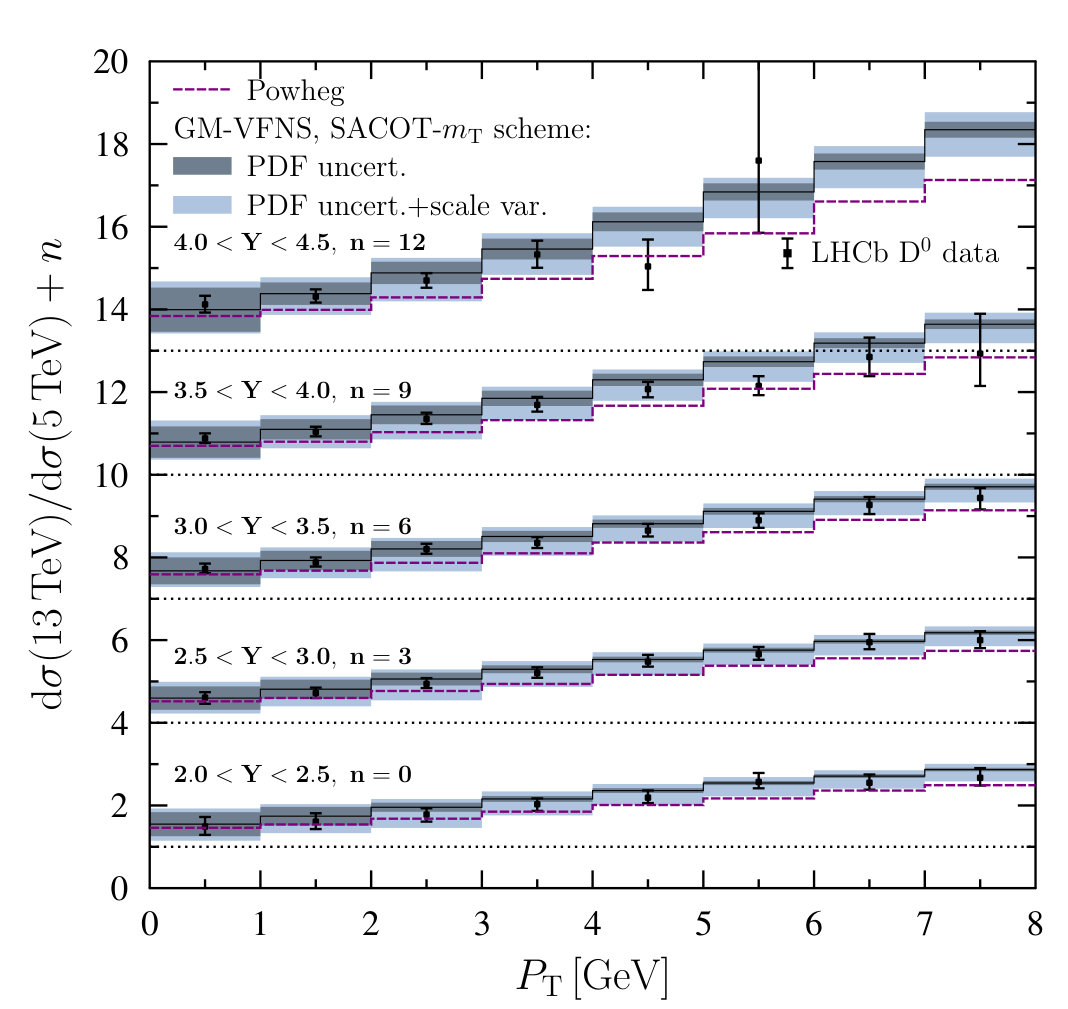 Figure 1
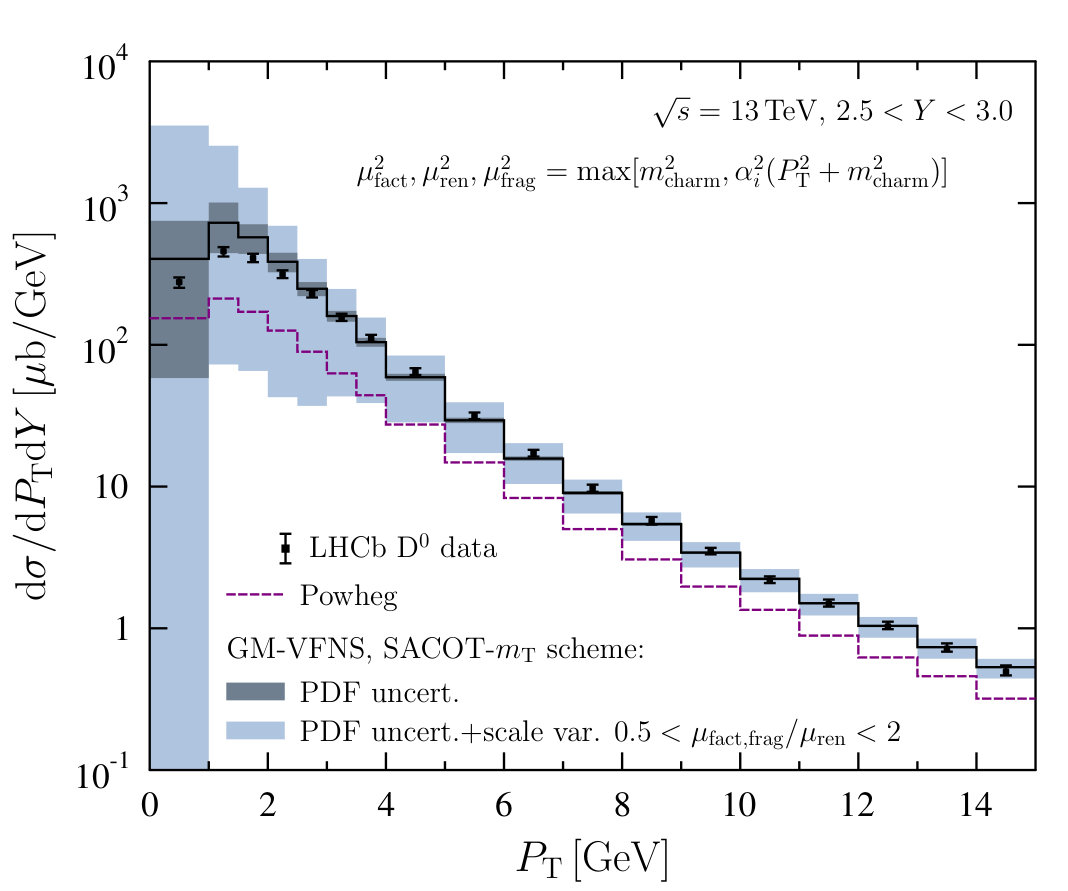 Figure 2
 Figure 3
 Figure 4
 Figure 5
Peer Reviews
No public reviews on file for this paper yet. If you reviewed it on a platform where reviews are public (OpenReview, ICLR, NeurIPS, ICML), you can paste yours below so the community can read it here.
Videos
No videos yet. Explain this paper in a talk, walkthrough, or lecture? Add one.
Taxonomy
TopicsParticle physics theoretical and experimental studies · Quantum Chromodynamics and Particle Interactions · High-Energy Particle Collisions Research
Hadroproduction of open heavy flavour for PDF analyses
Ilkka Helenius
University of Jyvaskyla, Department of Physics, P.O. Box 35, FI-40014 University of Jyvaskyla, Finland
Helsinki Institute of Physics, P.O. Box 64, FI-00014 University of Helsinki, Finland
Institute for Theoretical Physics, Tübingen University, Auf der Morgenstelle 14, 72076 Tübingen, Germany
University of Jyvaskyla, Department of Physics, P.O. Box 35, FI-40014 University of Jyvaskyla, Finland
Helsinki Institute of Physics, P.O. Box 64, FI-00014 University of Helsinki, Finland
Abstract:
Due to the large masses of the charm and bottom quarks, their production cross sections are calculable within the perturbative QCD. This makes the heavy-quark mesons important observables in high-energy collisions of protons and nuclei. However, the available calculations for heavy-flavored-meson hadroproduction have been somewhat problematic in reliably describing the cross sections across the full kinematic range from zero to very high . This has put some question marks on the robustness of LHC heavy-flavored-meson measurements in studying the partonic structure of the colliding hadrons and nuclei. Here, we introduce SACOT- – a novel scheme for open heavy-flavour hadroproduction within the general-mass variable-flavour-number formalism that solves this problem. The introduced scheme is an analogue of the SACOT- scheme often used for deeply-inelastic scattering in global analyses of PDFs.
1 Introduction
The hadroproduction of open heavy flavour – D mesons in particular – has recently been advocated as a promising constraint for proton parton distribution functions (PDFs) [1, 2]. The theoretical description is typically based on the fixed flavour-number scheme (FFNS) [3], fonll code [4], or FFNS matched to parton showers [5]. However, the use of e.g. FFNS calculation in conjunction with PDFs defined in variable flavour-number schemes (the commonly used general-purpose PDFs) may be too restrictive, and in this sense calculations within the framework of general-mass variable-flavour-number scheme (GM-VFNS) would be more natural. Here, we will discuss our novel implementation of the GM-VFNS, the so-called SACOT- scheme [6].
2 D-meson production in fixed flavour-number scheme
Within FFNS – assuming no intrinsic heavy-quark content in the proton – the massive quarks are always produced in pairs by the partonic processes, . The cross section for inclusive production can be written as an integral of PDFs and partonic cross sections ,
[TABLE]
where and denote the rapidity and transverse momentum of the produced heavy quark. The factorization and renormalization scales are marked by and . The kinematic variables are the “massive” Mandelstam variables,
[TABLE]
denoting the momenta of the incoming partons and outgoing heavy quark by and , respectively. The partonic cross sections scale as , and, thanks to the heavy-quark mass, remain finite even at . The heavy-quark cross sections can be turned into, say D0-meson production cross sections by folding with fragmentation functions (FFs) . The fragmentation variable is not unique when the masses of the heavy quark and D0 meson are kept non zero. For simplicity, we define , where and are the energies of the D0 meson and heavy quark in the center-of-mass frame of the p-p collision. Assuming that the fragmentation is collinear we get,
[TABLE]
where the (lower case) partonic and (upper case) hadronic variables are related by
[TABLE]
and marks the hadronic transverse mass. While this framework appears to work well at low (see e.g. [7]), the description seems to deteriorate towards high . Presumably, this can be attributed to the behaviour of the partonic cross sections which begin to dominate and should be resummed, as we will come to conlcude.
3 D-meson production in general-mass variable-flavour-number scheme
The GM-VFNS description can be obtained from FFNS by resumming the terms that appear in FFNS. As an example, in Figure 1 the diagram (a) gives rise to such logarithmic behaviour when the initial-state gluon splits into a pair. This is only the first of the whole series of diagrams that are in GM-VFNS summed into the heavy-quark PDF .
Effectively, this summation can be realized by including the heavy-quark initiated contribution (c) and a subtraction term (b) that avoids the double counting between diagrams (a) and (c). The contribution from channel, represented here by the diagram (c), can be written as
[TABLE]
The subtraction term (b) is obtained from this same expression by replacing the heavy-quark PDF with its perturbative expression,
[TABLE]
where is the QCD coupling, and is the usual gluon-to-quark splitting function. However, the exact form of in the above expressions is not unique [8]. In practice, we can only require that the zero-mass expressions are recovered at high ,
[TABLE]
The easiest option is to define , i.e. use the zero-mass expressions to begin with. This is known as the SACOT scheme [9]. The problem of this choice is that it leads to infinite cross sections towards due to the behaviour of the partonic cross sections. In the so-called FONLL scheme [4] this is avoided by multiplying the partonic cross section by an ad-hoc damping factor with , which serves to tame the unphysical behaviour at small . Alternatively, the problematic behaviour can be avoided simply by retaining the kinematics of the -pair production which, deep down, is the underlying process we describe. With this physical picture in mind, we define taking as in FFNS. This leads to well-behaved cross sections in the limit. We call this the SACOT- scheme, as it shares the same underlying idea as the SACOT- scheme in deeply-inelastic scattering [10].
Part of the terms in FFNS come also from final-state splittings. As an example, Figure 2 shows a diagram in which an outgoing gluon splits into a pair.
The resulting terms are absorbed into the fragmentation-scale dependent gluon FFs, , giving rise to gluon-fragmentation contributions,
[TABLE]
The subtraction term avoiding the double counting is again the same expression, but replacing the gluon FF by its perturbative form,
[TABLE]
In line with our scheme choice, the zero-mass matrix elements for with the massive expressions for , are adopted. Even if the heavy quarks do not explicitly appear in the process, the underlying process is also here the -pair production.
With this schematic justification, our “master formula” within GM-VFNS is,
[TABLE]
Unlike in FFNS, all partonic subprocesses are included and the FFs are scale dependent. In the limit , the partonic cross sections reduce to FFNS, but towards they tend to the zero-mass expressions. Our numerical realization of SACOT- scheme is crafted around the Mangano-Nason-Ridolfi code [3] for heavy quarks, and the incnlo code [11] for zero-mass partons. All terms up to are included.
4 Description of the LHCb D0 data
In Figure 3, we compare the LHCb 13 TeV D0 data [12] with our GM-VFNS theory calculation. The darker bands show the NNPDF3.1 (pch) [13] PDF uncertainty, and the lighter bands combine the scale-variation and PDF errors. We have used here the KKKS08 FFs [14]. The calculation agrees very well with the data though the scale variation leads to a significant uncertainty at small . We have found that, the contribution from the three FFNS processes, including the subtraction terms, is less than 10% for and only around 3% for . This demonstrates that the terms in FFNS become quickly the dominant ones and must be resummed as done in GM-VFNS. A comparison using FFNS + parton-shower approach (with the same PDFs) is also presented. Here, we have used the Powheg-Box event generator [5] matched to the Pythia 8 [15] parton shower. We see that the Powheg+Pythia setup has a tendency to underpredict the experimental spectrum, and the ratio between two is clearly flatter than the GM-VFNS prediction. We deduce that the leading reason is that by starting only with pairs (generated by Powheg) one neglects the contributions in which the parton shower excites the pair only later on. In GM-VFNS these are resummed to the scale-dependent FFs and, indeed, e.g. the gluon-to-D contributions can be around 50% of the total budget. The gluon fragmentation also significantly changes the regions in which the PDFs are sampled. Thus, the use of FFNS-based computation when using D-meson data to fit GM-VFNS PDFs would inflict a potential bias.
Acknowledgments
The support by the Academy of Finland Projects 297058 & 308301, the Carl Zeiss Foundation, and the state of Baden-Württemberg through bwHPC, are acknowledged. We have used the computing facilities of the Finnish IT Center for Science (CSC) in our work.
The reference list from the paper itself. Each links out to its DOI / PubMed record.
- 1[1] O. Zenaiev et al. , Eur. Phys. J. C 75 (2015) 396.
- 2[2] R. Gauld and J. Rojo, Phys. Rev. Lett. 118 (2017) 072001.
- 3[3] M. L. Mangano, et al. , Nucl. Phys. B 373 (1992) 295.
- 4[4] M. Cacciari, et al. , JHEP 9805 (1998) 007.
- 5[5] S. Frixione, et al. , JHEP 0709 (2007) 126.
- 6[6] I. Helenius and H. Paukkunen, JHEP 1805 (2018) 196.
- 7[7] O. Zenaiev, Eur. Phys. J. C 77 (2017) no.3, 151.
- 8[8] R. S. Thorne and W. K. Tung, ar Xiv:0809.0714 [hep-ph].