Energy deposition on nuclear emulsion by slow recoil ions for directional dark matter searches
Akira Hitachi, A. Mozumder, Kiseki D. Nakamura

TL;DR
This paper evaluates energy deposition by slow recoil ions in nuclear emulsions, crucial for designing detectors for directional dark matter searches, by analyzing ion tracks, quenching factors, and background effects.
Contribution
It provides detailed analysis of energy deposition and track structures of various recoil ions, enhancing the understanding for improved dark matter detector design.
Findings
Electronic energy deposition varies with ion type and energy.
Heavy recoil ions produce distinct track structures relevant for background discrimination.
Proton track analysis informs neutron background mitigation strategies.
Abstract
The electronic energy deposited on nuclear emulsions due to C ions of 5 -- 200~keV and Kr ions of 5 -- 600~keV are evaluated and compared with those due to fast ions for design and construction of fine grain nuclear emulsion for directional dark matter searches. Nuclear quenching factors and the electronic LET (linear energy transfer), the specific electronic energy deposited along the ion track, are evaluated. The so-called core and penumbra of heavy-ion track structure is modified for understanding the track due to recoil ions produced by dark matter candidate, WIMPs, striking nucleus in the AgBr crystal of nuclear emulsion. The very heavy recoil ions, 100 -- 180~keV Pb ions, produced in -decay are also studied. In addition, the track structures due to proton ions of 25 -- 80~keV are evaluated to consider the influence of background neutrons in underground laboratories.
Click any figure to enlarge with its caption.
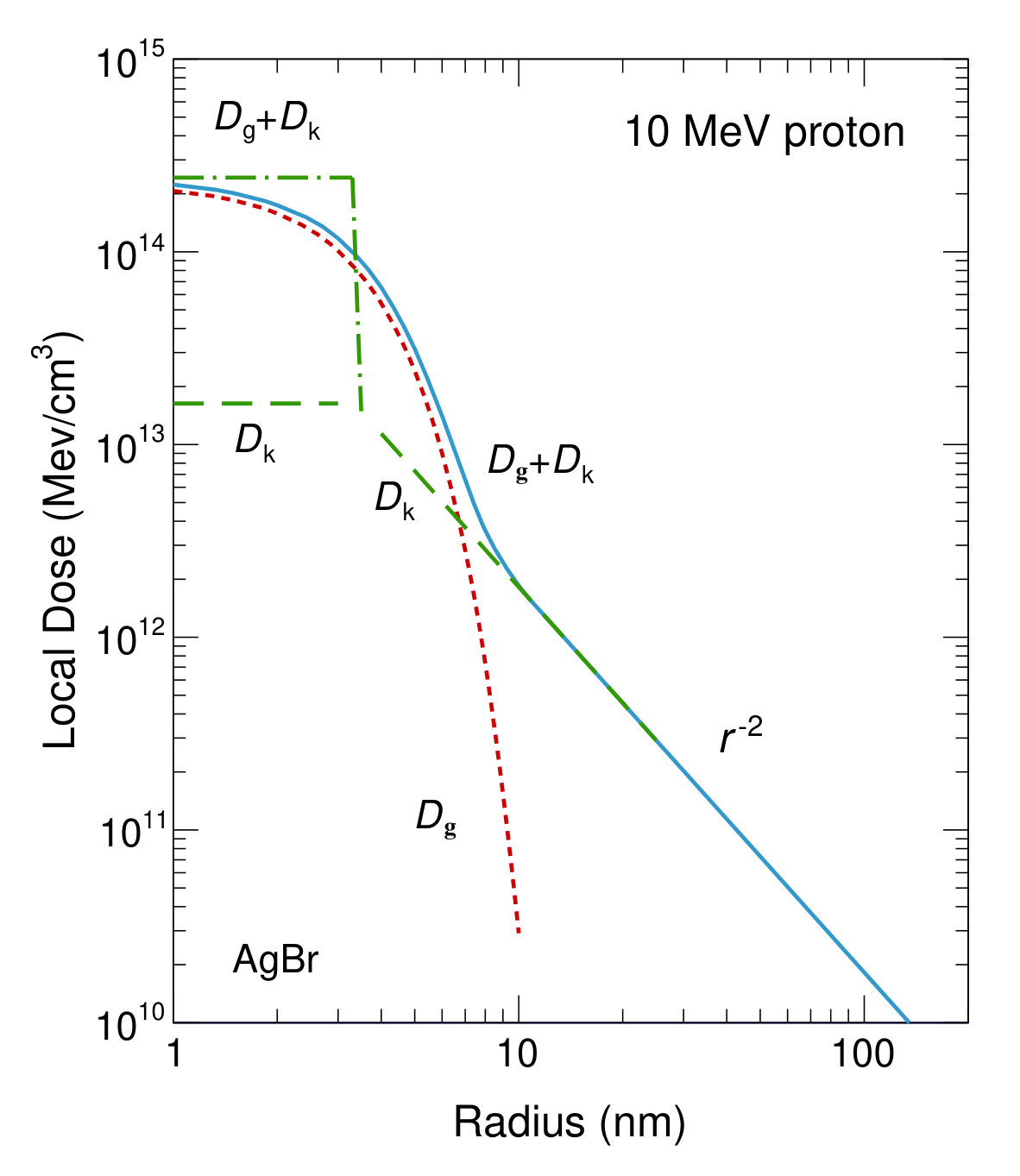 Figure 1
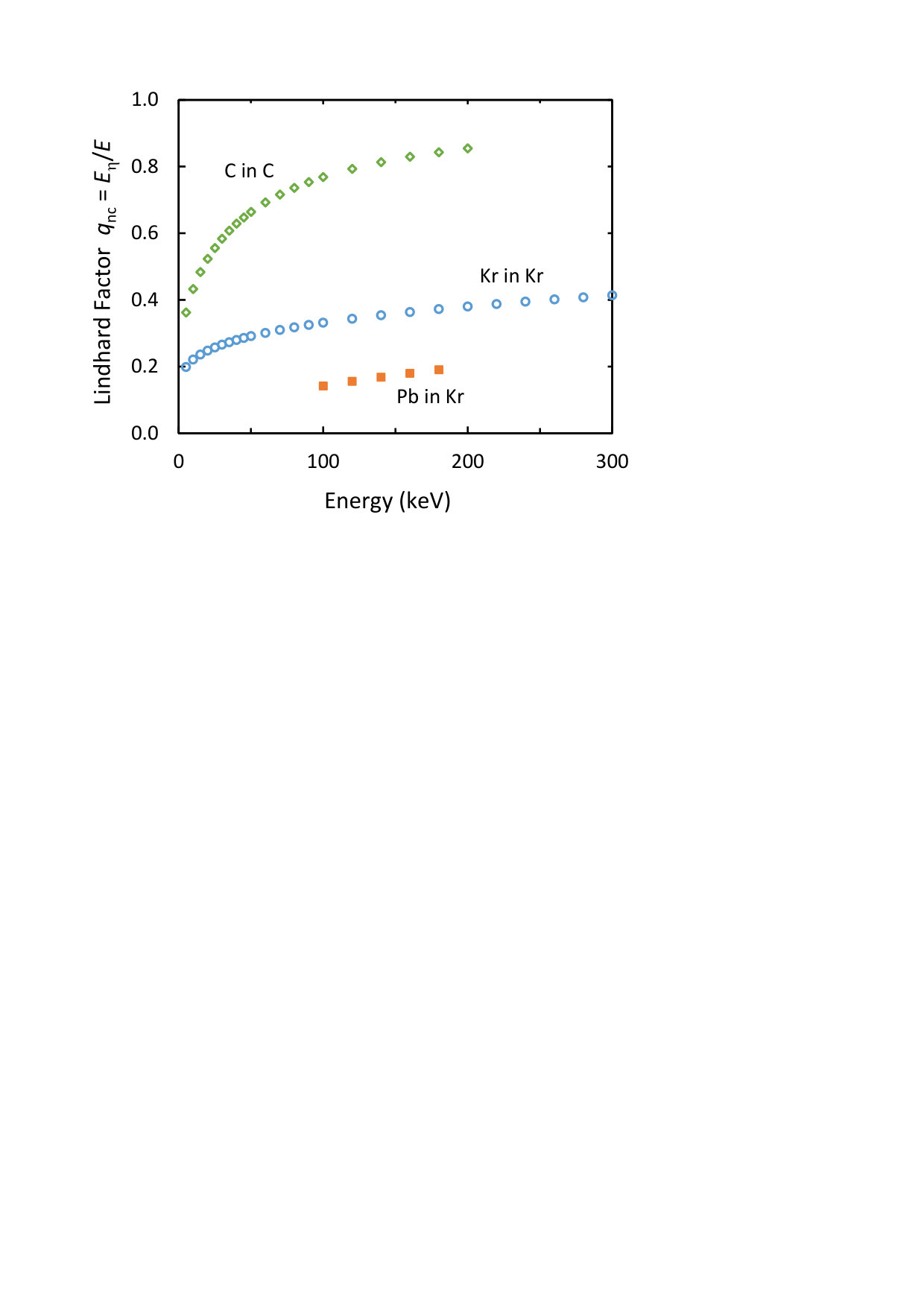 Figure 2
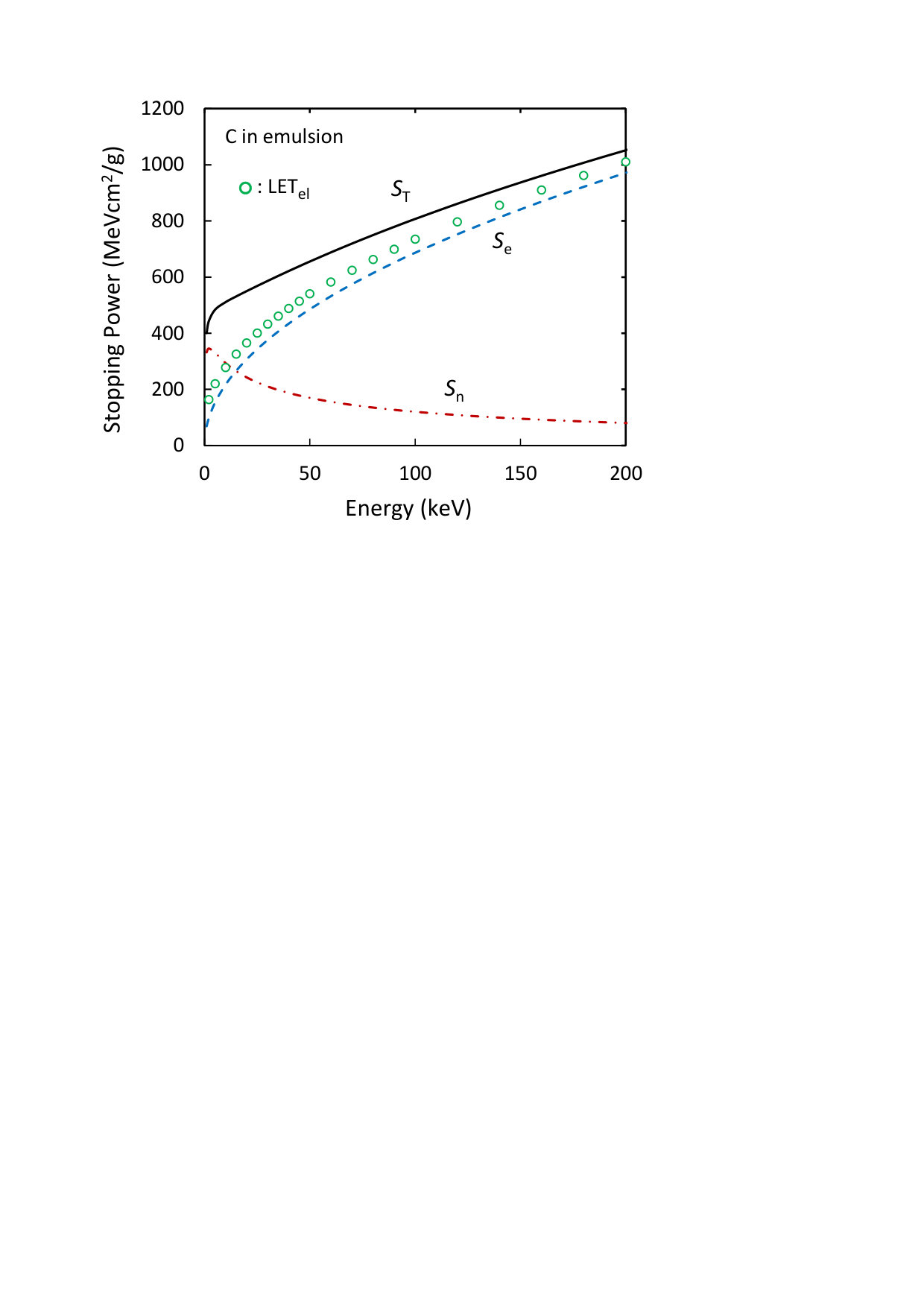 Figure 3
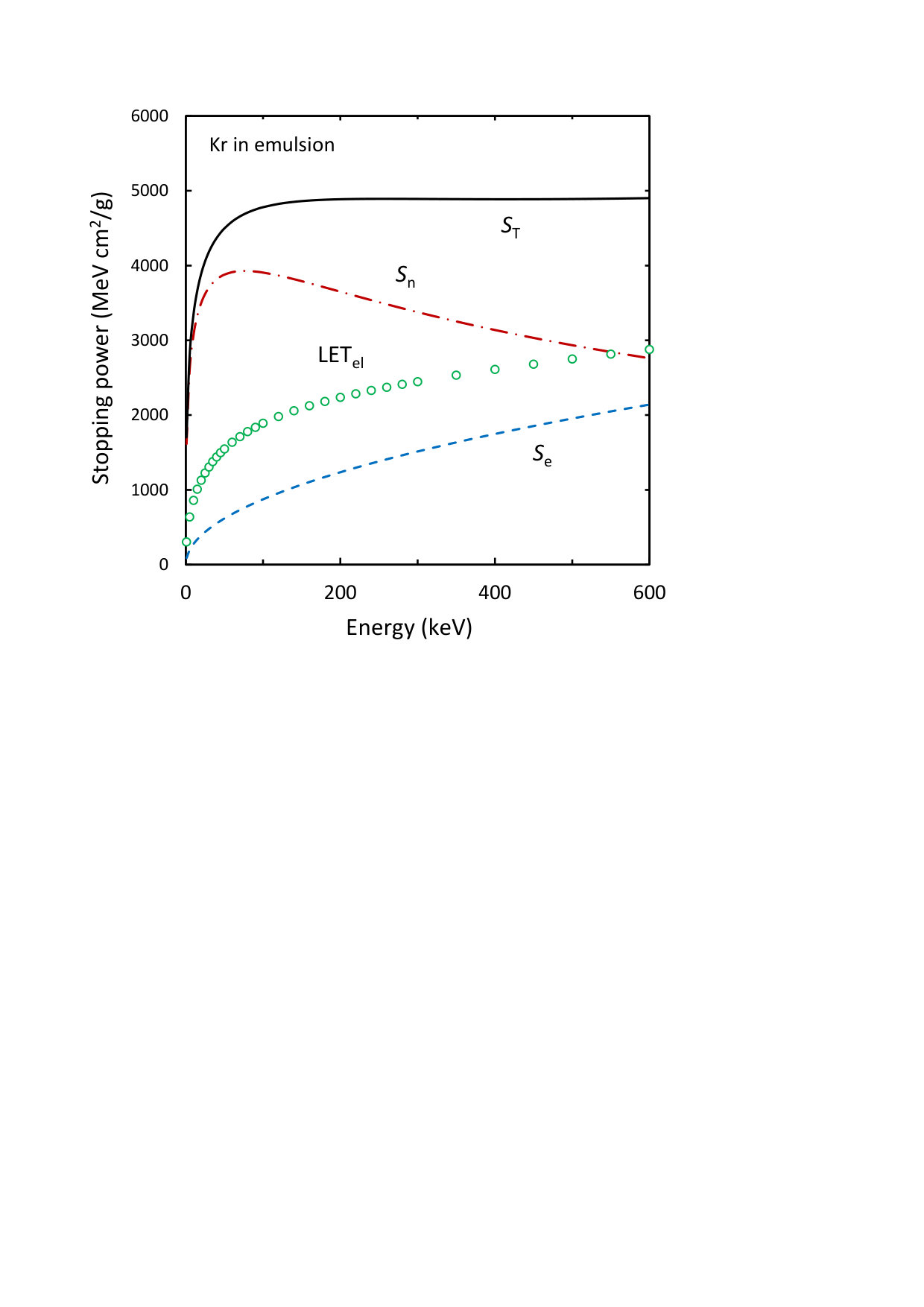 Figure 4
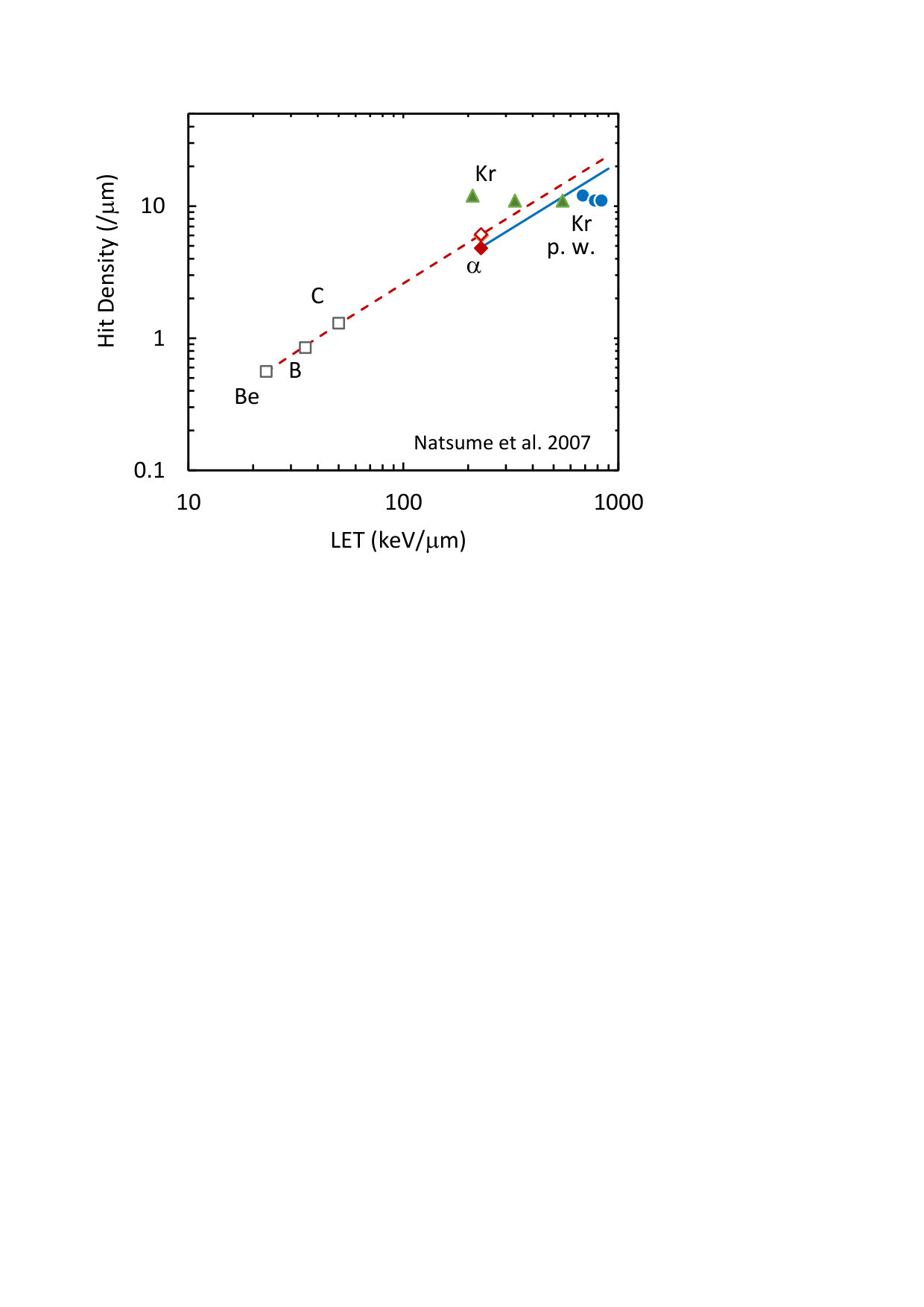 Figure 5
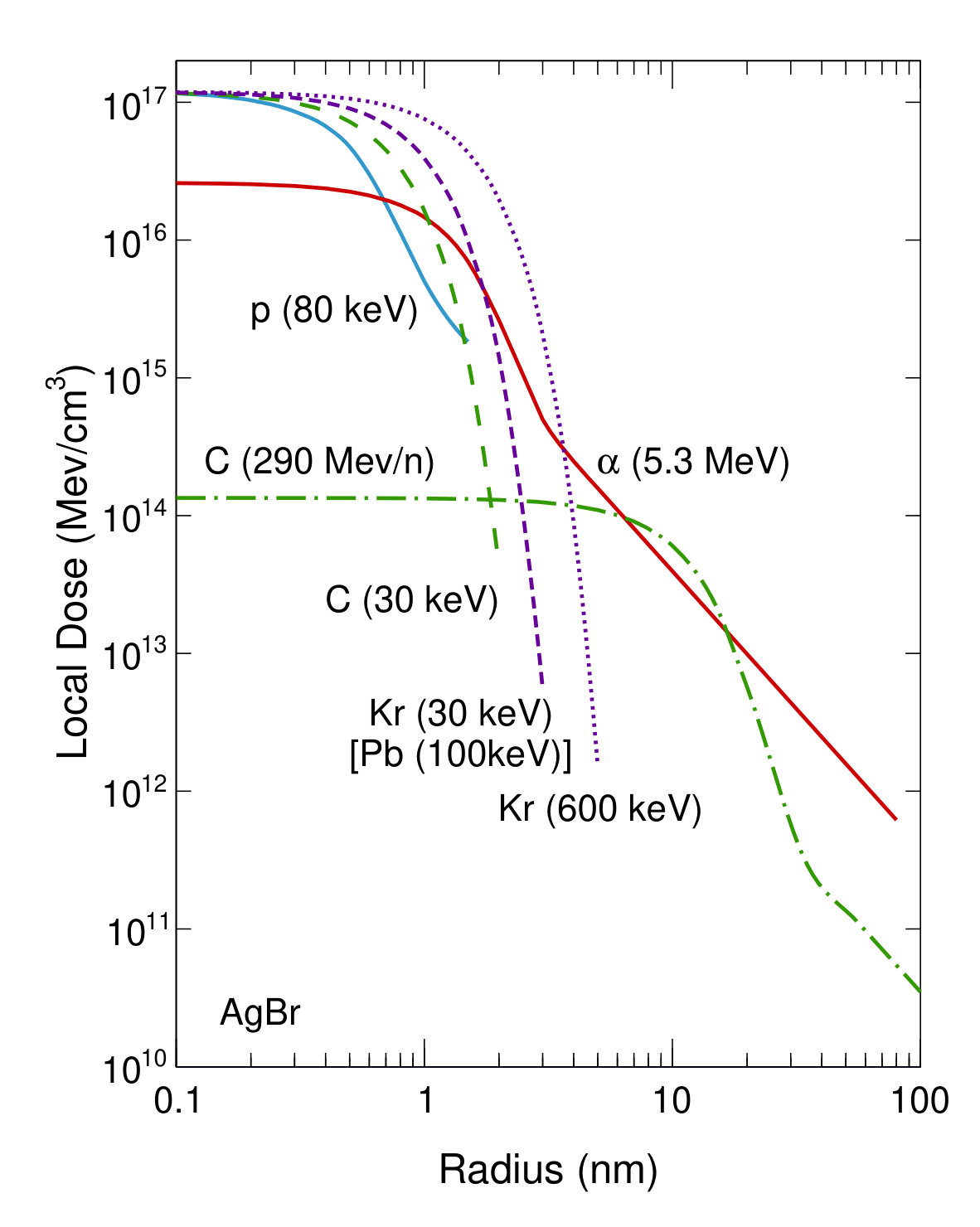 Figure 6
| particles | energy | range | |||||
| keV | m | keV/m | keV | nm | nm | ||
| protons | 25 | 0.29 | 1.0 | 87 | 0.05 | 0.48111Expanded core radius | - |
| protons | 80 | 0.74 | 1.0 | 109 | 0.18 | 0.46111Expanded core radius | 1.5 |
| protons | 10 | 630 | 1.0 | 16 | 22 | 3.3 | 2,070 |
| alphas | 5.3 | 25 | 1.0 | 212 | 2.9 | 1.2 | 63 |
| C | 3.48 | - | 1.0 | 50 | 735 | 11 | 5.9 |
| C | 30 | 0.093 | 0.58 | 190 | - | 0.7111Expanded core radius | - |
| C | 100 | 0.30 | 0.77 | 260 | - | 0.8111Expanded core radius | - |
| Kr | 30 | 0.024 | 0.27 | 340 | - | 0.9111Expanded core radius | - |
| Kr | 100 | 0.060 | 0.33 | 550 | - | 1.2111Expanded core radius | - |
| Kr | 200 | 0.11 | 0.37 | 680 | - | 1.3111Expanded core radius | - |
| Kr | 600 | 0.35 | 0.48 | 830 | - | 1.4111Expanded core radius | - |
| Pb | 100 | 0.040 | 0.14 | 360 | - | 1.0111Expanded core radius | - |
| Pb | 170 | 0.058 | 0.19 | 540 | - | 1.2111Expanded core radius | - |
Peer Reviews
No public reviews on file for this paper yet. If you reviewed it on a platform where reviews are public (OpenReview, ICLR, NeurIPS, ICML), you can paste yours below so the community can read it here.
Videos
No videos yet. Explain this paper in a talk, walkthrough, or lecture? Add one.
Taxonomy
TopicsDark Matter and Cosmic Phenomena · Nuclear physics research studies · Quantum, superfluid, helium dynamics
Energy deposition on nuclear emulsion by slow recoil ions for directional dark matter searches
Akira Hitachi
Research Institute for Science and Engineering, Waseda University, Shinjuku, Tokyo 169-8555, Japan
A. Mozumder
Radiation Laboratory, University of Notre dame, Notre Dame, IN 46556-5674, USA
Kiseki D. Nakamura
Particle Physics Laboratory, Kobe University, Kobe, Hyogo 657-8501, Japan
Abstract
The electronic energy deposited on nuclear emulsions due to C ions of 5 – 200 keV and Kr ions of 5 – 600 keV are evaluated and compared with those due to fast ions for design and construction of fine grain nuclear emulsion for directional dark matter searches. Nuclear quenching factors and the electronic LET (linear energy transfer), the specific electronic energy deposited along the ion track, are evaluated. The so-called core and penumbra of heavy-ion track structure is modified for understanding the track due to recoil ions produced by dark matter candidate, WIMPs, striking nucleus in the AgBr crystal of nuclear emulsion. The very heavy recoil ions, 100 – 180 keV Pb ions, produced in -decay are also studied. In addition, the track structures due to proton ions of 25 – 80 keV are evaluated to consider the influence of background neutrons in underground laboratories.
I Introduceion
Identification of dark matter is one of compelling challenges in cosmology, astrophysics and particle physics. The scientific evidence, such as the rotational velocity of galaxies in the cluster Zwicky (1933), the rotational velocity of stars and gases in the galaxy Rubin and W. K. Ford (1970); Rubin et al. (1980) and the gravitational lensing McKay et al. (2002); Clowe et al. (2006); Massey et al. (2010) confirm the existence of nonbaryonic dark matter. The unseen dark matter accounts for a quarter of the universe energy. The Galaxy is surrounded by dark matter. The solar system is traveling around the galactic center at 230 km/s towards Cygnus. The detection of WIMPs, Weakly Interacting Massive Particles, the leading candidates for galactic dark matter, usually observe the ionization, excitation and chemical reactions caused by recoil ions of a few to a few tens of keV energy, produced by elastic scattering with WIMPs Goodman and Witten (1985); Ellis and Flores (1991); Lewin and Smith (1996); Suzuki and Hitachi ; J. C. Spooner (2007). Various types of detectors are in operation observing two or more kinds of signals exploiting deference in the response for slow recoil ions and background -rays Aprile et al. (2018); Amole et al. (2017); Agnese et al. (2018). The resulting kinetic spectrum for recoil ions will not be monochromatic but may be described as similar to exponential. The directional detection of WIMPs will give excellent capability of discriminating nuclear recoil signals from background -rays and neutrons, etc., by exploiting daily modulation of WIMP wind J. C. Spooner (2007); Spergel (1988).
Nuclear emulsions have been used for detecting various particles with wide ranges of energy. A careful analysis of the details of the track gives much information about the type of particle and its energy Erskine (1979). Nuclear emulsions have exceptional capabilities for adjusting sensitivity for particle and its energy, according to the experimental purpose, by changing the grain size and the developing procedure, etc. Most of -rays, which is the major source of the backgrounds, can be rejected by adjusting the sensitivity of emulsion. The fine grain nuclear emulsions have been proposed and being developed for the directional detection of WIMPs Natsume et al. (2007); Naka et al. (2013); D’Ambrosio et al. (2014). The basic information for the interaction of slow ions (, where is the velocity of the ion and is the Bohr velocity, and is the velocity of the light) with detector media such as stopping power, energy sharing, and quenching are crucial for design and construction of dark matter detectors. The electronic energy deposited on the nuclear emulsions is discussed for understanding the track images. We propose a simple model to predict the footprints of WIMPs in nuclear emulsions. The electronic LET (linear energy transfer) plays an important role in slow ion collisions Suzuki and Hitachi ; Hitachi (2005, 2008).
The nuclear emulsion consists of AgBr crystal (grain) sustained in gelatin Natsume et al. (2007); Naka et al. (2013); D’Ambrosio et al. (2014). The conduction electrons created by charged particles may become trapped, combined with mobile silver ions and form aggregates of silver atoms. The latent image specks are formed on each crystal by following reactions:
[TABLE]
Development makes Ag filament structure. The density of AgBr crystal is 6.473 g/cm3 and the number density of AgBr is . The atomic distance is 2.88 Å. The direct band gap energy is 4.292 eV Carrera and Brown (1971); Testa et al. (1988) and the average energy required for an ionization is 5.8 eV Yamakawa (1951). The crystal size of the grain for standard emulsion is 200 nm and that for fine grain emulsion is 18 – 40 nm. The density of fine-grain emulsion is 3.2 g/cm3 and the mass ratio of the atoms can be approximated as Ag:Br:C(N,O) = 9:7:2. The number density of atoms is . The sensitivity of the emulsion depends very much on the grain size and also on the developer, etc.
II Heavy ion track
It may be better to take a simple model to obtain some idea of response of emulsion to recoil ions because composition and structure and chemical reactions in nuclear emulsion are quite complicated. In addition, accurate values of some physical and chemical quantities are hard to obtain. The -ray theory of track structure has been proposed for the response of nuclear emulsions Katz and Pinkerton (1975); Waligörski et al. (1986), since the “visual” radial image of the track is largely determined by the penetration of energetic secondary electrons (-rays). However, the -ray theory is not suitable for slow recoil ions since the energy and the range of -rays are too small. We propose a model close to the so-called core and penumbra of heavy-ion track structure. The track for fast ions such as -particles and ions of several MeV/n to a few GeV/n can be regarded as cylindrical geometry, consists of the high-density core and surrounding less dense penumbra Mozumder (1999); Chatterjee and Shaefer (1976); Magee and Chatterjee (1980). The core is due to glancing (distant) collisions and the penumbra is formed by -rays produced by knock-on (close) collisions. Glancing collisions transfer small amount of energy frequently within the core, a region of finite size. The radius of the core is given by Bohr-criterion,
[TABLE]
where is Plank’s constant divided by , is the velocity of incident ion and is the energy of lowest electronic excited state of the medium. The stopping power theory supports the equipartition of the total energy loss between the glancing and close collisions. The initial radial distribution of track core given by glancing collisions may be approximated as Gaussian with a size parameter as the same as the core radius Hitachi et al. (1992)
[TABLE]
where is the radius and is the linear energy transfer.
Knock-on collisions transfer large amount of energy less frequently producing -rays. The -rays deposit a part of its energy in the core and the rest in surrounding penumbra. With a simple model, the -ray contributions for the core and the penumbra are written as Chatterjee and Shaefer (1976); Magee and Chatterjee (1980),
[TABLE]
where is the radius of the penumbra and is given by the range of -rays of the maximum energy. Normal ejection of -rays with constant energy loss is assumed. The kinematically limited maximum -ray energy is given by where is the electron mass and is the mass of incident particles, or where when the incident ion is relativistic. A typical initial radial distribution of dose in AgBr crystal due to 10 MeV proton is shown in Fig. 1. The direct energy gap was used for .
The simple model commonly used Chatterjee and Shaefer (1976) assumes also constant dose due to glancing collisions, instead of Eq. (4)
[TABLE]
Then, the dose within the core is the sum of Eqs. (5) and (7) as shown in Fig. 1. The sharp distinction made in the model between core and penumbra is an artificial concept introduced mainly for conducting the analytical process Chatterjee and Shaefer (1976). Introducing a Gaussian distribution for the glancing collisions, Eq. (4), the present model makes the distinction moderate. The Gaussian form can be used for treating redistribution of energy and chemical reactions in track core, e.g., diffusion reactions in scintillation quenching in liquid Ar Hitachi et al. (1992). The fraction of energy deposited with in a cylinder of radius is given by,
[TABLE]
The first term represents a contribution of glancing collisions and the second term is due to -rays to the core. The third term is due to -rays deposited in the penumbra with in radius . Eq. (8) can be also applied for the present model when is large enough than . Values for track parameters of various particles are listed in Table 1.
For relativistic particles, Fermi’s criterion
[TABLE]
is used for , where is the maximum core size and is given by Mozumder (1974),
[TABLE]
where and is the refractive index, taken to be 2.253 for AgBr crystal. The angular frequency in the compound consist of light elements, such as water, the geometrical mean ionization potential of the electrons (excluding the K electrons) is used.
Often, the following form Magee and Chatterjee (1980)
[TABLE]
is used with the plasma frequency,
[TABLE]
where is the number density of electrons, is the charge of electron, is the effective mass of the electron, and is the permittivity of free space. The values for in water are 93 ÅMozumder (1974) and 103 ÅChatterjee and Shaefer (1976), respectively, for Eqs. (10) and (12), and are close to each other. However, the use of the plasma frequency for heavy elements such as AgBr gives very large , and consequently, unreasonably small value. Because, AgBr crystal has the band structure, we take the average energy required for produce a hole-electron pair which gives = 5.8 eV or that . Then we obtain = 170 Åwith Eq. (10) in AgBr crystal.
The track dimensions and depend only on the particle velocity . decrease as at a large . The same shape can be applied for various ions at the same energy per nucleon, MeV/n. However, dose (energy density) depends on the LET and thus on the particle charge. LET scales as square of the effective charge, , which is a function of the velocity Magee and Chatterjee (1980).
III Slow recoil ions
III.1 Stopping powers
For the interaction of slow ions with matter, the nuclear stopping power is of the same order of magnitude as the electronic stopping power Lindhard et al. (1963). The total stopping power is the sum of the two; . The value for given by the Bohr criterion becomes unreasonably small to make excitation higher than by slow ions. The projectile cannot come close enough to the target atom due to repulsive potential in ordinary manner. In addition, even the kinematically limited maximum energy for secondary electrons may not exceed for some cases. These means that usual theories for based on ion-atom collisions such as Bohr’s classical theory and Bethe’s quantum mechanical theory are inaplicable to those slow collisions. Lindhard et al. considered dielectric response Lindhard and Winther (1964). A charged particle incident on the electron gas causes polarization and changes the dielectric constant. Consequently, the incident particle receives the electric force opposite direction that causes . For slow ions, is expressed as where is the dimensionless energy and is the dimensionless range. Based on the Thomas-Fermi treatment, is given to a first approximation by Lindhard and Scharff (1961),
[TABLE]
where and the atomic number and the atomic mass and suffix 1 and 2 are for projectile and the target, respectively, and = 0.529 Å is the Bohr radius. The parameter is given by Eq. (13) and is expressed as for . For most cases, .
The nuclear process follows the usual procedure of a screened Rutherford scattering. The nuclear stopping power can be expressed by the analytical expression using the Firsov potential Biersack (1968),
[TABLE]
where and is the Thomas-Fermi-Firsov screening radius,
[TABLE]
The stopping powers discussed above give the same values as those in the HMI tables Biersack et al. (1975) at a low . The energy is converted to by
[TABLE]
Eq. (16) becomes for . The values of are with in keV, 0.1759, 0.0350 and 0.00268, 0.00500 for C ions in C, C in Kr, Kr ions in C, and Kr ions in Kr, respectively.
The effect of the charge state of the projectile on the stopping power is determined by the screening radius ( in Eq. (15) or the corresponding part in Eq. (13)) Tilinin (1995). The dependence on is moderate as it can be seen by replacing by . The projectiles of various exchange electrons with target atoms and soon become the charge equilibrium according to the velocity. Values of determined by the charge equilibrium for slow ions are small, therefore affects quite weakly the stopping power. If the different charge states give different results, it is likely through the surface effects.
III.2 Electronic LET
The electronic stopping power do not directly give the electronic energy deposited to the target matter. The secondary ions will go into the collisional processes again, and so on. After cascade processes of stopping collisions, considerable amounts of energy go into atomic motion which is wasted as heat in ordinary detectors. Only a part of the energy goes to the electronic excitation which can causes ionization, excitation, and chemical reactions. It is necessary to obtain of the ratio, (the nuclear quenching factor or the Lindhard factor) to evaluate the detection efficiency, etc. Lindard et al. Lindhard et al. (1963) solved the homogeneous integral equation for and gave numerical results for for = 0.1, 0.15 and 0.2. The value of for Kr ions in Kr is 0.158, therefore it can be approximated as = 0.15. Following expressions was taken from Fig. 3 in Ref. Lindhard et al. (1963):
[TABLE]
They also gave a comprehensive formula for . is expressed as,
[TABLE]
for the values of . The comprehensive formula reproduces the numerical within an accuracy of several %. A function is later fitted by Lewin and Smith Lewin and Smith (1996) as
[TABLE]
Then, the nuclear quenching factor for recoil ions in a single element material, , is obtained by interpolation of the numerical results (Figs. 3 and 4 in Ref. Lindhard et al. (1963)) or the asymptotic form using Eqs. (18) and (19) as shown in Fig. 2.
The information of microscopic electronic energy deposition is required for evaluate the latent images produced in the nuclear emulsion. The electronic LET () becomes an important concept in slow ion collisions Hitachi (2005, 2008). We have simply . However, a little complication comes since (or ) is an integrated quantity. Then, we have
[TABLE]
where . An averaged form would make it clear,
[TABLE]
where is the range. The electronic LET represents the specific electronic energy deposited along the ion track and is not the same as the electronic stopping power as shown in Figs. 3 and 4. is larger than for slow ions because secondary ions can give its energy to the electronic excitation when their energy is large enough. For fast particles, the contributions of nuclear scattering are negligible, therefore, and are the same.
III.3 Slow recoil ion track
The track structure for slow recoil ions is different from the so-called core and penumbra of heavy-ion track structure discussed above. We assume most -rays produced by recoil ions do not have sufficient energy to effectively escape the core and form an undifferentiated core. Then, the radial distribution may be approximated as a single Gaussian and in Eq. (4) is replaced by for recoil ions. For recoil ions, becomes less than the interatomic distance , in which case is taken for . The excitation density can be so high that the number density of ionization estimated can exceed the number density of AgBr. When this should occur, redistribution of energy and core expansion may take place, is determined so that does not exceed . The maximum local dose was set to be .
The range of electron below 10 keV energy is not reliable because of experimental difficulties. The Bethe theory becomes invalid in this energy region. However, in connection with the study of track structure it is of some importance to describe the behavior of -rays of a few keV. Iskef et al. Iskef et al. (1983) have studied and compared published experimental information on penetration depths of electrons. They gave following ’best fit’ expression applicable to all media between 20 eV to 10 keV energy with a simple scaling factor . Extrapolated ranges, (in ), are given by,
[TABLE]
where the energy is in eV. Since, values for Ag and Br are practically the same, values for Ag was calculated and the range in AgBr crystal was obtained by using the density for AgBr crystal.
III.4 Very heavy recoil ions in -decay
In -decay, the daughter nucleus, such as Pb and Tl, are recoiled with typically 100 – 170 keV energy. The very heavy recoil ions in -decay produce WIMP-like signals in detector media, and their contribution to the background signal can be very serious. It is important to know what signal will be produced. Lindhard et al. Lindhard et al. (1963) gave a power law approximation for for at very low energy. The model has been applied for binary gases and gave satisfactory results except in hydrocarbons Hitachi (2008). We have
[TABLE]
for Pb ions in Kr (AgBr).
III.5 Compounds
The chemical composition of nuclear emulsion is quite complicated and the structure is also not homogeneous. We assume that only the energy deposited in AgBr crystal is used for the image production and no transfer of energy from gelatin to AgBr crystal. Composition (the ratio of number densities) of nuclear emulsion are assumed to be Ag:Br:C(N,O) = 0.4:0.4:2. Light elements such as C, N and O are regarded as C. H is ignored in stopping calculation except for in the density. The densities are taken as 6.473 g/cm3 and 3.2 g/cm3, for AgBr crystal and fine-grain nuclear emulsion, respectively. The stopping powers for slow ions are obtained using Eq. (13) and Eq. (14) for and , respectively, unless otherwise mentioned. The stopping powers in compounds are obtained using the Bragg rule,
[TABLE]
where and are the stopping power (in Å) and the number density, respectively, for -th element in target medium.
The evaluation of for is quite hard. Ag and Br recoil ions are produced in AgBr crystal. For further simplicity, heavy elements, Ag and Br are regarded as Kr to obtain values of in AgBr crystal, because and for those elements are close to those for Kr. Light ions such as C, N and O ions, on the other hand, produced in gelatin and may get into AgBr crystal. and of those light ions are much smaller than those for Ag and Br atoms, therefore it cannot be regarded that the projectile and the target are the same. A different approach is necessary. The electronic-to-total stopping power ratio for C ions in C differs less than 5% from that for C ions in Br for keV. Therefore, it may be safe to take values for C ions in C instead of those for C ions in emulsion except for extremely low energy. The value of for C ions in C was obtained by Eq. (18) with . It should be regarded as upper limits since it over estimates contributions of the secondary ions to . For H ions, it may be safe to take = 1 in a first approximation.
IV Results and Discussion
IV.1 Stopping powers and electronic LET
The Lindhard factors, , for 5 – 200 keV C ions in C and 5 – 600 keV Kr ions in Kr are shown in Fig. 2. Values for C ions in C and Kr ions in Kr increases rapidly at a low energy and tend to saturate as energy increases. The stopping powers and for C and Kr ions in emulsion as a function of energy are shown in Figs. 3 and 4. and differ very much in low energy region, where is larger than . comes close to for C ions above 50 keV. Since , and the most contribution to comes from , it can be seen that the approximation of regarding C ions in emulsion as C ions in C for estimating is verified. and for Kr ions in emulsion differ very much in low energy region and they are still considerably different each other even at 600 keV.
The mean hit density, , where is the number of the filaments, for -particles, 290 MeV/n relativistic Be, B and C ions, and low velocity Kr ions in fine grain nuclear emulsion reported are shown as a function of in Fig. 5 (Fig. 4 in Ref. Natsume et al. (2007)). The grain size is 40 nm. Figure 5 demonstrates an importance of . The electronic stopping power Ziegler et al. (2010) at incident energy were used for Kr ions (closed triangle) Natsume et al. (2007). Points for -particles and relativistic ions are on a straight line (broken line) in a log-log plot. Whereas, the data for Kr ions are almost constant and do not stay on the line. The electronic stopping power for 200, 400 and 600 keV Kr ions changes about a factor 2.5; however, the hit density is within the experimental error. The points for Kr ions were replotted also at in Fig. 5. The points came near to the straight line, when the difference in developer is taken into account (solid line). for those Kr ions differ less than 25%. The stopping power describes how the incident ion losses its energy and does not take secondary effects into account. LET, on the other hand, describes the energy deposited on the target material. The energy deposition due to secondary particles are also considered.
IV.2 Track structure
For the directional detection of WIMPs, the information on LET dependence of hit density is not sufficient. The initial radial distributions of local dose for various particles in AgBr crystal are estimated and compared in Fig. 6 for further studies. The averaged value was taken for LET as in Fig. 5 and the initial energy was taken for and , following custom. Values of and were calculated for AgBr crystal. The range of -rays for fast ions is larger than the grain size. However, the range in AgBr, not in emulsion, were taken to obtain . This is because the ratio determines the core/penumbra ratio and consequently the core density. The core radius is smaller than the grain size. The core density is much important than that in the penumbra in understanding the response of emulsion for WIMP searches. The values for was obtained by dividing the range (in g/cm2) for the maximum energy of -rays in emulsion Barka (1963) by the density for AgBr for keV. At a low energy, extrapolated ranges given by ‘best-fit’ expressions, Eq. (22), by Iskef et al. Iskef et al. (1983) were taken.
The dose of penumbra decreases as at a large ; however, it should be noted that this is the averaged value. The penumbra consists of -rays, therefore, the local LET should be regarded as that of -rays. The dose in the core for relativistic particles is more than two orders of magnitude lower than that for -particles, however, low LET core is not homogeneous, spar and blob formation has to be considered Mozumder (1999).
The track of slow recoil ions consists only of an undifferentiated core. The core radius depends only on for slow recoil ions when core expansion is taken. Most of energy is deposited within the radius of the grain size as can be seen in Fig. 6, therefore, is likely to stay within the grain if it is recoiled in the grain.
-particles can be a good measure to simulating the radiation effects for recoil ions for many WIMP detectors since the track core structure and density are alike to each other Suzuki and Hitachi ; Hitachi (2005). The energy of Ag and Br recoil ions, which the directional searches aim at, are generally higher than those for non-directional searches. for recoil ions are considerably larger than those for -particles as shown in Fig. 5. In addition, the core density calculated for recoil ions are much higher than that for -particles in AgBr crystal as shown in Fig. 6. Having the band structure, () and for AgBr crystal are much smaller than those for atoms and molecules without the band structure. Those makes relatively longer and less dense core for -particles The core radius for recoil ions and -particles are similar in magnitude; however, the local dose at the center of the core for recoil ions are about 5 times that for -particles. The effects of the difference in LET and local dose are to be investigated.
IV.3 Background
The very heavy recoil ions in -decay may leave WIMP-like tracks as mentioned in section III.4. The values of estimated for 100 – 180 keV Pb ions in AgBr crystal are shown in Fig. 2. Value of calculated for recoil ions and Pb ions are quite close to each other as shown in Table 1. In fact, the values for 100 keV and 170 keV Pb ions are 360 and 540 keV/m, respectively, and those for 30 keV and 100 keV Kr ions are 340 and 550 keV/m, respectively. The initial radial distribution for 30 keV Kr ions and 100 keV Pb ions are practically the same in Fig. 6. Usually, one does not see the heavy recoil ions and -particles as separate particles, since they are produced at the same time. The Pb track is associated with the much larger -particle track. However, in some cases, Pb recoiled at the boundary of AgBr crystal and gelatin such that an -particle goes into gelatin or escapes from the emulsion, and the Pb recoil fully goes into the crystal. Then, the recoil Pb ion can produce a WIMP-like signal.
Search for dark matter requires large exposure, i.e., mass time, therefore to obtain a good signal to noise ratio, it is better to reject causes of noises as much as possible by adjusting sensitivity of emulsion. Major contribution to the background in underground laboratories are -rays and neutrons. Since for the electron is much smaller than for recoil ions, -rays may be disregarded by setting sensitivity of emulsion and/or by cryogenic crystal effectKimura et al. (2017). Neutrons can produce WIMP-like signals as the neutron scattering is used to produce recoil ions to mock dark matter signal in detector media Naka et al. (2013). These signals are to be distinguished using daily modulation by directionality measurements. The directional detector usually sits on an equatorial mount. The position and direction will give some ways to reject the very heavy recoil ions in -decay as well as -rays and neutrons. In addition to these, a special caution should be payed to the knock-on protons produced by fast neutron Park et al. (2013) recoiling the hydrogen in the gelatin of the emulsion, as used in film badges, produce latent image in AgBr crystal. The result for 5.3 MeV -particles shown in Fig. 6 can also be interpreted as 1.3 MeV protons except value is different. The difference in can be taken care of simply, since Bethe formula, for stopping power for fast ions, scales as , a quarter for -particles will give the distribution for 1.3 MeV protons. Fast protons may be disregarded from its range. However, for directional capability, at least 2 – 3 grains are necessary, this makes 100 – 200 nm. With usual optical reading system, submicron track length will be necessary. Protons of energy less than 50 keV becomes difficult to distinguish from WIMP signal by means of the range alone. The energy of the Bragg peak for protons in Ag Br crystal is at about 80 keV. The range for 80 keV proton is 0.74 m. The radius of the core given by the Bohr-criterion becomes smaller than at about 70 keV for protons, then = = 0.288 nm is regarded as the minimum core radius. The result for 80 keV protons shows dose distribution of almost minimum radius. The maximum local dose calculated for 80 keV protons using = 0.3 nm exceeds , therefore, the core expansion, = 0.46 nm, was taken. Initial radial distribution of dose in AgBr crystal due to 80 keV protons is shown in Fig. 6. The local dose for penumbra due to -rays () was given by Eq. (6) with = 0.3 nm and = 1.5 nm. The local dose for penumbra may not play an important role for low energy protons. It is practically the same if the track consists only of an undifferentiated core of = 0.54 nm. An undifferentiated core of = 0.48 nm was taken for 25 keV protons in Table 1.
IV.4 General remarks
The errors in may be 5 – 15% in the Lindhard model as discussed in Ref. Hitachi (2005). We took instead of for Kr ions in Kr. This simplification may underestimate value about 4%. The errors in the independent element approximation for C in AgBr may be 10 – 20%. Overall uncertainties in the present calculation can be considerably larger. However, the latent image production mechanism is quite complicated and quantitative prediction is very difficult because blackness depends on many factors. The relative values in , and the track parameters will do and errors in the relative values are much smaller.
It is important to know if the latent image formation is determined by LET (or energy per crystal) or local dose (local deposited-energy density). for protons are about 100 keV/m and are much smaller than for Kr recoil ions and 1/3 that for C recoil ions in a submicron range. If LET is the main factor, it may not be difficult to disregard protons from Kr recoil ions. It may be harder for C recoils, however, it may still be possible to reject protons. However, the maximum local dose for protons are the same as those for C recoil ions and Kr recoil ions. It may be naive to assume that the grain becomes developable when the local dose shown in Fig. 6 exceeds a particular threshold value and the dose above this threshold will contribute the blackness of the track and determine the sensitivity. The track core for heavy ions is very thin therefore it can rapidly diffuse out for the radial direction. The reaction kinetics may have to be considered Hitachi et al. (1992).
The nuclear stopping process recoils Ag and Br atoms in the crystal; the replacement of atom may cause the distortion of crystal. The effect was not treated here and have to be considered. The energy spent as heat may increase the local temperature of the crystal and can influence the latent image formation. The energy goes to thermal energy. The thermal energy produces phonon and can be used Kimura et al. (2017). The nuclear LET (), the energy given to nuclear motion in the stopping process per unit path length, is expressed as
[TABLE]
In addition, some parts of also contributes to thermal energy. A part of is used as light emission Moser and Lyu (1971) and another is used as chemical reactions; the rest is spent as heat in emulsion. Slow ions suffer significant deviation from the initial trajectory due to scattering. The track detours and has branches. These effects also have to be considered.
The present model is simple and assumptions are clear. One can refine the calculation or extent the model when needed. The track structure obtained here do not immediately predict the latent image in emulsion because of the complex nature of response of emulsion to ionizing radiation. The present results can be used for adjusting sensitivity, grain size, finding optimum developing conditions, etc.
V Summary
The electronic energy deposition due to slow C and Kr ions in nuclear emulsion was estimated for directional detection of dark matter (WIMPs). The concept of electronic LET has been introduced and its importance were shown to explain the mean-hit density for slow Kr ions, -particles and relativistic ions. The so-called core and penumbra of heavy-ion track structure is considered and modified for various ions. The initial radial distributions of electronic dose for various ions are presented and compared for further studies. The tracks due to very heavy recoil ions, 100 – 180 keV Pb ions, produced in -decay are also estimated. The track for protons was also studied to evaluate influence of neutrons which is one of main background. It is demonstrated that some backgrounds can be difficult to distinguish with WIMP signals by difference in LET or in the track structure, in such cases directional detection becomes important.
Acknowledgements.
We would like to thank Prof. T. Tani for valuable discussion and Dr. T. Naka for providing information on nuclear emulsion. The work described herein was supported in part by the Office of Basic Energy Science of the Department of Energy. This is document number NDRL 5242 from the Notre Dame Radiation Laboratory.
The reference list from the paper itself. Each links out to its DOI / PubMed record.
- 1Zwicky (1933) F. Zwicky, Helv. Phys. Acta. 6 , 110 (1933).
- 2Rubin and W. K. Ford (1970) V. C. Rubin and J. W. K. Ford, Astrophys. J. 159 , 379 (1970).
- 3Rubin et al. (1980) V. C. Rubin, J. W. K. Ford, and N. Thonnard, Astrophys. J. 238 , 471 (1980).
- 4Mc Kay et al. (2002) T. A. Mc Kay et al. , Astrophys. J. Lett. 571 , L 85 (2002).
- 5Clowe et al. (2006) D. Clowe et al. , Astrophys. J. Lett. 648 , L 109 (2006).
- 6Massey et al. (2010) R. Massey, T. Kitching, and J. Richard, Rep. Prog. Phys. 73 , 086901 (2010).
- 7Goodman and Witten (1985) M. W. Goodman and E. Witten, Phys. Rev. D 31 , 3059 (1985).
- 8Ellis and Flores (1991) J. Ellis and R. A. Flores, Physics Letters B 263 , 259 (1991).