A note on chirally cosmetic surgery on cable knots
Tetsuya Ito

TL;DR
This paper investigates conditions under which cable and iterated torus knots do not admit chirally cosmetic surgeries, providing new restrictions based on knot structure and JSJ decomposition.
Contribution
It establishes new non-existence results for chirally cosmetic surgeries on cable and iterated torus knots, extending previous understanding in knot theory.
Findings
$(p,q)$-cable knots with $q eq 2$ do not admit chirally cosmetic surgery.
$(p,q)$-cable knots with $q=2$ do not admit chirally cosmetic surgery under certain JSJ conditions.
Most iterated torus knots, except $(2,p)$-torus knots, do not admit chirally cosmetic surgery.
Abstract
We show that a -cable of a non-trivial knot does not admit chirally cosmetic surgery for , or with additional assumptions. In particular, we show that -cable of non-trivial knot does not admit chirally cosmetic surgery as long as the JSJ piece of knot exterior does not contain -torus exterior. We also show that an iterated torus knot other than -torus knot does not admit chirally cosmetic surgery.
Click any figure to enlarge with its caption.
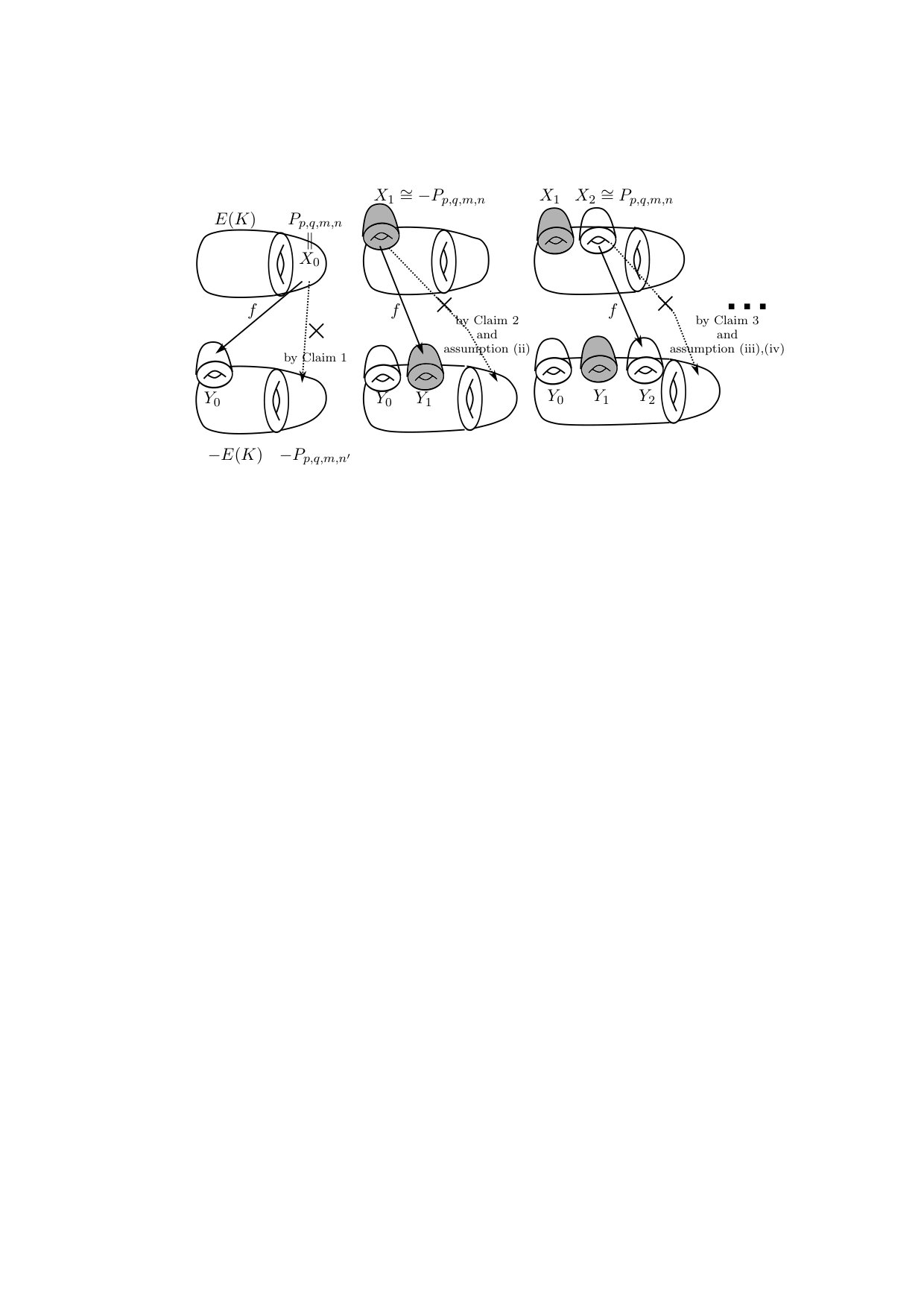 Figure 1
Peer Reviews
No public reviews on file for this paper yet. If you reviewed it on a platform where reviews are public (OpenReview, ICLR, NeurIPS, ICML), you can paste yours below so the community can read it here.
Videos
No videos yet. Explain this paper in a talk, walkthrough, or lecture? Add one.
A note on chirally cosmetic surgery on cable knots
Tetsuya Ito
Department of Mathematics, Kyoto University, Kyoto 606-8502, JAPAN
Abstract.
We show that a -cable of a non-trivial knot does not admit chirally cosmetic surgery for , or with additional assumptions. In particular, we show that -cable of non-trivial knot does not admit chirally cosmetic surgery as long as the JSJ piece of knot exterior does not contain -torus exterior. We also show that an iterated torus knot other than -torus knot does not admit chirally cosmetic surgery.
Key words and phrases:
2010 Mathematics Subject Classification:
Primary 57M25, Secondary 57M27
1. Introduction
Let be the Dehn surgery along a knot in of slope . Two Dehn surgeries and are purely cosmetic (resp. chirally cosmetic) if (resp. ). Here for an oriented 3-manifold we denote by the same 3-manifold with opposite orientation, and means that they are orientation preservingly homeomorphic.
It is expected that a non-trivial knot in does not have purely cosmetic surgeries (cosmetic surgery conjecture [Ki, Problem 1.81 (A)]), whereas there are two families of chirally cosmetic surgeries on non trivial knots;
- (a)
For amphicheiral knot , .
- (b)
for -torus knot we have for any .
Since currently no other examples of chirally cosmetic surgery of knots in are known, one encounters a natural question.
Question 1**.**
Is chirally cosmetic surgery of knots in either (a) or (b) ?
At first glance this may sound too optimistic since there are several unexpected phenomenon or clever constructions which negate naive conjectures on Dehn surgeries. Moreover, when we extend our attention to knots in general 3-manifolds , there are more examples of chirally cosmetic surgeries which are not generalizations of above examples (a) and (b) [BHW, IJ].
Nevertheless, recently we observed some results supporting the affirmative answer to this question [It, IIS]. In this note we show a non-existence of chirally cosmetic surgery for cable knots under some technical assumptions.
Let be the knot exterior, where denotes an open tubular neighborhood of . There is a family of essential tori (possibly empty) of such that each component of is geometric (i.e., either hyperbolic or Seifert fibered). Such a family of tori , called the JSJ tori, is unique up to isotopy when we take a minumum one. We call a connected component of the JSJ piece of .
Theorem 1**.**
Let be the -cable of a non-trivial knot . Assume that one of the following conditions are satisfied.
- (i)
.
- (ii)
, , and the JSJ piece of does not contain -torus knot exterior.
- (iii)
, and the JSJ piece of does not contain -torus knot exterior for any .
- (iv)
, and .
Then does not admit chirally cosmetic surgeries.
Here is the coefficient of for the Conway polynomial . We remark that in our notation the cable of is defined so that it has wrapping number ; intersects with at points.
We mention that a non-existence of purely cosmetic surgery of cable knots are shown in [Ta]. Although there are many similarities we do not use this result. Indeed, a mild modification of the proof of Theorem 1 proves a non-existence of purely cosmetic surgery on cable knots.
In a light of an example (b) of chirally cosmetic surgery and Theorem 1, one may think that an iterated torus knot is a possible candidate for new chirally cosmetic surgeries. However, we show that iterated torus knots does not admit chirally cosmetic surgery.
Theorem 2**.**
An iterated torus knot which is not a -torus knot does not admit chirally cosmetic surgeries.
Acknowledgement
The author has been partially supported by JSPS KAKENHI Grant Number 19K03490,16H02145. He is grateful to Kazuhiro Ichihara for invaluable comments and discussions.
2. Dehn surgery of cable knots
For a torus boundary component of a 3-manifold , a slope (on ) is an isotopy class of a non-trivial unoriented simple closed curve on . We take an ordered basis of to identify the set of slopes with ; We view as an oriented simple closed curve by taking one of its orientation, its homology class is written by for coprime integers and . Then we assign the slope a rational number (note that and depend on a choice of orientation, whereas does not).
In a case of knot complement , we take the standard meridian-longitude pair as an ordered basis of . The -surgery on is the 3-manifold obtained from by attaching the solid torus along so that the slope bounds a disk in the attached solid torus.
The torus knot is a slope curve on a boundary of the standardly embedded solid torus in , with respect to the basis of . Thus in our convention the -torus knot is the closure of the -braid . In the following, we will often view as a knot in the solid torus .
The -cable of the knot is the image of the standard torus knot , where is a homeomophism such that , and denotes the closure of . Since if , in the following we always assume that .
By [Go], the Dehn surgery along cable knot is described as follows;
[TABLE]
In the last case is a Seifert fibered space with base surface having two singular fibers, glued along the boundary of . Moreover is a JSJ piece of .
In the following we prove Theorem 1 by dividing arguments into the following four cases, according to and .
- Case 1:
(Lemma 1)
- Case 2:
(Lemma 2).
- Case 3:
, (Lemma 3).
- Case 4:
(Lemma 4).
It is Case 4 where we use additional assumptions (i)–(iv).
Before starting discussions, we review some known results on chirally cosmetic surgery which will be used in the argument.
A knot is an L-space knot if a Dehn surgery on yields an L-space. For an L-space knot , its Alexander polynomial , normalized so that and hold, is of the form
[TABLE]
for some [OS1, Corollary 1.3]. From this property, we have the following.
Proposition 1**.**
If is an L-space knot which is not unknot, .
Proof.
The coefficient of of the Conway polynomial is given by
[TABLE]
∎
The relevance of L-space knots and (chirally) cosmetic surgery comes from the following result.
Theorem 3**.**
[OS2*, Theorem 1.6]**
If with , then is an L-space knot.*
Then we turn to the proof of Theorem 1.
Lemma 1**.**
If then .
Proof.
is reducible but is irreducible whenever [Sc]. Hence they are not homeomorphic. ∎
Lemma 2**.**
If then .
Proof.
We may assume that and hence . Therefore we have and consequently and , or, and . We consider the former case and . The latter case is similar.
Since and , we have a chirally cosmetic surgery on the knot
[TABLE]
Since , i.e., the sign of two surgery slopes are the same, by Theorem 3 is an L-space knot. Hence by Proposition 1.
On the other hand, by the surgery formula of Casson-Walker invariant [Wa], we have
[TABLE]
here denotes the Dedekind sum. Since the Dedekind sum has the properties
[TABLE]
. Since we have
[TABLE]
This is a contradiction. ∎
Lemma 3**.**
If and then .
Proof.
Let be the number of JSJ tori of , and let be the JSJ piece of that contains . When is hyperbolic, the simplicial volume of its exterior satisfies . Since the simplicial volume strictly decreases under Dehn fillings when it is non-zero,
[TABLE]
On the other hand,
[TABLE]
we conclude .
When is Seifert fibered, has at most essential tori whereas contains essential tori so they are not homeomorphic. ∎
To treat Case 4, we give a more precise description of the Seifert fibered piece and how is attached to .
In the following we use Hatcher’s notation for Seifert fibered manifold [Ha]. For a compact oriented surface with genus and boundary components , let where are disjoint disks. Let be the circle bundle over with orientable total space. By taking a cross section we identify the total space with . For each torus boundary component of we have a canonical ordered basis given by which we call a section-regular fiber basis. is a 3-manifold obtained by attaching tori along each torus boundary so that the slope bounds a disk.
Let be the cable space, the complement of the regular neighborhood of the torus knot in a solid torus . We fix integers so that . With a suitable choice of section the cable space is identified with .
Besides a section-regular fiber basis, the boundaries of has another natural ordered basis. Let . By viewing as usual torus knot lying in , we have the standard meridian-longitude basis of . In terms of the meridian-longitude basis, the section-regular fiber basis is written by
[TABLE]
Since , we have an identification
[TABLE]
For we have a natural basis of which we call outer torus basis. In terms of the section-regular fiber basis , the outer torus basis is written by
[TABLE]
By definition of cabling, the exterior is glued to by the homeomorphism such that and .
Lemma 4**.**
Assume that one of the following conditions are satisfied.
- (i)
.
- (ii)
, , and the JSJ piece of does not contain -torus knot exterior.
- (iii)
, and the JSJ piece of does not contain -torus knot exterior for any .
- (iv)
, and .
Then for with , .
Proof.
Assume, to the contrary that so there is an orientation preserving homeomorphism .
By isotopy we assume that induces homeomorphisms of JSJ pieces. By the assumption , and have distinguished JSJ piece and . Let , and .
Claim 1**.**
.
Proof.
Assume to the contrary that so induces an orientation reversing homeomorphism . By uniqueness of Seifert fibration, sends the regular fiber of to the regular fiber of . Since is orientation reversing, it inverts the orientation of regular fiber hence we have .
On the other hand, induces an orientation reversing homeomorphism hence is amphichieral. In particular, we have .
As we have discussed, in , the outer torus basis of are identified with and , respectively. Similarly, in , the outer torus basis of are identified with and , respectively. Therefore and hence in terms of the section-regular fiber basis and of and , we have
[TABLE]
The first equation shows , which contradicts with the second equation. ∎
Thus is a JSJ piece . Hence there exists a JSJ piece of which is homeomoprhic to .
The next claim, together with our assumption (ii), shows that such a JSJ piece cannot be send to .
Claim 2**.**
Let be a JSJ piece of which is homeomorphic to . If , then and is homeomoprhic to -torus knot exterior. Moreover, is an L-space knot.
Proof of Claim 2.
Since is a Seifert fibered space with disk base and two singular fibers that appears as a JSJ piece of the knot exterior , is homeomorphic to the torus knot exterior for some . We fix integers so that . If ,
[TABLE]
Thus we may assume that we have , , and that there are integers such that
[TABLE]
In particular we have
[TABLE]
Since , we have . By (2.1), and are coprime hence we have . Consequently, we get , , and
[TABLE]
Then (2.1) is written by
[TABLE]
So we have hence . If , we have so . Moreover, means that the signs of surgery slopes and are the same hence is an L-space knot by Theorem 3.
If , we have so . Then we have so it contradicts the assumption.
∎
Thus is a JSJ piece of . Hence we have a JSJ piece of which is homeomoprhic to . The next claim, similar to Claim 2, together with the assumptions (iii) and (iv) shows that such a JSJ piece cannot be send to , either.
Claim 3**.**
Let be a JSJ piece of which is homeomorphic to . If then , and . Moreover is homeomoprhic to -torus knot exterior.
Proof of Claim 3.
As in Claim 2, is homeomorphic to the torus knot exterior for some coprime and we have
[TABLE]
Here are integers chosen so that . We may assume that , , .
We have either or . In the latter case we also have so in both cases we always have . Since we have so .
On the other hand, there is an integer such that so we have . This implies that and are coprime so we have . Consequently, hence .
By comparing Seifert invariants, we have integers such that
[TABLE]
so we have . Consequently, we have so . Thus .
Also, by we have . This shows that . By the Casson-Walker invariant we have
[TABLE]
we have
[TABLE]
Since because this implies , we have . On the other hand, since we have . Thus .
∎
Therefore appears as a JSJ piece of hence we have a JSJ piece of which is homeomoprhic to .
Then we repeat the argument; for each , we have a JSJ piece which is homeomorphic to (if is odd) or (if is even). Then by assumption of lemma and Claim 2 (if is odd) or Claim 3 (if is even), we see that hence gives a new JSJ piece of . This means that we find a new JSJ piece in , homeomorphic to (if is even) or (if is odd) (see Figure 1 below for a schematic illustration). Thus contains infinitely many JSJ piece, which is absurd.
∎
3. Iterated cables
For a sequence of coprime integers with and a knot , we define an iterated cable inductively by
[TABLE]
When is the unknot , the iterated cable is called the iterated torus knot.
We prove a theorem which is slightly general than Theorem 2, by adding more arguments to Lemma 4.
Theorem 4**.**
Let be a non-satellite knot. Then an iterated cable for does not admit chirally cosmetic surgery.
Proof of Theorem 4.
An iterated cable of torus knot is an iterated torus knot so we may assume that is either hyperbolic or unknot. We put , and view the iterated cable as , the -cable of the iterated cable .
The JSJ decomposition of is given by
[TABLE]
if is unknot, and
[TABLE]
otherwise (i.e., is hyperbolic). When is hyperbolic, no JSJ piece of is homeomorphic to the torus knot exterior so by Theorem 1, does not admit chirally cosmetic surgery. Thus we assume that is an iterated torus knot. Since the classification of chirally cosmetic surgery of torus knots are known [IIS, Ro], in the following we assume that is not a torus knot.
Assume, to the contrary that so there is an orientation preserving homeomorphism . By Lemma 1, 2, 3, hence .
By isotopy we assume that induces homeomorphisms of JSJ pieces. By Claim 1 in Lemma 4, is a JSJ piece of . Since the cable space has two boundary components whereas the boundary of is connected, we have . Since is a JSJ piece of other than , we have . This shows that gives an orientation homeomorphism
[TABLE]
By Claim 2 in Lemma 4, we have and is an L-space knot. On the other hand, by [Hom] an iterated torus knot is an L-space knot implies that has the same sign. This is a contradiction. ∎
The reference list from the paper itself. Each links out to its DOI / PubMed record.
- 1[BHW] S. Bleiler, C. Hodgson and J. Weeks, Cosmetic surgery on knots, in Proceedings of the Kirbyfest (Berkeley, CA, 1998) , 23–34 (electronic), Geom. Topol. Monogr., 2, Geom. Topol. Publ., Coventry.
- 2[Go] C. Gordon, Dehn surgery and satellite knots, Trans. Amer. Math. Soc, 275 (1983), 687–708.
- 3[Ha] A. Hatcher, Notes on basic 3-manifold topology, https://pi.math.cornell.edu/~hatcher/3M/3Mdownloads.html
- 4[Hom] J. Hom, A note on cabling and L-space surgeries, Algebr. Geom. Topol. 11 (2011) 219–223.
- 5[IIS] K. Ichihara, T. Ito and T.Saito, Chirally cosmetic surgeries and Casson invariants, preprint.
- 6[IJ] K. Ichihara and I.D. Jong, with an appendix by H. Masai Cosmetic banding on knots and links, Osaka J. Math. 55 (2018), 731–745.
- 7[It] T. Ito, On LMO invariant constraints for cosmetic surgery and other surgery problems for knots in S 3 superscript 𝑆 3 S^{3} , Comm. Anal. Geom. to appear.
- 8[Ki] R. Kirby (ed.) Problems in low-dimensional topology, AMS/IP Stud. Adv. Math., 2.2, Geometric topology (Athens, GA, 1993), 35–473, Amer. Math. Soc., Providence, RI, 1997.