Non-Minimal Flavour Violation in $A_4\times SU(5)$ SUSY GUTs
Samuel J. Rowley, Jordan Bernigaud, Bj\"orn Herrmann, Stephen F. King

TL;DR
This paper investigates non-minimal flavour violation in $A_4 imes SU(5)$ SUSY GUTs, emphasizing the importance of comprehensive parameter scans to understand dark matter compatibility and flavour constraints.
Contribution
It introduces a detailed analysis of CP-conserving non-minimal flavour violation in $A_4 imes SU(5)$ SUSY GUTs, highlighting the need for simultaneous parameter scans.
Findings
Dark matter can be accommodated with a light right-handed smuon near the neutralino mass.
Proper constraints require scanning all NMFV parameters together.
The study identifies regions of parameter space consistent with dark matter and flavour constraints.
Abstract
We study CP-conserving non-minimal flavour violation in inspired Supersymmetric Grand Unified Theories (GUTs), focussing on the regions of parameter space where dark matter is successfully accommodated due to a light right-handed smuon a few GeV heavier than the lightest neutralino. We find that it is necessary to scan over all NMFV parameters simultaneously in order to properly constrain the space of the model.
Click any figure to enlarge with its caption.
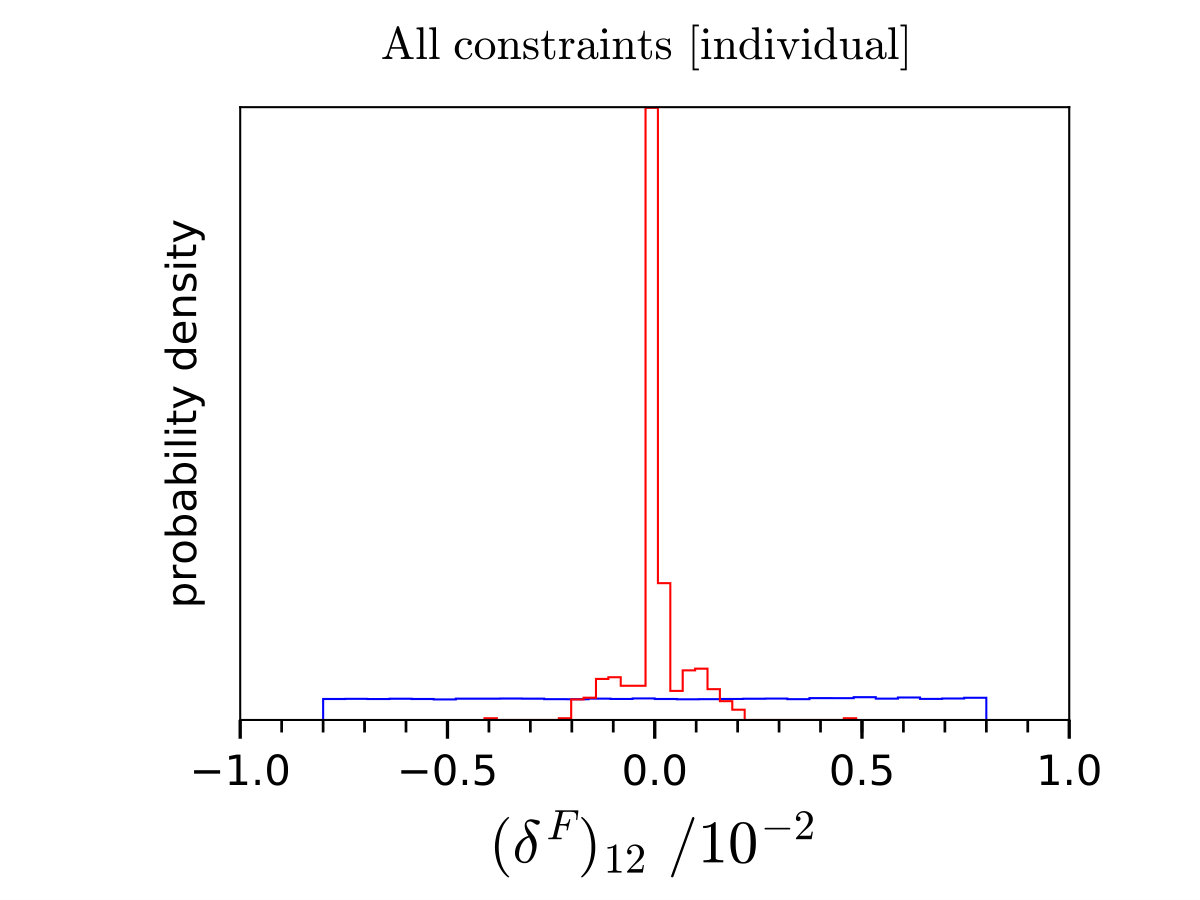 Figure 1
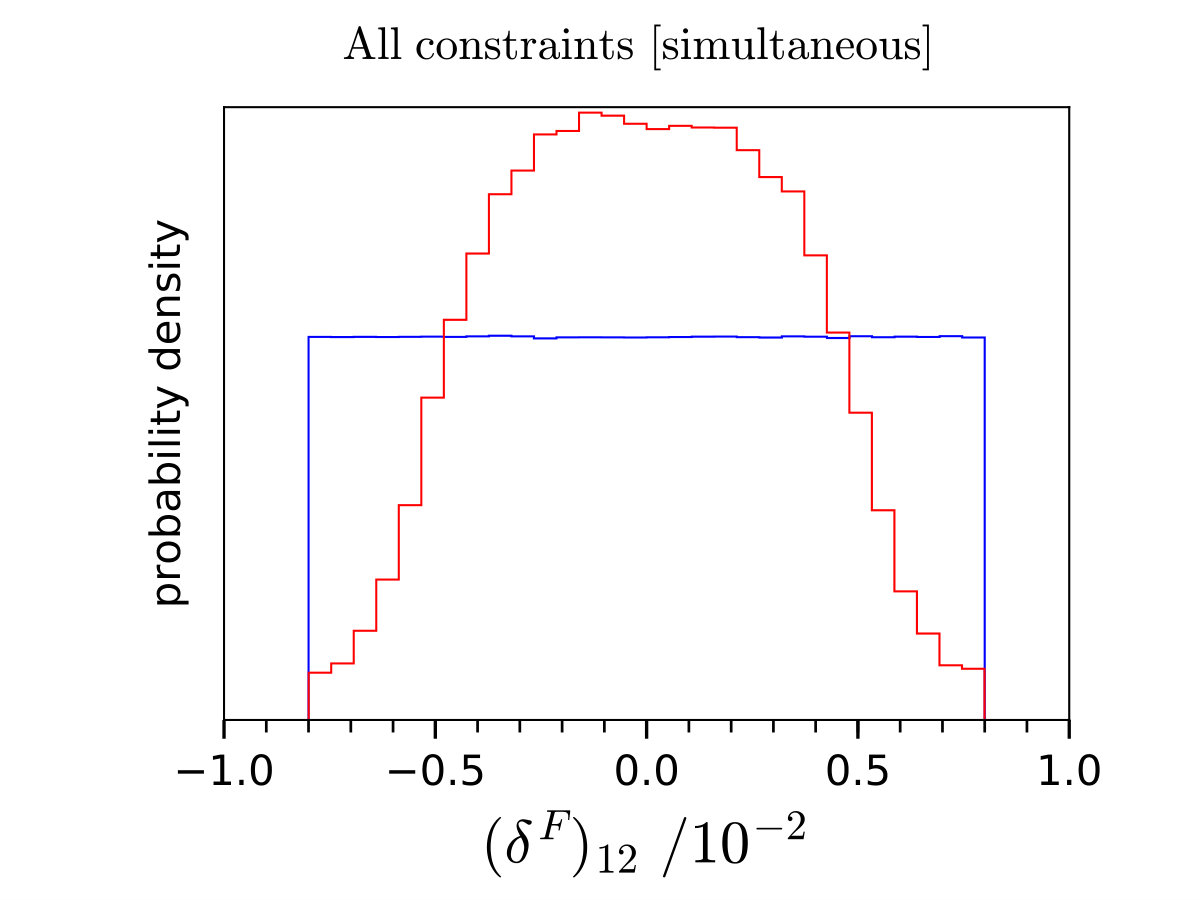 Figure 2
Peer Reviews
No public reviews on file for this paper yet. If you reviewed it on a platform where reviews are public (OpenReview, ICLR, NeurIPS, ICML), you can paste yours below so the community can read it here.
Videos
No videos yet. Explain this paper in a talk, walkthrough, or lecture? Add one.
Taxonomy
TopicsParticle physics theoretical and experimental studies · Computational Physics and Python Applications · Dark Matter and Cosmic Phenomena
\newfloatcommand
capbtabboxtable[][\FBwidth]
Non-Minimal Flavour Violation in SUSY GUTs
Samuel J. Rowley1111Speaker, contribution to the 2019 EW session of the 54th Rencontres de Moriond
Jordan Bernigaud2
Björn Herrmann2
Stephen F. King1
1School of Physics and Astronomy, Univerisity of Southampton, Southampton, SO17 1BJ, UK
2Univ. Grenoble Alpes, USMB, CNRS, LAPTh, 9 Chemin de Bellevue, F-74000 Annecy, France
Email:[email protected]
Abstract
In these proceedings, we study CP-conserving non-minimal flavour violation in inspired Supersymmetric Grand Unified Theories (GUTs), focussing on the regions of parameter space where dark matter is successfully accommodated due to a light right-handed smuon a few GeV heavier than the lightest neutralino. We find that it is necessary to scan over all NMFV parameters simultaneously in order to properly constrain the space of the model.
1 Introduction
Despite the absence of experimental evidence, supersymmetric (SUSY) extensions continue to provide attractive solutions to shortcomings of the Standard Model (SM); they cure the hierarchy problem related to the Higgs mass and lead to a more precise gauge-coupling unification as compared to the SM, and can give viable dark matter candidates.
Non-observation of SUSY may to some extent be moderated by the argument that current direct searches rely on specific assumptions. Moreover, as superpartner mass bounds increase, assuming the Minimal Flavour Violation (MFV) paradigm postulating that all flavour-violating interactions are related to the CKM- and PMNS-matrices only, may be relaxed without violating experimental limits. Allowing for additional sources of flavour violation leads to a modification of superpartner decay patterns, hence the obtained mass limits may be weakened [1]. It appears that a considerable region of the parameter space of the TeV-scale Minimal Supersymmetric Standard Model (MSSM) can accomodate such Non-Minimal Flavour Violation (NMFV) in the squark sector with respect to current experimental and theoretical constraints [2, 3].
The goal of this study constrain the NMFV framework of a known model [4] by introducing off-diagonal squark and slepton mass-squared terms in the Lagrangian at GUT scale, motivated by analyses [5, 6] which show that such flavour violation is generically expected. Here, we take a phenomenological approach, and simply introduce flavour violating terms at high energy to explore their effect on low scale observables.
2 Non-Minimal Flavour Violation
2.1 Flavour in SUSY-Breaking
It is well known that Supersymmetry (SUSY) must be broken to some degree. The associated SUSY-breaking Lagrangian contains all terms which do not necessarily respect SUSY but hold to the tenets of gauge invariance and renormalisability. In the MSSM, this reads:
[TABLE]
While the soft mass and trilinear parameters appearing in Eq. (1) are assumed to be diagonal matrices in flavour space within the MFV framework, they may comprise non-diagonal entries when relaxing this hypothesis and considering a NMFV scenario. It is convenient to parametrize flavour violation in a dimensionless manner by normalising to respective diagonal entries of the sfermion mass matrices;
[TABLE]
with and being the vacuum expectation values of the up- and down-type Higgs doublets, respectively.
2.2 The Model
We impose and symmetries at the GUT scale. To this end, we unify the three families of the usual into the triplet of leading to a unified soft mass parameter for the three generations. Families of are singlets of , and each generation may have an independent soft parameter , , [5].
Breaking forces off-diagonal elements to be smaller than diagonal entries, providing a theoretical motivation for small-but-non-zero flavour violation in such a class of models. gives the following relationships between the dimensionless NMFV parameters in the basis before rotation to the SCKM basis, at the GUT scale:
[TABLE]
These four matrices parametrize the flavour violation in the setup studied here. Note that , and are necessarily symmetric whereas is not leading to a total of 15 NMFV parameters at the GUT scale.
It is apparent that we have flavour violation at phenomenological scales from two sources; the presence of off-diagonal elements in various coupling matrices at the GUT scale due to breaking, and further effects induced by RGE running.
3 Setup and Tools
We consider two MFV reference parameter points, one of which is inspired by a previous study of this model [4], and the other one with a heavier smuon. In both cases, we switch on off-diagonal mass terms, consistent with , arising from breaking effects.
Diagonal entries of soft matrices are fixed and NMFV parameters are entered for each point by random selection about empirically determined limits. Parameters are then handed to SPheno[7] at the GUT scale, and are run using two-loop RGEs down to low scales where data is available for comparison. Flavour phenomena as listed in table 2 are calculated using SPheno and the relic density of the lightest neutralino (our DM candidate) is calculated by a custom version of micrOMEGAs[8].
Predictions are then compared against experimental data to determine if the point under test is viable [9, 10]. In this manner of comparison, we set upper bounds on the amount of flavour violation allowed in this scenario. It is necessary to scan over all flavour violating parameters simultaneously, as to exploit hidden correlations and cancellations, and obtain accurate limits on flavour violation.
4 Results
Using the proceedure outlined above, we constrain the NMFV parameter space of this model in both reference scenarios. In figure 3, we demonstrate the importance of scanning over multiple parameters in tandem; the left panel details the result of allowing a single parameter to vary, keeping all others fixed. In such a case the posterior distribution (in red) is sharply peaked around 0, meaning that not much flavour violation is allowed.
In a stark contrast to this, the right panel of figure 3 shows a broad distribution, allowing a considerable amount of flavour violation.
For a detailed discussion of all results, we encourage the reader to consult the full paper [11].
5 Conclusion
As experiments continue to exlcude parameter space for the MSSM and other favoured minimal SUSY theories, it is important to investigate and constrain those more exotic scenarios that may include non-universal gaugino masses, compressed spectra etc. that may be able to elude conventional collider searches.
We have constrained the flavour violating parameter space of the MSSM in this specific GUT scenario. We stress that small flavour violation is a prediction of unified models that include a flavour symmetry, and as such studying how superpartners can influence various flavour violating phenomena is a critical part of testing SUSY at currently accessible scales.
Work in this area is ongoing, with an eye to enable SUSY GUT model descrimination using flavour physics and to further constrain the MSSM.
6 References
The reference list from the paper itself. Each links out to its DOI / PubMed record.
- 1[1] A. Chakraborty, M. Endo, B. Fuks, B. Herrmann, M. M. Nojiri, P. Pani and G. Polesello, Eur. Phys. J. C 78 (2018) no.10, 844 doi:10.1140/epjc/s 10052-018-6331-x [ar Xiv:1808.07488 [hep-ph]].
- 2[2] K. Kowalska, JHEP 1409 (2014) 139 doi:10.1007/JHEP 09(2014)139 [ar Xiv:1406.0710 [hep-ph]].
- 3[3] K. De Causmaecker, B. Fuks, B. Herrmann, F. Mahmoudi, B. O’Leary, W. Porod, S. Sekmen and N. Strobbe, JHEP 1511 (2015) 125 doi:10.1007/JHEP 11(2015)125 [ar Xiv:1509.05414 [hep-ph]].
- 4[4] A. S. Belyaev, S. F. King and P. B. Schaefers, Phys. Rev. D 97 (2018) no.11, 115002 doi:10.1103/Phys Rev D.97.115002 [ar Xiv:1801.00514 [hep-ph]].
- 5[5] S. Antusch, S. F. King and M. Spinrath, Phys. Rev. D 87 (2013) no.9, 096018 doi:10.1103/Phys Rev D.87.096018 [ar Xiv:1301.6764 [hep-ph]].
- 6[6] M. Dimou, S. F. King and C. Luhn, JHEP 1602 (2016) 118 doi:10.1007/JHEP 02(2016)118 [ar Xiv:1511.07886 [hep-ph]].
- 7[7] W. Porod, F. Staub and A. Vicente, Eur. Phys. J. C 74 (2014) no.8, 2992 doi:10.1140/epjc/s 10052-014-2992-2 [ar Xiv:1405.1434 [hep-ph]].
- 8[8] D. Barducci, G. Bélanger, J. Bernon, F. Boudjema, J. Da Silva, S. Kraml, U. Laa and A. Pukhov, Comput. Phys. Commun. 222 (2018) 327 doi:10.1016/j.cpc.2017.08.028 [ar Xiv:1606.03834 [hep-ph]].