TL;DR
This paper introduces an entropy-based data filtering method to improve neural conversational models by removing generic responses, leading to more diverse and engaging chatbot outputs without requiring manual annotations.
Contribution
The authors propose a simple, unsupervised entropy-based filtering technique to enhance response diversity in neural dialog models, outperforming previous methods that rely on model modifications or annotated data.
Findings
Filtered datasets produce more diverse responses.
Models trained on filtered data outperform baselines on 17 metrics.
The method is effective without human supervision.
Abstract
Current neural network-based conversational models lack diversity and generate boring responses to open-ended utterances. Priors such as persona, emotion, or topic provide additional information to dialog models to aid response generation, but annotating a dataset with priors is expensive and such annotations are rarely available. While previous methods for improving the quality of open-domain response generation focused on either the underlying model or the training objective, we present a method of filtering dialog datasets by removing generic utterances from training data using a simple entropy-based approach that does not require human supervision. We conduct extensive experiments with different variations of our method, and compare dialog models across 17 evaluation metrics to show that training on datasets filtered this way results in better conversational quality as chatbots…
Click any figure to enlarge with its caption.
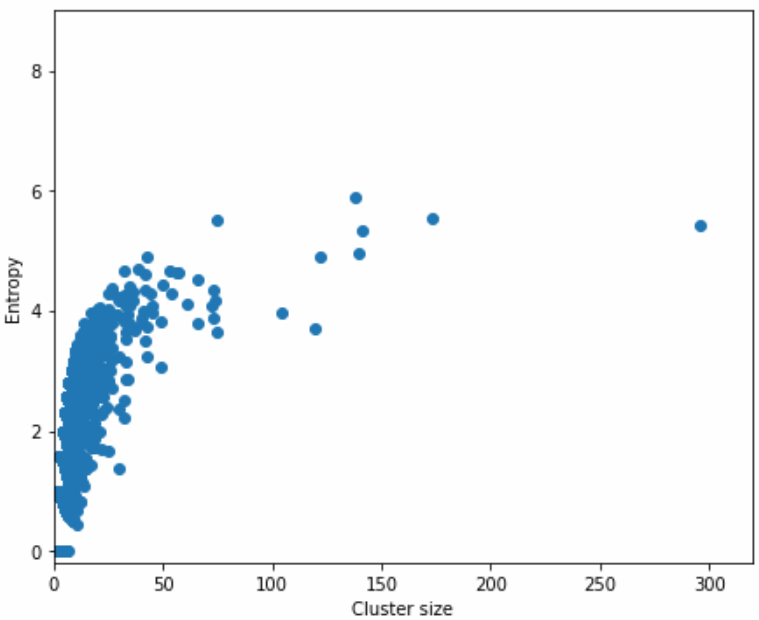 Figure 1
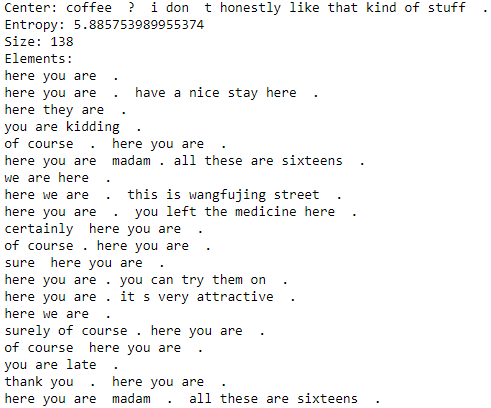 Figure 2
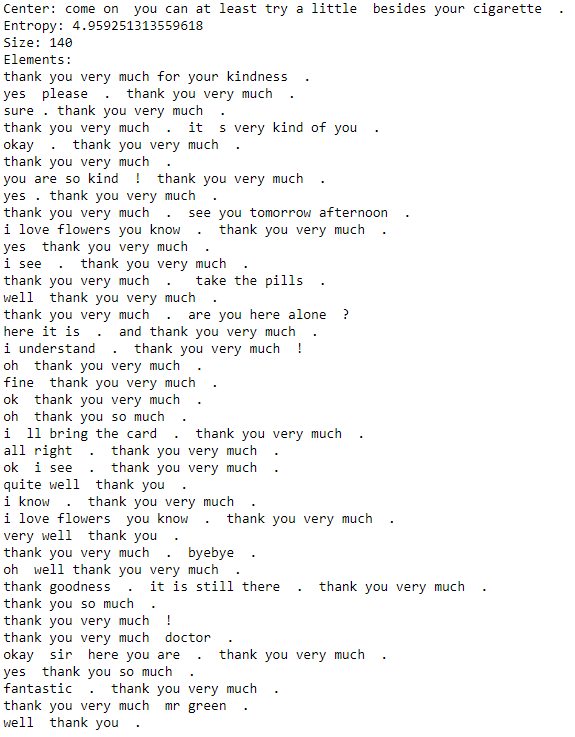 Figure 3
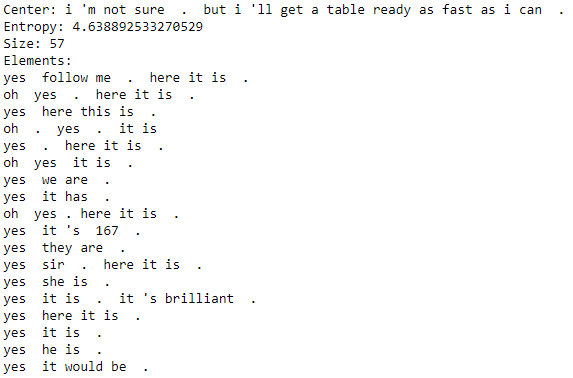 Figure 4
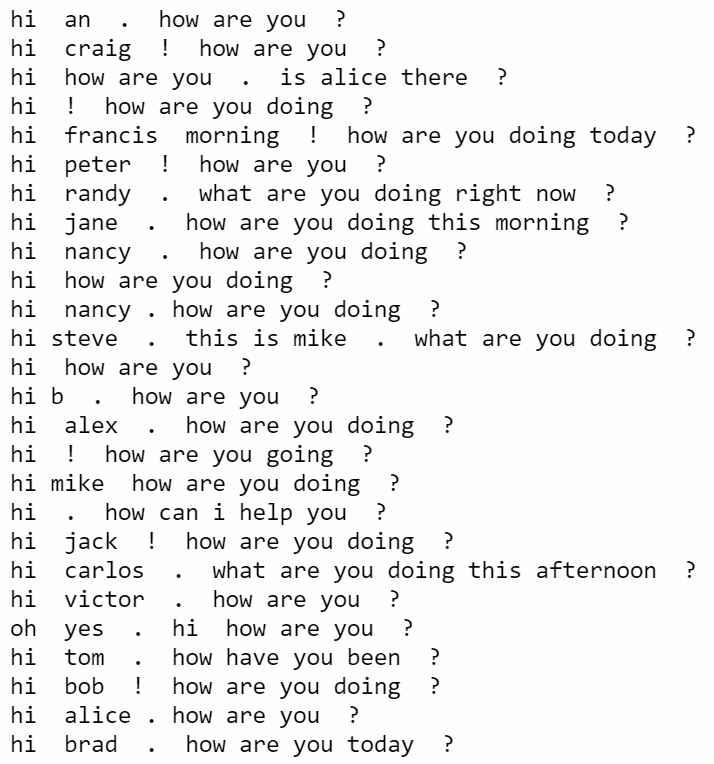 Figure 5
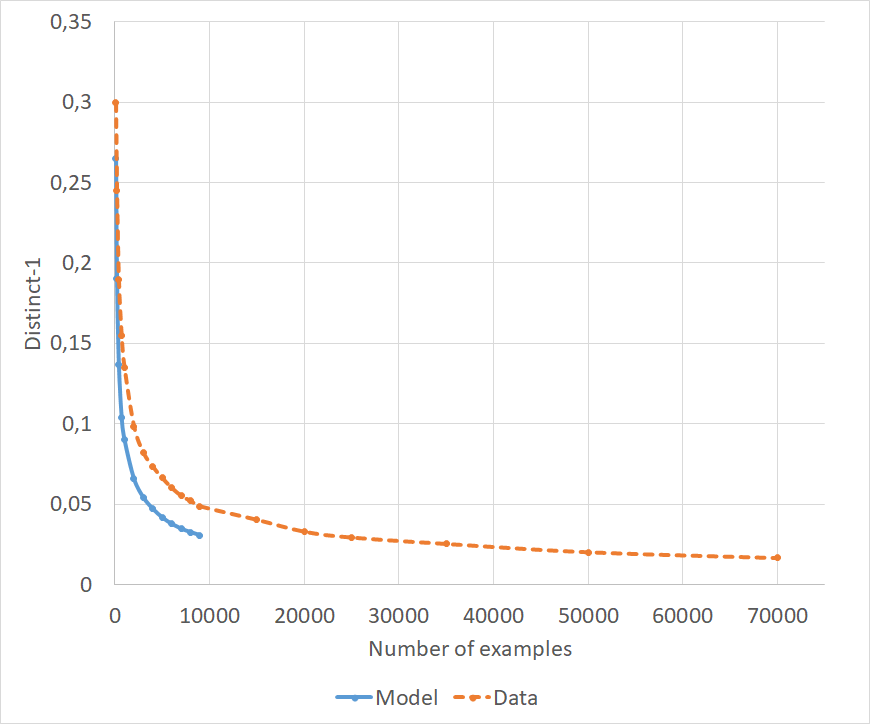 Figure 6
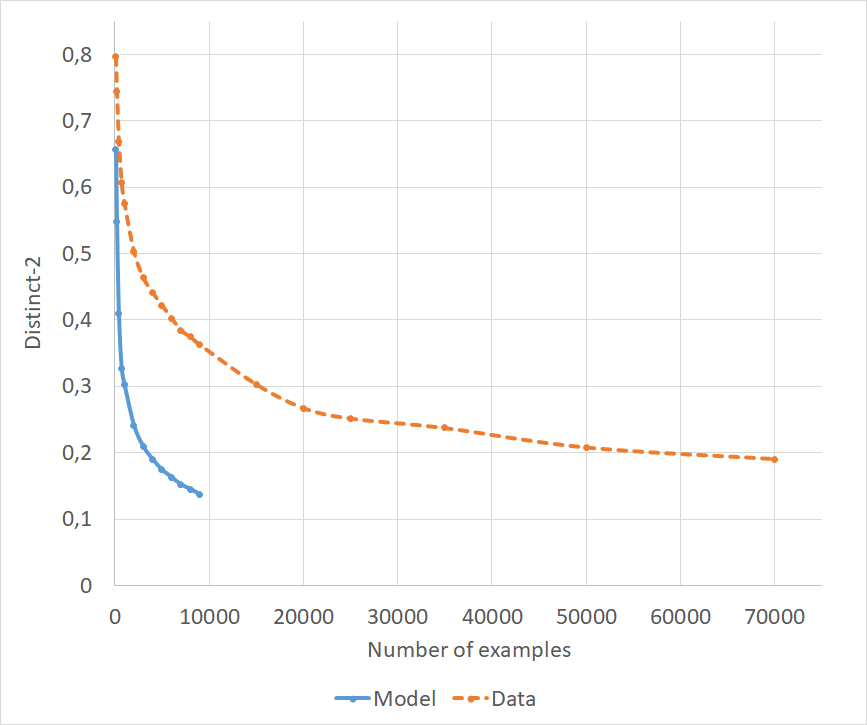 Figure 7
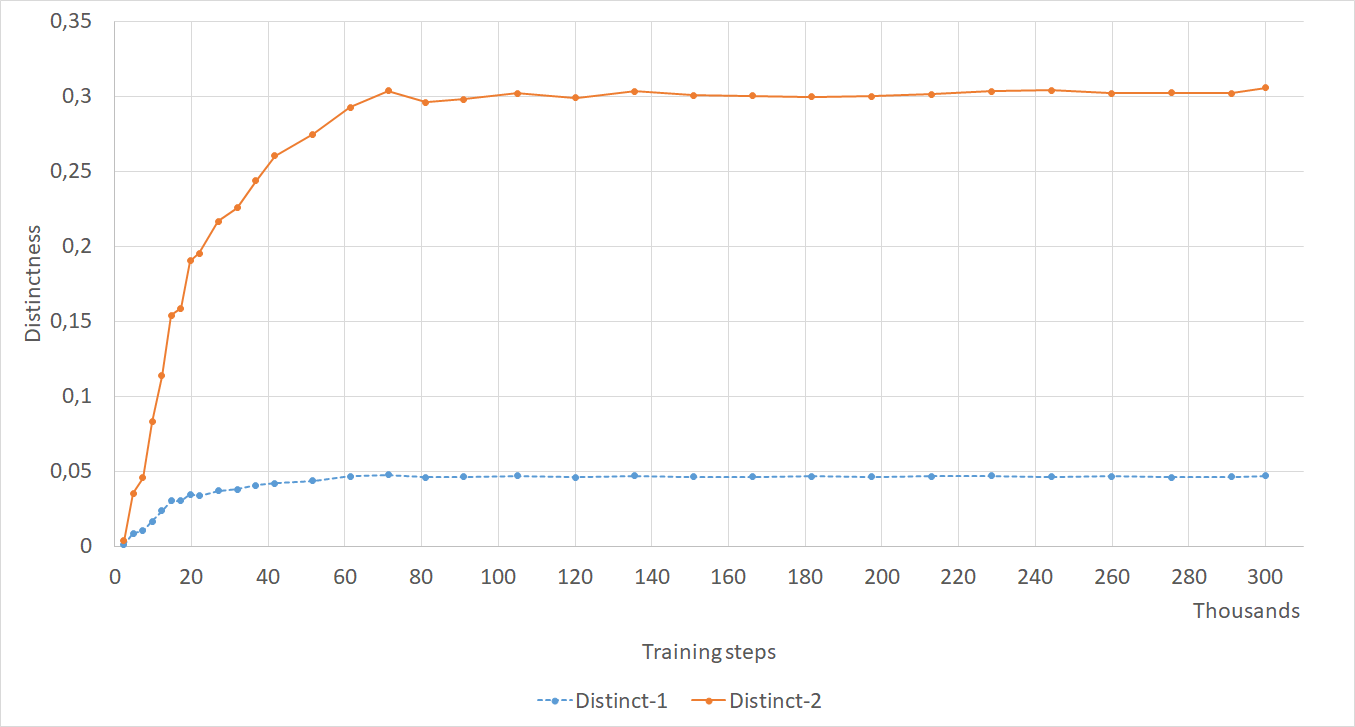 Figure 8
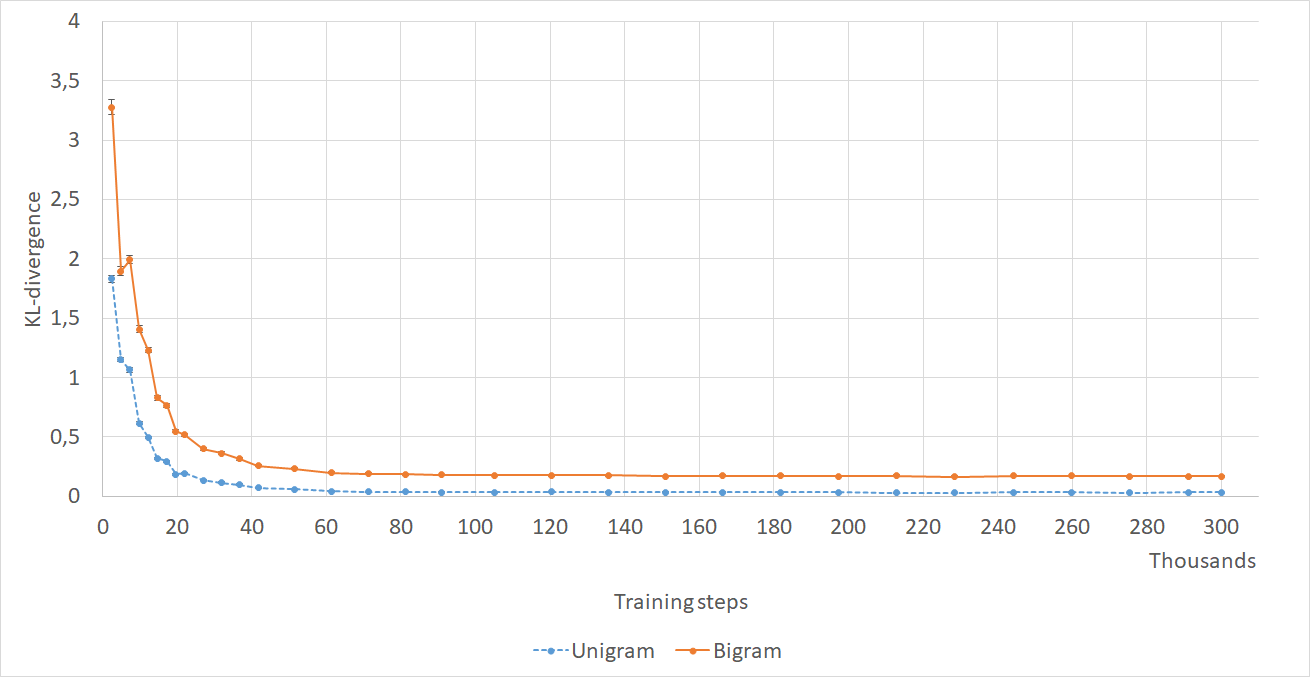 Figure 9
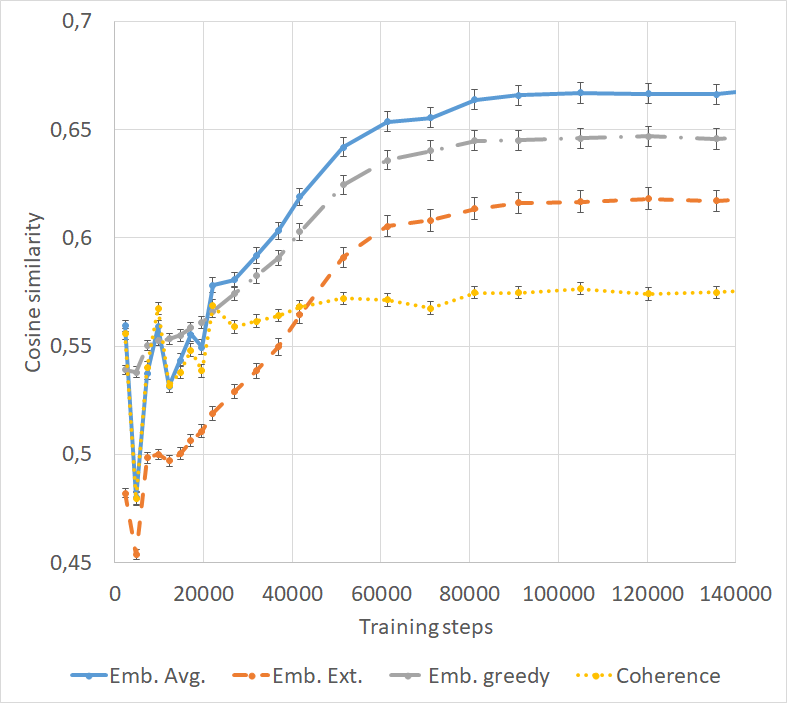 Figure 10
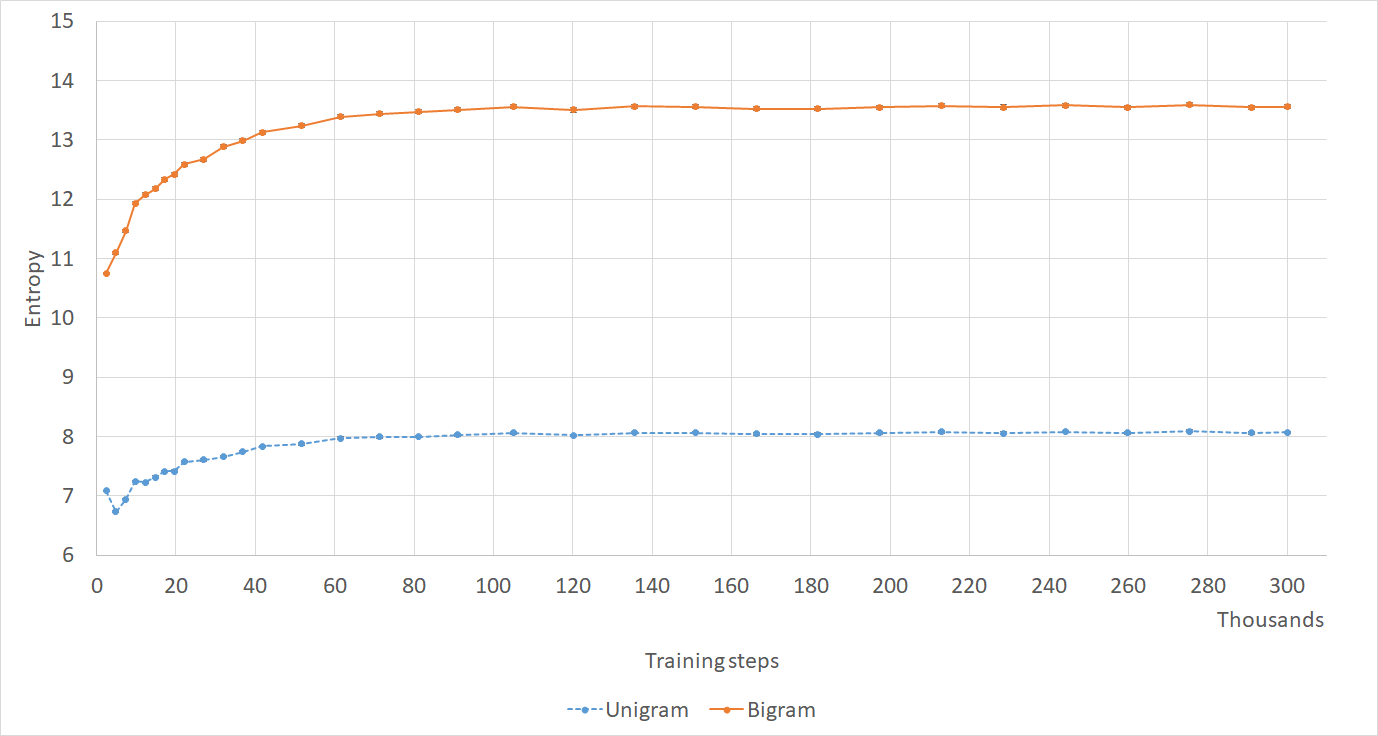 Figure 11
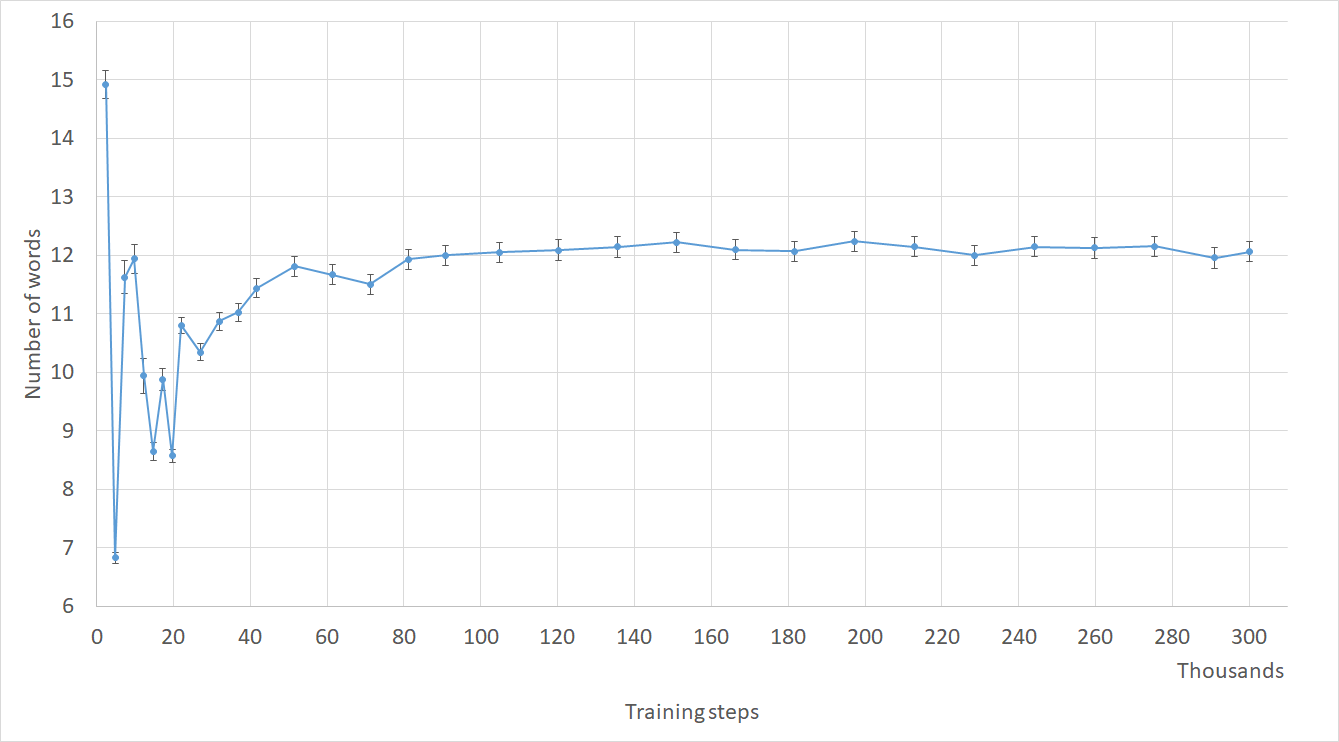 Figure 12
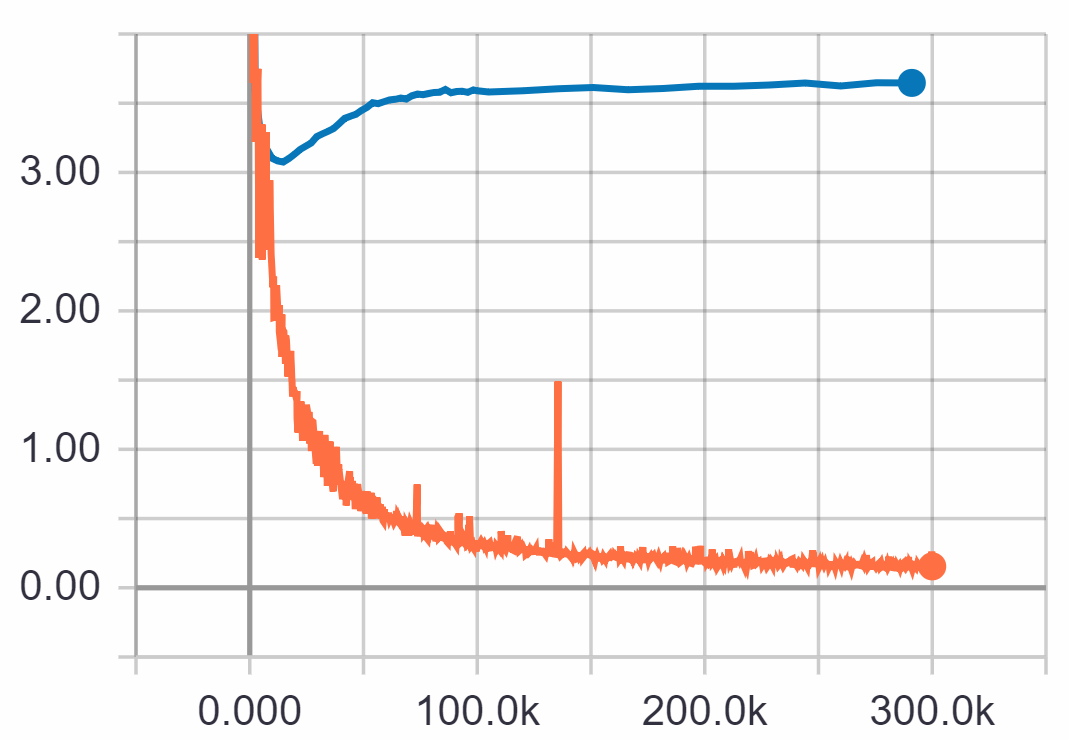 Figure 13
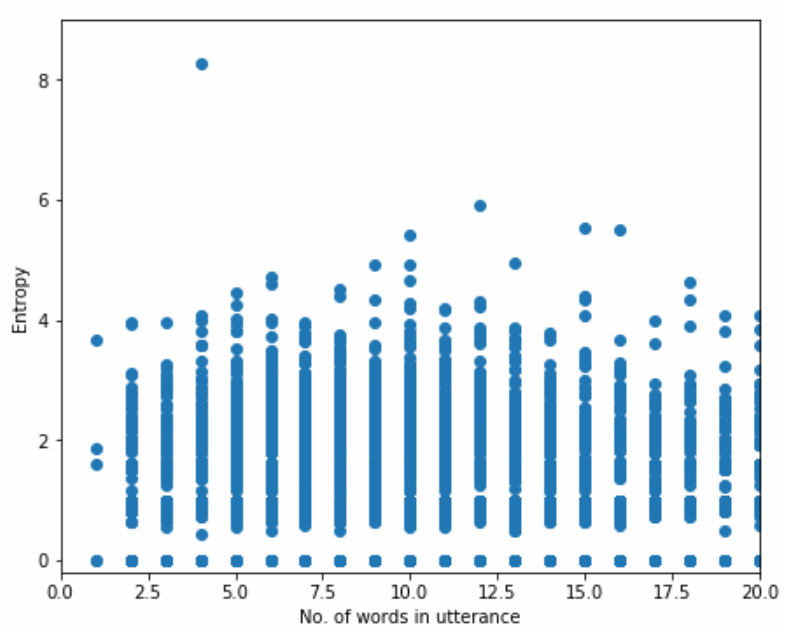 Figure 14
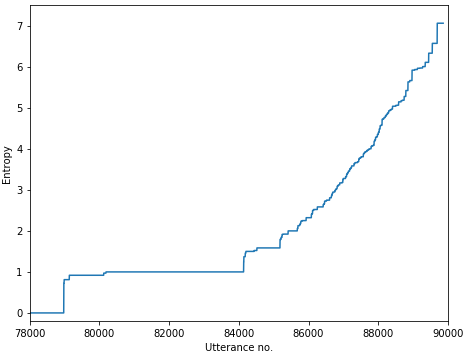 Figure 15
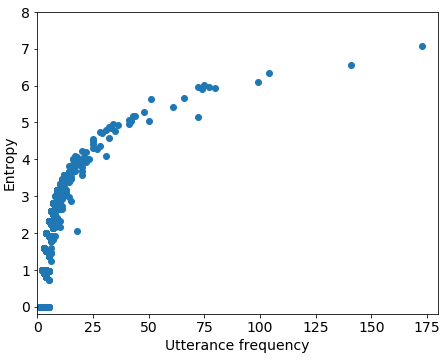 Figure 16
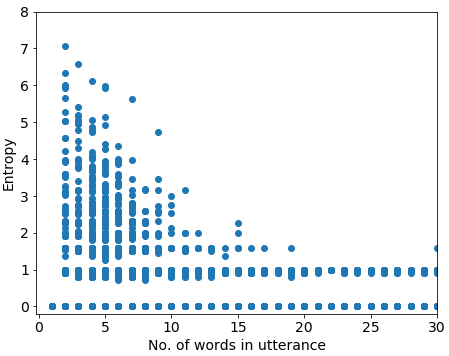 Figure 17
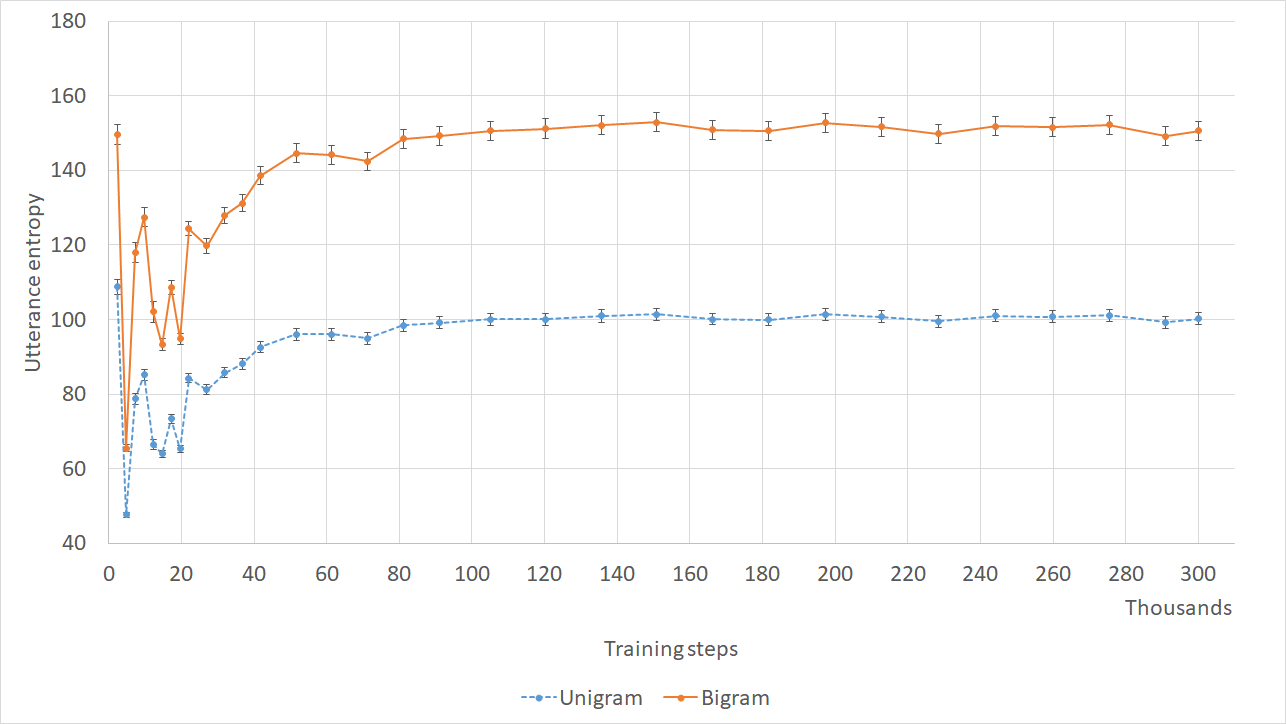 Figure 18
| Dataset | Type | Th. | source | target | both |
|---|---|---|---|---|---|
| DailyDialog | id | 1 | 5.64% | 6.98% | 12.2% |
| ae | 3.5 | 5.39% | 7.06% | 12.0% | |
| sc | 3.5 | 6.53% | 8.45% | 14.3% | |
| Cornell | id | 4 | - | 7.39% | 14.1% |
| id | 0.5 | - | 1.82% | 9.96% |
| avg | ext | gre | coh | d1 | d2 | b1 | b2 | b3 | b4 | |||||||||
|---|---|---|---|---|---|---|---|---|---|---|---|---|---|---|---|---|---|---|
| trf | 8.6 | 7.30 | 12.2 | 63.6 | 93 | .330 | .85 | .540 | .497 | .552 | .538 | .0290 | .149 | .142 | .135 | .130 | .119 | |
| ID | b | 9.8 | 7.44 | 12.3 | 71.9 | 105 | .315 | .77 | .559 | .506 | .555 | .572 | .0247 | .138 | .157 | .151 | .147 | .136 |
| t | 10.9 | 7.67 | 12.7 | 83.2 | 121 | .286 | .72 | .570 | .507 | .554 | .584 | .0266 | .150 | .161 | .159 | .156 | .146 | |
| s | 9.4 | 7.19 | 11.9 | 66.4 | 98 | .462 | 1.08 | .540 | .495 | .553 | .538 | .0262 | .130 | .139 | .133 | .128 | .117 | |
| AE | b | 7.9 | 7.25 | 12.0 | 57.7 | 83 | .447 | 1.05 | .524 | .486 | .548 | .524 | .0283 | .132 | .128 | .121 | .115 | .105 |
| t | 8.6 | 7.26 | 12.1 | 61.4 | 90 | .425 | 1.12 | .526 | .492 | .548 | .529 | .0236 | .115 | .133 | .127 | .121 | .111 | |
| s | 9.0 | 7.21 | 11.9 | 65.1 | 95 | .496 | 1.16 | .536 | .490 | .548 | .538 | .0232 | .109 | .134 | .130 | .126 | .116 | |
| SC | b | 10.0 | 7.40 | 12.3 | 72.6 | 108 | .383 | .97 | .544 | .497 | .549 | .550 | .0257 | .131 | .145 | .142 | .138 | .128 |
| t | 11.2 | 7.49 | 12.4 | 82.2 | 122 | .391 | .97 | .565 | .500 | .552 | .572 | .0250 | .132 | .153 | .153 | .152 | .142 | |
| s | 11.1 | 7.15 | 11.9 | 74.4 | 114 | .534 | 1.27 | .546 | .501 | .560 | .544 | .0213 | .102 | .144 | .139 | .135 | .125 | |
| avg | ext | gre | coh | d1 | d2 | b1 | b2 | b3 | b4 | |||||||||
| trf | 11.5 | 7.98 | 13.4 | 95 | 142 | .0360 | .182 | .655 | .607 | .640 | .567 | .0465 | .297 | .333 | .333 | .328 | .315 | |
| ID | b | 13.1 | 8.08 | 13.6 | 107 | 162 | .0473 | .210 | .668 | .608 | .638 | .598 | .0410 | .275 | .334 | .340 | .339 | .328 |
| t | 12.2 | 8.04 | 13.6 | 100 | 150 | .0335 | .181 | .665 | .610 | .640 | .589 | .0438 | .289 | .338 | .341 | .339 | .328 | |
| s | 12.3 | 7.99 | 13.5 | 101 | 153 | .0406 | .187 | .662 | .610 | .641 | .578 | .0444 | .286 | .339 | .342 | .338 | .326 | |
| AE | b | 11.9 | 7.98 | 13.5 | 98 | 147 | .0395 | .197 | .649 | .600 | .628 | .574 | .0434 | .286 | .318 | .321 | .318 | .306 |
| t | 12.5 | 7.99 | 13.5 | 102 | 155 | .0436 | .204 | .656 | .602 | .634 | .580 | .0423 | .279 | .324 | .327 | .325 | .313 | |
| s | 12.1 | 7.93 | 13.4 | 99 | 148 | .0368 | .186 | .658 | .605 | .636 | .578 | .0425 | .278 | .325 | .328 | .324 | .311 | |
| SC | b | 12.8 | 8.07 | 13.6 | 105 | 159 | .0461 | .209 | .655 | .600 | .629 | .583 | .0435 | .282 | .322 | .328 | .327 | .316 |
| t | 13.0 | 8.06 | 13.6 | 107 | 162 | .0477 | .215 | .657 | .602 | .632 | .585 | .0425 | .279 | .324 | .330 | .329 | .318 | |
| s | 12.1 | 7.96 | 13.4 | 100 | 150 | .0353 | .183 | .657 | .606 | .638 | .576 | .0443 | .286 | .331 | .333 | .329 | .317 | |
| RT | 13.5 | 8.40 | 14.2 | 116 | 177 | .0300 | .151 | .531 | .452 | .481 | .530 | .0577 | .379 | .090 | .121 | .130 | .125 | |
| GT | 14.1 | 8.39 | 13.9 | 122 | 165 | 0 | 0 | 1 | 1 | 1 | .602 | .0488 | .362 | 1 | 1 | 1 | 1 | |
| Input | Response |
|---|---|
| your starting salary is 2500 yuan a month and after you become a permanent employee it will be higher . | base: i can tell you what is the best way to find a job . |
| base-o: do you know what it is ? | |
| target: i ’m very interested in the position . | |
| target-o: that ’s very nice of you . i ’ll have to think about it . | |
| you can greatly improve your grades by always reflecting on what you can improve on . | base: i want to be a great singer . |
| base-o: i really appreciate it . thanks . | |
| target: i think i am experienced in that position . i think i would like to make a good impression . | |
| target-o: i always liked it . thank you . | |
| umm i think i would be hard to find something in that range in this area . you know the environment in the south district is the nicest . | base: what about the kitchen ? |
| base-o: what about the kitchen ? | |
| target: what about the kitchen ? | |
| target-o: what about the kitchen ? |
| avg | ext | gre | coh | d1 | d2 | b1 | b2 | b3 | b4 | |||||||||
|---|---|---|---|---|---|---|---|---|---|---|---|---|---|---|---|---|---|---|
| trf | 8.1 | 6.55 | 10.4 | 54 | 75 | 2.29 | 3.40 | .667 | .451 | .635 | .671 | 4.7e-4 | 1.0e-3 | .108 | .120 | .120 | .112 | |
| ID | b | 7.4 | 6.67 | 10.8 | 50 | 69 | 1.96 | 2.91 | .627 | .455 | .633 | .637 | 2.1e-3 | 7.7e-3 | .106 | .113 | .111 | .103 |
| t | 12.0 | 6.44 | 10.4 | 74 | 106 | 2.53 | 3.79 | .646 | .456 | .637 | .651 | 9.8e-4 | 3.2e-3 | .108 | .123 | .125 | .118 | |
| RT | 13.4 | 8.26 | 14.2 | 113 | 170 | .03 | .12 | .623 | .386 | .601 | .622 | 4.6e-2 | 3.2e-1 | .079 | .102 | .109 | .105 | |
| GT | 13.1 | 8.18 | 13.8 | 110 | 149 | 0 | 0 | 1 | 1 | 1 | .655 | 4.0e-2 | 3.1e-1 | 1 | 1 | 1 | 1 | |
| avg | ext | gre | coh | d1 | d2 | b1 | b2 | b3 | b4 | |||||||||
|---|---|---|---|---|---|---|---|---|---|---|---|---|---|---|---|---|---|---|
| trf | 20.6 | 6.89 | 11.4 | 121 | 177 | 2.28 | 3.40 | .643 | .395 | .591 | .659 | 2.1e-3 | 6.2e-3 | .0519 | .0666 | .0715 | .0693 | |
| ID | b | 20.3 | 6.95 | 11.4 | 119 | 171 | 2.36 | 3.41 | .657 | .394 | .595 | .673 | 1.2e-3 | 3.4e-3 | .0563 | .0736 | .0795 | .0774 |
| t | 29.0 | 6.48 | 10.7 | 157 | 226 | 2.68 | 3.69 | .644 | .403 | .602 | .660 | 1.4e-3 | 4.6e-3 | .0550 | .0740 | .0819 | .0810 | |
| RT | 14.0 | 9.81 | 15.9 | 136 | 171 | .05 | .19 | .681 | .334 | .543 | .695 | 8.5e-2 | 5.4e-1 | .0444 | .0751 | .0852 | .0840 | |
| GT | 14.0 | 9.78 | 15.8 | 135 | 167 | 0 | 0 | 1 | 1 | 1 | .734 | 8.1e-2 | 5.3e-1 | 1 | 1 | 1 | 1 | |
| Utterance | Frequency | Entropy |
|---|---|---|
| yes . | 173 | 7.06 |
| thank you . | 141 | 6.57 |
| why ? | 104 | 6.33 |
| here you are . | 99 | 6.10 |
| ok . | 75 | 6.00 |
| what do you mean ? | 77 | 5.97 |
| may i help you ? | 72 | 5.96 |
| can i help you ? | 80 | 5.93 |
| really ? | 74 | 5.91 |
| sure . | 66 | 5.66 |
| what can i do for you ? | 51 | 5.63 |
| why not ? | 61 | 5.42 |
| what ? | 48 | 5.27 |
| what happened ? | 44 | 5.18 |
| anything else ? | 43 | 5.17 |
| thank you very much . | 72 | 5.14 |
| what is it ? | 41 | 5.06 |
| i see . | 42 | 5.05 |
| no . | 42 | 5.04 |
| thanks . | 50 | 5.03 |
| Name | Value |
|---|---|
| Hidden size | 512 |
| Number of hidden layers | 6 |
| Label smoothing | 0.1 |
| Filter size | 2048 |
| Number of attention heads | 8 |
| Layer dropout | 0.2 |
| Relu dropout | 0.1 |
| Attention dropout | 0.1 |
| Learning rate | 0.2 |
| Learning rate warmup steps | 8000 |
| Input | Unfiltered | Unfiltered-Overfitted | identity target filtered | identity target filtered-overfitted |
|---|---|---|---|---|
| some high speed chase scene i think . | i ’m not sure . | but many things are went wrong ! | i ’m so sorry . | enough ! |
| how long is this bus ride ? | about twelve hours . | it ’s about fortyfive minutes to an hour . | it ’s about 20 minutes . | it ’s only about fortyfive minutes to an hour . |
| is that yellow bus it ? | no it ’s not far . it ’s a bit cold . | yeah . there s a new one in america . | no it ’s a yellow one . | no it ’s not very expensive these days . |
| hi mary ! what do you like to do in your spare time ? | i like playing basketball . | well i like to play the piano . | i like playing basketball . | i like playing chess . |
| let me see . we can visit the country . we have n’t done that for such a long time . | i hope so . | yes there are many famous paintings on show . i hope it ’s the nicest city in the united states . | i ’m glad to hear that . | where are your parents ? |
| thirty u . s . dollars . . . and it ’s only been used for six months . | that ’s fine . | i see . is it a long time to come to the station ? | how many months did you get there ? | what ’re two weeks ? |
| five hundred dollars altogether . | here you are . | here you are . | here is your bill . | here you are . thank you byebye . |
| look at this bridge . we will soon be crossing the thames . | yes i agree . | oh yeah . | how far is it ? | well there ’s a spanish teacher . so i ’ll often go back to the spanish museum . |
| is the furniture crafted well ? | yes it is . | yes it ’s fully furnished . | yes the furniture is right over there . | yes it ’s a furnished eatin kitchen . the furniture and the icebox are all pretty outdated . |
| where do they go ? | they ’re on the bottom floor . | i have no idea . | they re in the cabinet next to the library . | go to them department please . |
| let me pay for it . | ok . here you are . | cash credit card or debit card ? | ok . here is the money . | cash credit card or debit card ? |
| he never does and in fact he seldom communicates with him . | he is a hard job . he can also learn a lot from the government . | that ’s right . he has no children and his wife experience too . | he is a very kind of man . | yeah . he ’s a very easy teacher . |
| so you must have had a busy and enjoyable day yesterday . | yes i am . i really enjoyed it . | yes . i am very sorry i can t make it . | i will . thanks for coming . | yes . let ’s go . |
| yes . the reservation under mr . watson . | ok . | could you spell that please ? | i ’m afraid there ’s no seat in the middle of the table . | ok . would you please fill out the table ? |
| there are so many to choose from . i did n’t know you could do all of this using a card . | i see . | what ’s the best part ? | i ’m not sure . i ’ll go to the doctor and get my card right away . | you mean you do n’t have to tell me the truth ? |
| it was great ! how was your year ? | it was great . i had a great time . | my mother had a birthday party for me . | it was great . i ’m glad i did n’t like it . | it was ok . there was a lot of turbulence though . the worst thing was n’t too good ! |
| tomorrow ? no i am afraid i won t be able to . i m going on business to birmingham . | i think you are looking for a .<unk><unk>in the future . the best reason why are you want to see the results . | well there is a problem with the exchange rate . it s the same size that you have in the u . s . | you should go to the dentist . | you might want to change your plans . with the cold and wet weather that we re supposed to have tomorrow the roads are going to be rather slippery . |
| Input | Unfiltered | Unfiltered-Overfitted | identity target filtered | identity target filtered-overfitted |
|---|---|---|---|---|
| you ’re flattering me . | no . | no really . | no but you can t . | no really . i can only hear a little accent . |
| three bags and a suitcase . this is my luggage to check . | ok . i will take one . | what ’s this ? essential oil ? wow ! this is a small bag . | i ’ll put you in the bag . | ok . is this your luggage properly labelled sir ? |
| i like orange better . | what ’s your favorite flavor ? | how about drinks ? | i ’ll tell you what you ’re doing . | could i have some water ? |
| i like to watch barbie sticking her tongue out . | what ’s her figure ? | oh she ’s a pretty woman . | you are not supposed to be serious . | oh shut up ! she ’s not what you are thinking about . |
| if you give us your inquiry i shall go very carefully into the price and try my best to put you on the best of the terms . | ok . i will take it . | thank you very much . we will try our best to do our best to help you . | i understand . i understand that you are right . | ok i will . i look forward to it . |
| ok . any time on friday will be ok with me . | ok . see you then . | i think so . | i ’ll be expecting you then . | great ! |
| no wonder you can control your voice so well . you are a professional singer . | i am not a singer . | i would n’t mind a position that would be great . | i am a singer . i think i can be a singer in the lead . | i would n’t like to be a singer but i love to sing that dream . |
| when can i get high speed internet installed ? | you can make a list of the company and make sure that you do n’t have to use the machine . | you ’ll need to make an appointment before the company starts . | you can get up at the airport and you ’ll have to make an appointment . | you ’ll have to make an appointment before we can come in and install it . |
| i like those kinds of programmes too . they re very informative . i think that many people underrate the education value of tv . | i agree . people often criticize tv for showing too much sex and violence . | i agree . people often criticize tv for showing too much sex and violence . | i think that teenagers should be often become addicted and violence . | i agree . people often criticize tv for showing too much sex and violence . |
| can you tell that i m excited ? | i m afraid i m not a child . | i m a fashion designer . next month i have a fashion show . | i m not sure . what do you want to know ? | i m sure that i ll cook the same for you . |
| would you like to have a shampoo sir ? | yes i ’d like a glass of iced tea . | no thank you . | no i ’d rather have it with me . | yes with the lux dandruff shampoo . it helps a lot to get rid of my dandruff . |
| what else would i prepare sir ? | you can bring your beef with your chicken and a bottle of wine . | oh good ! can you make some recommendation for me ? | well the interviewers are not interested in the position . | let me see . everything looks fine . |
| he always says i am a hard worker with consciousness of responsibility sufficient education and enough experience . | i think that maybe you are right . | what s the matter with you ? | how many years of experience will you earn ? | would you like to work in the finance department ? |
| what made you think that ? | i like it a lot . | i love that shirt on you . | i think it ’s great . i think i ve learned a lot from different countries . | i will care for it . |
| i can tell you what bus to catch but you have to walk a little bit . | i do n’t know . | tell me how to get a ticket and a student bus station . | i ’m sorry but i do n’t have to wait . | you ’re going to have a car . |
Peer Reviews
No public reviews on file for this paper yet. If you reviewed it on a platform where reviews are public (OpenReview, ICLR, NeurIPS, ICML), you can paste yours below so the community can read it here.
Code & Models
Videos
No videos yet. Explain this paper in a talk, walkthrough, or lecture? Add one.
Improving Neural Conversational Models
with Entropy-Based Data Filtering
Richard Csaky
Department of Automation and Applied Informatics
Budapest University of Technology and Economics
\ANDPatrik Purgai
Department of Automation and Applied Informatics
Budapest University of Technology and Economics
&Gabor Recski
Apollo.AI
Abstract
Current neural network-based conversational models lack diversity and generate boring responses to open-ended utterances. Priors such as persona, emotion, or topic provide additional information to dialog models to aid response generation, but annotating a dataset with priors is expensive and such annotations are rarely available. While previous methods for improving the quality of open-domain response generation focused on either the underlying model or the training objective, we present a method of filtering dialog datasets by removing generic utterances from training data using a simple entropy-based approach that does not require human supervision. We conduct extensive experiments with different variations of our method, and compare dialog models across 17 evaluation metrics to show that training on datasets filtered this way results in better conversational quality as chatbots learn to output more diverse responses.
1 Introduction
Current open-domain neural conversational models (NCM) are trained on pairs of source and target utterances in an effort to maximize the likelihood of each target given the source Vinyals and Le (2015). However, real-world conversations are much more complex, and a plethora of suitable targets (responses) can be adequate for a given input. We propose a data filtering approach where the “most open-ended” inputs - determined by calculating the entropy of the distribution over target utterances - are excluded from the training set. We show that dialog models can be improved using this simple unsupervised method which can be applied to any conversational dataset. We conduct several experiments to uncover how some of the current open-domain dialog evaluation methods behave with respect to overfitting and random data. Our software for filtering dialog data and automatic evaluation using 17 metrics is released on GitHub under an MIT license111github.com/ricsinaruto/NeuralChatbots-DataFiltering222github.com/ricsinaruto/dialog-eval. This paper exists in poster333https://bit.ly/2Myu060 and blog post444https://bit.ly/2T1JJMk form as well.
2 Background
Most open-domain NCMs are based on neural network architectures developed for machine translation (MT, Sutskever et al. (2014); Cho et al. (2014); Vaswani et al. (2017)). Conversational data differs from MT data in that targets to the same source may vary not only grammatically but also semantically Wei et al. (2017); Tandon et al. (2017): consider plausible replies to the question What did you do today?. Dialog datasets also contain generic responses, e.g. yes, no and i don’t know, that appear in a large and diverse set of contexts Mou et al. (2016); Wu et al. (2018). Following the approach of modeling conversation as a sequence to sequence (seq2seq, Sutskever et al. (2014)) transduction of single dialog turns, these issues can be referred to as the one-to-many, and many-to-one problem. seq2seq architectures are not suited to deal with the ambiguous nature of dialogs since they are inherently deterministic, meaning that once trained they cannot output different sequences to the same input. Consequently they tend to produce boring and generic responses Li et al. (2016a); Wei et al. (2017); Shao et al. (2017); Zhang et al. (2018a); Wu et al. (2018).
Previous approaches to the one-to-many, many-to-one problem can be grouped into three categories. One approach involves feeding extra information to the dialog model such as dialog history Serban et al. (2016); Xing et al. (2018), categorical information like persona Li et al. (2016b); Joshi et al. (2017); Zhang et al. (2018b), mood/emotion Zhou et al. (2018); Li et al. (2017c), and topic Xing et al. (2017); Liu et al. (2017); Baheti et al. (2018), or through knowledge-bases Dinan et al. (2019); Ghazvininejad et al. (2018); Zhu et al. (2017); Moghe et al. (2018). A downside to these approaches is that they require annotated datasets which are not always available, or might be smaller in size. Augmenting the model itself, with e.g. latent variable sampling Serban et al. (2017b); Zhao et al. (2017, 2018); Gu et al. (2019); Park et al. (2018); Shen et al. (2018b); Gao et al. (2019), or improving the decoding process Shao et al. (2017); Kulikov et al. (2018); Mo et al. (2017); Wang et al. (2018) is also a popular approach. Sampling provides a way to generate more diverse responses, however such models are more likely to output ungrammatical or irrelevant responses. Finally, directly modifying the loss function Li et al. (2016a), or training by reinforcement Li et al. (2016d); Serban et al. (2017a); Li et al. (2016c); Lipton et al. (2018); Lewis et al. (2017) or adversarial learning Li et al. (2017b); Ludwig (2017); Olabiyi et al. (2018); Zhang et al. (2018c) has also been proposed, but this is still an open research problem, as it is far from trivial to construct objective functions that capture conversational goals better than cross-entropy loss.
Improving dataset quality through filtering is frequently used in the machine learning literature Sedoc et al. (2018); Ghazvininejad et al. (2018); Wojciechowski and Zakrzewicz (2002) and data distillation methods in general are used both in machine translation and dialog systems Axelrod et al. (2011); Li et al. (2017a). Xu et al. (2018b) introduced coherence for measuring the similarity between contexts and responses, and then filtered out pairs with low coherence. This improves datasets from a different aspect and could be combined with our present approach. However, natural conversations allow many adequate responses that are not similar to the context, thus it is not intuitively clear why filtering these should improve dialog models. Our experiments also further support that cross-entropy is not an adequate loss function (shown qualitatively by Csaky (2019) and Tandon et al. (2017)), by showing that many automatic metrics continue to improve after the validation loss reaches its minimum and starts increasing. However, we found that the metrics steadily improve even after we can be certain that the model overfitted (not just according to the loss function). Further research is required, to determine whether this indicates that overfitted model responses are truly better or if it’s a shortcoming of the metrics that they prefer such models.
Currently, there is no well-defined automatic evaluation method Liu et al. (2016), and while some metrics that correlate more with human judgment have been proposed recently Li et al. (2017b); Lowe et al. (2017); Tao et al. (2018), they are harder to measure than simpler automatic metrics like perplexity or BLEU Papineni et al. (2002). Furthermore, even human evaluation has its downsides, like high variance, high cost, and difficulty of replicating experimental setups Zhang et al. (2018b); Tao et al. (2018). Some works resort to human evaluations Krause et al. (2017); Fang et al. (2018), others use automatic metrics only Olabiyi et al. (2018); Xing and Fernández (2018); Kandasamy et al. (2017); Shalyminov et al. (2018); Xu et al. (2018b), and some use both Shen et al. (2018a); Xu et al. (2018a); Baheti et al. (2018); Ram et al. (2018). While extensive human evaluation of the methods presented here is left for future work, we do conduct an especially thorough automatic evaluation both at the validation loss minimum and of overfitted models. We believe our experiments also shed light on the limitations of frequently used automatic metrics.
3 Methods
3.1 Intuition
We approach the one-to-many, many-to-one problem from a relatively new perspective: instead of adding more complexity to NCMs, we reduce the complexity of the dataset by filtering out a fraction of utterance pairs that we assume are primarily responsible for generic/uninteresting responses. Of the 72 000 unique source utterances in the DailyDialog dataset (see Section 4.1 for details), 60 000 occur with a single target only. For these it seems straightforward to maximize the conditional probability , and denoting a specific source and target utterance. However, in the case of sources that appear with multiple targets (one-to-many), models are forced to learn some “average” of observed responses Wu et al. (2018).
The entropy of response distribution of an utterance is a natural measure of the amount of “confusion” introduced by . For example, the context What did you do today? has high entropy, since it is paired with many different responses in the data, but What color is the sky? has low entropy since it’s observed with few responses. The many-to-one scenario can be similarly formulated, where a diverse set of source utterances are observed with the same target (e.g. I don’t know has high entropy). While this may be a less prominent issue in training NCMs, we shall still experiment with excluding such generic targets, as dialog models tend to generate them frequently (see Section 2).
3.2 Clustering Methods and Filtering
We refer with identity to the following entropy computation method. For each source utterance in the dataset we calculate the entropy of the conditional distribution , i.e. given a dataset of source-target pairs, we define the target entropy of as
[TABLE]
Similarly, source entropy of a target utterance is
[TABLE]
The probabilities are based on the observed relative frequency of utterance pairs in the data.
For the purposes of this entropy-based filtering, we considered the possibility of also including some form of similarity measure between utterances that would allow us to detect whether a set of responses is truly diverse, as in the case of a question like What did you do today?, or diverse only on the surface, such as in the case of a question like How old are you? (since answers to the latter are semantically close). Measuring the entropy of semantic clusters as opposed to individual utterances may improve our method by reducing data sparsity. For example How are you? can appear in many forms, like How are you <name>? (see Section 4.2). While the individual forms have low entropy (because they have low frequency), we may decide to filter them all if together they form a high-entropy cluster.
To this end we performed the filtering based not only on the set of all utterances, as in the case of identity, but also on clusters of utterances established by clustering their vector representations using the Mean Shift algorithm Fukunaga and Hostetler (1975). Source and target utterances are clustered separately. In the avg-embedding setup the representation of utterance is computed by taking the average word embedding weighted by the smooth inverse frequency of words Arora et al. (2017), where and are the embedding and the probability555Based on the observed relative frequency in the data. of word respectively. We also experiment with sent2vec666https://github.com/epfml/sent2vec, a more sophisticated sentence embedding approach, which can be thought of as an extension of word2vec to sentences Pagliardini et al. (2018).
The target entropy of a source cluster is
[TABLE]
where is the set of all clusters and is the conditional probability of observing an utterance from cluster after an utterance from cluster . In the context of these methods, the entropy of an utterance will mean the entropy of its cluster. Note that identity is a special case of this cluster-based entropy computation method, since in identity a “cluster” is comprised of multiple examples of one unique utterance. Thus a target cluster’s entropy is computed similarly to Equation 2, but using clusters as in Equation 3.
Entropy values obtained with each of these methods were used to filter dialog data in three ways. The source approach filters utterance pairs in which the source utterance has high entropy, target filters those with a high entropy target, and finally the both strategy filters all utterance pairs that are filtered by either source or target. Some additional techniques did not yield meaningful improvement and were excluded from further evaluation. Clustering based on the Jaccard similarity of the bag of words of utterances only added noise to identity and resulted in much worse clusters than sent2vec. Clustering single occurrences of each unique utterance (as opposed to datasets with multiplicity) lead to less useful clusters than when clustering the whole dataset, probably because it resulted in less weight being given to the frequent utterances that we want to filter out. K-means proved inferior to the Mean Shift algorithm, which is a density-based clustering algorithm and seems to work better for clustering vectors of sentences. Filtering stop words before clustering did not improve the quality of clusters, probably because many utterances that we want to filter out contain a large number of stop words.
4 Data Analysis
4.1 Dataset
With 90 000 utterances in 13 000 dialogs, DailyDialog Li et al. (2017c), our primary dataset, is comparable in size with the Cornell Movie-Dialogs Corpus Danescu-Niculescu-Mizil and Lee (2011), but contains real-world conversations. Using the identity approach, about 87% of utterances have 0 entropy (i.e. they do not appear with more than one target), 5% have an entropy of 1 (e.g. they appear twice, with different targets), remaining values rise sharply to 7. This distribution is similar for source and target utterances.
Entropy is clearly proportional to utterance frequency (Figure 1), but has a wide range of values among utterances of equal frequency. For example, utterances with a frequency of 3 can have entropies ranging from 0 to , the latter of which would be over our filtering threshold of 1 (see Section 5.1 for details on selecting thresholds). Since high-entropy utterances are relatively short, we also examined the relationship between entropy and utterance length (Figure 2). Given the relationship between frequency and entropy, it comes as no surprise that longer utterances have lower entropy.
4.2 Clustering Results
Compared to identity, both sent2vec and avg-embedding produce a much lower number of clusters with 0 entropy, but also a huge cluster with more than 5000 elements (the size of the second largest cluster is below 500), which we didn’t filter since it clearly doesn’t group utterances with similar meaning. Generally, clusters were formed of similar utterances with the occasional exception of longer outlier utterances clustered together (instead of creating a separate cluster for each outlier), which can be attributed to the nature of the clustering algorithm. Overall, sent2vec appeared to produce better clusters than avg-embedding, as reflected in the evaluation in Section 5.
We experimented with different bandwidth values777Bandwidth is like a radius in the latent space of utterance representations Fukunaga and Hostetler (1975). for the Mean Shift algorithm to produce clusters with as many elements as possible while also keeping the elements semantically similar. In an example cluster (Figure 3) we can see that the clustering was able to group together several variants of How are you?, in particular, those with different names. In general, we noticed that both in the case of identity and the clustering methods, utterances labeled with the highest entropy are indeed those generic sources and replies which we hoped to eliminate. See Appendix A.1 for a selection of high entropy utterances and clusters.
5 Experiments
In this section the model and parameter setups are presented along with 17 evaluation metrics. Limitations of these metrics are discussed and a comparison between our filtering methods is presented on DailyDialog (Section 5.3), and other datasets (Section 5.4).
5.1 Model and Parameters
We use transformer Vaswani et al. (2017) as our dialog model, an encoder-decoder architecture relying solely on attention mechanisms Bahdanau et al. (2015). transformer has already been applied to a plethora of natural language processing tasks, including dialog modeling Dinan et al. (2019); Mazare et al. (2018); Devlin et al. (2018). We used the official implementation888https://github.com/tensorflow/tensor2tensor (see Appendix A.2 for a report of hyperparameters). The vocabulary for DailyDialog was limited to the most frequent 16 384 words, and train / validation / test splits contained 71 517 / 9 027 / 9 318 examples, respectively.
Clustering and Filtering.
For avg-embedding fastText999https://fasttext.cc/ embeddings were used. The bandwidth of Mean Shift was set to 0.7 and 3.5 for avg-embedding and sent2vec, which produced 40 135 and 23 616 clusters, respectively. Entropy thresholds and amount of data filtered can be found in Table 1. Generally we set the threshold so that filtered data amount is similar to the DailyDialog identity scenario. We also set a threshold for the maximum average utterance length (15 and 20 for avg-embedding and sent2vec) in clusters that we considered for filtering, excluding outliers from the filtering process (see Section 4.2).
Training and Decoding.
Word embeddings of size 512 were randomly initialized, batch size was set to 2048 tokens, and we used the Adam optimizer Kingma and Ba (2014). We experimented with various beam sizes Graves (2012), but greedy decoding performed better according to all metrics, also observed previously Asghar et al. (2017); Shao et al. (2017); Tandon et al. (2017).
5.2 Evaluation Metrics
As mentioned in Section 2, automatic evaluation of chatbots is an open research problem. In order to get as complete a picture as possible, we use 17 metrics that have been applied to dialog models over the past years, briefly described below. These metrics assess different aspects of response quality, thus models should be compared on the whole set of metrics.
Response length.
Widely used as a simple engagement indicator Serban et al. (2017b); Tandon et al. (2017); Baheti et al. (2018).
Word and utterance entropy.
The per-word entropy of responses is measured to determine their non-genericness Serban et al. (2017b). Probabilities are calculated based on frequencies observed in the training data. We introduce the bigram version of this metric, to measure diversity at the bigram level as well. Utterance entropy is the product of and , also reported at the bigram level.
KL divergence.
We use the KL divergence between model and ground truth (GT) response sets to measure how well a model can approximate the GT distribution of words. Specifically, we define distributions and based on each set of responses and calculate the KL divergence for each GT response. The bigram version of this metric is also reported.
Embedding metrics.
Embedding average, extrema, and greedy are widely used metrics Liu et al. (2016); Serban et al. (2017b); Zhang et al. (2018c). average measures the cosine similarity between the averages of word vectors of response and target utterances. extrema constructs a representation by taking the greatest absolute value for each dimension among the word vectors in the response and target utterances and measures the cosine similarity between them. Finally, greedy matches each response token to a target token (and vice versa) based on the cosine similarity between their embeddings and averages the total score across all words. For word embeddings and average word embedding representations, we used the same setup as in avg-embedding.
Coherence.
We measure the cosine similarity between pairs of input and response Xu et al. (2018b). Although a coherence value of 1 would indicate that input and response are the same, generally a higher value seems better as model responses tend to have lower coherence than targets.
Distinct metrics.
Distinct-1 and distinct-2 are widely used in the literature Li et al. (2016a); Shen et al. (2018a); Xu et al. (2018b), measuring the ratio of unique unigrams/bigrams to the total number of unigrams/bigrams in a set of responses. However, they are very sensitive to the test data size, since increasing the number of examples in itself lowers their value. While the number of total words increases linearly, the number of unique words is limited by the vocabulary, and we found that the ratio decreases even in human data (see Appendix A.3 for details). It is therefore important to only compare distinct metrics computed on the same test data.
Bleu.
Measuring n-gram overlap between response and target is widely used in the machine learning and dialog literature Shen et al. (2018a); Xu et al. (2018b). We report BLEU-1, BLUE-2, BLEU-3, and BLEU-4 computed with the 4th smoothing algorithm described in Chen and Cherry (2014).
Normally metrics are computed at the validation loss minimum of a model, however in the case of chatbot models loss may not be a good indicator of response quality (Section 2), thus we also looked at how our metrics progress during training. Figure 4 shows how coherence and the 3 embedding metrics saturate after about 80-100k steps, and never decrease (we ran the training for 300k steps, roughly 640 epochs). Most metrics show a similar trend of increasing until 100k steps, and then stagnating (see Appendix A.3 for more figures).
In contrast, validation loss for the same training reaches its minimum after about 10-20k steps (Figure 5). This again suggests the inadequacy of the loss function, but it also questions the validity of these metrics, as they seem to favor a model that overfitted the training data, which we can assume after 640 epochs. This could be due to the many identical inputs in train and test splits, because of the nature of dialog data. Most interesting are embedding metrics and BLEU scores (Section 5.3), since they show that even after overfitting responses do not get farther from targets. This is in line with other findings reporting that qualitatively responses are better after overfitting Csaky (2019); Tandon et al. (2017), however occasionally they also tend to be too specific and irrelevant. We leave it for future work to conduct human evaluation between non-overfitted and overfitted models to solidify these claims. In light of these issues, we compare trainings on the DailyDialog dataset both at the validation loss minimum and at an overfitted point (150 epochs).
5.3 DailyDialog Results
We compute metrics on the unfiltered test set to show that filtered trainings perform better even on utterances that would have been filtered from the training data. trf, the baseline transformer model trained on unfiltered data is compared to the 9 trainings on filtered data. In all tables the 17 metrics from left to right are: response length, unigram and bigram entropy, unigram and bigram utterance entropy, unigram and bigram KL divergence, embedding average, extrema and greedy, coherence, distinct-1 and distinct-2, and finally, BLEU-1, BLEU-2, BLEU-3 and BLEU-4 (see Section 5.2).
Evaluating at the minimum validation loss (Table 2) clearly shows that models trained on data filtered by identity and sent2vec are better than the baseline. identity performs best among the three methods, surpassing the baseline on all but the distinct-1 metric. sent2vec is a close second, getting higher values on fewer metrics than identity, but mostly improving on the baseline. Finally, avg-embedding is inferior to the baseline, as it didn’t produce clusters as meaningful as sent2vec, and thus produced a lower quality training set. It seems like filtering high entropy targets (both in the case of identity and sent2vec) is more beneficial than filtering sources, and both falls mostly in the middle as expected, since it combines the two filtering types. By removing example responses that are boring and generic from the dataset the model learns to improve response quality. Finding such utterances is useful for a number of purposes, but earlier it has been done mainly manually Li et al. (2016d); Shen et al. (2017), whereas we provide an automatic, unsupervised method of detecting them based on entropy.
Every value is higher after 150 epochs of training than at the validation loss minimum (Table 3). The most striking change is in the unigram KL divergence, which is now an order of magnitude lower. identity still performs best, falling behind the baseline on only the two distinct metrics. Interestingly this time both filtering was better than the target filtering. sent2vec still mostly improves the baseline and avg-embedding now also performs better or at least as good as the baseline on most metrics. In some cases the best performing model gets quite close to the ground truth performance. On metrics that evaluate utterances without context (i.e. entropy, divergence, distinct), randomly selected responses achieve similar values as the ground truth, which is expected. However, on embedding metrics, coherence, and BLEU, random responses are significantly worse than those of any model evaluated.
Computing the unigram and bigram KL divergence with a uniform distribution instead of the model yields a value of 4.35 and 1.87, respectively. Thus, all models learned a much better distribution, suggesting that this is indeed a useful metric. We believe the main reason that clustering methods perform worse than identity is that clustering adds some noise to the filtering process. Conducting a good clustering of sentence vectors is a hard task. This could be remedied by filtering only utterances instead of whole clusters, thus combining identity and the clustering methods. In this scenario, the entropy of individual utterances is computed based on the clustered data. The intuition behind this approach would be that the noise in the clusters based on which we compute entropy is less harmful than the noise in clusters which we consider for filtering. Finally, Table 4 shows responses from the baseline and the best performing model to 3 randomly selected inputs from the test set (which we made sure are not present in the training set) to show that training on filtered data does not degrade response quality. We show more example responses in Appendix A.3.
5.4 Cornell and Twitter Results
To further solidify our claims we tested the two best performing variants of identity (both and target) on the Cornell Movie-Dialogs Corpus and on a subset of 220k examples from the Twitter corpus101010https://github.com/Marsan-Ma/chat_corpus/. Entropy thresholds were selected to be similar to the DailyDialog experiments (Table 1). Evaluation results at the validation loss minimum on the Cornell corpus and the Twitter dataset are presented in Table 5 and Table 6, respectively. On these noisier datasets our simple identity method still managed to improve over the baseline, but the impact is not as pronounced and in contrast to DailyDialog, both and target perform best on nearly the same number of metrics. On these noisier datasets the clustering methods might work better, this is left for future work. Compared to DailyDialog there are some important distinctions that also underline that these datasets are of lesser quality. The coherence metric is worse on the ground truth responses than on model responses (Table 5, and some embedding metrics and BLEU scores are better on randomly selected responses than on model responses (Table 6).
6 Conclusion
We proposed a simple unsupervised entropy-based approach that can be applied to any conversational dataset for filtering generic sources/targets that cause “confusion” during the training of open-domain dialog models. We compared various setups in an extensive quantitative evaluation, and showed that the best approach is measuring the entropy of individual utterances and filtering pairs based on the entropy of target, but not source utterances. Some limitations of current automatic metrics and the loss function have also been shown, by examining their behavior on random data and with overfitting.
In the future, we plan to explore several additional ideas. As mentioned in Section 5.3, we want to extend our clustering experiments combining the ideas behind identity and the clustering methods to make them more robust to noise. We wish to conduct clustering experiments on noisier datasets and try other sentence representations Devlin et al. (2018). We also plan to combine our method with coherence-based filtering Xu et al. (2018b). Furthermore, we intend to perform a direct quantitative evaluation of our method based on human evaluation. Finally, we believe our method is general enough that it could also be applied to datasets in other similar NLP tasks, such as machine translation, which could open another interesting line of future research.
Acknowledgments
We wish to thank Evelin Ács, Péter Ihász, Márton Makrai, Luca Szegletes, and all anonymous reviewers for their thoughtful feedback. Work partially supported by Project FIEK 16-1-2016-0007, financed by the FIEK_16 funding scheme of the Hungarian National Research, Development and Innovation Office (NKFIH).
Appendix A Appendix
A.1 High Entropy Utterances
A.1.1 Top 20 high entropy utterances
A.1.2 High Entropy Clusters
A.2 Model Parameters
A.3 Evaluation Metrics and Examples
The reference list from the paper itself. Each links out to its DOI / PubMed record.
- 1Arora et al. (2017) Sanjeev Arora, Yingyu Liang, and Tengyu Ma. 2017. A simple but tough-to-beat baseline for sentence embeddings . In International Conference on Learning Representations .
- 2Asghar et al. (2017) Nabiha Asghar, Pascal Poupart, Xin Jiang, and Hang Li. 2017. Deep active learning for dialogue generation . In Proceedings of the 6th Joint Conference on Lexical and Computational Semantics (*SEM 2017) , pages 78–83. Association for Computational Linguistics. · doi ↗
- 3Axelrod et al. (2011) Amittai Axelrod, Xiaodong He, and Jianfeng Gao. 2011. Domain adaptation via pseudo in-domain data selection . In Proceedings of the 2011 Conference on Empirical Methods in Natural Language Processing , pages 355–362, Edinburgh, Scotland, UK. Association for Computational Linguistics.
- 4Bahdanau et al. (2015) Dzmitry Bahdanau, Kyunghyun Cho, and Yoshua Bengio. 2015. Neural machine translation by jointly learning to align and translate . In International Conference on Learning Representations (ICLR 2015) .
- 5Baheti et al. (2018) Ashutosh Baheti, Alan Ritter, Jiwei Li, and Bill Dolan. 2018. Generating more interesting responses in neural conversation models with distributional constraints . In Proceedings of the 2018 Conference on Empirical Methods in Natural Language Processing , pages 3970–3980. Association for Computational Linguistics.
- 6Chen and Cherry (2014) Boxing Chen and Colin Cherry. 2014. A systematic comparison of smoothing techniques for sentence-level BLEU . In Proceedings of the Ninth Workshop on Statistical Machine Translation , pages 362–367, Baltimore, Maryland, USA. Association for Computational Linguistics. · doi ↗
- 7Cho et al. (2014) Kyunghyun Cho, Bart van Merriëenboer, Caglar Gulcehre, Fethi Bougares, Holger Schwenk, and Yoshua Bengio. 2014. Learning phrase representations using rnn encoder-decoder for statistical machine translation . In Proceedings of the 2014 Conference on Empirical Methods in Natural Language Processing (EMNLP) , pages 1724–1734, Doha, Qatar.
- 8Csaky (2019) Richard Csaky. 2019. Deep learning based chatbot models . National Scientific Students’ Associations Conference. Https://tdk.bme.hu/VIK/Download Paper/asdad.
