D2D Assisted Beamforming for Coded Caching
Hamidreza Bakhshzad Mahmoodi, Jarkko Kaleva, Seyed Pooya, Shariatpanahi, Babak Khalaj, and Antti T\"olli

TL;DR
This paper introduces a novel D2D-assisted beamforming scheme for coded caching that enhances content delivery efficiency by combining local device exchanges with multicast downlink transmission, reducing delivery time and transceiver complexity.
Contribution
It proposes a new beamforming approach leveraging D2D content exchange, optimizing delivery time, and reducing transceiver complexity in coded caching systems.
Findings
D2D exchange increases multicast rate.
The scheme reduces overall delivery time.
Lower transceiver complexity achieved.
Abstract
Device-to-device (D2D) aided beamforming for coded caching is considered in finite signal-to-noise ratio regime. A novel beamforming scheme is proposed where the local cache content exchange among nearby users is exploited. The transmission is split into two phases: local D2D content exchange and downlink transmission. In the D2D phase, users can autonomously share content with the adjacent users. The downlink phase utilizes multicast beamforming to simultaneously serve all users to fulfill the remaining content requests. We first explain the main procedure via two simple examples and then present the general formulation. Furthermore, D2D transmission scenarios and conditions useful for minimizing the overall delivery time are identified. We also investigate the benefits of using D2D transmission for decreasing the transceiver complexity of multicast beamforming. By exploiting the…
Click any figure to enlarge with its caption.
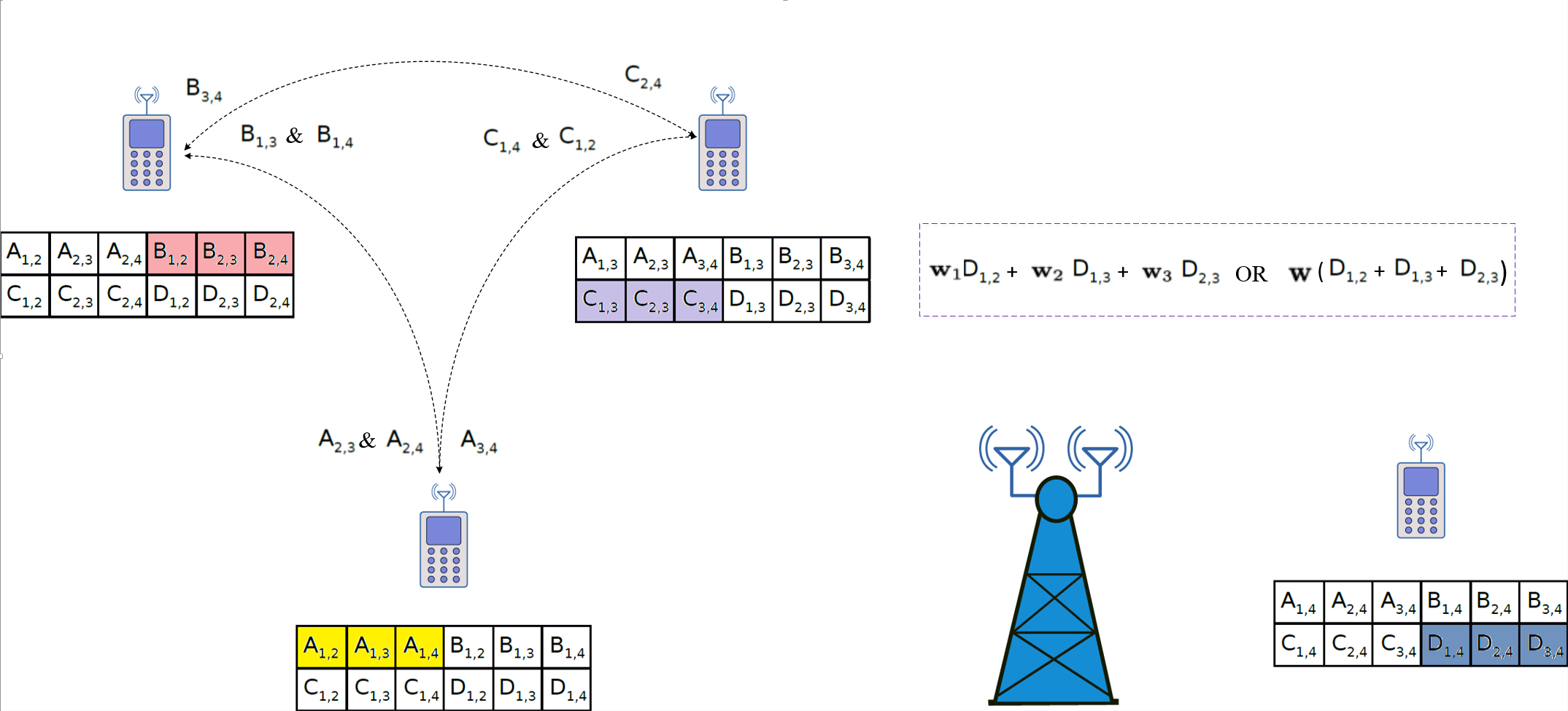 Figure 1
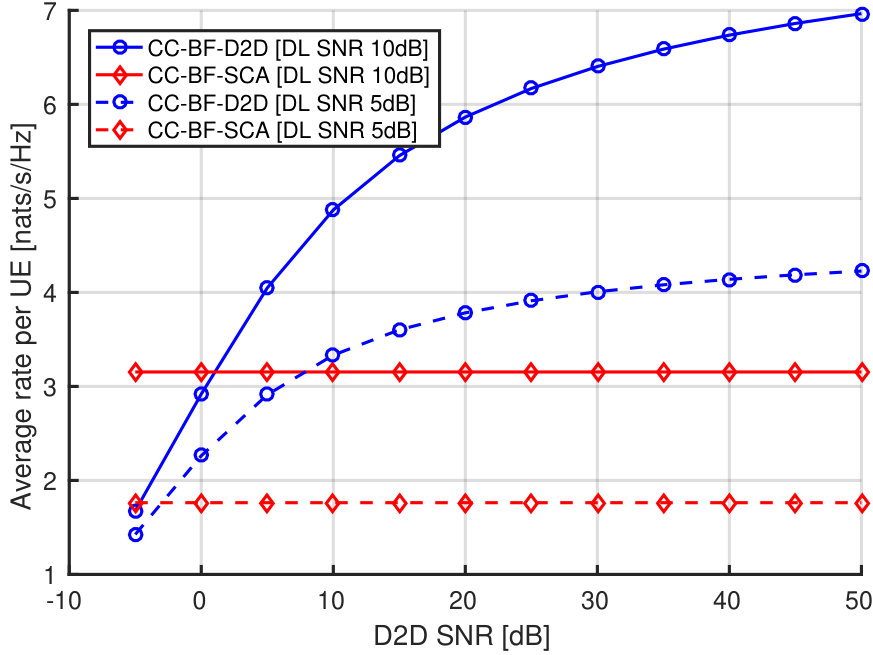 Figure 2
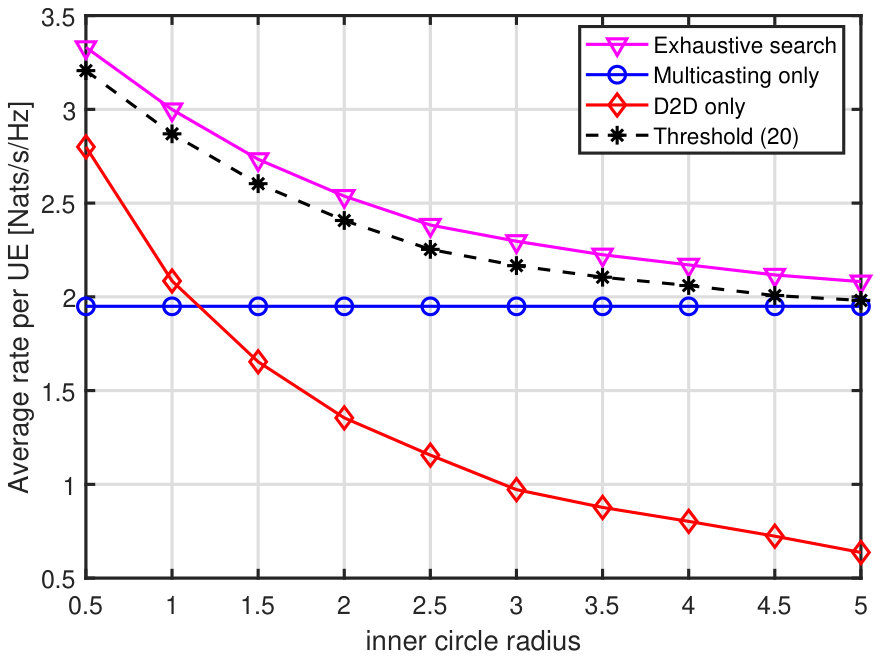 Figure 3
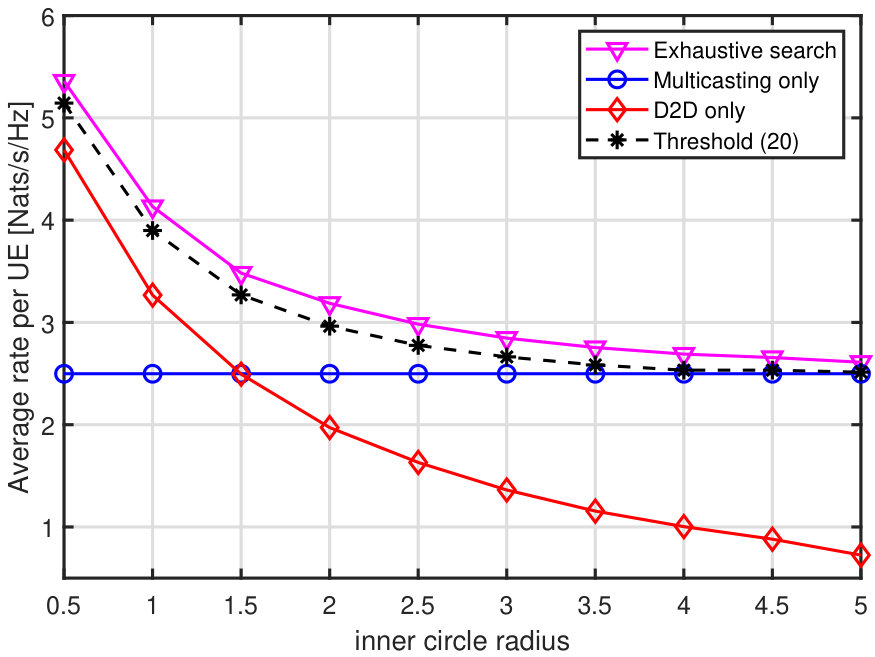 Figure 4
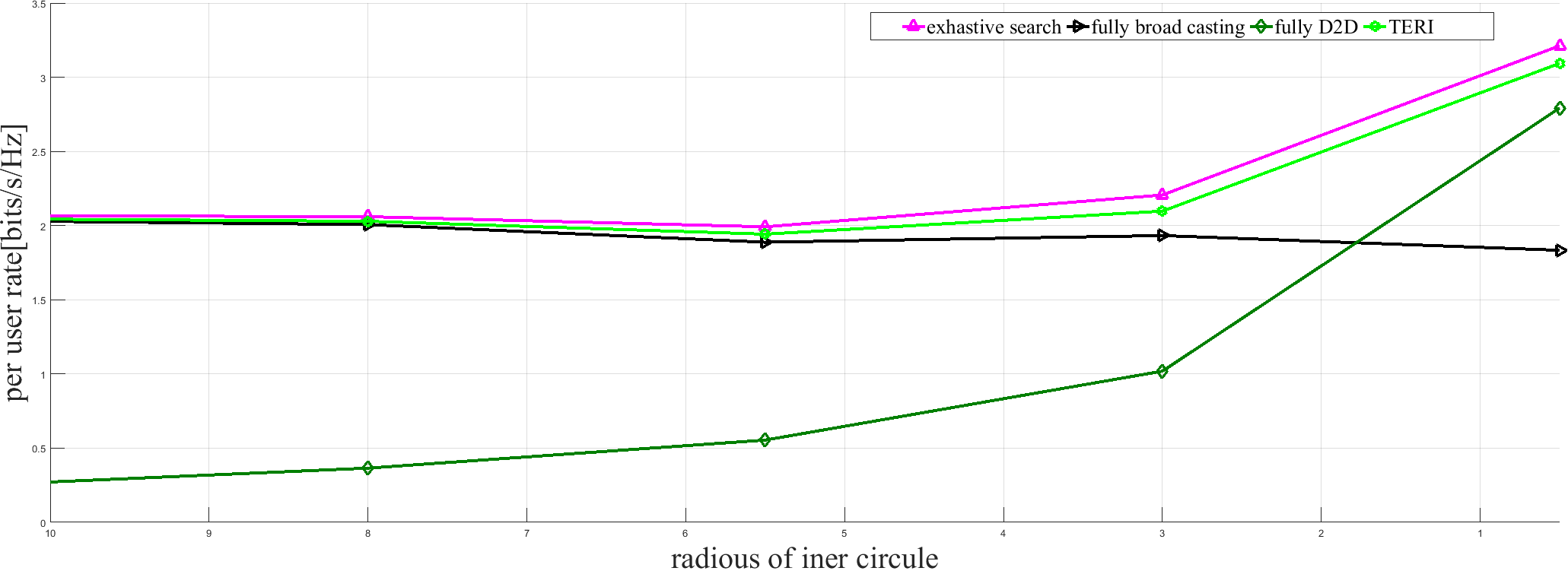 Figure 5
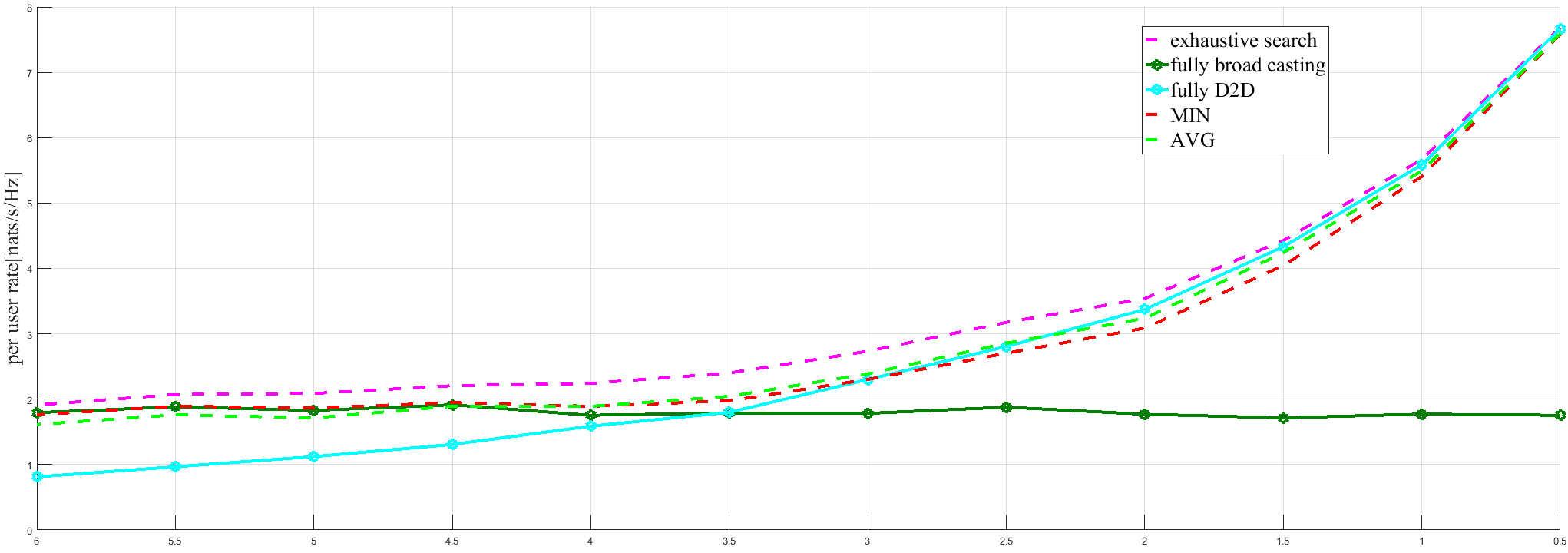 Figure 6
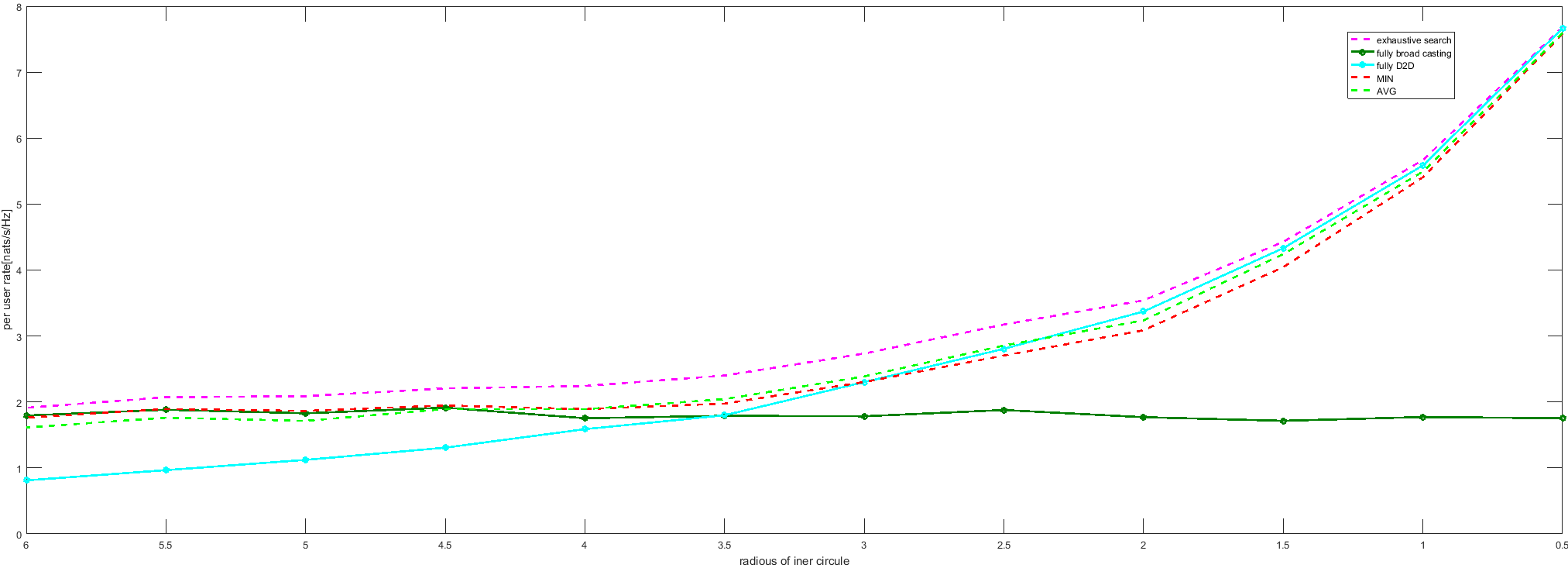 Figure 7
 Figure 8
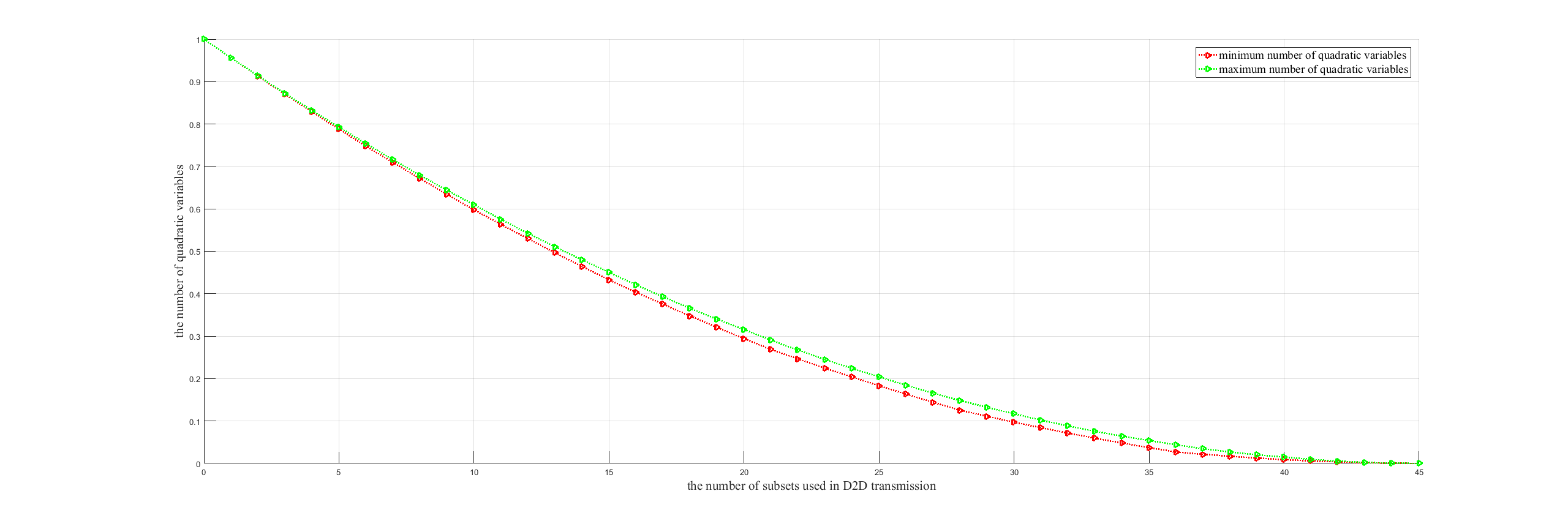 Figure 9
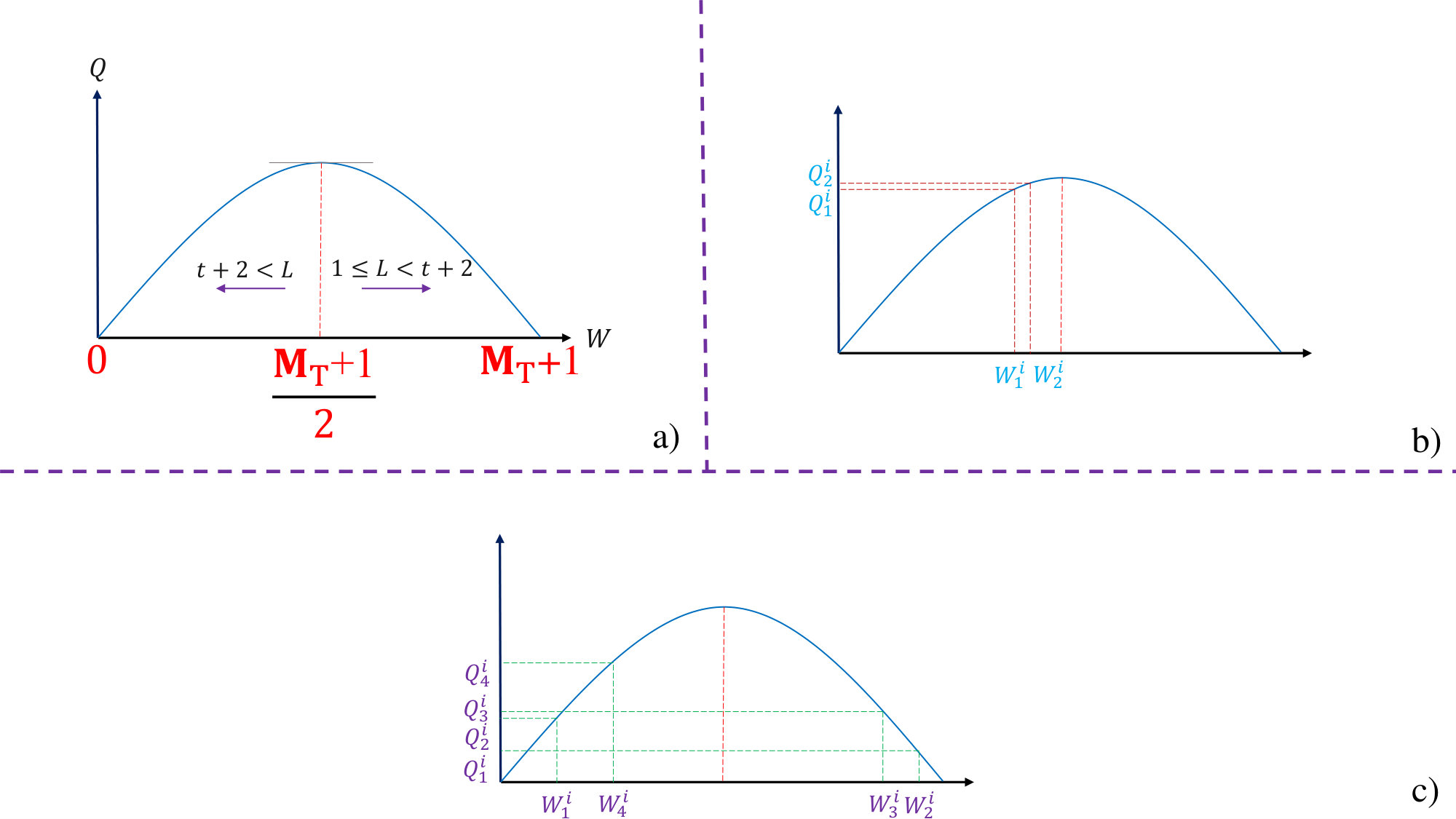 Figure 10
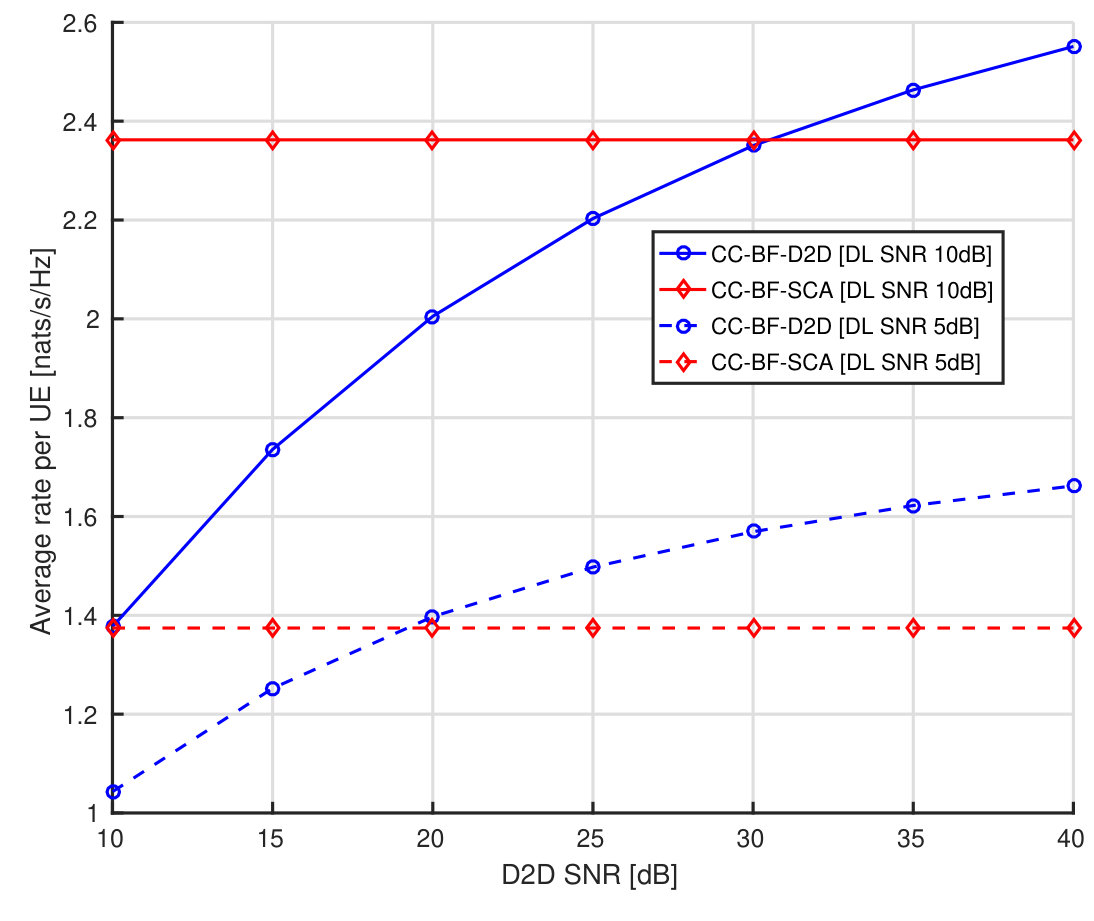 Figure 11
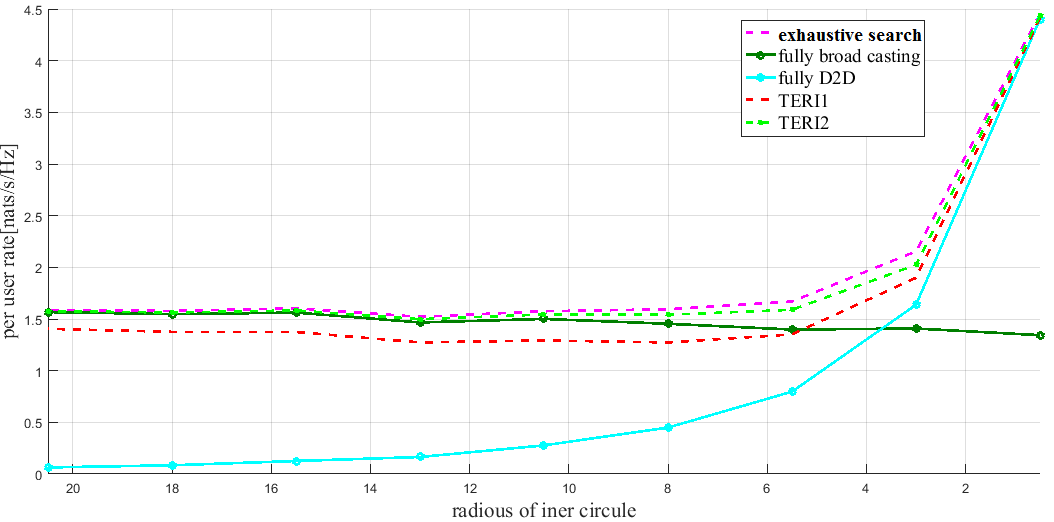 Figure 12
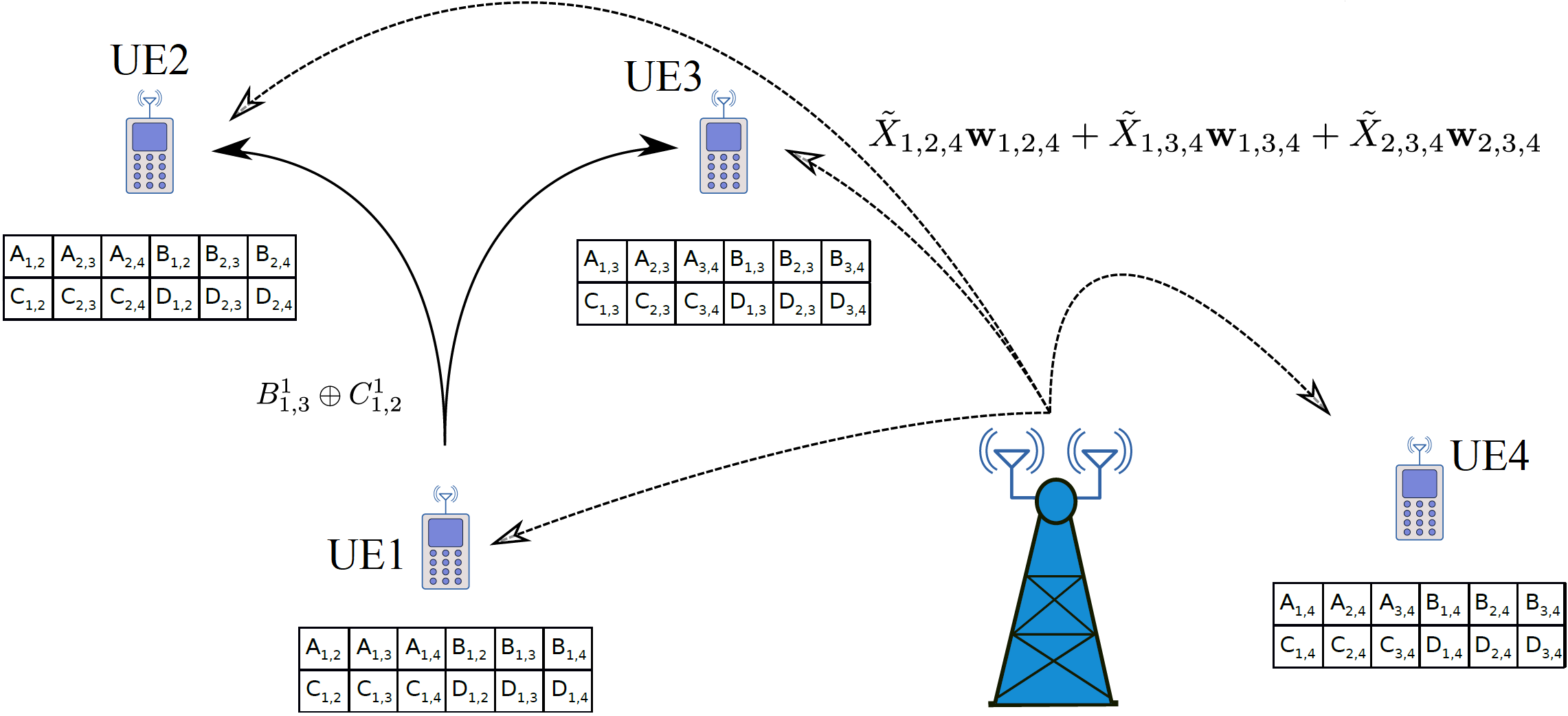 Figure 13
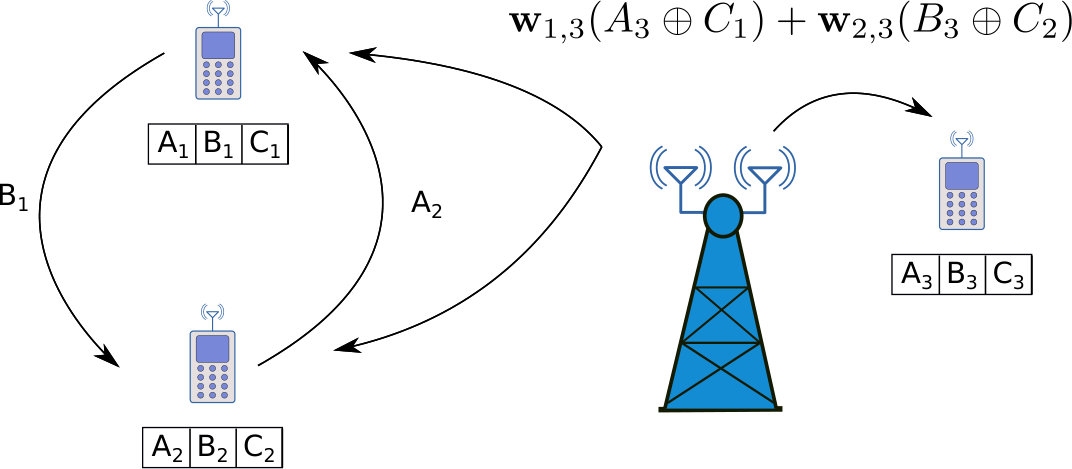 Figure 14
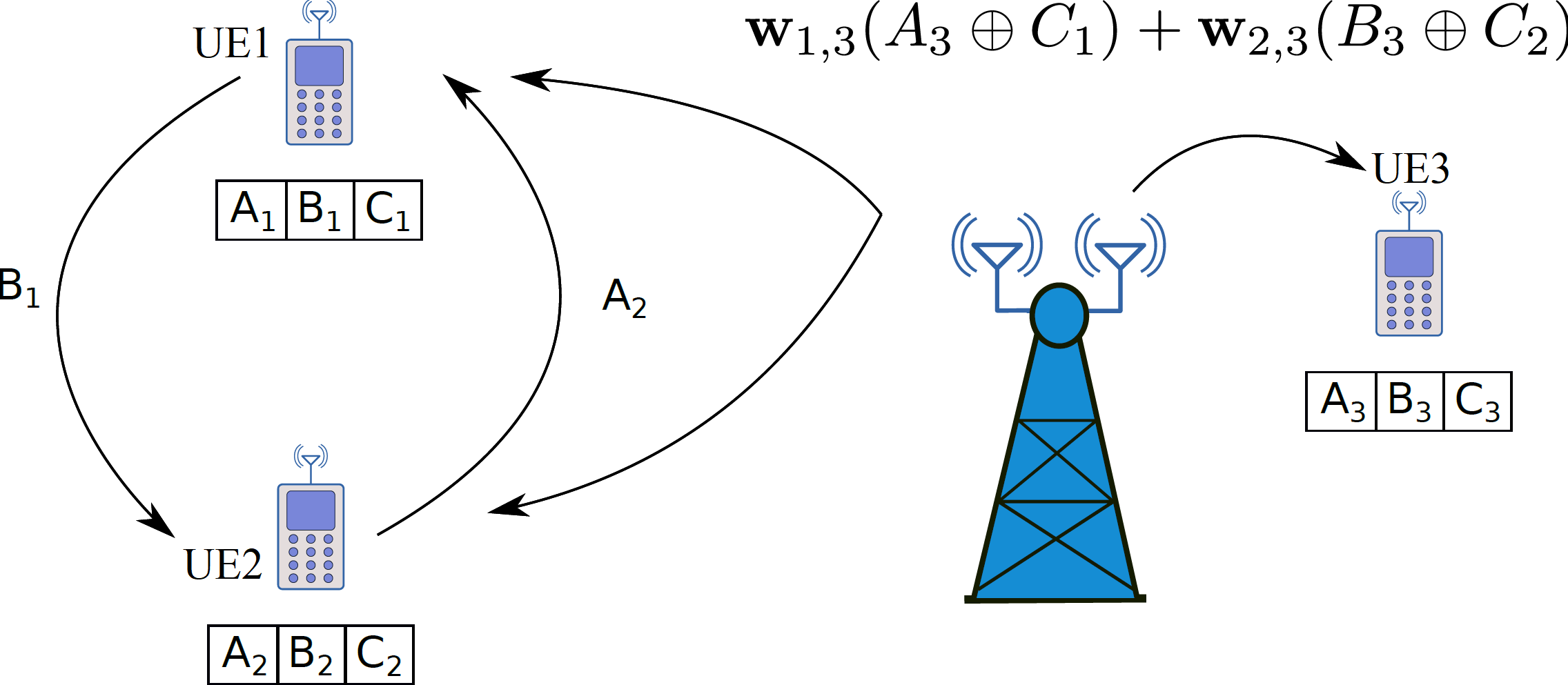 Figure 15
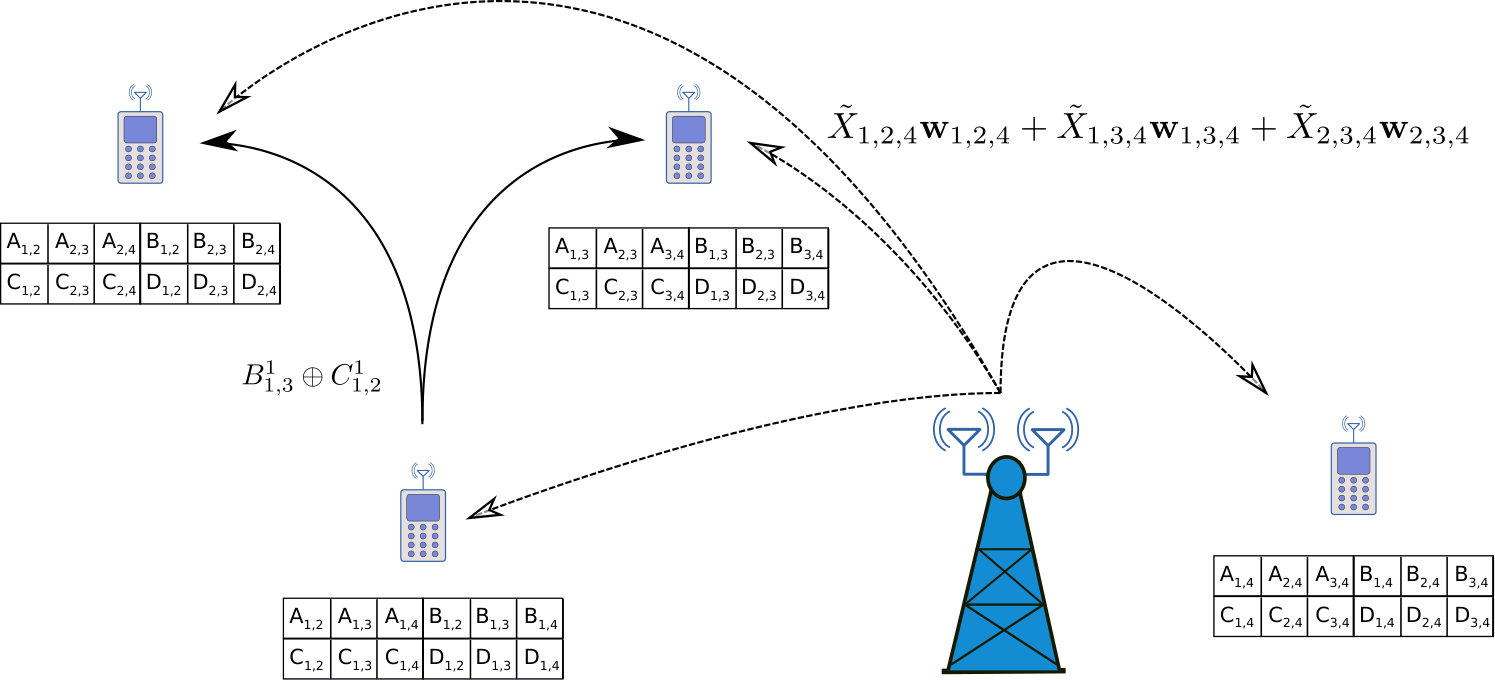 Figure 16
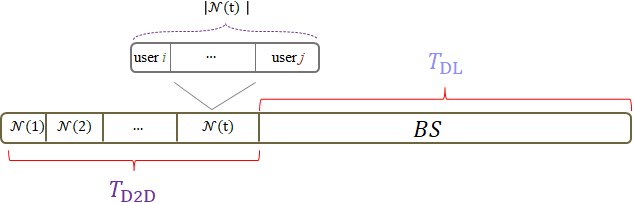 Figure 17
Peer Reviews
No public reviews on file for this paper yet. If you reviewed it on a platform where reviews are public (OpenReview, ICLR, NeurIPS, ICML), you can paste yours below so the community can read it here.
Videos
No videos yet. Explain this paper in a talk, walkthrough, or lecture? Add one.
\DeclareAcronym
ADMM short = ADMM, long = alternating direction method of multipliers, list = Alternating Direction Method of Multipliers, class = abbrev
\DeclareAcronymAoA short = AoA, long = angle-of-arrival, list = Angle-of-Arrival, class = abbrev
\DeclareAcronymAoD short = AoD, long = angle-of-departure, list = Angle-of-Departure, class = abbrev
\DeclareAcronymBB short = BB, long = base band, list = Base Band, class = abbrev
\DeclareAcronymBC short = BC, long = broadcast channel, list = Broadcast Channel, class = abbrev
\DeclareAcronymBS short = BS, long = base station, list = Base Station, class = abbrev
\DeclareAcronymBR short = BR, long = best response, list = Best Response, class = abbrev
\DeclareAcronymCB short = CB, long = coordinated beamforming, list = Coordinated Beamforming, class = abbrev
\DeclareAcronymCC short = CC, long = coded caching, list = Coded Caching, class = abbrev
\DeclareAcronymCE short = CE, long = channel estimation, list = Channel Estimation, class = abbrev
\DeclareAcronymCoMP short = CoMP, long = coordinated multi-point transmission, list = Coordinated Multi-Point Transmission, class = abbrev
\DeclareAcronymCRAN short = C-RAN, long = cloud radio access network, list = Cloud Radio Access Network, class = abbrev
\DeclareAcronymCSE short = CSE, long = channel specific estimation, list = Channel Specific Estimation, class = abbrev
\DeclareAcronymCSI short = CSI, long = channel state information, list = Channel State Information, class = abbrev
\DeclareAcronymCSIT short = CSIT, long = channel state information at the transmitter, list = Channel State Information at the Transmitter, class = abbrev
\DeclareAcronymCU short = CU, long = central unit, list = Central Unit, class = abbrev
\DeclareAcronymD2D short = D2D, long = device-to-device, list = Device-to-Device, class = abbrev
\DeclareAcronymDE-ADMM short = DE-ADMM, long = direct estimation with alternating direction method of multipliers, list = Direct Estimation with Alternating Direction Method of Multipliers, class = abbrev
\DeclareAcronymDE-BR short = DE-BR, long = direct estimation with best response, list = Direct Estimation with Best Response, class = abbrev
\DeclareAcronymDE-SG short = DE-SG, long = direct estimation with stochastic gradient, list = Direct Estimation with Stochastic Gradient, class = abbrev
\DeclareAcronymDFT short = DFT, long = discrete fourier transform, list = Discrete Fourier Transform, class = abbrev
\DeclareAcronymDoF short = DoF, long = degrees of freedom, list = Degrees of Freedom, class = abbrev
\DeclareAcronymDL short = DL, long = downlink, list = Downlink, class = abbrev
\DeclareAcronymGD short = GD, long = gradient descent, list = Gradeitn Descent, class = abbrev
\DeclareAcronymIBC short = IBC, long = interfering broadcast channel, list = Interfering Broadcast Channel, class = abbrev
\DeclareAcronymi.i.d. short = i.i.d., long = independent and identically distributed, list = Independent and Identically Distributed, class = abbrev
\DeclareAcronymJP short = JP, long = joint processing, list = Joint Processing, class = abbrev
\DeclareAcronymKKT short = KKT, long = Karush-Kuhn-Tucker, class = abbrev
\DeclareAcronymLOS short = LOS, long = line-of-sight, list = Line-of-Sight, class = abbrev
\DeclareAcronymLS short = LS, long = least squares, list = Least Squares, class = abbrev
\DeclareAcronymLTE short = LTE, long = Long Term Evolution, class = abbrev
\DeclareAcronymLTE-A short = LTE-A, long = Long Term Evolution Advanced, class = abbrev
\DeclareAcronymMIMO short = MIMO, long = multiple-input multiple-output, list = Multiple-Input Multiple-Output, class = abbrev
\DeclareAcronymMISO short = MISO, long = multiple-input single-output, list = Multiple-Input Single-Output, class = abbrev
\DeclareAcronymMSE short = MSE, long = mean-squared error, list = Mean-Squared Error, class = abbrev
\DeclareAcronymMMSE short = MMSE, long = minimum mean-squared error, list = Minimum Mean-Squared Error, class = abbrev
\DeclareAcronymmmWave short = mmWave, long = millimeter wave, list = Millimeter Wave, class = abbrev
\DeclareAcronymMU-MIMO short = MU-MIMO, long = multi-user \acMIMO, list = Multi-User \acMIMO, class = abbrev
\DeclareAcronymOTA short = OTA, long = over-the-air, list = Over-the-Air, class = abbrev
\DeclareAcronymPSD short = PSD, long = positive semidefinite, list = Positive Semidefinite, class = abbrev
\DeclareAcronymQoS short = QoS, long = quality of service, list = Quality of Service, class = abbrev
\DeclareAcronymRCP short = RCP, long = remote central processor, list = Remote Central Processor, class = abbrev
\DeclareAcronymRRH short = RRH, long = remote radio head, list = Remote Radio Head, class = abbrev
\DeclareAcronymRSSI short = RSSI, long = received signal strength indicator, list = Received Signal Strength Indicator, class = abbrev
\DeclareAcronymRX short = RX, long = receiver, list = Receiver, class = abbrev
\DeclareAcronymSCA short = SCA, long = successive convex approximation, list = Successive Convex Approximation, class = abbrev
\DeclareAcronymSG short = SG, long = stochastic gradient, list = Stochastic Gradient, class = abbrev
\DeclareAcronymSNR short = SNR, long = signal-to-noise ratio, list = Signal-to-Noise Ratio, class = abbrev
\DeclareAcronymSINR short = SINR, long = signal-to-interference-plus-noise ratio, list = Signal-to-Interference-plus-Noise Ratio, class = abbrev
\DeclareAcronymSOCP short = SOCP, long = second order cone program, list = Second Order Cone Program, class = abbrev
\DeclareAcronymSSE short = SSE, long = stream specific estimation, list = Stream Specific Estimation, class = abbrev
\DeclareAcronymSVD short = SVD, long = singular value decomposition, list = Singular Value Decomposition, class = abbrev
\DeclareAcronymTDD short = TDD, long = time division duplex, list = Time Division Duplex, class = abbrev
\DeclareAcronymTX short = TX, long = transmitter, list = Transmitter, class = abbrev
\DeclareAcronymUE short = UE, long = user equipment, list = User Equipment, class = abbrev
\DeclareAcronymUL short = UL, long = uplink, list = Uplink, class = abbrev
\DeclareAcronymULA short = ULA, long = uniform linear array, list = Uniform Linear Array, class = abbrev
\DeclareAcronymUPA short = UPA, long = uniform planar array, list = Uniform Planar Array, class = abbrev
\DeclareAcronymWMMSE short = WMMSE, long = weighted minimum mean-squared error, list = Weighted Minimum Mean-Squared Error, class = abbrev
\DeclareAcronymWMSEMin short = WMSEMin, long = weighted sum \acMSE minimization, list = Weighted sum \acMSE Minimization, class = abbrev
\DeclareAcronymWBAN short = WBAN, long = wireless body area network, list = Wireless Body Area Network, class = abbrev
\DeclareAcronymWSRMax short = WSRMax, long = weighted sum rate maximization, list = Weighted Sum Rate Maximization, class = abbrev
D2D Assisted Beamforming for Coded Caching
Hamidreza Bakhshzad Mahmoodi⋆, Jarkko Kaleva⋆, Seyed Pooya Shariatpanahi∗, Babak Khalaj† and Antti Tölli⋆ This work was supported by the Academy of Finland under grants no. 319059 (Coded Collaborative Caching for Wireless Energy Efficiency) and 318927 (6Genesis Flagship). Centre for Wireless Communications, University of Oulu, P.O. Box 4500, 90014, Finland
Institute for Research in Fundamental Sciences (IPM) Tehran, Iran, Sharif University of Technology, Tehran, Iran
[email protected], [email protected], [email protected]
Abstract
Device-to-device (D2D) aided beamforming for coded caching is considered in finite signal-to-noise ratio regime. A novel beamforming scheme is proposed where the local cache content exchange among nearby users is exploited. The transmission is split into two phases: local D2D content exchange and downlink transmission. In the D2D phase, users can autonomously share content with the adjacent users. The downlink phase utilizes multicast beamforming to simultaneously serve all users to fulfill the remaining content requests. We first explain the main procedure via two simple examples and then present the general formulation. Furthermore, D2D transmission scenarios and conditions useful for minimizing the overall delivery time are identified. We also investigate the benefits of using D2D transmission for decreasing the transceiver complexity of multicast beamforming. By exploiting the direct D2D exchange of file fragments, the common multicasting rate for delivering the remaining file fragments in the downlink phase is increased providing greatly enhanced overall content delivery performance.
I Introduction
Caching popular content near end-users is a widely accepted solution for supporting high quality content delivery in next generation networks. This solution includes benefiting from off-peak hours of the network to move the content closer to the end-users, which will be used to mitigate the content delivery burden in network peak hours. Many recent papers have investigated the potentials of this paradigm to improve wireless networks performance, such as [1], [2], and [3]. A promising scheme in this context is proposed in [4], which is known as the so-called \AcCC approach. In this scheme, instead of locally caching the entire files at the end-user, fragments of all files in the library are stored in all the users’ cache memories. In the delivery phase, carefully formed coded messages are multicast to groups of users, which results in global caching gain [4].
\Ac
CC has been shown to be greatly beneficial for both wired and wireless content delivery, under various assumptions [4, 5, 6, 7, 8, 9]. The original coded caching setup is extended in [7] to a multiple server scenario under different network topologies, aiming to further minimize the required delivery time of requested content. For high \acSNR regime, [8, 9, 10, 11] show that coded caching can boost the performance of the wireless network in terms of Degrees-of-Freedom (DoF). Specifically, in wireless broadcast channels with a multiple-antenna base station, the global coded caching gain and the spatial multiplexing gain are shown to be additive and will increase the network data rate [7, 8, 11].
In order to bridge the gap between high-SNR analysis of \acCC and the practical finite-SNR scenarios, recent works on finite \acSNR regime have also shown \acCC to be greatly beneficial when the interference is properly accounted for [12, 13, 14, 15, 16]. While, the works [12] and [13] use a rate-splitting approach to benefit from the global caching gain and the spatial multiplexing gain at finite SNR, the work [14] follows a Zero-Forcing (ZF) based approach (extending the ideas in [7] to the finite-SNR setup), which is also order-optimal in terms of DoF. Moreover, the work [15, 16] extends [14] to a general beamformer solution which manages the interaction between interference and noise in an optimal manner. The general interference management framework proposed in [15, 16], improves the finite-SNR performance of the coded caching in wireless networks significantly. Moreover, the complexity issues associated with the corresponding optimization problem are addressed in [16].
This paper considers a delivery scheme optimized for finite \acSNR region, where the multicast beamforming [16] of file fragments is complemented by allowing direct \acD2D exchange of local cache content. Finding the optimal D2D opportunities in finite SNR is particularly challenging due to the high computational complexity for the DL multicast beamformer design. The optimal D2D/DL mode selection requires exhaustive search for D2D opportunities over a group of users, which quickly becomes computationally intractable. To over come these practical limitations, we provide a low complexity mode selection algorithm, which allows efficient determination of D2D opportunities even for large number users. The computational complexity of the proposed algorithm is greatly reduced with respect to the exhaustive search baseline while retaining comparable performance.
II System Model
We consider a system consisting of a single antenna \acBS and single antenna users. The \acBS has a library of files, namely , where each file has the size of bits. The normalized cache size (memory) at each user is files. Each user caches a function of the files, denoted by , which is stored in the cache content placement phase during off peak hours. At the content delivery phase, user makes a request for the file .
Upon the requests arrival, first we have a \acD2D sub-phase which is divided into a number of D2D time slots. In each time slot , a group of nearby users, denoted by set , are instructed by the BS to locally exchange data (see Fig. 1). Furthermore, each D2D time slot is divided into individual D2D transmissions. In each D2D transmission a user transmits a coded message comprised of of some file fragments denoted by to an intended set of receivers , which are interested in decoding . Thus, the message can be transmitted at rate111In this paper, for simplicity, we assume that all D2D user groups are served in a TDMA fashion. Further improvement can be achieved by allowing parallel transmissions within multiple groups.
[TABLE]
where is the device’s transmit power constraint, and is the channel response from user to user . It should be noted that in each D2D transmission we assume that each user in , multicasts a message to a group of user. Thus, the rate is limited by the weakest receiver.
In the downlink phase, the \acBS multicasts coded messages containing all the remaining file fragments, such that, all of the users will be able to decode their requested content.
The received downlink signal at user terminal is given by
[TABLE]
where is the modulated version of the intended message to be decoded by all the users in subset of set , and is the corresponding beamforming vector. The channel vector between the \acBS and user is , and the receiver noise is given by . The \acCSIT of all users is assumed to be perfectly known. The final achievable rate (per user) over the above-described two phases is given by
[TABLE]
where and denote the time used for the \acD2D and \acDL transmission sub-phases, respectively.
III D2D Aided Beamforming Explained: Examples
In this section, we discuss the main concepts of the proposal via two examples. In the first example, we have a network of users, and in the second example, the number of users is increased to .
III-A Example 1: , , , and
In this example illustrated in Fig. 2, we have users and a library of files, where each user has the cache size for storing just file. The base station is equipped with transmit antennas. To begin with, the cache content at each user is
[TABLE]
where we have assumed that each file is divided into three equal-sized sub-files. This follows the same cache placement as in [4]. In this example, we assume that users and are in close proximity, while user is far from them (see Fig. 2). To describe the idea let us assume that users , , and request files , , and , respectively. Now, the actual transmission strategy is split into two phases. In the first phase, which is called as the D2D sub-phase, users and are assumed to be using \acD2D transmission to share their local cache content. Thus, the D2D sub-phase consists of a single D2D time slot with . It is evident that user would request from user and user would request from user , and, since the \acD2D transmission is assumed to be half duplex and requires TDMA, this single time slot constitutes of two D2D transmissions. The time required for the \acD2D sub-phase is given by
[TABLE]
where , , and
[TABLE]
Note that, in each transmission, fraction of the corresponding file is transmitted.
In the second (DL) sub-phase, the \acBS multicasts the remaining content via coded messages. User was not active in the \acD2D phase and still requires contents and . However, users and only require and , respectively. This content is XOR coded over two messages for user pairs and . Namely, the messages are and .
Here, is a coded message, which would benefit users and . Similarly, is a coded message intended for users and . Thus, in order to deliver the correct coded message to each user, multicast beamformer vectors and are associated with messages and , respectively. The downlink signal follows as , where and are the modulated messages (for more details see [16]). Note that, here, user is assumed to use SIC receiver to decode both intended messages (interpreted as a multiple access channel (MAC)), while, users and only get served with a single message with the other seen as interference.
Suppose now user can decode both of its required messages and with the equal rate222Symmetric rate is imposed to minimize the time needed to receive both messages , and .
[TABLE]
where the rate region corresponding to , and , is limited by , and .
Accordingly, the corresponding downlink beamformer design problem can be expressed as
[TABLE]
where the rates of users and are given as
[TABLE]
Due to D2D transmissions, the beamformer design problem is different as compared to [16]. The partial file exchange in the D2D phase alleviates the interference conditions of the DL phase, thus, making the DL multicasting more efficient and less complex. On the other hand, the D2D transmission requires an orthogonal allocation in time domain. This introduces an inherent trade-off between the amount of resources allocated to the D2D and DL phases.
Finally, the corresponding symmetric rate maximization is given as
[TABLE]
The rate constraints can be written as convex second-order cone constraints as shown in [16]. However, the \acSINR constraints are non-convex and require an iterative solution. A \acSCA solution for the \acSINR constraints can be found, e.g., in [16]. Please notice that, here due to D2D transmission in the the first phase we have only two beamformer vectors ( and ), which means that we can dedicate more power to our intended signals ( and ) compared to [16]. The time required for the \acDL phase is given by
[TABLE]
Note that, also in this phase, all users are served with coded messages of size bits, which are multiplexed with the help of the beamforming vectors. Finally, the achievable rate over the D2D and DL phases is given in (3).
III-B Example 2: , , , and
In this example, we have users and a library of files, where each user has a cache for storing files. Also, the base station is equipped with transmit antennas. Following the same placement as in [4] (from now on we note ), each file is split into subfiles, as follows
[TABLE]
Each file is cached at user if . Let us assume that users request files , respectively.
In this example, we suppose that users , , and are close to each other, while user is far from them. Then, the \acD2D sub-phase consists of exchanging information between the first three users locally (collected in ) in three orthogonal D2D transmissions. More specifically, each subfile is divided into parts which are discriminated by their superscript indices. Then, in the first D2D transmission of length seconds, user multicasts to . In the second D2D transmission, user transmits to , which will take seconds. Finally, in the third D2D transmission of length seconds, user transmits to . These transmissions require the total time of
[TABLE]
in which and are determined by (1). Then, in the DL sub-phase, the BS transmits the remaining messages
[TABLE]
where , , and . At the end of this sub-phase, user is interested in decoding , , user is interested in decoding , , user is interested in decoding , , and finally, user is interested in decoding all the three terms , . Thus, from the perspective of users , , and , we have a MAC channel with two useful terms and one interference term. However, from the perspective of the user , we have a MAC channel with three useful terms. Thus, for users , , and we have MAC rate region
[TABLE]
For example, for , we have , and .
In order to derive the fourth user’s 3-stream rate region, we face a MAC with three messages. Thus, we have MAC region inequalities, which will result in (the details are omitted here due to lack of space. For details refer to [15, 16]). When all the MAC inequalities for all the users are gathered together we can derive the common multicast rate, which is shown in the corresponding downlink beamformer design problem as follows
[TABLE]
Finally, the delivery time of the DL sub-phase is .
It should be noted that, compared to the solution proposed in [16], we have one term removed from the downlink transmission, i.e., . This term is already taken care of in the D2D phase, which in turn enhances the performance of the downlink phase.
IV D2D Aided Beamforming: The General Case
In this section, we formulate and analyze the proposed scheme in the general setting. The cache content placement phase is identical to the one proposed in [4]. In general, in each data transmission, users can be served simultaneously [16]. Thus, when , transmission phases are required in total. Unlike in [16], here, the data delivery is split into D2D and DL sub-phases.
To examine the optimal D2D sub-phase user allocation, we need to perform exhaustive search of the D2D subsets. There are, in total, different user subsets (of size ) among number of users in each transmission phase. Thus, the exhaustive search would require evaluations of (3). In each of these evaluations, all the beamformers must be solved and total rate computed. Then, the highest one should be chosen. To simplify the notation, we consider an indication function , which specifies whether the corresponding subset has been allocated for D2D transmission. We define as the size of the transmitted file fragment [16].
IV-A Total delivery time
Now, for a given D2D mode allocation, the D2D delivery time is given as
[TABLE]
where and is from (1). Since in each D2D subset each file fragment is transmitted by users, we further divide each file fragment in to sub-packets so that we can transmit a distinct sub-packet by each user (see Example 2).
The beamformers for the DL phase are solved using the SCA approach from [16]. The main difference, in contrast to [16], is that we should not consider all the subsets. Here, only those subsets for which should be involved in the DL phase. This will reduce the interference between parallel streams significantly. The DL sub-phase throughput is given by
[TABLE]
where
[TABLE]
where
[TABLE]
After computing the rate for DL sub-phase the is computed as , then the achievable symmetric rate per user is computed using (3). For a large number of users and transmit antennas, solving (IV-A) requires a considerable amount of computation, due to the iterative convex approximation for each subset evaluation [16]. In the following, we provide a low complexity heuristic solution for the proposed mode assessment problem.
IV-B Heuristic D2D mode selection with low complexity
In order to decrease the computational load of evaluating and for different D2D mode allocations, we provide a throughput approximation for the D2D mode allocations without having to rely on the general SCA solution for the DL beamformer design. The D2D transmissions occur in orthogonal time slots. The accumulated D2D phase duration is denoted by . Each successful D2D exchange reduces the remaining number of file fragments to be transmitted by the BS. Thus, there are fewer multicast messages and corresponding beamforming vectors in the DL optimization problem. This allows more efficient (less restricted) multicast beamformer design, which results in reduced DL phase duration . The D2D mode selection is iteratively carried out as long as the following condition holds:
[TABLE]
where is the total number of file fragments that should be delivered to all the users so that they can decode their intended files. Moreover, and are the coarse approximated delivery times in the iteration. In (20), we check if any D2D user subset will reduce the DL duration more than the duration of the corresponding D2D transmission. If a specific subset in iteration satisfies (20), then the D2D transmission for this subset is done following the approach proposed in [17].
In each D2D time slot, fragments of files are delivered by orthogonal D2D transmissions. On the other hand, in the DL sub-phase, all the remaining fragments () are delivered simultaneously. Thus, in (20), the average delivery time for one fragment in the D2D and DL phases are compared. In each iteration, we choose a subset for D2D candidate, i.e., the subset which provides the highest rate. If, at any specific iteration, (20) does not hold, using more D2D transmissions will not improve the overall rate and the iterative process is terminated. Therefore, at most iterations are required compared to needed for the exhaustive search.
The D2D delivery time is coarsely approximated as
[TABLE]
Since, in each D2D transmission (e.g., user ’s transmission in Fig. 1), part of each fragment is delivered, is considered as to scale the delivery time. Here, the approximated D2D rate for each subset is simply defined as the average rate of the users in that subset. In each D2D subset there are number of users which transmit a data useful for number of other users, thus in total there are terms in (21). Note that, for each iteration , we only consider those subsets that have not already been allocated for D2D.
The DL delivery time is coarsely approximated as
[TABLE]
where is the approximated rate of user considering that () subsets had been chosen for D2D transmission in the previous iterations. Here, for simplicity, we omit the interference among parallel multicast streams and consider equal power loading over all the remaining subsets of users (). In general, beamformers should be designed in such a way that all the users in subset can decode the message . For the heuristic mode selection process, however, we simply use the average channel gain assuming matched filter beamforming () to coarsely indicate the multicast beamforming potential for a given subset. Once the users for D2D mode transmission are found based on (20), the final delivery time and the rate are computed as described in Section IV-A.
V Numerical Examples
For better understanding the network level impact of D2D transmission, we have simulated general scenarios for and users cases. In our scenarios, users are scattered in a circular area with radius of meters. Moreover, in order to see the effect of D2D transmission in different situations we control the maximum user separation. Thus, we have considered another circle inside the cell area which can be located anywhere inside the cell and users are scattered inside this smaller circle. In this manner the maximum distance between two users is (r is the radius of smaller circle) but the users distance to BS is any number between 0 to ( is the radius of cell). Thus, by changing we can control the maximum users’ separation in D2D mode which helps us investigate the beneficial users distance in D2D mode. The channel coefficients of the users are as where is a complex Gaussian variable with zero mean and unit variance, is the path loss exponent ( for DL and for D2D), is the users distance from the transmitter (BS in DL and user in D2D).
Transmit powers at users for D2D transmission and at the BS for DL multicast beamforming are adjusted in a way that, the received SNR is [math] dB at meter distance from another user, and at the cell edge (m distance between a user and BS), respectively. Fig. 3 shows the per user rate for case (Example ) as a function of inner circle radius. Fig. 3 demonstrates that, when users are close to each other, we have a significant gain from using a combination of multicasting and D2D transmissions. However, when the maximum distance between users start to increase the rate of ’D2D only’ transmission decreases drastically. The reasonable range for using D2D transmission in particular scenarios is between m (m maximum distance), while this distance changes by path loss exponent, D2D and DL available power, , etc.
Fig. 4 shows the per user rate versus inner circle radius for (Example ). For a higher number of users the gain from using D2D transmission among nearby users is clearly larger than in 3. However, the gain of D2D transmission decreases more rapidly compared to the case . Since , we need more users to be closer to each other in order to be able to perform the D2D transmission in an efficient manner.
It is worth to mention that, using the heuristic D2D mode selection criteria defined in Section IV results in minimal loss in per user rate, with a greatly reduced complexity, as compared to the exhaustive search.
VI Conclusions
A novel delivery scheme optimized for finite \acSNR region was proposed, where the multicast beamforming of file fragments is complemented by allowing direct \acD2D exchange of local cache content. The benefits of partial D2D offloading of multicast delivery of coded caching content were investigated. Two simple example scenarios were assessed in detail and a generalized formulation was also provided. Moreover, a heuristic low complexity mode selection scheme was proposed with comparable performance to the optimal exhaustive search. In the future work, we will provide a detailed complexity analysis of the proposed scheme, which will formalize the gains related to the computational complexity.
The reference list from the paper itself. Each links out to its DOI / PubMed record.
- 1[1] K. Shanmugam, N. Golrezaei, A. G. Dimakis, A. F. Molisch, and G. Caire, “Femtocaching: Wireless content delivery through distributed caching helpers,” IEEE Transactions on Information Theory , vol. 59, no. 12, pp. 8402–8413, Dec 2013.
- 2[2] E. Bastug, M. Bennis, and M. Debbah, “Living on the edge: The role of proactive caching in 5g wireless networks,” IEEE Communications Magazine , vol. 52, no. 8, pp. 82–89, Aug 2014.
- 3[3] G. Paschos, E. Bastug, I. Land, G. Caire, and M. Debbah, “Wireless caching: technical misconceptions and business barriers,” IEEE Communications Magazine , vol. 54, no. 8, pp. 16–22, August 2016.
- 4[4] M. A. Maddah-Ali and U. Niesen, “Fundamental limits of caching,” IEEE Trans. Inform. Theory , vol. 60, no. 5, pp. 2856–2867, May 2014.
- 5[5] N. Karamchandani, U. Niesen, M. A. Maddah-Ali, and S. N. Diggavi, “Hierarchical coded caching,” IEEE Trans. Inform. Theory , vol. 62, no. 6, pp. 3212–3229, Jun 2016.
- 6[6] R. Pedarsani, M. A. Maddah-Ali, and U. Niesen, “Online coded caching,” IEEE/ACM Transactions on Networking , vol. 24, no. 2, pp. 836–845, Apr 2016.
- 7[7] S. P. Shariatpanahi, S. A. Motahari, and B. H. Khalaj, “Multi-server coded caching,” IEEE Trans. Inform. Theory , vol. 62, no. 12, pp. 7253–7271, Dec 2016.
- 8[8] N. Naderializadeh, M. A. Maddah-Ali, and A. S. Avestimehr, “Fundamental limits of cache-aided interference management,” IEEE Trans. Inform. Theory , vol. 63, no. 5, pp. 3092–3107, May 2017.