Strongly Tunable Anisotropic Thermal Transport in MoS2 by Strain and Lithium Intercalation: First--Principles Calculations
Shunda Chen, Aditya Sood, Eric Pop, Kenneth E. Goodson, Davide Donadio

TL;DR
This study uses first-principles calculations to demonstrate that lithium intercalation and strain can reversibly and significantly tune the anisotropic thermal conductivity of MoS2, enabling advanced heat management and phononic device design.
Contribution
It reveals the large, reversible tunability of MoS2's thermal conductivity anisotropy through combined strain and lithium intercalation, a novel approach for thermal control.
Findings
Thermal conductivity can be tuned over one to two orders of magnitude.
Thermal conductivity anisotropy can be modulated by two orders of magnitude.
Both in-plane and cross-plane conductivities are highly sensitive to strain and intercalation.
Abstract
The possibility of tuning the vibrational properties and the thermal conductivity of layered van der Waals materials either chemically or mechanically paves the way to significant advances in nanoscale heat management. Using first-principles calculations we investigate the modulation of heat transport in MoS2 by lithium intercalation and cross-plane strain. We find that both the in-plane and cross-plane thermal conductivity (kr, kz) of MoS2 are extremely sensitive to both strain and electrochemical intercalation. Combining lithium intercalation and strain, the in-plane and cross-plane thermal conductivity can be tuned over one and two orders of magnitude, respectively. Furthermore, since kr and kz respond in different ways to intercalation and strain, the thermal conductivity anisotropy can be modulated by two orders of magnitude. The underlying mechanisms for such large tunability of…
Click any figure to enlarge with its caption.
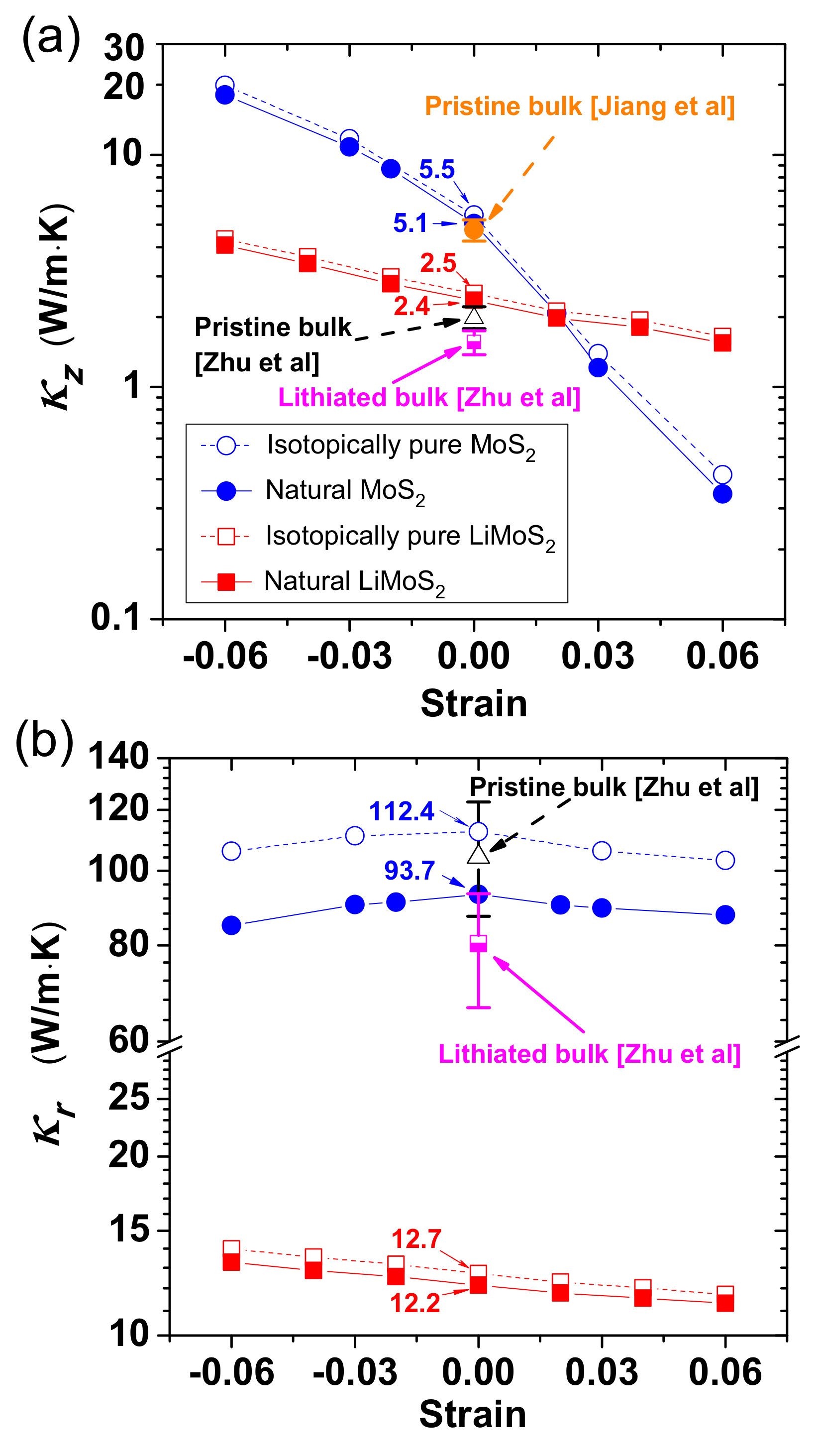 Figure 1
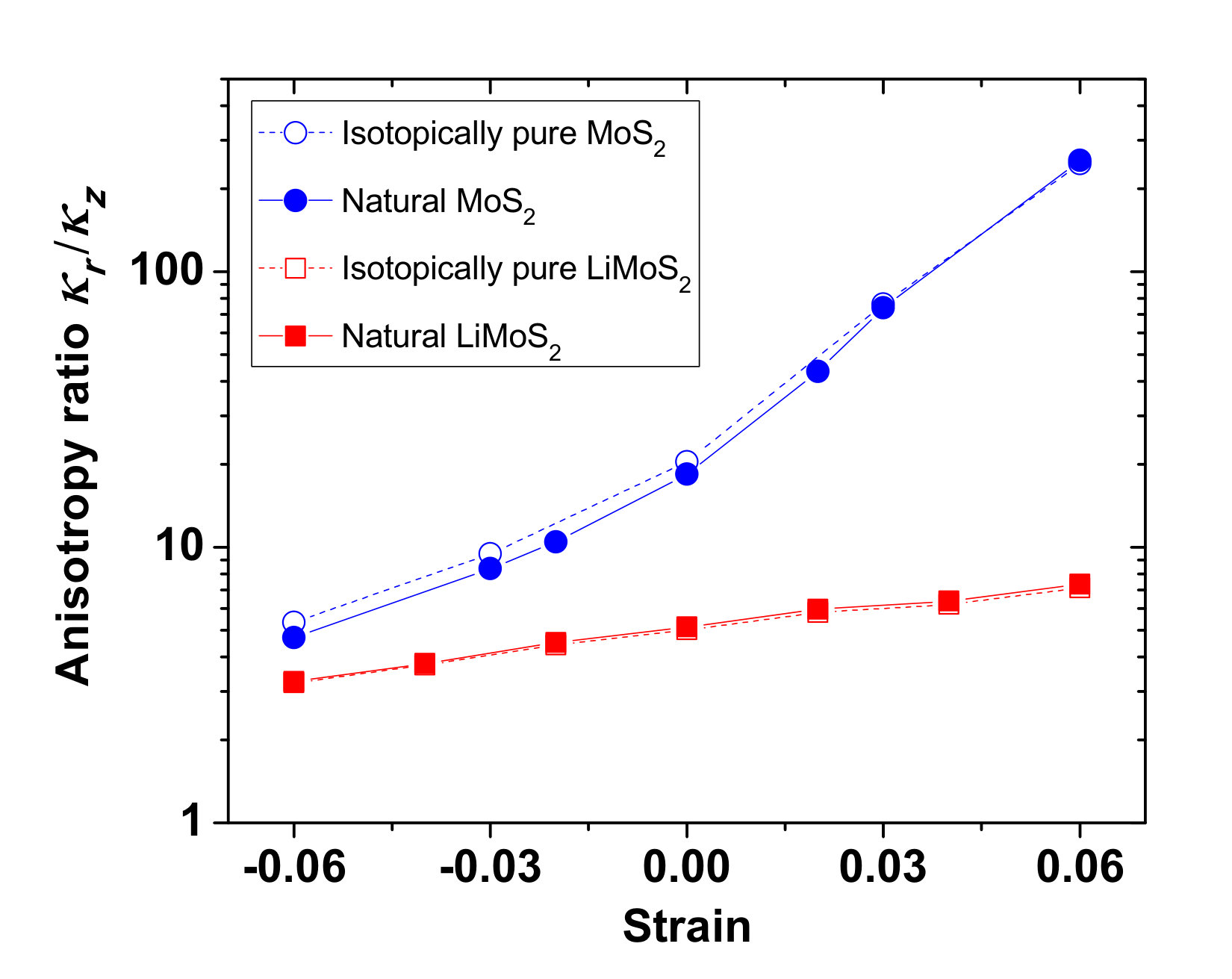 Figure 2
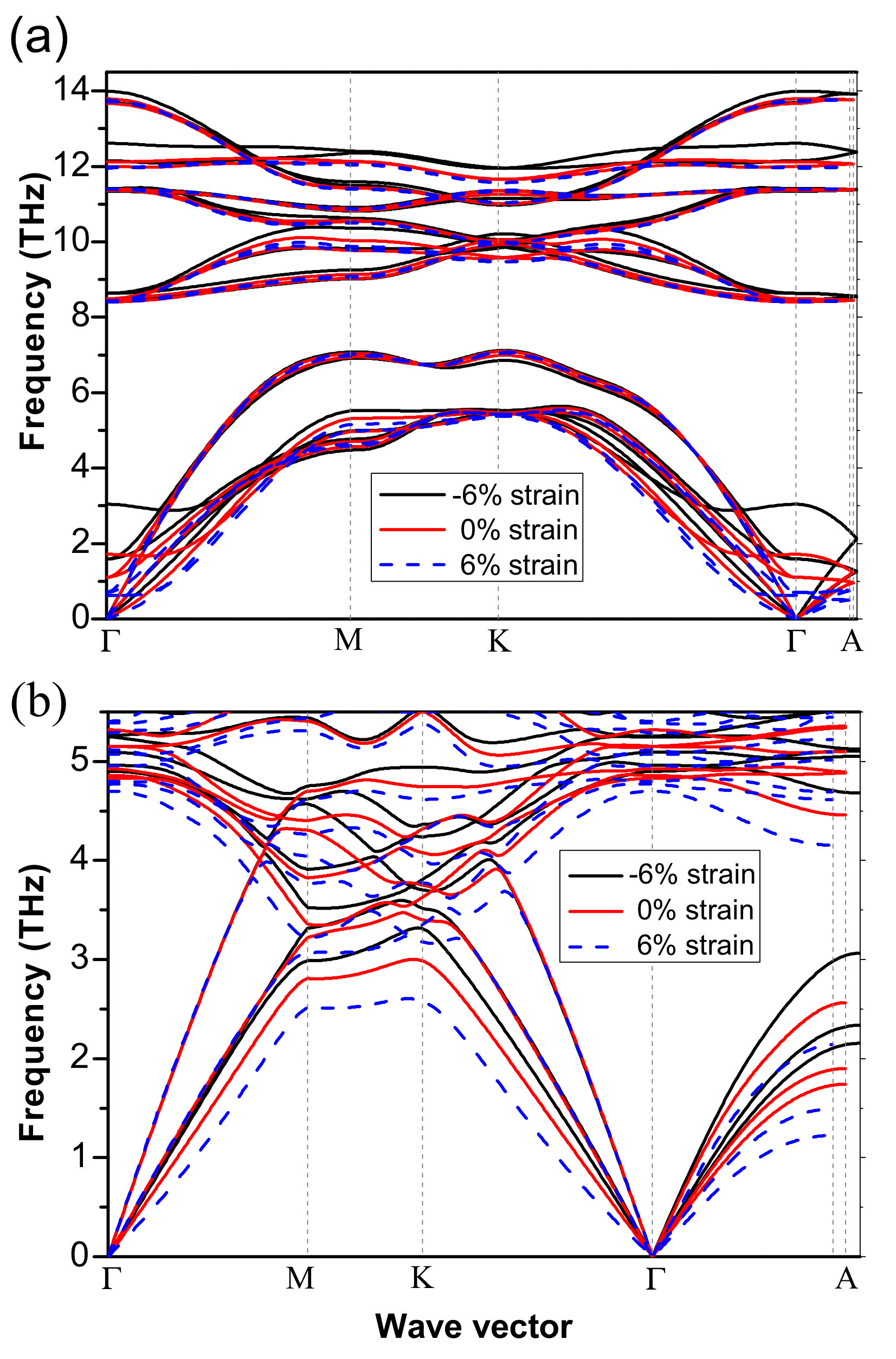 Figure 3
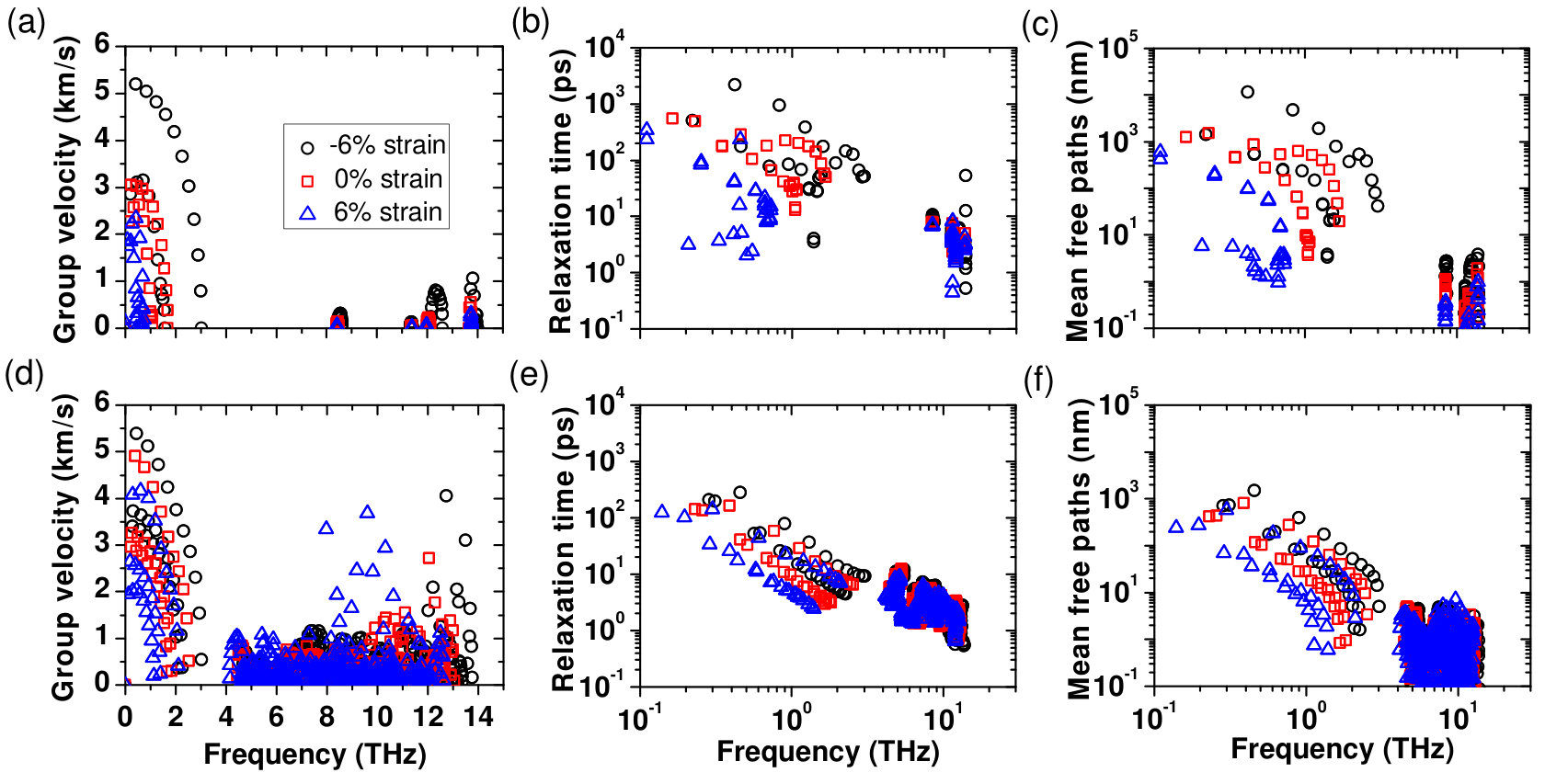 Figure 4
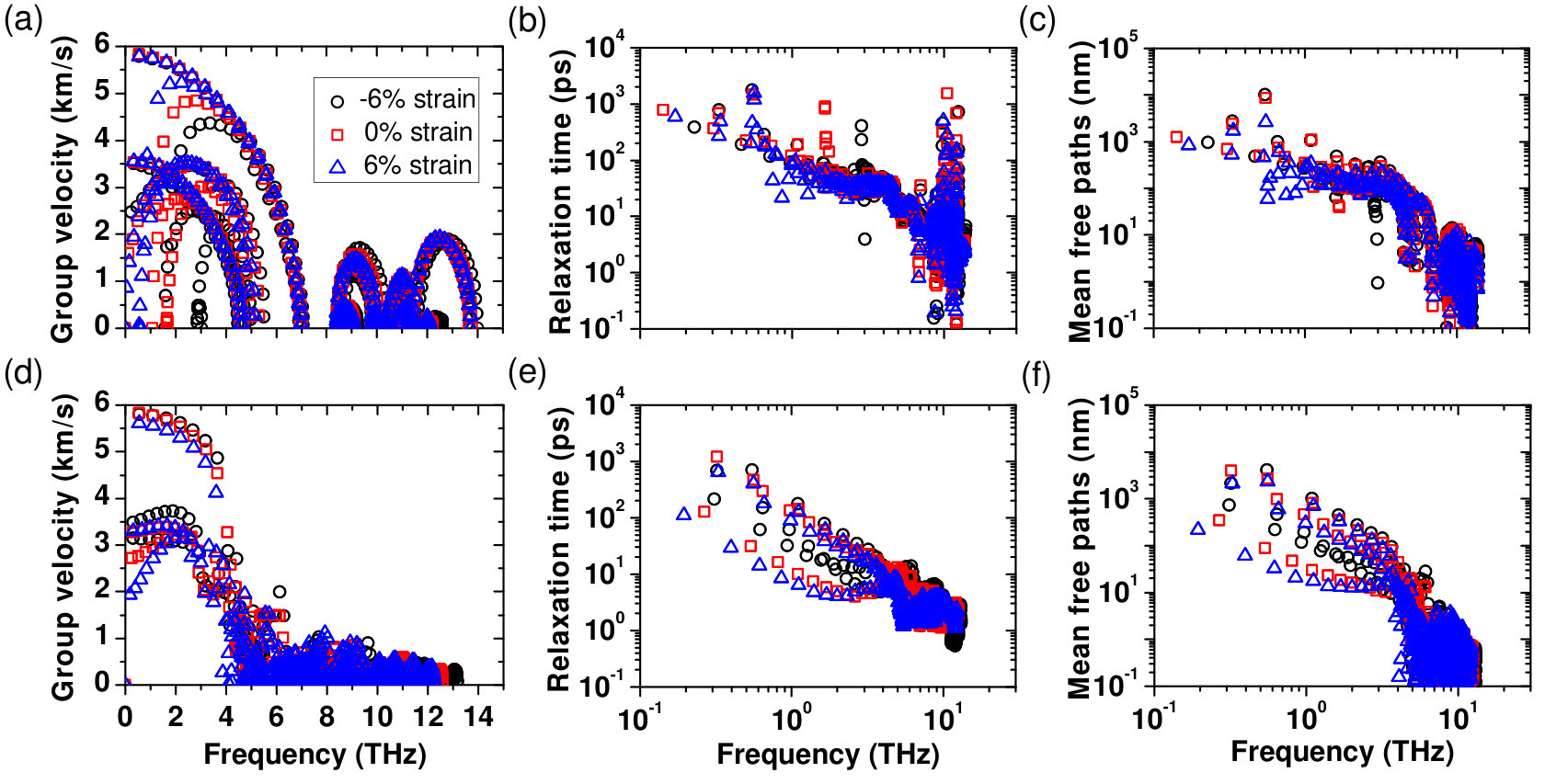 Figure 5
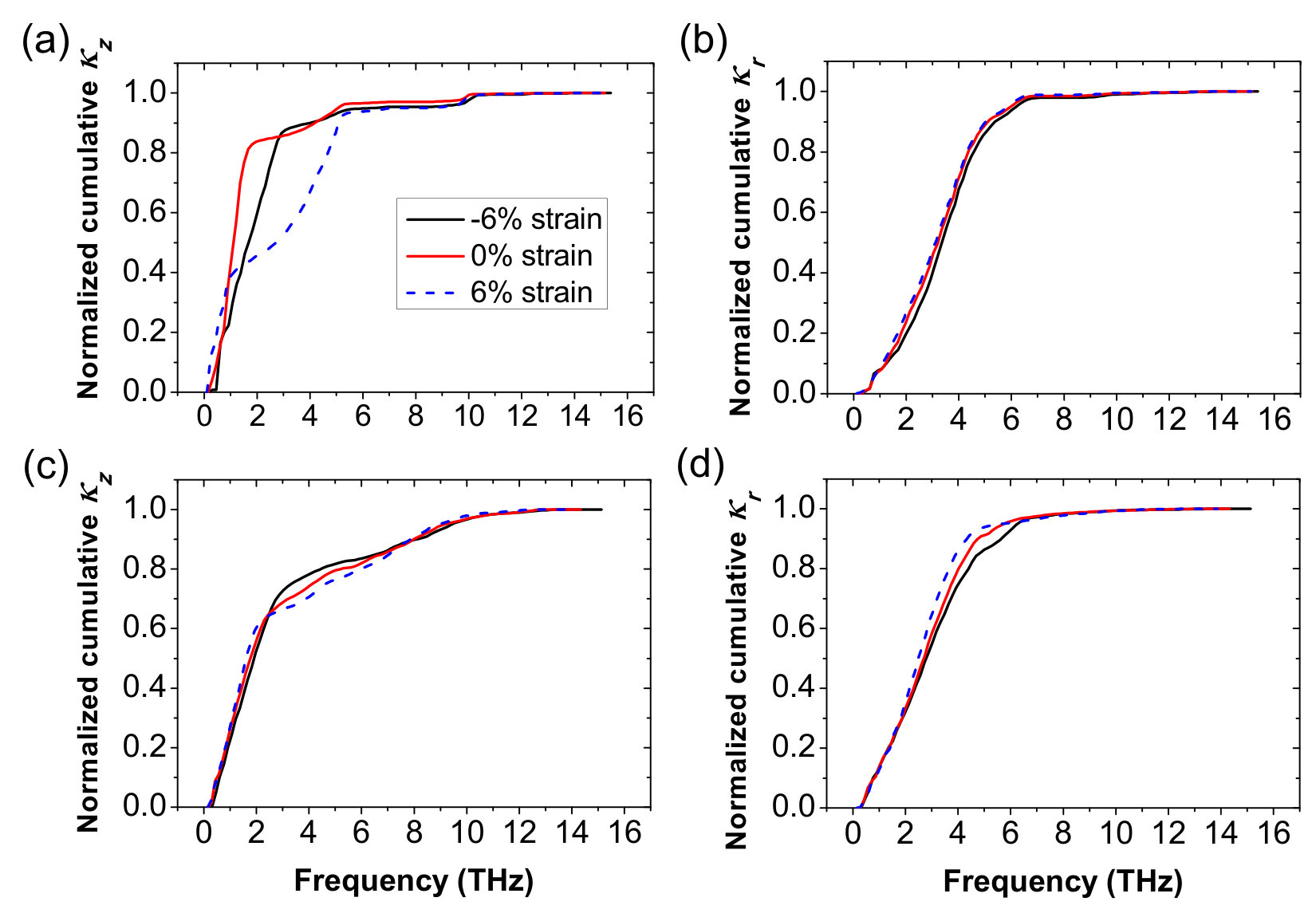 Figure 6
| Method | (2H)-MoS2 | (1T)-LiMoS2 | a-axis expansion | c-axis expansion | ||
|---|---|---|---|---|---|---|
| a | c | a | c | |||
| LDA (This work) | 3.142 | 12.053 | 6.776 | 6.054 | 7.8% | 0.46% |
| vdW-DF-cx (This work) | 3.158 | 12.284 | 6.789 | 6.229 | 7.5% | 1.4% |
| LDA (Ref. [30]) | 3.14 | 12.05 | - | - | - | - |
| PBE (DFT-D3) (Ref. [29]) | 3.157 | 12.225 | - | - | - | - |
| vdW-DF-cx (Ref. [31]) | 3.152 | 12.291 | - | - | - | - |
| Exp. (Ref. [65]) | 3.169 | 12.322 | - | - | - | - |
| Exp. (Ref. [66]) | - | - | 6.798 | 6.262 | 7.3% | 1.6% |
| Exp. (Ref. [27]) | - | 12.32 | - | 6.19 | - | 0.5% |
Peer Reviews
No public reviews on file for this paper yet. If you reviewed it on a platform where reviews are public (OpenReview, ICLR, NeurIPS, ICML), you can paste yours below so the community can read it here.
Videos
No videos yet. Explain this paper in a talk, walkthrough, or lecture? Add one.
Strongly Tunable Anisotropic Thermal Transport in MoS2 by Strain and Lithium Intercalation: First–Principles Calculations
Shunda Chen1, Aditya Sood2,3,6, Eric Pop2,4,5, Kenneth E. Goodson3, Davide Donadio1
1Department of Chemistry, University of California Davis, One Shields Ave. Davis, CA 95616, USA
2Department of Electrical Engineering, Stanford University, Stanford, CA 94305, USA
3Department of Mechanical Engineering, Stanford University, Stanford, CA 94305, USA
4Department of Materials Science and Engineering, Stanford University, Stanford, CA 94305, USA
5Precourt Institute for Energy, Stanford University, Stanford, CA 94305, USA
6Present address: Stanford Institute for Materials and Energy Sciences, SLAC National Accelerator Laboratory, Menlo Park, CA 94025, USA
Abstract
The possibility of tuning the vibrational properties and the thermal conductivity of layered van der Waals materials either chemically or mechanically paves the way to significant advances in nanoscale heat management. Using first-principles calculations we investigate the modulation of heat transport in MoS2 by lithium intercalation and cross-plane strain. We find that both the in-plane and cross-plane thermal conductivity (, ) of MoS2 are extremely sensitive to both strain and electrochemical intercalation. Combining lithium intercalation and strain, the in-plane and cross-plane thermal conductivity can be tuned over one and two orders of magnitude, respectively. Furthermore, since and respond in different ways to intercalation and strain, the thermal conductivity anisotropy can be modulated by two orders of magnitude. The underlying mechanisms for such large tunability of the anisotropic thermal conductivity of MoS2 are explored by computing and analyzing the dispersion relations, group velocities, relaxation times and mean free paths of phonons. Since both intercalation and strain can be applied reversibly, their stark effect on thermal conductivity can be exploited to design novel phononic devices, as well as for thermal management in MoS2-based electronic and optoelectronic systems.
††: \TDM
Keywords: 2D Layered Materials, MoS2, Lithium Intercalation, Anisotropic Thermal Conductivity, Strain, Tunability
1 Introduction
Among two-dimensional (2D) layered materials, transition metal dichalcogenides (TMDCs) are of special interest for next-generation electronic and optoelectronic devices. In fact, in contrast to graphene, many TMDCs are semiconductors with considerable band gap [1, 2, 3, 4]. Among TMDCs, molybdenum disulphide (MoS2) has been explored most intensively [5, 6, 3, 2, 7, 8, 9, 10, 4]. Its mechanical flexibility makes it a compelling semiconducting material for flexible electronics [11, 12, 13, 14], and its large interlayer separation provides ideal space to intercalate guest species, such as alkali metal ions. Lithium intercalation of MoS2, has been reported to enhance the optical transmission and increase electrical conductivity due to changes in the electronic band structure and the injection of free carriers [15]. Reversible intercalation and deintercalation of Li in MoS2 opens a route for novel applications in batteries and supercapacitors [16].
Thermal management in such applications, both at the nanoscale and at the macroscopic scale is a crucial issue [17]. As in other layered van der Waals materials, heat transport in MoS2 is strongly anisotropic featuring high conductivity in plane and low conductivity across the layers. In spite of its importance, the estimates of thermal conductivity of MoS2 reported are in a wide range. The experimental estimates for in-plane thermal conductivity () at room temperature vary from 13.3 to 110 Wm*-1K-1* [18, 19, 20, 21, 22, 23, 24], and those of cross-plane thermal conductivity () vary from 2.0 to 5.3 Wm*-1K-1* [21, 25, 24]. Such discrepancies may stem either from different quality of samples or from different experimental conditions and measurement techniques.
Even though it was suggested that intercalation may produce substantial reduction of thermal conductivity [14, 26], fundamental aspects of thermal transport in intercalated MoS2 are still not well understood. Recent measurements indicate that lithiation reduces of a MoS2 thin-film by a factor of two, while the effect on bulk samples is non-monotonic as a function of the concentration of Li [27]. At a fractional Li composition (in LixMoS2) of 0.86, of bulk MoS2 is reduced by 1.25 times, and is reduced by about 1.31 times [27]. In addition, thermal conductance across tens of nanometer thick MoS2 films can be reversibly reduced by times through electrochemical lithiation [28].
Atomistic simulations could provide a rationale for such experimental findings, and help resolving discrepancies in experiments. Heat transport in MoS2 has been addressed theoretically by both first-principles anharmonic lattice dynamics and molecular dynamics (MD) simulations. First-principles calculations can be transferable and predictive, but the computation of anharmonic force constants and the solution of the linearized Boltzmann transport equation (BTE) need to satisfy tight convergence criteria. Former first-principles BTE calculations give between 83 to 103 Wm*-1K-1* [29, 30, 31], and from 2.3 to 5.1 Wm*-1K-1* [29, 30, 31]. Non-monotonic changes of as a function of partial lithium intercalation were recently reproduced by first-principles calculations on finite thickness open systems [32]. MD simulations, in turn, depend on the quality of the empirical potentials utilized, and provide too large a range of estimates for from 1.35 to 110 Wm*-1K-1* [33, 34, 35, 36, 37, 38, 39], whereas for values are between 4 and 6.6 Wm*-1K-1* [33, 40]. Interestingly, MD simulations predicted a large modulation of as a function of cross-plane strain [37], but it is necessary to verify whether this result is independent of the adopted empirical potential, so to provide quantitative predictions that would aid the design of new MoS2-based materials and devices.
While the possibility of modulating the thermal conductivity of MoS2 is very appealing for applications in nanoscale electronic and thermal devices with tunable thermal functionality [41, 42, 43, 44, 45, 25, 46, 47, 48, 49, 50, 51], a compelling understanding of the combined effects of strain and electrochemical intercalation is still lacking.
To fill this gap, we investigate the phonon properties and thermal conductivity of pristine and lithiated MoS2 (LiMoS2), and we systematically probe the influence of cross-plane strain effects, by first-principles calculations. We show that both the in-plane and cross-plane thermal conductivity of MoS2 can be tuned substantially by lithium intercalation and cross-plane strain. For both pristine MoS2 and LiMoS2, the cross-plane thermal conductivity is strongly enhanced by compressive strain and decreased by tensile strain. In MoS2 such variation amounts to up to two orders of magnitude for the strain range investigated. Furthermore we show that Li intercalation produces a more than seven-fold reduction of , while is halved. The different response of the in-plane and cross-plane components of may be exploited to modulate the anisotropy ratio, so to achieve more or less directional heat dissipation.
We compute the thermal conductivity of pristine hexagonal trigonal prismatic (2H)-MoS2 and LiMoS2 by solving the linearized phonon BTE, with harmonic and anharmonic force constants computed by first-principles density functional theory (DFT). DFT calculations are performed using both the local density approximation (LDA) and a van der Waals functional (vdW-DF) with consistent exchange (vdW-DF-cx) [52]. This first-principles BTE (FP-BTE) approach [53] has proven accurate and predictive for a large variety of systems, including 2D and van der Waals layered materials [54, 55, 56, 57, 58, 59, 60, 61, 62, 31]. As a result of linearizing and solving the BTE, the lattice thermal conductivity tensor is expressed as:
[TABLE]
where is the Bose-Einstein distribution function, is the phonon angular frequency, is the group velocity component along the -direction, and is the relaxation time for phonons with polarization propagating in the direction . Self-consistent BTE entails a directional dependence of phonon relaxation times, as the direction of the heat flux determines different shifts in the phonon population and therefore different scattering efficiency [54, 62]. In the calculation of phonon relaxation times we consider intrinsic three-phonon scattering processes and extrinsic isotopic mass scattering [63]. The natural isotopic distributions of Mo, S, and Li are considered [64] and results are compared to those obtained for isotopically pure systems, so as to assess the effect of isotopic scattering. Systems are considered in the infinite periodic bulk limit with no boundary scattering.
Following Eq. 1, FP-BTE not only provides a reliable estimate of , but it also allows one to resolve the contribution to in terms of phonon frequency, polarization and mean free path (MFP), thus uncovering the mechanistic details of heat transport in crystalline materials. Our accurate, well converged, parameter-free first-principles calculations predict a strong modulation of thermal conductivity of layered MoS2 by mechanical strain and lithium intercalation, and provide both a detailed microscopic interpretation of recent experiments and reliable benchmarks for future ones.
2 Results and discussion
Structure.
The stable 2H phase of MoS2 consists of planes with one formula unit each per unit cell, arranged in AB stacking. Upon lithium intercalation, MoS2 planes undergo a transition from trigonal prismatic 2H to distorted octahedral 1T, and their stacking changes from AB to AA [68]. The in-plane symmetry is reduced and in the 1T phase the primitive cell contains four LiMoS2 units in a superstructure.
The optimized lattice parameters of both pristine and lithiated MoS2 (Table 1) compare very well with experiments. These results confirm that our computational framework describes accurately the structural features of MoS2 and their changes upon Li intercalation. In particular, we note that the 2H to 1T transition, occurring upon intercalation, produces an expansion of the in-plane lattice parameter by 7.8% [66], but accommodates lithium with an inter-planar expansion as small as 0.5%, as also observed in recent experiments [27]. vdW-DF-cx calculations give lattice constants closer to experiments (within 0.4%) than LDA, and consistent lattice expansion rates: a-axis (in-plane) expansion of 7.5% and c-axis (cross-plane) expansion of 1.4%, which are in good agreement with experimental data [66]. This result is important, because it suggests that in experiments, in which large c-axis expansion rates are observed [69, 70, 71], either the transition to the 1T phase is not complete or samples entail mesoscale disorder that induces strain.
Upon intercalation Li donates an electron to the system, which would in principle become metallic. However a Jahn-Teller transition [72] to the distorted 1T phase re-instates a gap between the valence and conduction band, making the system a semiconductor. Even if the 1T lithiated system were assumed to be metallic, the electrical contribution to thermal conductivity would be much smaller than the lattice contribution, as estimated by Zhu et al[27]. Hence, in the following we can safely neglect the contribution of electrons to thermal transport.
Thermal conductivity.
Figure 1 shows the in-plane and cross-plane thermal conductivity of pristine and fully lithiated MoS2 as a function of strain. Since the discrepancies among former FP-BTE calculations [29, 30, 31] of the thermal conductivity of pure MoS2 may be due to convergence issues, we have taken care of converging our calculations with respect to all the DFT and BTE parameters (see Supplementary Figures S1-S13). In particular, due to the long-range nature of the interactions in MoS2, it is critical to consider interactions up to the 9th neighbors shell to construct the anharmonic force constants tensor in order to achieve well-converged results for (Figure S7).
We find that isotopic scattering has a strong effect on , for which isotopically pure MoS2 turns out about 20% higher than that of MoS2 with natural composition. The isotopic effect for is milder as the difference is only 10%, and it is even weaker on both and of LiMoS2 (see Figure 1 and Figure S25 for more details). The following results refer to materials with natural isotopic composition.
Along with structural changes, lithium intercalation into MoS2 leads to a seven-fold reduction of in-plane thermal conductivity, and two-fold reduction in cross-plane thermal conductivity. The two-fold reduction in upon full lithiation predicted by FP-BTE is on the same order as the reduction of measured by Zhu et al[27] for bulk MoS2 (the measured drops from 2 to 1.6 Wm*-1K-1* upon lithiation to , a factor of 1.25). Note that our FP-BTE predicts of pristine bulk MoS2 of about 5 Wm*-1K-1*, whereas Zhu et al [27] measured 2 Wm*-1K-1*. Such discrepancy may be due to the small penetration depth (high modulation frequency) of the time-domain thermoreflectance (TDTR) measurement, as discussed in Refs. [24, 67, 73]. However, given that the source of MoS2 crystals is generally mineralogical, variations in crystal quality between samples cannot entirely be ruled out. Our results set the theory benchmark for the thermal conductivity of an unlithiated pristine system, and are in excellent agreement with recent measurements by Jiang et al[24, 67] and DFT calculations by Lindroth et al[31]. As for in-plane thermal conductivity there is a striking discrepancy between calculations and TDTR measurements [27], which suggest that is only slightly affected by lithium intercalation. Such discrepancy between ab initio theory and experiments would deserve further investigation.
Even larger modulations of occur in samples strained in the direction perpendicular to the MoS2 planes. In these calculations the cross plane lattice parameter is fixed and all the other parameters, including the in-plane lattice parameter are relaxed. We consider strain () from -6% (compressive) to (tensile), corresponding to applied stress from -6 to 5 GPa, respectively (Figure S14). The cross-plane thermal conductivity of pristine MoS2 varies monotonically over two orders of magnitude, from 0.35 Wm*-1K-1* upon tensile strain to 18.09 Wm*-1K-1* upon compressive strain. Recent measurements show that increases under compressive strain in multilayer MoS2 [74], in qualitative agreement with our predictions. In contrast, the cross-plane thermal conductivity of LiMoS2 exhibits less variability, from 1.5 Wm*-1K-1* upon tensile strain to 4.1 Wm*-1K-1* upon compressive strain. Consequently, a crossover in occurs upon tensile strain: the cross-plane thermal conductivity of LiMoS2 becomes larger than that of MoS2 for tensile strain larger than 2. Cross-plane strain also causes variations of the in-plane thermal conductivity but to a lesser extent. of MoS2 is reduced by up to about 10 by either tensile or compressive strain. of LiMoS2 varies monotonically from 11.3 Wm*-1K-1* for systems subject to large tensile strain to 13.3 Wm*-1K-1* upon compressive strain.
Since cross-plane and in-plane components of the thermal conductivity tensor show different sensitivity to cross-plane strain, it is then possible to modulate the anisotropy ratio () over a very wide range of values. Within the strain range investigated, the anisotropy ratio of MoS2 is varied from 5 to 250 (Figure 2). Conversely, lithiation significantly reduces the overall anisotropy of and the ratio changes from 3.3 to 7.3 as a function of strain. The modulation of the anisotropy ratio of is not significantly affected by isotopic composition.
Phonon properties.
We now analyze the origin of the modulation of thermal conductivity induced by lithium intercalation and strain, in terms of phonon properties and their contribution to , as expressed by Eq. 1. The two panels of Figure 3 display the effects of Li intercalation and strain on phonon dispersion relations. Previous reports showed that the majority heat carriers are acoustic modes with frequency below 6 THz for in-plane and 3 THz for cross-plane (see also Figure 6), and that the gap between acoustic and optical modes in pure MoS2 limits the amount of viable scattering channels, leading to very high in-plane thermal conductivity [29, 30, 31].
Upon intercalation we observe two major changes in the dispersion relations. On the one hand, both in-plane and cross-plane acoustic modes are stiffened upon lithiation. On the other hand the larger number of atoms per unit cell in LiMoS2 engenders a corresponding number of phonon branches that fill the gaps of the spectrum of MoS2 (see Figure 3, and Figures S12, S13 and S15). The majority of these optical modes, especially those localized on Li atoms have relatively flat dispersion and do not carry significant amounts of heat, but they contribute scattering channels to acoustic modes [28]. The overall effect is a significant reduction of , especially in plane.
Cross-plane strain mostly influences the dispersion relations of the acoustic modes of both MoS2 and LiMoS2. Along the -A high symmetry direction, i.e. cross-plane, compressive strain induces a significant stiffening of all three acoustic branches in both systems, while tensile strain induces softening. For phonons propagating in-plane (-M-K- path), cross-plane strain impacts only the flexural modes, producing either stiffening (compressive) or softening (tensile).
The magnitude of such changes is much larger for MoS2 than for LiMoS2, as confirmed by the calculation of the cross plane group velocities, reported in Figure 4a and 4d. The group velocities of the phonons propagating across the layers of MoS2 are largely enhanced upon compression and reduced upon tensile strain, in accordance with the effect seen on its thermal conductivity. In particular, the speed of sound increases from 3000 m/s to 5500 m/s upon 6 compression. Considering that acoustic modes are the main heat carriers, and that is proportional to , such change is sufficient to justify the increase of thermal conductivity upon compression from to Wm*-1K-1* (Figure 1a). The same argument explains the reduction of upon tensile strain.
Such variations of group velocities are accompanied by enhancement/reduction in phonon relaxation times (Figure 4b), hence in mean free paths (Figure 4c), which overall contribute to the observed strong modulation of . In LiMoS2, group velocities, relaxation times and mean free paths follow the same trends as in MoS2, but the effect of strain is much weaker (Figure 4d-f). This is because the stiffening of the structure upon intercalation limits the range of variation of the cross plane group velocities. For compressed and unstrained systems, phonon lifetimes in LiMoS2 are significantly smaller than those in pristine MoS2, resulting in a much reduced . However, the smaller range of variation of group velocities and lifetimes upon tensile strain leads to the observed crossover in at strain. Hence intercalated metals may play a role as channels between layers, possibly enhancing heat transport in weakly bonded strained systems.
The analysis of the in-plane phonon properties of MoS2 and LiMoS2 sheds light on the trends of . Group velocities, relaxation times and mean free paths along the high symmetry -M direction are reported in Figure 5a-c for pristine MoS2 and Figure 5d-f for LiMoS2. The effect of lithium intercalation on in-plane phonon modes is to reduce the frequency range of acoustic modes with significant group velocity, as well as to reduce the overall lifetimes and mean free paths. Both these effects are consequences of the 2H–1T structural transition, and account for the observed major reduction of from 93.2 to 12.2 Wm*-1K-1*. For pristine MoS2, strain reduces the MFPs of the ZA modes through two different mechanisms. Compressive strain reduces the group velocities, whereas tensile strain reduces the relaxation times. These two disparate effects cause a mild reduction of upon both tensile and compressive cross-plane strain, inducing the non-monotonic behavior shown in Figure 1b. For LiMoS2, both the group velocities and the relaxation times of the ZA modes increase upon compressive deformations and decrease under tensile strain, leading to a monotonic trend of versus strain.
These effects modify the relative contribution of phonons with different frequency to the total cross-plane and in-plane thermal conductivity, as shown by the cumulative and as a function of frequency reported in Figure 6. For pristine MoS2, compressive strain extends the contribution of higher frequencies to by stiffening of the acoustic branches. Conversely, tensile strain reduces the range of the acoustic branches so much that the relative contribution of higher frequencies appears more relevant. Li intercalation extends substantially the range of frequencies that contribute to cross-plane heat transport, making the contributions from optical modes up to THz relevant. As for in-plane heat transport, Li intercalation significantly affects the absolute value of , but not the relative contribution of different phonon frequencies. The relative contribution of different phonon frequencies to is mildly affected for the lightly stiffening (softening) of flexural modes by compressive (tensile) strain.
Although we have not considered the effect of in-plane strain, we argue that it would induce the modulation of phonon transport analogous to those computed upon cross-plane strain, due to the mechanical response of the system through its Poisson’s ratio (Figures S26, S27) [75, 76, 77]. Consistently with this argument, MD simulations suggested that both tensile and compressive in-plane strain would reduce of single-layer MoS2 [78].
3 Conclusions
In conclusion, first-principles calculations performed with strict convergence criteria allow us to resolve discrepancies in the literature about the thermal conductivity of MoS2, thus establishing a reliable benchmark for future experiments and simulations.
These calculations show that both the in-plane and cross-plane thermal conductivity of MoS2 are critically sensitive to both strain and intercalation. We predict that lithium intercalation of bulk MoS2 produces more than seven-fold reduction in , and two-fold reduction in . These results constitute a lower bound for the thermal conductivity modulation caused by Li intercalation, without considering structural disorder (mixed phases, vacancies, etc). Most remarkably, of MoS2 can be modulated over two orders of magnitude by strain between -6 to 6, whereas of LiMoS2 is less sensitive to strain. By combining strain and intercalation it is possible to tune the anisotropy ratio of from 5 to 250. Being able to modulate the thermal conductivity anisotropy ratio over such a wide range can have important applications in thermal management. These calculations provide a theoretical benchmark that will enable the interpretation of experimental measurements of thermal conduction in intercalated van der Waals transition metal dichalcogenides. They provide guidelines to design materials and engineer devices with tunable thermal conductivity.
4 Methods
To properly take into account collective effects in phonon transport, we solve the BTE self-consistently, as implemented in the ShengBTE code [79, 80, 54, 81].
DFT calculations are performed within local density approximation (LDA) of the exchange and correlation functional [82] by using the Quantum-Espresso package [83, 84]. Core electrons are approximated using norm-conserving pseudopotentials [85], and the valence electronic wavefunctions are expanded in a plane-wave basis set with a kinetic energy cutoff of 100 Ry. The charge density is integrated on 10x10x4 and 4x4x4 Monkhorst-Pack meshes of k-points for pristine MoS2 and LiMoS2, respectively. Structural and cell relaxations are performed using a quasi-Newton optimization algorithm with a tight convergence criterion of Rydberg/Bohr for maximum residual force component. To model lithium intercalation of MoS2, we used the optimized MoS2 structure to construct a 2x2x1 supercell, and inserted Li atoms in the vdW gap. We verified that the system relaxes spontaneously to the distorted 1T phase.
We utilize density-functional perturbation theory (DFPT) [86] to calculate harmonic interatomic force constants (IFCs) with 10x10x4 and 4x4x4 q-point meshes for pristine (2H)-MoS2 and LiMoS2, respectively. Anharmonic third order force constants for the calculation of lattice thermal conductivity are computed by finite differences up to a cutoff interatomic distance 7.04 Å, corresponding to the 11th nearest neighbour shell, in a supercell containing atoms for pristine (2H)-MoS2. For (1T)-LiMoS2 we use a cutoff up to 8th nearest neighbour in a super-cell with atoms. Third derivatives of the potential energy with respect to displacements of atoms along coordinates are computed by finite differences ( Å), and translational invariance is enforced using the Lagrangian approach [81].
For pristine MoS2, it is necessary to take iterative self-consistent (SCF) calculations, since relaxation time approximation (RTA) underestimates its thermal conductivity (see Figures S16 and S17). For LiMoS2, we found that RTA yields the same results as SCF within 1% (see Figures S18 and S19). We carefully checked the convergence with q-points grids up to 45x45x11 for pristine MoS2 (see Figure S5) and up to 23x23x23 for LiMoS2 (see Figure S6). Details on convergence tests are provided in the supporting information.
The main results of this work are confirmed by calculations performed using a van der Waals density functional (vdW-DF) [87, 88, 89, 90] with non-empirical consistent exchange (vdW-DF-cx) [91, 52], and projector augmented wave (PAW) pseudopotentials [92, 93] (see Figures S20-S24). These tests justify a posteriori the use of LDA, which reproduces the van der Waals interaction among different planes due to error cancellation between the exchange and the correlation parts of the functional. More details are provided in the supporting information.
Supporting Information: Detailed convergence tests of FP-BTE calculations, full phonon dispersion curves, stress-strain curves for pristine MoS2 and LiMoS2 (Figures S1-S15); comparison between the self-consistent (SCF) solution and relaxation time approximation (RTA) of the Boltzmann transport equation (Figures S16-S19); calculations performed using van der Waals density functional (vdW-DF, with non-empirical consistent exchange) and projector augmented wave (PAW) pseudopotentials (Figures S20-S24); a comparison of of systems with pure and natural isotopic composition upon cross-plane strain (Figure S25); the Poisson’s ratio for pristine MoS2 and LiMoS2 by LDA and vdW-DF with non-empirical consistent exchange (Figures S26-S27).
Useful discussions with Jesús Carrete, Wu Li, Majid Zeraati, David Strubbe, Daniele Selli and Shruba Ganghopadhyay are gratefully acknowledged. AS, EP and KEG acknowledge funding from the National Science Foundation (NSF) under the EFRI 2-DARE grant 1542883.
References
- [1]
Chhowalla M, Shin H S, Eda G, Li L J, Loh K P and Zhang H 2013 Nat Chem 5 263–275 ISSN 1755-4330 URL http://www.nature.com/nchem/journal/v5/n4/full/nchem.1589.html
- [2]
Wang Q H, Kalantar-Zadeh K, Kis A, Coleman J N and Strano M S 2012 Nat Nano 7 699–712 ISSN 1748-3387 URL https://www.nature.com/nnano/journal/v7/n11/full/nnano.2012.193.html
- [3]
Butler S Z, Hollen S M, Cao L, Cui Y, Gupta J A, Gutiérrez H R, Heinz T F, Hong S S, Huang J, Ismach A F, Johnston-Halperin E, Kuno M, Plashnitsa V V, Robinson R D, Ruoff R S, Salahuddin S, Shan J, Shi L, Spencer M G, Terrones M, Windl W and Goldberger J E 2013 ACS Nano 7 2898–2926 ISSN 1936-0851 URL http://dx.doi.org/10.1021/nn400280c
- [4]
Duong D L, Yun S J and Lee Y H 2017 ACS Nano 11 11803–11830 ISSN 1936-0851 URL https://doi.org/10.1021/acsnano.7b07436
- [5]
Splendiani A, Sun L, Zhang Y, Li T, Kim J, Chim C Y, Galli G and Wang F 2010 Nano Lett. 10 1271–1275 ISSN 1530-6984 URL http://dx.doi.org/10.1021/nl903868w
- [6]
Radisavljevic B, Radenovic A, Brivio J, Giacometti V and Kis A 2011 Nature Nanotechnology 6 147–150 ISSN 1748-3395 URL https://www.nature.com/articles/nnano.2010.279
- [7]
Sundaram R S, Engel M, Lombardo A, Krupke R, Ferrari A C, Avouris P and Steiner M 2013 Nano Lett. 13 1416–1421 ISSN 1530-6984 URL http://dx.doi.org/10.1021/nl400516a
- [8]
Lee H S, Min S W, Chang Y G, Park M K, Nam T, Kim H, Kim J H, Ryu S and Im S 2012 Nano Lett. 12 3695–3700 ISSN 1530-6984 URL http://dx.doi.org/10.1021/nl301485q
- [9]
Yin Z, Li H, Li H, Jiang L, Shi Y, Sun Y, Lu G, Zhang Q, Chen X and Zhang H 2012 ACS Nano 6 74–80 ISSN 1936-0851 URL http://dx.doi.org/10.1021/nn2024557
- [10]
Tsai M L, Su S H, Chang J K, Tsai D S, Chen C H, Wu C I, Li L J, Chen L J and He J H 2014 ACS Nano 8 8317–8322 ISSN 1936-0851 URL http://dx.doi.org/10.1021/nn502776h
- [11]
Pu J, Yomogida Y, Liu K K, Li L J, Iwasa Y and Takenobu T 2012 Nano Lett. 12 4013–4017 ISSN 1530-6984 URL http://dx.doi.org/10.1021/nl301335q
- [12]
Chang H Y, Yang S, Lee J, Tao L, Hwang W S, Jena D, Lu N and Akinwande D 2013 ACS Nano 7 5446–5452 ISSN 1936-0851 URL http://dx.doi.org/10.1021/nn401429w
- [13]
Cheng R, Jiang S, Chen Y, Liu Y, Weiss N, Cheng H C, Wu H, Huang Y and Duan X 2014 Nature Communications 5 5143 ISSN 2041-1723 URL http://www.nature.com/ncomms/2014/141008/ncomms6143/full/ncomms6143.html
- [14]
Wan C, Gu X, Dang F, Itoh T, Wang Y, Sasaki H, Kondo M, Koga K, Yabuki K, Snyder G J, Yang R and Koumoto K 2015 Nat Mater 14 622–627 ISSN 1476-1122 URL http://www.nature.com/nmat/journal/v14/n6/full/nmat4251.html
- [15]
Xiong F, Wang H, Liu X, Sun J, Brongersma M, Pop E and Cui Y 2015 Nano Lett. 15 6777–6784 ISSN 1530-6984 URL http://dx.doi.org/10.1021/acs.nanolett.5b02619
- [16]
Rasamani K D, Alimohammadi F and Sun Y 2017 Materials Today 20 83–91 ISSN 1369-7021 URL http://www.sciencedirect.com/science/article/pii/S1369702116302334
- [17]
Pop E 2010 Nano Res. 3 147–169 ISSN 1998-0124, 1998-0000 URL https://link.springer.com/article/10.1007/s12274-010-1019-z
- [18]
Sahoo S, Gaur A P S, Ahmadi M, Guinel M J F and Katiyar R S 2013 J. Phys. Chem. C 117 9042–9047 ISSN 1932-7447 URL http://dx.doi.org/10.1021/jp402509w
- [19]
Yan R, Simpson J R, Bertolazzi S, Brivio J, Watson M, Wu X, Kis A, Luo T, Hight Walker A R and Xing H G 2014 ACS Nano 8 986–993 ISSN 1936-0851 URL http://dx.doi.org/10.1021/nn405826k
- [20]
Jo I, Pettes M T, Ou E, Wu W and Shi L 2014 Appl. Phys. Lett. 104 201902 ISSN 0003-6951 URL http://aip.scitation.org/doi/10.1063/1.4876965
- [21]
Liu J, Choi G M and Cahill D G 2014 Journal of Applied Physics 116 233107 ISSN 0021-8979 URL http://aip.scitation.org/doi/10.1063/1.4904513
- [22]
Zhang X, Sun D, Li Y, Lee G H, Cui X, Chenet D, You Y, Heinz T F and Hone J C 2015 ACS Appl. Mater. Interfaces 7 25923–25929 ISSN 1944-8244 URL http://dx.doi.org/10.1021/acsami.5b08580
- [23]
Bae J J, Jeong H Y, Han G H, Kim J, Kim H, Kim M S, Moon B H, Lim S C and Lee Y H 2017 Nanoscale 9 2541–2547 ISSN 2040-3372 URL https://pubs.rsc.org/en/content/articlelanding/2017/nr/c6nr09484h
- [24]
Jiang P, Qian X and Yang R 2017 Review of Scientific Instruments 88 074901 ISSN 0034-6748 URL http://aip.scitation.org/doi/10.1063/1.4991715
- [25]
Muratore C, Varshney V, Gengler J J, Hu J, Bultman J E, Roy A K, Farmer B L and Voevodin A A 2014 Phys. Chem. Chem. Phys. 16 1008–1014 ISSN 1463-9084 URL http://pubs.rsc.org/en/content/articlelanding/2014/cp/c3cp53746c
- [26]
Cho J, Losego M D, Zhang H G, Kim H, Zuo J, Petrov I, Cahill D G and Braun P V 2014 Nature Communications 5 4035 ISSN 2041-1723 URL http://www.nature.com/ncomms/2014/140603/ncomms5035/full/ncomms5035.html
- [27]
Zhu G, Liu J, Zheng Q, Zhang R, Li D, Banerjee D and Cahill D G 2016 Nature Communications 7 13211 ISSN 2041-1723 URL http://www.nature.com/ncomms/2016/161021/ncomms13211/full/ncomms13211.html
- [28]
Sood A, Xiong F, Chen S, Wang H, Selli D, Zhang J, McClellan C J, Sun J, Donadio D, Cui Y, Pop E and Goodson K E 2018 Nature Communications 9 4510 ISSN 2041-1723 URL https://www.nature.com/articles/s41467-018-06760-7
- [29]
Gandi A N and Schwingenschlögl U 2016 EPL 113 36002 ISSN 0295-5075 URL http://stacks.iop.org/0295-5075/113/i=3/a=36002
- [30]
Gu X, Li B and Yang R 2016 Journal of Applied Physics 119 085106 ISSN 0021-8979 URL http://aip.scitation.org/doi/full/10.1063/1.4942827
- [31]
Lindroth D O and Erhart P 2016 Phys. Rev. B 94 115205 URL https://link.aps.org/doi/10.1103/PhysRevB.94.115205
- [32]
Bunjaku T and Luisier M 2018 arXiv:1811.07695 [cond-mat] ArXiv: 1811.07695 URL http://arxiv.org/abs/1811.07695
- [33]
Varshney V, Patnaik S S, Muratore C, Roy A K, Voevodin A A and Farmer B L 2010 Comput. Mater. Sci. 48 101–108 ISSN 0927-0256 URL http://www.sciencedirect.com/science/article/pii/S0927025609004583
- [34]
Liu X, Zhang G, Pei Q X and Zhang Y W 2013 Appl. Phys. Lett. 103 133113 ISSN 0003-6951 URL http://aip.scitation.org/doi/10.1063/1.4823509
- [35]
Jiang J W, Park H S and Rabczuk T 2013 Journal of Applied Physics 114 064307 ISSN 0021-8979 URL http://aip.scitation.org/doi/10.1063/1.4818414
- [36]
Wei X, Wang Y, Shen Y, Xie G, Xiao H, Zhong J and Zhang G 2014 Appl. Phys. Lett. 105 103902 ISSN 0003-6951 URL http://aip.scitation.org/doi/10.1063/1.4895344
- [37]
Ding Z, Jiang J W, Pei Q X and Zhang Y W 2015 Nanotechnology 26 065703 ISSN 0957-4484 URL http://stacks.iop.org/0957-4484/26/i=6/a=065703
- [38]
Kandemir A, Yapicioglu H, Kinaci A, Çaǧın T and Sevik C 2016 Nanotechnology 27 055703 ISSN 0957-4484 URL http://stacks.iop.org/0957-4484/27/i=5/a=055703
- [39]
Hong Y, Zhang J and Zeng X C 2016 J. Phys. Chem. C 120 26067–26075 ISSN 1932-7447 URL http://dx.doi.org/10.1021/acs.jpcc.6b07262
- [40]
Wei Z, Liu B, Liu C, Bi K, Yang J and Chen Y 2015 J. Phys. D: Appl. Phys. 48 465303 ISSN 0022-3727 URL http://stacks.iop.org/0022-3727/48/i=46/a=465303
- [41]
Cahill D G, Braun P V, Chen G, Clarke D R, Fan S, Goodson K E, Keblinski P, King W P, Mahan G D, Majumdar A, Maris H J, Phillpot S R, Pop E and Shi L 2014 Applied Physics Reviews 1 011305 ISSN 1931-9401 URL http://aip.scitation.org/doi/10.1063/1.4832615
- [42]
Wang H, Yuan H, Hong S S, Li Y and Cui Y 2015 Chem. Soc. Rev. 44 2664–2680 ISSN 1460-4744 URL http://pubs.rsc.org/en/content/articlelanding/2015/cs/c4cs00287c
- [43]
Chiritescu C, Cahill D G, Nguyen N, Johnson D, Bodapati A, Keblinski P and Zschack P 2007 Science 315 351–353 ISSN 0036-8075, 1095-9203 URL http://science.sciencemag.org/content/315/5810/351
- [44]
Mavrokefalos A, Nguyen N T, Pettes M T, Johnson D C and Shi L 2007 Appl. Phys. Lett. 91 171912 ISSN 0003-6951 URL http://aip.scitation.org/doi/full/10.1063/1.2800888
- [45]
Luckyanova M N, Johnson J A, Maznev A A, Garg J, Jandl A, Bulsara M T, Fitzgerald E A, Nelson K A and Chen G 2013 Nano Lett. 13 3973–3977 ISSN 1530-6984 URL http://dx.doi.org/10.1021/nl4001162
- [46]
Luo Z, Maassen J, Deng Y, Du Y, Garrelts R P, Lundstrom M S, Ye P D and Xu X 2015 Nature Communications 6 8572 ISSN 2041-1723 URL http://www.nature.com/ncomms/2015/151016/ncomms9572/full/ncomms9572.html
- [47]
Renteria J D, Ramirez S, Malekpour H, Alonso B, Centeno A, Zurutuza A, Cocemasov A I, Nika D L and Balandin A A 2015 Adv. Funct. Mater. 25 4664–4672 ISSN 1616-3028 URL http://onlinelibrary.wiley.com/doi/10.1002/adfm.201501429/abstract
- [48]
Chen J, Chen S and Gao Y 2016 J. Phys. Chem. Lett. 7 2518–2523 ISSN 1948-7185 URL http://dx.doi.org/10.1021/acs.jpclett.6b00858
- [49]
Chen J, Chen S and Gao Y 2017 Phys. Rev. B 95 134301 URL https://link.aps.org/doi/10.1103/PhysRevB.95.134301
- [50]
Gao Y, Liu Q and Xu B 2016 ACS Nano 10 5431–5439 ISSN 1936-0851 URL http://dx.doi.org/10.1021/acsnano.6b01674
- [51]
Kang J S, Ke M and Hu Y 2017 Nano Lett. 17 1431–1438 ISSN 1530-6984 URL http://dx.doi.org/10.1021/acs.nanolett.6b04385
- [52]
Berland K, Arter C A, Cooper V R, Lee K, Lundqvist B I, Schröder E, Thonhauser T and Hyldgaard P 2014 J. Chem. Phys. 140 18A539 ISSN 0021-9606 URL http://aip.scitation.org/doi/10.1063/1.4871731
- [53]
Broido D A, Malorny M, Birner G, Mingo N and Stewart D A 2007 Appl. Phys. Lett. 91 231922 ISSN 0003-6951 URL http://aip.scitation.org/doi/10.1063/1.2822891
- [54]
Ward A, Broido D A, Stewart D A and Deinzer G 2009 Phys. Rev. B 80 125203 URL https://link.aps.org/doi/10.1103/PhysRevB.80.125203
- [55]
Ward A and Broido D A 2010 Phys. Rev. B 81 085205 URL https://link.aps.org/doi/10.1103/PhysRevB.81.085205
- [56]
Fugallo G, Lazzeri M, Paulatto L and Mauri F 2013 Phys. Rev. B 88 045430 URL https://link.aps.org/doi/10.1103/PhysRevB.88.045430
- [57]
Garg J, Bonini N, Kozinsky B and Marzari N 2011 Phys. Rev. Lett. 106 045901 URL https://link.aps.org/doi/10.1103/PhysRevLett.106.045901
- [58]
Lindsay L, Broido D A and Reinecke T L 2012 Phys. Rev. Lett. 109 095901 URL https://link.aps.org/doi/10.1103/PhysRevLett.109.095901
- [59]
Lindsay L, Broido D A and Reinecke T L 2013 Phys. Rev. Lett. 111 025901 URL https://link.aps.org/doi/10.1103/PhysRevLett.111.025901
- [60]
Bonini N, Garg J and Marzari N 2012 Nano Lett. 12 2673–2678 ISSN 1530-6984 URL http://dx.doi.org/10.1021/nl202694m
- [61]
Fugallo G, Cepellotti A, Paulatto L, Lazzeri M, Marzari N and Mauri F 2014 Nano Lett. 14 6109–6114 ISSN 1530-6984 URL http://dx.doi.org/10.1021/nl502059f
- [62]
Zeraati M, Vaez Allaei S M, Abdolhosseini Sarsari I, Pourfath M and Donadio D 2016 Phys. Rev. B 93 085424 URL https://link.aps.org/doi/10.1103/PhysRevB.93.085424
- [63]
Tamura S i 1983 Phys. Rev. B 27 858–866 URL https://link.aps.org/doi/10.1103/PhysRevB.27.858
- [64]
Berglund M and Wieser M E 2011 Pure Appl. Chem., PAC 83 397–410 ISSN 0033-4545, 1365-3075 URL https://www.iupac.org/publications/pac/83/2/0397/
- [65]
Petkov V, Billinge S J L, Larson P, Mahanti S D, Vogt T, Rangan K K and Kanatzidis M G 2002 Phys. Rev. B 65 092105 URL https://link.aps.org/doi/10.1103/PhysRevB.65.092105
- [66]
Mulhern P J 1989 Can. J. Phys. 67 1049–1052 ISSN 0008-4204 URL http://www.nrcresearchpress.com/doi/abs/10.1139/p89-184
- [67]
Jiang P, Qian X, Gu X and Yang R 2017 Adv. Mater. 29 1701068 ISSN 1521-4095 URL http://onlinelibrary.wiley.com/doi/10.1002/adma.201701068/abstract
- [68]
Cheng Y, Nie A, Zhang Q, Gan L Y, Shahbazian-Yassar R and Schwingenschlögl U 2014 ACS Nano 8 11447–11453 ISSN 1936-0851 URL http://dx.doi.org/10.1021/nn505668c
- [69]
Somoano R B, Hadek V and Rembaum A 1973 J. Chem. Phys. 58 697–701 ISSN 0021-9606 URL http://aip.scitation.org/doi/10.1063/1.1679256
- [70]
Py M A and Haering R R 1983 Can. J. Phys. 61 76–84 ISSN 0008-4204 URL http://www.nrcresearchpress.com/doi/abs/10.1139/p83-013
- [71]
Rocquefelte X, Bouessay I, Boucher F, Gressier P and Ouvrard G 2003 Journal of Solid State Chemistry 175 380–383 ISSN 0022-4596 URL http://www.sciencedirect.com/science/article/pii/S002245960300330X
- [72]
Jahn H A and Teller E 1937 Proc. R. Soc. Lond. A 161 220–235 ISSN 0080-4630, 2053-9169 URL http://rspa.royalsocietypublishing.org/content/161/905/220
- [73]
Sood A, Xiong F, Chen S, Cheaito R, Lian F, Asheghi M, Cui Y, Donadio D, Goodson K E and Pop E Quasi-ballistic Thermal Transport Across MoS2 Thin Films (Submitted)
- [74]
Meng X, Pandey T, Fu S, Yang J, Jeong J, Chen K, Singh A, He F, Xu X, Singh A K, Lin J F and Wang Y 2017 arXiv:1708.03849 [cond-mat] ArXiv: 1708.03849 URL http://arxiv.org/abs/1708.03849
- [75]
Greaves G N, Greer A L, Lakes R S and Rouxel T 2011 Nature Materials 10 823–837 ISSN 1476-4660 URL https://www.nature.com/articles/nmat3134
- [76]
Jiang J W and Park H S 2014 Nature Communications 5 4727 ISSN 2041-1723 URL https://www.nature.com/articles/ncomms5727
- [77]
Woo S, Park H C and Son Y W 2016 Phys. Rev. B 93 075420 URL https://link.aps.org/doi/10.1103/PhysRevB.93.075420
- [78]
Ding Z, Pei Q X, Jiang J W and Zhang Y W 2015 J. Phys. Chem. C 119 16358–16365 ISSN 1932-7447 URL http://dx.doi.org/10.1021/acs.jpcc.5b03607
- [79]
Sparavigna A 2002 Phys. Rev. B 66 174301 URL https://link.aps.org/doi/10.1103/PhysRevB.66.174301
- [80]
Li W, Lindsay L, Broido D A, Stewart D A and Mingo N 2012 Phys. Rev. B 86 174307 URL https://link.aps.org/doi/10.1103/PhysRevB.86.174307
- [81]
Li W, Carrete J, A Katcho N and Mingo N 2014 Comput. Phys. Commun. 185 1747–1758 ISSN 0010-4655 URL http://www.sciencedirect.com/science/article/pii/S0010465514000484
- [82]
Perdew J P and Zunger A 1981 Phys. Rev. B 23 5048–5079 URL https://link.aps.org/doi/10.1103/PhysRevB.23.5048
- [83]
Giannozzi P, Baroni S, Bonini N, Calandra M, Car R, Cavazzoni C, Davide Ceresoli, Chiarotti G L, Cococcioni M, Dabo I, Corso A D, Gironcoli S d, Fabris S, Fratesi G, Gebauer R, Gerstmann U, Gougoussis C, Anton Kokalj, Lazzeri M, Martin-Samos L, Marzari N, Mauri F, Mazzarello R, Stefano Paolini, Pasquarello A, Paulatto L, Sbraccia C, Scandolo S, Sclauzero G, Seitsonen A P, Smogunov A, Umari P and Wentzcovitch R M 2009 J. Phys.: Condens. Matter 21 395502 ISSN 0953-8984 URL http://stacks.iop.org/0953-8984/21/i=39/a=395502
- [84]
Giannozzi P, Andreussi O, Brumme T, Bunau O, Nardelli M B, Calandra M, Car R, Cavazzoni C, Ceresoli D, Cococcioni M, Colonna N, Carnimeo I, Corso A D, de Gironcoli S, Delugas P, Jr R A D, Ferretti A, Floris A, Fratesi G, Fugallo G, Gebauer R, Gerstmann U, Giustino F, Gorni T, Jia J, Kawamura M, Ko H Y, Kokalj A, Küçükbenli E, Lazzeri M, Marsili M, Marzari N, Mauri F, Nguyen N L, Nguyen H V, de-la Roza A O, Paulatto L, Poncé S, Rocca D, Sabatini R, Santra B, Schlipf M, Seitsonen A P, Smogunov A, Timrov I, Thonhauser T, Umari P, Vast N, Wu X and Baroni S 2017 Journal of Physics: Condensed Matter 29 465901 URL http://stacks.iop.org/0953-8984/29/i=46/a=465901
- [85]
Hartwigsen C, Goedecker S and Hutter J 1998 Phys. Rev. B 58 3641–3662 URL https://link.aps.org/doi/10.1103/PhysRevB.58.3641
- [86]
Baroni S, de Gironcoli S, Dal Corso A and Giannozzi P 2001 Rev. Mod. Phys. 73 515–562 URL https://link.aps.org/doi/10.1103/RevModPhys.73.515
- [87]
Thonhauser T, Zuluaga S, Arter C, Berland K, Schröder E and Hyldgaard P 2015 Phys. Rev. Lett. 115 136402 URL https://link.aps.org/doi/10.1103/PhysRevLett.115.136402
- [88]
Thonhauser T, Cooper V R, Li S, Puzder A, Hyldgaard P and Langreth D C 2007 Phys. Rev. B 76 125112 URL https://link.aps.org/doi/10.1103/PhysRevB.76.125112
- [89]
Berland K, Cooper V R, Lee K, Schröder E, Thonhauser T, Hyldgaard P and Lundqvist B I 2015 Rep. Prog. Phys. 78 066501 ISSN 0034-4885 URL http://stacks.iop.org/0034-4885/78/i=6/a=066501
- [90]
Langreth D C, Lundqvist B I, Chakarova-Käck S D, Cooper V R, Dion M, Hyldgaard P, Kelkkanen A, J Kleis, Kong L, Li S, Moses P G, Murray E, Puzder A, Rydberg H, Schröder E and Thonhauser T 2009 J. Phys.: Condens. Matter 21 084203 ISSN 0953-8984 URL http://stacks.iop.org/0953-8984/21/i=8/a=084203
- [91]
Berland K and Hyldgaard P 2014 Phys. Rev. B 89 035412 URL https://link.aps.org/doi/10.1103/PhysRevB.89.035412
- [92]
Blöchl P E 1994 Phys. Rev. B 50 17953–17979 URL https://link.aps.org/doi/10.1103/PhysRevB.50.17953
- [93]
Kresse G and Joubert D 1999 Phys. Rev. B 59 1758–1775 URL https://link.aps.org/doi/10.1103/PhysRevB.59.1758
The reference list from the paper itself. Each links out to its DOI / PubMed record.
- 1[1] Chhowalla M, Shin H S, Eda G, Li L J, Loh K P and Zhang H 2013 Nat Chem 5 263–275 ISSN 1755-4330 URL http://www.nature.com/nchem/journal/v 5/n 4/full/nchem.1589.html
- 2[2] Wang Q H, Kalantar-Zadeh K, Kis A, Coleman J N and Strano M S 2012 Nat Nano 7 699–712 ISSN 1748-3387 URL https://www.nature.com/nnano/journal/v 7/n 11/full/nnano.2012.193.html
- 3[3] Butler S Z, Hollen S M, Cao L, Cui Y, Gupta J A, Gutiérrez H R, Heinz T F, Hong S S, Huang J, Ismach A F, Johnston-Halperin E, Kuno M, Plashnitsa V V, Robinson R D, Ruoff R S, Salahuddin S, Shan J, Shi L, Spencer M G, Terrones M, Windl W and Goldberger J E 2013 ACS Nano 7 2898–2926 ISSN 1936-0851 URL http://dx.doi.org/10.1021/nn 400280 c
- 4[4] Duong D L, Yun S J and Lee Y H 2017 ACS Nano 11 11803–11830 ISSN 1936-0851 URL https://doi.org/10.1021/acsnano.7b 07436
- 5[5] Splendiani A, Sun L, Zhang Y, Li T, Kim J, Chim C Y, Galli G and Wang F 2010 Nano Lett. 10 1271–1275 ISSN 1530-6984 URL http://dx.doi.org/10.1021/nl 903868 w
- 6[6] Radisavljevic B, Radenovic A, Brivio J, Giacometti V and Kis A 2011 Nature Nanotechnology 6 147–150 ISSN 1748-3395 URL https://www.nature.com/articles/nnano.2010.279
- 7[7] Sundaram R S, Engel M, Lombardo A, Krupke R, Ferrari A C, Avouris P and Steiner M 2013 Nano Lett. 13 1416–1421 ISSN 1530-6984 URL http://dx.doi.org/10.1021/nl 400516 a
- 8[8] Lee H S, Min S W, Chang Y G, Park M K, Nam T, Kim H, Kim J H, Ryu S and Im S 2012 Nano Lett. 12 3695–3700 ISSN 1530-6984 URL http://dx.doi.org/10.1021/nl 301485 q