Electronic structure of Fe and magnetism in the $3d/5d$ double perovskites Ca$_2$FeReO$_6$ and Ba$_2$FeReO$_6$
E. Granado, J. C. Cezar, C. Azimonte, J. Gopalakrishnan, and K., Ramesha

TL;DR
This study investigates the electronic structure and magnetism of two Fe/Re double perovskites, Ca$_2$FeReO$_6$ and Ba$_2$FeReO$_6$, revealing how their different Re $5d$ electron configurations influence Fe $3d$ magnetism.
Contribution
It provides detailed spectroscopic insights into the distinct magnetic behaviors and electronic states of Ca$_2$FeReO$_6$ and Ba$_2$FeReO$_6$, highlighting the role of Re $5d$ electrons.
Findings
Ca$_2$FeReO$_6$ has Fe close to Fe$^{3+}$ with constrained magnetic moments.
Ba$_2$FeReO$_6$ exhibits intermediate Fe oxidation states with larger Fe magnetic moments.
Magnetic transition behaviors differ between the two compounds, influenced by Re $5d$ electron configurations.
Abstract
The Fe electronic structure and magnetism in (i) monoclinic CaFeReO with a metal-insulator transition at K and (ii) quasi-cubic half-metallic BaFeReO ceramic double perovskites are probed by soft x-ray absorption spectroscopy (XAS) and magnetic circular dichroism (XMCD). These materials show distinct Fe XAS and XMCD spectra, which are primarily associated with their different average Fe oxidation states (close to Fe for CaFeReO and intermediate between Fe and Fe for BaFeReO) despite being related by an isoelectronic (Ca/Ba) substitution. For CaFeReO, the powder-averaged Fe spin moment along the field direction ( T), as probed by the XMCD experiment, is strongly reduced in comparison with the spontaneous Fe moment previously obtained by neutron diffraction, consistent with a…
Click any figure to enlarge with its caption.
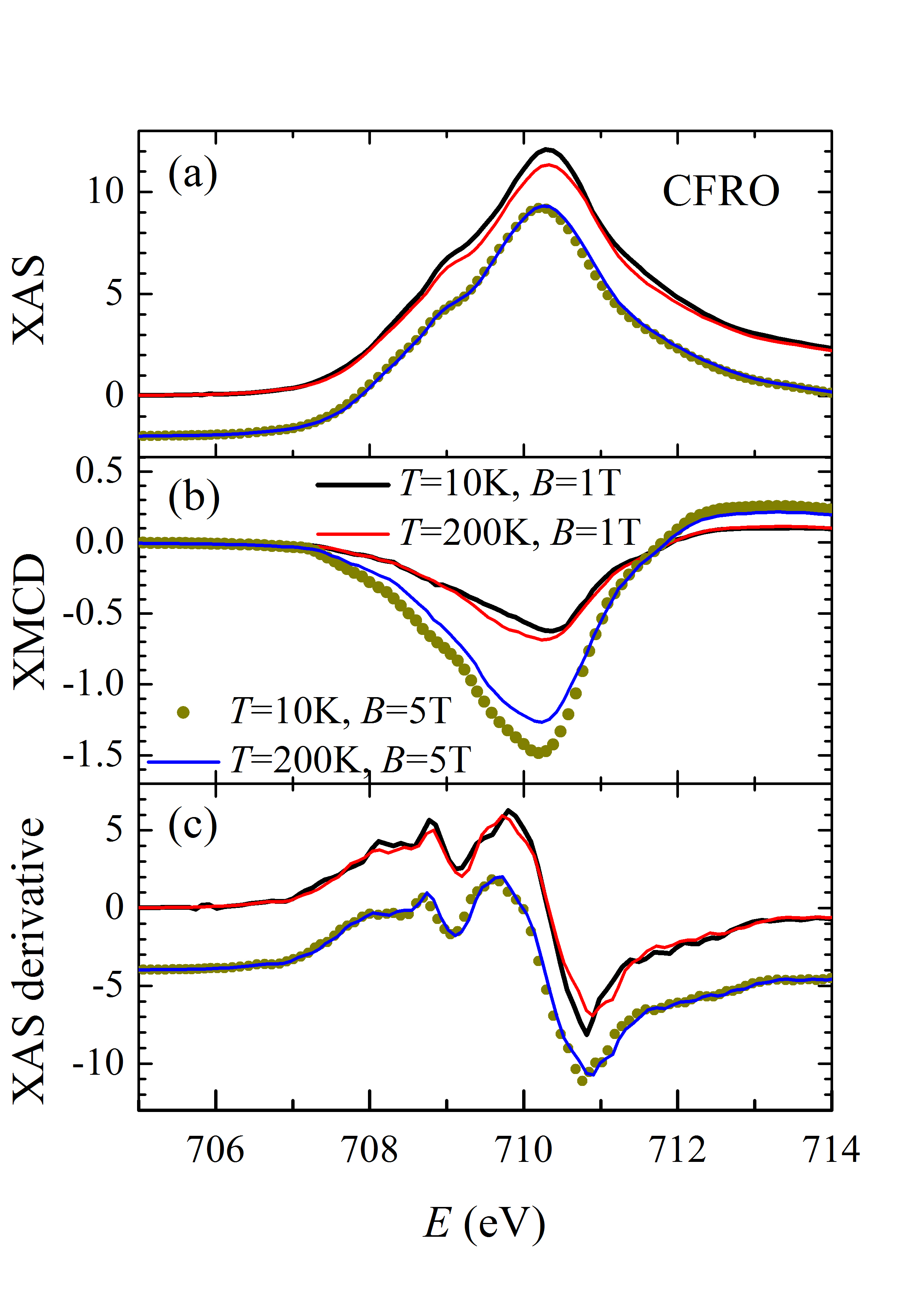 Figure 1
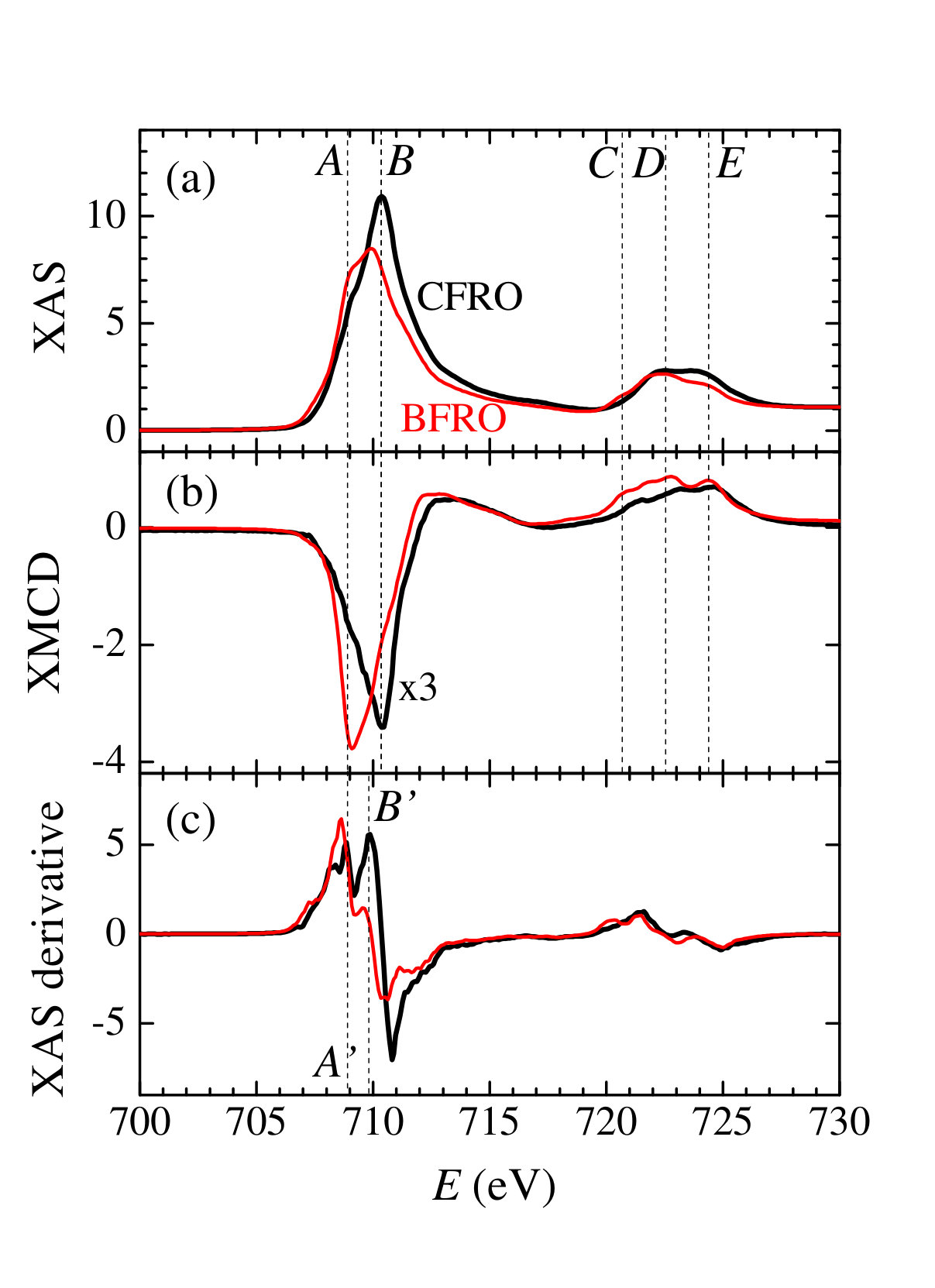 Figure 2
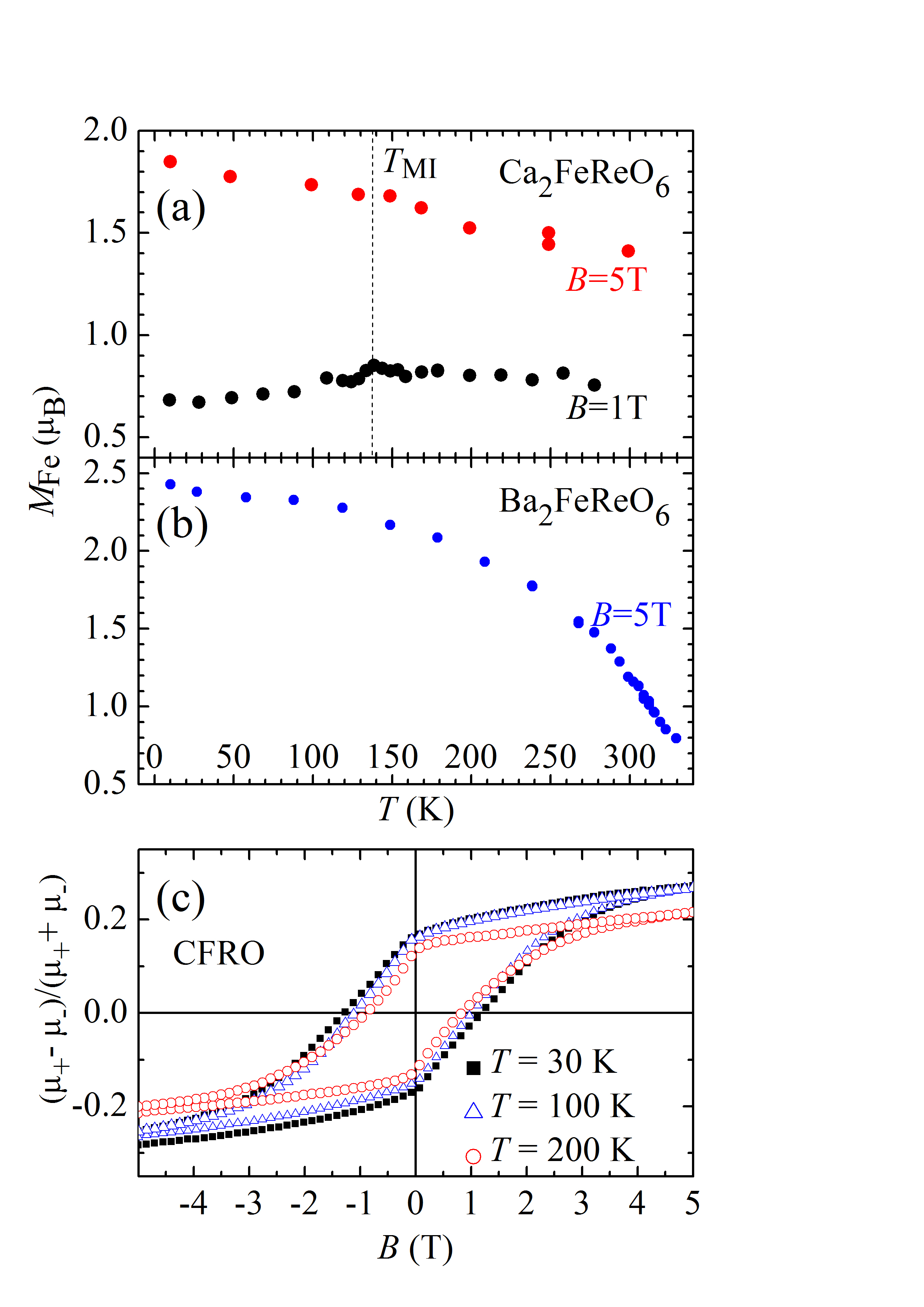 Figure 3
Peer Reviews
No public reviews on file for this paper yet. If you reviewed it on a platform where reviews are public (OpenReview, ICLR, NeurIPS, ICML), you can paste yours below so the community can read it here.
Videos
No videos yet. Explain this paper in a talk, walkthrough, or lecture? Add one.
Electronic structure of Fe and magnetism in the double perovskites Ca2FeReO6 and Ba2FeReO6
E. Granado
“Gleb Wataghin” Institute of Physics, University of Campinas - UNICAMP, Campinas, São Paulo 13083-859, Brazil
J. C. Cezar
Laboratório Nacional de Luz Síncrotron, Caixa Postal 6192, Campinas, São Paulo 13083-970, Brazil
C. Azimonte
“Gleb Wataghin” Institute of Physics, University of Campinas - UNICAMP, Campinas, São Paulo 13083-859, Brazil
J. Gopalakrishnan
Solid State and Structural Chemistry Unit, Indian Institute of Science, Bangalore 560012, India
K. Ramesha
Solid State and Structural Chemistry Unit, Indian Institute of Science, Bangalore 560012, India
Abstract
The Fe electronic structure and magnetism in (i) monoclinic Ca2FeReO6 with a metal-insulator transition at K and (ii) quasi-cubic half-metallic Ba2FeReO6 ceramic double perovskites are probed by soft x-ray absorption spectroscopy (XAS) and magnetic circular dichroism (XMCD). These materials show distinct Fe XAS and XMCD spectra, which are primarily associated with their different average Fe oxidation states (close to Fe3+ for Ca2FeReO6 and intermediate between Fe2+ and Fe3+ for Ba2FeReO6) despite being related by an isoelectronic (Ca2+/Ba2+) substitution. For Ca2FeReO6, the powder-averaged Fe spin moment along the field direction ( T), as probed by the XMCD experiment, is strongly reduced in comparison with the spontaneous Fe moment previously obtained by neutron diffraction, consistent with a scenario where the magnetic moments are constrained to remain within an easy plane. For T, the unsaturated XMCD signal is reduced below consistent with a magnetic transition to an easy-axis state that further reduces the powder-averaged magnetization in the field direction. For Ba2FeReO6, the field-aligned Fe spins are larger than for Ca2FeReO6 ( T) and the temperature dependence of the Fe magnetic moment is consistent with the magnetic ordering transition at K. Our results illustrate the dramatic influence of the specific spin-orbital configuration of Re electrons on the Fe local magnetism of these Fe/Re double perovskites.
I Introduction
In recent years, considerable attention has been given to or -based materials showing a combination of sizable spin-orbit coupling and electronic correlations. In particular, the spin-orbit entangled state found in Sr2IrO4 and related iridates is a direct consequence of such combination Kim, ; Kim2, ; Jackeli, ; Caorev, , with profound physical consequences such as a remarkable similarity between the iridate and cuprate phase diagrams Kim_ARPES1, ; Yan, ; Kim_ARPES2, ; Samanta, . This new front of research in condensed matter physics is not expected to remain restricted to iridates, but is most likely extensible to other compounds containing magnetic or ions. Also, alternating and ions in an ordered double perovskite structure offers a possible pathway to investigate ground states arising from the combination of strong SOC in ions and strong electronic correlation in ions Cavichini, . An interesting and relatively well studied family of double perovskites is the FeReO6 system (= Ca, Sr, Ba). The compounds Ba2FeReO6 and Sr2FeReO6 are ferrimagnetic half-metals with paramagnetic transition temperatures ’s above room temperature, being materials of interest for spintronics that are also related to the physics of Sr2FeMoO6 double perovskites (for reviews, see Refs. Serratereview, ; DeTeresareview, ; Vasalareview, ). Ba2FeReO6 in particular has a cubic crystal structure above K and a slight tetragonal distortion below due to a significant orbital polarization of the Re electrons Ferreira, ; Azimonte1, . The interplanar Bragg distances follow the direction of an external magnetic field below , advocating for a decisive role of a sizable spin-orbit coupling to the physics of this and related materials Azimonte1, . In fact, a number of x-ray magnetic circular dichroism (XMCD) studies in this family yielded large values of the Re orbital/spin magnetization ratio ( Azimonte1, ; Azimonte2, ; Sikora1, ; Sikora2, ; Escanhoela, ).
The half-metallic and ferrimagnetic ground state of many double perovskites such as Sr2FeMoO6, Sr2FeReO6 and Ba2FeReO6 is normally modelled in terms of double exchange interactions in the presence of spin-polarized conduction electrons Serratereview, ; DeTeresareview, ; Vasalareview, . In fact, the electronic structure of these materials is such that the spin-up Fe shell is completely filled, and the electronic band crossing the Fermi level is composed of hybridized Fe(:)-O()-Re(:) spin-down levels. Thus, the conduction electrons can be shared by Fe and Re ions in the ferrimagnetic configuration, leading, in an ionic picture, to mixed-valent FeFe3+ and ReRe5+ ions for Ba2FeReO6 and Sr2FeReO6 Gopal, .
The double exchange mechanism provides a clear connection between the physics of double perovskites and that of doped manganites. A distinction between these systems, however, is that strong correlation effects between Mn electrons lead to competing charge and orbitally ordered phases for manganites manganitereview, , being a decisive factor to unlock a plethora of fascinating physical phenomena and phase transitions that are characteristic of this system. On the other hand, in double perovskites the effects of electronic correlations are somewhat less explored. A candidate for showing strong correlation effects is Ca2FeReO6, the physical properties of which differ strongly from those of Ba2FeReO6 and Sr2FeReO6. For instance, Ca2FeReO6 shows a metal-insulator transition at K Kato, , a much lower temperature than the ferrimagnetic ordering temperature of this material, K Westerburg, ; Granado, ; Alamelu, ; DeTeresa, . Structurally, the competing phases are characterized by the same monoclinic space group with an tilt pattern in Glazer’s notation but with slightly different lattice parameters Westerburg, ; Granado, ; Kato, ; Oikawa, . Band structure calculations do not capture the insulating state of Ca2FeReO6 unless a relevant on-site Coulomb repulsion term is introduced Wu, ; Jeng, ; Szotek, ; Iwasawa, ; Antonov, ; Lee, ; Jeon, , leading to the perception that the Re electrons are indeed significantly correlated in this double perovskite Granado, ; Iwasawa, ; Antonov, ; Lee, . In fact, this transition at has been associated with an orbital ordering transition of the Re electrons Oikawa, ; Lee, ; Yuan, . The possible orbital character of the transition does not necessarily imply that the state above is orbitally disordered, nor that the spin-orbital coupling energy is smaller than the exchange coupling in this system. Actually, the monoclinic lattice parameter of Ca2FeReO6 shows an anomalous expansion below , Granado, , suggesting that an orbitally ordered state associated with the Re spin-orbit coupling develops just below the magnetic ordering transition (i.e., much above ). This conclusion is also supported by the large magnetostriction of this compound even for Serrate, . Thus, the possible orbital transition at for Ca2FeReO6 most likely involves two distinct and competing spin-orbital ordered states rather than being a transition between an orbitally ordered and a disordered state. According to neutron diffraction experiments Granado, ; Oikawa, , the spin-orbital state below shows a spontaneous moment direction along the monoclinic principal axis (b), while above the magnetic moments lie in the ac-plane. More recently, an inelastic neutron scattering study showed the development of a gap in the spin excitations below Yuan, , consistent with the development of an easy-axis magnetic state below this temperature. On the other hand, the gapless magnetic excitations above are consistent with either an easy-plane spin-orbital configuration or an orbitally disordered state. Application of a magnetic field of several tesla tends to favor the growth of the metallic state Granado, . This effect leads to a remarkable magnetoresistance effect for Ca2FeReO6 and Ca1.5Sr0.5FeReO6 magnetoresistance,
Despite the considerable attention paid so far to the behavior of the Re electrons and the relative role of their electronic correlations and spin-orbit coupling in these Fe/Re-based double perovskites, relatively little information on the element-specific Fe electronic states is presently available. Considering that the valence/conduction electrons in these systems may show a mixed character between Fe , Re and O levels, a systematic investigation of the Fe -projected states may provide additional information about the intriguing physics presented by this system. In this work, we report the Fe electronic structure and magnetism of Ca2FeReO6 and Ba2FeReO6 by means of XAS and XMCD experiments at the Fe edges, for temperatures below 350 K and magnetic fields below 5 T. The XAS spectra show substantial differences between these compounds, consistent with their distinct Fe electronic occupations. The temperature-dependencies of their XAS spectra show anomalies associated with charge-transfer effects at K for Ca2FeReO6 and K for Ba2FeReO6. In addition, the Fe moment at low temperatures obtained from our XMCD data for Ca2FeReO6 for a field of 5 T is substantially smaller than the Fe moment obtained by a previous neutron diffraction study on the same sample Granado, , signaling a very strong magnetostructural coupling for the Fe moments. For T, the unsaturated XMCD signal is reduced below indicating a magnetically harder insulating state with respect to the metallic one. It is inferred that the observed hardness of the Fe moments in CFRO, and to a lesser extend in BFRO, is caused by a superexchange interaction with the Re moments, where the latter are pinned to the lattice due to the sizable spin-orbit interaction. This also leads to the observed sensitivity of the field-aligned Fe ordered moments probed by XMCD to the transition at , where the specific spin-orbital ordering pattern of the Re electrons is most likely changed.
II Experimental details
The pellets of polycrystalline Ca2FeReO6 and Ba2FeReO6 used here are the same employed in our previous investigations Granado, ; Azimonte1, ; Azimonte2, . Details of the synthesis method can be found elsewhere Prellier, . The XAS and XMCD measurements were done at the European Synchrotron Radiation Facility (ESRF), on the high field magnet end station of beamline ID08 by taking the total electron yield. The pellets were scrapped prior to the measurements with a diamond file under high vacuum. All XAS [] and XMCD [] experiments were performed with 100 % circularly polarized light under applied magnetic fields along the direction of beam propagation. and spectra as a function of were collected on warming by changing the helicity of the incoming photons at a fixed field, which was applied at the base temperature after a zero field cooling procedure from 300 K. All XAS data were normalized by the edge step between 700 and 730 eV. The spectra taken in different conditions were aligned in energy using a weak feature observed in the incident flux () near the Fe edge position, which was associated with a small Fe contamination in the beamline optics.
III Results and analysis
Figures 1(a)-1(c) show the XAS, XMCD and XAS derivative spectra, respectively, of Ba2FeReO6 and Ca2FeReO6 at the Fe edges and K. These edges correspond to electronic transitions from the Fe () and () core levels to the Fe states above the Fermi level. For the XAS spectrum of Ca2FeReO6 at the edge, a relatively sharp peak is observed at 710.5 eV (feature in Fig. 1) with a shoulder at eV (), while at the edge a structure with two overlapping peaks at 722.5 and 724.5 eV ( and ) is seen. The XMCD spectrum of Ca2FeReO6 shows a negative peak at position in the edge and three positive peaks at the edge. The XMCD spectrum of Ba2FeReO6 shows a pronounced negative peak at the position, while the XMCD shows an additional positive peak at with respect to Ca2FeReO6. We should mention that a theoretical XAS spectrum of Ba2FeReO6 was recently generated by ab-initio calculations Antonov, , showing very good agreement with our experimental data. The XAS derivative spectrum of Ca2FeReO6 shows two relatively sharp positive peaks at 708.8 and 709.8 eV, which are marked in Fig. 1(c) as and , respectively. Also, a shoulder located eV below feature is observed. Measurements performed in different beamtime periods and on different pieces of our ceramic sample of Ca2FeReO6 showed variations of the relative magnitude of this shoulder with respect to the sharp feature , indicating a large sensitivity of this spectral feature on possible variations of the conditions of the probed surface. The systematic XAS and XMCD measurements of Ca2FeReO6 as a function of temperature and magnetic field shown below were taken in a fresh re-scraped ceramic piece yielding the most pronounced sharp feature with a minimal low-energy shoulder as displayed in Figs. 1(c) and 2(c).
Figures 2(a)-2(c) show the XAS, XMCD and XAS derivative spectra, respectively, of Ca2FeReO6 at the Fe edge at selected temperatures ( and 200 K) and magnetic fields ( and 5 T). Although all spectra are very similar, minor changes in the spectrum at K and T can be noticed, most notably sharper XAS derivative features at 709.5 and 710.5 eV [see Fig. 2(c)]. These distinctions are most likely associated with the dominance of the insulating state below and low fields, which may show slightly different lattice parameters Granado, ; Oikawa, and electronic structure, thereby altering slightly the Fe edge spectrum. For high fields ( T) and/or high temperatures ( K), the metallic phase tends to be dominant Granado, , explaining the similar Fe XAS and XMCD spectral shapes for T obtained at both 10 and 200 K (see Fig. 2).
From the XMCD data at the Fe edges, the powder-averaged Fe spin and orbital net moments aligned along the field direction were extracted through well established sum rules Thole, ; Carra, ; Chen, ; Azimonte1, ; Azimonte2, . Here, we employ the Fe level occupations and for Ca2FeReO6 and Ba2FeReO6, respectively, obtained by band structure calculations Wu, , and also applied the correction term and for the Fe spin moments in Ca2FeReO6 and Ba2FeReO6, respectively, due to the spin-orbit coupling in the Fe core holes Teramura, ; Azimonte1, ; Azimonte2, . Also, the mean value of the dipole magnetic operator is assumed to be much smaller than the projected spin . This assumption is certainly valid for nearly spherical shells, which is arguably the case for Ca2FeReO6 considering the proximity of the Fe electronic configuration to the Fe3+ state for Ca2FeReO6 (see below). For Ba2FeReO6 with an intermediate Fe valence between 2+ and 3+, this assumption is less justified. Nonetheless, even in this case we argue that the correction is rather modest, since an estimated % of the Fe magnetic moments would arise from the fully occupied spin-up band for which . The extracted Fe moments at K and T are and for Ca2FeReO6 and Ba2FeReO6, respectively, which are consistent with previous results Azimonte1, ; Azimonte2, . Figure 3(a) shows the temperature-dependence of the Fe spin moments for Ca2FeReO6 for and 5 T. The corresponding data for Ba2FeReO6 and T are given in Fig. 3(b). The Fe orbital moments are null within our sensitivity ( ) for both samples and all temperatures and are not shown. The Fe spin moments for Ca2FeReO6 and T show a smooth increase on warming from the lowest temperatures, peaking at and decreasing again on further warming. The thermal evolution of the Fe spins is qualitatively different for the same sample and T, rather showing a continuous decrease on warming with a small bump at . For Ba2FeReO6 and T, the Fe magnetization shows a continuous decrease upon warming, with an inflection point at K. The significant Fe moments above this temperature are ascribed to a -induced magnetic polarization in the paramagnetic phase.
IV Discussion
IV.1 Electronic structure
The XAS spectra at the Fe edges [see Fig. 1] provide important information on the Fe electronic states of Ca2FeReO6 and Ba2FeReO6. A comparison of our data with published results for Sr2FeMoO6 and related compounds Ray, ; AbbateDP, ; Kang, ; Kuepper, ; Kuepper2, ; Besse, ; Kang2, reveals that the shoulder is weaker for Ca2FeReO6 than for Sr2FeMoO6, indicating a valence state closer to Fe3+ for the former. Also, the XAS spectrum of Ca2FeReO6 is similar to that of LaFeO3 Abbate, , except for a smaller splitting of and peaks and a slightly larger spectral weight ratio for Ca2FeReO6. These considerations indicate an Fe valence state close to +3 for our Ca2FeReO6 sample, which is consistent with a Mösbauer spectrum obtained for this sample Gopal, and with bond valence analysis using the Fe-O distances obtained from powder diffraction data, which yielded a valence of +2.94 at room temperature Granado, ; Oikawa, . The smaller splitting of the and features in Ca2FeReO6 with respect to LaFeO3 is associated with a smaller overall cubic crystal field parameter for the former, which is presumably an influence of the strongly charged Re5+ cations in the crystal field sensed by Fe. For Ba2FeReO6, the shoulder at the XAS edge shows a significantly larger spectral weight in comparison to Ca2FeReO6. Also, at the edge an additional peak component () can be seen at 719 eV. Note that, besides the changes in lineshape, the XAS and XMCD spectra of Ba2FeReO6 are shifted to lower energies in comparison to Ca2FeReO6, indicating a smaller Fe valence state for the former. This conclusion is also in general agreement with previous XAS Herrero, , Mössbauer Gopal, , and neutron diffraction Azimonte1, studies.
It is interesting to notice that, according to the above scenario, the formal Re valence must be close to Re5+ in the insulating phase of Ca2FeReO6, with two electrons in the Re levels. In an atomistic picture, this should lead to local states with effective total angular momentum Chen, . The local Re magnetization in this case is then given by (Re) in units of Bohr magnetons Chen2, , thus the ordered local magnetization projected into the principal axis should be (Re) , in agreement with experimental values obtained by neutron diffraction Granado, ; Oikawa, .
IV.2 Magnetism
A detailed account of our XMCD measurements provides useful information on the element-specific magnetism of Ca2FeReO6 and Ba2FeReO6. As shown in Figs. 3(a) and 3(b), the extracted Fe moments at K and T through XMCD sum rules are and for Ca2FeReO6 and Ba2FeReO6, respectively, which should be contrasted with the zero-field neutron diffraction values at comparable temperatures, and , respectively Granado, ; Azimonte1, . Thus, while the XMCD moment taken for Ba2FeReO6 at T is 77 % of the neutron diffraction value, for Ca2FeReO6 this proportion is reduced to only 54 %. In a previous preliminary study, such surprisingly small moments were attributed to magnetically hard magnetic domains and significant Fe/Re intersite disorder across those grain boundaries probed by soft XAS measurements obtained by total electron yield detection method Azimonte2, . On the other hand, the Re moments previously obtained by bulk-sensitive XAS at the hard x-ray Re edges at ordinary fields ( T) also seem to be significantly reduced with respect to neutron diffraction values Escanhoela, ; Azimonte1, ; Granado, ; Sikora1, . Also, the curves of Fig. 3(c) indicate that the Ca2FeReO6 moments are close to domain wall saturation for T in the conditions of our experiment, and therefore the relatively small Fe spin moments aligned to such an external field obtained by XMCD do not seem to be attributable to persistent magnetic domains. Note that the extremely large magnetocrystalline anisotropy of the Fe moments implied by the above considerations is highly unusual for Fe3+ with half-filled shell and null orbital moment, confirmed here by our analysis of XMCD data. In the present case, the hardness of the Fe spins is presumably caused by a superexchange interaction between Fe and Re moments, where the latter can be pinned to the lattice by the large unquenched orbital component. For Ca2FeReO6, the monoclinic structure likely stabilizes an specific spin-orbital configuration for the Re moments, also pinning down the Fe spins. As a consequence, the Fe moments would be necessarily confined to a specific axis or plane of the crystal structure. In a powder ceramic sample like the present case, the crystalline axes are randomly oriented with respect to the applied magnetic field, therefore the component of the average Fe moments along the field measured by XMCD should be substantially smaller than the spontaneous Fe moments measured by neutron diffraction, as indeed observed here. A simple calculation shows that, when the atomic moments are constrained to lie along an specific axis of the crystal structure, the domain-saturated powder-averaged magnetization along the field direction will be only , where is the spontaneous intradomain magnetization along the easy axis (probed by neutron scattering). If the above constraint is partly relaxed so that the moments have an easy plane rather than an easy axis, the saturated powder-averaged magnetization along the field direction will be . The XMCD value for the Fe moment for T is 54 % of the spontaneous moment obtained from neutron powder diffraction for Ca2FeReO6 at low temperatures, which is close to the expected value for an easy axis configuration. We should mention that, for much higher fields ( T), the magnetic moments will tend to align along the field direction through a non-hysteretic magnetic rotation process, leading to magnetic moments obtained by XMCD that should be closer to the spontaneous moments obtained by neutron diffraction Sikora2, .
The above considerations provide insight not only to the harder magnetic state of the insulating phase with respect to the metallic one, but also to the physical mechanism leading to the magnetic field-dependence of the balance between these phases Granado, . In fact, since the metallic phase has a easy-plane spin-orbital configuration and therefore a larger powder-averaged magnetization in the field direction with respect the easy-axis configuration of the insulating state, that phase also has a stronger Zeeman coupling energy, thereby altering the delicate energy balance between such competing phases. The influence of the magnetic field is amplified by the fact that the competing phases have very similar free energies over a wide temperature range magnetoresistance, .
For the quasi-cubic tetragonal crystal structure of Ba2FeReO6, the situation may be distinct with respect to Ca2FeReO6, owing to the quasi-degeneracy between the Re spin-orbital states. In this case, the magnetic moments may be allowed to align along equivalent crystallographic directions, such as the a, b, or c quasi-cubic axes, whichever is closest to the external field for each grain. This scenario tends to yield an average projected Fe moment in the field direction, measured by XMCD at relatively modest fields, which is only slightly smaller than the neutron diffraction value, consistent with our observation for this material. A weaker magnetostructural coupling for this compound is also consistent with the rather weak tetragonal distortion below Azimonte1, ; Ferreira, and the nearly gapless magnetic excitation spectrum Plumb, .
V Conclusions
In summary, the Fe electronic state in FeReO6 ( = Ca and Ba) is found to be strongly dependent on . For Ca2FeReO6 the Fe valence state is close to 3+ both below and above . For Ba2FeReO6, the Fe XAS spectrum is consistent with an intermediate state between Fe2+ and Fe3+. Such valence instability of Fe with respect to an isoelectronic -site substitution likely results from a competition between (i) Re electronic correlations assisted by strong spin-orbit coupling favoring an insulating ground state with pure Fe3+ and Re5+ valence states, and (ii) double exchange interactions for hybridized Fe()-O()-Re() electrons that favor a ferrimagnetic and metallic ground state with mixed-valent Fe and Re ions. Concerning the magnetic properties, the powder-averaged Fe moments aligned to a field of 5 T obtained through XMCD sum rules for Ca2FeReO6 is nearly half of the spontaneous moments extracted from previous neutron diffraction data at low temperatures, suggesting a very strong magnetocrystalline anisotropy for the Fe local moments in this material, presumably caused by exchange interactions with the Re moments. This effect is less severe for Ba2FeReO6.
Acknowledgements.
ESRF is acknowledged for concession of beamtime. This work was supported by FAPESP Grants No. 2017/10581-1 and No. 2018/20142-8, and CNPq Grants No. 409504/2018-1 and No. 308607/2018-0, Brazil.
The reference list from the paper itself. Each links out to its DOI / PubMed record.
- 1(1) B.J. Kim, H. Jin, S.J. Moon, J.-Y. Kim, B.-G. Park, C.S. Leem, J. Yu, T.W. Noh, C. Kim, S.-J. Oh, J.-H. Park, V. Durairaj, G. Cao, and E. Rotenberg, Phys. Rev. Lett. 101 , 076402 (2008).
- 2(2) B.J. Kim, H. Ohsumi, T. Komesu, S. Sakai, T. Morita, H. Takagi, and T. Arima, Science 323 , 1329 (2009).
- 3(3) G. Jackeli and G. Khaliullin, Phys. Rev. Lett. 102 , 017205 (2009).
- 4(4) G. Cao and P. Schlottmann, Rep. Progr. Phys. 81 , 042502 (2018).
- 5(5) Y.K. Kim, O. Krupin, J.D. Denlinger, A. Bostwick, E. Rotenberg, Q. Zhao, J.F. Mitchell, J. W. Allen, and B. J. Kim, Science 345 , 187 (2014).
- 6(6) Y.J. Yan, M.Q. Ren, H.C. Xu, B.P. Xie, R. Tao, H.Y. Choi, N. Lee, Y.J. Choi, T. Zhang, and D.L. Feng, Phys. Rev. X 5 , 041018 (2015).
- 7(7) Y.K. Kim, N.H. Sung, J.D. Denlinger, and B.J. Kim, Nature Phys. 12 , 37 (2016).
- 8(8) K. Samanta, F.M. Ardito, N.M. Souza-Neto, and E. Granado, Phys. Rev. B 98 , 094101 (2018).