Search for the production of W$^\pm$W$^\pm$W$^\mp$ events at $\sqrt{s} =$ 13 TeV
CMS Collaboration

TL;DR
This paper reports a search for triple W boson production in proton-proton collisions at 13 TeV, using CMS data, and sets limits on anomalous couplings and axion-like particles, with no significant signal observed.
Contribution
First search for W$^"+$W$^"+$W$^"-$ production at 13 TeV, providing experimental limits on anomalous gauge couplings and axion-like particles.
Findings
Observed significance of 0.60 sigma, below the expected 1.78 sigma.
Measured signal yield ratio of 0.34 with large uncertainties.
Set limits on anomalous quartic gauge couplings and axion-like particles.
Abstract
A search for the production of events containing three W bosons predicted by the standard model is reported. The search is based on a data sample of proton-proton collisions at a center-of-mass energy of 13 TeV recorded by the CMS experiment at the CERN LHC and corresponding to a total integrated luminosity of 35.9 fb. The search is performed in final states with three leptons (electrons or muons), or with two same-charge leptons plus two jets. The observed (expected) significance of the signal for WWW production is 0.60 (1.78) standard deviations, and the ratio of the measured signal yield to that expected from the standard model is 0.34 . Limits are placed on three anomalous quartic gauge couplings and on the production of massive axionlike particles.
Click any figure to enlarge with its caption.
 Figure 1
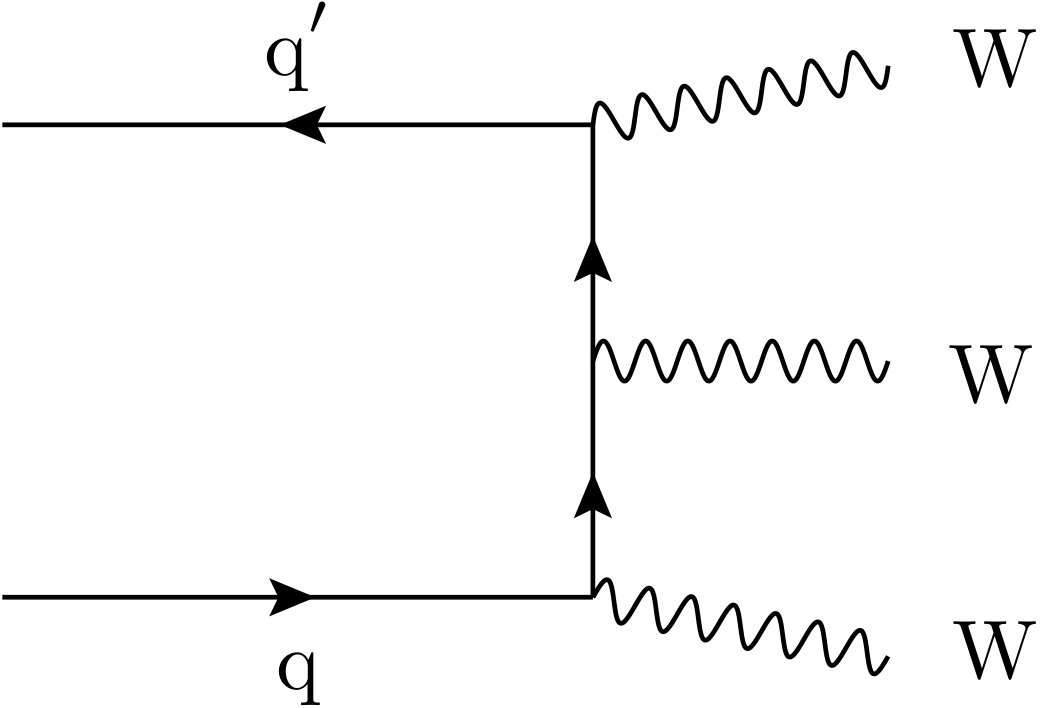 Figure 1
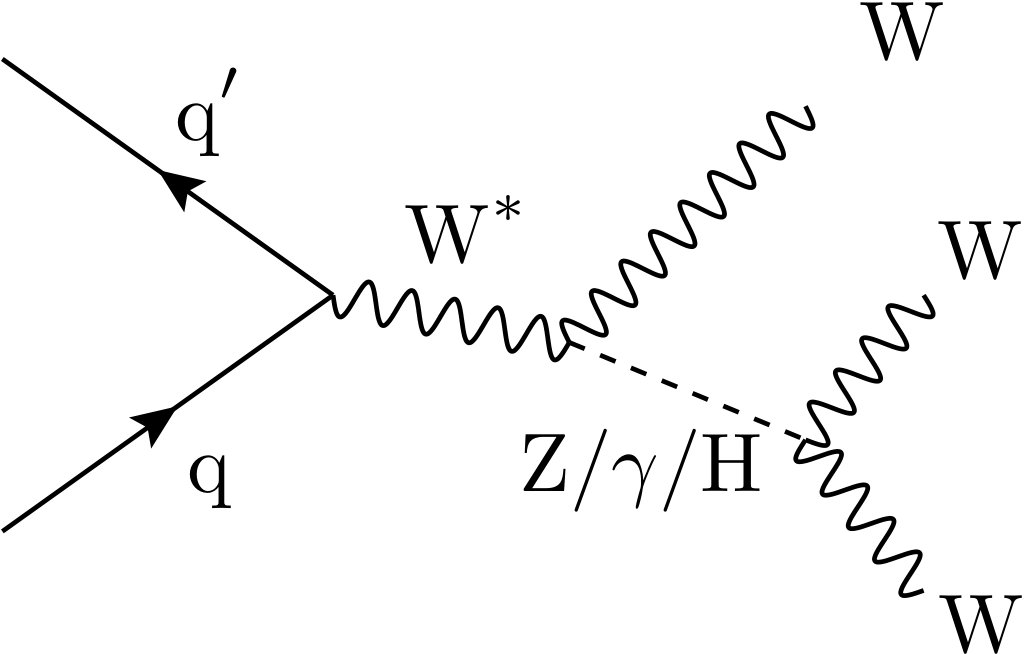 Figure 1
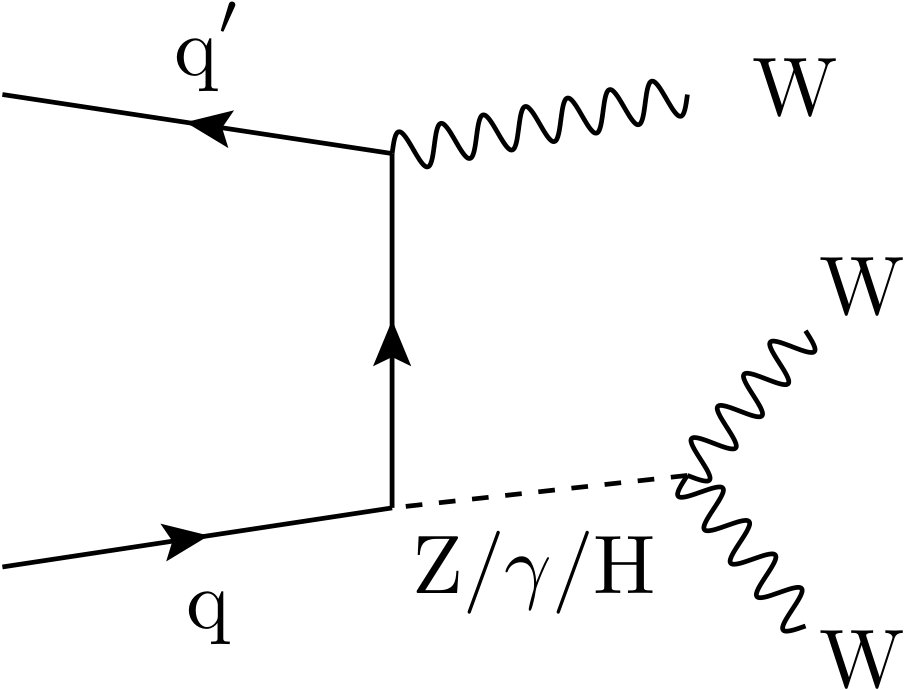 Figure 1
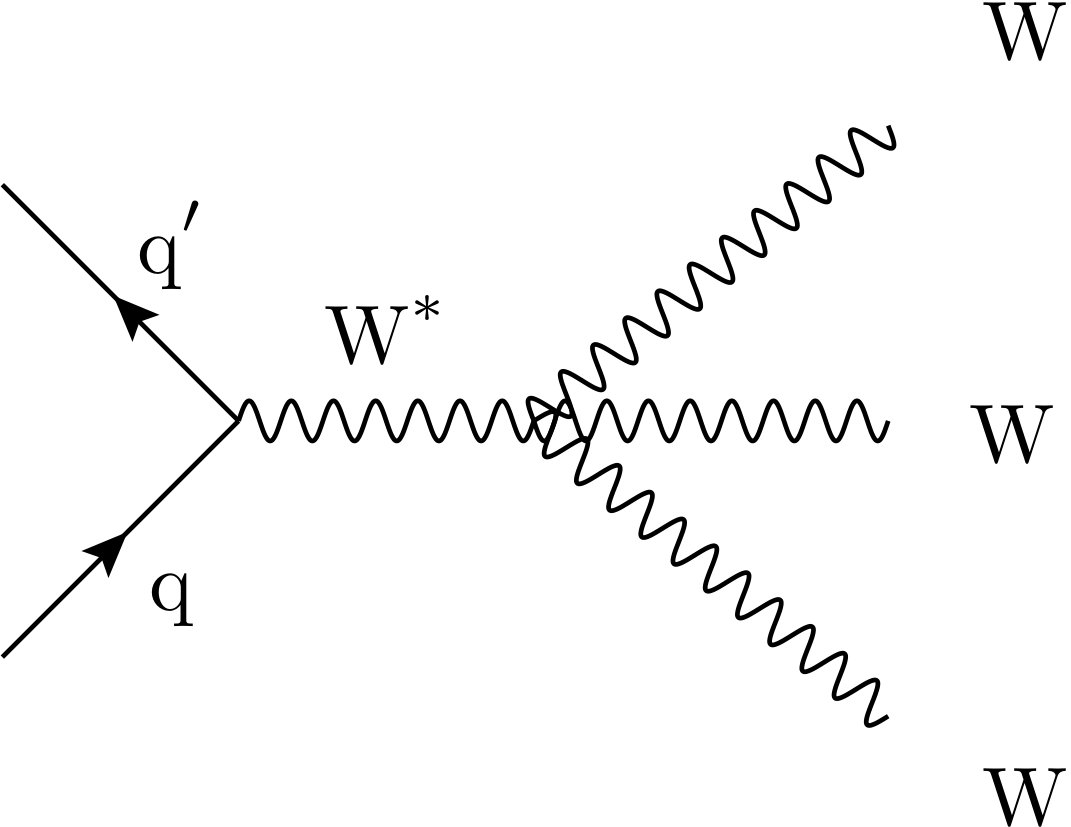 Figure 1
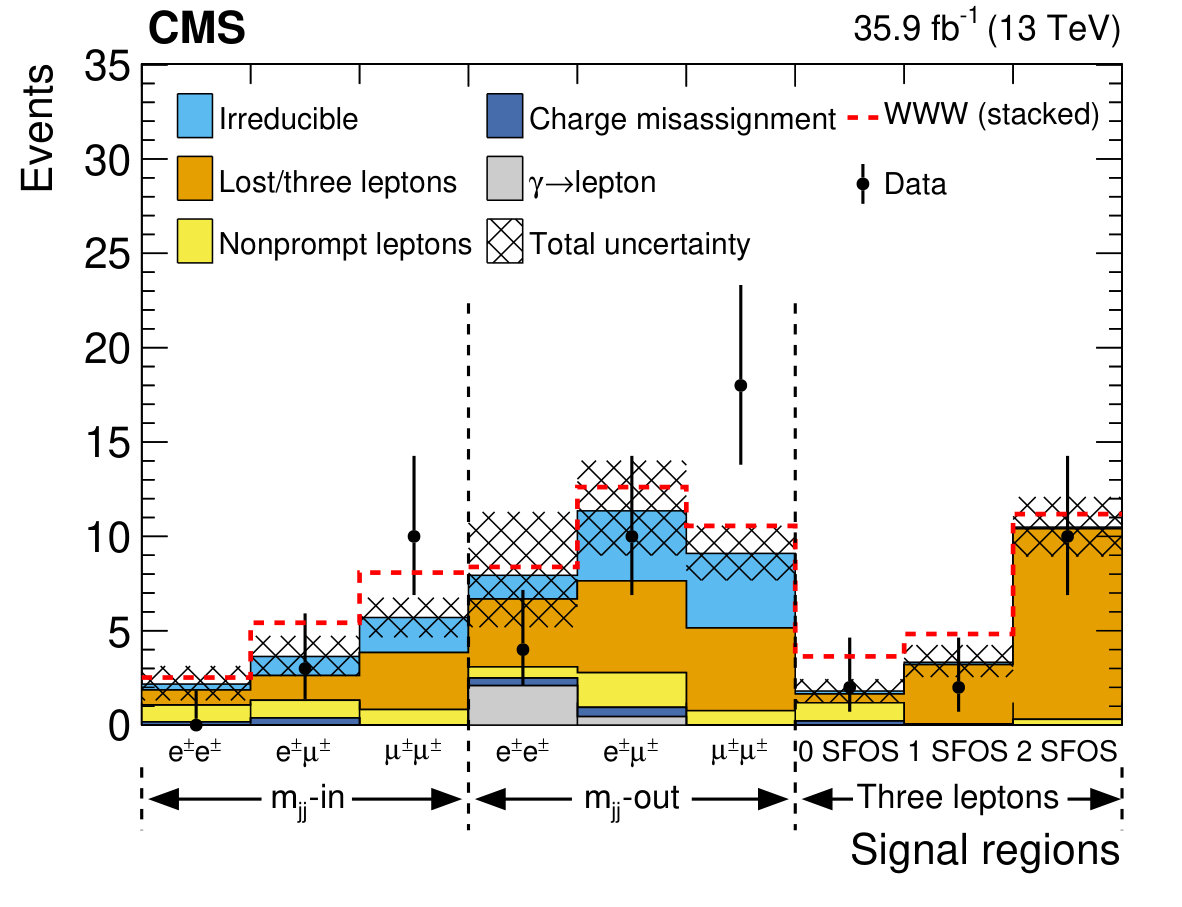 Figure 2
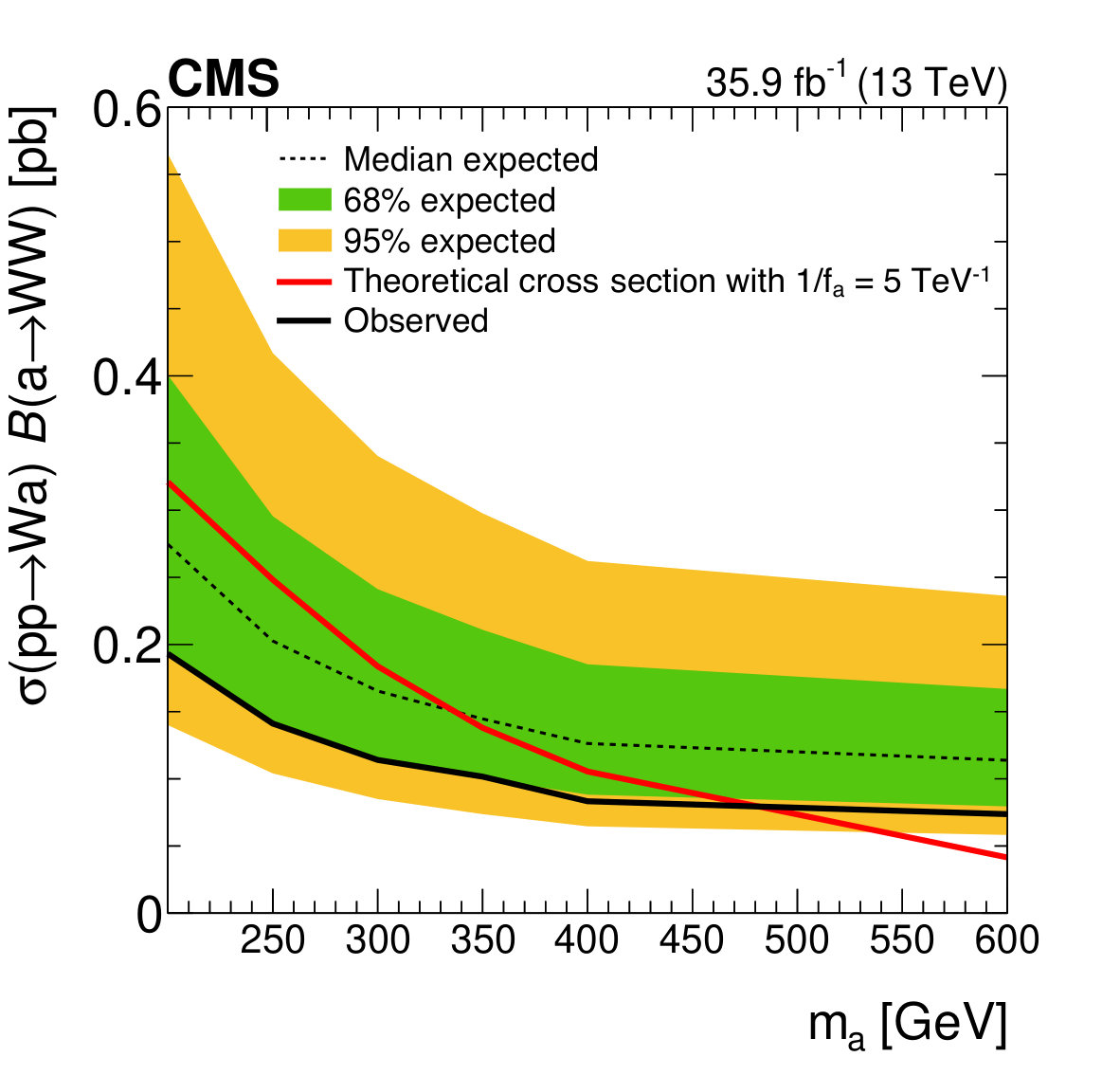 Figure 3
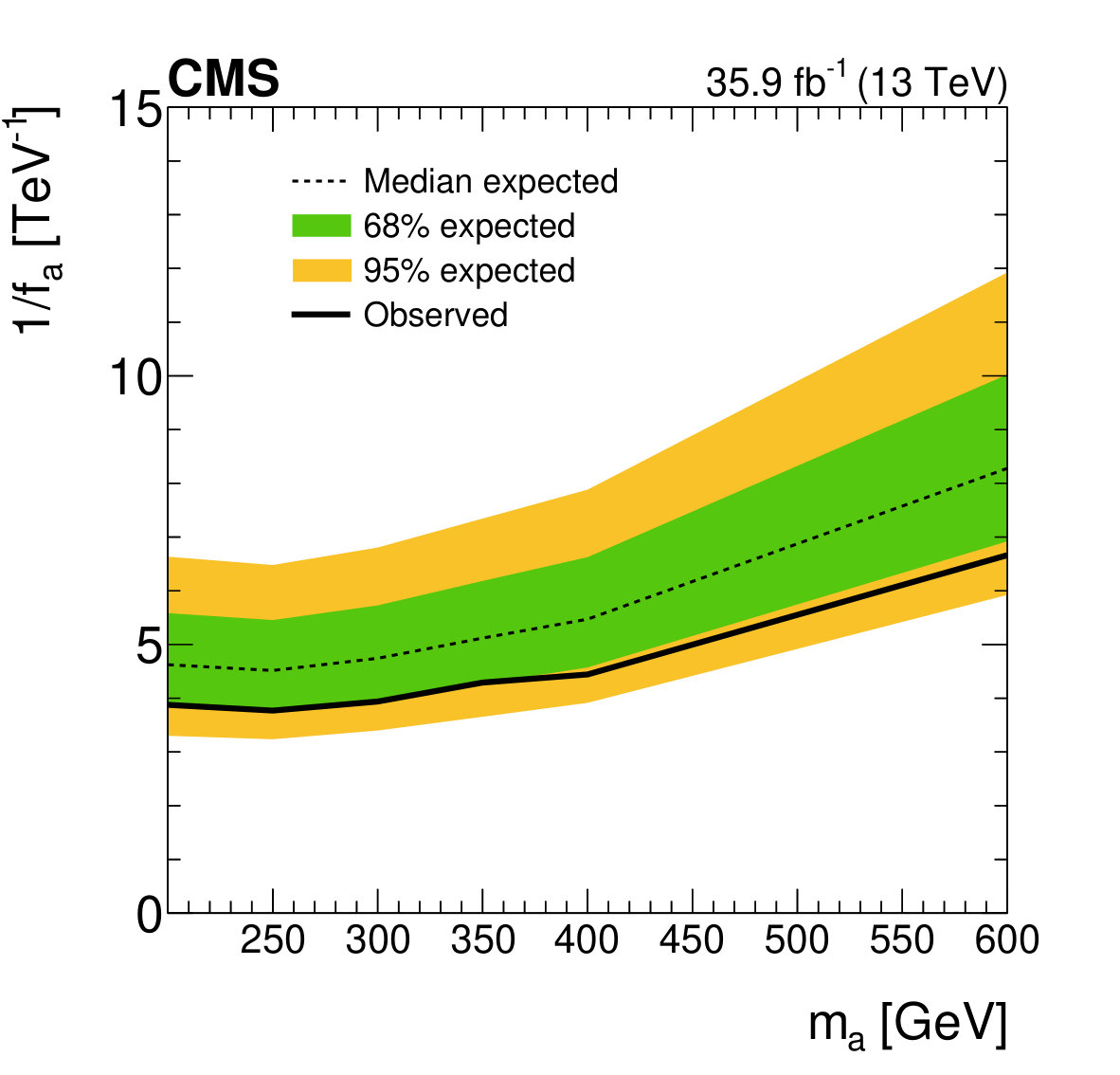 Figure 3
 Figure 9
 Figure 10
Peer Reviews
No public reviews on file for this paper yet. If you reviewed it on a platform where reviews are public (OpenReview, ICLR, NeurIPS, ICML), you can paste yours below so the community can read it here.
Videos
No videos yet. Explain this paper in a talk, walkthrough, or lecture? Add one.
\cmsNoteHeader
SMP-17-013
\RCS
\RCS \RCS
\cmsNoteHeaderSMP-17-013
Search for the production of events at
Abstract
A search for the production of events containing three \PWbosons predicted by the standard model is reported. The search is based on a data sample of proton-proton collisions at a center-of-mass energy of 13\TeVrecorded by the CMS experiment at the CERN LHC and corresponding to a total integrated luminosity of . The search is performed in final states with three leptons (electrons or muons), or with two same-charge leptons plus two jets. The observed (expected) significance of the signal for production is standard deviations, and the ratio of the measured signal yield to that expected from the standard model is . Limits are placed on three anomalous quartic gauge couplings and on the production of massive axionlike particles.
0.1 Introduction
According to the standard model (SM), events with three \PWbosons (, labeled in the following) are produced in proton-proton () collisions at the CERN LHC. The process is sensitive to triple and quartic gauge couplings (QGC), so the observation and study of this process provides an important test of the electroweak sector of the SM. Figure 1 shows examples of lowest-order Feynman diagrams for production. The analysis presented here focuses on the electroweak production of events. The associated production of the Higgs (\PH) boson with a \PWboson, where the \PHboson decays to , is considered to be part of the signal production, whereas other processes such as the production of are considered to be background processes. The nonresonant production cross section is calculated to be [1] and, after including the contribution of with one off-shell \PWboson [2], the total theoretical electroweak production cross section is . In this paper, the label includes both types of production.
A search for production in 8\TeV collision data [3] and evidence for the production of three massive gauge bosons in 13\TeV collisions [4] were reported by the ATLAS Collaboration.
The analysis presented in this paper is performed with a sample of collisions at a center-of-mass energy of 13\TeVproduced by the LHC and recorded with the CMS detector in 2016; the integrated luminosity for this sample is .
Events containing three \PWbosons can be classified by the expected number of charged leptons (electrons or muons only) in the final state: 41.7% contain no leptons, 42.4% contain one lepton, 9.6% have two leptons with opposite-sign (OS) charge, 4.8% have two same-sign (SS) leptons, and 1.6% of all events contain three leptons (). These branching fractions include the contributions from leptonic decays of leptons to electrons or muons and neutrinos. Large backgrounds from the production of events with multiple jets, \PW bosons and jets, Drell-Yan lepton pairs and jets, and \ttbarfinal states preclude the isolation of a signal except for categories of events with two SS leptons (with the third \PWboson decaying hadronically) and with three leptons. This search exploits these two event categories.
Certain new physics processes could lead to an excess of events over the SM prediction. These include, for example, processes with anomalous triple gauge couplings (aTGCs) [5] and anomalous QGCs (aQGCs) [6, 7, 5, 8]. Since this analysis cannot improve the constraints already placed on aTGCs by recent diboson searches [9, 10, 11, 12, 13, 14], it focuses on aQGCs. The production of massive, axionlike particles (ALPs) [15, 16, 17, 18, 19, 20, 21, 22, 23, 24] is also considered. In the absence of a signal beyond the SM, limits are placed on aQGCs and on the production of ALPs in association with \PWbosons.
0.2 The CMS detector
The central feature of the CMS apparatus is a superconducting solenoid of 6\unitm internal diameter, providing a magnetic field of 3.8\unitT. Within the solenoid volume are a silicon pixel and strip tracker, a lead tungstate crystal electromagnetic calorimeter (ECAL), and a brass and scintillator hadron calorimeter, each composed of a barrel and two endcap sections. Forward calorimeters extend the pseudorapidity () coverage provided by the barrel and endcap detectors. Muons are detected in gas-ionization detectors embedded in the steel flux-return yoke outside the solenoid. Events of interest are selected using a two-tiered trigger system [25]. The first level of the CMS trigger system, composed of custom hardware processors, uses information from the calorimeters and muon detectors to select the most interesting events in a fixed time interval of less than 4\mus. The high-level trigger processor farm further decreases the event rate from around 100\unitkHz to less than 1\unitkHz, before data storage. A more detailed description of the CMS detector, together with a definition of the coordinate system used and the relevant kinematic variables, can be found in Ref. [26].
0.3 Data and simulated event samples
The data are collected using dilepton triggers that select either two electrons, two muons, or one electron and one muon. These triggers require the leptons to have a high transverse momentum \ptand to satisfy loose isolation requirements. The dielectron trigger requires for the leading (subleading) electron. The dimuon trigger requires for the leading (subleading) muon. Finally, for the electron+muon trigger, the leading lepton must have and the subleading lepton must have if it is an electron, or if it is a muon. Data recorded using prescaled single electron and single muon triggers with \ptthresholds of 8 and 17\GeV, respectively, are utilized for studies of background rates. Events with contributions from beam halo processes or anomalous noise in the calorimeter are rejected using dedicated filters [27].
Samples of simulated events are used to optimize the event selection, to estimate some of the SM background processes, and to interpret the results in terms of production. The \MGvATNLO2.2.2 generator [28] is used in the next-to-leading-order (NLO) mode with FxFx jet matching [29] to generate triboson events, both the signal ( including ) and the triboson background processes (such as ). The same generator is used in the leading-order (LO) mode with the MLM jet matching [30] to generate SM \ttbar, \ttbar+X (), \PW+jets, \PZ+jets, , and events. Other diboson (, , and ) events and the single top quark process are generated at NLO with \POWHEG2.0 [31, 32, 33, 34]. The most precise cross section calculations available are used to normalize the simulated samples, and usually correspond to either NLO or next-to-NLO accuracy [35, 36, 37, 38, 39, 40, 28, 41, 2, 42].
The \MGvATNLOevent generator is used in the NLO mode to simulate events following the model for photophobic, axionlike particles according to the model described in Ref. [24]. The aQGC samples are generated using \MGvATNLO2.2.2 in the LO mode and the reweighting prescription of Ref. [43].
The NNPDF3.0 [44] parton distribution functions (PDFs) are used for all samples. Parton showering, hadronization, and the underlying event are modeled by \PYTHIA8.205 [45] with parameters set by the CUETP8M1 tune [46]. Additional collisions due to multiple interactions in the same or adjacent beam crossings, known as pileup, are also simulated, and the simulated distribution of pileup interactions is reweighted to match the data. The response of the CMS detector is simulated with the \GEANTfour [47] package. The simulated events are reconstructed using the same software as the real data.
0.4 Event reconstruction
The CMS event reconstruction is based on the particle-flow (PF) algorithm [48], which combines information from the tracker, calorimeters, and muon systems to identify charged and neutral hadrons, photons, electrons, and muons, known as PF candidates.
Each event must contain at least one interaction vertex. The reconstructed vertex with the largest value of summed physics-object is taken to be the primary vertex (PV). The physics objects are the objects reconstructed by a jet finding algorithm [49, 50, 51] applied to all charged particle tracks associated with the vertex and also the corresponding missing transverse momentum (\ptmiss).
Electrons and muons are identified by associating a track reconstructed in the silicon detectors with either a cluster of energy in the ECAL [52] or a track in the muon system [53], as appropriate. To be selected for this analysis, electron and muon candidates must satisfy and . Electrons with , which corresponds to the transition region between the barrel and endcap regions of the ECAL, are discarded. Several working points are defined, which differ according to the identification criteria chosen including the requirements on the three-dimensional impact parameter and relative isolation . The impact parameter is the distance between the PV and the point of closest approach of the lepton track; is required for all lepton candidates. This requirement is tightened to for electrons in the SS category. The relative isolation of a lepton with is defined as
[TABLE]
In this expression, is the scalar \ptsum of charged particles from the PV in a cone of around the lepton direction, and is the equivalent \ptsum for the neutral hadrons and the photons. The lepton momentum itself is not included in . The total neutral component contains contributions from pileup, estimated using where the average \ptflow density is calculated in each event using the jet area method [54], are subtracted. The effective area is the geometric area of the lepton isolation cone multiplied by an -dependent factor that accounts for the residual dependence of the isolation on the pileup. Electrons are required to satisfy for the SS () category, and muons must satisfy . These leptons are referred to as “tight” leptons. For “loose” electrons and muons used in the estimation of the nonprompt-lepton background, is required. For “rejection” electrons and muons, used to remove background events where extra leptons are present in either the SS or category, is required. For electrons in the SS category, the background contribution coming from a mismeasurement of the track charge is not negligible. The sign of this charge is inferred using three different observables; requiring all three to agree reduces this background contribution [52].
Events containing leptons decaying into charged hadrons are rejected by requiring no isolated tracks aside from selected electrons and muons. An isolated track is a charged PF lepton (charged PF hadron) with , , and a longitudinal distance to the PV of ; it must be isolated in the sense that and . Any isolated track or lepton that matches a selected lepton candidate within is discarded.
PF candidates are clustered into jets using the anti-\ktjet clustering algorithm [49] with a distance parameter , implemented in the \FASTJETpackage [50, 51]. Jets must pass loose selection criteria based on the fractions of neutral and charged energy in the jet, and on the relative amount of electromagnetic and hadronic energy. Jets with and are selected unless they are within of a selected lepton or isolated track. Jet energies are corrected for contributions from pileup and to account for nonuniform detector response [55]. The loose working point of the combined secondary vertex (CSVv2) \PQb tagging algorithm [56] is used to identify jets containing the decay of a heavy-flavor hadron. For this working point, the efficiency to select \PQb quark jets is above 80% and the rate for tagging jets originating from the hadronization of gluons, and \PQu, \PQd, and \PQsquarks is about 10%. In order to apply the CSVv2 \PQb tagging algorithm, the jet must be reconstructed within .
The vector missing transverse momentum \ptvecmissis defined as the negative vector \ptsum of all PF particle candidates. The magnitude of \ptvecmissis denoted \ptmiss. Corrections to jet energies due to the nonuniformity in the detector response are propagated to \ptmiss [57].
0.5 Search strategy and event selection
The event selection criteria are designed to maximize the signal significance in the two final states used in the analysis: two SS leptons and at least two jets (SS category), and three leptons ( category). Cross sections for background processes are much larger than the signal cross section, so stringent requirements must be applied in order to achieve sensitivity to production.
The SS category contains signal events with the two SS \PWbosons decaying leptonically and the third \PWboson decaying hadronically. Correspondingly, the selection requires exactly two tight, high-\ptSS leptons and at least two high-\ptjets. This category is divided into two signal regions (SRs): “-in” includes the events in which the invariant mass of the two jets closest in is compatible with the \PWboson mass, ; “-out” includes the remaining events. The -in SR is expected to contain more signal events and fewer background events than the -out region. The -out region still contains a sizable number of events, from off-shell \PWbosons from \PW\PHproduction, for example. It is therefore is considered a signal region. The main background contribution is called the lost-lepton background and stems from three-lepton events with one lepton not selected due to an inefficiency (\eg, the isolation requirement) or because it falls outside the detector acceptance. Most of this background contribution comes from production and a smaller contribution from events. The rejection of events with an extra lepton or isolated track reduces this background contribution considerably. A smaller background contribution comes from the production of genuine SS lepton pairs, mainly through + jets and production. This contribution is reduced by requiring the two highest-\ptjets not have a large invariant mass or large separation and by excluding events with \PQb-tagged jets. Another background contribution comes from events with one or more nonprompt leptons, such as those from semileptonic decays of heavy-flavor hadrons which arise mainly in \PW+jets and \ttbar+jets production. The stringent lepton identification requirements are designed to suppress this contribution as much as possible. Additional requirements that \ptmissbe substantial and that the dilepton mass not be small further suppress this contribution. In the channel, a requirement is placed to reduce the contribution from the lost-lepton background from production; is the largest transverse mass obtained from \ptmissand any lepton in the event. Background contributions from events containing misidentified or converted photons and from events with a lepton charge misassignment are minor. The details of the event selection for the SS category are listed in Table 0.5. There are six SRs defined according to the value of (-in or -out) and the flavors of the leptons: , , or .
The reference list from the paper itself. Each links out to its DOI / PubMed record.
- 1[1] S. Dittmaier, A. Huss, and G. Knippen, “Next-to-leading-order QCD and electroweak corrections to \PW \PW \PW \PW \PW \PW \PW\PW\PW production at proton-proton colliders”, JHEP 09 (2017) 034, 10.1007/JHEP 09(2017)034 , ar Xiv:1705.03722 . · doi ↗
- 2[2] D. de Florian et al., “Handbook of LHC Higgs cross sections: 4. Deciphering the nature of the Higgs sector”, CERN Report CERN-2017-002-M, 2016. 10.23731/CYRM-2017-002 , ar Xiv:1610.07922 . · doi ↗
- 3[3] ATLAS Collaboration, “Search for triboson \Wpm \Wpm \P Wmp \Wpm \Wpm \P Wmp \Wpm\Wpm\P Wmp production in \Pp \Pp \Pp \Pp \Pp\Pp collisions at s = 8 \Te V 𝑠 8 \Te V \sqrt{s}=8\Te V with the ATLAS detector”, Eur. Phys. J. C 77 (2017) 141, 10.1140/epjc/s 10052-017-4692-1 , ar Xiv:1610.05088 . · doi ↗
- 4[4] ATLAS Collaboration, “Evidence for the production of three massive vector bosons with the ATLAS detector”, (2019). ar Xiv:1903.10415 . Submitted to Phys. Lett. B .
- 5[5] C. Degrande et al., “Effective field theory: a modern approach to anomalous couplings”, Annals Phys. 335 (2013) 21, 10.1016/j.aop.2013.04.016 , ar Xiv:1205.4231 . · doi ↗
- 6[6] W. Buchmüller and D. Wyler, “Effective Lagrangian analysis of new interactions and flavor conservation”, Nucl. Phys. B 268 (1986) 621, 10.1016/0550-3213(86)90262-2 . · doi ↗
- 7[7] B. Grzadkowski, M. Iskrzyński, M. Misiak, and J. Rosiek, “Dimension-six terms in the standard model Lagrangian”, JHEP 10 (2010) 085, 10.1007/JHEP 10(2010)085 , ar Xiv:1008.4884 . · doi ↗
- 8[8] C. Degrande, “A basis of dimension-eight operators for anomalous neutral triple gauge boson interactions”, JHEP 02 (2014) 101, 10.1007/JHEP 02(2014)101 , ar Xiv:1308.6323 . · doi ↗