Short time behavior of continuous time quantum walks on graphs
Bal\'azs Endre Szigeti, G\'abor Homa, Zolt\'an Zimbor\'as, Norbert, Barankai

TL;DR
This paper investigates the initial behavior of continuous time quantum walks on graphs, revealing how graph topology influences short time dynamics and how symmetry and coherence affect these asymptotics.
Contribution
It provides a detailed analysis of short time asymptotics of CTQWs, including effects of symmetry, potentials, and non-coherent effects, with analytical formulas validated numerically.
Findings
Short time asymptotics follow power laws determined by graph topology.
Time-reversal symmetry doubles the power-law exponent in transition probabilities.
Breaking symmetry and introducing non-coherent effects significantly alter short time behavior.
Abstract
Dynamical evolution of systems with sparse Hamiltonians can always be recognized as continuous time quantum walks (CTQWs) on graphs. In this paper, we analyze the short time asymptotics of CTQWs. In recent studies, it was shown that for the classical diffusion process the short time asymptotics of the transition probabilities follows power laws whose exponents are given by the usual combinatorial distances of the nodes. Inspired by this result, we perform a similar analysis for CTQWs both in closed and open systems, including time-dependent couplings. For time-reversal symmetric coherent quantum evolutions, the short time asymptotics of the transition probabilities is completely determined by the topology of the underlying graph analogously to the classical case, but with a doubled power-law exponent. Moreover, this result is robust against the introduction of on-site potential terms.…
Click any figure to enlarge with its caption.
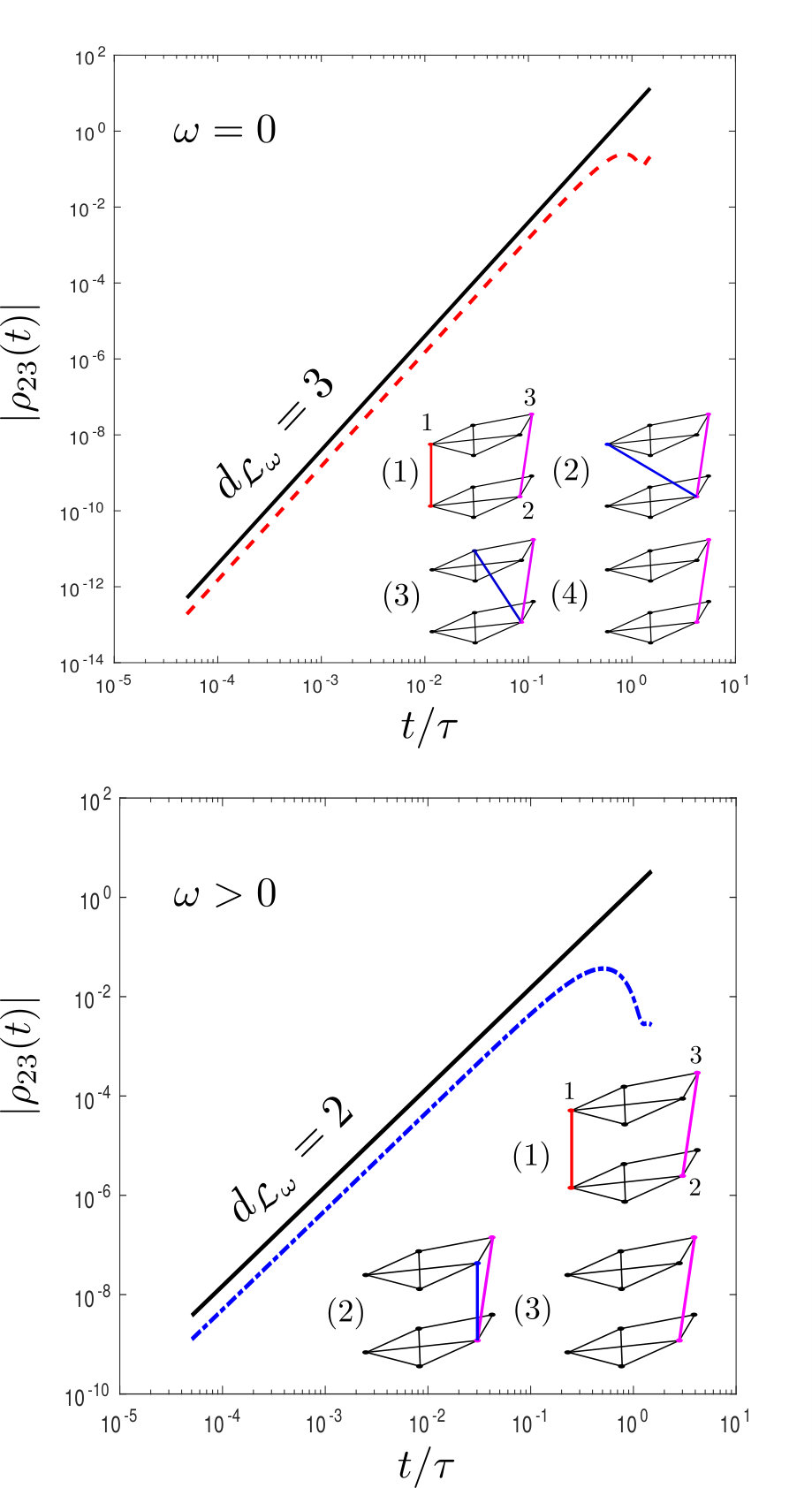 Figure 1
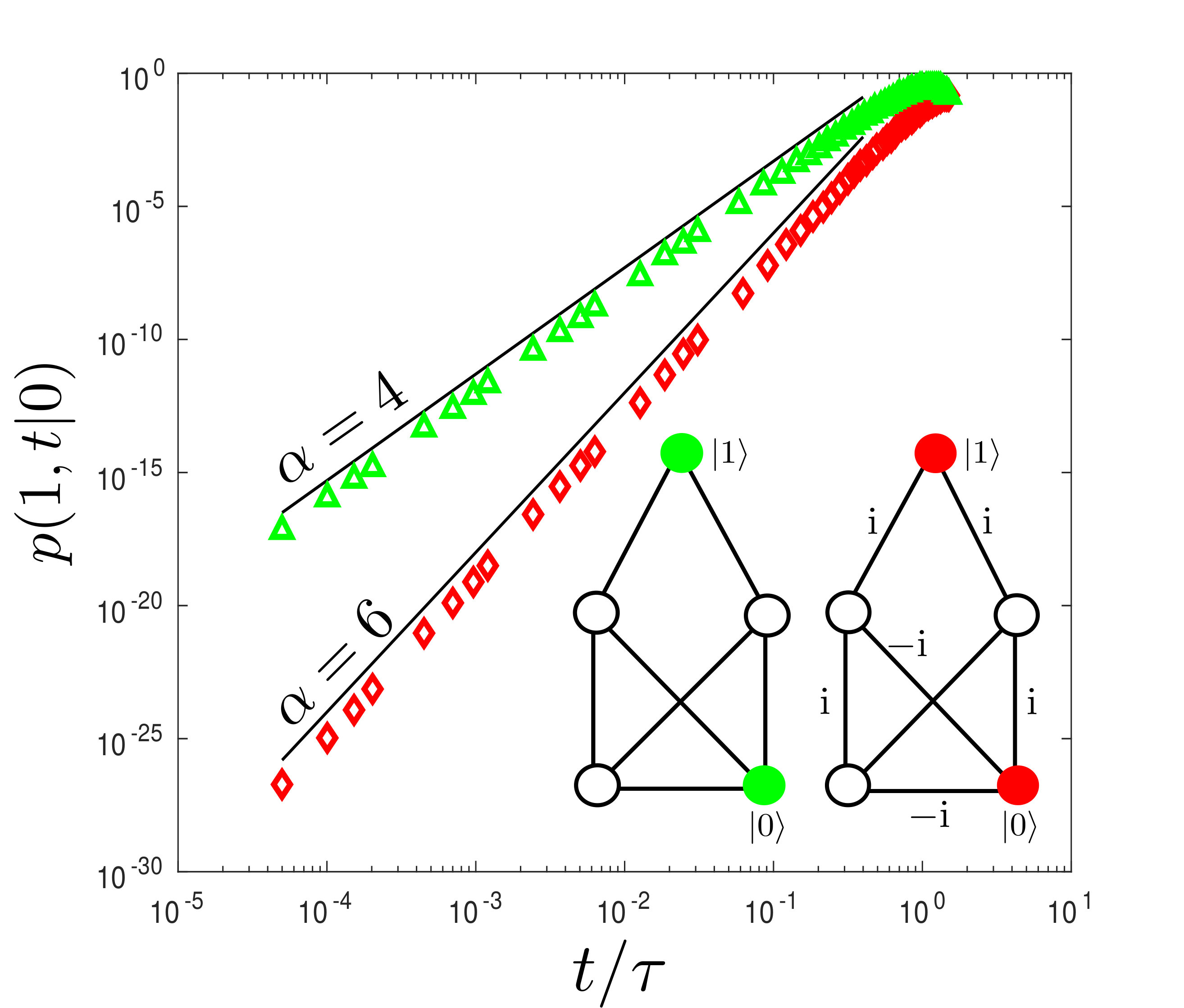 Figure 2
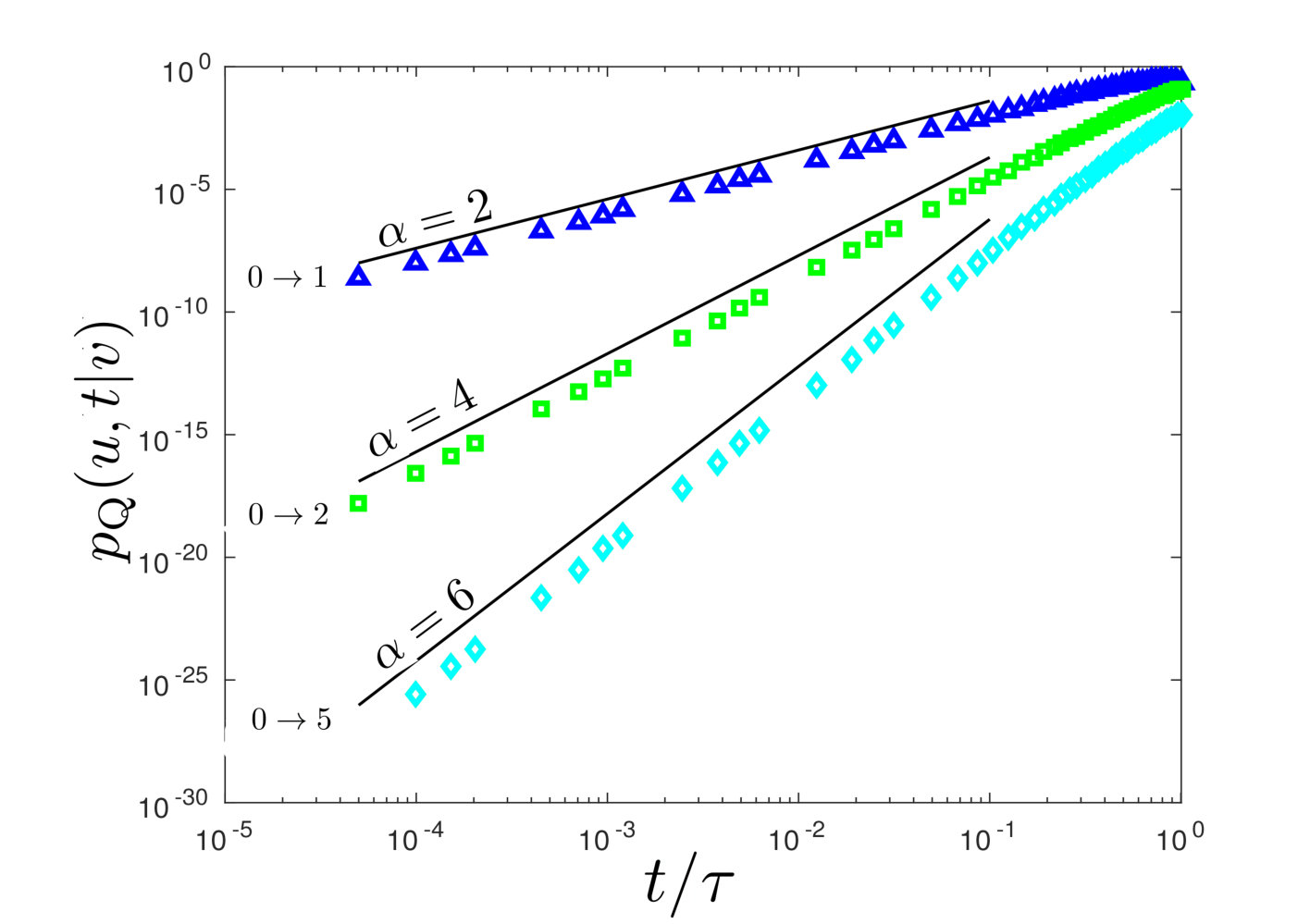 Figure 3
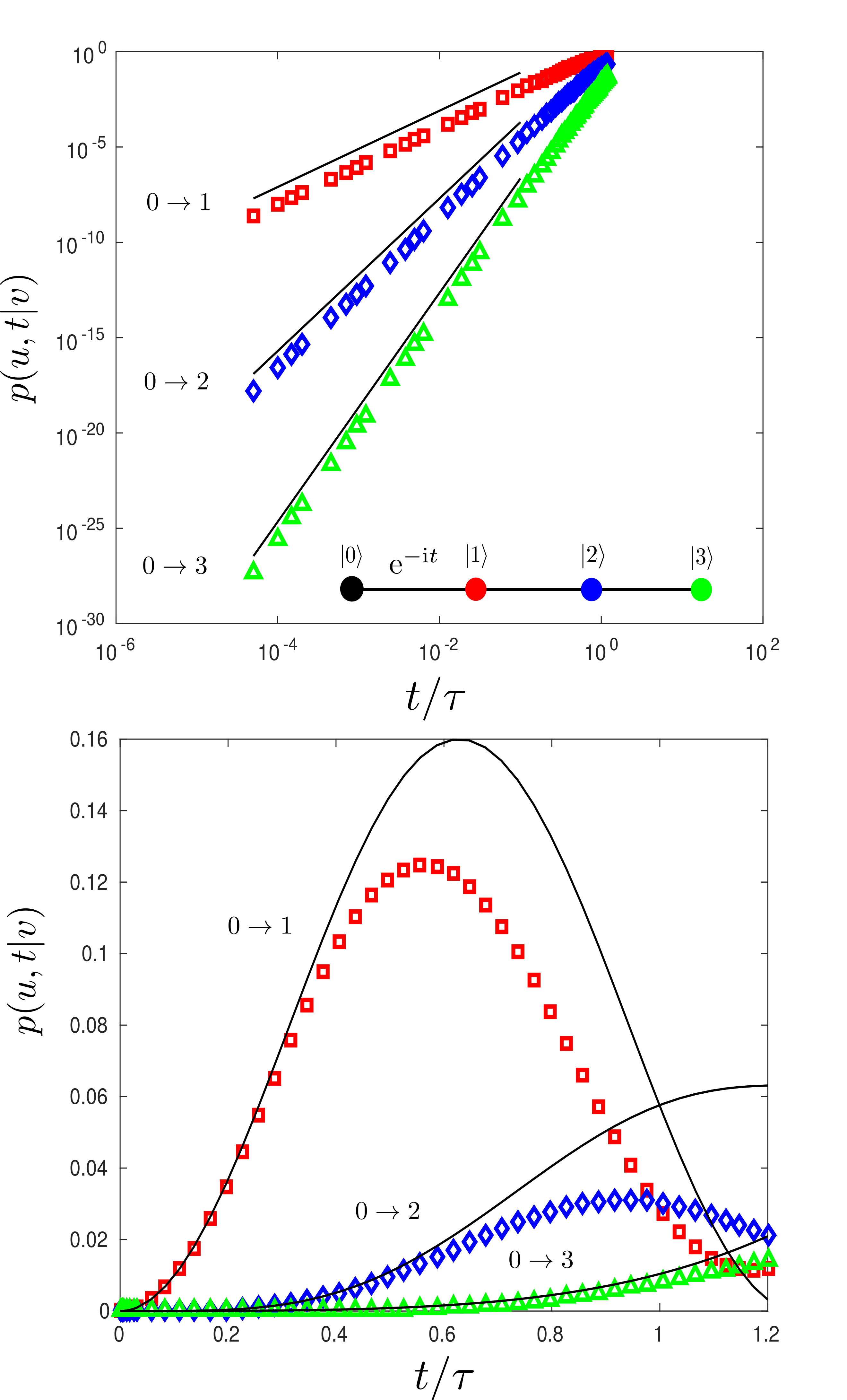 Figure 4
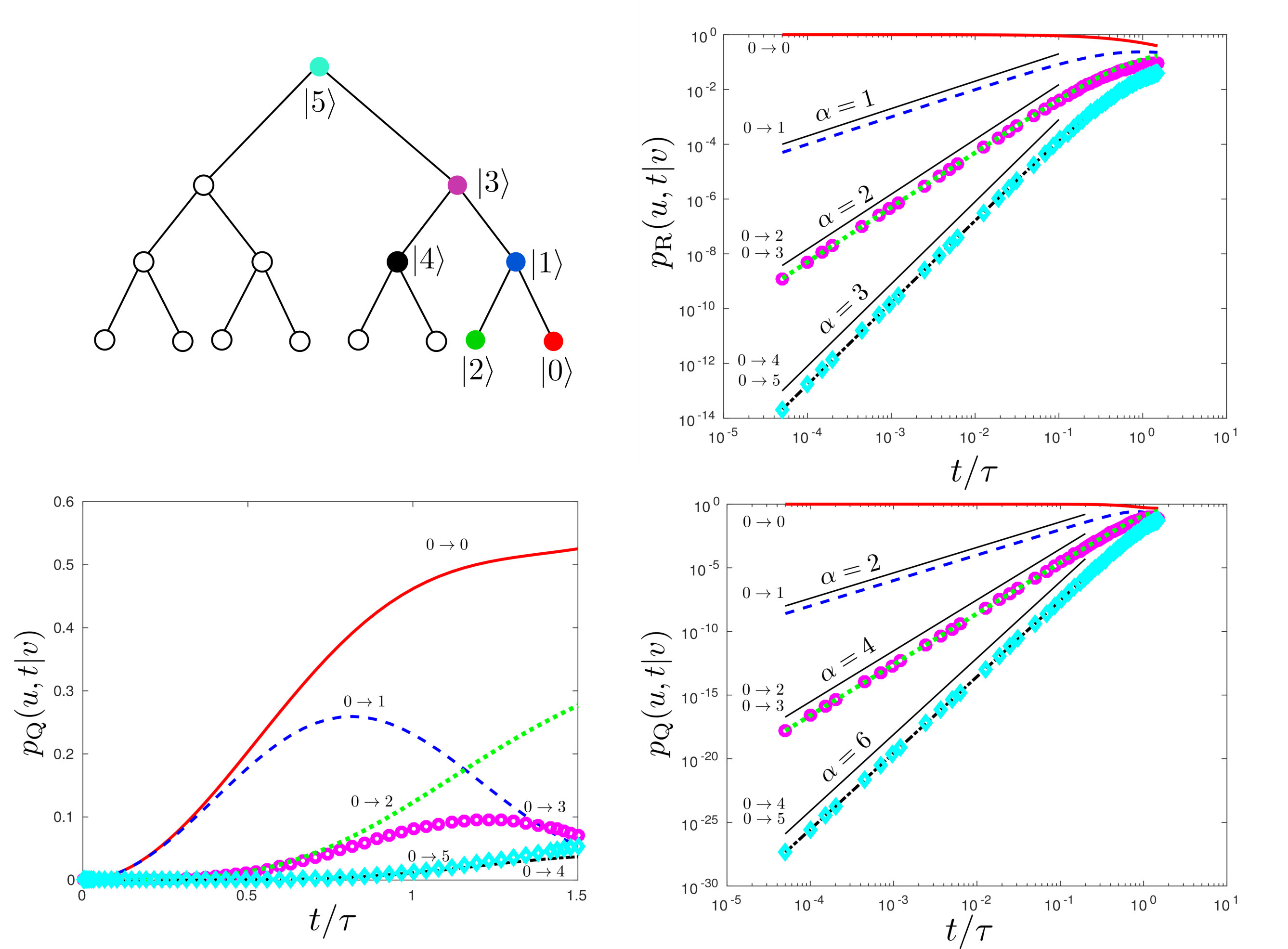 Figure 5
Peer Reviews
No public reviews on file for this paper yet. If you reviewed it on a platform where reviews are public (OpenReview, ICLR, NeurIPS, ICML), you can paste yours below so the community can read it here.
Videos
No videos yet. Explain this paper in a talk, walkthrough, or lecture? Add one.
Short time behavior of continuous time quantum walks on graphs
Balázs Endre Szigeti
Institute for Particle and Nuclear Physics, Wigner Research Centre for Physics, Konkoly-Thege Miklós út 29-33, H-1121 Budapest, Hungary
Department of Atomic Physics, Eötvös University, Pázmány Péter Sétány 1/A, H-1117 Budapest, Hungary
Gábor Homa
Department of Physics of Complex Systems, Eötvös University, Pázmány Péter Sétány 1/A, H-1117 Budapest, Hungary
Zoltán Zimborás
Institute for Particle and Nuclear Physics, Wigner Research Centre for Physics, Konkoly-Thege Miklós út 29-33, H-1121 Budapest, Hungary
MTA-BME Lendület Quantum Information Theory Research Group
Mathematical Institute, Budapest University of Technology and Economics,
P.O.Box 91, H-1111, Budapest, Hungary.
Norbert Barankai
MTA-ELTE Theoretical Physics Research Group, Pázmány Péter Sétány 1/A, H-1117 Budapest, Hungary
Abstract
Dynamical evolution of systems with sparse Hamiltonians can always be recognized as continuous time quantum walks (CTQWs) on graphs. In this paper, we analyze the short time asymptotics of CTQWs. In recent studies, it was shown that for the classical diffusion process the short time asymptotics of the transition probabilities follows power laws whose exponents are given by the usual combinatorial distances of the nodes. Inspired by this result, we perform a similar analysis for CTQWs both in closed and open systems, including time-dependent couplings. For time-reversal symmetric coherent quantum evolutions, the short time asymptotics of the transition probabilities is completely determined by the topology of the underlying graph analogously to the classical case, but with a doubled power-law exponent. Moreover, this result is robust against the introduction of on-site potential terms. However, we show that time-reversal symmetry breaking terms and non-coherent effects can significantly alter the short time asymptotics. The analytical formulas are checked against numerics, and excellent agreement is found. Furthermore, we discuss in detail the relevance of our results for quantum evolutions on particular network topologies.
I Introduction
Continuous time quantum walks (CTQWs) on graphs Kempe (2003); Mülken and Blumen (2011); Venegas-Andraca (2012); Reitzner et al. (2011) have been used frequently in the past to successfully model coherent transport phenomena in those systems whose phenomenological description allows the application of tight-binding approximations May and Kühn (2008). Examples of such exciton networks consists of light harvesting complexes Mohseni et al. (2008); Caruso et al. (2009), dendrimers Mülken et al. (2006), trapped atomic ions Maier et al. (2019) and arrays of quantum dots Perdomo et al. (2010); Semião et al. (2010), just to name a few.
From a quantum information perspective, CTQWs appeared as possible physically realizable implementations of quantum algorithms of search Farhi and Gutmann (1998); Childs and Goldstone (2004); Portugal (2013); Meyer and Wong (2015); Chakraborty et al. (2016) and generic quantum computation Childs (2009); Chase and Landahl (2008); Agliari et al. (2010), and were compared on various occasions with their classical counterpart, the continuous time random walk (CTRW), that is, the diffusion process Chung (1997); Weiss (2005); Telcs (2006).
A large number of experiments Engel et al. (2007); Collini et al. (2010); Panitchayangkoon et al. (2010); Govia et al. (2017), numerical calculations and theoretical studies Mülken and Blumen (2011); Wang and Manouchehri (2013); Kendon (2007); Zimborás et al. (2013); Faccin et al. (2013); Rossi et al. (2017); Boada et al. (2017) have been devoted to analyze the transport properties of these systems. Among the most investigated topics were the state transfer properties Bose (2003); Christandl et al. (2004); Burgarth and Bose (2005); Bernasconi et al. (2008); Cameron et al. (2014); Liu and Zhou (2015) and the long time behavior Konno (2005); Shikano (2013); Darázs and Kiss (2013); Philipp et al. (2016); Fedichkin et al. (2006); Liu and Balu (2017) of these systems. Closed as well as open systems were studied and now there are plenty of examples where the supremacy of CTQW over CTRW has been demonstrated. However, there are some cases when CTQWs underperform the old diffusive transport Xu (2009); Agliari et al. (2008).
Contrary to the long time asymptotics, the behavior of CTQWs at short timescales has missed such substantial attention. This is especially surprising if one notes that the short time dynamics of local Hamiltonians appearing in universal, continuous time quantum computation offers non-tomographical, efficient reconstruction of the governing Hamiltonian Shabani et al. (2011); da Silva et al. (2011). This resembles the situation in the theory of CTRW: Though the study of the short time asymptotics of Brownian motion on Riemannian manifolds has been initiated nearly half a century ago Varadhan (1967) and the results obtained have been subsequently extended and generalized in many ways Molchanov (1975); Zhang (2000); Ter Elst et al. (2007), theorems concerning short time behavior of CTRW on graphs have been appeared only recently. In two current studies Keller et al. (2016); Steinerberger (2018), it was shown that the short time behavior of the transition probabilities of diffusion processes differ in a considerable amount when compared to their (in space) continuous counterpart. While Brownian motion in locally Euclidean spaces can be approximated by a Gaussian distribution for short timescales, the same type of asymptotics tells that the transition probabilities , corresponding to distinct vertices and of a graph follow power law. If is the distance between the aforementioned vertices, then Keller et al. (2016); Steinerberger (2018)
[TABLE]
i.e., for small positive times we have
[TABLE]
Also the constant has been determined Steinerberger (2018). If denotes the number of shortest paths that connects to , then
[TABLE]
In this paper, we show that similar results apply to CTQWs as well. Given a tight-binding model with adjacency matrix and on-site potential , the complex transition amplitudes of the CTQW between position eigenstates and follows the asymptotics
[TABLE]
Thus, the time evolution of the entries of the mixing matrix of the CTQW possesses the short time asymptotic form
[TABLE]
Since is the probability of finding the system in the position eigenstate if initially it was prepared in the state , the comparison of Eq. (2) and Eq. (5) shows that CTQWs always underperform CTRWs at short timescales. Such a douling effect has been also observed in the tail distribution of the first passage time of CTQW Thiel et al. (2018a): The long-time assymptotics of the first passage time of a quantum walker of a one dimensional tight-binding model follows a power law in time with exponent , while a classic result of Lévy shows that such a scaling in CTRW has exponent Thiel et al. (2018b). This is a rather general phenomenon which can appear when the spectrum of the Hamiltionian is continuous and the so called measurement density of states contains Van Hove singularities Thiel et al. (2018b). The sort-time analysis of the evolution of CTQWs coupled to its environment with the assumption of Markovian open system dynamics shows that a small amount of decoherence can halve the exponent in Eq. (5) to that of Eq. (2), resembling the well studied properties of environment assisted quantum transport Shabani et al. (2011); da Silva et al. (2011).
Since the set of Hamiltonians is much larger than the set of symmetric generators of stochastic Markovian dynamics, the structure of the short time asymptotics of CTQWs is more abundant compared to that of CTRWs. These noticeable differences, caused by interference patterns become apparent when one considers chiral quantum walks Zimborás et al. (2013); Lu et al. (2016). It turns out that the interference patterns can increase the exponent in Eq. (5) resulting in further deceleration of the initial dynamics.
Interestingly, the asymptotics of Eq. (4) is universal in the sense that the coefficients appearing do not depend on the on-site potential. The potential matrix only determines the timescale of the short-time regime, where Eq. (4) is worth to consider. Note, however, that a closer look on the evolution and the application of time-dependent perturbation theory can further improve Eq. (4) and widen the time horizon where results like Eq. (4) can approximate the initial dynamics.
The paper is organized as follows. In section II, we present the main propositions concerning the short time asymptotics of linear dynamical systems whose time evolution is governed by a possibly time dependent but sparse matrix. In section III, we apply these statements to closed and open CTQWs and illustrate our results by various case studies including chiral walks. Conclusion and future direction of research are given in section IV.
II Main mathematical results
II.1 The main theorem
Throughout this section will denote a finite-dimensional Hilbert space with an orthonormal basis labeled by the vertices of a graph with edge set . The graph is assumed to be simple and directed. For each distinct vertices of the graph , we denote the set of the shortest, directed paths connecting to by . If is a path in of length , then it can be represented by a sequence of vertices with , and the edges formed by the consecutive members of are just the edges of .
We consider a continuous family of linear operators satisfying the property on if and only if the directed edge is a member of . In that case, we say that is the graph of . Given distinct vertices and , and a shortest path of length , we define the corresponding path amplitude as
[TABLE]
If is a matrix operating on , its norm is defined through
[TABLE]
where . Note that the norm satisfies the inequality
[TABLE]
for any complex , and has the submultiplicative property
[TABLE]
Let denote the reciprocal of the maximum among the norms of if runs from zero to :
[TABLE]
We can now state and prove the main theorem on short time asymptotics.
Proposition 1. The solution of the matrix differential equation
[TABLE]
satisfies the inequality
[TABLE]
for all of distance . Here, the sum goes over the set of shortest paths running from to in , and is defined in Eq. (6).
Before proving the statement, some remarks should be added. First, note that in the proposition is not necessarily hermitian. Indeed, it can be any square matrix. This fact gives the opportunity to apply the statement also to Lindbladian dynamics in section III. The characteristic measure of the short time dynamics is , that the approximation contained in Eq. (12) is informative only whenever is less than . For time-independent generators, is independent of . Moreover, does not depend on a complex prefactor of modulus one multiplying . Since every CTRW taking place on a symmetric weighted graph has a corresponding CTQW with the same generator but multiplied by , the scales of the short time asymptotics are necessarily identical. In the case of chiral CTQW, the appearance of the path amplitudes in Eq. (12) results in interference patterns with which CTQW obtains a richer structure as compared to CTRW, where the amplitudes are always positive.
Proof. As is a continuous map, the solution of the differential equation (11) can be written as the sum of the Dyson series
[TABLE]
Let be the graph distance between nodes and . Then, for any and for any the identity holds. Thus, when calculating the entry , the Dyson series reduces to
[TABLE]
For any linear operator , one has , so we can bound each term in Eq. (14) as
[TABLE]
Therefore,
[TABLE]
where we used Taylor’s theorem with the Lagrange form of the remainder, which holds with a suitably chosen . This implies
[TABLE]
Now, let us perform the expansion
[TABLE]
It is clear that only those indices contribute in the above sum for which forms a path in connecting to . This means that one can replace the above sum over vertex sets to a sum over the path-set :
[TABLE]
Inserting this into Eq. (17), we arrive to Eq. (12).
II.2 Improvement of the timescale
The main drawback of Proposition 1 is the appearance of the norms . Choosing the Hilbert space basis , and assuming that is constant in time, then splitting to a sum of diagonal and off-diagonal parts (which is the case for instance in tight-binding models) and varying only the diagonal entries affects the timescale dramatically. However, using time-dependent perturbation theory, more can be said than what Eq. (12) would allow. Let be an arbitrary square matrix with diagonal part and off-diagonal part . Let be the smallest real satisfying . Let be the adjacency matrix obtained by setting all non-zero entries of to one. The graph described by is simple but directed: the edge with tail and head is a member of if and only if . Define as
[TABLE]
Proposition 2. The following inequality holds:
[TABLE]
for all , where
[TABLE]
* and is the set of shortest directed paths connecting to in of length .*
Proof. Define . Note that
[TABLE]
where is the solution to
[TABLE]
Also note
[TABLE]
Let and . Then, the th order term of the Dyson series of Eq. (24) multiplied by is of the form
[TABLE]
Since and holds, we have the following upper bounds:
[TABLE]
which hold for any two vertices and of , so we can write
[TABLE]
Therefore, since holds, we find
[TABLE]
where is given in Eq. (22). From this point, the arguments of the proof of Proposition 1 can be repeated to obtain
[TABLE]
which proves the statement.
It is a well-known fact that the largest eigenvalue of the adjacency matrix of a simple, undirected graph is also largest in magnitude, and is bounded by the highest degree of from above. That is, when admits the property if and only if , then is symmetric, so
[TABLE]
A particular example is the tight-binding model, taking place on the simple, undirected graph with adjacency matrix . Then, can be replaced in Proposition 2 by to obtain:
[TABLE]
where
[TABLE]
III Application of the results
III.1 Comparison of CTRW and CTQW
In order to compare the short time asymptotics of the probabilistic and unitary versions of continuous time walks, we fix a simple, undirected graph , containing no self-loops. Using the adjacency matrix and the degree matrix , the CTRW dynamics is generated by the graph Laplacian Chung (1997); Telcs (2006) , that is, if are arbitrary vertices, then the conditional probability of observing the walker at vertex if its initial position was is
[TABLE]
The unitary walk on the same graph is generated by with transition probabilities given by
[TABLE]
Since , the norm of the generators which define the timescale of the short-time regime are equal, the two dynamics defined above and the hitting probabilities are naturally comparable. We choose the graph to be a binary tree depicted in Fig. 1. It is clearly visible that the numerical results fit very well to the theoretical curves in the time horizon both in case of CTQW and CTRW. The only exception is the transition, where the error of the approximative formula becomes significant already for . However, this is easily understandable if one notes that in that case the denominator of the error bound appearing in Eq. (4) becomes comparable to the numerator.
III.2 CTQWs with arbitrary on-site potential
In order to demonstrate the universality of the short time asymptotics in tight-binding models, we consider Hamiltonians of the form , where is a diagonal matrix, called the on-site potential. The hitting probabilities are
[TABLE]
Consider the graph that has been introduced in the previous subsection III.1. We choose the on-site potentials from an ensemble of independent, identically distributed Gaussian random variables with mean zero and unit variance. Fig. 2 illustrates the transition probabilities between vertices of different distances. The time series depicted in Fig. 2 has been obtained by first calculating the full time series of the hitting probabilities between fixed sites and for different random realizations of . If the index marks the different realizations of the on-site potential, then these numerical calculations resulted in sequences of pairs , , varying between and . Here, . After that, the diagonal sequence has been plotted. The figure provides strong evidence of the independence of the short time asymptotics from the on-site potential.
III.3 Chiral Quantum Walks
Next, we discuss the short time properties of chiral walks Zimborás et al. (2013); Lu et al. (2016). These walks are defined by modifying the
adjacency matrix of a graph by assigning a complex phase to a transition allowed by the adjacency matrix, and the conjugate phase to the transition , i.e., by defining the Hamiltonian
[TABLE]
Chiral quantum walks offer a flexible way to engineer transport properties of quantum networks. For example, while for a non-chiral CTQW the transition probabilities satisfy the time-reversal and reflection symmetries, i.e., and , for chiral walks these may be broken and only the composition of these symmetries are satisfied, . This freedom has been used to direct, enhance or suppress transport by tuning the complex phases Zimborás et al. (2013); Lu et al. (2016); Manzano and Hurtado (2018); Wong (2015).
Similarly, it turns out that chiral walks display also highly adjustable short-time properties compared with their non-chiral counter parts. By varying the strength of the diagonal potential terms or the off-diagonal hopping terms of non-chiral CTQWs, one cannot change the leading exponent of in the short-time expansion of the transition probabilities as discussed in the previous subsection. Contrary to this, one can (in case of some network topologies) change the leading exponent by adjusting the phase factors in a chiral walk Hamiltonian. This can be easily shown: Consider a chiral quantum walk Hamiltonian on which we divide into a diagonal and an off-diagonal term, , where exactly those entries of the off-diagonal term are non-zero for which the nodes and are connected. As discussed in Section II, one can show for the transition probability that
[TABLE]
where the sum goes over the different shortest paths from to . If we tune the phases of the off-diagonal entries to be positive reals, then is non-zero, and the leading exponent is . However, for certain geometries, we can choose the phases of these entries in such a way that the sum over different paths cancel each other and the first non-vanishing leading term will then have a leading exponent larger than . The effect of such a cancellation on a specific graph is illustrated on Fig. 3. Note that the particular graph we choose in this case could not be a tree graph, since the phases then can be transformed out yielding a non-chiral CTQW with the same transition probabilities as the original chiral walk Zimborás et al. (2013) (see also Appendix A). It is clear that with the specified arrangement of complex phases with respect to the transition the leading exponent is , contrary to the non-chiral case when it is .
III.4 Time-dependent Hamiltonian dynamics
To study CTQW in time-dependent tight-binding models, let us consider a time-dependent Hamiltonian of the form
[TABLE]
where is the adjacency matrix of a simple, undirected graph, containing no self-loops and is a family of unitary matrices, not commuting with for all time instances. Note that, for any choice of unitarity guarantees that introduced in Eq. (10) is determined solely by :
[TABLE]
We choose the particular case when , being a real diagonal matrix. Due to for distinct time instances and , the resulting time evolution of Eq. (40) can be significantly complicated. This is always the case, even if represents a tree, which cannot support a non-trivial chiral walk. To illustrate the effect of the appearance of in Eq. (40), is chosen such that it corresponds to a linear chain of length whose nodes are labeled in linear order from [math] to , while . A short calculation shows that the short time asymptotics of the transition amplitudes are
[TABLE]
Fig. 4 shows the comparison of the exact numerical calculations and the approximative formula of Eq. (42), which corresponds to a chain of three links, one of them admitting a rotating phase. Fig. 4 shows that the theoretical curves fit well in the time horizon . In the time horizon , the error of the approximative formula becomes significant as we have seen in the previous section.
According to Proposition 2, when is replaced by , the potential matrix of a tight-binding model, one can think about in Eq. (40) as the Hamiltonian of the system in the interaction picture. This allows one to extend the validity of the short time approximation from the time horizon defined by to that of , which is usually greater than according to Gershgorin’s circle theorem. One consequence of this is the claim that localization needs more time than to develop: at the timescale , Eq. (4) implies the constant increase of the transition probabilities in time. Here, we show that such a behavior persists also at the timescale .
Let be a simple, undirected graph and assume that the non-vanishing entries of are i.i.d Gaussian random variables centered around the origin and have unit variance. Let be two non-identical nodes of . We show that the disorder average of the approximative transition probability from to increases monotonically. Assume that the distance of nodes and is and let define a shortest path connecting to within . Define as a tuple of positive reals containing elements with and let be the set of such tuples. For any vertex , tuple and path of length let
[TABLE]
where stands for Kronecker’s delta function. Then, using Proposition 2 we obtain
[TABLE]
Define as the generating function of the Gaussian distribution centered around the origin and having unit variance:
[TABLE]
and note that
[TABLE]
Therefore, up to an accuracy of order , we obtain
[TABLE]
which increases monotonically with .
III.5 Open CTQW
The time evolution of a mixed state of a finite dimensional open quantum system in the Markovian regime is described by the Lindblad equation , where is given by
[TABLE]
wherein the ’s are linear operators acting on the Hilbert space of the system. Choosing a basis in , the super-operator becomes a map between matrices. Choosing the basis in the space of matrices, can be represented as a matrix with entries .
There is a natural way to realize this matrix as a generalized process taking place on a graph obtained from the complete, directed graph of nodes, whose vertices are labeled by the matrix units and whose edges are deleted when the corresponding matrix entry vanishes. Then, splitting the matrix of into diagonal and purely off-diagonal matrices gives rise to a general walk on to which Proposition 1 can be applied.
Assume that in Eq. (48) is a Hamiltonian of a tight-binding model corresponding to the graph . We would like to construct the graph of a Lindbladian which corresponds to a quantum stochastic walk (QSW) as has been first introduced in Whitfield et al. (2010). QSW keeps the locality structure of the original unitary process by incorporating Lindblad operators of the form , whenever the edge is contained within the edge set of . Note that can be recognized as a symmetric directed graph, that is if and only if . For convenience, to every vertex of the complete, directed graph of nodes, we assign the projection and to every directed edge in , we associate the matrix unit . Then, we have the following equations:
[TABLE]
so the Lindbladian of the QSW acts on an arbitrary matrix as
[TABLE]
where measures the relative strength of the coherent and the dissipative parts of the dynamics. For any edge of , the tail and head vertex of are denoted by and , respectively. Let . Then, a short calculation gives
[TABLE]
where is the degree of the vertex within and is just Kronecker’s delta. A similar calculation for any edge of results in
[TABLE]
where refers to adjacency within . Grouping together the projections and separately the matrix units , , the matrix of admits the following block-matrix form:
[TABLE]
Here, , where is the Laplacian of , which generates CTRW on according to Eq. (34). The non-square matrix is equal to , where is the signed incidence matrix of within , that is for a given edge and a vertex ,
[TABLE]
Furthermore, we have . Finally, is the sum of the diagonal matrix composed of the entries
[TABLE]
and the matrix , where is the signed adjacency matrix given by the entries
[TABLE]
Therefore, the block structure of is of the form
[TABLE]
where is the degree matrix of and is the diagonal matrix defined in Eq. (55). This determines , the graph of completely.
The shortest paths of can be illustrated in the following way. Suppose that we would like to find the shortest directed path connecting vertices of labeled by matrix units and . Pick up two copies of the original graph . Any pair of vertices which formed by vertices of the distinct copies of represents a node of and appears as a crosslink between nodes of the copies of (see Fig. 5). Then, to find the shortest directed path connecting to one manipulates the endpoints of the crosslink initially representing by moving its endpoints through neighboring vertices of according to the following rules: On the one hand, if , one is allowed to move only one endpoint of the crosslink in each step. On the other hand, when , the rules of moving the crosslinks are the same except of those which correspond to projections: the endpoints of the crosslink can be changed within one step to obtain if is adjacent to within .
The pictorial representation of the the shortest paths of described above gives the following distance of and within . When , then
[TABLE]
and the number of such paths is
[TABLE]
all of them carrying the amplitude
[TABLE]
However, if , then
[TABLE]
Every pair which minimizes the r.h.s of Eq. (61) defines a directed path connecting the vertex corresponding to to the vertex corresponding to : This path is a concatenation of three paths , and within : is a shortest path connecting to within , is a shortest path connecting to within and finally connects the projections to along projections for which is a shortest path connecting to within . The number of the shortest paths with such a pair is equal to
[TABLE]
and such a path carries the amplitude
[TABLE]
In the finite dimensional linear space of complex matrices, the map which assigns to every pair of matrices and is a hermitian scalar product turning to a Hilbert space, the Hilbert-Schmidt space of matrices. For the sake of brevity, we denote this scalar product by . This also induces the norm . Every super-operator acting linearly on obtains a norm similar to that have been introduced in section II:
[TABLE]
and this norm satisfies the usual properties. Therefore, we can apply the methods of section II in order to obtain the short time evolution of density matrix entries.
If is the Lindbladian of a QSW, the short time asymptotics of the time evolution of the density matrix entries of an initial pure state can be obtained by the approximation of the scalar product . If , we obtain
[TABLE]
Note that, for , this equation is not the same as the product of the approximative formulae of and as given by Proposition 1. But this is not surprising if one notes that acting on the Hilbert-Schmidt space of is different than acting on . Not even the timescales where Eq. (4) and Eq. (65) are applicable are the same. Indeed, if denote the eigenvalues of , then , while , clearly indicating whenever is non-negative.
If , then the application of Eq. (61) and Eq. (62) enables us to write
[TABLE]
where the sum runs over the the pairs which are the minimizers of the r.h.s of Eq. (63).
Results of comparison of numerical calculations and approximative formulae Eq. (65) and Eq. (66) in case of the small graph introduced in section III.3 are depicted in Fig. 5.
IV Conclusion and Outlook
We studied the short time asymptotics of quantum dynamics on graphs considering both coherent and open continuous time quantum walks, including time-dependent couplings. In the case of non-chiral coherent CTQWs, the short time asymptotics is completely determined by the topology of the graph. The transition probabilities follow the short time asymptotics
[TABLE]
Furthermore, it has been shown that the on-site potential does not affect this asymptotics. Similar results can be obtained for chiral CTQWs, but it is important to note that introducing time-reversal breaking terms may increase the exponent of the first non-vanishing term in the transition probabilities. We have also studied open CTQWs through stochastic quantum walks and proved that the short time dynamics of these systems are also significantly altered when they are coupled to the environment.
Finally, we would like to mention possible future applications of our results. We hope to be able to use these for designing quantum networks with efficient transport properties. In particular, the fact that one can reduce some transition probabilities by tuning the phases of the hopping amplitudes in chiral walks could be utilized to design certain preferred (and non-preferred) transportation directions. Similar features for designing (non-)preferred directions or even generating dark states by tuning the hopping were already studied in Refs. Zimborás et al. (2013); Tödtli et al. (2016); Sett et al. (2019); our methods could provide a more systematic treatment of this. Another possible application of our results comes from the observation that the actual measurement of the short time asymptotics resulting in the distance of the nodes can be interpreted as a distance oracle. Such an oracle can be used to reconstruct the graph of the Lindbladian of the system. One may hope that such a reconstruction would be efficient, as it is known that there exist randomized algorithms for the reconstruction problem with query complexity Mathieu and Zhou (2013). These two possible directions are left for future work.
Acknowledgements
The work was supported by the Hungarian National Research, Development and Innovation Office (NKFIH) through Grants No. K120660, K109577, K124351, K124152, KH129601, and the Hungarian Quantum Technology National Excellence Program (Project No. 2017-1.2.1-NKP-2017- 00001). ZZ also acknowledges support from the János Bolyai Scholarship of the Hungarian Academy of Sciences.
Appendix A Gauge transformation of chiral walks
Let be a directed graph without self-loops. Assume that whenever the edge with tail and head appears in , then also holds. Let denote the complex phase of modulus one attached to the edge . Denote by the hermitian matrix containing entries , where if and zero otherwise. By hermiticity, we have . Let us denote the matrix composed of the numbers by . We prove the following statement.
Proposition. There exists a unitary, diagonal matrix such that if and only if along any closed, directed path , the product of complex phases is equal to one
[TABLE]
Proof. Assume that holds and let . Then, , so for a given closed path we have
[TABLE]
In the reversed direction of the statement, assume that the condition holds. Choose a vertex and for each other vertex , a path connecting to . Let defined through the diagonal entries and . Then, if ,
[TABLE]
where is the closed path
[TABLE]
Since the condition of Eq. (68) holds, we have , thus the statement is proved.
Note that such a global trivialization of phases can be always achieved for Hamiltonians corresponding to tree graphs, since the walks generated by and have identical site-to-site transition probabilities Zimborás et al. (2013), a chiral walk on a tree has identical short time asymptotics as its non-chiral counterpart.
The reference list from the paper itself. Each links out to its DOI / PubMed record.
- 1Kempe (2003) J. Kempe, Contemporary Physics 44 , 307 (2003).
- 2Mülken and Blumen (2011) O. Mülken and A. Blumen, Physics Reports 502 , 37 (2011).
- 3Venegas-Andraca (2012) S. E. Venegas-Andraca, Quantum Information Processing 11 , 1015 (2012).
- 4Reitzner et al. (2011) D. Reitzner, D. Nagaj, and V. Bužek, Acta Physica Slovaca. Reviews and Tutorials 61 , 603 (2011).
- 5May and Kühn (2008) V. May and O. Kühn, Charge and energy transfer dynamics in molecular systems (John Wiley & Sons, 2008).
- 6Mohseni et al. (2008) M. Mohseni, P. Rebentrost, S. Lloyd, and A. Aspuru-Guzik, The Journal of Chemical Physics 129 , 11B 603 (2008).
- 7Caruso et al. (2009) F. Caruso, A. W. Chin, A. Datta, S. F. Huelga, and M. B. Plenio, The Journal of Chemical Physics 131 , 09B 612 (2009).
- 8Mülken et al. (2006) O. Mülken, V. Bierbaum, and A. Blumen, The Journal of Chemical Physics 124 , 124905 (2006).