Comparaison between Coulomb and Hulth\`en potentials within Bohr Hamiltonian for $\gamma$-rigid nuclei in the presence of minimal length
M. Chabab, A. El Batoul, M. Hamzavi, A. Lahbas, I. Moumene, M., Oulne

TL;DR
This paper derives analytical solutions for the Schrödinger equation with Coulomb and Hulthén potentials in the Bohr Hamiltonian considering minimal length effects, and compares theoretical predictions with experimental data for γ-rigid nuclei at critical shape phase transition.
Contribution
It introduces a novel analytical approach to solve the Bohr Hamiltonian with specific potentials under minimal length formalism, providing new insights into nuclear structure at critical points.
Findings
Analytical energy eigenvalues and wave functions derived.
Theoretical excitation energies match experimental data at X(3) critical point.
Transition rates are calculated and compared with observations.
Abstract
In this work we solve the Schr\"odinger equation for Bohr Hamiltonian with Coulomb and Hulth\'en potentials within the formalism of minimal length in order to obtain analytical expressions for the energy eigenvalues and eigenfunctions by means of asymptotic iteration method. The obtained formulas of the energy spectrum and wave functions, are used to calculate excitation energies and transition rates of -rigid nuclei and compared with the experimental data at the shape phase critical point X(3) in nuclei.
Click any figure to enlarge with its caption.
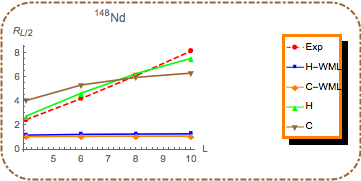 Figure 1
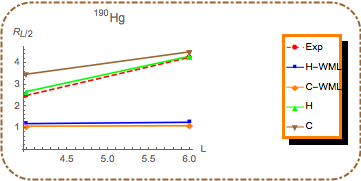 Figure 2
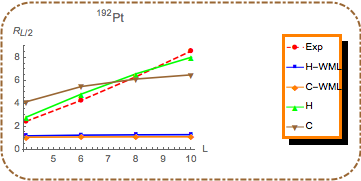 Figure 3
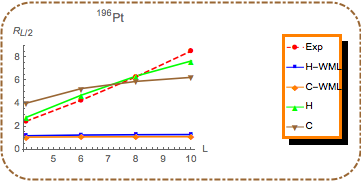 Figure 4
| Nucleus | ||||||||||||
|---|---|---|---|---|---|---|---|---|---|---|---|---|
| 104Ru Exp | 2.48 | 4.35 | 6.48 | 8.69 | 2.76 | 4.23 | 5.81 | |||||
| H | 2.82 | 4.78 | 6.49 | 7.85 | 3.91 | 4.51 | 5.62 | 0.00003 | 0.003 | 0.63 | ||
| C | 4.121 | 5.42 | 6.06 | 6.42 | 4.11 | 4.63 | 5.51 | 0.58 | -1.31 | 1.36 | ||
| 120Xe Exp | 2.44 | 4.23 | 6.34 | 8.77 | 2.82 | 3.95 | 5.31 | |||||
| H | 2.81 | 4.75 | 6.43 | 7.76 | 3.89 | 4.48 | 5.58 | 0.00003 | 0.003 | 0.70 | ||
| C | 4.07 | 5.35 | 5.98 | 6.33 | 4.06 | 4.58 | 5.44 | 0.58 | -1.31 | 1.43 | ||
| 122Xe Exp | 2.50 | 4.43 | 6.69 | 9.18 | 3.47 | 4.51 | ||||||
| H | 2.86 | 4.94 | 6.81 | 8.34 | 4.18 | 4.79 | 0.00004 | 0.003 | 0.58 | |||
| C | 4.29 | 5.67 | 6.35 | 6.72 | 4.29 | 4.84 | 0.58 | -1.31 | 1.53 | |||
| 124Xe Exp | 2.48 | 4.37 | 6.58 | 8.96 | 3.58 | 4.60 | 5.69 | |||||
| H | 2.85 | 4.89 | 6.71 | 8.19 | 4.10 | 4.70 | 5.86 | 0.00003 | 0.003 | 0.47 | ||
| C | 4.25 | 5.61 | 6.28 | 6.65 | 4.25 | 4.79 | 5.71 | 0.58 | -1.31 | 1.32 | ||
| 148Nd Exp | 2.49 | 4.24 | 6.15 | 8.19 | 3.04 | 3.88 | 5.32 | 7.12 | ||||
| H | 2.79 | 4.68 | 6.30 | 7.58 | 3.77 | 4.36 | 5.44 | 6.63 | 0.00003 | 0.003 | 0.49 | |
| C | 4.07 | 5.36 | 5.99 | 6.34 | 4.07 | 4.58 | 5.45 | 6.00 | 0.58 | -1.31 | 1.31 | |
| 150Sm Exp | 2.32 | 3.83 | 5.50 | 7.29 | 2.22 | 3.13 | 4.34 | 6.31 | ||||
| H | 2.66 | 4.27 | 5.54 | 6.47 | 3.23 | 3.78 | 4.73 | 5.70 | 0.00003 | 0.004 | 0.64 | |
| C | 3.58 | 4.66 | 5.19 | 5.48 | 3.55 | 4.00 | 4.73 | 5.19 | 0.58 | -1.30 | 1.17 | |
| 152Gd Exp | 2.19 | 3.57 | 5.07 | 6.68 | 1.79 | 2.70 | 3.72 | 4.85 | ||||
| H | 2.53 | 3.88 | 4.86 | 5.54 | 2.80 | 3.31 | 4.15 | 4.93 | 0.00003 | 0.005 | 0.67 | |
| C | 3.17 | 4.08 | 4.52 | 4.77 | 3.12 | 3.52 | 4.14 | 4.53 | 0.41 | -1.52 | 1.06 | |
| 172Os Exp | 2.66 | 4.63 | 6.70 | 8.89 | 3.33 | 3.56 | 5.00 | 6.81 | ||||
| H | 2.81 | 4.76 | 6.45 | 7.79 | 3.88 | 4.47 | 5.58 | 6.82 | 0.00003 | 0.003 | 0.63 | |
| C | 4.19 | 5.52 | 6.17 | 6.54 | 4.18 | 4.72 | 5.61 | 6.18 | 0.58 | -1.31 | 1.29 | |
| 190Hg Exp | 2.50 | 4.26 | 3.07 | 3.77 | 4.74 | 6.03 | ||||||
| H | 2.68 | 4.31 | 3.44 | 3.88 | 4.58 | 5.02 | 0.00004 | 0.004 | 0.16 | |||
| C | 3.48 | 4.51 | 3.48 | 4.51 | 5.01 | 5.30 | 0.95 | -1.02 | 0.66 | |||
| 192Pt Exp | 2.48 | 4.31 | 6.38 | 8.62 | 3.78 | 4.55 | ||||||
| H | 2.84 | 4.85 | 6.629 | 8.06 | 4.02 | 4.63 | 0.00003 | 0.003 | 0.41 | |||
| C | 4.18 | 5.50 | 6.16 | 6.52 | 4.17 | 4.71 | 0.58 | -1.31 | 1.33 | |||
| 196Pt Exp | 2.47 | 4.29 | 6.33 | 8.56 | 3.19 | 3.83 | ||||||
| H | 2.80 | 4.72 | 6.37 | 7.68 | 3.82 | 4.41 | 0.00002 | 0.003 | 0.60 | |||
| C | 4.03 | 5.29 | 5.91 | 6.26 | 4.02 | 4.53 | 0.58 | -1.31 | 1.41 |
| Nucleus | ||||||||||
|---|---|---|---|---|---|---|---|---|---|---|
| 100Mo Exp | 1.86(11) | 2.54(38) | 3.32(49) | 2.49(12) | 0 | 0.97(49) | 0.38(11) | |||
| H | 1.88 | 3.33 | 6.16 | 11.26 | 1.52 | 0.14 | 2.29 | 2.98 | 0.84 | |
| C | 2.25 | 1.41 | 0.76 | 0.43 | 1.41 | 4.88 | 0.73 | 0.07 | 1.06 | |
| 108Ru Exp | 1.65(20) | |||||||||
| H | 1.59 | 2.13 | 2.88 | 3.98 | 0.56 | 0.08 | 0.58 | 2.04 | 0.05 | |
| C | 2.61 | 1.71 | 0.93 | 0.53 | 1.98 | 5.82 | 0.77 | 0.04 | 0.96 | |
| 128Xe Exp | 1.47(15) | 1.94(20) | 2.39(30) | |||||||
| H | 1.73 | 2.65 | 4.22 | 6.83 | 0.97 | 0.11 | 1.25 | 2.52 | 0.48 | |
| C | 2.44 | 1.57 | 0.85 | 0.48 | 1.71 | 5.39 | 0.75 | 0.05 | 0.83 | |
| 146Nd Exp | 1.47(39) | |||||||||
| H | 1.80 | 2.97 | 5.11 | 8.84 | 1.23 | 0.13 | 1.73 | 2.76 | 0.33 | |
| C | 2.35 | 1.50 | 0.81 | 0.45 | 1.57 | 5.15 | 0.74 | 0.06 | 0.88 | |
| 148Nd Exp | 1.62 | 1.76 | 1.69 | 0.54 | 0.25 | 0.28 | ||||
| H | 1.71 | 2.57 | 3.99 | 6.33 | 0.90 | 0.11 | 1.14 | 2.45 | 0.59 | |
| C | 2.49 | 1.61 | 0.87 | 0.49 | 1.78 | 5.50 | 0.76 | 0.05 | 0.91 | |
| 150Sm Exp | 1.93(30) | 2.63(88) | 2.98(158) | 0.93(9) | 1.93 | |||||
| H | 1.78 | 2.86 | 4.81 | 8.15 | 1.14 | 0.12 | 1.56 | 2.68 | 0.57 | |
| C | 2.40 | 1.53 | 0.83 | 0.47 | 1.64 | 5.26 | 0.74 | 0.05 | 0.76 | |
| 172Os Exp | 1.56(6) | 1.82(10) | 1.99(11) | 2.29(26) | 0.33(5) | 0.04 | 0.12(1) | 0.62(6) | ||
| H | 1.70 | 2.52 | 3.87 | 6.06 | 0.87 | 0.11 | 1.07 | 2.42 | 1.01 | |
| C | 2.50 | 1.62 | 0.88 | 0.50 | 1.81 | 5.54 | 0.76 | 0.05 | 1.16 | |
| 190Hg Exp | ||||||||||
| H | 1.77 | 2.83 | 4.73 | 7.97 | 1.12 | 0.12 | 1.52 | 2.66 | ||
| C | 2.37 | 1.51 | 0.82 | 0.46 | 1.60 | 5.20 | 0.74 | 0.062 | ||
| 192Pt Exp | 1.56 | 1.22 | ||||||||
| H | 1.68 | 2.46 | 3.72 | 5.75 | 0.82 | 0.10 | 1.00 | 2.37 | 0.48 | |
| C | 2.50 | 1.62 | 0.88 | 0.49 | 1.80 | 5.54 | 0.76 | 0.050 | 0.09 | |
| 196Pt Exp | 1.48(2) | 1.80(10) | 1.92(25) | =0 | 0.12 | |||||
| H | 1.70 | 2.54 | 3.93 | 6.19 | 0.89 | 0.11 | 1.10 | 2.43 | 0.60 | |
| C | 2.48 | 1.60 | 0.87 | 0.49 | 1.77 | 5.48 | 0.759 | 0.05 | 0.63 |
Peer Reviews
No public reviews on file for this paper yet. If you reviewed it on a platform where reviews are public (OpenReview, ICLR, NeurIPS, ICML), you can paste yours below so the community can read it here.
Videos
No videos yet. Explain this paper in a talk, walkthrough, or lecture? Add one.
Taxonomy
TopicsNuclear physics research studies · Crystallography and Radiation Phenomena · Quantum chaos and dynamical systems
Comparaison between Coulomb and Hulthèn potentials within Bohr Hamiltonian for -rigid nuclei in the presence of minimal length
I. Moumene
High Energy Physics and Astrophysics Laboratory, Faculty of Science Semlalia, Cadi Ayyad University, P.O.B. 2390, Marrakesh,Morocco
Department of Physics, University of Zanjan, P.O. Box 45195-313, Zanjan, Iran
\runningheads
Preparation of Papers for Heron Press Science Series Books M. Chabab, A. El Batoul, M. Hamzavi, A. Lahbas, I.Moumene, M. Oulne
{start}
\coauthor
M. Chabab1,\coauthor A. El Batoul1,\coauthor M. Hamzavi2,\coauthor A. Lahbas1,1, \coauthorM. Oulne1
1
2
{Abstract}
In this work we solve the Schrödinger equation for Bohr Hamiltonian with Coulomb and Hulthén potentials within the formalism of minimal length in order to obtain analytical expressions for the energy eigenvalues and eigenfunctions by means of asymptotic iteration method. The obtained formulas of the energy spectrum and wave functions , are used to calculate excitation energies and transition rates of -rigid nuclei and compared with the experimental data at the shape phase critical point X(3) in nuclei.
1 Introduction
Several analytical solutions of the Bohr Hamiltonian with different model potentials have been proposed. On the other hand, this problem is related to the evolution of Critical Point Symmetries concept. For example, the symmetry E (5) [1] describes the second-order phase transition between spherical and -unstable nuclei, while the transition from vibratory to axially symmetric nuclei is described by symmetry X (5) [2] and X(3) [3] which is a special case of this latter in which is fixed to =0. This model has been developed with the introduction of the concept of minimal length [4]. In this context, different model potentials have been used such as infinite Square Well (ISW) [5], the harmonic oscillator [6], the sextic potential [7] and the Davidson one within X(3) symmetry.
In the present work we focused on the study of the Bohr Hamiltonian in the presence of a minimal length in X(3) model with two known potentials, namely: Hulthén and coulomb, where we have obtained the expressions of eigenvalues and wave functions by means of the asymptotic iteration method (AIM)[8, 9]. Such a useful method is efficient to solve many similar problems [10, 11].
2 Formulation of the Model
The Bohr Hamiltonian in the presence of a minimal length is given by [4]
[TABLE]
with
[TABLE]
where is the angular part of the Laplace operator
[TABLE]
The corresponding deformed Schrödinger equation to the first order in reads as
[TABLE]
By introducing an auxiliary wave function
[TABLE]
we obtain the following differential equation satisfied by
[TABLE]
By considering the wave function as
[TABLE]
and
[TABLE]
[TABLE]
where is :
- •
The Coulomb potential:
[TABLE]
- •
The Hulthén potential :
[TABLE]
3 Energy Spectrum
3.1 Hulthén potential
Using the new variable , Eq (7) becomes
[TABLE]
In order to apply AIM, we consider the following ansatz:
[TABLE]
with
[TABLE]
Using the AIM, we obtain the energy spectrum in the following form:
[TABLE]
3.2 Coulomb potential
By substituting the folowing ansatz in Eq (7), we get
[TABLE]
with
[TABLE]
Applying the AIM, we obtain the energy spectrum as
[TABLE]
with
[TABLE]
and
[TABLE]
4 Wave functions
4.1 Hulthén
The wave function is written in terms of Hypergeometric functions
[TABLE]
where N is a normalization constant [12]
[TABLE]
4.2 Coulomb
The wave function in this case is written in terms of Laguerre polynomials
[TABLE]
with
[TABLE]
5 Transition rates B(E2)
The general expression for the quadrupole transition operator is [13]
[TABLE]
where t denotes a scalar factor and is the Winger functions of Euler angles.
The B(E2) transition rates are given by [3]
[TABLE]
where are Clebsch-Gordan coefficients and
[TABLE]
6 Numerical results
6.1 Spectra of -rigid nuclei
The formulas of the energy spectrum, obtained by the equations 12 and 14, are used to calculate the excitation energies of -rigid nuclei. The energy spectrum of Coulomb potential depends on two parameters ( , ), while in the Hulthén potential, it depends on ( , ). All these parameters have been set by fitting the excitation energies normalized to the energy of the first excited state . We evaluate the root mean square (rms) deviation between theoretical values and the
experimental data by
[TABLE]
where is the number of states, while and represent the theoretical and experimental energies of the level, respectively. is the energy of the first excited level of the ground state band.
From the Eq (9) and (8), one can see that both potentials have mathematically similar behaviors. If we give the same value to the parameter in Coulomb potential (Eq.(8)) and in the Hulthén one (Eq.(9)), we get overcome curves. The Figure (1) shows that in the absence of minimal length case, the obtained results for energy ratios with both potentials are identical for all even-even nuclei, while in its presence, the calculated energy ratios with Hulthén potential are
fairly better than those obtained with Coulomb one. The best candidate nuclei for the model with Hulthén potential are: 172Os, 192Pt, 196Pt and 190Hg.
7 Conclusion
In this work, we have solved the Bohr-Mottelson Hamiltonian in the -rigid regime within the minimal length formalism with two well-known potentials: Coulomb and Hulthén.
From the comparison between the energy spectra and transition probabilities in the two cases: presence and absence of the minimal length, one can conclude that the obtained results with Hulthén potential within the ML are better. This latter reproduces well the candidates which already have been obtained including the predicted new one: 190Hg.
Acknowledgements
I.Moumene would like to thank the organizing committee for giving her the greatest opportunity to attend and be one of the team members in this interesting workshop, and their hospitality during the meeting.
Also she would like to thank the university CADI AYYAD for the financial support.
A huge thank to professor M. Oulne and A. Antonov for their encouragement.
The reference list from the paper itself. Each links out to its DOI / PubMed record.
- 1[1] F. Iachello, Phys. Rev. Lett. 85 (17) (2000) 3580.
- 2[2] F. Iachello, Phys. Rev. Lett. 87 (5) (2001) 052502.
- 3[3] D. Bonatsos, D. Lenis, D. Petrellis, P. A. Terziev, I. Yigitoglu, Phys. Lett. B 632 (2006) 238–242.
- 4[4] M. Chabab, A. El Batoul, A. Lahbas, M. Oulne, Phys. Lett.B B 758 (2016) 212–218.
- 5[5] D. Bonatsos, D. Lenis, D. Petrellis, P. A. Terziev, I. Yigitoglu, Phys. Lett. B 621 (2005) 102–108.
- 6[6] M. J. Ermamatov, P. R. Fraser, Phys. Rev. C 84 (2011) 044321.
- 7[7] R. Budaca, P. Buganu, M. Chabab, A. Lahbas, M. Oulne, Annals Phys. 375 (2016) 65–90.
- 8[8] H. Ciftci, R. L. Hall, N. Saad, J. Phys. A: Math. Gen. 36 (47) (2003) 11807.