Dynamical Singularities of Floquet Higher-Order Topological Insulators
Haiping Hu, Biao Huang, Erhai Zhao, and W. Vincent Liu

TL;DR
This paper introduces a systematic method to create and analyze Floquet higher-order topological insulators with dynamically generated corner modes, using topological invariants derived from the full unitary return map.
Contribution
It provides a versatile framework for generating Floquet higher-order topological phases from trivial Hamiltonians and introduces new dynamical topological invariants for their characterization.
Findings
Demonstrated Floquet quadrupole and octupole insulators with protected corner modes
Developed dynamical invariants from the full unitary return map
Identified Weyl singularities in phase bands related to topological charges
Abstract
We propose a versatile framework to dynamically generate Floquet higher-order topological insulators by multi-step driving of topologically trivial Hamiltonians. Two analytically solvable examples are used to illustrate this procedure to yield Floquet quadrupole and octupole insulators with zero- and/or -corner modes protected by mirror symmetries. Furthermore, we introduce dynamical topological invariants from the full unitary return map and show its phase bands contain Weyl singularities whose topological charges form dynamical multipole moments in the Brillouin zone. Combining them with the topological index of Floquet Hamiltonian gives a pair of invariant and which fully characterize the higher-order topology and predict the appearance of zero- and -corner modes. Our work establishes a systematic route to construct and characterize Floquet…
Click any figure to enlarge with its caption.
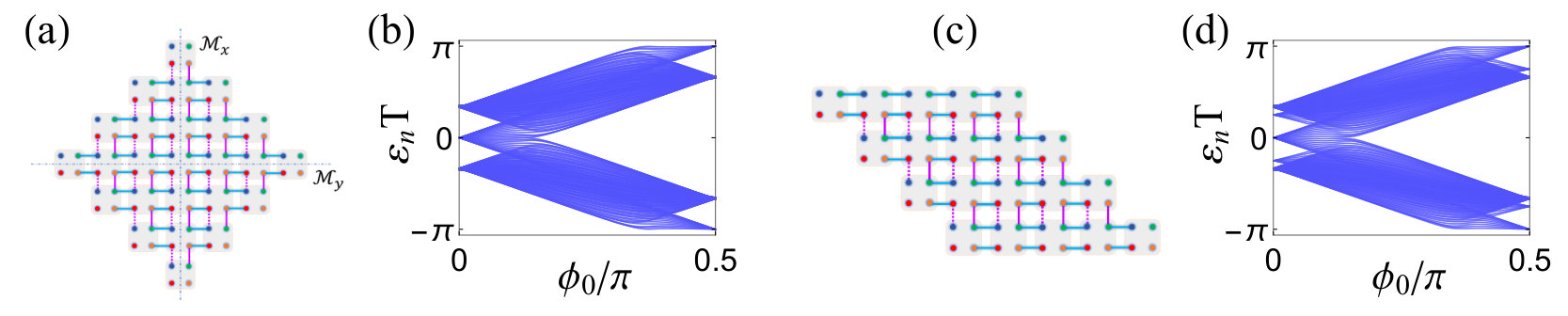 Figure 1
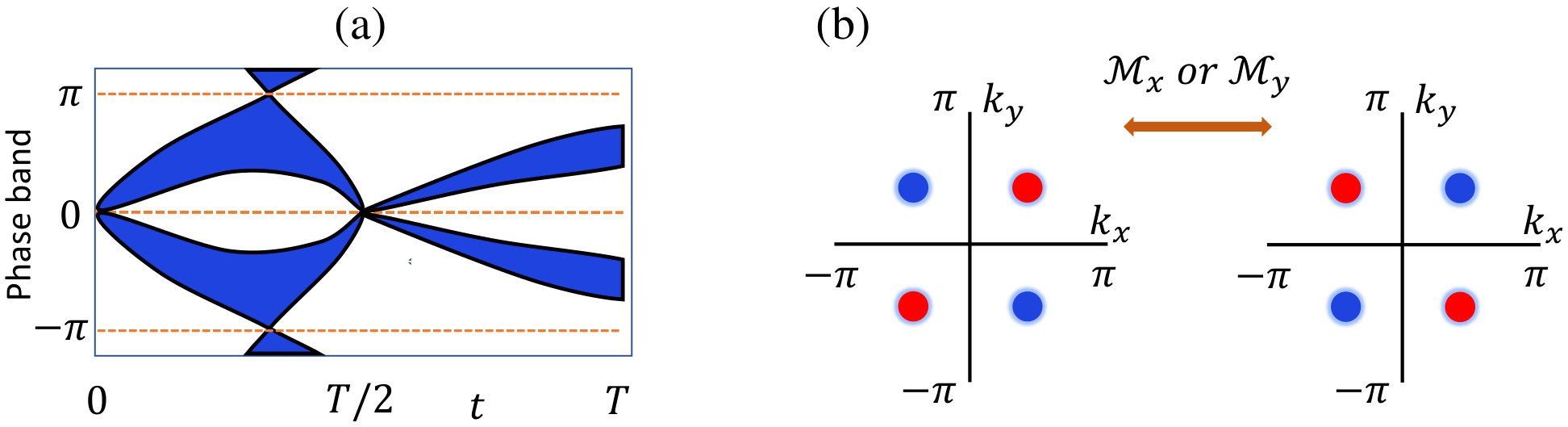 Figure 2
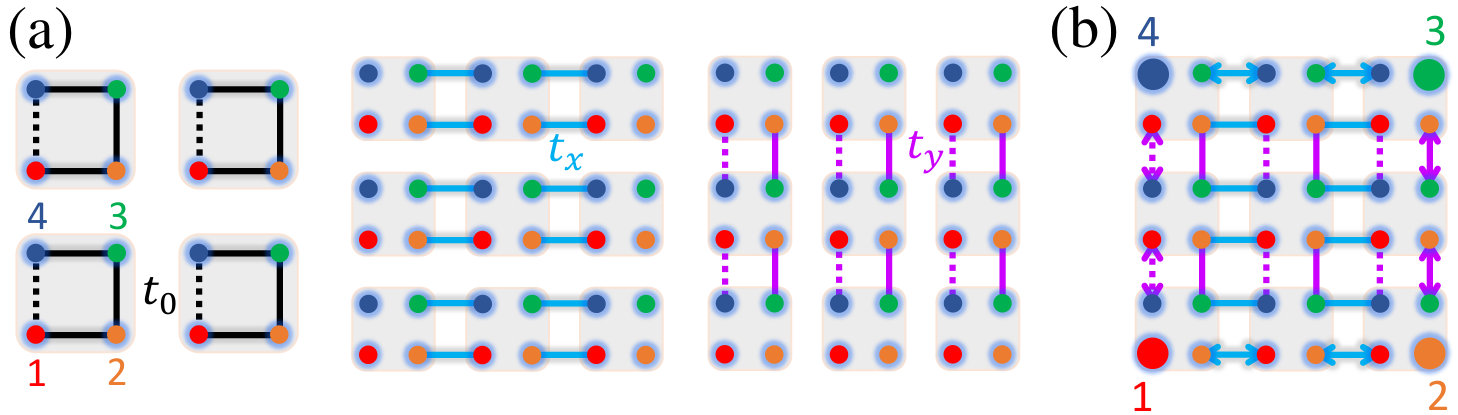 Figure 1
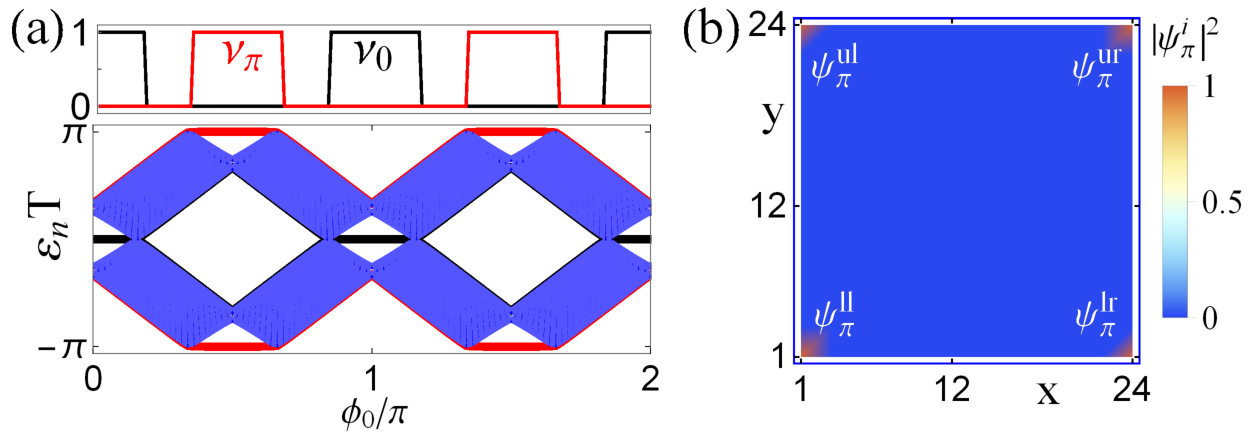 Figure 2
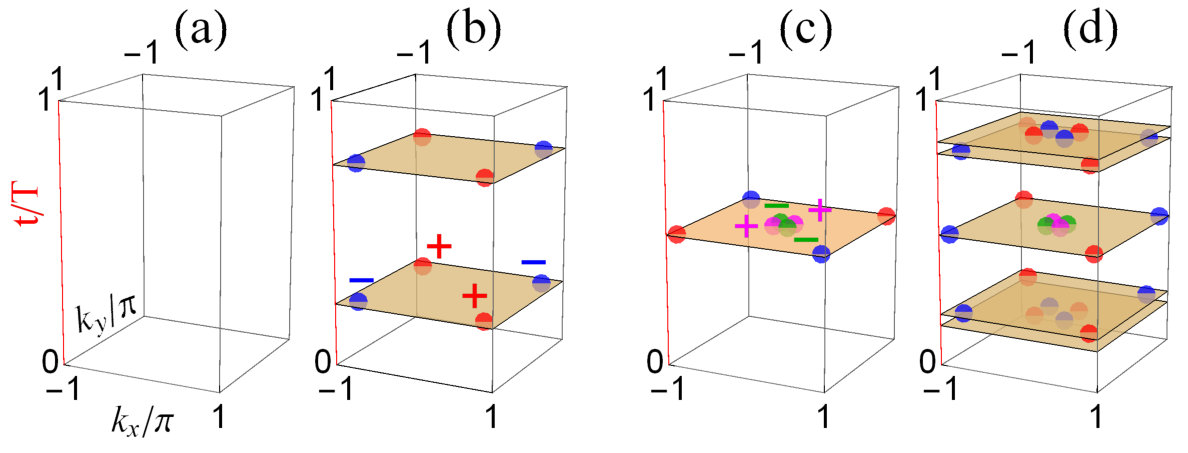 Figure 3
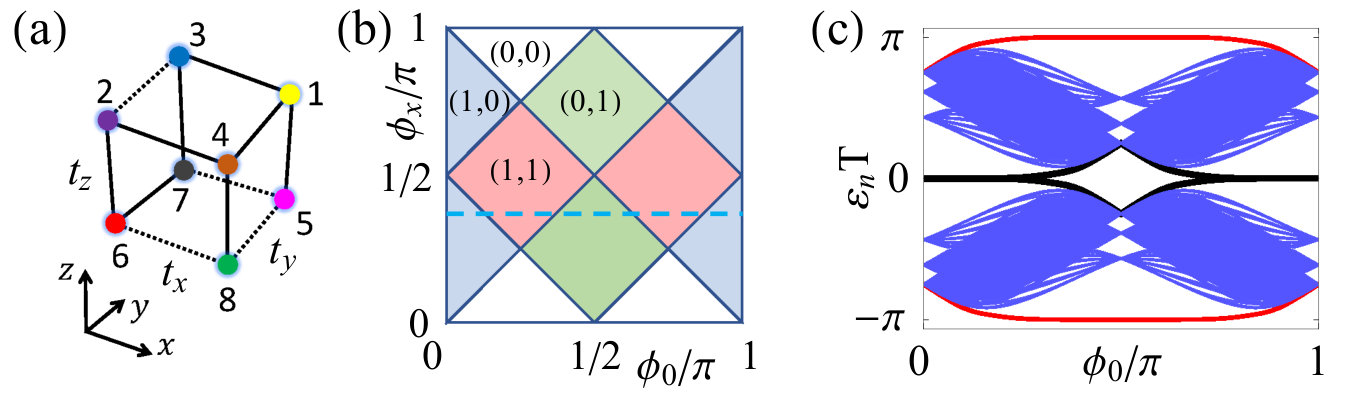 Figure 4
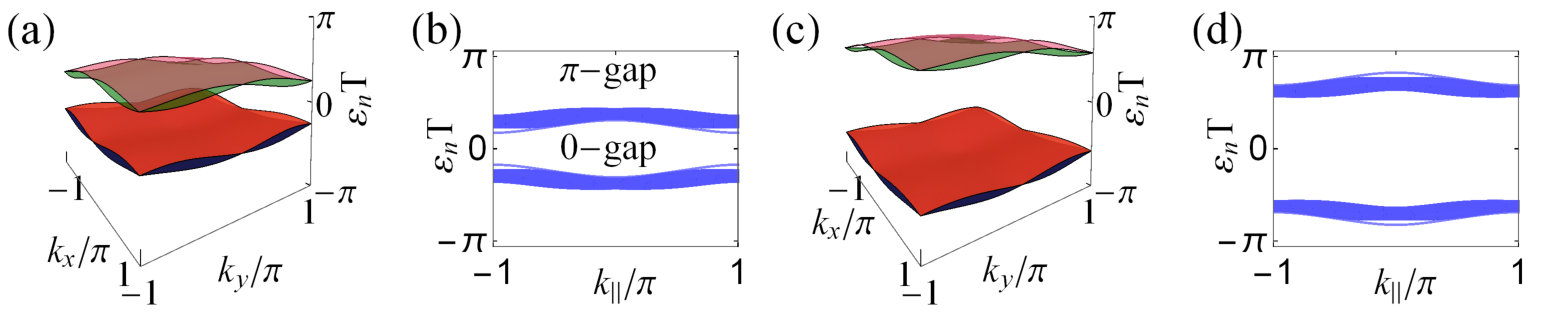 Figure 7
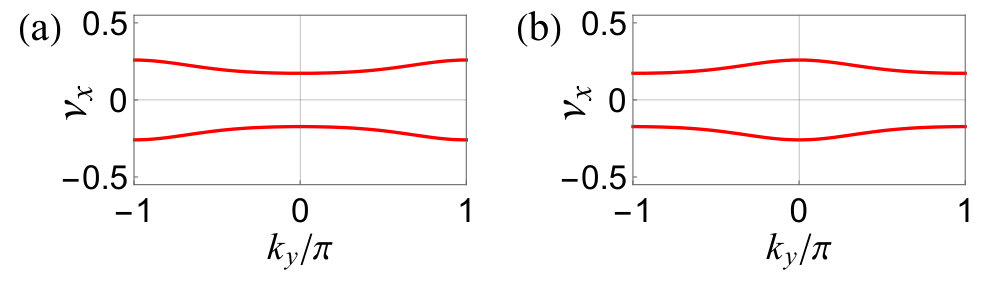 Figure 8
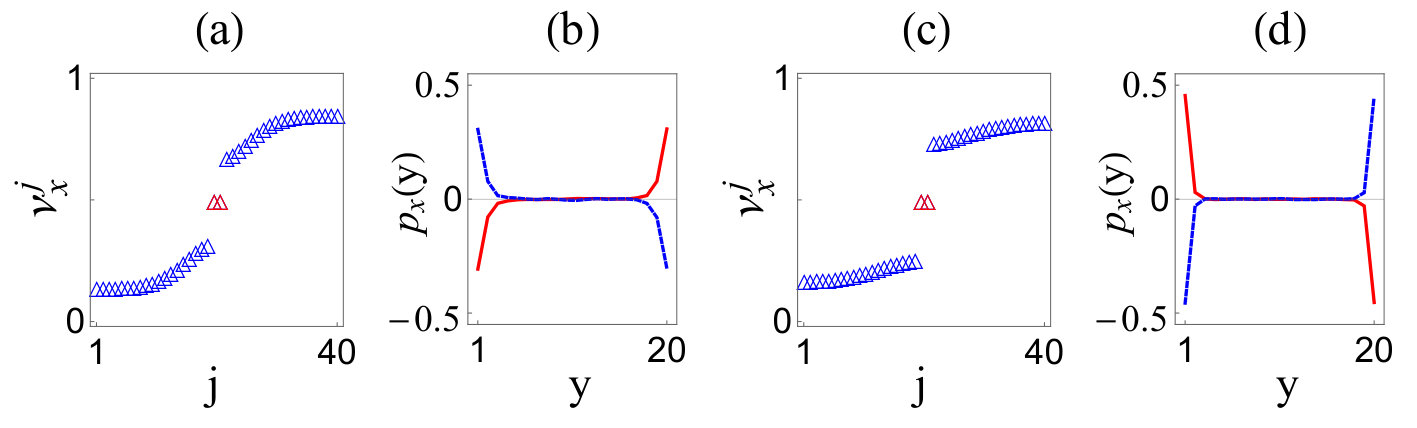 Figure 9
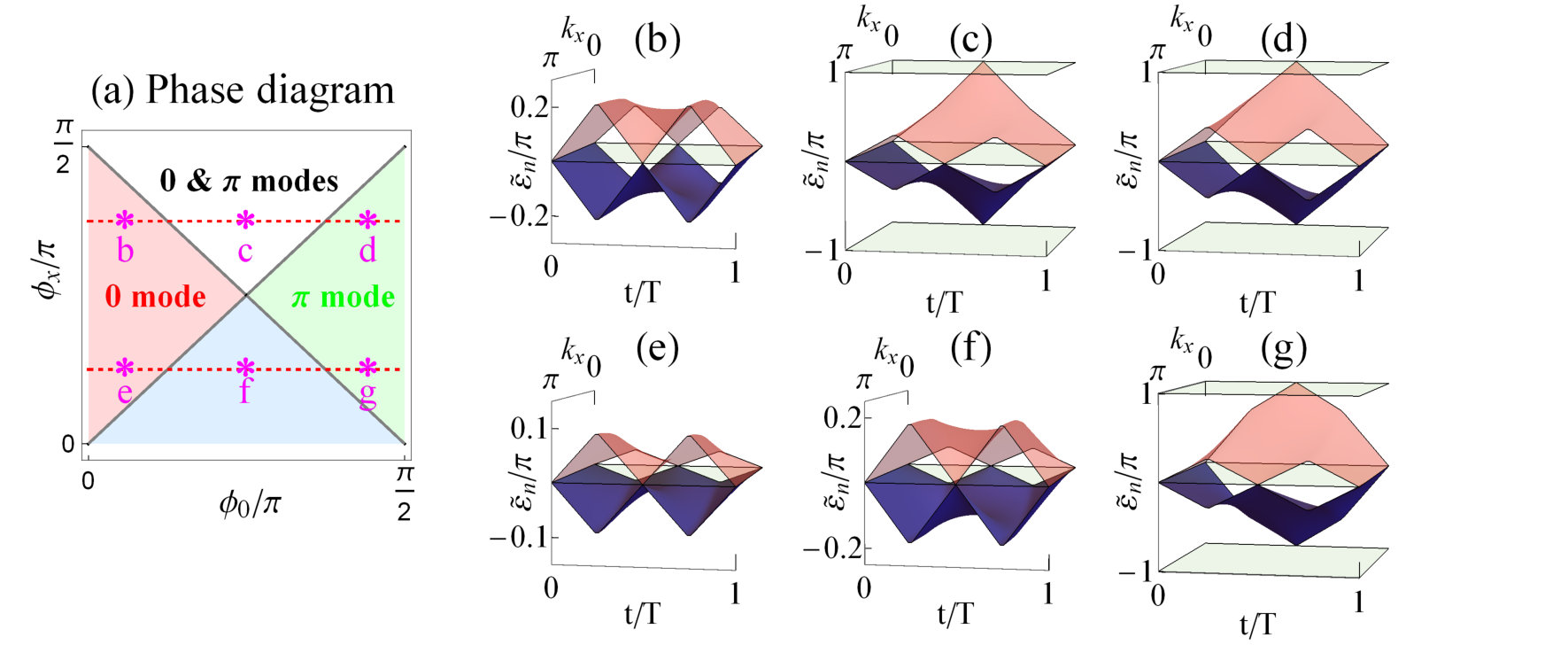 Figure 10
 Figure 11
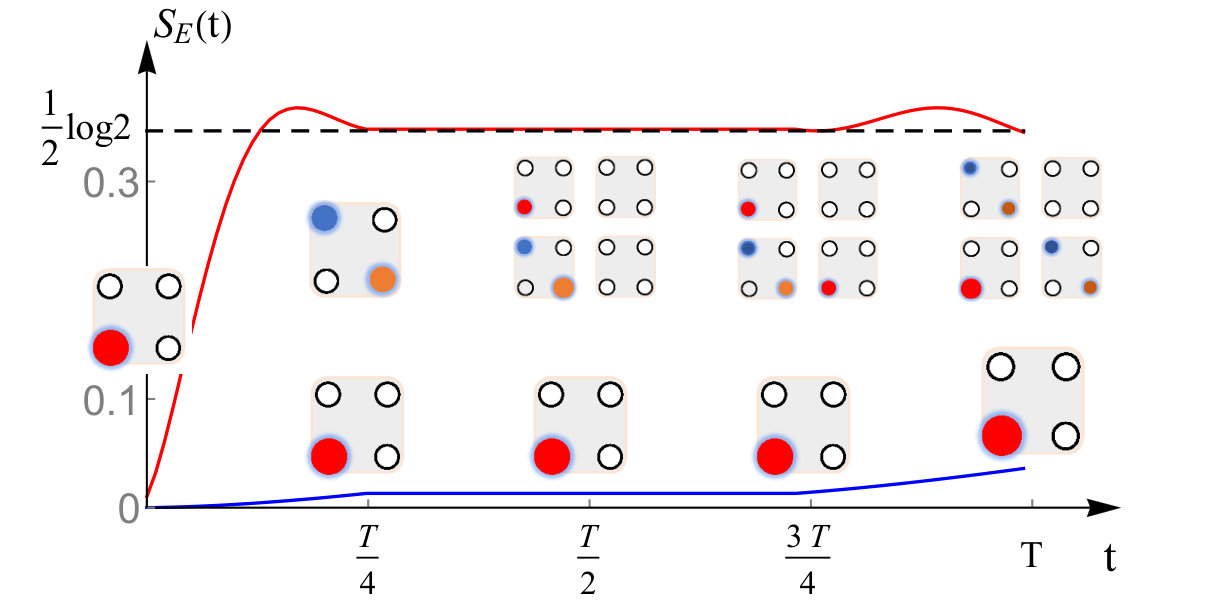 Figure 12
Peer Reviews
No public reviews on file for this paper yet. If you reviewed it on a platform where reviews are public (OpenReview, ICLR, NeurIPS, ICML), you can paste yours below so the community can read it here.
Videos
No videos yet. Explain this paper in a talk, walkthrough, or lecture? Add one.
Dynamical Singularities of Floquet Higher-Order Topological Insulators
Haiping Hu
Department of Physics and Astronomy, George Mason University, Fairfax, Virginia 22030, USA
Department of Physics and Astronomy, University of Pittsburgh, Pittsburgh, Pennsylvania 15260, USA
Biao Huang
Department of Physics and Astronomy, University of Pittsburgh, Pittsburgh, Pennsylvania 15260, USA
Erhai Zhao
Department of Physics and Astronomy, George Mason University, Fairfax, Virginia 22030, USA
Quantum Materials Center, George Mason University, Fairfax, Virginia 22030, USA
W. Vincent Liu
Department of Physics and Astronomy, University of Pittsburgh, Pittsburgh, Pennsylvania 15260, USA
Wilczek Quantum Center, School of Physics and Astronomy and T. D. Lee Institute, Shanghai Jiao Tong University, Shanghai 200240, China
Shenzhen Institute for Quantum Science and Engineering and Department of Physics, Southern University of Science and Technology, Shenzhen 518055, China
Abstract
We propose a versatile framework to dynamically generate Floquet higher-order topological insulators by multi-step driving of topologically trivial Hamiltonians. Two analytically solvable examples are used to illustrate this procedure to yield Floquet quadrupole and octupole insulators with zero- and/or -corner modes protected by mirror symmetries. Furthermore, we introduce dynamical topological invariants from the full unitary return map and show its phase bands contain Weyl singularities whose topological charges form dynamical multipole moments in the Brillouin zone. Combining them with the topological index of Floquet Hamiltonian gives a pair of invariant and which fully characterize the higher-order topology and predict the appearance of zero- and -corner modes. Our work establishes a systematic route to construct and characterize Floquet higher-order topological phases.
Introduction. Topological phases of matter review1 ; review2 are characterized by bulk topological invariants and the appearance of robust edge/surface states. Recently, the notion of topological phases and bulk-edge correspondence has been extended to higher-order topological insulators (HOTIs) hoti01 ; hoti02 . A defining characteristic of HOTI is the emergence of corner or hinge modes, i.e. excitations at the intersections of edges or surfaces with energies inside the bulk gap and protected by crystalline symmetries hoti01 ; hoti02 ; hoti1 ; hoti2 ; hoti3 ; hoti4 ; hoti5 ; hoti6 ; hoti7 ; hoti8 ; hoti9 ; hoti10 ; hoti11 ; hoti12 ; hoti13 ; hoti14 . Theoretical concepts such as the nested Wilson loops hoti01 ; hoti02 and many-body multipole operators multipole1 ; multipole2 have been proposed to capture their topological properties and the bulk-corner/hinge correspondence. Experimentally HOTIs have been observed in phononic hotiexp1 and photonic systems hotiphotonicexp1 ; hotiphotonicexp2 ; hotiphotonicexp3 , circuit arrays hotiexp3 and crystal solids hotiexp4 .
The notion of topological phases has also been generalized to Floquet systems where the Hamiltonian is periodic in time, , with the driving period fti1 ; jiangliang ; lindner ; kitagawa ; ano1 . Periodic driving provides a powerful tool to engineer the quasienergy band structure by tuning the driving amplitude, frequency and shape. Despite the apparent similarity between quasienergy and energy, the topological properties of Floquet systems are much richer than static systems. One of its unique features is the appearance of in-gap modes pinned at quasienergy and localized at the edge, even though the bulk quasienergy bands are trivial. Such anomalous Floquet topological insulators are intrinsically dynamical phases. In order to systematically classify Floquet topological phases fclass1 ; fclass2 ; fclass3 , one must examine the full time-evolution operator . In particular, the so-called return map [see Eq. (1) below] defines a or topological invariant fclass2 ; fclass3 for each quasienergy gap. In 2D, for example, it corresponds to the winding number ano1 ; counter ; harmonic which counts the topological charge of Weyl-like singularities ano2 ; anatomy in the instantaneous phase band during time evolution. The return map, together with the effective Hamiltonian , can describe a large class of first-order Floquet topological insulators fclass1 ; fclass2 ; fclass3 .
It is then natural to ask whether periodic driving can give rise to new high-order topological phenomena that have no static analogues, and if so, how to characterize them? Recently, several specific models have appeared to realize Floquet HOTIs (FHOTIs) in periodically driven systems fhoti1 ; fhoti2 ; fhoti3 ; fhoti4 ; fhoti5 . These proposals however rely on building-block Hamiltonians with specific lattice structures or symmetries and are therefore not general. Moreover, the existing topological invariants in Refs. fhoti1 ; fhoti2 ; fhoti3 ; fhoti4 ; fhoti5 are supplied in a case by case manner, applicable only to a certain specific model or symmetry class. A theory for FHOTIs that can predict the corner modes (CMs) from bulk invariants constructed from a general and is still lacking.
Motivated by these considerations, in this paper we demonstrate a generic route to realize and characterize FHOTIs. The construction does not rely on any specific space-time symmetries of the building-block Hamiltonians. As an example, a 2D model is solved analytically to determine the phase diagram, which contains two Floquet quadrupole topological phases with 0- and -CMs respectively. Via the decomposition of the unitary evolution, we show that the topology of the quasienergy bands is captured by invariant from the nested Wilson loops, while the return maps feature multipole patterns of dynamical singularities: the topological charges of the Weyl-type singularities of form a quadrupole moment in the Brillouin zone (BZ) at certain instants. Two dynamical invariants are introduced to count these charges. From and , we show that each quasienergy gap is characterized by a index that predicts the appearance or absence of CMs. The new invariants work for all mirror-symmetry protected FHOTIs and go beyond the periodic table of first-order Floquet topological insulators. The construction and topological analysis are then generalized to 3D Floquet octupole topological insulators.
Dynamical construction of FHOTI. The dynamics of a periodically driven lattice system with Hamiltonian is governed by the unitary evolution , where and denotes time-ordering. To extract its topology, it is convenient to decompose into a unitary loop satisfying and the time evolution of a constant Hamiltonian fclass2 . Explicitly, one can define the effective Hamiltonian as well as the return map ano1 ; fclass2 ; fclass3
[TABLE]
Usually, is defined for a given gap with the logarithm branch cut lying within it. It is apparent from Eq. (1) that the topology of is carried by both and . The spectra of are known as quasienergy bands and we take .
The basic idea of dynamical construction of FHOTI can be illustrated by a simple example of Floquet quadrupole insulator depicted in Fig. 1(a). Consider a square lattice, where each unit cell (shaded box) consists of four lattice sites. Our strategy is to herd the motion (more precisely the quantum walks) of particles by spatial control of the tunneling amplitudes in multiple steps within each driving period. Three trivial Hamiltonians , and serve as the building blocks: only contains inter-cell hopping along the direction, and only contains intra-cell hopping . To visualize the emergence of topological CMs, consider the limit of and two-step driving: followed by . The semiclassical particle motion is sketched in Fig. 1(b). It is clear that particles in the bulk move along a plaquette, while particles on the four edges hop back and forth. However, particles initially at the four corners remain localized and completely decoupled from the bulk and edge dynamics. They are nothing but Floquet CMs. We will show below that the CMs persist to finite as the bulk excitations form Floquet bands separated by gaps. Similar to static case hoti01 ; hoti02 , the Floquet CM is protected by crystalline symmetries (e.g., mirror reflection).
This picture motivates us to propose the following generic -step driving sequence. In each step with time interval , the system evolves according to a constant Hamiltonian assumed, for simplicity, to be a sum of anti-commuting terms (see , in Eq. (4) below). Accordingly,
[TABLE]
Here , , with the spectrum of . By definition, the wave functions of CMs at quasienergy zero (0-CM) and (-CM) satisfy
[TABLE]
The existence of solution to these eigen equations is guaranteed by properly choosing and as follows. Consider a state localized at the corner (Fig. 1b). It may couple to neighboring sites by in the first step. But for all other steps , is chosen so . A 0-CM is realized if we choose . Its wave function is simply given by . Similarly setting gives rise to -CM with . For 0- and CMs to coexist fhoti1 , one can choose for example and for even . We will give a few examples below to illustrate how this construction procedure can be applied to generate different kinds of FHOTIs.
Floquet quadrupole insulator. First we present an analytically solvable model of Floquet quadrupole insulator (FQI) and demonstrate the emergence of topological CMs. The overall set up has been introduced above in Fig. 1 on the square lattice. The unit cell is conveniently described by two sets of Pauli matrices and . The trivial building blocks are hopping Hamiltonians , , and where is the quasi-momentum. The terms in anti-commute and the system possesses two mirror symmetries and . The driving protocol is
[TABLE]
with time interval ). For , the FQI phase with 0-CMs appears when SM
[TABLE]
with . The FQI phase with -CMs lies within
[TABLE]
For all other values of , the system is a trivial band insulator with no CMs.
Fig. 2(a) shows the quasienergy spectra as function of for a finite lattice with open boundary conditions. In between the bulk bands, we observe four-fold degenerate in-gap modes pinned at or . They appear alternatively with a period of exactly as is varied, and are separated from each other by the topologically trivial phase, in consistent with Eqs. (5)-(6). The wave functions of these in-gap modes are shown in Fig. 2(b). They are indeed localized at the four corners arising from the bulk quadrupoles. In comparison, the quasienergy spectra for periodic boundary condition or stripe geometry are fully gapped SM , indicating vanishing conventional dipoles.
This model provides an elegant example of our dynamical construction of FHOTIs and CMs summarized in Eq. (2). Denote the wave functions of four CMs as ( and take , the lower-left corner for example. For , the 0-CM wave function is localized at a single site labeled as 1 [Fig. 1], , corresponding to the value in our construction scheme. The other two driving steps do not couple the CMs to the bulk. For , the -CM wave function is , corresponding to . When deviating from these ideal limits, the CMs spread further into the bulk but remain localized. The FQI and CMs persist as long as the bulk gaps stay open.
Dynamical topological invariants. For static HOTI, the higher-order bulk topology and appearance of CMs can be described by introducing Wannier bands and nested Wilson loops hoti01 ; hoti02 ; SM ; wannier . The analysis can be generalized to Floquet systems to capture the topological properties of and the quasienergy bands. We chose the lower two overlapping quasienergy bands to construct the Wannier-band subspace () and compute the nested polarizations hoti01 ; hoti02 ; SM , for example,
[TABLE]
In the presence of mirror symmetries and , the nested polarization and are quantized to be [math] (trivial) or (topological) hoti01 ; hoti02 , yielding a classification. The topological quadrupole phase corresponds to . It is characterized by invariant
[TABLE]
For the two FQI phases above, is found to be , which is consistent with the quantized tangential polarization along the edges hoti01 ; hoti02 ; SM . By itself, however, cannot distinguish the two FQI phases, or predict in which gap the CMs reside or even the existence of CMs (e.g. for anomalous FQI fhoti1 , is zero but CMs are present). This is not surprising because it only captures the topology of , not the full . For FHOTI, an intrinsically dynamical topological invariant is needed.
Such a dynamical invariant can be defined from the return map . The diagonalization of yields , with the eigenphases forming the phase bands ano2 ; fclass2 . For our system, during the time evolution , the gap may close at [math] or as the phase bands touch each other at isolated points in the -space, similar to Weyl points in semimetals, and reopen afterwards. Such singular points resemble magnetic monopoles and carry topological charges ano2 . For the -th degeneracy point of band , we compute its topological charge , with a small surface enclosing .
Due to the mirror symmetries , these “Weyl points” at a specific time instant always come in quartets, i.e. at in the 2D BZ. And their charges form a quadrupole pattern footnote as illustrated in Fig. 3(a)-(d). Such dynamical quadrupole (with zero total charge) indicates the higher-order topology and the absence of 1D edge states ano1 ; ano2 . In fact, one can prove that a quadrupole pattern is equivalent to its mirror image by a continuous deformation based on or SM . Thus, , the total Weyl charge within the first quadrant of the BZ during , is only defined modulo 2, and its parity can serve as the dynamical invariant for corresponding gap. Combining from with the quadrupole invariant for , we arrive at two -valued invariants for the 0- and -gap respectively (for details, see SM ),
[TABLE]
We stress that the nature of originates from mirror symmetries. A nonzero value of () indicates the appearance of CMs at the [math]-gap (-gap). Thus, our Floquet system follows a classification and is described by two invariants (), one for each gap. To check the correspondence between bulk invariants Eq. (9) and the CMs observed in numerics, we give a few examples of the Weyl charges in Figs. 3(a)-(d). For the FQI phase with 0-CMs [Fig. 3(a)(b)], we have and or . In both cases, . For the FQI phase with -CMs [Fig. 3(c)(d)], and or . Thus, . It is clear that Eq. (9) correctly predicts the appearance of Floquet CMs, in agreement with Fig. 2(a). We have checked that the invariants also apply to anomalous FQIs with discussed in fhoti1 ; SM .
Floquet octupole insulator. Next we show how to generate Floquet octupole insulators (FOIs) on a cubic lattice following our general scheme. The degrees of freedom inside the eight-site unit cell, illustrated in Fig. 4(a), can be described by three sets of Pauli matrices , and . The dynamical construction employs four building blocks: an intra-unit cell hopping Hamiltonian and three inter-unit cell hopping Hamiltonians , , with , for , , and . The driving protocol consist of two steps: for and , ; for , . Let us focus on the simple case of . Then the phase boundaries can be found analytically SM ,
[TABLE]
with and .
The phase diagram on the plane is depicted in Fig. 4(b). It contains three distinct FOIs and a trivial phase. Roughly speaking, the FOI phase with only 0-CMs is located near and , while the FOI phase with only -CMs occupies regions around . Sandwiched in between is the third, anomalous FOI which has both 0- and -CMs. The quasienergy spectrum for a finite system with open boundary conditions is shown in Fig. 4(c) for parameters along a cut in the phase diagram with fixed . The location of different Floquet CMs agrees with the phase boundaries given by Eq. (10). To cast this example in the general scheme Eq. (2), we notice the 0-CM at point is simply with . The -CM at is just with . The system has three mirror symmetries: ; ; and . Together they quantize the octupole moment. Similar to the FQIs, the topology of the Floquet system is carried by both and the return map . The former is characterized by a invariant SM ; the latter contains singularities of the phase bands in 4D -space. We find the invariants in Eq. (9) are still valid SM .
Outlook. We have introduced a versatile route to construct and characterize FHOTIs. The building blocks are topologically trivial and accessible in many synthetic (e.g. photonic and cold-atoms) quantum systems. For example, the quadrupole phase can be realized based on the -flux Hofstadter model piflux1 ; piflux2 with the addition of a superimposed superlattice along both the and directions hoti01 . Alternatively, the modulation along one direction may be replaced by utilizing spin degree of freedom, with the effective hoppings being induced by Raman coupling and laser-assisted tunneling in different directions, respectively. The driving protocol can be viewed more generally as discrete-time quantum walks on lattice qw1 ; qw2 ; qw3 . By imposing further constraints on the building blocks or the driving protocols, our construction can be generalized to realize higher-order topological phases in other symmetry classes. In contrast to previous constructions of model-dependent topological invariants, the phase-band singularities are general for Floquet systems, hinting the possibility of a unified scheme for characterizing the higher-order topology for a wide class of systems. Experimentally, in addition to the observation of CMs, the higher-order topology may be identified from the tomography of band-touching singularities btproposal . Finally, it would be interesting to investigate FHOTIs in the frequency domain ano1 ; frequency and the time evolution of CMs from the entanglement perspective SM .
Acknowledgements.
This work is supported by NSF Grant No. PHY-1707484 (H.H. and E.Z.), AFOSR Grant No. FA9550-16-1-0006 (H.H., E.Z., and W.V.L.), MURI-ARO Grant No. W911NF-17-1-0323 (B.H. and W.V.L.), and NSF of China Overseas Scholar Collaborative Program Grant No. 11429402 sponsored by Peking University (W.V.L.).
Appendix A Supplementary materials for “Dynamical singularities of Floquet higher-order topological insulators”
In this supplementary material, we provide details on the derivation of stroboscopic evolution operator for driving protocol Eq. (4), Floquet spectra under different boundary conditions, nested Wilson loop (NWL) approach, justification of invariants, phase-band characterizations for the anomalous Floquet quadrupole insulators (FQIs) and Floquet octupole insulators (FOIs), time-evolution of corner modes (CMs).
A.1 Derivation of stroboscopic evolution operator and phase boundaries
While the driving consists of three steps, for analytical convenience we have shifted the time origin, which amounts to a gauge transformation, and partitioned the time evolution into four parts. The stroboscopic evolution operator for our driving protocol Eq. (4) can be explicitly calculated as ( is assumed, , , , , , ).
[TABLE]
Each term in Eq. (11) can be expanded as
[TABLE]
As is a unitary operator, it can be rewritten as the sum of a real and imaginary Hermite operator, i.e., with and . After some calculations, one finds
[TABLE]
The topological phase transitions are determined by the gap closings located at [math] and , i.e., when the eigenvalues of take . For the specific case discussed in the main text, , the Dirac points satisfy . We have
[TABLE]
As , the 0-gap closing condition dictating the emergence of 0-CMs is then
[TABLE]
with solutions
[TABLE]
Similarly, the -gap closing condition which dictating the emergence of -CMs is
[TABLE]
with solutions
[TABLE]
A.2 Floquet spectra under different boundary conditions
The bulk-edge-corner correspondence manifest itself through the Floquet spectra under different boundary conditions. In Fig. 2(a) of the main text, we have demonstrated the Floquet spectra of driving protocol Eq. (4) under open boundary conditions (OBC). There we have observed the emergence of two types of FQIs, supporting either 0- or -CMs, respectively. As a comparison, here we show their corresponding Floquet spectra under periodical boundary conditions (PBC) and stripe geometry.
Fig. 5 (a)(c) depict their Floquet spectra under PBC. The existence of both 0- and - gap splits the bulk bands into two sets, with each set containing two degenerate bands at high-symmetry points in the 2D Brillouin zone (BZ). The two sets are each other’s particle-hole partner. Using either set of the bulk Floquet bands, we can construct the Wannier bands using Wilson loop, similar to the static case. We will discuss this point in detail in the next part. Fig. 5(b)(d) depict the Floquet spectra under stripe geometry, which are fully gapped, without any in-gap modes along the 1D edges. This is a key difference from the first-order topological phase. Together with the Floquet spectra under OBC, the appearance of CMs is a salient feature of the higher-order topology of FQIs.
The CMs are protected by mirror symmetries and . In crystalline topological phases, boundaries of different orientations may host modes of different dispersions or robustness. The boundary/corner modes in the FQIs depend on the edge termination, and not all of them are robust. Two examples of zigzag edges and their corresponding Floquet spectra are illustrated in Fig. 6(a)(c) and Fig. 6(b)(d), respectively. In the limit of vanishing intra-cell coupling , there are a great many degenerate edge/corner states at zero energy. However, these states are not protected. For finite intra-cell couplings , the sites on the edge become coupled. Accordingly, the edge states acquire dispersion and move away from zero energy. One can numerically verify that there is no localized corner states at finite . This is not surprising, because the four edges in Fig. 6(a)(c) no longer respect both and symmetries, in contrast to the edges we considered in the main text. Consequently, the edge polarization is no longer quantized, and the corner states, if any, are no longer protected by mirror symmetries.
A.3 Nested Wilson loop approach
The NWL approach provides an intuitive route towards the characterization of the hierarchical structure of bulk multipole moments and higher-order topology. Following previous literature hoti01 ; hoti02 , here we briefly review this method and show how to calculate the edge polarizations and bulk multipole moments for the static Bloch bands as well as Floquet bands. The multipole moments are quantized in the presence of mirror symmetries, yielding a classification of the topological multipole insulators. The following discussions apply to both static and periodically driven systems. For the latter, we need to replace the Bloch bands with Floquet bands.
The starting point is the Wilson loop, a unitary operator describing parallel transport of eigenstates along a closed path in the BZ. In thermodynamical limit, the Wilson loop is a path-ordered exponential:
[TABLE]
where is the Berry connection of the Bloch/Floquet eigenstates , i.e., .
(I) Topological quadrupole insulator in 2D.
We first consider the topological quadrupole insulator in 2D, with a minimal of four bulk bands hoti01 ; hoti02 . One can define as the Wilson loop along a path parallel to in the 2D BZ with . Here is the base point of the Wilson loop (similarly for a path parallel to , one can define ). Compared to the static system with the band index in running over all the occupied bands, in our Floquet system, can be chosen in either set (with or with ) of the bulk Floquet bands. With the identification that is adiabatically connected to the physical Hamiltonian wannier of the 1D edge: , it is well suited to characterize the boundary topology. Diagonalization of yields
[TABLE]
Here and the -dependence of the eigenphases has been explicitly written. is proportional to the Wannier center (the position of electrons within the unit cell), forming the so-called Wannier band. Fig. 7 depicts the two Wannier bands under PBC for both types of FQIs in our driving protocol Eq. (4). Here the base Floquet bands in Eq. (19) has been chosen to be inside . The Wannier bands are fully gapped over the entire range of .
As a manifestation of the underlying higher-order topology, the Wannier bands can carry their own topology, with the appearance of protected Wannier modes at the boundaries of the system. This can be confirmed by checking the Wannier bands with a stripe geometry. Numerically, by absorbing the lattice sites along the open direction () into inner degrees of freedom, the Wannier bands can be calculated as
[TABLE]
Here , is the number of unit cells along . denotes the Wilson loop with as its starting point. The resulting are depicted in Fig. 8(a) and 8(c) for the two types of FQIs identified in model (4) of the main text. In addition to the bulk values of (blue), there appear two in-gap modes (red) pinned at and localized at opposite boundaries. Utilizing the above Wannier bands, one can further calculate the tangential polarization, as an indication of the boundary topology. With the stripe geometry, the spatially resolved tangential polarization is defined as
[TABLE]
Here is the Floquet eigenstate in the slab geometry. denotes the -th component of the eigenvector, labels the unit cell and labels the sites within the cell, and is summed over quasienergy bands with . The spatial profile of is shown in Fig. 8(b) and 8(d) for the two FQI phases, respectively. Although it vanishes in the bulk, the polarization develops peaks at the two boundaries . Moreover, we find the overall polarization is quantized to when is integrated over half the slab (or ). The edge polarization vanishes after the topological phase transition, accompanied by the disappearance of CMs with full open boundaries. The protection by the bulk gap is a clear evidence that the edge polarization is caused by the bulk quadrupoles and not a pure edge property.
Based on the Wannier bands , one can construct the so-called NWL to characterize the bulk higher-order topology. Let us proceed by defining the Wannier-band subspace as
[TABLE]
provides a natural splitting of the original pair of bands, which are degenerate at the high-symmetry points in the BZ for our driving system. Now in this single Wannier-band subspace, the NWL is the Wilson loop along , i.e.,
[TABLE]
where , with . The associated polarization on the Wannier-band subspace is
[TABLE]
which can be further represented as
[TABLE]
in thermodynamical limit. Here is the Berry potential over the Wannier-band subspace.
In the presence of mirror symmetries and , the nested polarization and are quantized to be [math] or hoti01 ; hoti02 , yielding a classification of the Wannier-band topology. Physically, when the effective edge Hamiltonian (for the edge parallel to ) is in a topological insulator phase, ; while for the trivial insulator phase, . The above discussions and conclusions apply to the other edge. The topological quadrupole phase corresponds to , with the quadrupole invariant in the main text being identified as
[TABLE]
in the notation indicates Floquet bands. Note that the tangential polarizations and quadrupole invariant are the same regardless of the choice of Wannier bands . We can omit the index as in the main text. When , the driving system is in FQI phase, featuring edge polarizations; while when , the system is in a trivial insulator phase.
(II) Topological octupole insulator in 3D.
The above procedure can be easily extended to the calculations of octupole moment in 3D. The minimal model of a topological octupole insulator requires eight bands hoti01 ; hoti02 . This can be understood from a microscopic point of view, where a bulk octupole can be regarded as two spatially separated quadrupoles of opposite signs. Naturally, the octupole moment of 3D materials manifest itself through the existence of surface-bound quadrupole moments. Let us take the surface perpendicular to as example. Following previous discussions, the Wilson loop along a path parallel to (i.e., ) in the 3D BZ is denoted as . It is adiabatically connected to the surface Hamiltonian of the 3D material as
[TABLE]
Diagonalization of gives
[TABLE]
with . The four eigenphase bands can be further categorized into two gapped sectors, with each sector consisting of two overlapping bands. Note that the above phase bands resemble the bulk bands of a quadrupole insulator, with surface topology hidden inside. One can label each sector by respectively and rewrite Eq. (29) as for . By choosing either sector (taking the sector as example), one can further construct the Wannier states
[TABLE]
with . Based on these Wannier states, the non-Abelian NWL along can be explicitly written as
[TABLE]
with , . is a matrix. The summation over repeated index is assumed. Physically, is adiabatically connected to the 1D hinge Hamiltonian (the hinger shared by and plane) as
[TABLE]
All the above procedures finally bring us to the boundary of the boundary. In a topological octupole phase, should have the same topology as 1D topological insulator. Further diagonalizing , i.e.,
[TABLE]
yields two gapped Wannier bands . We define the Wannier-sector by choosing either one as
[TABLE]
The NWL and associated Wannier-sector polarization along can then be calculated as
[TABLE]
Physically, if is in a 1D topological/trivial insulator phase, . By tracing back the whole procedure, the non-trivial nested polarization of is a consequence of the 2D quadrupole topology of as well as the 3D octupole topology of . In the above calculations, the order of Wilson loop nesting and the choice of Wannier bands are arbitrary. Similar discussions can be performed for other hinges and Wannier-sector polarization and .
In the presence of mirror symmetries , , , the octupole moment and Wannier-sector polarizations are quantized to be or [math] hoti01 ; hoti02 , yielding a classification of the octupole phase. We note that each surface of a topological octupole insulator is a topological quadrupole insulator. With the characterization of the latter on hand [see Eq. (27)], it is natural to define the invariant as
[TABLE]
with refering to the Floquet bands. When , the system is in Floquet topological octupole phase, featuring surface quadrupoles as well as hinge polarizations; while when , the system is in a trivial insulator phase.
A.4 invariants with mirror symmetries
In the main text, we have introduced two invariants and as follows:
[TABLE]
to characterize the CMs in each quasienergy gap. Here is the invariant of the Floquet Hamiltonian defined by NWL and counts the dynamical Weyl charges (gap-closings) in the phase bands of return map . We note that the topological invariants are general, and work for all FHOTIs protected by mirror symmetries, not just for the model or specific examples given in the main text.
The invariants defined above follow the standard constructions of Floquet topological invariants fclass1 ; fclass2 ; fclass3 . For Floquet system, the full evolution is decomposed into two parts. Mathematically, this decomposition is homotopic to a two-step evolution fclass2 : (also called unitary loop) followed by a constant evolution , as illustrated in Fig. 9(a). The loop unitary may generate CMs. As the eigenvalues of (for fully gapped system) have magnitude strictly less than , the -CMs which are determined by gap closings of in the whole time evolution, are attributed to the -gap closings of ; while the 0-CMs are determined by both and the loop unitary: if no [math]-gap closing happens for , the 0-CMs are solely determined by the topology of , however, if [math]-gap closings happen, the Floquet topological invariant should include the additional contributions from .
Next, we show the necessity of taking module 2 in Eq. (38) due to mirror symmetries and . This renders a classification for FHOTIs due to both [math]- and -gaps. Under mirror reflections, we have
[TABLE]
Hence the Weyl charges always come in quartets and form a quadrupole pattern in the BZ at a specific time instant. To see that, we consider for example a Weyl charge at and takes the form in its neighborhood (the other two bands are energetically far away and irrelevant). Then near , should take the form . These two Weyl charges have opposite signs. Similarly arguments apply to Weyl charges at and . The charge distributions from the first to fourth quadrant of BZ can be either or as illustrated in Fig. 9(b). Now we show these two patterns are in fact equivalent to each other. Mathematically, we can find a continuous path (i.e., without introducing any new gap-closings or -openings) to connect the two patterns. Using mirror symmetry (or ), the continuous path (parameterized by ) can be constructed as:
[TABLE]
Obviously ; , where is used. Note and have opposite quadrupole patterns and along the whole path , the phase bands keep unchanged.
Therefore we can conclude the two patterns are equivalent and the Weyl charge in each quadrant of BZ is only defined module 2. It is worth to mention the difference from traditional Weyl points without any symmetry constraints. In Weyl semimetals, only two Weyl points with opposite charges can annihilate each other and open a gap when brought together. The equivalence of the two quadrupole patterns indicates that any two of them can annihilate each other and open a gap when brought together, even when they have the same charge in the first quadrant of BZ. (If this is the case, we can continuously deform one of them to its opposite sign and annihilate the other in each quadrant as in the Weyl semimetal case.)
A.5 Phase-band touchings for the anomalous case
In this part, we demonstrate the phase bands of for Floquet driving ( are the same as Eq. (4)):
[TABLE]
The phase boundaries for the special case are determined by fhoti1 (, )
[TABLE]
The phase diagram is illustrated in Fig. 10(a). Totally there are four distinct Floquet phases, featured by the appearance of different CMs. Let us examine their phase bands in detail.
For the two FQI phases with either 0- or -CMs, , indicating the existence of bulk quadrupole moment. For the 0-CM case [Fig. 10(b)(e)], the phase bands touch twice at and (there is no touching with quasienergy zone edge), yielding from Eq. (9); while for the -CM case [Fig. 10(d)(g)], the phase bands touch both zero and the zone edge once, yielding . For the anomalous phase with both 0- and -CMs and trivial phase without any CMs, . The phase bands of the former [Fig. 10(c)] touch both zero and the zone edge once, yielding . The phase bands for the latter [Fig. 10(f)] touch zero twice, yielding .
A.6 Phase boundaries and phase-band characterizations of Floquet octupole insulators
In this part, we derive the phase boundaries of different Floquet phases [see Eq. (10) in the main text] and demonstrate their phase-band characterizations in 4D -space. For convenience, we focus on the case. The stroboscopic evolution operator can be represented as (, )
[TABLE]
The real part of determines the phase boundaries, which can be explicitly calculated as
[TABLE]
The topological phase transitions are due to gap closings located at [math] and , i.e., when the eigenvalues of take . The 0-gap closing condition (dictating the appearance/disappearance of 0-CMs) is then
[TABLE]
with solutions
[TABLE]
Similarly, The -gap closing condition (dictating the appearance/disappearance of -CMs) is
[TABLE]
with solutions
[TABLE]
The Floquet phase diagram has already been illustrated in Fig. 4(b) in the main text, in consistent with the above boundary conditions.
Now we show the dynamical characterizations of different FOIs from the phase bands. The full topology comes from both the Floquet Hamiltonian and the phase-band singularities. First, we calculate using the NWL approach introduced above and find: for the FOI with either 0- or -CMs, ; for the FOI with both types of CMs and trivial case, . We note that the third phase is specific to driven systems and dub it as anomalous FOI. For the seven phases in Fig. 11(a)-(g), from left to right. The rest is to determine the band touchings in the phase bands of . The relevant touchings happen at four diagonal lines . We take line as an example. The phase bands projected onto this line for different phases are illustrated in Fig. 11. Note that due to additional symmetries, each phase band is four-fold degenerate. The relevant band-touching points are eight-fold degenerate. From left to right, the band touchings with zero quasienergy are times and with quasienergy zone edge are in the 4D -space, yielding and for the seven phases. These results fully agree with the appearance of CMs and phase diagram [see Fig. 4(b) in the main text].
A.7 Evolution of corner modes and entanglement entropy
The evolution of CMs can reveal different dynamics of the two types of FQIs [see Fig. 2(a)] in the driving protocol Eq. (4). Here we provide another perspective from the entanglement entropy (EE) and consider the dynamical evolution of a single particle initially localized at the corner with wave function . The time-evolved wave function at time is given by
[TABLE]
By cutting along the diagonal line of the square lattice (the lattice is now split into two parts A and B), the time-dependent EE for subsystem A is defined as
[TABLE]
where is the reduced density matrix for subsystem A. Formally, the EE of a non-interacting fermion state can be calculated using the correlation functions as
[TABLE]
Here are the eigenvalues of the correlation matrices defined as
[TABLE]
Now let us examine the corner dynamics, as sketched in Fig. 12. For the FQI with 0-CMs, the initial particle (red) will basically stay at the left-down corner in the whole period. It will eventually disperse into the bulk after a long time due to the non-vanishing overlapping of the 0-CM wave function with the bulk. While for FQI with -CMs, the particle will first move to its nearest two sites (orange), (blue) in the first step, and disperse into the bulk in the second and third step. Such difference in dynamics is governed by the time-dependent EE. We can see stays almost at zero for the FQI with 0-CMs; while for the FQI with -CMs, it will saturate to .
The reference list from the paper itself. Each links out to its DOI / PubMed record.
- 1(1) M. Z. Hasan and C. L. Kane, Colloquium: Topological insulators , Rev. Mod. Phys. 82 , 3045 (2010). · doi ↗
- 2(2) X.-L. Qi and S.-C. Zhang, Topological insulators and superconductors , Rev. Mod. Phys. 83 , 1057 (2011). · doi ↗
- 3(3) W. A. Benalcazar, B. A. Bernevig, and T. L. Hughes, Quantized electric multipole insulators , Science 357 , 61 (2017). · doi ↗
- 4(4) W. A. Benalcazar, B. A. Bernevig, and T. L. Hughes, Electric multipole moments, topological multipole moment pumping, and chiral hinge states in crystalline insulators , Phys. Rev. B 96 , 245115 (2017). · doi ↗
- 5(5) J. Langbehn, Y. Peng, L. Trifunovic, F. von Oppen, and P. W. Brouwer, Reflection-Symmetric Second-Order Topological Insulators and Superconductors , Phys. Rev. Lett. 119 , 246401 (2017). · doi ↗
- 6(6) Z. Song, Z. Fang, and C. Fang, ( d − 2 𝑑 2 d-2 )-Dimensional Edge States of Rotation Symmetry Protected Topological States , Phys. Rev. Lett. 119 , 246402 (2017). · doi ↗
- 7(7) F. Schindler, A. M. Cook, M. G. Vergniory, Z. Wang, S. S. P. Parkin, B. A. Bernevig, and T. Neupert, Higher-order topological insulators , Sci. Adv. 4 , eaat 0346 (2018). · doi ↗
- 8(8) F. K. Kunst, G. van Miert, and E. J. Bergholtz, Lattice models with exactly solvable topological hinge and corner states , Phys. Rev. B 97 , 241405(R) (2018). · doi ↗