Active Perception and Control from Temporal Logic Specifications
Rafael Rodrigues da Silva, Vince Kurtz, and Hai Lin

TL;DR
This paper introduces a scalable framework combining belief-space planning and symbolic control to enable autonomous systems to satisfy probabilistic temporal logic specifications through active perception in uncertain environments.
Contribution
It proposes a counterexample-guided inductive synthesis algorithm for probabilistic temporal logic, integrating active perception with symbolic control for complex task execution.
Findings
Successfully synthesizes controllers satisfying PRTL specifications.
Automatically generates actions to improve belief confidence.
Effectively combines belief-space planning with symbolic control.
Abstract
Next-generation autonomous systems must execute complex tasks in uncertain environments. Active perception, where an autonomous agent selects actions to increase knowledge about the environment, has gained traction in recent years for motion planning under uncertainty. One prominent approach is planning in the belief space. However, most belief-space planning starts with a known reward function, which can be difficult to specify for complex tasks. On the other hand, symbolic control methods automatically synthesize controllers to achieve logical specifications, but often do not deal well with uncertainty. In this work, we propose a framework for scalable task and motion planning in uncertain environments that combines the best of belief-space planning and symbolic control. Specifically, we provide a counterexample-guided-inductive-synthesis algorithm for probabilistic temporal logic…
Click any figure to enlarge with its caption.
 Figure 1
 Figure 2
 Figure 3
 Figure 4
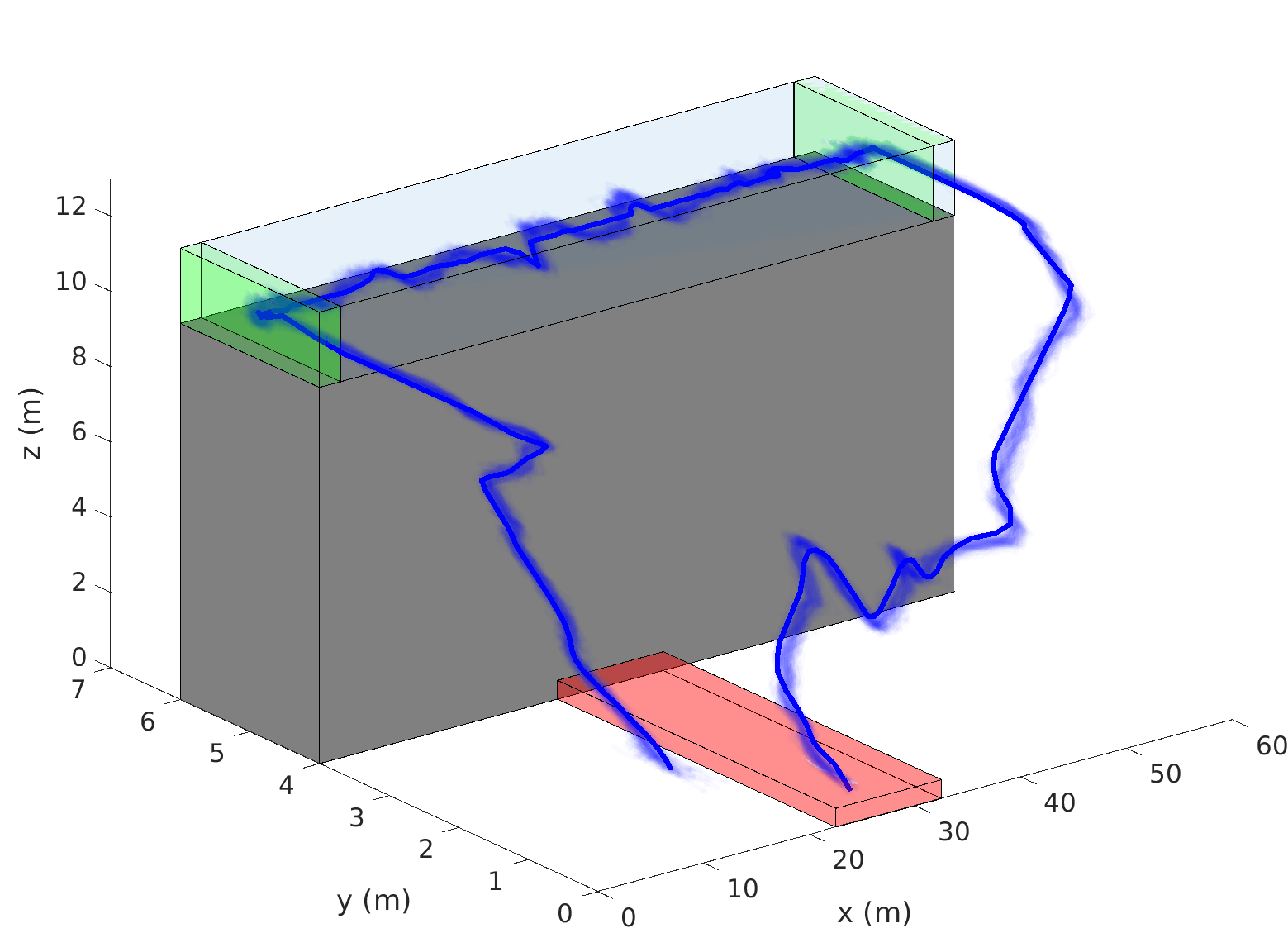 Figure 5
Peer Reviews
No public reviews on file for this paper yet. If you reviewed it on a platform where reviews are public (OpenReview, ICLR, NeurIPS, ICML), you can paste yours below so the community can read it here.
Videos
No videos yet. Explain this paper in a talk, walkthrough, or lecture? Add one.
Taxonomy
TopicsFormal Methods in Verification · Logic, Reasoning, and Knowledge · AI-based Problem Solving and Planning