Attractors for semilinear wave equations with localized damping and external forces
To Fu Ma, Paulo N. Seminario-Huertas

TL;DR
This paper investigates the long-term behavior of semilinear wave equations with localized damping and external forces, establishing uniform boundedness, continuity, and existence of generalized exponential attractors, advancing understanding of their dynamics.
Contribution
It introduces new results on the uniform boundedness, parameter continuity, and generalized exponential attractors for wave equations with localized damping.
Findings
Uniform boundedness of attractors with respect to forcing parameter
Continuity of attractors in a residual dense set of parameters
Existence of generalized exponential attractors
Abstract
This paper is concerned with long-time dynamics of semilinear wave equations defined on bounded domains of with cubic nonlinear terms and locally distributed damping. The existence of regular finite-dimensional global attractors established by Chueshov, Lasiecka and Toundykov (2008) reflects a good deal of the current state of the art on this matter. Our contribution is threefold. First, we prove uniform boundedness of attractors with respect to a forcing parameter. Then, we study the continuity of attractors with respect to the parameter in a residual dense set. Finally, we show the existence of generalized exponential attractors. These aspects were not previously considered for wave equations with localized damping.
Click any figure to enlarge with its caption.
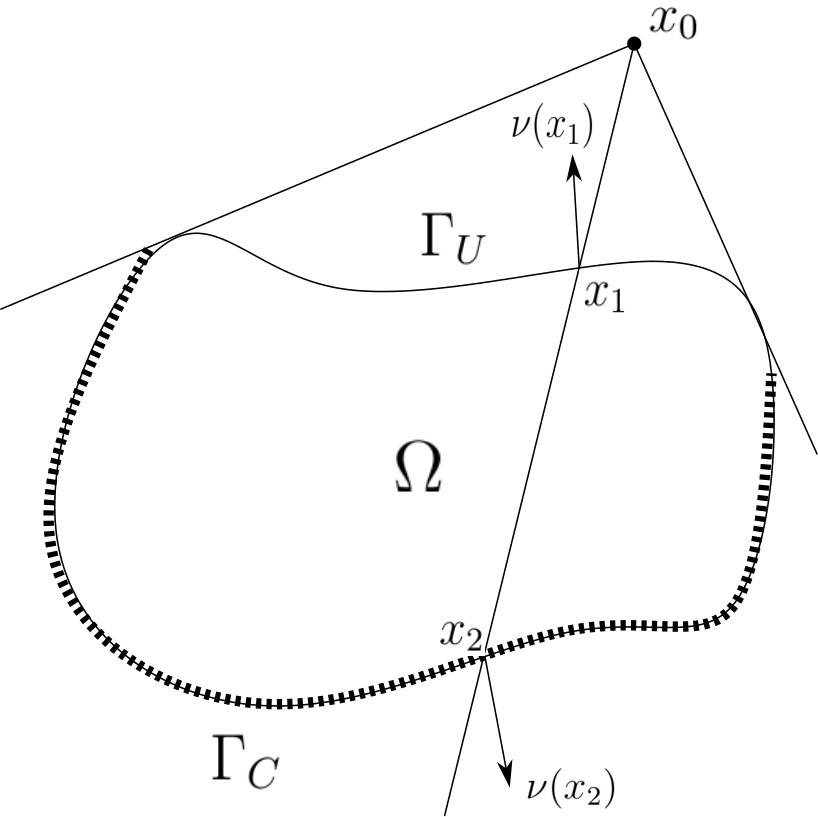 Figure 1
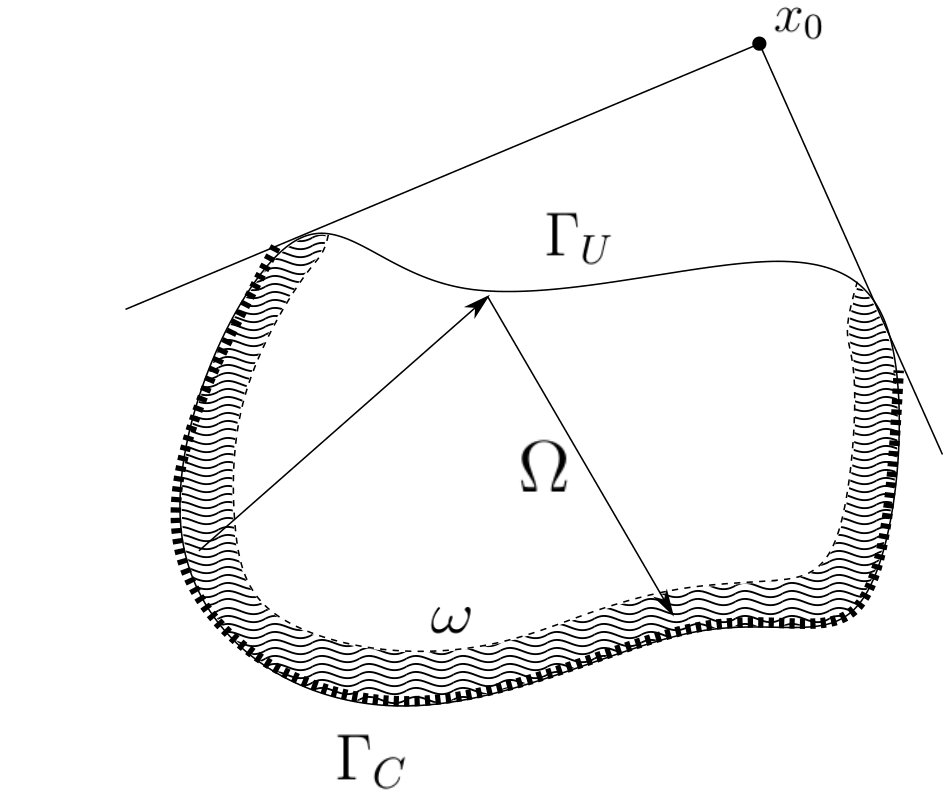 Figure 2
Peer Reviews
No public reviews on file for this paper yet. If you reviewed it on a platform where reviews are public (OpenReview, ICLR, NeurIPS, ICML), you can paste yours below so the community can read it here.
Videos
No videos yet. Explain this paper in a talk, walkthrough, or lecture? Add one.
Attractors for semilinear wave equations with localized damping and external forces
Abstract.
This paper is concerned with long-time dynamics of semilinear wave equations defined on bounded domains of with cubic nonlinear terms and locally distributed damping. The existence of regular finite-dimensional global attractors established by Chueshov, Lasiecka and Toundykov (2008) reflects a good deal of the current state of the art on this matter. Our contribution is threefold. First, we prove uniform boundedness of attractors with respect to a forcing parameter. Then, we study the continuity of attractors with respect to the parameter in a residual dense set. Finally, we show the existence of generalized exponential attractors. These aspects were not previously considered for wave equations with localized damping.
Key words and phrases:
Locally distributed damping, critical exponent, continuity of attractor, upper-semicontinuity, generalized exponential attractor.
1991 Mathematics Subject Classification:
Primary: 35B41, 35L71, 35B33; Secondary: 35B40.
∗ Corresponding author: T. F. Ma
To Fu Ma∗ and Paulo N. Seminario Huertas
Institute of Mathematical and Computer Sciences, University of São Paulo
São Carlos 13566-590, SP, Brazil
Dedicated to Professor Tomás Caraballo on the occasion of his 60th birthday.
1. Introduction
This paper is concerned with long-time dynamics of semilinear wave equations of the form
[TABLE]
defined in a bounded domain of with smooth boundary . We consider this problem with three distinguished features, namely, locally distributed damping, nonlinearity with critical Sobolev growth and external force with a parameter . Here critical Sobolev growth means that growths at most like . As we will see, for a variety of , problem (4) has a unique finite energy solution in , where . Then the solution operator of (4) defines a -semigroup on .
The existence of global attractors for wave equations with critical nonlinearity was firstly established by Arrieta, Carvalho and Hale [1]. They proved the existence of regular attractors in a framework of linear full damping , that is, with and . Later, the existence of global attractors for wave equations with locally distributed damping was established by Feireisl and Zuazua [11]. They considered a nonlinear damping term localized in a collar of , that is, the support of contains , where is some open neighborhood of in . The question of whether such attractors have finite fractal dimension was finally established by Chueshov, Lasiecka and Toundykov [8]. There, existence of regular finite dimensional attractors was proved for a more general damping region , satisfying an observability condition (see Figure 1). Both damping regions in [8, 11] satisfy the geometric control condition (GCC) which asserts that every ray of geometric optics within must reach the control region. See Figure 2 and e.g. [4, 24, 25].
The results in [1, 8, 11] consider problem (4) with external force . Our objective is to assume and study continuity aspects of attractors with respect to the parameter . We also study the existence of exponential attractors.
The main contributions of the present paper are summarized as follows.
The existence of attractors for the system , defined by (4), can be justified with [8]. However, since the damping term is in general effective only on a neighborhood of , it is not easy to estimate the size of a bounded absorbing set. In other words, given an initial value in a bounded set , show the existence of a constant , independent of , such that
[TABLE]
Such an estimate would promptly show that attractors are uniformly bounded. Indeed, in [8] the authors showed dissipativeness of the system by exploring its gradient structure combined with a unique continuation theorem [29]. In [11], the authors proved existence of a bounded absorbing set by using a contradiction argument combined with a unique continuation theorem [27], without showing an estimate like (5). Here, in Theorem 3.2, we prove that attractors are bounded uniformly with respect to .
Once proved that attractors are uniformly bounded, we can apply a recent result by Hoang, Olson and Robinson [16] to study the continuity of with respect to the Hausforff metric. Then, we prove that is continuous on any , a dense residual subset of . In addition, we show that upper-semicontinuity of with respect to the parameter holds for all . See Theorems 4.1 and 4.2. These results were not considered before for waves equations with locally distributed damping.
We recall that an exponential attractor for a system is a compact set that is forward invariant, has finite fractal dimension, and exponentially attracts bounded sets of . Exponential attraction means that for any bounded set , there exists a constant such that
[TABLE]
where represents the Hausdorff semi-distance in (e.g. Eden et al [10]). In general, establishing existence of exponential attractors for nonlinear wave equations is a difficult task. Indeed, most results are related to parabolic like equations. However, we shall prove the existence of so-called generalized exponential attractors (cf. Chueshov and Lasiecka [6]). This differs from the former one by requiring that the attractor have finite fractal dimension in a possibly larger space containing . See Theorem 5.1.
2. Well-posedness and global attractors
Our study is based in part on the results presented in [8] concerned with problem (4), with , in the energy space
[TABLE]
The norm in is given by
[TABLE]
where denotes -norms. The existence of strong solutions is placed in
[TABLE]
We shall freely use standard notations and properties of Sobolev spaces as in e.g. [13, 28].
2.1. Assumptions
Let be a bounded domain of with smooth boundary . We consider nonlinear structural forces satisfying
[TABLE]
and
[TABLE]
where is the principal eigenvalue of the Laplacian operator with Dirichlet boundary condition. With respect to the damping term, we assume with and such that
[TABLE]
for some constants . For the external force we take
[TABLE]
Finally, for the control/damping region we assume there exists a point such that a (uncontrolled) part of the boundary
[TABLE]
is nonempty, where denotes the outward normal vector on . We also define an open connected (controlled) part of of that satisfies , possibly overlapping (see figure 1). Then we can define the control/damping region
[TABLE]
for some . Finally we take , nonnegative, such that for some ,
[TABLE]
Remark 1**.**
The boundedness of in the assumption (8) is not necessary for global existence. As shown in [8], this is essential for the proof that attractors have finite fractal dimension. We observe that constructed in (10) satisfies the geometric control condition (GCC). See figure 2. ∎
2.2. Well-posedness
We can write problem (4) as a Cauchy problem
[TABLE]
defined in , where
[TABLE]
and .
Theorem 2.1** (Well-posedness [8]).**
Suppose that hypotheses (6)-(11) are satisfied and . Then we have:
- (1)
If then problem (4) has a unique solution
[TABLE] 2. (2)
If , then above solution has stronger regularity
[TABLE] 3. (3)
Let us denote the solution operator by . Then given and a bounded set of , there exists a constant such that
[TABLE]
for all and .
Remark 2**.**
Theorem 2.1 is a known result. A detailed proof with is presented in [8]. Since the external force is not time-dependent it does not change the arguments in [8]. Essentially, under the hypotheses, is maximal monotone in , and is locally Lipschitz in since the nonlinear perturbation is locally Lipschitz from to . The continuity estimate (13) shows that solution operator is a -semigroup on . ∎
We end this subsection with some remarks on the energy of the system. Given any solution of problem (4) we define its total energy by setting
[TABLE]
where .
Lemma 2.2**.**
There exist positive constants , depending on and , such that
[TABLE]
In addition,
[TABLE]
Proof.
The proof is standard. Indeed, the first and second inequalities in (14) follow from assumptions (7) and (6) respectively, for any . We sketch a proof of the first inequality since it will be used some times. Indeed, from assumption (7) we can choose (small) such that as . This implies the existence of a constant such that
[TABLE]
Then
[TABLE]
From this we infer the first inequality in (14) by taking . To obtain the energy estimate (15) we integrate first equation of (4) multiplied by . ∎
Remark 3**.**
Since the energy is not increasing, using (14) we can estimate by the size of initial value . In particular, all solution trajectories with initial value in a bounded set remain uniformly bounded. Indeed,
[TABLE]
independently of . ∎
2.3. Global attractors
In this section we recast the main result in [8] on the existence of regular finite dimensional attractors for critical waves with locally distributed damping. We recall that a global attractor for a system , where is a complete metric space and is a -semigroup, is a nonempty fully invariant compact set that attracts bounded sets of . The fractal (box-counting) dimension of a compact set is defined
[TABLE]
where is the minimal number of closed balls necessary to cover . See e.g. [3, 13, 19, 28] or [6, Chapter 7].
Theorem 2.3** (Global attractors [8]).**
Suppose that hypotheses (6)-(11) are satisfied and . Then:
- (1)
The dynamical system corresponding to problem (4) possesses a global attractor with finite fractal dimension. 2. (2)
Let denote the set of stationary solutions of the problem (4). Then we have
[TABLE]
the unstable manifold emanating from the stationary points. 3. (3)
The attractor has higher regularity and its full trajectories , , satisfy
[TABLE]
where is a generic increasing positive function not depending on or on a particular trajectory.
Remark 4**.**
The proof the theorem, with , was presented in [8]. Since is an autonomous perturbation, the proof of the theorem with follows with same methods and arguments. Firstly, it is shown that the system has a gradient structure. This is done by using a unique continuation theorem in [12, 29]. Then, a difficult part is to show asymptotic regularity/compactness of the system. To this end, new observability inequalities, trough Carleman estimates [12, 20, 21], are obtained in order to prove a stability inequality. For the reader’s convenience we shall prove the gradient structure in Lemma 3.1 below. ∎
Remark 5**.**
After the apparition of [8], Blair, Smith and Sogge [5] proved new Strichartz type estimates for wave equations on manifolds with boundary. This provided new tools to study wave equations in bounded domains of with quintic nonlinearities (rather than cubic). With respect to wave equations with locally distributed damping, Joly and Laurent [17] considered linear damping and sub-quintic nonlinearities (). Their results were presented in a formalism of Riemannian geometry, assuming that the control region satisfies (GCC) only. To establish existence of global attractors, they proved a proper unique continuation theorem based on the one by Robbiano and Zuily [26], that requires to be analytic. In the framework of [17], regularity and fractal dimension of attractors are open questions. We refer the reader to, e.g. [7, 9, 18, 22, 23, 30] for some recent works on attractors for wave equations with cubic and quintic nonlinearities. ∎
3. Uniformly bounded attractors
In this section we prove that global attractors given by Theorem 2.3 are uniformly bounded with respect to . We recall that a mapping is called a strict Lyapunov function for a system if the functional is non-increasing with respect to , for any . Moreover, if for all , then is a fixed point of . A dynamical system is called gradient if it possesses a strict Lyapunov function.
Lemma 3.1** (Gradient system [8]).**
Suppose that hypotheses of Theorem 2.1 hold. Then the total energy is a strict Lyapunov functional.
Proof.
We sketch a proof for the reader’s convenience. Let us define
[TABLE]
where is the solution of problem (4) with initial data . From (15) we see that is non-increasing. Now, if is stationary for some , it follows that
[TABLE]
Using (8) we infer that
[TABLE]
In particular, for any ,
[TABLE]
Therefore, the semiflow is a solution of
[TABLE]
By density arguments, we can assume is a strong solution in and then, differentiating the equation and putting , we obtain
[TABLE]
Upon (22) we apply a unique continuation theorem which is compatible with the geometric conditions of (e.g. [12, Theorem 2.2]) to conclude that over . Therefore is a fixed point of . ∎
Theorem 3.2**.**
Under the hypotheses of Theorem 2.3, there exists a constant such that
[TABLE]
In addition, there exists a constant such that
[TABLE]
for any full trajectory that belongs to .
Proof.
From Lemma 3.1 we know that system is gradient by taking the energy functional as a Lyapunov function (17).
Next, we recall a property of gradient systems that asserts the following: if is the global attractor of a gradient system with Lyapunov function , and bounded set of stationary points , then . See e.g. [6, Remark 7.5.8]. In our context, we have
[TABLE]
where denotes the set of fixed points of .
Now, we observe that must be uniformly bounded. Indeed, if then where is a weak solution of the stationary problem
[TABLE]
Using assumption (7) and Poincaré inequality we obtain a constant such that
[TABLE]
Therefore for some constant , independently of . This shows that is uniformly bounded with respect to . In particular, taking into account the definition of in (17) and the second inequality in (14), we see that
[TABLE]
On the other hand, using the first inequality in (14), we see that
[TABLE]
Combining last two estimates with (25) we obtain the uniform bound (23) by taking . Finally, taking , we see from (16) that estimate (24) holds. ∎
Remark 6**.**
We note that from (23), taking , the ball is a bounded absorbing set of , uniformly on . Given a bounded set , there exists a entrance time such that , if , for any . ∎
4. On the continuity of attractors
Let be a family of global attractors for a system , where belongs to a complete metric space . We say that is upper semicontinuous on if
[TABLE]
where denotes the Hausdorff semi-distance in . Analogously, if we commutate and in the above limit, then we say that is lower semicontinuous on . Then is continuous on if
[TABLE]
where {\rm d}_{X}(A,B)=\max\big{\{}{\rm dist}_{X}(A,B),{\rm dist}_{X}(B,A)\big{\}} is the Hausdorff metric in .
While it is more or less standard to check upper semicontinuity of attractors for a large class of dissipative systems, the proof of lower semicontinuity is much more involving (cf. [14, 15]).
We shall use a recent result by Hoang, Olson and Robinson [16] on the continuity of attractors with respect to a parameter. Their results extend earlier ones by Babin and Pilyugin [2]. Accordingly, let be a family of parametrized semigroups defined on , with in a complete metric space . Assume that
The system has a global attractor for every ,
There exists a bounded set such that for every ,
For , is continuous in , uniformly for in bounded subsets of .
Then is continuous on all where is a “residual” set dense in . See [16, Theorem 5.2].
Theorem 4.1** (Continuity on a residual dense subset).**
In the context of Theorem 2.3 there exists a set dense in such that is continuous with respect to any parameter , that is,
[TABLE]
Proof.
We shall apply [16, Theorem 5.2] to the context of Theorem 2.3. Then above assumption holds. The assumption also holds because of the uniform bound (23) in Theorem 3.2. It remains to prove condition .
Let be a bounded set of . Given and , let us denote
[TABLE]
Then is a solution of
[TABLE]
and consequently we have
[TABLE]
By assumption (6) we know that for some . Then,
[TABLE]
From Remark 3, are uniformly bounded, and hence there exists a constant such that
[TABLE]
The assumptions (8) and (11) imply that
[TABLE]
Also,
[TABLE]
Inserting above three estimates into (4) we obtain
[TABLE]
where is independent of . Then Gronwall inequality yields
[TABLE]
Since , we finally see that
[TABLE]
which shows . As a conclusion, by applying [16, Theorem 5.2], there exists a dense set such that (26) holds. This ends the proof. ∎
Theorem 4.2** (Upper semicontinuity).**
In the context of Theorem 2.3 the family of global attractors is upper semicontinuous with respect to parameters in , that is,
[TABLE]
Proof.
We argue by contradiction following [14]. Suppose that is not upper semicontinuous at . Then from (28) there exists and sequences and such that
[TABLE]
Since the global attractors are also characterized as
[TABLE]
let be a bounded full trajectory of such that . Then by (24) in Theorem 3.2, we see that
[TABLE]
From classical compactness arguments, we deduce the existence of a pair , such that, up to a subsequence,
[TABLE]
Moreover, by (30) and (31), it follows that
[TABLE]
We claim that is a bounded full trajectory of the limiting semi-flow . Now, it is enough to show that is a full bounded trajectory for the problem (4) with , that is,
[TABLE]
Indeed, since satisfies the equation
[TABLE]
we can proceed as in the verification of in Theorem 4.1 to conclude that (32) is the limit of (33) as . This is possible because, for any , the control conditions in the damping region remains the same. Therefore
[TABLE]
which contradicts (29). ∎
5. Generalized exponential attractor
The objective of this section is to prove the existence of a generalized fractal exponential attractor for the dynamic system associated with problem (4). Let be a Hilbert space. Formally, cf. [6, Definition 7.4.4], a generalized (fractal) exponential attractor for a system is a compact set that attracts exponentially bounded sets of , is forward invariant, and have finite fractal dimension in a larger space . Our result reads as follows.
Theorem 5.1**.**
Under the hypotheses of Theorem 2.3, the system associated to problem (4) possesses a generalized exponential attractor.
The proof of Theorem 5.1 will be completed at the end of this section. It needs the following abstract result.
Theorem 5.2**.**
[6, Theorem 7.4.2]* Let be a closed bounded set of a separable Hilbert space and suppose that is a Lipschitz mapping. In addition, suppose there exist compact seminorms and on such that*
[TABLE]
for any , where and are constants. Then, for any there exists a positively invariant compact set , of finite fractal dimension, satisfying
[TABLE]
for some .
Remark 7**.**
To apply Theorem 5.2 in the context of problem (4) we shall apply rather technical arguments. They rely on some results of [8] mainly related to Carleman estimates in order to absorb some lower order terms generated by, for instance, the integral
[TABLE]
We shall recover some of theses estimates in Lemma 5.3 below. ∎
Remark 8**.**
(Notations for Section 5) In what follows, we will be in the context of Theorem 2.3. To simplify notations, without loss of generality, we take and instead . Given two initial data and in a bounded set , we shall use notation
[TABLE]
Putting we write
[TABLE]
From Remark 6, possesses a bounded absorbing set , which can be assumed closed and forward invariant. Moreover, , and will denote several positive constants with obvious meaning. ∎
Lemma 5.3**.**
[8, Proposition 6]* Given sufficiently large, there exist constants and such that*
[TABLE]
where
[TABLE]
Lemma 5.3 allows us to prove the following key estimate.
Lemma 5.4**.**
Let be a closed positively invariant bounded absorbing set of the system . Then, there exist positive constants and such that
[TABLE]
Proof.
Firstly, we see that given ,
[TABLE]
for some constant . This estimate is analogous to the one in [8, Proposition 8]. The only difference is that trajectories (not necessarily complete) are bounded in instead within attractor .
Then, in view of definition of in (5.3), we have from (5),
[TABLE]
for certain . Then, taking small enough, the estimate (34) becomes
[TABLE]
with and some constant . Since is closed forward invariant, we obtain for any ,
[TABLE]
which shows (36). ∎
Now, we are in a position to consider Theorem 5.2 in our context. Given , large enough, we define
[TABLE]
where
[TABLE]
It is clear that
[TABLE]
Additionally we define
[TABLE]
where is a closed invariant bounded absorbing set as in Lemma 5.4, and define by setting
[TABLE]
Lemma 5.5**.**
Under above definitions we have:
- (1)
Let be a bounded subset of . Then there exists a constant such that
[TABLE]
for any . 2. (2)
There exist constants and such that, for any
[TABLE]
[TABLE]
where . 3. (3)
The mapping possesses a positively invariant compact set , of finite fractal dimension, and
[TABLE]
for some and .
Proof.
The Lipschitz condition (40) follows from (13) and (38). To prove (2), we integrate (36) over and add it to (36), obtaining
[TABLE]
From definition of norm (39) we see (2).
To prove the last statement we apply Theorem 5.2 with , . Indeed, we note that defines a compact seminorm in . In addition, since is closed forward invariant, we have . Then Theorem 5.2 grants (42). ∎
For the next lemma we define the ultra-weak phase space
[TABLE]
Lemma 5.6**.**
Let be a closed forward invariant bounded absorbing set. Then there exist a constant such that
[TABLE]
Proof.
The Cauchy problem (12) implies that
[TABLE]
Now, since is locally Lipschitz and is bounded, the estimate (13) implies that
[TABLE]
for some constant . Since , we see for ,
[TABLE]
which implies (43). ∎
Proof of Theorem 5.1. For large enough, we obtain from (42),
[TABLE]
for some and . In particular,
[TABLE]
where is the projection of over the first component, that is,
[TABLE]
It is clear that is a compact set in and . Moreover,
[TABLE]
We define the compact set in (candidate to exponential attractor)
[TABLE]
Then, by construction . In addition, from (13) and (44) we see that
[TABLE]
for some . It remains to show that has finite fractal dimension in some space containing . We shall use Lemma 5.6.
Let us define a mapping
[TABLE]
Then we have
[TABLE]
We claim that is Lipschitz restricted to . Indeed, taking into account that , estimates (13) and (43) imply that,
[TABLE]
for some . This proves the claim. Now, since Lipschitz mapping does not increase fractal dimension (e.g. [10, Proposition C.1]), we conclude that
[TABLE]
Then from (45) it follows that . Thus, is a generalized exponential attractor for with finite fractal dimension in . This completes the proof of Theorem 5.1. ∎
Acknowledgements
This paper was done while the second author was visiting the Department of Mathematics of University of Chile, whose kind hospitality is gratefully acknowledged. He also thanks professors Gonzalo Robledo Rodrígues and Álvaro Castañeda Gonzales for arranging funding support from FONDECYT, REGULAR grant 1170968. The first author was partially supported by CNPq grant 312529/2018-0.
The reference list from the paper itself. Each links out to its DOI / PubMed record.
- 1[1] J. Arrieta, A. N. Carvalho and J. K. Hale, A damped hyperbolic equation with critical exponent , Comm. Partial Differential Equations 17 (1992) 841-866
- 2[2] A. V. Babin and S. Yu Pilyugin, Continuous dependence of attractors on the shape of domain , J. Math. Sci. 87 (1997) 3304-3310.
- 3[3] A. V. Babin and M. I. Vishik, Attractors of Evolution Equations, Studies in Mathematics and its Applications 25, North-Holland, Amsterdam, 1992.
- 4[4] C. Bardos, G. Lebeau and J. Rauch, Sharp sufficient conditions for the observation, control, and stabilization of waves from the boundary , SIAM J. Control Optim. 30 (1992) 1024-1065.
- 5[5] M. Blair, H. F. Smith and C. D. Sogge, Strichartz estimates for the wave equation on manifolds with boundary , Ann. Inst. H. Poincaré Anal. Non Linéaire 26 (2009) 1817-1829.
- 6[6] I. Chueshov and I. Lasiecka, Von Karman Evolution Equations. Well-posedness and Long-time Dynamics, Springer Monographs in Mathematics, Springer, New York, 2010.
- 7[7] I. Chueshov, M. Eller and I. Lasiecka, On the attractor for a semilinear wave equation with critical exponent and nonlinear boundary dissipation , Comm. Partial Differential Equations 27 (2002) 1901-1951.
- 8[8] I. Chueshov, I. Lasiecka and D. Toundykov, Long-term dynamics of semilinear wave equation with nonlinear localized interior damping and a source term of critical exponent , Discrete Contin. Dyn. Syst. 20 (2008) 459-509.