Nucleon strangeness polarization from $\Lambda/\bar\Lambda$ hyperon production in polarized proton-proton collision at RHIC
Xiaonan Liu, Bo-Qiang Ma

TL;DR
This paper investigates the polarization of strange quarks in the proton by analyzing polarized hyperon production in proton-proton collisions at RHIC, providing insights consistent with theoretical models and lattice QCD.
Contribution
It introduces a method to extract strange and antistrange quark polarization from hyperon production data, revealing asymmetries in the proton sea.
Findings
Strange quark polarization Δs ≈ -0.025 ± 0.019
Antistrange quark polarization Δs̄ ≈ -0.001 ± 0.012
Results align with theoretical and lattice QCD predictions.
Abstract
We calculate the inclusive production of a polarized or hyperon from the single longitudinally polarized proton and proton () collision at RHIC. By comparing the data reported by the STAR Collaboration, we find that this process is sensitive to the polarization of strange and antistrange quarks of the proton in the experimental range. By introducing asymmetric coefficients with the minimization of , we further identify the asymmetry of the polarized strange-antistrange quarks in the proton sea and find that the first moment is for strange quark and for antistrange quark, with central values agreeing with the light-cone meson-baryon fluctuation model prediction, the recent lattice QCD determination of strangeness polarization and results from a global QCD analysis given by the…
Click any figure to enlarge with its caption.
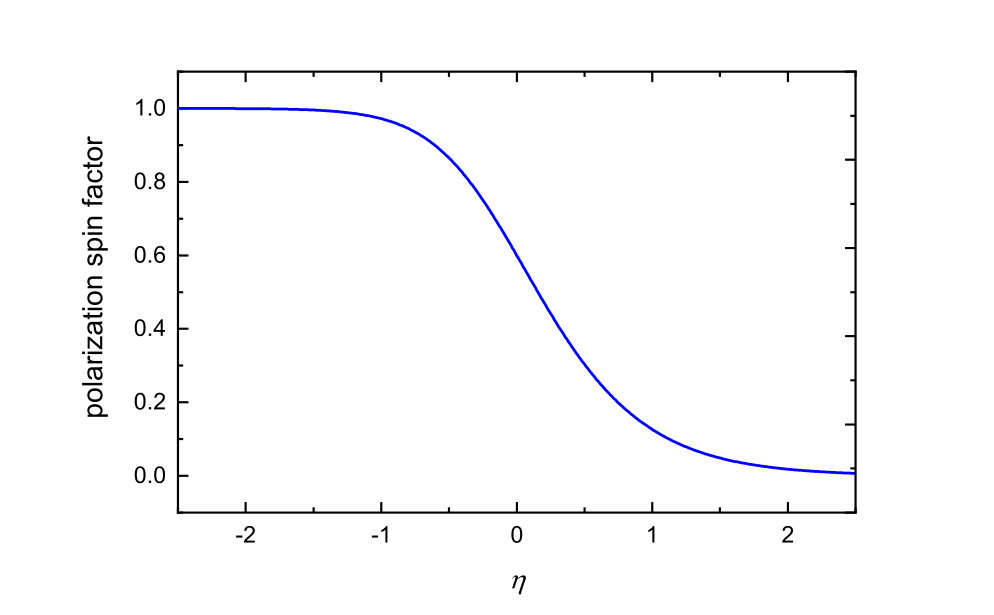 Figure 1
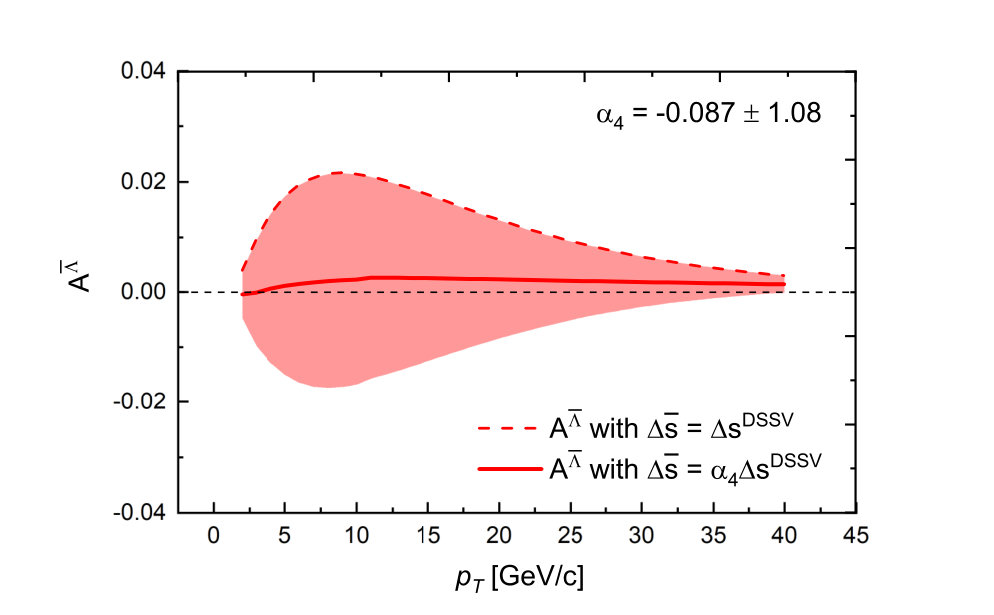 Figure 10
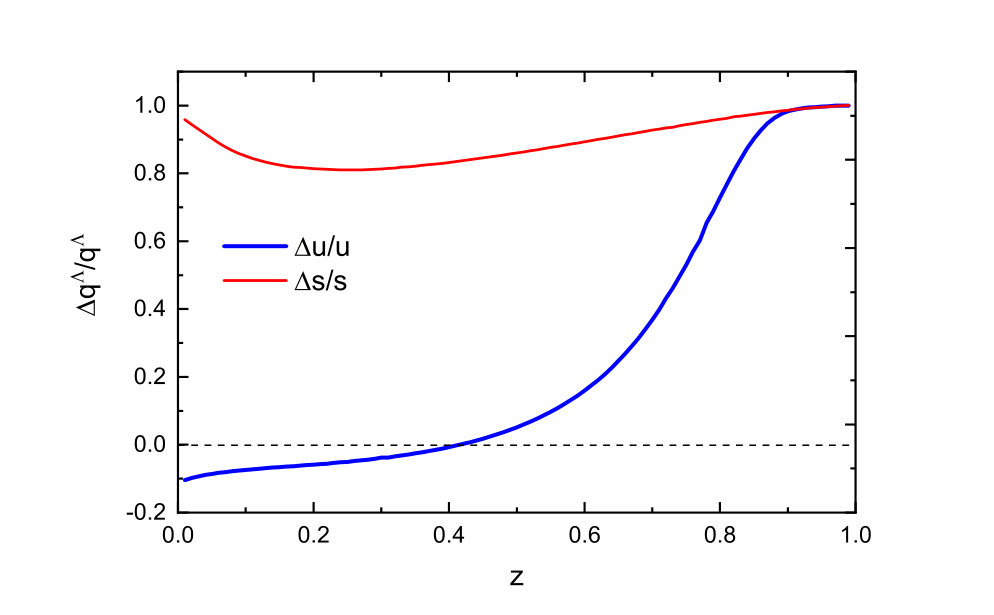 Figure 2
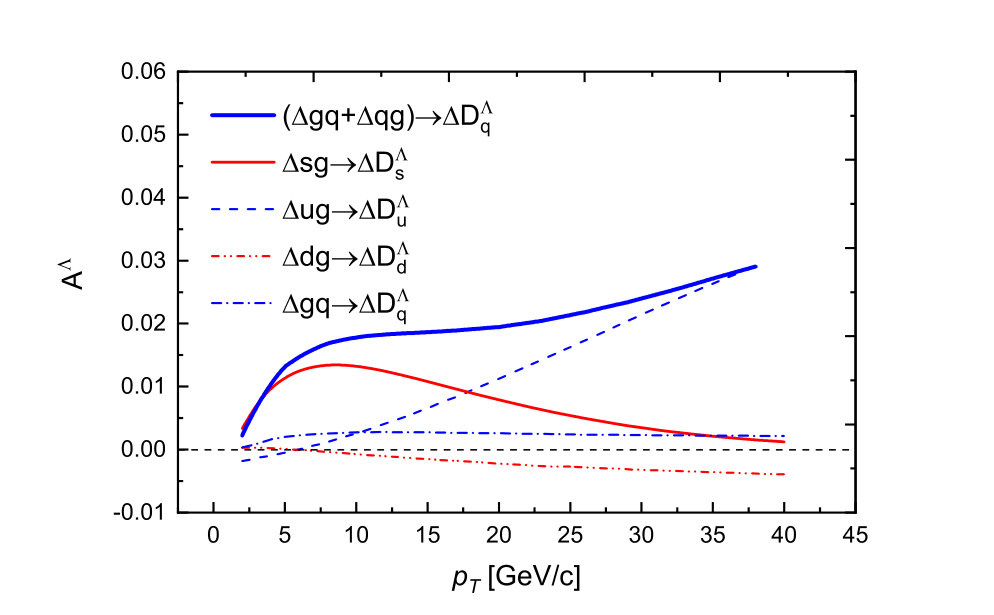 Figure 3
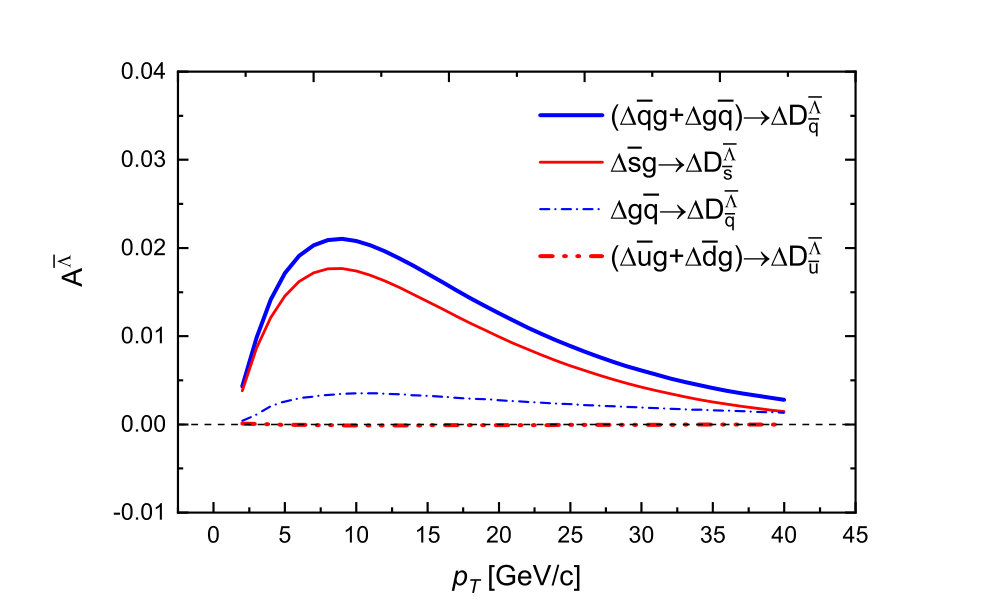 Figure 4
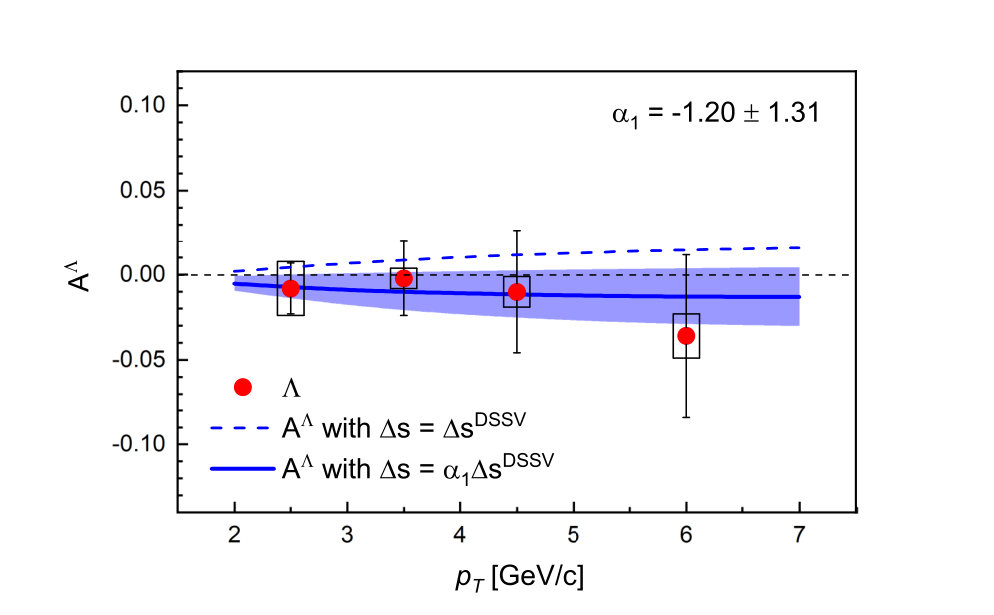 Figure 5
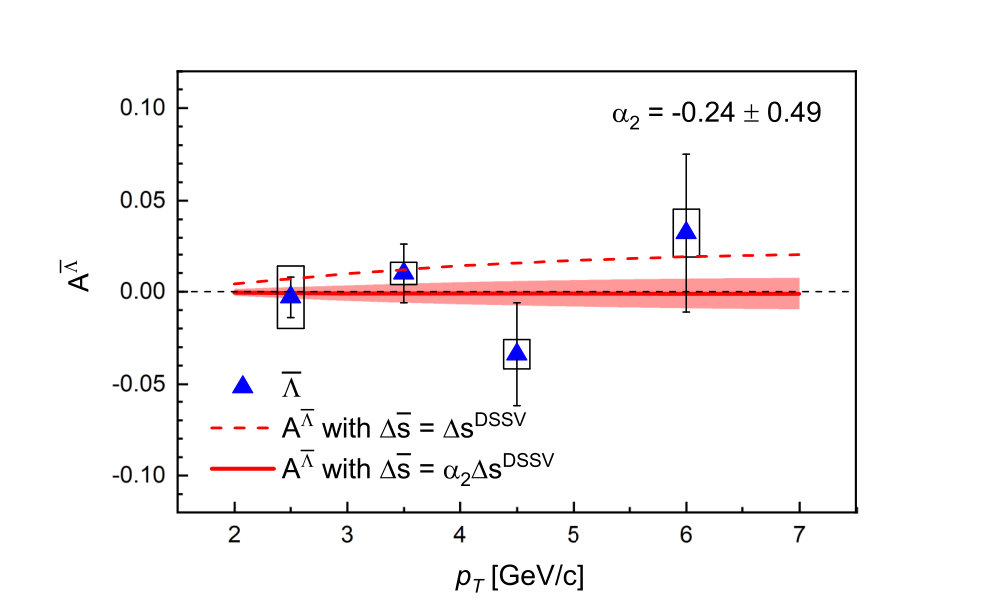 Figure 6
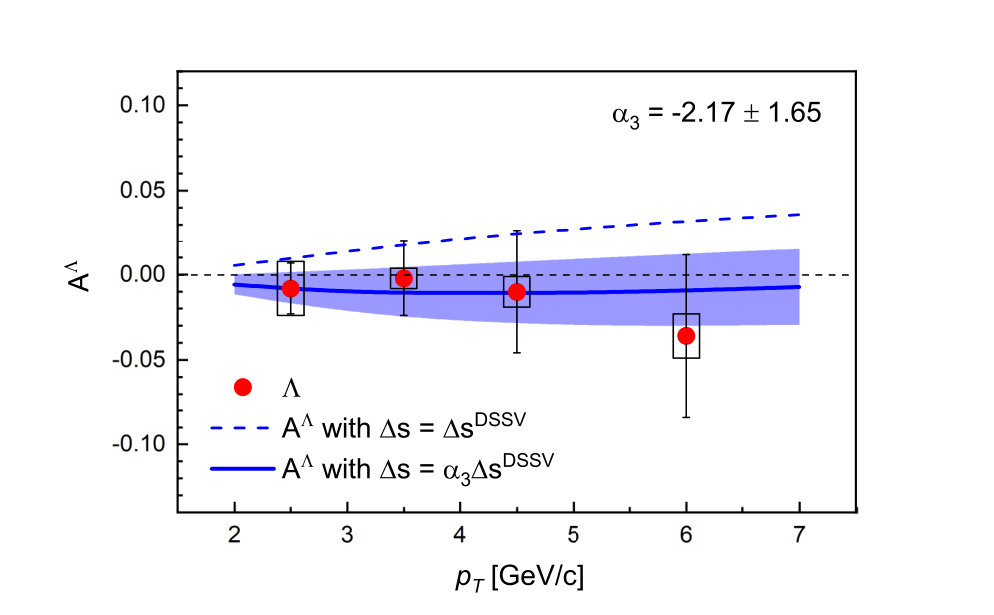 Figure 7
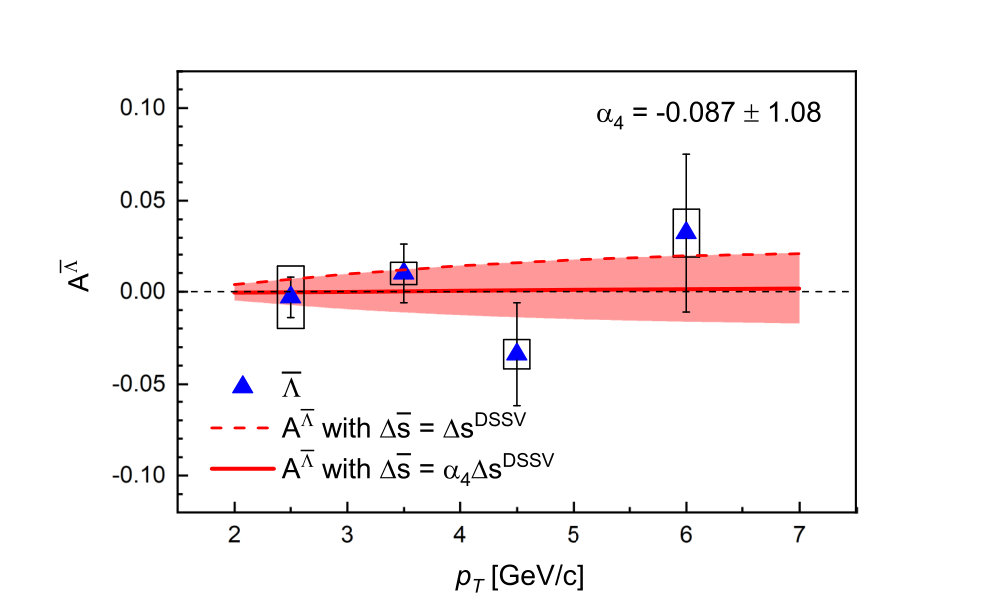 Figure 8
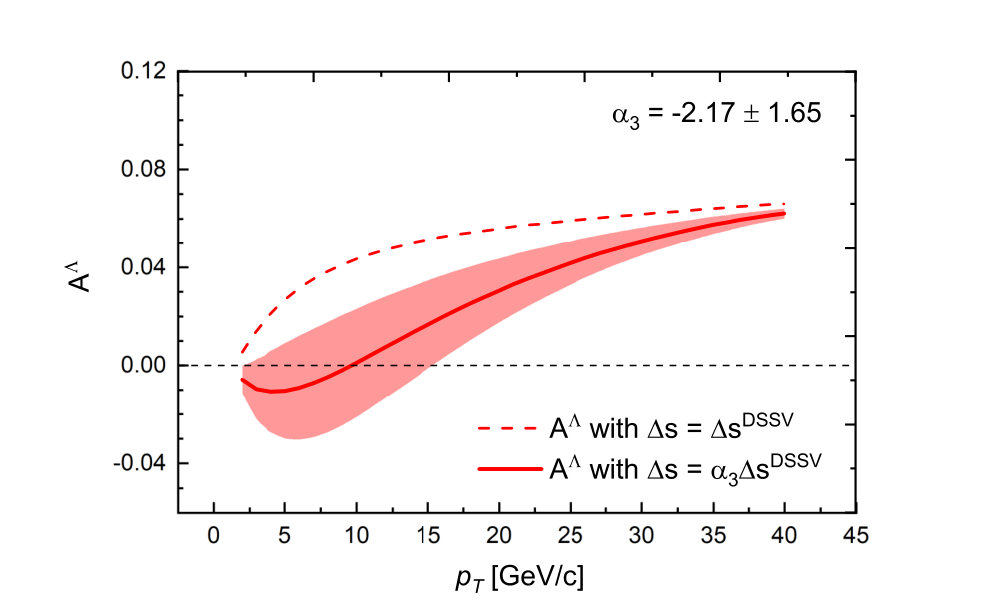 Figure 9
| coefficient | value | |||
|---|---|---|---|---|
| 1.201.31 | 0.0140.015 | 0.37 | ||
| 0.240.49 | 0.0030.005 | 2.48 |
| coefficient | value | |||
|---|---|---|---|---|
| 2.171.65 | 0.0250.019 | 0.42 | ||
| 0.0871.08 | 0.0010.012 | 2.24 |
Peer Reviews
No public reviews on file for this paper yet. If you reviewed it on a platform where reviews are public (OpenReview, ICLR, NeurIPS, ICML), you can paste yours below so the community can read it here.
Videos
No videos yet. Explain this paper in a talk, walkthrough, or lecture? Add one.
∎
\thankstext
e1e-mail: [email protected]
11institutetext: School of Physics and State Key Laboratory of Nuclear Physics and Technology, Peking University, Beijing 100871, China 22institutetext: Collaborative Innovation Center of Quantum Matter, Beijing, China 33institutetext: Center for High Energy Physics, Peking University, Beijing 100871, China
Nucleon strangeness polarization from hyperon production in polarized proton-proton collision at RHIC
Xiaonan Liu\thanksrefaddr1
Bo-Qiang Ma\thanksrefe1,addr1,addr2,addr3
(Received: date / Accepted: date)
Abstract
We calculate the inclusive production of a polarized or hyperon from the single longitudinally polarized proton and proton () collision at RHIC. By comparing the data reported by the STAR Collaboration, we find that this process is sensitive to the polarization of strange and antistrange quarks of the proton in the experimental range. By introducing asymmetric coefficients with the minimization of , we further identify the asymmetry of the polarized strange-antistrange quarks in the proton sea and find that the first moment is for strange quark and for antistrange quark, with central values agreeing with the light-cone meson-baryon fluctuation model prediction, the recent lattice QCD determination of strangeness polarization and results from a global QCD analysis given by the Jefferson Lab Angular Momentum (JAM) Collaboration.
††journal: Eur. Phys. J. C
1 Introduction
The spin content of the proton has received extensive attentions since the so-called “proton spin crisis” Ashman:1987hv ; Ashman:1989ig . There have been significant progress on spin distributions of light flavor valence quarks both experimentally and theoretically. Recently, some efforts have been made on the polarization of the light flavor sea quarks Tian:2017xul ; Tian:2017qwk and the quark-antiquark asymmetry of helicity distributions in nucleon sea Liu:2018mio . Studies of the momentum distribution asymmetry between strange and antistrange Brodsky:1996hc ; Signal:1987gz ; Burkardt:1991di ; Holtmann:1996be ; Sufian:2018cpj are of significance for the study of nonperturbative quantum chromodynamics (QCD) with fruitful progress Ma:1997gh ; Barone:1999yv ; Ding:2004ht ; Ding:2004dv ; Wakamatsu:2004pd ; Alwall:2005xd ; Ding:2005ub ; Gao:2005gj ; Hao:2005dw ; Bourrely:2007if ; Diehl:2007uc ; Gao:2007ht ; Gao:2008ch ; Zhou:2009mx ; Chi:2014xba ; Hobbs:2014lea ; Wakamatsu:2014asa ; Vega:2015hti ; Du:2017nzy . However, the understanding of helicity distributions for strange-antistrange quark pairs and is far from satisfactory and needs further studies. Researches show that studies of spin-transfer reactions Owens:1986mp ; Stratmann:1992gu ; Kotzinian:1997vd ; deFlorian:1998ba ; Ma:2000uu ; Boros:2000ex ; Ma:2001na ; Ellis:2002zv ; Xu:2002hz ; Xu:2004es ; Xu:2005ru ; Chen:2007tm ; Zhou:2010vm and measurements of the polarized structure function Ashman:1987hv ; Ashman:1989ig ; Adams:1994zd ; Abe:1994cp ; Abe:1997cx ; Adams:1997tq ; Adeva:1998vv ; Airapetian:2006vy , can provide new insights into the nucleon spin structure and yield a better understanding of the hadronization process. The baryon plays a special role in this respect since it has a rather simple spin structure in the naive quark parton model GellMann:1964nj , as well as that its self-analyzing parity violating decays Lee:1957qs make polarization measurements experimentally feasible.
The STAR experiment at Relativistic Heavy Ion Collider (RHlC) Harrison:2003sb ; Harrison:2002es ; Courant:2003ad is carrying out a spin physics program in high-energy polarized proton-proton collisions at and in order to gain a deeper insight into the nucleon spin structure and dynamics of the proton. Theoretical investigations deFlorian:1998ba ; Boros:2000ex ; Ma:2001na ; Xu:2002hz ; Xu:2004es ; Xu:2005ru ; Chen:2007tm ; Zhou:2010vm suggest that the spin transfer process of the production in the singly polarized proton-proton collision provides a platform to extract polarized parton distribution functions of the proton and polarized quark fragmentation functions of quarks into hyperon. The experiments measuring the polarization of hyperon produced in singly polarized collisions Abelev:2009xg ; Adam:2018kzl may provide information about not only the inclusive production of hadrons but also the strange and antistrange quark polarizations inside the proton.
Compared to lepton-induced reaction experiments, the corresponding cross section of the hadron-hadron collision is larger and the luminosity of the incoming proton beams can be made higher. Moreover, there are many subprocesses that may lead to the final state in singly polarized collisions due to the rich internal structure of the proton, such as , , , etc., which may produce large partonic spin asymmetries. Therefore productions of and are sensitive to polarized parton distributions in the proton, making STAR ideal to explore quark and gluon polarization.
In this work, we perform the calculation of longitudinal spin transfers to and hyperons produced in polarized proton-proton collisions at RHIC. By comparing recent data Adam:2018kzl reported by the STAR Collaboration, we find that this process is sensitive to the polarization of strange and antistrange quarks of the proton in the experimental range. Such result agrees with the conclusions in previous studies Xu:2005ru ; Chen:2007tm ; Zhou:2010vm . By introducing asymmetric coefficients with the minimization of in fitting data, we further identify the asymmetry of the polarized strange-antistrange quarks in the proton and find that the first moment is for strange quark and for antistrange quark, with central values agreeing with the light-cone meson-baryon fluctuation model prediction Brodsky:1996hc , the recent lattice QCD determination of strangeness polarization QCDSF:2011aa and results from a global QCD analysis given by the Jefferson Lab Angular Momentum (JAM) Collaboration Ethier:2017zbq .
The reminder of this paper is organized as follows. Sect. 2.1 provides general formulae for production cross section. As the hyperon production process in singly polarized collisions contains many different hard subprocesses, Sect. 2.2 elucidates kinematic regions and identifies the major subprocess. We then calculate fragmentation functions for quarks to in Sect. 2.3. Numerical results of the spin transfer to are shown in Sect. 3.1 with considerations of the asymmetry of polarized strange-antistrange quarks in the proton, together with discussions and conclusions. A brief summary is given in Sect. 4.
2 Theoretical calculation
2.1 The general formulae for cross section
We consider the single inclusive production process , where a polarized is produced from the single longitudinally polarized collision at RHIC. The longitudinal spin transfer to hyperon produced in polarized proton-proton collisions is defined as Owens:1986mp
[TABLE]
where and stand for the polarized and unpolarized cross sections, respectively. The definition and derivation of the parton-parton scattering contribution to the single-particle inclusive cross section can be found in Refs. Berman:1971xz ; Ellis:1973nb . By using factorization theorem Collins:1987pm , the differential cross-section for high-transverse momentum distributions has been computed to next-to-leading order accuracy in perturbative QCD Aversa:1988vb ; deFlorian:2002az ; Jager:2002xm . In this way, such cross sections can be expressed as convolutions of perturbatively calculable partonic spin-transfer cross sections Owens:1986mp ; Stratmann:1992gu ; Boros:2000ex with certain sets of parton distributions and fragmentation functions at the scale , just as follows,
[TABLE]
with
[TABLE]
here and are rapidity and transverse momentum, and is the transverse momentum counterpart. We denote the momenta of incoming protons and the produced hyperon by , and , respectively. , and are corresponding momentum fractions carried by partons , and , and and are corresponding lower limits of integration.
In Eq. (1), represents the polarized distribution function of parton in proton and the unpolarized one of parton in proton , at the scale . is the polarized fragmentation function of parton into baryon , and in our case . , the difference of cross sections at the parton level between the two processes and , can be found in, for example, Ref. Owens:1986mp . The summation in Eq. (1) runs over all possible parton-parton subprocesses, , , , etc.. An analogous expression for unpolarized cross section is obtained by Eq. (1) with the symbol dropped throughout. In the calculation we adopt de Florian-Sassot-Stratmann-Vogelsang (DSSV) polarized parton distribution functions (PDFs) deFlorian:2008mr ; deFlorian:2009vb as inputs to spin-dependent parton distributions of proton directly. With sufficient statistics, this set of PDFs not only provides the total up and down quarks distributions, and , and light sea quark polarizations, , , = , but also gives an important constraint on the gluon polarization . Considering that this set of PDFs adopts Martin-Stirling-Thorne-Watt (MSTW) unpolarized PDFs Martin:2009iq as a reference set to avoid problems with the fundamental positivity constraint, we adopt the MSTW parametrization as unpolarized PDFs for proton in order to maintain self-consistency. The non-perturbative fragmentation functions for are given by the revised Gribov-Lipatov relation Gribov:1971zn ; Gribov:1972ri ; Brodsky:1996cc ; Barone:2000tx ; Ma:2002ur and the light-cone SU(6) quark-spectator-diquark model Ma:1999gj ; Ma:1999wp adjusted by the Albino-Kniehl-Kramer (AKK) parametrization Albino:2005mv ; Albino:2008fy based on considerations following Ref. Du:2017nzy .
The Mandelstam variables at the parton level are given by
[TABLE]
here is the total center of mass energy.
It is obvious from Eq. (2) that the lower limits of momentum fraction of the initial state, and , depend mainly on experimental conditions, namely rapidity and transverse momentum . The momentum fraction carried by the final state baryon, , is also related to the momentum fraction of the initial state. Note that the magnitude of momentum fractions represents different regions of momentum distributions, that is, the region where the momentum fraction is smaller is mainly the sea region, and the region where the momentum fraction is larger is the valence region. Such general relationships can help us to analyze the dynamic range of collisions in the calculation and to obtain an understanding of the spin transfer in this process.
2.2 Elucidate the kinematic regions and major subprocess
The main aim of the spin transfer process to hyperon produced in collisions is to extract the polarized quark and gluon distributions. However, in the case of collisions where many subprocesses can lead to final state hyperons, we need to identify out the most contributing channel related to the polarized parton distributions.
We first check the relation between , the integral lower limit of , and using Eq. (2). The small value of is associated with in the sea part of the polarized proton whereas typical values of corresponding to the valence region correspond to a high , where the quarks are polarized much more strongly, resulting in an asymmetry increase with . Information about contribution from parton distributions of the polarized proton can also be tracked from looking at the dependence of . Similarly, if there is a large positive , this can be used to extract the large part parton content of the proton. The high and large lead to dominating contribution to the spin transfer to final state hyperons with the valence part of the polarized proton. Hence it is reasonably to conclude that in large region in collisions, the fragmentation of quarks from the subprocesses and dominates. We expect that and , particularly , quark fragmentation dominates the production in high and large rapidity region, as supported by previous studies deFlorian:1998ba ; Boros:2000ex ; Ma:2001na ; Xu:2002hz . The connection between and allows us to further determine the dynamic behavior. It can be seen from Eq. (2) that when is small, is relatively large and mainly corresponds to the valence region, and as increases, the integral lower limit of gradually expands to the sea region. Considering that the gluon is distributing much greater over the sea region of the proton than quarks, the sum of valence and sea quark contributions is suppressed at small and . It means that the subprocess plays a major role than case Boros:2000ex ; Ma:2001na . It is also argued in Ref. Boros:2000ex that the contribution from falls off faster than that from with increasing rapidity, since decreases faster than with increasing . Therefore we can conclude that the subprocess plays the most important role in the hyperon production of proton-proton collisions deFlorian:1998ba ; Boros:2000ex ; Ma:2001na ; Xu:2002hz , so we only consider the spin transfer of this subprocess.
Based on the above considerations, the process of our calculation can be expressed as:
[TABLE]
Specifically, this contains four subprocesses:
- (1)
; 2. (2)
; 3. (3)
; 4. (4)
.
We write the detailed expressions in the following way:
[TABLE]
where , , , with omitted and being the polarization transfer factor for the two subprocesses, see Ref. Xu:2002hz for details. Due to that the fragmentation mechanism of the polarized gluon into is unclear, we take in our calculation. Likewise, we use corresponding expressions analogy to Eq.( LABEL:eq:qgall) for the longitudinal spin transfer to , by replacing with . There are several differences in the calculation of compared to . For hyperon, the dominant subprocess should be , where we take according to CP symmetry. Due to the lack of fragmentation functions for polarized sea quarks to , we set in the calculation, based on same considerations as the gluon case. Different from the case, the polarized sea quarks play a main role in the process of spin transfer to , in which distributions of polarized sea quarks are relatively important.
For hadron-hadron collisions, each of the parton subprocess has its own polarization transfer factor. For the polarization transfer factor , the variable , and in the center-of-mass frame , where is the angle between the incoming parton and the outgoing parton . Fig. 1 shows the polarization transfer factor versus rapidity of the process . It can be seen that for the process the longitudinal polarization transfer factor gradually tends to zero, as rapidity increases. There is no dependence on rapidity for the longitudinal process with .
2.3 Fragmentation functions and AKK parametrization
Fragmentation functions (FFs) describe phenomena of hadronization, i.e., how quarks or gluons transform into hadrons. The improvement in the knowledge of fragmentation functions is an important ingredient in the global analysis of the nucleon spin structure. PDFs and FFs cannot be computed perturbatively, but they can be measured from a limited set of data over a limited range of . Because it is easier to extract PDFs from experiment than FFs, it would be very useful if there exists simple connection Brodsky:1996cc ; Barone:2000tx ; Ma:2002ur between PDFs and FFs, so that one can predict the poorly known from the rather well known . We adopt a revised form of the Gribov-Lipatov “reciprocity” relation Gribov:1971zn ; Gribov:1972ri ; Brodsky:1996cc ; Barone:2000tx ; Ma:2002ur , i.e.,
[TABLE]
to obtained fragmentation functions for , with PDFs described by the SU(6) quark-diquark model Ma:1999gj ; Ma:1999wp .
Gribov and Lipatov Gribov:1971zn ; Gribov:1972ri provided a connection between distinct physical situations in deep inelastic electron scattering in perturbation theory. Brodsky and Ma Brodsky:1996cc have shown that the fragmentation functions measured in quark and jet hadronization at are related by crossing to the quark distributions measured in deep inelastic scattering processes at , a limit with both sides in physical regions is also proved by Barone, Drago and Ma Barone:2000tx . Ma, Schmidt, Soffer and Yang Ma:2002ur further studied the relation between the quark distribution function and the fragmentation function . Their work supports the revised Gribov-Lipatov relation at , as an approximate relation for the connection between distribution and fragmentation functions. In fact, most other theoretical estimates Burkardt:1993zh ; Kotzinian:1997vd ; Ashery:1999am ; Anselmino:2000ga ; Liu:2000fi on the quark fragmentation functions are also based on some knowledge of quark distributions. Note that such a relation provides successful descriptions of the available polarization data in several processes Ma:1999wp ; Ma:2000cg ; Ma:2001na ; Chi:2014xba ; Du:2017nzy , despite the crudeness of the model and the limited range of the Gribov-Lipatov reciprocity relation, we still expect that the above estimate can serve as a reasonable guide to the size of the expected effects.
As an explanation to understand proton spin puzzle Ma:1991xq ; Ma:1992sj , one can construct the light-cone SU(6) quark-spectator-diquark model of the proton Ma:1996np ; Ma:1997gy by taking into account the relativistic effect of the quark transversal motions, i.e., the Melosh-Wigner rotation effect Wigner:1939cj ; Melosh:1974cu ; Buccella:1974bz , to calculate the valence quark spin distributions in the light-cone formalism, which provides a convenient framework for the relativistic description of hadrons in terms of quark degree of freedom. The Melosh-Wigner rotation is one of the most important ingredients of the light-cone formalism, and it helps to built up the quark helicity distributions of the nucleon Ma:1996np ; Ma:1997gy .
The light-cone SU(6) quark-spectator-diquark model can be extended from the nucleon to the hyperon Ma:1999gj ; Ma:1999wp . The unpolarized valence quark distributions , and for are given in this model by
[TABLE]
where ( for scalar spectator or for axial vector spectator) denotes the amplitude for quark to be scattered while the spectator is in the diquark state . To obtain an estimate of , we employ the Brodsky-Huang-Lepage (BHL) prescription Brodsky:1981jv ; Huang:1994dy of the light-cone momentum space wave function
[TABLE]
with parameters (in units of MeV) , and , , for and , , , for Ma:1999gj ; Ma:1999wp . When expressed in terms of the light-cone momentum space wave function , reads and is normalized such that .
The quark helicity distributions for , and quarks for can be written as
[TABLE]
in which and are Melosh-Wigner correction factors for scalar and axial vector spectator-diquark cases. They are obtained by averaging over with and , where is the mass of the diquark spectator. From Eq. (7) we get , and then have
[TABLE]
Thus we arrive at simple relations between the polarized and unpolarized quark distributions for the valence , and quarks.
According to Eqs. (6-9), we obtain not only the unpolarized but also the polarized fragmentation functions of valence quarks of with parton distribution functions and helicity distributions calculated by the SU(6) quark-spectator-diquark model Ma:1999gj ; Ma:1999wp . The helicity distributions for valence quarks of calculated by the SU(6) quark-diquark model, are shown in Fig. 2 (the solid curves), with the distributions for and quarks being identical.
In order to reproduce the experimental data in a reasonable form, we adjust the fragmentation functions obtained by theoretical calculations with AKK parametrization Albino:2008fy as an input. The sea quark distribution functions for the proton can take the parametrization directly, with the other octet baryons such as obtained from the SU(3) symmetry Ma:2001ri . Considering that AKK FFs for production are defined to be sum of those for and , and according to , we modify the fragmentation functions obtained by the light-cone model as Ref. Du:2017nzy :
[TABLE]
where , , .
Considering that the light-cone model does not provide information on gluon fragmentation, we take directly. So far, there is no clear understanding of the polarized fragmentation function of the gluon into . For simplicity, but without loss of generality, we may take in our calculation at first. In Sect. 3.2, we consider by assuming that the gluon polarization behaves in a similar way between the octet baryons. The two cases may assess how big is the impact of neglecting . In this way of parametrization, the unpolarized sea distributions and gluon distributions may be included as those of the input parametrization, thus the sea part and the valence part of quark distributions are consistent with each other. The fragmentation functions are also reasonably scale dependent as they are mainly based on the parametrization set. Therefore we construct a set of polarized fragmentation functions for quark to in consistent with available parametrization of unpolarized fragmentation functions, with additional separation between quark and antiquark fragmentation functions Du:2017nzy .
3 Results
3.1 The symmetric case for
We calculate the spin transfer of the inclusive production process of a polarized from single longitudinally polarized collision under the subprocess at . The final results for the spin transfer to with integration over (0, 1.2) and renormalization scale are presented in Fig. 3. A conventional range of variation is . In this work, the hard scale, , is set equal to the transverse momentum . According to Refs. deFlorian:1998ba ; Boros:2000ex , for instance, there is only a very weak dependence on the scale by calculating the polarization using and . We show various contributions from the polarized quarks/antiquarks and gluon in Fig. 3(a) for and Fig. 3(b) for and also their total contributions (the thick solid curves). Clearly, the difference between and is significant for the total spin transfer, whereas the contributions from the polarized strange-antistrange quarks, where we take from the DSSV set of the proton polarized PDFs deFlorian:2008mr ; deFlorian:2009vb , are similar for and cases. The spin transfers of the quark (the thin solid curves) for the channel , become large around – GeV and gradually decrease with increasing. Note that channels for the polarized quarks (the dashed curves), including also quarks (the dashed dot dot curves), contribute significanly in large region, thus it is reasonable to conclude that the difference mainly comes from the valence part of quarks between and , due to the zero contribution from valence quark to fragmentation because of in our calculation. In addition, in spite of the suppression from polarization transfer factor (see the solid curve in Fig. 1), we also find a sizeable contribution due to the gluon polarization (the dashed dot curves) transferred to the quark polarization in the longitudinal spin transfers to and in Fig. 3(b). This indicates that the measurement of the spin transfer to and particularly may provide additional information concerning the gluon polarization.
We compare the calculated results, as shown in Fig. 4 with the dashed curves, with experimental data Adam:2018kzl reported by the STAR Collaboration. The STAR Collaboration extracted the longitudinal spin transfers to and hyperons in polarized proton-proton collisions for extended up to 7 GeV/c with mid-rapidity covered during the 2009 RHIC run. Figure 4 reveals that our calculated results can reasonably fit the data points within err-bars.
3.2 The asymmetric case for
Since the spin transfer of strange quark to dominates within the experimental range, based on previous analysis, it is interesting to further explore the effect on the behaviour of strangeness. This may provide more information about the polarized strange quark in the proton through the spin transfer process. The strange quark distribution in the nucleon is usually obtained from analyses of the deep inelastic lepton-nucleon scattering data by assuming identical momentum distribution for the strange and antistrange quark distributions, i.e., . According to Refs. Brodsky:1996hc ; Signal:1987gz ; Burkardt:1991di ; Holtmann:1996be ; Sufian:2018cpj , however, the distributions of sea quarks and antiquarks, which are intrinsic to the nucleon bound state wave function, need not be identical.
To investigate the contribution to the spin transfer difference between and hyperons from the nucleon asymmetric strange-antistrange sea distribution, we need an asymmetric strange sea input. The light-cone meson-baryon fluctuation model Brodsky:1996hc , where the nucleon wave function at low resolution can be viewed as a fluctuating system coupling to the intermediate baryon-meson Fock state , predicts the nucleon asymmetric strange-antistrange sea distributions: the intrinsic quarks in the proton sea are negatively polarized, whereas the intrinsic antiquarks give zero contributions to the proton spin. From previous results, we see that under the present experimental conditions, the spin transfer process from proton to is sensitive to the polarized strange and antistrange quarks. The results in Fig. 4 also illustrate this point well. In order to further explore the influence of the polarized strange and antistrange quarks, a strange-antistrange asymmetry is given in the following way.
To test the asymmetry of the polarized strange-antistrange quarks in the proton, based on the assumption provided by the DSSV parametrization deFlorian:2008mr ; deFlorian:2009vb , we take an asymmetric coefficient on the polarized strange quark with , and antistrange quark with , respectively. To insure that the value of the asymmetric coefficients are in a reasonable physical range, we adopt the relation to satisfy the constraint condition in energy scale GeV. By making a test with the simplest form on the value of between range (, ), we obtain the fitting results of with corresponding and errors in Table 1. We also calculate the first moment of the modified polarized strange quark, , and the corresponding antiquark counterpart . We then compare the calculated results with the light-cone meson-baryon fluctuation model prediction. According to the calculated results presented in Table 1, where the first moment is for strange quark and for antistrange quark, we see that the central values of the fitting results are basically consistent with the model prediction to and .
We also compare our results of spin transfers and with the experiment data in Fig. 4, with the solid curves representing the results with the asymmetric input of the polarized strange and antistrange quarks. The asymmetric coefficients for corresponding processes are presented with errors. The shadow region covers the error band. One can see that the spin transfer to in the polarized collision is sensitive to the polarization of strange-antistrange quarks and the fitting results can describe the experimental data within a reasonable error range.
Since the polarization of gluon is not negligible, it is unreasonable to take in an oversimplified and crude way. As before, due to the lack of the knowledge of the polarized gluon fragmentation into , it makes sense to consider assuming that the gluon polarization behaves in a similar way between the octet baryons, i.e.,
[TABLE]
As already remarked, we take the spin-dependent parton distribution functions for the proton from DSSV set deFlorian:2008mr ; deFlorian:2009vb , the spin-averaged parton distribution functions for the proton from MSTW set Martin:2009iq , and the unpolarized fragmentation functions for from AKK set Albino:2005mv ; Albino:2008fy , respectively.
We compute also the longitudinal spin transfer to including the fragmentation from polarized gluon, and find that the cross section for collisions is sensitive to the contribution owing to a large, positive gluon polarization of the proton. In the following, we denote and as the asymmetric coefficients, and present the calculated results in Table 2 and compare in Fig. 5 the results with data. As one can see, it is worth mentioning that the asymmetry between the strange/antistrange quark is enhanced in this case, with the first moment is for strange quark and for antistrange quark. It is interesting to notice that the central value of our new results agrees with the recent lattice QCD determination of strangeness polarization, at QCDSF:2011aa , and a more negative value, , given by the Jefferson Lab Angular Momentum (JAM) Collaboration Ethier:2017zbq .
We finally compare in Fig. 6 the results for the symmetric and asymmetric cases of polarized strange-antistrange quarks, including the contribution from the polarized gluon fragmentation. The solid curve represents the result with the asymmetric input of the polarized strange and antistrange quarks, and the dashed curve represents the result with the symmetric input of the polarized strange and antistrange quarks. We note that there is significant difference between asymmetric and symmetric cases, thus further improvement of the precision in experiments can distinguish the two cases to shed light on the strange-antistrange polarization asymmetry of the nucleon sea.
4 Summary
In summary, we study the inclusive production process of polarized from a single longitudinally polarized collision at . Based on the analysis of kinematic regions, the subprocess plays a major role in proton-proton collision processes. By comparing calculated results with data reported by the STAR Collaboration Adam:2018kzl , we find that this process is sensitive to the polarization of strange and antistrange quarks within the experimental range and GeV. By introducing asymmetric coefficients with the minimization of , we further identify the asymmetry of the polarized strange-antistrange quarks in protons. We find that the first moment is for strange quark and for antistrange quark, which agrees with the light-cone meson-baryon fluctuation model prediction Brodsky:1996hc , the recent lattice QCD determination of strangeness polarization QCDSF:2011aa and results from a global QCD analysis given by the Jefferson Lab Angular Momentum (JAM) Collaboration Ethier:2017zbq . The significant difference between symmetric and asymmetric cases suggests that the spin transfer process of is feasible to study strange-antistrange polarizations. The large statistical errors of data are also the reason why fitting errors are large, and high precision experiments are expected to shed light on the strangeness spin structure of the nucleon.
Acknowledgements.
This work is supported by National Natural Science Foundation of China (Grant No. 11475006).
The reference list from the paper itself. Each links out to its DOI / PubMed record.
- 1(1) J. Ashman et al. [European Muon Collaboration], Phys. Lett. B 206 , 364 (1988)
- 2(2) J. Ashman et al. [European Muon Collaboration], Nucl. Phys. B 328 , 1 (1989)
- 3(3) F. Tian, C. Gong and B.-Q. Ma, Nucl. Phys. A 961 , 154 (2017)
- 4(4) F. Tian, C. Gong and B.-Q. Ma, Nucl. Phys. A 968 , 379 (2017)
- 5(5) M. Liu and B.-Q. Ma, Phys. Rev. D 98 , no. 3, 036024 (2018)
- 6(6) S. J. Brodsky and B.-Q. Ma, Phys. Lett. B 381 , 317 (1996)
- 7(7) A. I. Signal and A. W. Thomas, Phys. Lett. B 191 , 205 (1987)
- 8(8) M. Burkardt and B. Warr, Phys. Rev. D 45 , 958 (1992)