Proofs of Conjectures about Pattern-Avoiding Linear Extensions
Colin Defant

TL;DR
This paper investigates pattern avoidance in linear extensions of finite posets, proving conjectures related to k-ary heaps and rectangular posets, advancing understanding of permutation patterns in poset theory.
Contribution
It proves a conjecture about pattern avoidance in k-ary heaps and confirms several conjectures on linear extensions of rectangular posets.
Findings
Proved a conjecture on pattern avoidance in k-ary heaps.
Confirmed conjectures about pattern-avoiding linear extensions of rectangular posets.
Established general results linking poset linear extensions to permutation pattern avoidance.
Abstract
After fixing a canonical ordering (or labeling) of the elements of a finite poset, one can associate each linear extension of the poset with a permutation. Some recent papers consider specific families of posets and ask how many linear extensions give rise to permutations that avoid certain patterns. We build off of two of these papers. We first consider pattern avoidance in -ary heaps, where we obtain a general result that proves a conjecture of Levin, Pudwell, Riehl, and Sandberg in a special case. We then prove some conjectures that Anderson, Egge, Riehl, Ryan, Steinke, and Vaughan made about pattern-avoiding linear extensions of rectangular posets.
Click any figure to enlarge with its caption.
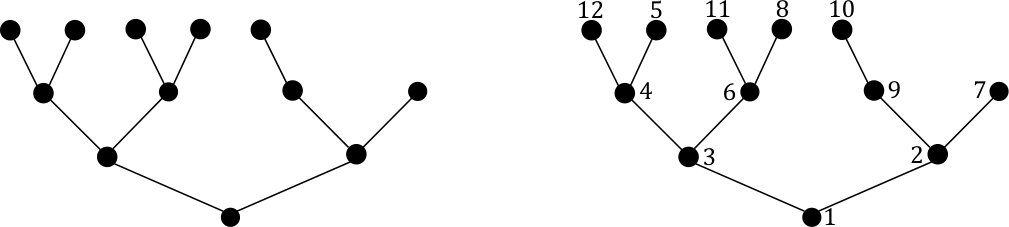 Figure 1
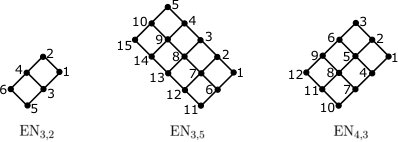 Figure 2
Peer Reviews
No public reviews on file for this paper yet. If you reviewed it on a platform where reviews are public (OpenReview, ICLR, NeurIPS, ICML), you can paste yours below so the community can read it here.
Videos
No videos yet. Explain this paper in a talk, walkthrough, or lecture? Add one.
Taxonomy
TopicsAdvanced Combinatorial Mathematics · semigroups and automata theory · Advanced Mathematical Identities
\publicationdetails
2120194165438
Proofs of Conjectures about Pattern-Avoiding Linear Extensions
Colin Defant\affiliationmark1,2 The author was supported by a Fannie and John Hertz Foundation Fellowship and an NSF Graduate Research Fellowship.
Princeton University
(2019-5-8; 2019-9-13; 2019-9-15)
Abstract
After fixing a canonical ordering (or labeling) of the elements of a finite poset, one can associate each linear extension of the poset with a permutation. Some recent papers consider specific families of posets and ask how many linear extensions give rise to permutations that avoid certain patterns. We build off of two of these papers. We first consider pattern avoidance in -ary heaps, where we obtain a general result that proves a conjecture of Levin, Pudwell, Riehl, and Sandberg in a special case. We then prove some conjectures that Anderson, Egge, Riehl, Ryan, Steinke, and Vaughan made about pattern-avoiding linear extensions of rectangular posets.
keywords:
Permutation pattern; linear extension; heap; rectangular poset.
1 Introduction
Let be the set of permutations of , which we write as words in one-line notation. Given , we say a permutation contains the pattern if there exist indices in such that for all , we have if and only if . We say avoids if it does not contain . Let be the set of permutations avoiding the patterns (this list of patterns could be finite or infinite).
The study of pattern avoidance in permutations, which began with Knuth’s analysis of permutations that are sortable via a stack [20], has grown into a large, thriving area of research in combinatorics [6, 19, 22]. Recently, there has been a great amount of interest in pattern avoidance in other combinatorial objects such as words, inversion sequences, set partitions, and trees [1, 2, 4, 5, 7, 8, 9, 10, 11, 12, 13, 14, 15, 16, 17, 18, 21, 23, 24, 25, 27, 29]. The papers [3, 5, 14, 21, 29] consider the following general type of problem. Let be an -element poset, and suppose we are given some canonical total ordering of the elements of . We can view each linear extension of as a bijective labeling of the elements of with the elements of . If we read these labels in the canonical order, we obtain a permutation. We can then ask how many linear extensions give rise to permutations that avoid certain patterns. An alternative, yet essentially equivalent, formulation of this problem is to consider a canonical labeling of and then view each linear extension of as an ordering. Again, each linear extension gives rise to a permutation, so we can ask the same enumerative questions about pattern avoidance.
As a first example, we consider the problems introduced in [21]. A complete -ary tree is a rooted tree in which each vertex that is not in the penultimate or the last level has exactly children and all vertices in the last level are as far left as possible. We make the convention that trees grow up from their roots (as in real life). A -ary heap is a complete -ary tree whose vertices are bijectively labeled with the elements of so that each vertex is given a label that is smaller than the labels of its children. Associating complete -ary trees with posets in the natural way, one can view a -ary heap as a linear extension of the underlying complete -ary tree. We endow each complete -ary tree with the breadth-first ordering (traversing the levels from bottom to top with each level traversed from left to right). Reading the labels in a -ary heap in this order yields a permutation in , which we call the permutation associated to the -ary heap. For example, the left image in Figure 1 shows the unique complete binary tree with vertices. The right image shows a binary heap obtained by labeling this tree. The permutation associated to this binary heap is . In Section 2, we prove a conjecture from [21] concerning binary heaps whose associated permutations avoid the pattern . In fact, we will prove a much more general result.
The second type of problem we consider deals with the rectangular posets studied in [3]. The poset has elements that are labeled in a canonical fashion. The easiest way to define these posets is via examples. The Hasse diagrams of , , and , along with their canonical labelings, are shown in Figure 2. Each linear extension of can be viewed as an ordering of the labels, which is a permutation in . For example, the linear extensions of correspond to the permutations , and . In Section 3, we prove several of the conjectures that the authors of [3] posed about pattern-avoiding linear extensions of these posets.
2 Pattern-Avoiding -ary Heaps
Let denote the set of -vertex -ary heaps whose associated permutations avoid the patterns . The authors of [21] found formulas for for every set except the singleton set . In fact, they were unable to explicitly enumerate binary heaps avoiding . They did, however, compute for and prove that
[TABLE]
Their data led them to conjecture that111The actual conjecture was written as “ for some ,” but it is clear from context that the authors really meant what is written in (1).
[TABLE]
We will see that this conjecture follows as a special consequence of the main theorem of this section. To state this theorem, we need one additional piece of terminology.
Given and , the direct sum of and , denoted , is the permutation in obtained by “placing above and to the right of .” More formally, the entry of is
[TABLE]
A permutation is called sum indecomposable if it cannot be written as the direct sum of two shorter permutations.
Theorem 2.1**.**
Fix an integer and a nonempty sequence of permutation patterns . If the permutations are all sum indecomposable, then
[TABLE]
Remark 2.1**.**
How do we know that the limits in Theorem 2.1 actually exist? Because the permutations are sum indecomposable, we have an injective map given by for all . This shows that the sequence is supermultiplicative, so the limit on the left-hand side exists by Fekete’s lemma. We also have an injective map sending each -ary heap to its associated permutation. This shows that . We will see in the proof of Theorem 2.1 that , so the limit on the right-hand side exists as well. It is interesting to note that this right-hand limit does not depend on .
Let denote the Catalan number. It is well known that . This implies that . Consequently, we can specialize Theorem 2.1 to obtain the following result. In the special case in which , this settles the conjecture from [21] that is stated in (1).
Corollary 2.1**.**
If , then .
of Theorem 2.1.
Fix an integer and a sequence of sum indecomposable permutation patterns . As mentioned in Remark 2.1, we must prove that
[TABLE]
To ease notation, let
[TABLE]
[TABLE]
The proof is trivial if one of the patterns is the permutation , so we may assume otherwise. Because the patterns are sum indecomposable, the identity permutation is in and is the permutation associated to an element of . Thus, . Fix , and let be such that and for every . Now choose such that , and put .
Claim: If is a permutation associated to a -ary heap in and , then is a permutation associated to a -ary heap in .
Let us see how this claim implies Theorem 2.1. Suppose by way of contradiction that . Assuming the claim, we have
[TABLE]
[TABLE]
Since and , we have . Hence, . Letting tend to [math] shows that , contradicting our assumption that . This completes the proof of Theorem 2.1 assuming the claim.
Now, let and be as in the claim. Let be the complete -ary tree with vertices, and let be the vertex of that appears in the breadth-first ordering. It is straightforward to check that the vertices are incomparable (meaning none is a descendant of another). It follows that is the permutation associated to some -ary heap in . Because and avoid the sum indecomposable permutations , their direct sum must also avoid these permutations. This completes the proof of the claim. ∎
3 Rectangular Posets
An inversion of a permutation is a pair such that and . Let denote the number of inversions of . Following [3], we let , where is the set of linear extensions of (viewed as permutations of the labels of ) that avoid the pattern . The following three theorems were stated as conjectures in [3]222Technically speaking, Theorem 3.1 was stated incorrectly in that article..
Theorem 3.1**.**
For all , we have
[TABLE]
Theorem 3.2**.**
For all , we have
[TABLE]
Theorem 3.3**.**
For all , we have
[TABLE]
where is defined by and for .
of Theorem 3.1.
It is easy to verify this theorem when , so assume . Let be a linear extension of (viewed as a permutation of the labels). Note that appears before in because, otherwise, the entries would form a pattern. Similarly, must appear before , lest the entries form a pattern. It follows that if we remove the entries and from , then we will be left with the permutation
[TABLE]
Let be such that and . We can easily check that the possibilities for and are given by and . We find that
[TABLE]
This can easily be rewritten as . ∎
of Theorem 3.2.
Let be the collection of subsets of , and define by
[TABLE]
The map is a bijection. It is now easy to check that
[TABLE]
of Theorem 3.3.
Let be the set of such that . Let . Fix , and let be the set of permutations such that for all . One can check that the sets
[TABLE]
[TABLE]
partition . Call these sets , and , respectively.
The operation that consists of removing the entries , and from a permutation establishes bijections , , , , and . After taking into account the number of inversions that are removed by each of these bijections, we obtain the identities
[TABLE]
[TABLE]
and
[TABLE]
This yields
[TABLE]
The sets partition , so
[TABLE]
Solving the recurrence relations (2) and (3) subject to the initial conditions , we obtain the desired identity . ∎
The article [3] also poses several conjectures concerning the polynomials and various OEIS sequences [26]. We settle many of these conjectures333We also correct some typos made in the original statements of these conjectures. in the following theorem. Since our focus is on the combinatorics of pattern-avoiding linear extensions and not these specific polynomials, we omit some details from the proof. In what follows, let denote the coefficient of in the Laurent series .
Theorem 3.4**.**
Define the polynomials by and for . For ,
- •
the values of are given by OEIS sequence A134465;
- •
the values of are given by OEIS sequence A098156;
- •
the values of are given by OEIS sequence A116914;
- •
the values of are given by OEIS sequence A072547;
- •
the values of are given by OEIS sequence A002054;
- •
the values of are given by OEIS sequence A127531.
Proof.
Let . The recurrence for translates into the identity
[TABLE]
Computing proves the first bullet point. The remainder of the proof makes use of the method of diagonals, which is discussed in Section 6.3 of [28].
If we view as a function of the complex variable , then
[TABLE]
where is sufficiently small and the integral is taken over the circle of radius centered at the origin. By the Residue Theorem, this is
[TABLE]
where are the singularities of (viewed as functions of ) that tend to [math] as . We can explicitly compute that and that
[TABLE]
Let and so that . Let . Since and are simple poles of , we find that
[TABLE]
We have
[TABLE]
and this proves the second bullet point.
To prove the third, fourth, fifth, and sixth bullet points, we choose an integer and view as a complex function of the variable . As above, we have
[TABLE]
where are the singularities of that tend to [math] as . Let and so that . If , then the only singularity of that tends to [math] as is
[TABLE]
If , then there is one other singularity, which is . One can check that
[TABLE]
Note that in each of these expressions, the coefficient of is [math] for every . It follows that for all integers and , the coefficient of in agrees with the coefficient of in . We have
[TABLE]
where . When , we can explicitly compute and simplify these expressions in order to obtain proofs of the last four bullet points. ∎
4 Acknowledgments
The author thanks the anonymous referees for helpful comments.
The reference list from the paper itself. Each links out to its DOI / PubMed record.
- 1[1] M. H. Albert, R. E. L. Aldred, M. D. Atkinson, C. Handley, and D. Holton, Permutations of a multiset avoiding permutations of length 3 3 3 . European J. Combin. , 22 (2001), 1021–1031.
- 2[2] M. Anderson, M. Diepenbroek, L. Pudwell, and A. Stoll, Pattern avoidance in reverse double lists, Discrete Math. Theor. Comput. Sci. , 19 (2018), #13.
- 3[3] D. Anderson, E. S. Egge, M. Riehl, L. Ryan, R. Steinke, Y. Vaughan, Pattern avoiding linear extensions of rectangular posets. J. Comb. , 9 (2018), 185–220.
- 4[4] A. Baxter and L. Pudwell, Ascent sequences avoiding pairs of patterns. Electron. J. Combin. , 22 (2015), P 1.58.
- 5[5] D. Bevan, D. Levin, P. Nugent, J. Pantone, L. Pudwell, M. Riehl, and M. L. Tlachac, Pattern avoidance in forests of binary shrubs. Discrete Math. Theor. Comput. Sci. , 18 (2016), #8.
- 6[6] M. Bóna, Combinatorics of permutations. CRC Press, 2012.
- 7[7] P. Brändén and T. Mansour, Finite automata and pattern avoidance in words. J. Combin. Theory Ser. A , 110 (2005), 127–145.
- 8[8] A. Burstein and T. Mansour, Words restricted by patterns with at most 2 2 2 distinct letters. Electron. J. Combin. , 9.2 (2002) #R 3.2.