Effect of Imbalanced Charge Transport on the Interplay of Surface and Bulk Recombination in Organic Solar Cells
Dorothea Scheunemann, Sebastian Wilken, Oskar J. Sandberg, Ronald, \"Osterbacka, Manuela Schiek

TL;DR
This study investigates how imbalanced charge transport affects surface recombination and open-circuit voltage in organic solar cells, revealing the significant influence of contact work function variations and charge mobility imbalance.
Contribution
It provides a detailed analysis of the impact of charge mobility imbalance on surface recombination and $V_{oc}$, including new analytical expressions and generalized simulation results.
Findings
Small anode work function changes significantly affect $V_{oc}$ dependence on light intensity.
Imbalanced charge transport shifts the dominant recombination mechanism from bulk to surface.
Analytical models describe $V_{oc}$ behavior under space charge pile-up conditions.
Abstract
Surface recombination has a major impact on the open-circuit voltage () of organic photovoltaics. Here, we study how this loss mechanism is influenced by imbalanced charge transport in the photoactive layer. As a model system, we use organic solar cells with a two orders of magnitude higher electron than hole mobility. We find that small variations in the work function of the anode have a strong effect on the light intensity dependence of . Transient measurements and drift-diffusion simulations reveal that this is due to a change in the surface recombination rather than the bulk recombination. We use our numerical model to generalize these findings and determine under which circumstances the effect of contacts is stronger or weaker compared to the idealized case of balanced charge transport. Finally, we derive analytical expressions for in the…
Click any figure to enlarge with its caption.
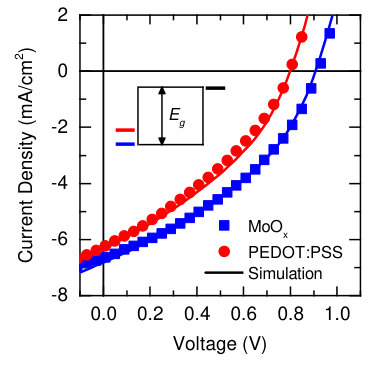 Figure 1
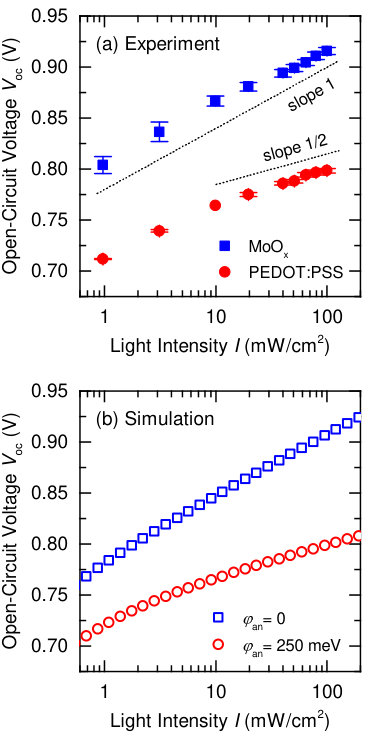 Figure 2
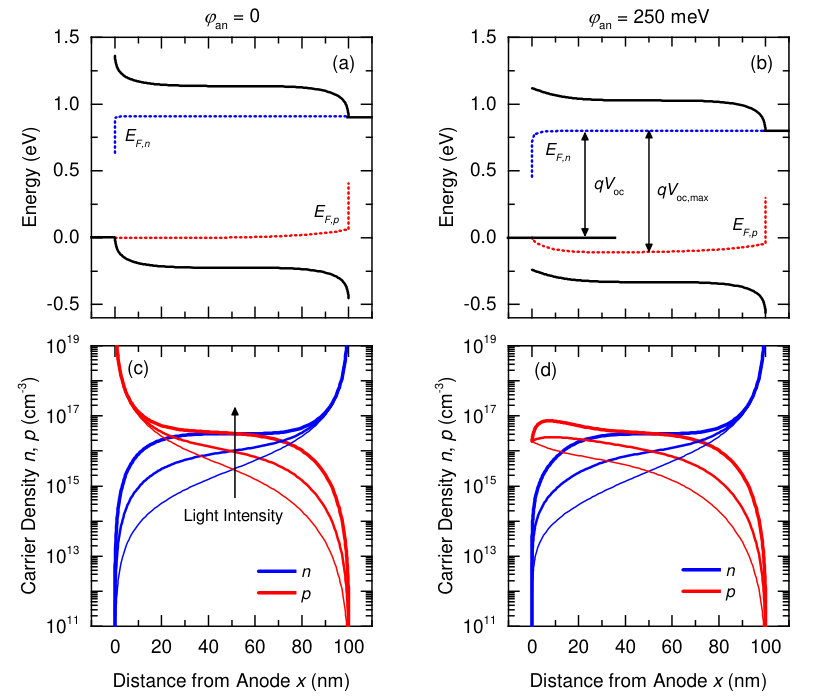 Figure 3
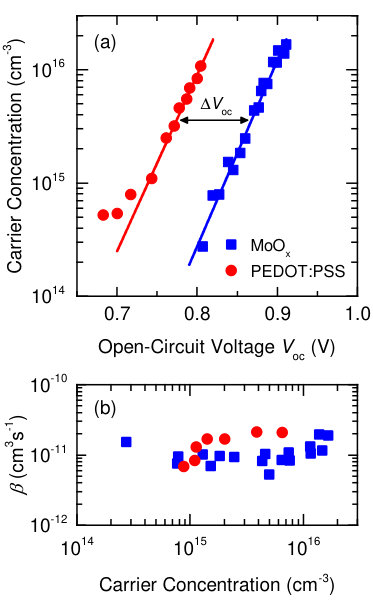 Figure 4
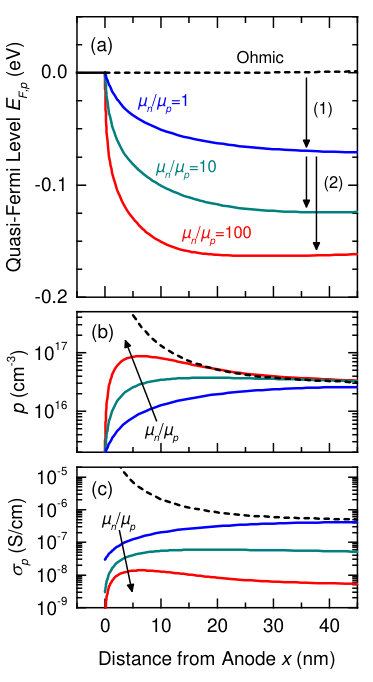 Figure 5
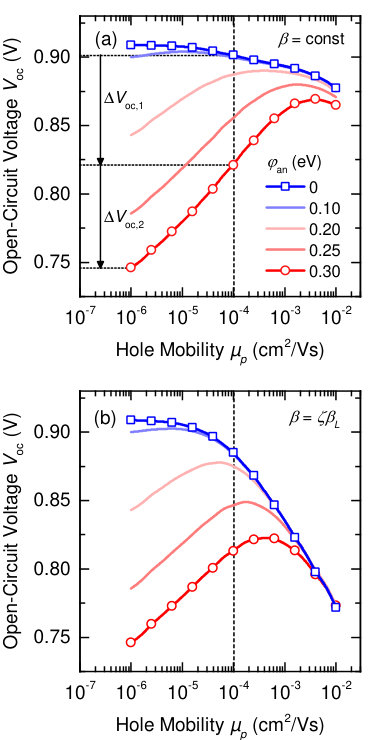 Figure 6
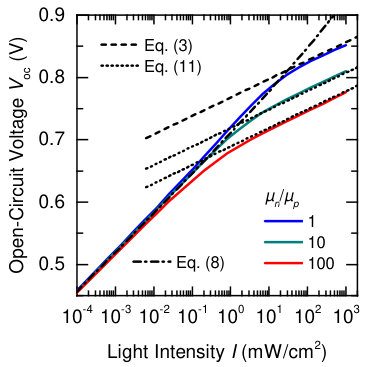 Figure 7
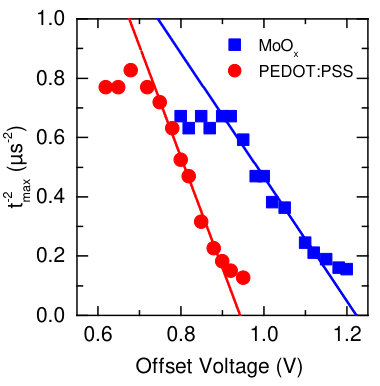 Figure 8
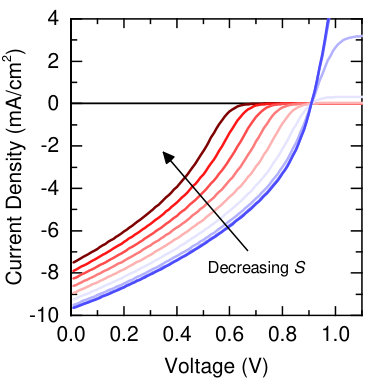 Figure 9
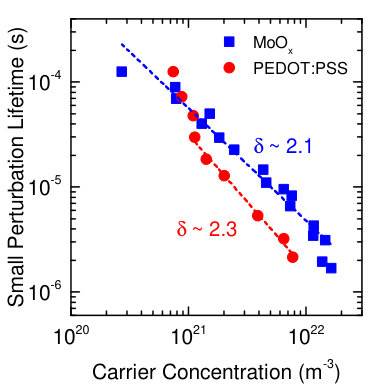 Figure 10
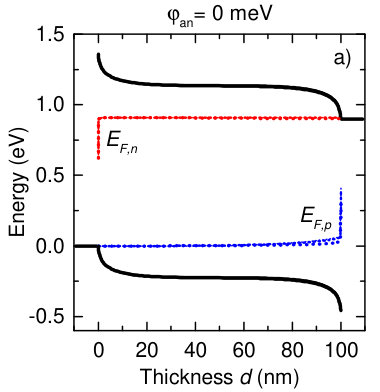 Figure 11
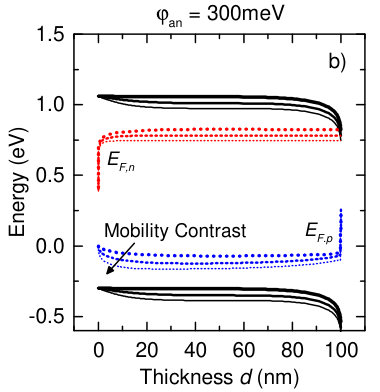 Figure 12
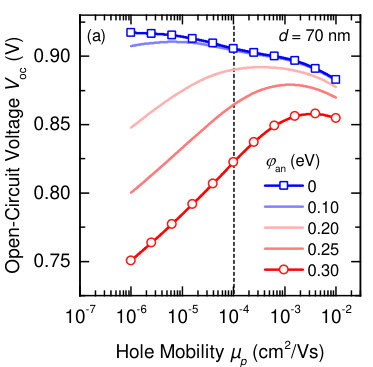 Figure 13
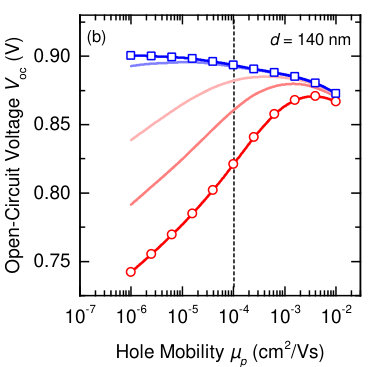 Figure 14
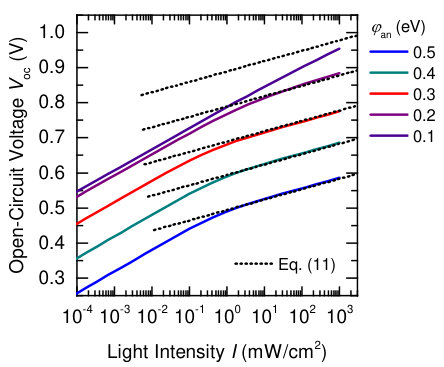 Figure 15
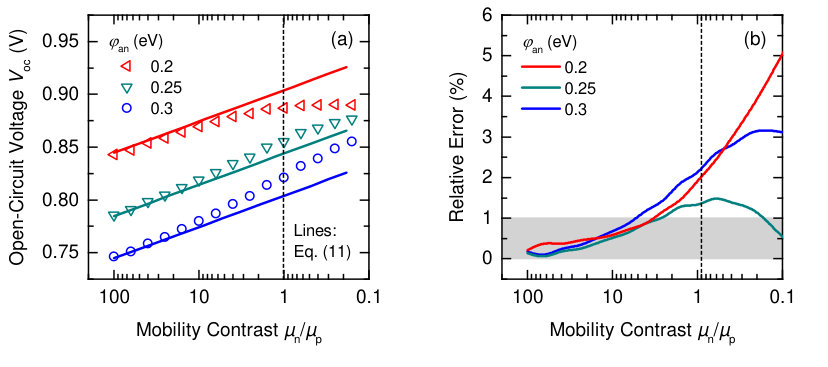 Figure 16
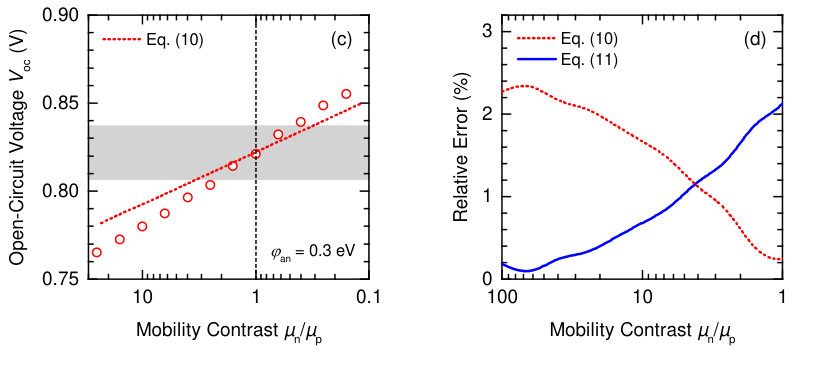 Figure 17
| Parameter | Value | Description |
|---|---|---|
| 300 K | Temperature | |
| 1.36 eV | Effective band gap | |
| 4 | Dielectric constant | |
| 100 nm | Active-layer thickness | |
| Effective density of states | ||
| Recombination coefficent | ||
| Surface recombination velocity | ||
| 0 eV | Injection barrier, cathode | |
| varied | Injection barrier, anode | |
| Electron mobility | ||
| Hole mobility |
Peer Reviews
No public reviews on file for this paper yet. If you reviewed it on a platform where reviews are public (OpenReview, ICLR, NeurIPS, ICML), you can paste yours below so the community can read it here.
Videos
No videos yet. Explain this paper in a talk, walkthrough, or lecture? Add one.
Effect of Imbalanced Charge Transport on the Interplay of Surface and Bulk Recombination in Organic Solar Cells
Dorothea Scheunemann
Sebastian Wilken
Physics, Faculty of Science and Engineering and Center for Functional Materials, Åbo Akademi University, Porthansgatan 3, 20500 Turku, Finland
Institute of Physics, Energy and Semiconductor Research Laboratory, Carl von Ossietzky University of Oldenburg, 26111 Oldenburg, Germany
Oskar J. Sandberg
Department of Physics, Swansea University, Singleton Park, Swansea, SA2 8PP, Wales, United Kingdom
Ronald Österbacka
Physics, Faculty of Science and Engineering and Center for Functional Materials, Åbo Akademi University, Porthansgatan 3, 20500 Turku, Finland
Manuela Schiek
Institute of Physics, Energy and Semiconductor Research Laboratory, Carl von Ossietzky University of Oldenburg, 26111 Oldenburg, Germany
Abstract
Surface recombination has a major impact on the open-circuit voltage () of organic photovoltaics. Here, we study how this loss mechanism is influenced by imbalanced charge transport in the photoactive layer. As a model system, we use organic solar cells with a two orders of magnitude higher electron than hole mobility. We find that small variations in the work function of the anode have a strong effect on the light intensity dependence of . Transient measurements and drift-diffusion simulations reveal that this is due to a change in the surface recombination rather than the bulk recombination. We use our numerical model to generalize these findings and determine under which circumstances the effect of contacts is stronger or weaker compared to the idealized case of balanced charge transport. Finally, we derive analytical expressions for in the case that a pile-up of space charge is present due to highly imbalanced mobilities.
I Introduction
Organic solar cells typically consist of a blend of an electron donor and an electron acceptor sandwiched between two electrical contacts Deibel and Dyakonov (2010); Mishra and Bäuerle (2012); Hou et al. (2018). Ideally, the contacts act as semipermeable membranes for electrons (cathode) and holes (anode). In this case, the open-circuit voltage is solely determined by the splitting of the quasi-Fermi levels in the blend Würfel (2009); Vandewal et al. (2009). If only bimolecular recombination is present,
[TABLE]
has been suggested, where is the elementary charge, the band gap, the Boltzmann constant, the temperature, the recombination coefficient, the density of states and the generation rate Koster et al. (2005); Tress et al. (2012). The latter part of Eq. (1) predicts a slope of when plotting versus the logarithm of the light intensity.
However, many contacts like metals or doped polymers are non-selective contacts. This means they have the ability to exchange both minority and majority charge carriers with the photoactive layer. The extraction of minority carriers (electrons at the anode, holes at the cathode) leads to a reduction of Reinhardt et al. (2014). Here, we call this loss mechanism surface recombination, with a corresponding recombination current
[TABLE]
where denotes the surface recombination velocity and the concentration of minority carriers close to the contact under consideration Wagenpfahl et al. (2010a); Sandberg et al. (2014).
In the case of Ohmic contacts, is strongly reduced by charge carrier injection. Because of the high concentration of majority carriers at the interface, minority carriers are much more likely to recombine in the bulk, rather than leaving the device via the “wrong” electrode. As a result, is still determined solely by properties of the bulk and follows Eq. (1).
The situation changes when one of the contacts is non-Ohmic. For instance, if an injection barrier is present at the anode, less holes are injected into the blend, so that and are effectively increased. Solak et al. Solak et al. (2016) showed that the open-circuit voltage at high light intensities may then be described by
[TABLE]
Compared to Eq. (1), there are two differences: First, the constant energetic part is reduced by the barrier height. Second, because of the factor in front of the logarithm, the intensity dependence of is now given by a slope of (instead of ). Such a reduction of the slope has been demonstrated both in experiment and simulation Sandberg et al. (2016); Wheeler et al. (2015); Solak et al. (2016). The transition between Eq. (1) and Eq. (3) has been assumed to take place when equals the built-in voltage Solak et al. (2016).
For large , surface recombination is not limited by the interface kinetics, but the transport of carriers towards the contact Sandberg et al. (2016). Hence, the question arises, how the open-circuit voltage depends on the charge carrier mobility . Numerical studies have indicated a decrease of with increasing mobility if the contacts are non-selective Tress et al. (2012); Kirchartz et al. (2009); Wagenpfahl et al. (2010b). The result is a finite optimum value of in terms of the overall device efficiency, independent of the recombination mechanism in the bulk.
In the above considerations, the mobilities of electrons () and holes () are considered balanced. However, this condition is often not fulfilled in practice. Many polymer-fullerene solar cells, for instance, exhibit a higher electron than hole mobility Bartelt et al. (2015); Stolterfoht et al. (2016), while it is the other way round for devices based on recent non-fullerene acceptors Holliday et al. (2016); Yan et al. (2018); Hou et al. (2018). It is well known that the imbalanced mobilities lead to a pile-up of space charge close to one contact, which may reduce both the fill factor and short-circuit current Mihailetchi et al. (2005); Stolterfoht et al. (2015). In contrast, little attention has been paid on how this affects the open-circuit voltage. Recently, Spies et al. Spies et al. (2017) suggested that the additional charge will further reduce the built-in potential and, thus, severely affect the magnitude of .
In this work, we use an experimental system with a strong mobility mismatch of and a well calibrated numerical model to discuss the effect of imbalanced transport on the open-circuit voltage in more detail. We show that the ratio between electron and hole mobility critically determines whether is dominated by surface recombination or bimolecular recombination in the bulk. With the help of the numerical simulations we expand the analytical framework given by Eq. (3) to the case of imbalanced mobilities.
II Experimental and Numerical Framework
II.1 Experiment
We fabricated solar cells based on a bulk heterojunction of the small molecule donor 2,4-bis[4-(N,N-diisobutylamino)-2,6-dihydroxyphenyl] squaraine (SQIB) and the fullerene acceptor [6,6]phenyl-C61-butyric acid methyl ester (PCBM). This blend is known for a strong contrast between the mobility of electrons () and holes () Scheunemann et al. (2017). Our devices had the structure indium tin oxide/HTL/SQIB:PCBM/LiF/Al, where HTL denotes the hole transport layer. Details regarding the used materials and the device preparation can be found elsewhere Brück et al. (2014); Abdullaeva et al. (2016); Scheunemann et al. (2017).
To realize both devices with an Ohmic and a non-Ohmic contact, we changed the HTL from molybdenum suboxide (MoOx) to the doped polymer PEDOT:PSS. The energy level of PEDOT:PSS lies within the band gap of the photoactive blend, effectively reducing by 280 mV (see Supplemental Material SM ). As shown in Fig. 1, this reduction results primarily in a significant drop of from 920 to 800 mV, which is in agreement with previous reports Liu et al. (2013); Yang et al. (2013); Chen et al. (2012). Conversely, the HTL had little effect on the short circuit current and the fill factor; both current-voltage curves exhibit the typical shape of space-charge-limited collection Mihailetchi et al. (2005). Averaged photovoltaic characteristics for both types of devices can be found in the Supplemental Material SM .
II.2 Numerical Model
We aimed to understand these findings using a numerical drift-diffusion model Burgelman et al. (2000). The model treats the bulk heterojunction as an effective semiconductor sandwiched between two electrical contacts. The alignment of the work function of the contacts and the transport levels of the effective semiconductor is given by the injection barriers (anode) and (cathode). The injection of charge carriers is then assumed to occur via thermionic emission. Surface recombination at the contacts is treated according to Eq. (2).
We then assumed that excess charges are generated by illumination through the transparent anode. To take into account the spatial distribution of the photogeneration, we coupled the drift-diffusion model with transfer-matrix calculations Pettersson et al. (1999); Burkhard et al. (2010). The recombination of mobile carriers in the photoactive layer is considered to be solely bimolecular,
[TABLE]
where and is the density of electrons and holes, respectively, and the intrinsic carrier density. This is motivated by a recent study Scheunemann et al. (2017), where we show that non-geminate recombination SQIB:PCBM blends resembles a second-order process with a prefactor independent on the carrier density. However, we note that herein, Eq. (4) is used only as an empirical rate equation, without making any assumptions on the details of the actual recombination mechanism (e.g., whether it is radiative or non-radiative). All relevant input parameters for the simulation are listed in Tab. 1.
With this model we were able to describe the experimental data only by varying the injection barrier height at the anode, while keeping all other parameters constant (see solid lines in Fig. 1). This proves that the variation of the HTL only affects the energy level alignment at the anode, but not the bulk properties of the active layer. Thus, we have at hand a suitable model system to study the effect of imbalanced mobilities on .
III Results and Discussion
III.1 Impact of an injection barrier
Figure 2(a) shows the experimental light intensity () dependence of the open circuit voltage. For the MoOx device, versus has nearly a slope of , as predicted by Eq. (1) for Ohmic contacts. Hence, we can assume that is limited by bimolecular recombination in the bulk only. In contrast, the PEDOT:PSS device shows a transition towards a lower slope at mid to high light intensity. The reduced slope agrees qualitatively well with Eq. (3). This kind of behavior, with the slope going from at low intensity to at higher intensity (while remains lower than for the MoOx device over the entire intensity regime), suggests that surface recombination at one non-Ohmic contact is dominating in the PEDOT:PSS device Sandberg et al. (2016).
As can be seen in Fig. 2(b), both the absolute value and the intensity dependence of are well captured by our numerical model if we only change the magnitude of . It was not possible to reproduce the experimental data by varying the surface recombination velocity at the anode instead (see Supplemental Material SM ). A significant reduction of would give rise to an extraction barrier, which would then result in S-shaped current-voltage curves Sandberg et al. (2014); Wilken et al. (2014); Wagenpfahl et al. (2010a); Sundqvist et al. (2016). Because such an S-kink is not present in the data shown in Fig. 1, we expect the surface recombination current to be mainly determined by the carrier concentrations at the anode and the transport properties of the bulk.
Figure 3 shows the effect of the anode work function on the energy band diagrams, as well as the electron and hole concentration. The solid lines in panels (a) and (b) denote the transport levels under 1-sun illumination and the dashed lines the quasi-Fermi levels. The MoOx device shows significant band bending at both electrodes caused by injection of majority carriers into the semiconductor. In case of the anode, there is a high concentration of holes, exceeding the concentration of photogenerated carriers in the bulk by several orders of magnitude. Because of the high hole concentration, electrons are likely to recombine within the bulk, rather than being extracted. The quasi-Fermi levels at both electrodes are flat, so that the open-circuit voltage represents the splitting of the quasi-Fermi levels in the bulk. The situation remains relatively unchanged with increasing photogeneration. Hence, the light intensity dependence of shows a constant slope over the intensity range studied herein and can be described by bimolecular recombination in the bulk.
For the PEDOT:PSS device with a non-Ohmic contact, the concentration of injected holes is much lower, leading to a reduced band bending at the anode. Consequently, the electron concentration close to the anode is higher than for the case with an Ohmic contact. According to Eq. (2), this non-negligible concentration of minority carriers induces a surface recombination current . To ensure open-circuit conditions (no net current), it must be compensated by a hole current
[TABLE]
Because the magnitude of close the anode is fixed by the barrier height , and is considered constant, an increase of due to increasing photogeneration can only be compensated by a gradient of the quasi-Fermi level for holes. At 1-sun illumination, the gradient in is clearly visible. Consequently, the open-circuit voltage is reduced and no longer a measure of the quasi-Fermi level splitting in the bulk.
Notably, the drift-diffusion model predicts that beyond a thin region of approximately 15 nm close to the anode, both the quasi-Fermi level splitting and the carrier concentrations remain unchanged regardless of the anode work function. To check this prediction, we measured the carrier concentration under open-circuit conditions using bias-assisted charge extraction Kniepert et al. (2014); Scheunemann et al. (2017). Figure 4(a) shows indeed only a constant voltage shift between the data points for the MoOx and the PEDOT:PSS sample, while the carrier concentration at a given light intensity remains unchanged.
Furthermore, we performed transient photovoltage experiments to determine the carrier lifetime. By plotting the lifetime versus the carrier concentration (see Supplemental Material SM ) we obtained a reaction order close to 2 in both cases. This indicates that the recombination in the bulk is bimolecular, independent of whether an Ohmic or an non-Ohmic hole contact is present. That the nature of the contact does not affect the recombination in the bulk is also evident from Fig. 4(b), where we plot the recombination rate constant as a function of the carrier concentration. For both devices we find fairly similar values of .
Hence, we can conclude that the variation in between the MoOx and PEDOT:PSS devices is solely related to a gradient in the hole quasi-Fermi level at the anode, while the recombination in the bulk is largely unaffected. This is in line with previous studies on material combinations with balanced mobilities Wheeler et al. (2015); Spies et al. (2017). However, it seems surprising that a relatively low injection barrier of 250 meV has such a strong effect on both the magnitude and light intensity dependence of . In the following we show that this is a direct consequence of the highly imbalanced mobilities.
III.2 Effect of imbalanced charge transport on the open-circuit voltage
Having shown that our numerical model describes the experimental data well, we will now use it to discuss the effect of charge transport in more detail. Figure 5(a) demonstrates how an injection barrier at the anode (similar to the PEDOT:PSS device) affects the hole quasi-Fermi level for different ratios between and . For balanced mobilities (), the injection barrier induces a certain gradient , which leads to a voltage loss compared to the case with an Ohmic hole contact. If we now lower the hole mobility by one or two orders of magnitude, the gradient of the quasi-Fermi level increases significantly. This can be reflected by introducing a second loss component due to the imbalanced charge transport. Hence, the total loss in can be expressed as
[TABLE]
Another possible loss mechanism would be a reduction of the quasi-Fermi level splitting (and, thus, the carrier concentration) in the bulk due to very strong surface recombination Spies et al. (2017). However, such a reduction is not present here, which is both evident from the bulk recombination measurements (see Fig. 4) and the additional band diagrams shown in the Supplemental Material SM .
Figure 5(b) and 5(c) illustrate the effect of imbalanced charge transport in more detail. In Fig. 5(b), an accumulation of holes close to the anode for is clearly seen. However, at the same time, the absolute value of is decreased. Hence, it is worthwhile to take a look at the conductivity . Figure 5(c) shows that the increase of the hole concentration is not large enough to compensate the decrease of the hole mobility. At the same time, the conductivity for electrons is nearly unaffected. Hence, assuming more imbalanced charge transport effectively decreases the difference between and close to the anode. This can be understood in terms of a further loss of selectivity or an virtual increase of the injection barrier height Spies et al. (2017); Reinhardt et al. (2014).
Figure 6 shows as a function of for a fixed electron mobility of and different barrier heights . First, we discuss the case of a constant , which means the mobility does not affect the bulk recombination [Fig. 6(a)]. Only a weak variation of with is then visible for an Ohmic contact (). The slight decline of is due to the fact that also the cathode is assumed to be non-selective. When is very large (), the device is dominated by hole transport, so that surface recombination at the cathode becomes limiting. If we now introduce a significant barrier at the anode ), it is clearly seen that the voltage loss becomes determined by the mobility ratio. For , the reduction of is solely caused by , which is proportional to . This no longer holds true for imbalanced mobilities. In the case , the voltage loss is further increased by the mobility-dependent , and a logarithmic dependence of on can be seen. In contrast, for , surface recombination is partly compensated, as charges accumulate now at the (Ohmic) cathode. As a result, the total voltage loss is effectively reduced (). We also did simulations for and 140 nm (see Supplemental Material SM ). Previously, we have shown that this thickness range produces clear differences in the competition between charge extraction and bimolecular recombination Scheunemann et al. (2017). However, we find here that the mobility dependence of is fairly unaffected by the active-layer thickness. This shows that our results are independent on the collection of majority carriers.
Next, we consider the case that also the bulk recombination is limited by diffusion [Fig. 6(b)]. Such a process is commonly described by the Langevin model, predicting a mobility-dependent recombination coefficient
[TABLE]
However, it is known that the recombination in phase-separated organic blends is reduced compared to the Langevin model, , where is a reduction factor Pivrikas et al. (2005); Murthy et al. (2013); Göhler et al. (2018). Here, we chose , so that with the given mobilities of the SQIB:PCBM system, the experimental value of is reproduced. For , no difference in the mobility dependence of can be seen between Fig. 6(a) and Fig. 6(b), as is largely determined by the fixed . If the mobilities are similar, there is a significant contribution of to the magnitude of . In the case , the coefficient becomes so large that the device is entirely dominated by bulk recombination, and the barrier at the anode is no longer relevant. Altogether, this results in a maximum of , which shifts towards larger values of with increasing . Such an optimum value of is unique for imbalanced charge transport and was not observed in previous studies, where and were varied simultaneously Tress et al. (2012); Kirchartz et al. (2009); Wagenpfahl et al. (2010b).
Our numerical results show that independent of the bulk recombination mechanism, surface recombination at the anode critically determines for imbalanced mobilities with . In contrast, for , the quality of the anode is less important. We note that our conclusions are directly transferable to the case of a non-Ohmic cathode. A significant barrier would severely limit for , which is a relevant scenario for non-fullerene solar cells Holliday et al. (2016); Yan et al. (2018); Hou et al. (2018).
III.3 Analytical expression for in the case of imbalanced mobilities
Recently, Sandberg et al. Sandberg et al. (2016) provided analytical means to describe for different cases related to surface recombination. If one contact is non-Ohmic (here the anode) and surface recombination is limited by the diffusion of minority carriers (here electrons; effective velocity ) rather than the interface kinetics (), the authors derived the expression
[TABLE]
for low light intensities, where bulk recombination is negligible. When is far from flat-band conditions, we have , where is the electric field close to the anode. Equation (8) is valid as long as , with the effective diffusion length
[TABLE]
where is an effective mobility. At high enough light intensities, so that and flat-band conditions prevail on the anode side of the active layer, the surface recombination is restricted to a region given by the effective diffusion length. Under these conditions, can be approximated by Sandberg et al. (2014, 2016)
[TABLE]
which in the limit is equivalent to the result of Solak et al. Solak et al. (2016). We note that Eq. (10) already provides a framework to predict for moderate mobility contrasts; however, its derivation assumes that flat-band conditions prevail close to the surface recombination dominated region near the anode. This is no longer valid for for highly imbalanced mobilities.
For , a considerable pile-up of holes is taking place close to the anode at high light intensities, as is clearly visible in Fig. 3(d). As evident from Fig. 3(b), the resulting space charge region of holes gives rise to a photo-induced upward energy-level bending near the anode. In the hole-dominated space charge region, the bulk recombination of holes is negligibly small. Instead, at open-circuit conditions, the hole current within this region is balanced by an equal, but opposite surface recombination current of electrons, diffusing against the band bending at the anode. After accounting for the hole-induced energy-level bending and the associated electron diffusion, Eq. (10) modifies to
[TABLE]
as shown in Supplemental Material SM . The main feature of Eq. (11) is that it no longer depends on the bimolecular recombination strength . Hence, in the limit of highly imbalanced mobilities and at high enough light intensities, becomes independent of bulk recombination and is solely given by the contacts and the charge transport in the active layer. Equation (11) also explains the logarithmic dependence at high mobility contrasts seen in Fig. 6. The voltage loss due to the imbalanced mobilities is then given by
[TABLE]
As shown in Fig. 7 for mobility contrasts of one and two orders of magnitude, the modified analytical expression in Eq. (11) describes the numerical data well in the high-intensity regime. We note that as long as the anode can be considered as non-Ohmic (), this holds true also for other injection barrier heights (see Supplemental Material SM ). In the low-intensity regime, becomes independent of the mobility contrast and can be described by Eq. (8) instead. Our analysis demonstrates that the transition is shifted towards lower photogeneration for increasing .
Furthermore, we checked the validity of our analytical framework, as detailed in the Supplemental Material SM . We find that Eq. (11) predicts the open-circuit voltage for mobility contrasts with an relative error below 1% (for the parameters in Tab. 1). It is worth noting that Eq. (10), which neglects band bending in the hole-induced space charge region, reaches a similar accuracy only for a mobility imbalance of less than a factor of 2. Finally, we point out that Eq. (1) is in none of the cases presented in Fig. 7 suitable to describe the data, even in the low-intensity regime and even though only pure bimolecular recombination was assumed in the simulation. Hence, special care has to be taken when trying to assess information about the bulk recombination from the slope of versus , also called the light ideality factor Kirchartz et al. (2013). If the contacts are not sufficiently selective, the ideality factor will always be affected by surface recombination.
IV Conclusion
In summary, we have studied how imbalanced charge transport affects the interplay of bulk and surface recombination in organic solar cells. Combining experiments and simulations for a blend system with a strong mobility mismatch, we have identified two cases with respect to the energy level alignment at the electrodes: For Ohmic contacts, the open-circuit voltage still is representative of the quasi-Fermi level splitting in the bulk, even though the mobilities and are highly imbalanced. However, if one contact is non-Ohmic, becomes critically determined by the mobility ratio. For the devices studied herein (), we find that surface recombination at the anode reduces more strongly than it would be the case with balanced mobilities. The reason is that with decreasing , a larger gradient of the quasi-Fermi level is required to cancel out the surface recombination current of electrons. An analogous situation occurs for a device dominated by hole transport () at a the cathode. Hence, it is properties of the photoactive blend that decide whether an electrode can be considered appropriate.
We have also derived analytical equations for that take into account the pile-up of space charge due to highly imbalanced mobilities. In particular, Eq. (11) shows excellent agreement with the data from our experimentally validated numerical device model. With this we hope to provide a framework that helps researchers in designing efficient organic photovoltaics from materials with imbalanced charge transport.
Acknowledgements.
The authors thank Matthias Schulz and Arne Lützen (University of Bonn, Germany) for providing the squaraine dye, as well as Mathias Nyman and Staffan Dahlström (Åbo Akademi University) for fruitful discussions. D. S., S. W. and M. S. thank Jürgen Parisi for constant support of their research in Oldenburg. Financial support by the Magnus Ehrnrooth Foundation and the Research Mobility Programme of Åbo Akademi University is gratefully acknowledged.
The reference list from the paper itself. Each links out to its DOI / PubMed record.
- 1Deibel and Dyakonov (2010) C. Deibel and V. Dyakonov, “Polymer-Fullerene Bulk Heterojunction Solar Cells,” Rep. Prog. Phys. 73 , 96401 (2010) . · doi ↗
- 2Mishra and Bäuerle (2012) A. Mishra and P. Bäuerle, “Small Molecule Organic Semiconductors on the Move: Promises for Future Solar Energy Technology,” Angew. Chem. Int. Ed. 51 , 2020–2067 (2012) . · doi ↗
- 3Hou et al. (2018) J. Hou, O. Inganäs, R. H. Friend, and F. Gao, “Organic Solar Cells Based on Non-Fullerene Acceptors,” Nat. Mater. 17 , 119–128 (2018) . · doi ↗
- 4Würfel (2009) Peter Würfel, Physics of Solar Cells , 2nd ed. (Wiley-VCH, Weinheim, Germany, 2009).
- 5Vandewal et al. (2009) K. Vandewal, K. Tvingstedt, A. Gadisa, O. Inganäs, and J. V. Manca, “On the Origin of the Open-Circuit Voltage of Polymer-Fullerene Solar Cells,” Nat. Mater. 8 , 904–909 (2009) . · doi ↗
- 6Koster et al. (2005) L. J. A. Koster, V. D. Mihailetchi, R. Ramaker, and P. W. M. Blom, “Light Intensity Dependence of Open-Circuit Voltage of Polymer:Fullerene Solar Cells,” Appl. Phys. Lett. 86 , 123509 (2005) . · doi ↗
- 7Tress et al. (2012) W. Tress, K. Leo, and M. Riede, “Optimum Mobility, Contact Properties, and Open-Circuit Voltage of Organic Solar Cells: A Drift-Diffusion Simulation Study,” Phys. Rev. B 85 , 155201 (2012) . · doi ↗
- 8Reinhardt et al. (2014) J. Reinhardt, M. Grein, Bühler C., M. Schubert, and U. Würfel, “Identifying the Impact of Surface Recombination at Electrodes in Organic Solar Cells by Means of Electroluminescence and Modeling,” Adv. Energy Mater. 4 , 1400081 (2014) . · doi ↗