Chimera states in small disordered optomechanical arrays
Karl Pelka, Vittorio Peano, Andr\'e Xuereb

TL;DR
This paper investigates the emergence of long-lived chimera states in small disordered optomechanical arrays, revealing that disorder is essential for their existence, with implications for understanding synchronization in complex systems.
Contribution
It demonstrates that disorder enables chimera states in optomechanical arrays, combining numerical and analytical methods to uncover this phenomenon.
Findings
Chimera states exist only with disorder in the array.
Long-lived chimera states are observed in simulations.
Disorder is necessary for partial synchronization patterns.
Abstract
Synchronization of weakly-coupled non-linear oscillators is a ubiquitous phenomenon that has been observed across the natural sciences. We study the dynamics of optomechanical arrays - networks of mechanically compliant structures that interact with the radiation pressure force - which are driven to self-oscillation. These systems offer a convenient platform to study synchronization phenomena and have potential technological applications. We demonstrate that this system supports the existence of long-lived chimera states, where parts of the array synchronize whilst others do not. Through a combined numerical and analytical analysis we show that these chimera states can only emerge in the presence of disorder.
Click any figure to enlarge with its caption.
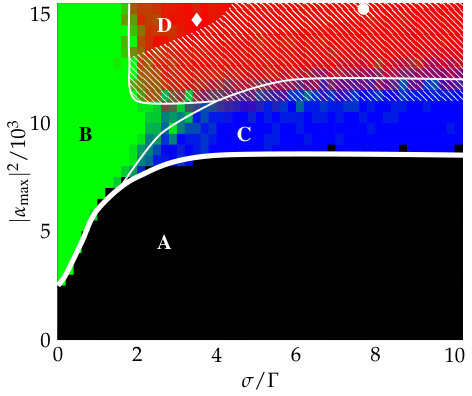 Figure 2
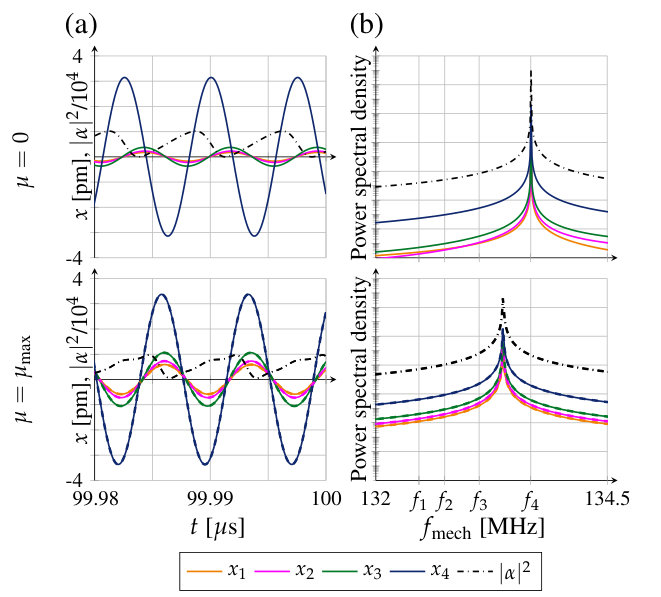 Figure 3
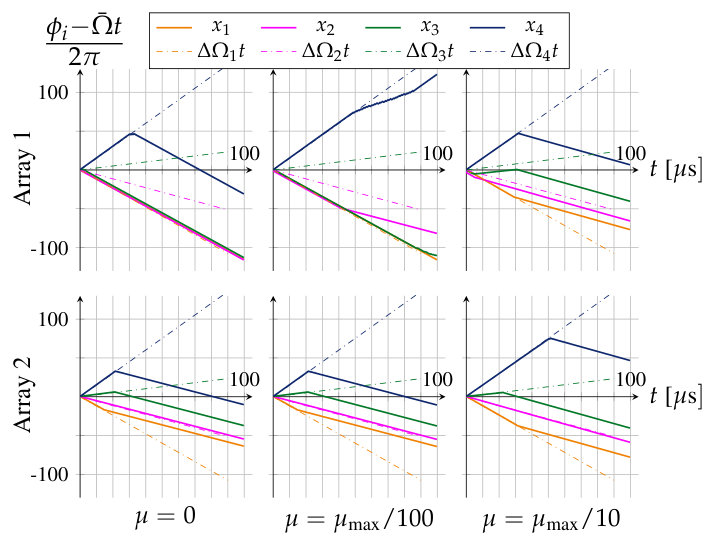 Figure 4
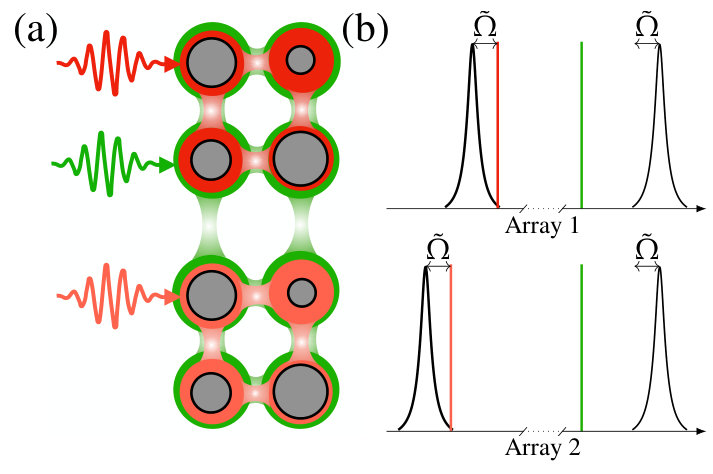 Figure 4
Peer Reviews
No public reviews on file for this paper yet. If you reviewed it on a platform where reviews are public (OpenReview, ICLR, NeurIPS, ICML), you can paste yours below so the community can read it here.
Videos
No videos yet. Explain this paper in a talk, walkthrough, or lecture? Add one.
Chimera states in small disordered optomechanical arrays
Karl Pelka
Department of Physics, University of Malta, Msida MSD 2080, Malta
Vittorio Peano
Max Planck Institute for the Science of Light, Staudtstraße 2, 91058 Erlangen, Germany
Department of Physics, University of Malta, Msida MSD 2080, Malta
André Xuereb
Department of Physics, University of Malta, Msida MSD 2080, Malta
Abstract
Synchronization of weakly-coupled non-linear oscillators is a ubiquitous phenomenon that has been observed across the natural sciences. We study the dynamics of optomechanical arrays—networks of mechanically compliant structures that interact with the radiation pressure force—which are driven to self-oscillation. These systems offer a convenient platform to study synchronization phenomena and have potential technological applications. We demonstrate that this system supports the existence of long-lived chimera states, where parts of the array synchronize whilst others do not. Through a combined numerical and analytical analysis we show that these chimera states can only emerge in the presence of disorder.
Introduction.—The synchronization of weakly-coupled oscillators is a common feature of non-linear dynamics that arises in various disciplines ranging from engineering to neuroscience Pikovsky (2003). The paradigmatic Kuramoto model Kuramoto (1984) explains how an ensemble of phase oscillators can exhibit collective synchronization induced by identical all-to-all coupling, in spite of differences in their natural frequencies. Aside from realisations in biological systems Michaels et al. (1987); Osaka (2017), synchronization of coupled oscillators finds technological application, e.g., in high-power laser diode arrays having high efficiency and low divergence Jiang et al. (1993); Ruiz-Oliveras et al. (2009); Apollonov et al. (1998); Apollonov (2014).
Kuramoto Kuramoto et al. (2002) discovered that the same type of non-linear interaction can lead to emergent phenomena for phase oscillators upon relaxing from a global identical coupling to a non-local coupling topology. These arrangements can be used to implement finite state machines Orosz et al. (2009), for example. However, they are also known to fail to synchronize completely, but rather to support coexistence of coherence and incoherence—later dubbed chimera states Abrams et al. (2004)—under specific conditions that are still being investigated. While the Kuramoto model is known to be analytically reducible with the Watanabe–Strogatz ansatz Watanabe et al. (1994), further results on generalized Kuramoto models with finite degrees of freedom or in the continuum limit gave insight into the relevant order parameters and their evolution in time Pikovsky et al. (2008); Ott et al. (2008, 2009); Abrams et al. (2008). Additional analyses were conducted showing that chimera states are robust to heterogeneities in natural frequencies Montbrió et al. (2008); Laing (2009, 2009), coupling topologies Shanahan (2010); Kundu et al. (2018), and noise Laing (2012). Theoretical work Panaggio et al. (2015); Omel’chenko (2015) also motivated successful experimental observations of such states in arrays of coupled chemical oscillators Tinsley et al. (2012), spatial light modulators Hagerstrom et al. (2012), and metronomes on swings Martens et al. (2013).
The study of the dynamics of micro-mechanical systems has undergone tremendous growth in recent years under the guise of optomechanics Aspelmeyer et al. (2013). The prototypical optomechanical system consists of a single mode of the electromagnetic radiation field, e.g., within a high-finesse optical cavity Kippenberg et al. (2005), interacting with the motion of a harmonic oscillator by means of the radiation pressure force Marquardt et al. (2006). The moving element variously takes the form of one of the end mirrors of a cavity Gröblacher et al. (2009), a semi-transparent membrane inside a cavity Thompson et al. (2008), one plate of a capacitor Teufel et al. (2011), a micro- or nano-particle Millen et al. (2014); Delić et al. (2019) in a cavity, or the cavity itself in the case of micro-toroids supporting whispering gallery modes of the radiation field Kippenberg et al. (2005). The optomechanical interaction has been used to cool the motion of the mechanical system down to its ground state Chan et al. (2011); Teufel et al. (2011), generate quantum entanglement between mechanical oscillators Ockeloen-Korppi et al. (2018); Riedinger et al. (2018), and produce proof-of-concept isolators and directional amplifiers for microwave radiation Bernier et al. (2017); Malz et al. (2018); Barzanjeh et al. (2017).
Recent work has started exploring the many-body dynamics of systems of coupled optomechanical networks, including the possibility of obtaining stronger coupling at the single-photon level Xuereb et al. (2012); Piergentili et al. (2011) and their use to study synchronization phenomena Heinrich et al. (2011); Zhang et al. (2012); Holmes et al. (2012); Lauter et al. (2015); Zhang et al. (2015). Such systems may also find technological use; synchronized optomechanical arrays, for example, could act as high-power and low-noise on-chip frequency sources Zhang et al. (2015).
The experimental observation of synchronization in optomechanical arrays Zhang et al. (2015) raises the question of its robustness against disorder in the natural frequencies of the mechanical oscillators, as well as potential interactions of multiple arrays on one chip. To explore this question we employ a toy model of two identical arrays of optomechanical oscillators subject to global mechanical coupling within each, as well as with the other, array. Our theoretical analysis reveals how this disorder gives rise to chimera states close to the regions of parameter space where the arrays synchronize. Our work identifies limitations for the large scale integration of optomechanical arrays on a chip.
Following the introduction of our model, we describe the results of exhaustive numerical experiments that allow us to identify the region of parameter space where chimera states arise in our model. We then analyse the continuum limit to obtain analytical results, and conclude by discussing the implications of our results for applications of optomechanical arrays.
Model.—We consider the collective dynamics of two identical optomechanical arrays, , each of which consists of mechanical modes coupled to one global laser-driven optical mode of amplitude , which is described by the equations of motion Heinrich et al. (2011); Zhang et al. (2012, 2015)
[TABLE]
Here , , , and denote the displacement, natural frequency, effective mass, and damping rate of the mechanical modes; the last two are assumed to be identical to simplify the analysis but we have verified that our numerical results still hold for small variations of those. We assume that the arrays contain identical sets of oscillators, i.e., such that the two arrays are indistinguishable; chimera states are well-defined only in cases where the oscillator populations are identical. Each optical mode is characterised by its decay rate and its detuning from the driving laser , which we assume are independent of . The optomechanical interaction shifts the resonance frequency by as a result of the mechanical displacements, and imparts a force on the mechanical modes. For blue detuning () and large-enough optical power, there exists a Hopf bifurcation leading to synchronised self-oscillation Marquardt et al. (2006); Heinrich et al. (2011); Zhang et al. (2015).
The focus of this work is the analysis of additional mechanical coupling between the arrays and its effects on their synchronization. The mechanical coupling is assumed to be global: , i.e., every pair of oscillators is coupled with strength . Such global spring-like coupling was shown theoretically Heinrich et al. (2011) and realized experimentally for two oscillators Zhang et al. (2012) with an optomechanical coupling driven with a red detuned laser (). Figure 1 illustrates a schematic illustration of a realization of this model, i.e., a system of consisting of two arrays of micro-toroidal optomechanical systems that allows for optical modes delocalized Zhang et al. (2015) over either one array or both arrays. Driving each array with an optical mode delocalized over it with blue detuning allows the excitation of the mechanical oscillators and self-sustained synchronized oscillation at large powers. Driving another optical mode delocalized over both arrays with red detuning introduces global spring-like coupling adjustable via the input power and the detuning.
The behavior of this system depends sensitively on the magnitude of the disorder in the frequencies of the mechanical elements, and on the input optical power. An overview of this behavior is depicted in Fig. 2, which is the main numerical result of this work. For weak disorder on the scale of a mechanical linewidth, we find that below a threshold input power there is no self-sustained oscillation (Region A). Above this threshold, we find synchronized oscillation of all mechanical oscillators for arbitrarily small additional mechanical spring-like interaction (Region B). The relative phase between the two arrays in the absence of the spring-like coupling is arbitrary and depends on the initial condition. In accordance with the analytical insight, one finds phase synchronization of the two arrays upon increasing the mechanical interaction.
For large-enough disorder, increasing the optical input power above the oscillation threshold leads to unsynchronized self-sustained oscillation of the arrays (Region C). Increasing the input power even further (Region D), one finds that both arrays always synchronize seperately to one of the natural frequencies in absence of interaction of the two arrays. Introducing the mechanical interaction between the two arrays can drive one of the arrays out of the synchronized state while the other one is not affected. Since this coexistence of synchronization in one array and lack of sychronization in the other depends crucially on the mechanical coupling between the two arrays, and since the two arrays are identical, we can label these chimera states. Increasing the mechanical interaction between the arrays even further will eventually lead to in-phase or anti-phase synchronization of the two arrays.
Numerical results with small arrays.—Under realistic circumstances, state-of-the-art optomechanical arrays consist of at most a few separate oscillators whose natural frequencies are spread beyond a linewidth (cf. Fig. S-5 in Ref. (Zhang et al., 2015, SI)). To address the effect of additional mechanical coupling, we conducted numerical investigations of Eqs. (1) using parameters from Ref. Zhang et al. (2015). We consider two identical arrays, each consisting of four oscillators whose natural frequencies are centered around MHz, and which have mechanical quality factor and effective mass pg. The optical modes interact with each array with a coupling strength MHz/nm and have a decay rate . They are driven by a blue-detuned laser with . The mechanical coupling between the arrays is set to be global; we explore coupling strengths up to .
We next turn to examples that illustrate the preceding discussion. Figure 3 shows the behavior of the coupled arrays for zero (top) and dominant (bottom) mechanical coupling for parameters at the white diamond in Fig. 2. Without mechanical coupling, collective oscillation of each array takes place at one of the natural frequencies, showing the existence of coherence. Due to the large disorder, the phase difference between pairs of mechanical oscillators will be non-zero. When the mechanical coupling dominates, collective oscillation of the arrays take place at an arbitrary frequency with the two arrays oscillating in phase, in agreement with the analytical results presented below.
Figure 4 shows the phase reconstruction of the two arrays for different mechanical coupling strengths for parameters at the white circle in Fig. 2. The top (bottom) row represents the first (second) array, and the columns represent zero (left), intermediate (middle), and dominant (right) mechanical coupling. For zero mechanical coupling, the two arrays synchronize independently of one another to one of the natural frequencies of their oscillators. For large mechanical coupling, we again find that both arrays synchronize; this time, however, they both synchronize to the same frequency. However, at intermediate coupling strengths, we find that the phases of the first array diverge while the second array remains synchronized. This indicates that there is a stable coexistence of synchronization in one array and incoherent oscillation in the other, mediated by the mechanical coupling of the arrays.
Continuum limit.—In the regime of self-sustained oscillations the light field can be adiabatically eliminated and the radiation pressure force is then a periodic function with fundamental frequency . Note that we can neglect the harmonics of the radiation pressure force and approximate . By averaging over time and only considering the slow contributions one finds a generalised Kuramoto-like model for the phase evolution Heinrich et al. (2011); Lauter et al. (2015)
[TABLE]
where we have defined and .
With the aim to obtain analytical insight using the Kuramoto-like model we follow the analysis of Ref. Ott et al. (2008). Thus, we require that the coupling constants can be considered the same and to depend only on the array index . Performing the continuum limit requires the conservation of the number of oscillators for consistency. This results in continuity equations for the probability densities to find oscillators with natural frequency to have phase at time :
[TABLE]
Following the method of Ref. Ott et al. (2008), we assume (i) a Lorentzian natural frequency distribution , and (ii) that the are periodic in :
[TABLE]
with the Ott–Antonsen property . This family of probability distributions contains the limiting cases of the uniform distribution for , which signifies no knowledge about the phases, and for , signifying perfect synchronization of all phases to . Conveniently, converges for all with to
[TABLE]
In absence of mechanical coupling, , the phases decouple. The solution to the dynamics is , and the corresponding stable fixed point is , i.e., perfect synchronization.
When the mechanical coupling is much larger than and , we can describe the dynamics of the system in terms of the phase difference . We find the fixed points with , which describes two cases—either (i) the two arrays synchronize perfectly, or (ii) each array synchronizes seperately but in antiphase with the other array. This result generalizes the findings for two optomechanical oscillators in Ref. Heinrich et al. (2011), extending its applicability to two arrays of oscillators.
If all terms are relevant, analytical insight can be gained by assuming that array , without loss of generality, is synchronized () and stays synchronized (). We obtain
[TABLE]
Since for the relevant cases (), we find that . Importantly, this means that if there is no disorder () there can be no chimera states (). Chimera states require disorder to exist in this system. Similarly, when the mechanical coupling dominates the disorder () the arrays must synchronize in phase or in antiphase.
Conclusions.—Our investigation shows that highly complex nonlinear classical dynamics emerges in disorder strongly-driven optomechanical arrays. The fascinating pattern formation leading to the coexistence of coherence and incoherence in two interacting arrays is found to be enforced by the competition between two synchronization mechanisms. Since disorder in the natural frequencies of oscillators in realistic setups is of the order of a few linewidths, the physics we describe is of technological relevance. Our study further shows that this complex behavior is readily accessible to experiments.
In closing, we note that optics is not the only mechanism to couple the two arrays mechanically. Such interactions can also be introduced by strain coupling if the arrays are connected by a substrate, or sound waves if they are in close proximity to one another. Because of their generality, the effects we describe must be accounted for in systems with multiple non-linear oscillators in close proximity. If chimera states are to be avoided, our results imply a limit to the packing density of such arrays; if chimera states are to be sought, we have shown that a certain amount of disorder must be present.
Acknowledgments.—This work is supported by the European Union’s Horizon 2020 research and innovation programme under Grant Agreement No. 732894 (FET Proactive HOT).
The reference list from the paper itself. Each links out to its DOI / PubMed record.
- 1Pikovsky (2003) A. Pikovsky, M. Rosenblum, and J. Kurths, Synchronization: A Universal Concept in Nonlinear Sciences (Cambridge University Press, Cambridge, 2003).
- 2Kuramoto (1984) Y. Kuramoto, Chemical Oscillations, Waves, and Turbulence (Springer, New York, 1984).
- 3Osaka (2017) M. Osaka, Appl. Math. 8 , 1227 (2017) . · doi ↗
- 4Michaels et al. (1987) D. C. Michaels, E. P. Matyas, and J. Jalife, Circ. Res. 61 , 704 (1987) . · doi ↗
- 5Jiang et al. (1993) Z. Jiang and M. Mc Call, J. Opt. Soc. Am. B 10 , 155 (1993) . · doi ↗
- 6Ruiz-Oliveras et al. (2009) F. R. Ruiz-Oliveras and A. N. Pisarchik, Phys. Rev. E 79 , 016202 (2009) . · doi ↗
- 7Apollonov et al. (1998) V. V. Apollonov, S. I. Derzhavin, V. I. Kislov, A. A. Kazakov, Yu. P. Koval’, V. V. Kuz’minov, D. A. Mashkovskii, and A. M. Prokhorov, Quantum Electron. 28 , 257 (1998) .
- 8Apollonov (2014) V. V. Apollonov Quantum Electron. 44 , 102 (2014) . · doi ↗