Finite-Size Effects in Heavy Halo Nuclei from Effective Field Theory
E. Ryberg, C. Forss\'en, D. R. Phillips, U. van Kolck

TL;DR
This paper explores how finite-size effects influence the charge radii of heavy halo nuclei within Effective Field Theory, highlighting the importance of core size and proposing an organizational scheme for these effects.
Contribution
It introduces a new organizational scheme in Halo EFT that accounts for finite-size effects in heavy cores, improving predictions of charge radii.
Findings
Finite-size effects decrease as 1/A_c for heavy cores.
Short-range operators can dominate the charge radius in one-neutron P-wave halos.
Halo EFT remains highly predictive for one-proton halos.
Abstract
Halo/Cluster Effective Field Theory describes halo/cluster nuclei in an expansion in the small ratio of the size of the core(s) to the size of the system. Even in the point-particle limit, neutron halo nuclei have a finite charge radius, because their center of mass does not coincide with their center of charge. This point-particle contribution decreases as , where is the mass number of the core, and diminishes in importance compared to other effects, e.g., the size of the core to which the neutrons are bound. Here we propose that for heavy cores the EFT expansion should account for the small factors of . As a specific example, we discuss the implications of this organizational scheme for the inclusion of finite-size effects in expressions for the charge radii of halo nuclei. We show in particular that a short-range operator could be the dominant effect in the charge…
Click any figure to enlarge with its caption.
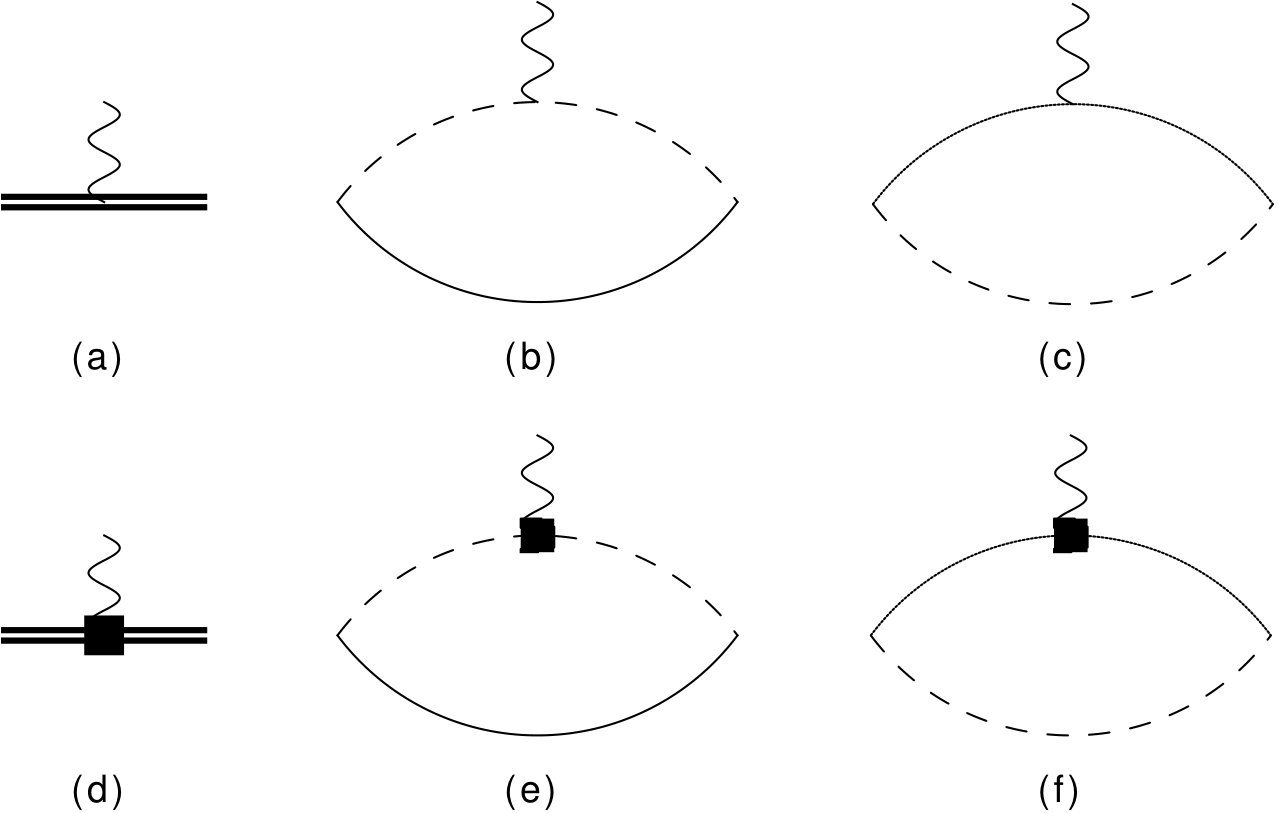 Figure 1
 Figure 2
| — | — | |||
| — | — | |||
Peer Reviews
No public reviews on file for this paper yet. If you reviewed it on a platform where reviews are public (OpenReview, ICLR, NeurIPS, ICML), you can paste yours below so the community can read it here.
Videos
No videos yet. Explain this paper in a talk, walkthrough, or lecture? Add one.
Finite-Size Effects in Heavy Halo Nuclei from Effective Field Theory
E. Ryberg
C. Forssén
Department of Physics, Chalmers University of Technology, 412 96 Göteborg, Sweden
D. R. Phillips
Institute of Nuclear and Particle Physics and Department of Physics & Astronomy. Ohio University, Athens, OH 45701, USA
Institut für Kernphysik, Technische Universität Darmstadt, 64289 Darmstadt, Germany
ExtreMe Matter Institute EMMI, GSI Helmholtzzentrum für Schwerionenforschung GmbH, 64291 Darmstadt, Germany
U. van Kolck
Institut de Physique Nucléaire, CNRS/IN2P3, Université Paris-Sud, Université Paris-Saclay, 91406 Orsay Cedex, France
Department of Physics, University of Arizona, Tucson, AZ 85721, USA
Abstract
Halo/Cluster Effective Field Theory describes halo/cluster nuclei in an expansion in the small ratio of the size of the core(s) to the size of the system. Even in the point-particle limit, neutron halo nuclei have a finite charge radius, because their center of mass does not coincide with their center of charge. This point-particle contribution decreases as , where is the mass number of the core, and diminishes in importance compared to other effects, e.g., the size of the core to which the neutrons are bound. Here we propose that for heavy cores the EFT expansion should account for the small factors of . As a specific example, we discuss the implications of this organizational scheme for the inclusion of finite-size effects in expressions for the charge radii of halo nuclei. We show in particular that a short-range operator could be the dominant effect in the charge radius of one-neutron halos bound by a P-wave interaction. The point-particle contribution remains the leading piece of the charge radius for one-proton halos, and so Halo EFT has more predictive power in that case.
I Introduction
Theoretical models of many-body systems usually treat the constituent particles as having no internal structure. This point-particle approximation is also used in cluster models, e.g., for the description of halo systems Zhukov:1993aw ; Hansen:1995pu ; Jensen:2004zz ; Frederico:2012xh , even though one might encounter situations for which the core is rather large. Finite-size effects are included a posteriori, but can become significant for certain observables. As an example, the total charge radius is usually calculated by simply adding in quadrature Friar:1975pp the charge radii of the constituents and the calculated point-particle radius, see e.g. the calculation of charge radii for neutron-rich helium isotopes in the Gamow Shell Model Papadimitriou:2011jx . Instead, it would be useful to construct a framework in which finite-size effects can be included systematically.
Constituent-size effects can be accounted for in effective field theories (EFTs), where they appear through derivative interactions. For example, the nucleon charge radius (and, more generally, nucleon form factors) can be calculated Bernard:1995dp in Chiral Perturbation Theory (ChPT) in an expansion in powers of , where is a momentum scale associated with the lightest carrier of the nuclear force, the pion, and GeV is the characteristic mass scale of QCD. The relevant pion parameters are its mass and decay constant. Chiral EFT Bedaque:2002mn is a generalization of ChPT to a typical nucleus, for which the binding energy per nucleon is and the radius . The nuclear charge radius includes the sum of the nucleons’ radii plus many-body effects generated by internucleon interactions and currents Phillips:2016mov . We would like to have a similar framework for clusterized systems.
Clusterized systems, with much smaller energies and larger radii, are additionally characterized by scales beyond the pion scales. These nuclei can be viewed as a collection of valence nucleons orbiting around either no core (few-nucleon systems), one core (halo nuclei) or many cores (cluster nuclei). The cores themselves frequently—but not always—have properties of typical nuclei. The generic existence of such systems can be understood as a consequence of a fine-tuning in QCD, which introduces a lighter momentum scale MeV Beane:2001bc ; vanKolck:2008bm . For such loosely bound systems we can devise EFTs that exploit the separation of scales without involving pions explicitly. In these EFTs one considers processes with typical momenta , such that , where k_{\mathrm{hi}}\hskip 1.99997pt\raisebox{2.15277pt}{<}\raisebox{-3.00003pt}{\sim}\hskip 1.99997ptk_{\pi} is a high-momentum scale. One then develops an expansion for observables in powers of . The very lightest nuclei are dilute systems with no core, where the dominant (two- and three-nucleon) interactions are S-wave. The corresponding EFT is Pionless EFT, for which power counting is relatively well understood Bedaque:2002mn .
Halo/Cluster EFT, here labeled HEFT, was proposed as an EFT for systems with one Bertulani:2002sz ; Bedaque:2003wa or more Higa:2008dn cores and valence nucleons Canham:2008jd ; Canham:2009xg . (See Ref. Hammer:2017tjm for a recent review.) HEFT power counting is a generalization of the power counting for Pionless EFT allowing for dominant interactions in waves with non-vanishing angular momentum and for a breakdown scale estimated from the first excitation of the core and/or its size. In the first cases considered, 5,6He Bertulani:2002sz ; Bedaque:2003wa ; Rotureau:2012yu ; Ji:2014wta ; Ryberg:2017tpv , there is an alpha-particle core, and the neutron-alpha (-) interaction is mostly of P-wave nature, generating a near-threshold 5He resonance. The - interaction, in turn, is obtained Higa:2008dn from - scattering and the lowest 8Be state. HEFT has since been extended to heavier cores and to proton halo systems Hammer:2017tjm . In most of these cases the high scale in HEFT is associated with the size of the core, i.e. . This means HEFT is an expansion in powers of , where is the unnaturally large size of the halo system.
The different contributions to the charge radius of a halo nucleus can then be organized in the HEFT expansion and the size of the effect due to the finite size of the core (and of the nucleon) estimated. We do that and thereby derive—for both S- and P-wave one-neutron halos—the charge radius formula that is frequently used in nuclear theory. However, we also point out that there is, in principle, another expansion parameter present when HEFT is applied to systems with a relatively large number, , of core nucleons. To leading order in the core is static, its recoil being small compared to nucleon recoil. Consequently the center of mass of a neutron halo coincides with its center of charge. Thus, whereas for light halos (e.g. 6He) the difference between these two generates an important contribution to the charge radius Lu:2013ena , for heavier systems the corresponding effect goes to zero. Correctly assessing the impact of the finite size of the constituents on the charge radius requires keeping track of factors of .
Moreover, the charge radii of halo nuclei are affected by a short-range operator, which is subleading in but leading in . We show that for one-neutron halos bound by a P-wave interaction (e.g. the excited state of 11Be) this effect may be as important as the long-distance contributions to the halo’s charge radius that have been previously computed in HEFT Hammer:2011ye . Similar considerations also apply to the form factors of two-neutron halos such as those discussed in Ref. Vanasse:2016hgn . They are not, however, as pressing for proton halos, where a finite charge radius will be generated by the photon coupling to the valence proton(s) even if the core is infinitely heavy.
This exemplifies the importance of keeping track—to the extent possible—of factors of in observables, rather than just counting powers of . This is quite similar to the need to distinguish between relativistic corrections that are suppressed by powers of the inverse nucleon mass, , and other corrections that only carry powers of vanKolck:1998bw ; Chen:1999tn ; Zhang:2017yqc . The significant difference between these two scales produces a hierarchy between effects that scale with the same power of . Only once that hierarchy has been identified can the power counting be formulated in an efficient manner.
We isolate the dependence that enters the charge radius through kinematic effects, i.e., because the nucleon-core mass ratio, , is small. In contrast, we assume that all Lagrangian coefficients (LECs) scale with a power of that is solely determined by the naive engineering dimension of the operator they multiply, i.e., we use naive dimensional analysis with respect to and do not attach any additional dependence to the LECs. It is true that is also dependent, because will generically be of order the inverse core size, , and can be taken to be . But any additional accounting of the dependence of short-distance physics in HEFT beyond this would require a more microscopic understanding of the dependence of all the cofficients in the EFT. This could be achieved by matching HEFT to a microscopic calculation, but it could be argued that such matching goes beyond the EFT philosophy of writing down a theory that is independent of the short-distance physics. In contrast, the kinematic effects we identify here are universal, in the sense that they occur irrespective of the nature of the forces between the halo nucleons and the core(s).
Here we focus on the charge radius of single-neutron halo nuclei, where the point contribution is suppressed by for the reason described above. But, the presence of the heavy core propagator is ubiquitous, so similar effects will affect other observables as well. For example, one expects the Born-Oppenheimer approximation to emerge in systems with multiple heavy cores and/or valence nucleons.
Our paper is structured as follows: In Sec. II we discuss the interplay between the various scales that are involved in an EFT for a halo system with a heavy core. We also discuss the low-energy scattering parameters for the nucleon-core system and introduce the charge radius in terms of the momentum expansion of the low-energy charge form factor. In Sec. III we derive the observable charge radius for S- and P-wave one-neutron halo states. The power counting is exemplified by considering the charge radius for selected halo states. We summarize our findings in Sec. IV. An appendix discusses the corresponding results for proton halos, where considering factors of does not lead to any change in the hierarchy of the various physical mechanisms that contribute to the charge radius.
II Power Counting
Once the relevant degrees of freedom are chosen, a model consists of a specific set of interactions among them. In contrast, with an EFT one considers the most general dynamics consistent with the known symmetries. It is crucial to organize the corresponding infinity of contributions to any observable according to their size (“power counting”).
We are interested in a clusterized system where the size of the system is sufficiently large that the constituents can be taken as point-like in a first approximation. This system might be probed with particles (photons, electrons, neutrinos, nucleons) of wavelength that cannot resolve the inner structure of the constituents. For simplicity we consider a few valence nucleons orbiting around a single core of radius consisting of nucleons. The arguments below can be generalized straightforwardly to multiple-core systems.
The power counting of HEFT is based, like that of other EFTs, on the ratio of momentum scales, . The high momentum scale is determined by physics not accounted for explicitly in HEFT. Since nuclei are bigger than nucleons we must have k_{\mathrm{hi}}\hskip 1.99997pt\raisebox{2.15277pt}{<}\raisebox{-3.00003pt}{\sim}\hskip 1.99997pt1/R_{\mathrm{N}}\sim k_{\pi}, with the size of a nucleon, which is generically set by pionic dynamics described by ChPT. But a more restrictive condition on arises from the requirement that details of the core are not resolved:
[TABLE]
Adopting the standard rule for the scaling of the nuclear size with we then have , although we note that several of the cores considered up until now in HEFT are somewhat larger than this valley-of-stability lore indicates. If there exist low-lying excited states of the core, corresponding to a lower momentum scale than the inverse size of the core, the high-momentum scale needs to be adjusted accordingly, or else explicit degrees of freedom must be introduced for the low-lying excited states. One example of this is in the reaction, where the low-lying excited state of 7Be must be included as an explicit degree of freedom in the HEFT if Eq. (1) is to prevail Zhang:2013kja ; Zhang:2014zsa .
can therefore be expected to increase for heavier systems, rendering finite-size effects more important. Meanwhile, decreases and will generically be smaller than . It introduces an additional expansion parameter. Explicit factors of enter through the core mass,
[TABLE]
where the average nucleon mass MeV and we have neglected the effect of nuclear binding for the kinematic purposes we have in mind here.
In our non-relativistic theory approximate Galilean invariance guarantees that the interactions depend on the mass of the particles only in trivial ways that can be scaled out of the theory. Therefore all explicit occurrences of are associated with the kinematics of the two-particle system, and once again, Galilean invariance means that they must be encoded in the halo’s reduced mass,
[TABLE]
where
[TABLE]
is the total nucleon-core mass, with . Specifically, has a fractional difference from of , reflecting the extent to which the core is still dynamical in the (effective) one-body problem.
The large mismatch in masses evident in Eq. (2) means that the pertinent energy scale for the valence nucleon is the one-nucleon separation energy
[TABLE]
which is much smaller than the binding energy of the core but much larger than the recoil energy of the core
[TABLE]
For energies of the order of the typical nucleon energy, , nucleon recoil is a leading-order effect. Beyond leading order the ratio occurs only in (small) relativistic corrections. In contrast, core recoil is suppressed by a factor of . Thus at leading order (LO) the core propagator is static, that is,
[TABLE]
Thus, for low-order calculations one can simplify the procedure by using a static core, and including recoil effects perturbatively as higher-order corrections. Relativistic corrections that scale like will be even smaller.
In addition to these kinematic factors of , there may be dependence on coming through the interaction coefficients, or “low-energy constants” (LECs). As a trivial example, electromagnetic interactions add up constructively for protons and the corresponding LECs in general depend on the core charge . It is not clear how to deal with this quantity a priori. In neutron halos, can be significantly smaller than , but this is not necessarily so for proton halos. We will keep factors of explicit and deal with them on a case-by-case basis.
Likewise, the LECs for strong interactions might in specific cases represent some constructive or destructive interference in the interactions of the valence nucleon with the core nucleons. One way to determine the dependence of these LECs is by matching HEFT to the ab initio solution of the same system with a more fundamental EFT Zhang:2013kja ; Zhang:2014zsa ; Hagen:2013jqa , in a region where both EFTs are valid. Another way is to look at systematic trends in LECs fitted to data for different cores. In either case a manifestation of strong dependence would be a particularly large or small LEC value with respect to the expected power of . Since there is no clear case at this point, below we limit ourselves to the kinematical factors arising from the core mass, although the counting of factors of could be improved later if needed.
II.1 Nucleon-core scattering
EFTs incorporate from the start the coupling to the continuum, so that most calculations of halo structure, including form factors, are intimately connected with nucleon-core scattering. A discussion of nucleon-core interactions is therefore necessary for the calculation of form factors, and we briefly review previous work on the subject here.
First we consider a halo system where the dominant core-nucleon interaction is S-wave. In this case, an EFT where all forces are of contact type reduces to the effective range expansion (ERE) Bedaque:2002mn ; Beane:2000fx . One can think of the scattering length as what characterizes the size of the halo system, and the effective range (and higher ERE parameters) as reflecting the breakdown scale, namely the size of the core. The large size of the halo system is manifest in a large scattering length, while higher effective-range parameters are assumed to have sizes set by :
[TABLE]
For an S-wave nucleon bound to the core with separation energy , the nucleon-core matrix has a pole at with
[TABLE]
The power counting for this system is almost identical to that of Pionless EFT for an S-wave bound state Beane:2000fx ; Bedaque:2002mn , which was adopted, for example, in the form-factor calculation of Ref. Hammer:2011ye . Note, however, that the suppression of the core recoil by Eq. (6) means that in LO the nucleon-core reduced mass that enters scattering is , see Eq. (3).
Similar considerations apply to higher partial waves, but differences arise from the different renormalization: the more singular character of the interactions requires more LECs at any given order. For P-wave nucleon-core scattering, for example, both the scattering “length” and the effective “range” appear at LO Bertulani:2002sz ; Bedaque:2003wa 111Note that the P-wave scattering length and effective range have dimensions of volume and momentum, respectively.. The mildest assumption Bedaque:2003wa is that the effective range, just as for S waves, is not fine tuned and directly reflects the breakdown scale,
[TABLE]
In this case is larger than the unitarity term , and -matrix poles of non-zero energy require a single fine tuning,
[TABLE]
Assuming the higher ERE parameters still scale with , they are all subleading, and at LO there are two poles: depending on the sign of , a resonance on the real axis or a real/virtual bound-state pair with binding momentum
[TABLE]
in terms of the separation energy . Thus, again, is related to the size of the halo system. At NLO the unitarity term needs to be included. If treated exactly, a third pole appears with momentum , that is, outside the EFT. In the unlikely case where there are three low-energy poles in the low-energy region, the in Eqs. (10) and (11) should be replaced by Bertulani:2002sz .
Just as for S waves, the assumption that no further powers of appear in the ERE parameters implies that the only change in power counting when treating as small is the extra expansion (3).
II.2 Charge form factor
The sizes of the halo system and its components are manifest not only in the ERE parameters but also in the charge form factor. The charge form factor is obtained as the matrix element of the zeroth component of the electromagnetic four-current, , according to
[TABLE]
where is the proton number of the halo nucleus and is the momentum transfer. A measure of the size of the nucleus is the charge radius . We now look at the power counting for the observable charge form factor of one-nucleon halo systems. The discussion here follows Ref. Hammer:2011ye , but makes explicit the factors of that were not incorporated into the power counting there. We discuss contributions to the charge form factor in the point-like limit, due to the finite-size of the constituents, and from additional two-body (short-range) contributions, as displayed in Fig. 1. More details and explicit examples will be presented in Sec. III.
We start by discussing the point-like part, , which comes from the photon coupling to the charge of the constituents. The corresponding operators in the Lagrangian have the general form where denotes either the core or the nucleon field and is the zeroth component of the photon four-vector field. The point-like contribution is kinematically generated by nucleon-core one-loop diagrams, where the photon couples to the core (in the neutron halo case) or to both the core and the proton (for the proton halo) — see Fig. 1(b,c). For a neutron halo, momentum dependence requires recoil of the core, and thus the charge radius, which involves two powers of momenta, is proportional to , where is defined in Eq. (4). Indeed, the loop for neutron-halo systems was calculated by Hammer and Phillips Hammer:2011ye with the leading-order (LO) results:
[TABLE]
The scalings are then given by
[TABLE]
assuming Eqs. (9), (10), and (12). However, it should be noted that typically so, if is close to , then can in practice be rather than the formally correct assignment we have used here.
The point-like contribution to the charge radius is interesting because it can be calculated from known properties of the constituents, but it exists against a backdrop of other, less well-known contributions. One type of these other contributions comes from the finite sizes of the constituent core and nucleon, which enter through the same loop diagrams as the point contributions, see Figs. 1(e,f). The finite-size contributions correspond to operators of the form . The two extra powers of the small momentum compared to the point-like terms coming from minimal substitution means that, by naive dimensional analysis, this operator carries a suppression of . Such terms produce a direct contribution to the charge radius that is not suppressed by . The nucleon finite-size contribution to will be denoted by and should be proportional to , i.e., to the proton or neutron charge radius squared, respectively, mohr_2015_22826 and Olive:2016xmw . This contribution scales as
[TABLE]
Meanwhile, the core-size contribution to the charge radius squared, , will scale as
[TABLE]
Taking the ratio of Eqs. (16) and (17) shows that in general the nucleon-finite-size contribution to the charge radius squared is smaller than the core-finite-size contribution by both and a factor of the total charge of the system. For the canonical estimate we have
[TABLE]
There is another contribution to the charge radius, but this time it is not determined by data from other processes. Short-range contributions to the charge density are encoded in a contact operator of the form , where denotes the dicluster field for either the S- or the P-wave system — see Fig. 1(d). Because of the two derivatives, this operator is suppressed by a factor of with respect to , which originates in the minimal substitution of the dicluster kinetic term — Fig. 1(a). The minimal substitution term ensures that the charge comes out correct; the term with two additional derivatives comes with short-range parameters, which we denote in S- and P-wave halos by, respectively, . In the case of an S-wave halo, the dicluster kinetic term is itself a relative effect (it gives rise to the range, Eq. (8)), for an overall suppression. For a P-wave system, the dicluster kinetic term leads to the “range” which scales with , see Eq. (10), and there is no extra suppression Hammer:2011ye . We expect short-range contributions to the charge radius that scale as
[TABLE]
again shown explicitly in Sec. III. Thus, for S-wave one-nucleon halos this short-range operator enters one order after the core-size contribution. For P-wave halos both contribute at the same order.
In summary, these power-counting arguments make explicit that the point-like contribution for one-nucleon halos involves a kinematical suppression factor for neutron halos. But this has the consequence that, for P-wave one-neutron halos, a short-range operator enters at the same order as the finite-size core contribution. The existence of such additional short-range operators will have negative influence on the predictive power of LO calculations.
III The charge radius formula
In this section we will derive charge-radius formulas in HEFT with the heavy core power counting. In the process we will critique some results from Ref. Hammer:2011ye where finite-size effects were not treated explicitly. For example, the charge radius formula used in Ref. Hammer:2011ye for a one-neutron halo system is
[TABLE]
where is the charge radius squared of the core. In principle, one should also add the neutron charge radius contribution , where is the core charge, but this term is usually neglected since is tiny. The key point is that Eq. (20) has not been derived within the field theory: finite-size contributions were instead added to the point-like result in a rather ad hoc fashion. In what follows we will show that (and, for that matter, ) indeed add to the charge radius squared, but in principle other contributions of similar size can appear. We also argue that it is important to keep track of the large suppression in neutron halos of the point-like radius for , when the main contribution to the charge radius of the system comes from the finite size of the constituents.
This derivation, carried out in the next subsections, starts from the HEFT Lagrangian. We will consider explicitly only dominant S- or P-wave interactions, and a spin-0 core — generalizations are straightforward but cumbersome to write. The Lagrangian for a spin-1/2 nucleon , where , and a spin-0 core with S- and P-wave interactions is given by
[TABLE]
The field is the spin-1/2 dicluster field, which we introduce for convenience. Its kinetic term has a sign and it has a residual mass , which is a parameter to be fixed. The most important S-wave coupling of nucleon and core has strength . For the P-wave interaction, corresponding to the last two terms, we have, for simplicity, included only the channel, through a spin-1/2 dicluster field and the Clebsch-Gordan coefficient \mathcal{C}_{si}^{s^{\prime}}=\left(\frac{1}{2}s1i\big{|}\left(\frac{1}{2}1\right)\frac{1}{2}s^{\prime}\right) Hammer:2011ye . The indices take values according to and . As above, is a sign, and and are parameters to be fixed, while was defined in Eq. (4). The field is the zeroth component of the photon four-vector field. Here is the third isospin Pauli matrix, and we have defined the charge number of the core . Note that is the charge ( or ) of the nucleon-core system. The charge radius of the nucleon (core) field is (), while and are additional short-range parameters with sizes given by Eq. (19), which will be discussed below.
This Lagrangian includes all operators that will contribute to the charge radius of the halo system up to NLO. Higher-order terms, such as the one that leads to the shape parameter in the ERE and terms that do not contribute to the charge form factor, are denoted by the ellipsis. The coefficients of the terms in Eq. (21) encode the finite size and composite nature of the core. We assign the same scaling to them as Hammer and Phillips, who used naive dimensional analysis to argue that are all 222For , which undergoes renormalization, this estimate is only valid for a renormalization scale of order , see below.. However, whereas Ref. Hammer:2011ye argued that this scaling rendered these effects of higher order, here we contend that they can provide the main contribution to the charge radius for heavy core systems.
The finite constituent sizes are reflected in the non-trivial momentum-transfer dependence of the core and nucleon form factors. The form factor of the core is given by the part of the Lagrangian where a photon couples to the core field, that is, terms of the form (and derivatives of ). The resulting charge form factor of the core is thus given by the diagrams shown in Fig. 2 as
[TABLE]
and as such the charge radius of the core is given by . Note that since Fig. 2 contains no loops the Lagrangian parameter appears directly here without being affected by renormalization—at this order. The nucleon charge form factors and charge radii can be considered in a similar fashion, with the exception that the electric charge of the neutron is zero:
[TABLE]
where for the neutron (proton). We now examine the effect of these terms in the charge radii of S- and P-wave neutron halos, while the case of proton halos is discussed in the Appendix.
III.1 S-wave neutron halos
Here we compute the expectation value of the zeroth component of the electromagnetic current, , which appears in Eq. (13), for an S-wave one-neutron halo. The long-distance contributions to this quantity are well known, cf. Refs. Chen:1999tn ; Beane:2000fx ; Hammer:2011ye , where the diagrams in Fig. 1(a,b) were evaluated (although only for in Refs. Chen:1999tn ; Beane:2000fx ). Here we include diagrams Fig. 1(d,e,f) as well, and so account for finite-size effects and the leading short-range, two-body operator.
The charge form factor of an S-wave one-neutron halo can be computed from the amputated correlator of the field with one insertion of all possible couplings to an photon. The diagrams that contribute up to are shown in Fig. 1. We must also apply a wavefunction renormalization factor , which defines the overlap of the field with the physical one-neutron halo state. The contributions from tree and loop diagrams can then be separated, viz.
[TABLE]
The wavefunction renormalization factor is Beane:2000fx ; Hammer:2011ye :
[TABLE]
where we kept some higher-order terms as well by not expanding the ratio. Note that is finite to this order.
At finite-size effects cannot play a role as the photon only “sees” the entire charge of the system. The leading contribution to the form factor at is then from the loop diagram in Fig. 1(b), where the virtual photon is attached to the core via its charge. This diagram also gives rise to subleading corrections to : it generates the point contribution to the form factor, but away from , this is suppressed by and not as large as other effects once .
The most important such other effect is due to the loop diagram Fig.1(e), i.e., the coupling of the photon to the finite size of the core inside the loop. The contribution of this graph can be combined with the corresponding coupling for the neutron, Fig. 1(f), to obtain the contribution stemming from the constituent form factors, Eqs. (22) and (23). The result can be expressed as a coordinate-space integral,
[TABLE]
We expand the integral (26) up to order to arrive at
[TABLE]
At , also receives a contribution from the tree-level diagram, Fig. 1(a). Considering also the tree diagram in Fig. 1(d), which represents the short-range contribution to the halo charge radius, we arrive at
[TABLE]
The first term here is a consequence of charge conservation and ensures that as we have , that is, the charge form factor is correctly normalized at zero momentum transfer. Moving away from we insert Eqs. (28) and (27) in Eq. (24), and compare with the term quadratic in momentum in Eq. (13), to obtain the charge-radius formula for S-wave neutron halos,
[TABLE]
where the “” represent higher-order contributions. Note that at this order the Lagrangian parameter appears directly here, without renormalization. This is because the LO loop that gives the point-charge contribution is finite. The point-charge contribution to was computed in Ref. Hammer:2011ye as , with given by Eq. (14).
Expanding in ,
[TABLE]
where the orders of various contributions are summarized in Table 1, assuming that . If , the most important terms are given by the point-radius . For larger , these terms rapidly lose importance, as do contributions from the neutron size. Unless we are dealing with light halos, we expect the dominant contribution to the difference in charge radii between halo and core to be given by . This is an example of a term that is missed if one simply adds the core radius by hand, rather than including it in the EFT as any other operator.
Unfortunately, while can be extracted from the core form factor (22), is a short-range term that cannot easily be extracted from a quantity other than the halo form factor itself. Since this is a short-range effect it is possible that it can be efficiently extracted from ab initio calculations of the charge radius. In such a calculation the difference between and can be viewed as originating in two effects:
A change in the size of the core when it is placed in the bound state with the neutron. 2. 2.
Pieces of the ab initio wave function not in the core + neutron piece of the Hilbert space, e.g., those due to excited states of the core.
These effects cannot, however, be separated in a model-independent way, and only their combination enters through .
As a concrete example we consider the S-wave ground state of the one-neutron halo , whose form factor and photodisintegration were investigated in Ref. Hammer:2011ye . The neutron separation energy is AjzenbergSelove:1990zh , corresponding to through Eq. (9). Using the charge radius of the core, Nortershauser:2009bd , as an estimate for its size, the breakdown scale is . This is also the momentum corresponding to the first excitation of the core at TILLEY2004155 , so there is no need to include a field for this state. These scales then give us the expansion parameter . This means that is numerically of the same size as corrections. Since , the neutron-radius contributions are suppressed by more than five powers of compared to . At LO there is a charge-radius prediction, but it is trivial since it is just the charge radius of the core, . This does, though, explain most of the measured value of ( Nortershauser:2009bd ). Estimating from the EFT expansion parameter , we find that the point-charge contribution to , i.e., the first term of Eq. (29), is . This explains more than half of the difference . The rest must come from the short-distance effect : the experimental value for can be reproduced if the short-range parameter is given by , which is of the expected order of magnitude, . This supports the power counting presented here. We thus see that must be a little smaller than in order to explain the data, although the errors on the atomic measurements of the and radii make it difficult to extract a precise value for .
III.2 P-wave neutron halos
An important aspect of the S-wave halo system is that all the charge form-factor diagrams we considered are finite. For P waves this is not the case. The increased singularity of the P-wave interaction can be seen already in the need for the effective-range term (10) at LO to allow proper renormalization of nucleon-core scattering. As before we will consider operators up to second order in the photon momentum and will show that, if the charge-radius contributions of the constituents are to be considered explicitly, we need an additional short-range operator to renormalize the halo charge radius.
Since the cancelation of divergences will be critical to what follows we recapitulate the formulas for neutron-core scattering derived in Refs. Bertulani:2002sz ; Hammer:2011ye . The power counting discussed in Sec. II.1 indicates that neutron-core scattering proceeds through the bare dicluster propagator at LO, and by an insertion of one nucleon-core bubble at NLO. Up to this order, elastic scattering with a P-wave interaction gives the matching
[TABLE]
where the are divergent integrals in the irreducible dicluster self-energy,
[TABLE]
It is evident from Eqs. (31) and (32) that two parameters, and , are needed to renormalize scattering up to NLO. The P-wave wavefunction renormalization is given by
[TABLE]
Note that, contrary to the S-wave wavefunction renormalization (25), is not finite to this order.
The P-wave charge form-factor diagrams are similar to those for the S-wave interaction, Fig. 1. The tree diagrams amount to
[TABLE]
while the one-loop diagrams give
[TABLE]
Expanding in powers of the momentum transfer ,
[TABLE]
The only difference with respect to the S wave, apart from , is that the P-wave bound-state wavefunction is , which is irregular at the origin. As a consequence, the integral that appears already in the momentum-independent term is divergent, and related to one of the divergent integrals in , the of Eq. (32).
The divergence in the momentum-independent contribution cancels between Eqs. (35) and (37), and we obtain a properly normalized form factor, Hammer:2011ye . The terms quadratic in momentum give the charge radius
[TABLE]
where the LO point-charge contribution, defined in Eq. (14), agrees with Ref. Hammer:2011ye , and the (finite) short-range contribution is related to the counterterm by
[TABLE]
An interesting point here is that the finite contribution of to from Eq. (37) is suppressed by an additional factor with respect to the estimate (17). The appearance of the full in (38) is a consequence of the particular renormalization condition (39).
In this renormalization scheme the effect beyond the “standard” charge-radius formula depends on the extent to which the dicluster counterterm differs from the core radius. In contrast to the S-wave case, here the difference must go to zero as the regulator is taken to infinity, in order to yield a finite . It is important to consider what would happen if we were to include the finite-size contributions, but not the short-range operator. In Eq. (37) we see that the constituent charge radii enter with a prefactor that corresponds to a divergent integral. Since the parameters and are observables—these are the charge radii of the core and the neutron—they cannot absorb this divergence. The only parameter available for this purpose is the . As such it is not possible to add the finite-size contributions without also including the short-range operator. Formally, the scaling of is for renormalization scales such that . However, the crucial difference between and is that the latter is an observable, while the former absorbs a divergence and so is scheme- and regulator-dependent.
As an explicit example, let us consider the P-wave excited state of with neutron separation energy AjzenbergSelove:1990zh . The breakdown scale for this EFT was argued in Sec. III.1 to be . These scales then give us the expansion parameter for the P-wave system. The corresponding charge radius formula is simply organized as
[TABLE]
In this case, the LO result is given by the combination of the charge radius of and an undetermined short-range parameter. The dots refer to corrections due to non-included interactions and the finite neutron size. We show the point-charge contribution explicitly to emphasize that it appears at N2LO in the heavy-core power counting. This means that the charge radius for the P-wave state in cannot be predicted in HEFT using the heavy-core power counting, unless the short-range parameter can be fixed to some other observable.
IV Conclusion
HEFT offers a systematic approach to make model-independent predictions of low-energy observables. In this paper we have discussed a new power-counting scheme for systems with a heavy-core nucleus, and we have derived the finite-size contributions to charge radii of one-nucleon halos. HEFT in general is restricted by appearances of short-range operators at rather low orders. With the heavy-core power counting, these restrictions are even enhanced for some systems and observables. For one-neutron halos where the core is much heavier than the neutron, the point-particle result for the charge radius is demoted from leading to subleading order since the core recoil due to the photon interaction is very small. In contrast, in the case of an S-wave system, the LO charge radius is given by the finite-size contributions of the constituents. For a P-wave one-neutron halo the heavy-core version of HEFT is non-predictive at LO, since the LO charge radius includes an undetermined short-range operator 333As we were finalizing this manuscript we found that a similar conclusion has been reached by Elkamhawy and Hammer Elkamhawy:2019 ..
Note, however, that not all systems are made less predictive in the heavy-core power counting. For proton halos there are no issues for the charge-radius results due to the core being heavy (as shown in the Appendix). This is due to the fact that the photon also couples to the proton field, which has a larger recoil than the core field. Furthermore, the expectation for the future is that more cluster data will become available and that this data can then be used to fix the parameters of the corresponding HEFT.
While we considered in detail the case of one-nucleon halo charge radii, the suppression of some contributions by factors of the inverse of the number of core nucleons is not restricted to this class of observables. The suppression for radii can be traced to the small recoil of the core or, equivalently, to the fact that the heavy-core propagator is static at leading order. Similar effects will in principle be present in any calculation at the loop level, where the propagator appears, for example the structure (energies, form factors, etc.) of two-nucleon halos or two-core systems. We leave the investigation of these additional implications of heavy cores to the future.
Acknowledgments
DRP and UvK acknowledge the hospitality of Chalmers University of Technology where this research was initiated. DRP thanks W. Elkamhawy for useful discussion. ER and CF were supported by the European Research Council under the European Community’s Seventh Framework Programme (FP7/2007-2013)/ERC grant agreement no. 240603, by the Swedish Foundation for International Cooperation in Research and Higher Education (STINT, IG2012-5158), and by the Swedish Research Council (dnr. 2010-4078). The work of DRP was supported by the US Department of Energy under contract DE-FG02-93ER-40756 and by the ExtreMe Matter Institute EMMI at the GSI Helmholtzzentrum für Schwerionenphysik, Darmstadt, Germany. UvK’s research was supported in part by the U.S. Department of Energy, Office of Science, Office of Nuclear Physics, under Award Number DE-FG02-04ER41338, and by the European Union Research and Innovation program Horizon 2020 under grant agreement no. 654002.
Appendix A Single-proton halos
For proton halos one needs additionally to account for Coulomb effects. Denoting by the charge of the core and by the fine-structure constant, the strength of the Coulomb interaction is characterized by the momentum scale . At energy the relative importance of Coulomb is given by the Sommerfeld parameter . For moderate , as in light nuclei, we expect k_{\mathrm{C}}\hskip 1.99997pt\raisebox{2.15277pt}{<}\raisebox{-3.00003pt}{\sim}\hskip 1.99997ptk_{\mathrm{lo}}. As increases the Coulomb force experienced by the halo proton increases. In that case, it might be appropriate to consider the limit . The effects of Coulomb in proton halo systems have been examined in Refs. Zhang:2014zsa ; Lensky:2011he ; Ryberg:2013iga ; Ryberg:2014exa ; Zhang:2015ajn ; Ryberg:2015lea ; Schmickler:2019ewl .
The charge form factor for proton halos involves the coupling of the photon to both the core and the proton. The point-like contribution to the charge radius is therefore not kinematically suppressed by and the scalings are naively given by
[TABLE]
These naive scalings are only valid if the Coulomb momentum is a low-momentum scale, that is k_{\mathrm{C}}\hskip 1.99997pt\raisebox{2.15277pt}{<}\raisebox{-3.00003pt}{\sim}\hskip 1.99997ptk_{\mathrm{lo}}. If instead we are in the strong Coulomb regime, , the predictive power of LO calculations is reduced, which has been analyzed for S-wave one-proton halo states in Ref. Ryberg:2015lea ; Schmickler:2019ewl . For example, the point-like contribution for S waves scales as if , which implies that the point-like contribution becomes suppressed by the strong Coulomb repulsion.
A.1 S-wave proton halos
The procedure for deriving the charge-radius formula for S-wave proton halos is similar to the neutron case; see Refs. Ryberg:2013iga ; Ryberg:2015lea . However, there are four main differences:
- (i)
The total charge of the system is .
- (ii)
The Coulomb interaction enters proton-core scattering and the wavefunction renormalization is given by
[TABLE]
where
[TABLE]
with being the polygamma function. For ,
[TABLE]
As before, some higher-order terms are kept at NLO in Eq. (A.2).
- (iii)
The photon couples also to the proton in the proton-core loop of Fig. 1(c), according to Eq. (23).
- (iv)
Coulomb interactions enter the loops in Fig. 1. The bound-state wavefunction is the Whittaker -function instead of the exponential .
Taking these differences into account, the resulting charge radius formula for an S-wave proton halo system is
[TABLE]
The leading-order point-charge contribution without the effective-range correction is given by
[TABLE]
where the loop-diagram is given in Ref. Ryberg:2015lea as
[TABLE]
where is a spherical Bessel function of the first kind.
The excited state of was considered in HEFT by Ryberg et al. Ryberg:2013iga ; Ryberg:2015lea . The excited state is located at below threshold Tilley:1993zz , which then defines the low-momentum scale . The first excitation of the core is at about Tilley:1993zz , so the size of the core defines the breakdown scale of about –, giving an expansion parameter . However, for the –proton system the Coulomb momentum scale is much larger than the low-momentum scale and is very close to unity Ryberg:2015lea . This makes the effective-range prefactor in Eq. (A.5) very large, so this proton halo state cannot be well described without the inclusion of effective-range corrections. In practice, the counterterm then enters at the same order as the finite-size contributions. Furthermore, in this strong Coulomb regime the LO point-like charge radius contribution, , scales with , as was discussed in Ref. Ryberg:2015lea . Therefore, organizing the charge-radius formula for the S-wave proton halo at hand, we have
[TABLE]
since and for .
The point-like contribution to the charge radius of , including the finite-range correction, was evaluated by Ryberg et al. Ryberg:2015lea to . Here, the assigned uncertainty originates from the asymptotic normalization coefficient (ANC) obtained from a fit to proton radiative-capture on 16O. One should note that corrections from finite-size contributions and the short-range operator can be as large as , unless at least parts of those corrections can be resummed. But Eq. (A.8) means that—at least formally—one may not add the finite-size contributions to the charge-radius result of without also including the unknown short-range parameter .
A.2 P-wave proton halos
As for the S-wave proton halos, many of the details in the derivation of charge-radius formula for a P-wave proton halo are the same as for the P-wave neutron halo. Again, the differences are that the photon couples also to the proton, the bound-state wavefunctions are Whittaker W-functions, the total charge is and the wavefunction renormalization is now given by
[TABLE]
with . For details, see Refs. Zhang:2014zsa ; Ryberg:2014exa . The resulting charge-radius formula for a P-wave proton halo system is
[TABLE]
where is the renormalized short-range parameter. Here we emphasize the contribution is not kinematically suppressed for systems where both constituents are charged, since the photon couples through minimal substitution also to the proton. Therefore, if is subleading to , it is possible to give a low-order charge-radius prediction of P-wave proton halos without including the short-range parameter .
The point-charge contribution was derived in Ref. Ryberg:2014exa and it is given by
[TABLE]
with the loop-diagram given by
[TABLE]
The one-proton separation energy of is TILLEY2004155 , giving a low-momentum scale . The core has two low-lying states that were both included explicitly into the field theory: the ground state and the excited state at Tilley:2002vg . It can be argued that the breakdown scale for the EFT is given by the alpha-particle threshold at a momentum scale of Tilley:2002vg and thus the expansion parameter is about , or even as large as with MeV.
The leading-order contribution to the charge radius of 8B was evaluated by Ryberg et al. Ryberg:2014exa to . Again, the uncertainty estimate comes from the relevant ANCs, which in this case were adopted from a microscopic ab initio computation by Nollett and Wiringa Nollett:2011 . Alternatively, one can obtain the ANCs from a fit to proton radiative-capture . Such a fit was performed by Zhang et al. Zhang:2014zsa and the ANCs are very consistent with the computed ones. However, the large expansion parameter suggests the finite-size and (unknown) short-range contributions to the charge radius of 8B can be significant.
The reference list from the paper itself. Each links out to its DOI / PubMed record.
- 1(1) M. V. Zhukov, B. V. Danilin, D. V. Fedorov, J. M. Bang, I. J. Thompson, J. S. Vaagen, Bound state properties of Borromean Halo nuclei: He-6 and Li-11, Phys. Rept. 231 (1993) 151–199. doi:10.1016/0370-1573(93)90141-Y . · doi ↗
- 2(2) P. G. Hansen, A. S. Jensen, B. Jonson, Nuclear halos, Ann. Rev. Nucl. Part. Sci. 45 (1995) 591–634. doi:10.1146/annurev.ns.45.120195.003111 . · doi ↗
- 3(3) A. S. Jensen, K. Riisager, D. V. Fedorov, E. Garrido, Structure and reactions of quantum halos, Rev. Mod. Phys. 76 (2004) 215–261. doi:10.1103/Rev Mod Phys.76.215 . · doi ↗
- 4(4) T. Frederico, A. Delfino, L. Tomio, M. T. Yamashita, Universal aspects of light halo nuclei, Prog. Part. Nucl. Phys. 67 (2012) 939–994. doi:10.1016/j.ppnp.2012.06.001 . · doi ↗
- 5(5) J. L. Friar, J. W. Negele, Theoretical and Experimental Determination of Nuclear Charge Distributions, Adv. Nucl. Phys. 8 (1975) 219–376.
- 6(6) G. Papadimitriou, A. T. Kruppa, N. Michel, W. Nazarewicz, M. Płoszajczak, J. Rotureau, Charge radii and neutron correlations in helium halo nuclei, Phys. Rev. C 84 (2011) 051304. ar Xiv:1109.0223 , doi:10.1103/Phys Rev C.84.051304 . · doi ↗
- 7(7) V. Bernard, N. Kaiser, U.-G. Meißner, Chiral dynamics in nucleons and nuclei, Int. J. Mod. Phys. E 4 (1995) 193–346. ar Xiv:hep-ph/9501384 , doi:10.1142/S 0218301395000092 . · doi ↗
- 8(8) P. F. Bedaque, U. van Kolck, Effective field theory for few nucleon systems, Ann. Rev. Nucl. Part. Sci. 52 (2002) 339–396. ar Xiv:nucl-th/0203055 , doi:10.1146/annurev.nucl.52.050102.090637 . · doi ↗