Boosting quantum vacuum signatures by coherent harmonic focusing
Felix Karbstein, Alexander Blinne, Holger Gies, Matt Zepf

TL;DR
This paper demonstrates that coherent harmonic focusing significantly enhances the optical signatures of quantum vacuum nonlinearity, potentially enabling their first experimental detection by increasing measurable signal photons.
Contribution
It introduces a novel use of coherent harmonic focusing to boost quantum vacuum signals, highlighting inelastic scattering as a promising detectable signature.
Findings
Signal photons from inelastic scattering are promising for detection.
Coherent harmonic focusing increases measurable signal photons.
Quasi-elastic signals remain background dominated.
Abstract
We show that coherent harmonic focusing provides an efficient mechanism to boost all-optical signatures of quantum vacuum nonlinearity in the collision of high-intensity laser fields, thereby offering a promising route to their first experimental detection. Assuming two laser pulses of given parameters at our disposal, we demonstrate a substantial increase of the number of signal photons measurable in experiments where one of the pulses undergoes coherent harmonic focusing before it collides with the fundamental-frequency pulse. Imposing a quantitative criterion to discern the signal photons from the background of the driving laser photons and accounting for the finite purity of polarization filtering, we find that signal photons arising from inelastic scattering processes constitute a promising signature. By contrast, quasi-elastic contributions which are conventionally assumed to form…
Click any figure to enlarge with its caption.
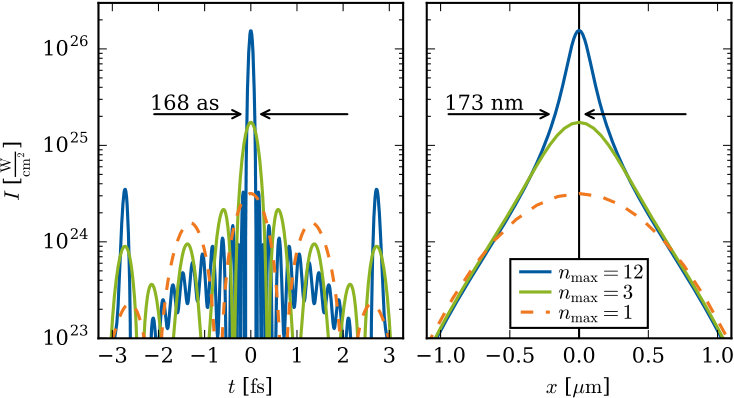 Figure 1
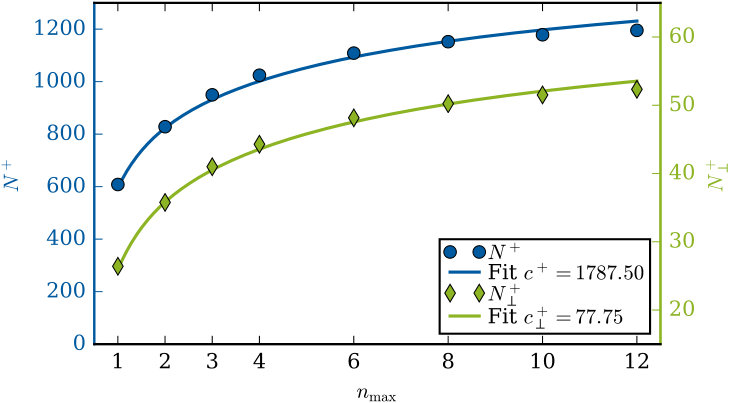 Figure 2
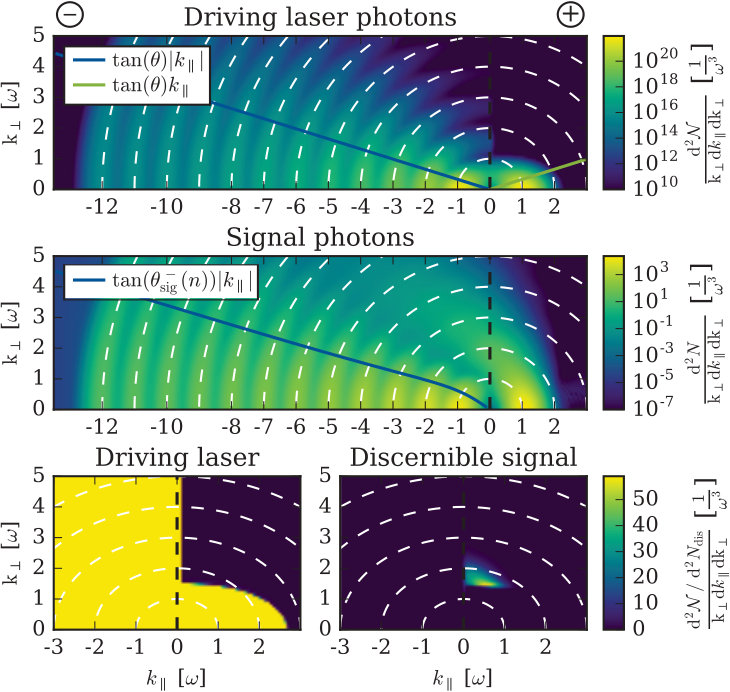 Figure 3
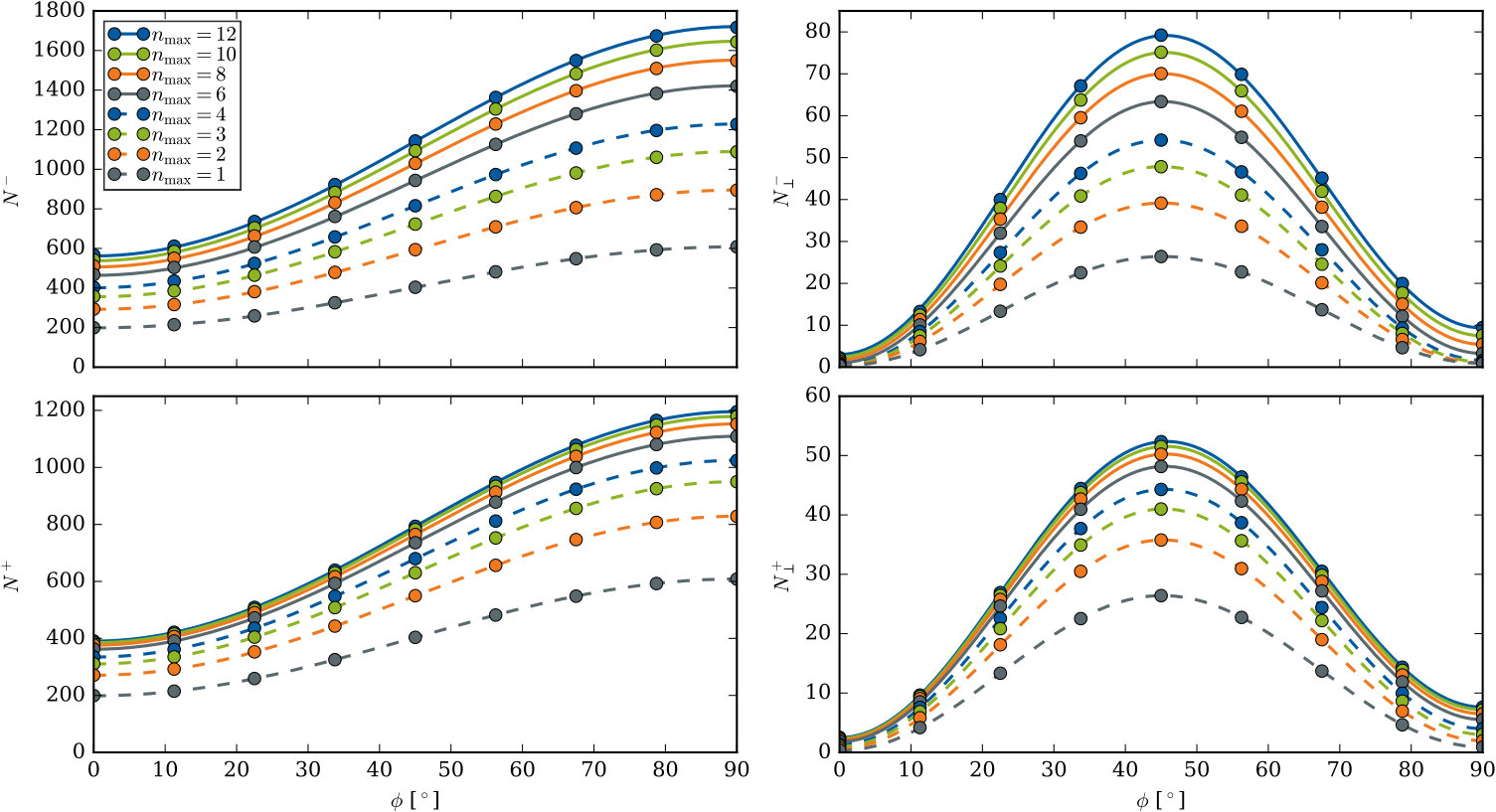 Figure 4
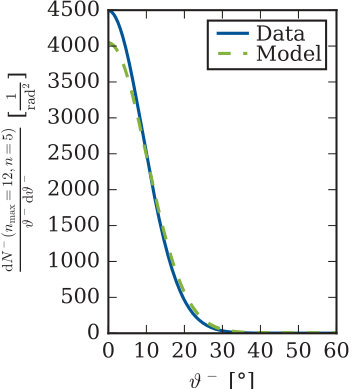 Figure 5
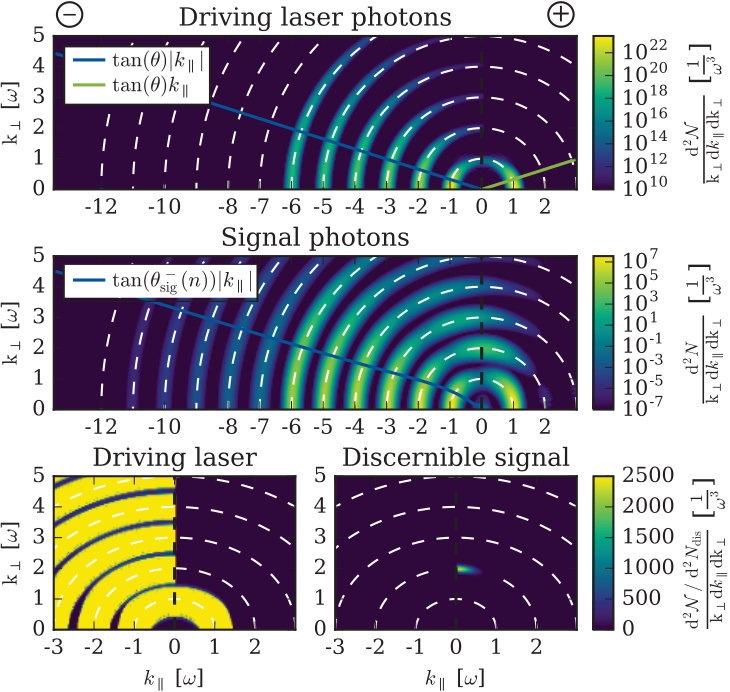 Figure 6
Peer Reviews
No public reviews on file for this paper yet. If you reviewed it on a platform where reviews are public (OpenReview, ICLR, NeurIPS, ICML), you can paste yours below so the community can read it here.
Videos
No videos yet. Explain this paper in a talk, walkthrough, or lecture? Add one.
Boosting quantum vacuum signatures by coherent harmonic focusing
Felix Karbstein
Helmholtz-Institut Jena, Fröbelstieg 3, 07743 Jena, Germany
Theoretisch-Physikalisches Institut, Abbe Center of Photonics, Friedrich-Schiller-Universität Jena, Max-Wien-Platz 1, 07743 Jena, Germany
Alexander Blinne
Helmholtz-Institut Jena, Fröbelstieg 3, 07743 Jena, Germany
Holger Gies
Helmholtz-Institut Jena, Fröbelstieg 3, 07743 Jena, Germany
Theoretisch-Physikalisches Institut, Abbe Center of Photonics, Friedrich-Schiller-Universität Jena, Max-Wien-Platz 1, 07743 Jena, Germany
Matt Zepf
Helmholtz-Institut Jena, Fröbelstieg 3, 07743 Jena, Germany
Institut für Optik und Quantenelektronik, Abbe Center of Photonics, Friedrich-Schiller-Universität Jena, Max-Wien-Platz 1, 07743 Jena, Germany
Abstract
We show that coherent harmonic focusing provides an efficient mechanism to boost all-optical signatures of quantum vacuum nonlinearity in the collision of high-intensity laser fields, thereby offering a promising route to their first experimental detection. Assuming two laser pulses of given parameters at our disposal, we demonstrate a substantial increase of the number of signal photons measurable in experiments where one of the pulses undergoes coherent harmonic focusing before it collides with the fundamental-frequency pulse. Imposing a quantitative criterion to discern the signal photons from the background of the driving laser photons and accounting for the finite purity of polarization filtering, we find that signal photons arising from inelastic scattering processes constitute a promising signature. By contrast, quasi-elastic contributions which are conventionally assumed to form the most prospective signal remain background dominated. Our findings may result in a paradigm shift concerning which photonic signatures of quantum vacuum nonlinearity are accessible in experiment.
Introduction
The quantum vacuum has remarkable properties. It is not trivial and inert, but amounts to a complex state whose properties are fully determined by quantum fluctuations. As these fluctuations comprise all existing particles, the quantum vacuum even constitutes a portal to new physics beyond the Standard Model of particle physics. To obtain a measurable response, the quantum vacuum has to be probed by some external stimulus. A powerful means is provided by strong macroscopic electromagnetic fields which couple directly to the charged particle sector. Within the Standard Model, the leading effect arises from the effective coupling of the prescribed electric and magnetic fields via a virtual electron-positron pair. This process is governed by quantum electrodynamics (QED) and supplements Maxwell’s classical theory in vacuum with effective nonlinear couplings of the electromagnetic fields Euler:1935zz ; Heisenberg:1935qt ; Weisskopf ; Schwinger:1951nm ; see also Dittrich:2000zu ; Dunne:2004nc ; Marklund:2008gj ; Dunne:2008kc ; Heinzl:2008an ; DiPiazza:2011tq ; Dunne:2012vv ; Battesti:2012hf ; King:2015tba ; Karbstein:2016hlj ; Battesti:2018bgc .
Up to now, the corresponding deviations have never been directly observed for macroscopically controlled fields. This is because the effective self-interactions are parametrically suppressed by powers of and , with critical electric (magnetic) field (). The strongest macroscopic fields available in the laboratory are delivered by high-intensity lasers reaching peak fields and . While these fields clearly fulfill , , they appear to be sufficient to facilitate a first detection of QED vacuum signatures. The basic idea is to collide high-intensity laser pulses and to look for vacuum-fluctuation-induced modifications of their properties, encoded in signal photons whose kinematics or polarization properties differ from the laser photons driving the effect, thereby allowing for a clear signal-to-background separation. For recent estimates of the prospective numbers of signal photons attainable in laser pulse collisions, cf., e.g., Refs. Lundstrom:2005za ; Lundin:2006wu ; Tommasini:2009nh ; Tommasini:2010fb ; King:2013am ; King:2012aw ; Gies:2017ygp ; Gies:2017ezf ; King:2018wtn ; Blinne:2018nbd ; Aboushelbaya:2019ncg . The smallness of the signal makes its detection challenging, even at dedicated high-intensity laser facilities such as CILEX CILEX , CoReLS CoReLS , ELI ELI and SG-II SG-II .
In this letter, we show that the number of attainable and, in particular, discernible signal photons can be increased significantly for a given laser pulse energy put into the interaction volume. To this end, we rely on the mechanism of coherent harmonic focusing (CHF), pioneered by Refs. Gordienko:2004 ; Gordienko:2005zz . Our quantitative analysis relies on the novel numerical approach Blinne:2018nbd allowing for first-principles simulations of photonic signatures of vacuum nonlinearities. We also provide analytical estimates based on a description of the driving laser fields as pulsed paraxial beams; cf. Ref. Karbstein:2018omb .
References Gordienko:2004 ; Gordienko:2005zz demonstrated that CHF can pave the way towards extreme intensities, thereby allowing for unprecedented experimental studies of nonperturbative electron-positron pair production in a highly localized strong field region; cf. also Ref. Gonoskov:2013ada . They showed that the reflection of a relativistically intense laser pulse of wavelength from the oscillating boundary of an overdense plasma produces a harmonic spectrum with the spectrum intensity scaling as , where labels the th harmonic Gordienko:2004 . These harmonics can be focused coherently down to a spot size of about using a concave plasma surface of appropriate curvature Gordienko:2005zz . While an improved description of the process resulted in a slight revision of the power as Baeva:2006 , in this letter we stick to the original prediction of Gordienko:2004 .
As a concrete example, we employ CHF to boost photonic signatures of QED vacuum nonlinearity in the head-on collision of two linearly polarized high-intensity laser fields of given parameters. For definiteness, we assume the initial laser pulses to agree in both wavelength and pulse duration . One comprises an energy and is focused to a beam waist of . The other is reflected at a concave overdense plasma surface, effectively partitioning the laser pulse energy – which after the reflection process is also assumed to be given by – as into the individual harmonics. Here, is the energy put into the th harmonic, is the harmonic cutoff and is a generalized harmonic number. Experimentally, it has been shown that second harmonic generation achieves efficiencies of for intensities approaching [46]. These efficiencies are in good agreement with the scaling assumed for the CHF efficiency for the n=2 channel and indicate the principle feasibility of implementing CHF scenarios with low harmonics in experiments.
The plasma surface focuses the th harmonic to a waist of , such that the electric peak field amplitude of the th harmonic scales as . This CHF pulse collides head-on with the fundamental-frequency pulse at zero impact parameter and temporal offset in the focus. For the impact of spatio-temporal offsets on photonic quantum vacuum signatures, cf., e.g., Refs. King:2012aw ; Dinu:2014tsa ; Karbstein:2016lby ; Karbstein:2018omb .
Formalism
The amplitude for emission of a single signal photon (wave vector , polarization ) from the electromagnetized QED vacuum reads Karbstein:2014fva
[TABLE]
Here, is the single signal photon state and encodes the vacuum-fluctuation-mediated interactions of the operator-valued signal photon field Karbstein:2014fva with the driving macroscopic electromagnetic field treated as a classical background Gies:2016yaa . For fields of frequencies , these effective interactions are governed by the one-loop Heisenberg-Euler effective Lagrangian Heisenberg:1935qt , implying
[TABLE]
where sources the signal photons. The above validity criterion is met for present and near-future high-intensity lasers of optical to x-ray frequencies.
In the Heaviside-Lorentz System and units , the leading contribution of reads Euler:1935zz ; Heisenberg:1935qt
[TABLE]
Equation (3) is valid for , and should allow for the reliable study of all-optical signatures of QED vacuum nonlinearity driven by high-intensity lasers with an accuracy on the level Blinne:2018nbd .
Upon insertion of Eq. (2) into Eq. (1), the signal photon emission amplitude can be expressed as
[TABLE]
where , fulfilling and , is the polarization vector of the signal photon state . Here, we label the two polarizations transverse to by . Without loss of generality, we choose the polarization basis such that the polarization vector always fulfills , i.e., is perpendicular to both and a given constant reference vector . Hence, spans the polarization mode polarized perpendicularly to , and is the vector completing the orthogonal basis.
With these definitions, Eq. (4) yields
[TABLE]
with and . The polarization and magnetization of the quantum vacuum are defined as Berestetskii
[TABLE]
Finally, the differential number of signal photons of polarization is related to the modulus square of Eq. (5) and reads
[TABLE]
For a polarization insensitive measurement we have .
Field configuration
To describe the electromagnetic fields of a focused laser pulse (wavelength , energy , duration , waist ), we employ the spectral pulse model Waters:2017tgl , detailed in Sec. III D 2 of Ref. Blinne:2018nbd . These fields fulfill Maxwell’s equations in vacuum exactly and are conveniently represented in terms of a complex vector potential in radiation gauge,
[TABLE]
with spectral amplitudes encoding the spatio-temporal field structure. The associated real-valued electric (magnetic) field is given by (). For a laser pulse propagating in direction, polarized along in the focus at , the spectral amplitudes are given by ,
[TABLE]
Here, denotes the Heaviside function, the laser photon energy, the momentum component along , and . The amplitudes (9) have been constructed such that the zeroth-order paraxial Gaussian beam is reproduced for weak focusing and long pulse durations Waters:2017tgl ; Karbstein:2017jgh .
To model our scenario of a fundamental-frequency laser pulse (propagation direction , polarization in the focus) colliding head-on with a CHF pulse (polarization in the focus) containing harmonics, we choose the spectral amplitudes in Eq. (8) as
[TABLE]
Subsequently, we refer to the laser pulse propagating in direction as “” pulse; the ‘” (“”) pulse is the fundamental-frequency (CHF) pulse.
The coherent superposition of the diffraction limited harmonics to form the CHF pulse results in a narrow, strongly peaked pulse shape of effective waist Gordienko:2005zz . For large values of , the effective pulse duration in the focus becomes essentially independent of the envelope of the contributing modes. Instead, it is also determined by the wavelength and given by Gordienko:2005zz ; cf. Fig. 1.
Results
In the remainder, we use the following parameters: , and . Both pulses are linearly polarized; the angle between their polarization vectors in the focus is . The value of is chosen mainly for numerical convenience, allowing us to scale up to . Such small pulse durations were so far only achieved at sub-Joule pulse energies Laszlo:2017 ; state-of-the-art high-intensity laser pulses feature durations ELI . We have explicitly confirmed for and ELI-NP ELI parameters (, , ) that the studied effects persist for longer pulse durations; cf. the Supplementary Material.
As will be demonstrated below, to a very good approximation the signal photons emitted into the “” half-space, characterized by wave vectors fulfilling , can be interpreted as arising from the “” pulse and being quasi-elastically scattered off the “” pulse. Manifestly inelastic scattering processes characterized by an energy transfer of are suppressed in comparison to the elastic contributions Karbstein:2015xra ; Karbstein:2014fva ; Gies:2017ygp . The study of photon scattering in the head-on collision of two linearly polarized paraxial beams Karbstein:2019bhp suggests that an angle of between the polarization vectors maximizes the signal photon number attainable in a polarization insensitive measurement. By contrast, the number of signal photons scattered into a perpendicularly polarized () mode should become maximum for an angle of . We have explicitly confirmed this behavior in our simulations (see Fig. 1 in the Supplementary Material) and stick to these optimal choices of when providing results for and in the remainder.
Aiming at the analysis of the polarization-flipped signal photons propagating into the “” half-space, we choose . This immediately implies that spans the mode polarized perpendicularly to , respectively, and . At the same time, this choice ensures that none of the driving laser photons are perpendicularly polarized; cf. Eq. (9).
Figure 2 depicts the attainable numbers of signal photons and as a function of .
The simulation results are remarkably well described by
[TABLE]
with polarization dependent numerical constants . Equation (11) follows from Eqs. (7) and (10) of Ref. Karbstein:2018omb upon identification of the probe (pump) with the fundamental frequency (CHF) pulse and assuming as well as . It only accounts for quasi-elastically scattered signal photons. The CHF peak field energy per spot size is determined as . Analytical estimates for the angular decay of as well as the radial divergences of the signal photons emitted into the “” space can be derived along the same lines; see the Supplementary Material.
Equation (11) implies that CHF can increase at most by a factor of
[TABLE]
relative to the collision of two fundamental-frequency pulses. Asymptotically, the increase of the CHF peak field with is compensated by a decrease of the effective focusing volume. The ratio of the coefficients and extracted in Fig. 2 is , and thus roughly agrees with that found for counter-propagating paraxial beams Karbstein:2019bhp .
Subsequently, we focus on simulation data for the signal photon spectra. In Fig. 3 we highlight the CHF case with . For a simple and fair assessment of the benefits of CHF, we compare the results of this CHF scenario with those for the collision of two fundamental frequency pulses of the same energy (). To assess the separability of the signal photons from the background, we also analyze the spectrum of the driving laser photons.
The integrated numbers of laser photons inferred from our simulation are
[TABLE]
constituting the background from which the signal has to be separated. These results are in good agreement with the analytical estimates obtained with Eq. (8) in the Supplementary Material.
We call the differential number of signal photons discernible from the background if it fulfills the discernibility criterion . Summing over the two transverse polarizations and integrating over the spectral regions where this criterion holds, we obtain
[TABLE]
discernible signal photons per shot at . This implies that essentially none of the quasi-elastically scattered signal photons, which dominate the total numbers of signal photons (cf. Eq. (12) and Fig. 2), can be discerned from the background of the driving laser photons. Microscopically, the discernible signal photons at appear to arise from the merging of two counter-propagating fundamental-frequency laser photons in the localized strong field of the CHF pulse. For an analogous scenario with ELI-NP ELI laser parameters and , we obtain at ; see Fig. 3 in the Supplementary Material.
Specializing the above criterion to the polarization mode, we obtain
[TABLE]
for ,
amounting to the polarization purity of an ideal polarization filter. These signal photons are predominantly emitted in “” forward direction at . This can be explained by the fact that the driving laser photons have zero overlap with the mode, allowing for an essentially background free measurement of the quasi-elastic scattering signal. The gain of achieved by CHF with relative to observed here is fully compatible with the gain of derived for the quasi-elastically scattered signal photons in Eq. (6) of the Supplementary Material. The signal photons constituting do in general not form a subset of , because both sides of the discernibility criterion are inherently polarization sensitive. For a realistic polarization filter with the discernibility criterion reads . In this case, the gain achieved by CHF is substantially larger and the number of discernible signal photons using an ambitious polarization purity becomes
[TABLE]
for .
These signal photons again feature an energy of . The corresponding spectra qualitatively agree with those depicted in Fig. 3 upon identifying and .
The results for and for , which are – at least in principle – accessible in experiment, clearly underpin the substantial enhancement of several orders of magnitude in the numbers of discernible signal photons achieved by CHF. It is interesting to note that such a dramatic enhancement could not be expected from the comparably moderate increase of the total numbers of signal photons (cf. Eq. (12) and Fig. 2) as well as the results for based upon the existence of a perfect polarization filter with . In this sense, our results exemplify that the criterion of the principle possibility of an experimental measurement of the effect based on real-world limitations, like a non-zero polarization purity, may significantly impact the assessment if the implementation of an advanced scheme, such as CHF, in experiment is worthwhile or not.
Our results exemplify that the assessment of an advanced scheme, such as CHF, necessarily requires the consideration of real-world limitations. In the present case, the mere existence of a rather small polarization purity leads to a decisive change of perspective on the relevance of the CHF scheme.
Conclusions
We have demonstrated in an idealized setup that CHF can substantially increase the number of discernible signal photons in the collision of high-intensity laser pulses for a given energy put into the interaction volume. We are confident that our findings will stimulate many further theoretical ideas and proposals as well as dedicated experimental campaigns aiming at the first verification of quantum vacuum nonlinearity using CHF and replications based on conventional higher-harmonic generation techniques.
Acknowledgements.
This work has been funded by the Deutsche Forschungsgemeinschaft (DFG) under Grant Nos. 416611371; 416607684; 416702141; 416708866 within the Research Unit FOR2783/1.
Supplementary Material
Here we provide some additional material underpinning the arguments given in the main text. Figure 4 confirms that the total number of signal photons attainable in a polarization insensitive measurement and the number of signal photons scattered into a perpendicularly polarized mode reach their maxima for different choices of the relative angle between the polarization vectors of the driving laser pulses in the focus . As detailed in the main text, considerations based on an analysis of the head-on collision of two paraxial laser fields predict () to be at a maximum for (). In the angle interval considered in Fig. 4, the corresponding angle is () for (). Our simulation data presented in Fig. 4 are perfectly compatible with these predictions.
The accurate description of by Eq. (12) in the main body of this letter suggests that Eq. (4) of Ref. Karbstein:2018omb can serve as an analytical estimate for the angular decay of . Sticking to the same assumptions, we obtain
[TABLE]
where is the polar angle measured relative to the forward beam axis of the “” pulse. Equation (1) fully characterized by , and the radial divergence of the driving laser pulses . For diffraction limited driving beams as considered here, we have . The corresponding estimate for the radial divergence of the signal photons emitted into the “” half-space is
[TABLE]
Note that generically surpasses the radial divergence of the “” laser pulse. Particularly for large values of the result of Eq. (1), and thus also Eq. (2), violate the condition of entering their derivation in Ref. Karbstein:2018omb . Nevertheless, Eq. (2) indicates that the signal photons originating from the “” pulse being quasi-elastically scattered off the strongly peaked “” pulse are distributed in a much wider angular regime than the divergence of the driving laser pulses.
Simultaneously, photons of each of the modes constituting the “” pulse experience quasi-elastic scattering off the “” pulse. The analytical estimate for their angular decay is
[TABLE]
where is the polar angle measured relative to the forward beam axis of the “” pulse. This expression also follows from Eq. (4) of Ref. Karbstein:2018omb , taking into account the invariance of our collision scenario under relabeling for . From Eq. (3) we infer
[TABLE]
such that the signal photon contributions of higher modes are predominantly scattered into the forward cone of the “” pulse. This result is in line with the assumption of entering its derivation Karbstein:2018omb .
Figure 5 exemplifies the angular decay of the signal photons as inferred from our simulation in comparison to the analytical estimate (3). The corresponding curves are in good agreement.
For the total number of signal photons emitted in “” direction, Eq. (3) gives rise to the scaling
[TABLE]
Taking into account Eq. (11) in the main body of this letter as well as , we obtain
[TABLE]
for the total number of attainable signal photons. Equation (6) in particular implies .
For completeness, we also provide an analytical estimate for the far-field angular decay of the driving laser photons in the th mode. Resorting to a paraxial beam model, we obtain Karbstein:2018omb
[TABLE]
For the fundamental-frequency “” pulse we have . On the other hand, the “” pulse consists of modes, i.e., . The associated laser photon numbers are
[TABLE]
Finally, in Fig. 6 we depict the spectra of the driving laser photons and signal photons attainable in a polarization insensitive measurement for the same scenario as discussed in the main text, but assuming ELI-NP ELI parameters (, , ) for the driving laser fields and . This results in discernible signal photons attainable in a polarization insensitive measurement. Figure 6 is qualitatively very similar to Fig. 3 in the main body of this letter. However, in the figure displayed here the frequency spread of both the various modes constituting the driving laser pulses and the signal photons is substantially smaller. The reason for this is the larger pulse envelope for the ELI-NP scenario, which is a factor of larger than the one considered in the main body of this letter.
The reference list from the paper itself. Each links out to its DOI / PubMed record.
- 1(1) H. Euler and B. Kockel, Naturwiss. 23 , 246 (1935).
- 2(2) W. Heisenberg and H. Euler, Z. Phys. 98 , 714 (1936), an English translation is available at [physics/0605038].
- 3(3) V. Weisskopf, Kong. Dans. Vid. Selsk., Mat.-fys. Medd. XIV , 6 (1936).
- 4(4) J. S. Schwinger, Phys. Rev. 82 , 664 (1951).
- 5(5) W. Dittrich and H. Gies, Springer Tracts Mod. Phys. 166 , 1 (2000).
- 6(6) G. V. Dunne, In *Shifman, M. (ed.) et al. : From fields to strings, vol. 1* 445-522 [hep-th/0406216].
- 7(7) M. Marklund and J. Lundin, Eur. Phys. J. D 55 , 319 (2009) [ar Xiv:0812.3087 [hep-th]].
- 8(8) G. V. Dunne, Eur. Phys. J. D 55 , 327 (2009) [ar Xiv:0812.3163 [hep-th]].