Frequency domain model of $f$-mode dynamic tides in gravitational waveforms from compact binary inspirals
Patricia Schmidt, Tanja Hinderer

TL;DR
This paper introduces a simple, efficient frequency-domain gravitational wave phase model capturing neutron star matter effects via $f$-mode dynamic tides, aiding in extracting neutron star properties from GW data.
Contribution
The paper develops the first approximate frequency-domain $f$-mode tidal GW phase model that explicitly relates to neutron star matter parameters, improving computational efficiency and interpretability.
Findings
Model agrees with dynamical tides up to 1 kHz.
Explicit dependence on tidal deformability and $f$-mode frequency.
Facilitates future measurements of neutron star properties.
Abstract
The recent detection of gravitational waves (GWs) from the neutron star binary inspiral GW170817 has opened a unique avenue to probe matter and fundamental interactions in previously unexplored regimes. Extracting information on neutron star matter from the observed GWs requires robust and computationally efficient theoretical waveform models. We develop an approximate frequency-domain GW phase model of a main GW signature of matter: dynamic tides associated with the neutron stars' fundamental oscillation modes (-modes). We focus on nonspinning objects on circular orbits and demonstrate that, despite its mathematical simplicity, the new "-mode tidal" (fmtidal) model is in good agreement with the effective-one-body dynamical tides model up to GW frequencies of kHz and gives physical meaning to part of the phenomenology captured in tidal models tuned to…
Click any figure to enlarge with its caption.
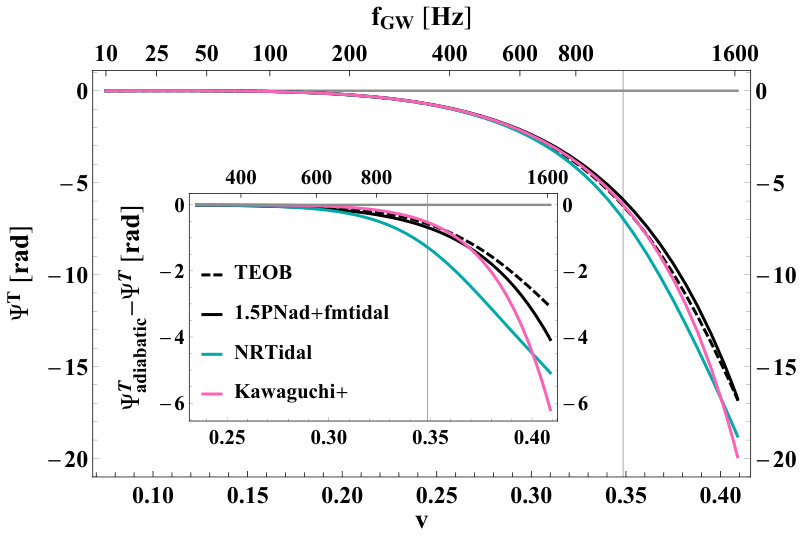 Figure 1
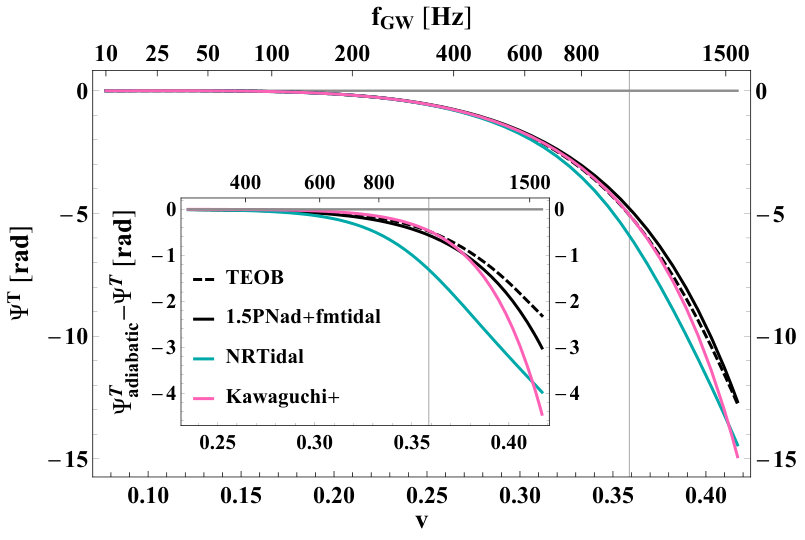 Figure 2
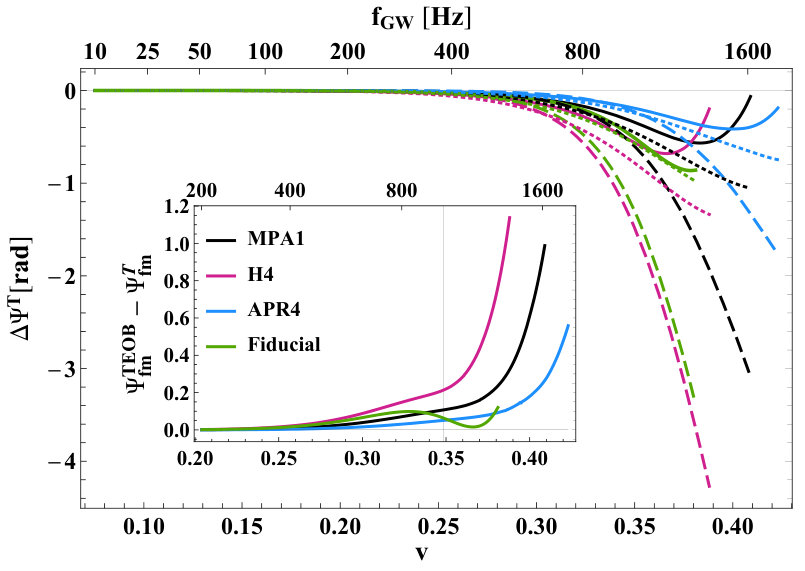 Figure 3
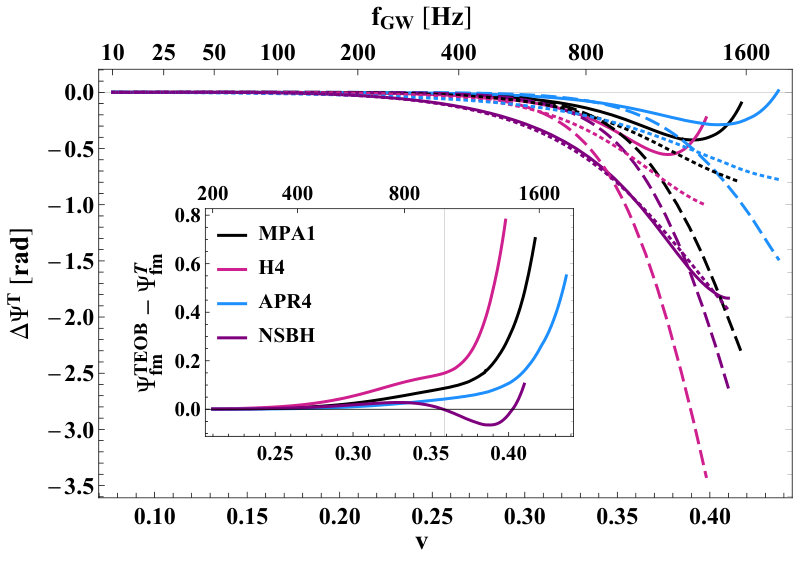 Figure 4
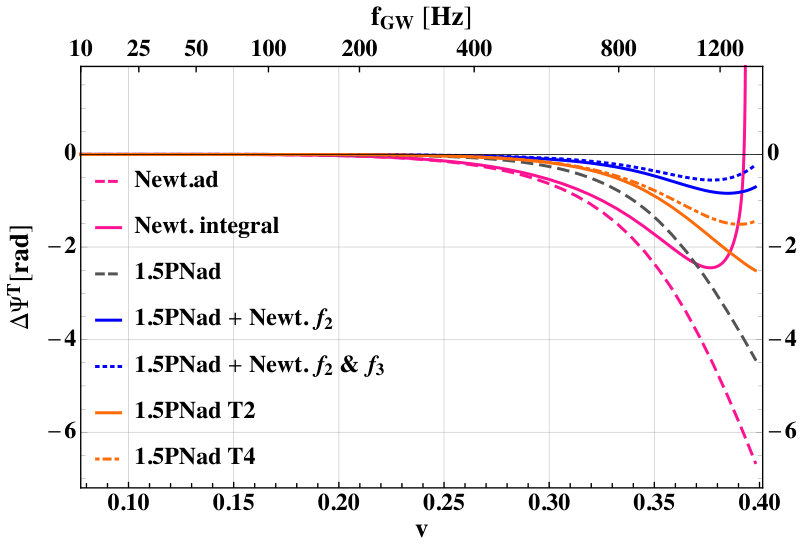 Figure 2
Peer Reviews
No public reviews on file for this paper yet. If you reviewed it on a platform where reviews are public (OpenReview, ICLR, NeurIPS, ICML), you can paste yours below so the community can read it here.
Videos
No videos yet. Explain this paper in a talk, walkthrough, or lecture? Add one.
Frequency domain model of -mode dynamic tides in gravitational waveforms from compact binary inspirals
Patricia Schmidt
School of Physics and Astronomy and Institute for Gravitational Wave Astronomy, University of Birmingham, Edgbaston, Birmingham, B15 9TT, United Kingdom
Tanja Hinderer
GRAPPA, Anton Pannekoek Institute for Astronomy and Institute of High-Energy Physics, University of Amsterdam, Science Park 904, 1098 XH Amsterdam, The Netherlands
Delta Institute for Theoretical Physics, Science Park 904, 1090 GL Amsterdam, The Netherlands
Abstract
The recent detection of gravitational waves (GWs) from the neutron star binary inspiral GW170817 has opened a unique avenue to probe matter and fundamental interactions in previously unexplored regimes. Extracting information on neutron star matter from the observed GWs requires robust and computationally efficient theoretical waveform models. We develop an approximate frequency-domain GW phase model of a main GW signature of matter: dynamic tides associated with the neutron stars’ fundamental oscillation modes (-modes). We focus on nonspinning objects on circular orbits and demonstrate that, despite its mathematical simplicity, the new “-mode tidal” (fmtidal) model is in good agreement with the effective-one-body dynamical tides model up to GW frequencies of kHz and gives physical meaning to part of the phenomenology captured in tidal models tuned to numerical relativity. The advantages of the fmtidal model are that it makes explicit the dependence of the GW phasing on the characteristic equation-of-state parameters, i.e., tidal deformabilities and -mode frequencies; it is computationally efficient; and it can readily be added to any frequency-domain baseline waveform. The fmtidal model is easily amenable to future improvements and provides the means for a first step towards independently measuring additional fundamental properties of neutron star matter beyond the tidal deformability as well as performing novel tests of general relativity from GW observations.
I Introduction
The first observation of gravitational waves (GWs) from the inspiraling neutron star (NS) binary GW170817 Abbott et al. (2017) initiated using GWs to elucidate long-standing questions in subatomic physics Lattimer and Prakash (2004); Potekhin (2010); Baym et al. (2018). This event enabled constraining, for the first time, the equation of state (EoS) of NS matter from tidal effects in the GW signal Abbott et al. (2019a, 2018). Extracting the information on the fundamental properties of NS matter from the GW data requires robust theoretical waveform models that are accurate over a wide range of parameters, computationally efficient, and include all relevant physical effects.
The presence of matter gives rise to a number of different GW signatures compared to signals from black hole (BH) binaries (see e.g. Rezzolla et al. (2018); Barack et al. (2019)). Here, we focus on a subset of tidal effects during a binary inspiral that are associated with the response of matter to the spacetime curvature sourced by the companion. Specifically, we consider the GW signature from the tidal excitation of the objects’ fundamental oscillation modes (-modes), which is characterized by two parameters for each th multipolar mode: the tidal deformability Flanagan and Hinderer (2008); Hinderer (2008); Binnington and Poisson (2009); Damour and Nagar (2009) and the angular fundamental-mode frequency111Oscillation modes are characterized by three integers , where denotes the number of radial nodes in the mode function and is the azimuthal integer. In the nonspinning case, the mode frequency is independent of , and for the -modes , hence our notation . Kokkotas and Schmidt (1999). In general relativity and for a range of proposed EoS models, the parameters and are related by approximately universal relations (UR) Chan et al. (2014). Measuring both parameters simultaneously can thus provide important insights into the fundamental properties of matter and represents a first step towards GW asteroseismology of NSs, where potential future measurements of tidally excited NS oscillation modes could enable discerning details of the complex physics of their interiors Andersson and Kokkotas (1998).
Tidal effects associated with the -modes have previously been included in gravitational waveform models in different ways. Analytical models have primarily focused on adiabatic tidal effects Flanagan and Hinderer (2008); Damour and Nagar (2010); Bini et al. (2012); Vines et al. (2011); Damour et al. (2012); Bini and Damour (2014); Bernuzzi et al. (2015a); Nagar et al. (2018) describing the regime where is much higher than any other frequency in the system. Finite- effects, known as dynamical tides, become most important in the late inspiral, when -th multiples of the orbital frequency characterizing the tidal forcing frequency become comparable to the -mode frequency, thus approaching resonance. Although the resonance itself is often at relatively high frequencies ( kHz), the -mode signatures in the GW phase start to accumulate long before the resonance Hinderer et al. (2016); Steinhoff et al. (2016); Flanagan and Hinderer (2008); Hinderer et al. (2010). These effects have been considered in Newtonian gravity Shibata (1994); Ho and Lai (1999); Flanagan and Hinderer (2008); Lai (1994); Kokkotas and Schaefer (1995); Reisenegger and Goldreich (1994) and within the time-domain tidal effective-one-body (EOB) model of Refs. Hinderer et al. (2016); Steinhoff et al. (2016), hereafter TEOB. EOB models require solving for the time evolution of the binary inspiral to obtain the GW signal, which is computationally expensive and makes the dependence on parameters less transparent. More efficient waveform models are those that directly provide a description of the GWs in the frequency domain, either from phenomenological models Ajith et al. (2007, 2008, 2011); Santamaria et al. (2010); Hannam et al. (2014); Khan et al. (2016), reduced-order models for EOB Field et al. (2014); Puerrer (2016); Bohé et al. (2017); Lackey et al. (2017), or surrogates of NR waveforms Blackman et al. (2017a, b). Frequency-domain models calibrated to numerical-relativity (NR) simulations in the tidal sector Lackey et al. (2017); Dietrich et al. (2017); Kawaguchi et al. (2018); Dietrich et al. (2019) phenomenologically describe an enhancement of matter effects compared to predictions from adiabatic tidal models; however, these models depend only on the tidal deformability parameters and are restricted in their parameter space coverage, and hence are of limited applicability.
In this paper we aim to advance the physics content of frequency-domain tidal models and thus enhance the scope of science that can be done with GW observations by developing an approximate analytic model of Newtonian dynamical -mode tides for efficient GW data analysis. We demonstrate that for a nonspinning quasicircular inspiral the dynamical -mode effects can be captured by a simple, closed-form expression that adds linearly to the known adiabatic tidal effects in the phase Flanagan and Hinderer (2008); Vines et al. (2011); Damour et al. (2012). We show that our simple model, which we refer to as “-mode tidal” (fmtidal), agrees well with the TEOB model for a range of EoSs. We further compare to two NR-calibrated models Dietrich et al. (2017); Kawaguchi et al. (2018); Dietrich et al. (2019) and find agreement with Kawaguchi et al. (2018) over most of the inspiral, indicating that part of the tidal enhancement over the adiabatic models that is captured phenomenologically by NR-calibrated terms is consistent with dynamical -mode tides. This is important for determining the choice of parameters in GW models and is expected to enhance the robustness of efficient models over a wider range in parameter space, potentially helping us to mitigate systematic errors that will become significant as GW detectors improve in sensitivity Samajdar and Dietrich (2018); Abbott et al. (2019a). Moreover, accounting for more realistic physics such as the -mode will render efficient GW models applicable to more general contexts and enable novel tests of the fundamental physics of NSs, exotic objects, and alternative theories of gravity.
The fmtidal model derived in this paper can be directly included in any frequency domain point-particle baseline model for a binary inspiral. Other matter effects such as spin-induced multipoles, gravitomagnetic tides, spin-tidal interactions, and tidal heating are already known and enter separately into these models Jiménez Forteza et al. (2018); Banihashemi and Vines (2018); Krishnendu et al. (2017); Poisson (1998); Isoyama and Nakano (2018); Abdelsalhin et al. (2018); Landry (2018). The fmtidal model can easily be improved with inputs from NR for the behavior at higher frequencies, where other physics may become important. We emphasize that fmtidal is specialized to nonspinning binaries on circular orbits where the -mode resonance occurs near the end of the inspiral. We leave to future work the inclusion of relativistic corrections Steinhoff et al. (2016, ) and spin effects on the -mode Ho and Lai (1999); Doneva et al. (2013); Steinhoff et al. . A Newtonian estimate Ho and Lai (1999) indicates that spin-induced shifts of the -mode resonance could change the orbital phase by cycles in extreme cases. Relativistic corrections are expected to lead to a net enhancement of the -mode effect and include frame-dragging and redshift-induced effective shifts of the resonance, an increased tidal field, and reduced GW dissipation; once theoretical results Steinhoff et al. for these corrections are available they can be used to refine the fmtidal model. Future work will also need to consider passage through resonance that is required for generalizing to other NS modes beyond the -modes Nollert (1999) and to eccentric orbits which lead to a striking -mode effect Gold et al. (2012); Chirenti et al. (2017); Yang et al. (2018).
We note work on a similar topic, containing complementary methods and results, recently appeared Andersson and Pnigouras (2019).
Throughout this paper we set .
II The fmtidal model
We focus on the tidal excitation of a NS’s fundamental or -modes of quadrupolar () and octopolar () order in a spherical-harmonic decomposition for nonspinning stars. We treat the NS itself as fully relativistic but compute tidal interactions in the binary in Newtonian gravity. We emphasize that for the nonspinning binaries considered here the relativistic corrections from the redshift and frame-dragging effects nearly cancel Steinhoff et al. (2016), making the Newtonian tidal excitation of -modes considered here a reasonable approximation. For each -th multipole there are, in general, -modes that become resonantly excited when , where is the binary’s orbital frequency.
To compute the dynamical -mode effects in the GW phasing, we follow Ref. Flanagan and Hinderer (2008): From the effective action describing a binary system comprising two finite-sized objects on circular orbits, we compute equilibrium solutions for the -mode degrees of freedom driven below their resonance frequency, calculate the energy of the system, and compute the power radiated in GWs from the quadrupole formula. Using the stationary phase approximation (SPA) the frequency domain GW signal can be written as Finn and Chernoff (1993); Cutler and Flanagan (1994) , where is the amplitude, the phasing for point masses, and the tidal phase contribution. The leading-order -mode tidal phase correction is given in terms of the definite integral in Eq. (9) of Ref. Flanagan and Hinderer (2008) for the quadrupolar -modes; for the octopolar -modes we obtain
[TABLE]
Here, the labels denote the two bodies, , is the total mass, the reduced mass, and .
The integrals in Eq. (1) and Eq. (9) of Ref. Flanagan and Hinderer (2008) diverge at the resonances, with the lowest-frequency resonance occurring when . However, this divergence is only an artifact of using preresonance solutions for the dynamical multipole moments when deriving the expressions for the GW phase, and it can be avoided by accounting for the GW-driven evolution through the resonance as in Hinderer et al. (2016); Steinhoff et al. (2016). The TEOB description of the near-resonance effects based on multiscale approximations involves Fresnel integrals that are nonlocal in time complicating the GW computation, while the simpler option of performing a low-order Taylor series expansion near the resonance fails to capture the detailed behavior Hinderer et al. (2010); Steinhoff et al. (2016).
Here, we instead apply the Padé approximation Padé (1892); Frobenius (1881) around the adiabatic limit to model the dominant dynamical -mode tidal effects in the GW phase. Padé approximations are commonly used to improve the divergent behavior of Taylor expansions and to derive more robust post-Newtonian (PN) waveform approximants (see e.g. Damour et al. (2001, 2000)). To determine the most suitable order of the Padé approximant we compare to the GW phase from the TEOB model. We find that for the -mode the -Padé approximant of the integrand provides an accurate yet simple approximation for a range of EoS and mass ratios, and for the -integral the -Padé approximation yields the best agreement with TEOB. This leads to explicit results for the finite -mode-frequency effects comprising the fmtidal model given by
[TABLE]
where , , , and . The fmtidal model for the -dependent contribution can readily be added to any frequency-domain adiabatic tidal model to complete the description of the -mode effects.
III Model accuracy
First, we benchmark the fmtidal model against results from the TEOB model Barausse et al. (2009); Barausse and Buonanno (2010, 2011); Taracchini et al. (2014, 2012); Bohé et al. (2017); Hinderer et al. (2016). Since the TEOB model is a time-domain model, we explore multiple avenues to obtain the frequency-domain phase: (i) computing the Fourier phase via the fast Fourier transform (FFT) of the time-domain TEOB waveform obtained from the publicly available LIGO Algorithms Library (LAL) LIGO Scientific Collaboration, Virgo Collaboration (2018); (ii) numerically solving the differential equation for the SPA phase , where we express the right-hand side as and use the numerical results for and obtained from an EOB inspiral evolution with a Mathematica implementation described in Hinderer et al. (2016); (iii) similar to (ii) but with obtained from the EOB conservative dynamics as in Damour et al. (2012); (iv) using the general result for the SPA phase Finn and Chernoff (1993); Cutler and Flanagan (1994) , up to arbitrary constants and functions linear in , where and are obtained by reinterpolating the results for and of the GWs from an EOB evolution with the LAL code. In each case we also compute the corresponding result for a point-particle inspiral and subtract it from the full TEOB frequency-domain phase to isolate the tidal contribution. We restrict our comparisons to the inspiral epoch, terminating at the peak in GW amplitude as predicted from a fit based on NR simulations Bernuzzi et al. (2015b).
To compare two phase models, and , we fix the residual gauge freedom of an overall time and phase shift parametrized by by minimizing the quantity
[TABLE]
where the alignment interval is Hz unless stated otherwise. We compare the different Fourier methods for TEOB for several EoS and mass ratios and find that both SPA methods (ii) and (iv) reproduce the FFT phase (i) to high accuracy, with the difference oscillating about zero and maximally rad towards the very end, which is comparable to the difference we find between two versions of the TEOB point-particle baseline known as “v2” Taracchini et al. (2014, 2012) and “v4” Bohé et al. (2017). Thus, for all subsequent comparisons we will use the most direct and entirely GW-based method (iv) to compute the Fourier phase of TEOB using the more recent v4 baseline.
We now consider the impact of different modifications to the PN tidal phase. Figure 1 shows the phase differences to TEOB and is representative of a number of other cases we analyzed. As seen from the figure, using the adiabatic tidal phase complete at 1.5PN order (1.5PNad) Flanagan and Hinderer (2008); Hinderer et al. (2010); Damour et al. (2012); Vines et al. (2011) combined with the -mode term of fmtidal yields good agreement with the TEOB model (solid blue curve); including the -mode effect leads to a small further reduction in the discrepancy (dotted blue curve). For comparison, we also show the divergent solutions of the integrals from Flanagan and Hinderer (2008) and Eq. (1) w.r.t. TEOB (solid magenta curve). In addition, Fig. 1 also shows that, as expected, low-order Taylor expansions [to quadratic (T2) and quartic (T4) order in ] of the apparent resonance singularity yield a larger difference to the TEOB phase (orange curves). We also consider higher-order (albeit incomplete) adiabatic PN corrections Damour et al. (2012) to the total tidal phase and find that the differences to TEOB with the 2.5PN adiabatic baseline are similar to (or smaller than, in some cases) the 1.5PN, and that the incomplete 2PN adiabatic tidal baseline gives the largest disagreement. This trend is not surprising as full PN orders are known to increase tides, while the tail terms present in half-PN orders reduce tidal effects; the TEOB model includes all of these. For the results presented here we choose to use the theoretically complete adiabatic 1.5PN order and note that it is straightforward to change the baseline in this model.
While the Padé approximation successfully regularizes the divergent phase integral, we still expect the fmtidal model to deviate from the TEOB phase at frequencies kHz222We note, however, that current generation GW detectors have reduced sensitivity at GW frequencies kHz. as it does not include details of the resonant -mode excitation and relativistic corrections. Since the TEOB model itself is likely to become inaccurate and miss additional physics in this regime, we leave further improvements of our model to future work once new analytical and NR knowledge becomes available.
Next, we test the fmtidal model for a range of binary configurations: three different EoSs of increasing stiffness (APR4 Akmal et al. (1998), MPA1 Müther et al. (1987) and H4 Lackey et al. (2006)), and NS masses of and . We use the approximate URs to obtain the -mode frequencies Chan et al. (2014) and octopolar deformability Yagi (2014); Yagi et al. (2014). To verify that our model correctly captures the dependence on and we also include a fiducial equal-mass NS-NS case where the URs are explicitly broken – concretely, we choose and instead of as predicted by universal relations – and a BH-NS binary with masses and the MPA1 EoS for the NS. Unless stated otherwise, we consider the total post-Newtonian tidal phase used in these comparisons to be the sum of the 1.5PN adiabatic tidal phase Vines et al. (2011); Damour et al. (2012), the Newtonian adiabatic octopolar term Hinderer et al. (2010), and from Eq. (2).
The left (right) panel of Fig. 2 shows the phase differences against TEOB for the equal (unequal) mass configurations. In all cases we find that adding the fmtidal effects to the adiabatic PN phase (solid curves) improves the overall agreement with TEOB as seen from comparing to the dotted curves corresponding to the adiabatic phasing only. The inset in Fig. 2 is a direct comparison of the -mode effects alone, showing the difference between fmtidal and the purely dynamical phase contributions in TEOB computed by subtracting the adiabatic TEOB phase (adTEOB) obtained with the LAL code by specifying very high values for the -mode frequency. The fmtidal results generally underestimate the dynamic tides; however, up to a GW frequency of kHz, and even higher frequencies for softer EoSs (e.g. APR4, blue curve), fmtidal reproduces the TEOB dynamic tides to within accuracy and better for all configurations considered. The systematic underestimation of dynamic tides in fmtidal w.r.t. TEOB may be attributed to higher-order adiabatic tidal corrections incorporated in the EOB model that mix nonlinearly with the -mode effects. We stress that in all cases the dominant total phase difference comes from the adiabatic sector and not the dynamical tides model as evident from the dot-dashed curves in the main panel.
Finally, Fig. 3 compares the fmtidal model to NR-calibrated models and is representative of results for a wider range of EoSs and mass ratios that we considered. The NR-calibrated phenomenological models Dietrich et al. (2017); Kawaguchi et al. (2018) provide explicit expressions for the tidal phase in terms of the parameters but do not include an explicit dependence on the -mode frequency. The NRTidal model Dietrich et al. (2017) is known to have shortcomings for unequal-mass binaries Kawaguchi et al. (2018), and from Fig. 3, we notice its disagreement with all analytic models from GW frequencies of Hz. Thus, focusing on comparisons to the Kawaguchi+ model Kawaguchi et al. (2018) which is only valid in the regime below kHz (indicated by the vertical line), we find very good agreement for the total phase as well as the phase residual when subtracting the adiabatic TEOB phase (see inset). This indicates that a large part of the phenomenology extracted from NR simulations in this regime is consistent with the dynamical -mode effect. The advantage of the analytic fmtidal description is its explicit physics content and dependence on characteristic matter parameters, which enables us to construct more robust models and perform new tests of fundamental physics.
IV Discussion
We have developed an approximate closed-form model of dynamical -mode tidal effects in the frequency-domain phase of GWs from a nonspinning binary inspiral. This model can be directly used in state-of-the-art computationally efficient BH baseline waveforms Hannam et al. (2014); Khan et al. (2016); Puerrer (2016); Bohé et al. (2017) together with a frequency-domain adiabatic tidal model Vines et al. (2011); Damour et al. (2012), which are routinely used in GW observations. While the fmtidal model derived here is based on a number of restrictions, it is readily amenable to future improvements using analytical results for other matter signatures and inputs from NR simulations for the late inspiral and beyond. As we demonstrated, our dynamical tides model fmtidal is in good agreement with the TEOB model, which contains a more detailed description of dynamic -mode tides but is computationally expensive rendering, it inefficient for GW data analysis. Having efficient models such as fmtidal for data analysis will become especially important as the sensitivity of GW detectors increases in the coming years, and we anticipate detecting tens of NS binary inspirals per year Abbott et al. (2019b). Further, including more realistic physics in frequency-domain tidal models, such as the -mode dependence derived here, provides a useful baseline for future efforts to reduce systematic uncertainties in upcoming GW measurements.
The main impact of the fmtidal model is its explicit dependence on the different characteristic matter parameters and . This enables new measurements Pratten et al. (2019) and efficient studies for the science case and design of future GW detectors without the restrictive assumption of the validity of quasiuniversal relations between and . Relaxing the UR assumption substantially enriches the scope of science derivable from future GW observations, allows us to gain deeper insights into matter and fundamental forces in unexplored regimes by probing multiple characteristic parameters simultaneously, and enables novel tests for strong-field dynamical gravity in the presence of matter and exotic compact objects that are otherwise impossible.
Acknowledgments
We thank Geraint Pratten, Alberto Vecchio, Samaya Nissanke, David Nichols, and Tim Dietrich for useful discussions and comments on the manuscript. P. S. acknowledges NWO Veni Grant No. 680-47-460. T. H. acknowledges support from the DeltaITP and NWO Projectruimte Grant No. GW-EM NS.
The reference list from the paper itself. Each links out to its DOI / PubMed record.
- 1Abbott et al. (2017) B. P. Abbott et al. (Virgo, LIGO Scientific), Phys. Rev. Lett. 119 , 161101 (2017) , ar Xiv:1710.05832 [gr-qc] . · doi ↗
- 2Lattimer and Prakash (2004) J. M. Lattimer and M. Prakash, Science 304 , 536 (2004) , ar Xiv:astro-ph/0405262 [astro-ph] . · doi ↗
- 3Potekhin (2010) A. Y. Potekhin, Phys. Usp. 53 , 1235 (2010) , [Usp. Fiz. Nauk 180,1279(2010)], ar Xiv:1102.5735 [astro-ph.SR] . · doi ↗
- 4Baym et al. (2018) G. Baym, T. Hatsuda, T. Kojo, P. D. Powell, Y. Song, and T. Takatsuka, Rept. Prog. Phys. 81 , 056902 (2018) , ar Xiv:1707.04966 [astro-ph.HE] . · doi ↗
- 5Abbott et al. (2019 a) B. P. Abbott et al. (LIGO Scientific, Virgo), Phys. Rev. X 9 , 011001 (2019 a) , ar Xiv:1805.11579 [gr-qc] . · doi ↗
- 6Abbott et al. (2018) B. P. Abbott et al. (LIGO Scientific, Virgo), Phys. Rev. Lett. 121 , 161101 (2018) , ar Xiv:1805.11581 [gr-qc] . · doi ↗
- 7Rezzolla et al. (2018) L. Rezzolla, P. Pizzochero, D. I. Jones, N. Rea, and I. Vidaña, Astrophysics and Space Science Library 457 (2018), 10.1007/978-3-319-97616-7 . · doi ↗
- 8Barack et al. (2019) L. Barack et al. , Class. Quant. Grav. 36 , 143001 (2019) , ar Xiv:1806.05195 [gr-qc] . · doi ↗