Probing quantum criticality and symmetry breaking at the microscopic level
Vasiliy Makhalov, Tanish Satoor, Alexandre Evrard, Thomas Chalopin,, Raphael Lopes, Sylvain Nascimbene

TL;DR
This paper experimentally investigates quantum criticality and symmetry breaking in a simulated infinite-range quantum spin model using Dysprosium atoms, revealing microscopic insights into phase transitions and collective behaviors.
Contribution
It demonstrates a novel microscopic probing method of quantum phase transitions and symmetry breaking in a large-spin atomic system, linking microscopic observables to macroscopic phenomena.
Findings
Observation of quantum critical behavior near the phase transition
Detection of coherent tunneling between symmetry-broken states
Access to microscopic spin projection parity measurements
Abstract
We report on an experimental study of the Lipkin-Meshkov-Glick model of quantum spins interacting at infinite range in a transverse magnetic field, which exhibits a ferromagnetic phase transition in the thermodynamic limit. We use Dysprosium atoms of electronic spin , subjected to a quadratic Zeeman light shift, to simulate interacting spins . We probe the system microscopically using single magnetic sublevel resolution, giving access to the spin projection parity, which is the collective observable characterizing the underlying symmetry. We measure the thermodynamic properties and dynamical response of the system, and study the quantum critical behavior around the transition point. In the ferromagnetic phase, we achieve coherent tunneling between symmetry-broken states, and test the link between symmetry breaking and the appearance of a finite order…
Click any figure to enlarge with its caption.
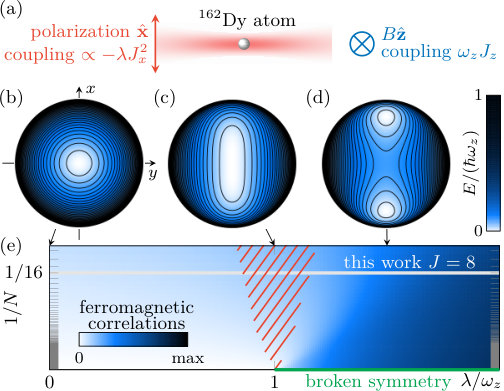 Figure 1
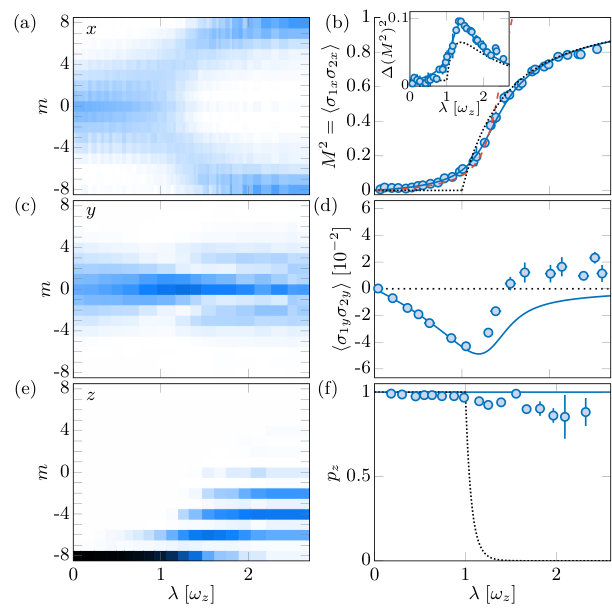 Figure 2
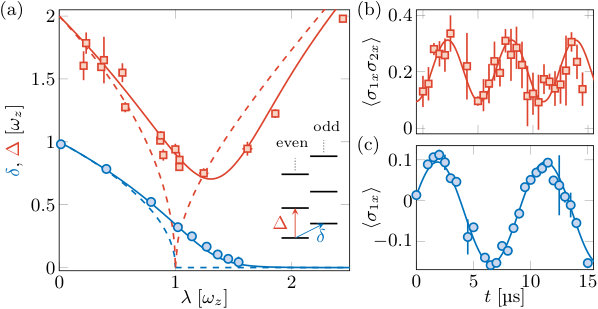 Figure 3
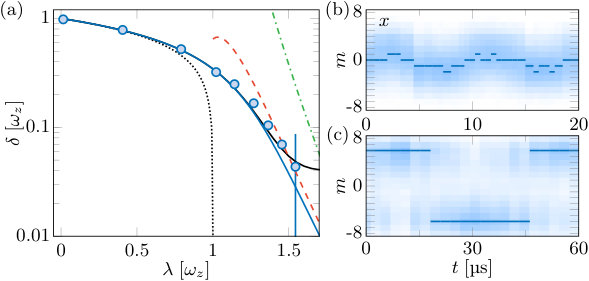 Figure 4
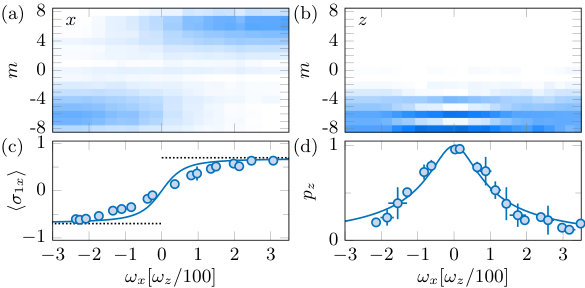 Figure 5
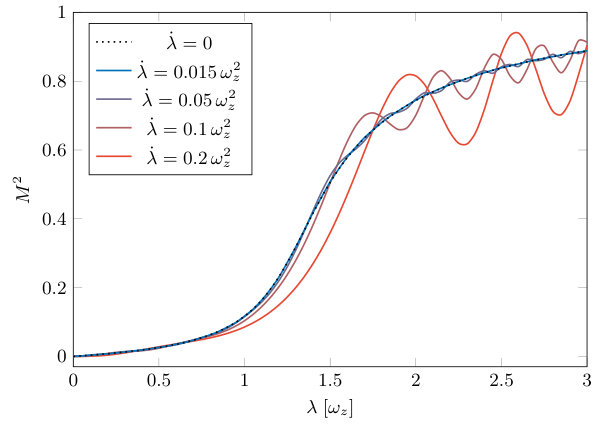 Figure 6
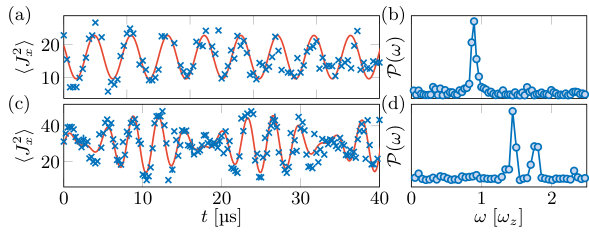 Figure 7
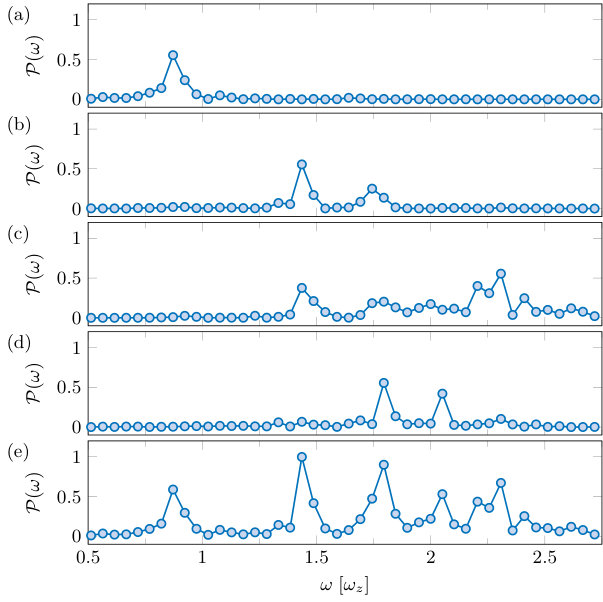 Figure 8
 Figure 9
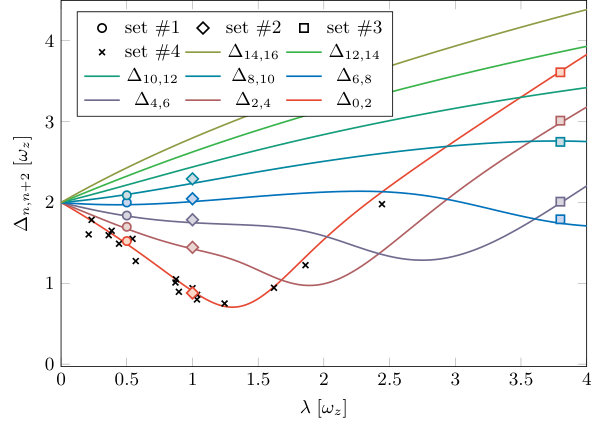 Figure 10
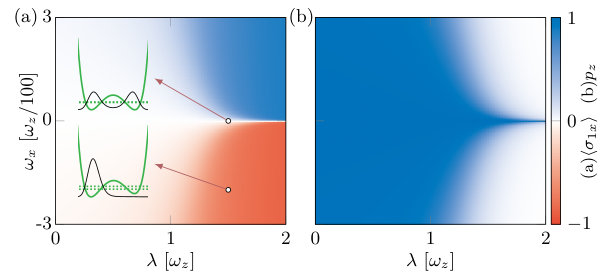 Figure 11
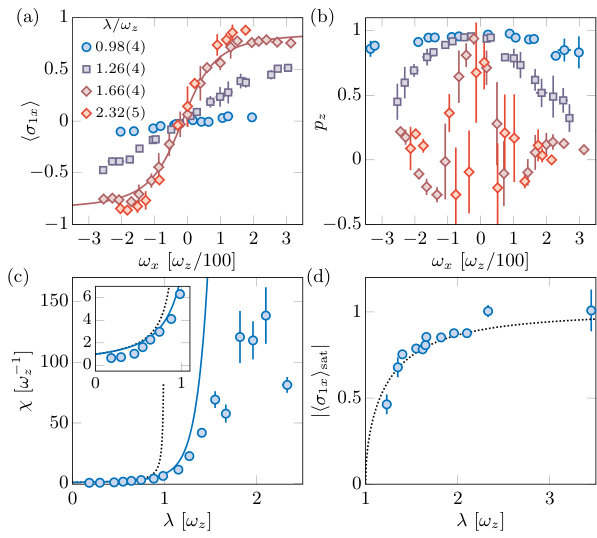 Figure 12
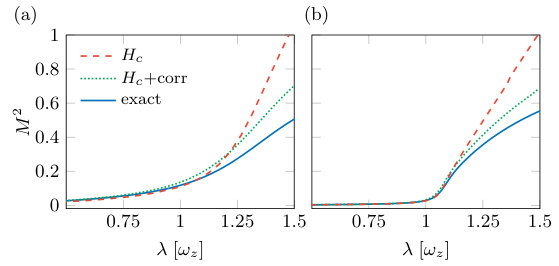 Figure 13
Peer Reviews
No public reviews on file for this paper yet. If you reviewed it on a platform where reviews are public (OpenReview, ICLR, NeurIPS, ICML), you can paste yours below so the community can read it here.
Videos
No videos yet. Explain this paper in a talk, walkthrough, or lecture? Add one.
††thanks: These two authors contributed equally.††thanks: These two authors contributed equally.
Probing quantum criticality and symmetry breaking at the microscopic level
Vasiliy Makhalov
Tanish Satoor
Alexandre Evrard
Thomas Chalopin
Raphael Lopes
Sylvain Nascimbene
Laboratoire Kastler Brossel, Collège de France, CNRS, ENS-PSL University, Sorbonne Université, 11 Place Marcelin Berthelot, 75005 Paris, France
(March 2, 2024)
Abstract
We report on an experimental study of the Lipkin-Meshkov-Glick model of quantum spins interacting at infinite range in a transverse magnetic field, which exhibits a ferromagnetic phase transition in the thermodynamic limit. We use Dysprosium atoms of electronic spin , subjected to a quadratic Zeeman light shift, to simulate interacting spins . We probe the system microscopically using single magnetic sublevel resolution, giving access to the spin projection parity, which is the collective observable characterizing the underlying symmetry. We measure the thermodynamic properties and dynamical response of the system, and study the quantum critical behavior around the transition point. In the ferromagnetic phase, we achieve coherent tunneling between symmetry-broken states, and test the link between symmetry breaking and the appearance of a finite order parameter.
From complex quantum materials such as cuprate superconductors to simple spin models, many-body systems close to a quantum critical point exhibit distinct properties driven by quantum fluctuations Sachdev (2011). Some features, such as the slowing down of relaxation times, can be probed via macroscopic observables. However, revealing specifically quantum properties, e.g. many-body quantum entanglement Osterloh et al. (2002), remains challenging. The recent development of highly controlled quantum systems of mesoscopic size, such as ion crystals Blatt and Roos (2012), ultracold gases Gross and Bloch (2017), Rydberg atom arrays Saffman (2016), or interacting photons Ma et al. (2011), allows for a microscopic characterization of collective quantum properties Georgescu et al. (2014), e.g. the full density matrix Ma et al. (2011), entanglement entropy Islam et al. (2015) or non-local string order Hilker et al. (2017). This degree of control could be used to investigate fundamental aspects of quantum phase transitions, such as the link between the breaking of an underlying symmetry and the onset of a non-zero order parameter Landau (1937). This connection cannot be tested in macroscopic systems as superselection rules forbid large-size quantum superpositions Bartlett et al. (2007), making spontaneous symmetry breaking unavoidable Anderson (1984).
In this Letter, we experimentally characterize at the microscopic level the Lipkin-Meshkov-Glick model (LMGm), consisting of quantum spins with infinite-range Ising interactions in a transverse field. This model is applicable to nuclear systems Lipkin et al. (1965); Cejnar et al. (2010), large-spin molecules Gatteschi and Sessoli (2003), trapped ions Lanyon et al. (2011); Islam et al. (2011) or two-mode Bose-Einstein condensates Albiez et al. (2005); Levy et al. (2007); Trenkwalder et al. (2016). Our study is based on the equivalence between the electronic spin of Dysprosium atoms and a set of spins symmetric upon exchange Landau and Lifshitz (1958), with Ising interactions simulated via a light-induced quadratic Zeeman shift Smith et al. (2004). In the thermodynamic limit (TL), the LMGm exhibits a ferromagnetic phase transition (see Fig. 1), characterized by spontaneous breaking of a symmetry – the parity of the total spin projection. We measure a crossover between para- and ferromagnetic behaviors, separated by a quantum critical regime where we observe non-classical behavior and a minimum of the energy gap Botet et al. (1982); Dusuel and Vidal (2004). A specific asset of our setup is the direct access to the quantum state parity, a collective observable hidden in macroscopic systems. We show that the symmetry breaking is directly related to the onset of a non-zero order parameter.
The LMGm is described by the Hamiltonian
[TABLE]
Here, denotes the projection of the spin along (), the factor ensures extensivity of the energy for large Campa et al. (2014), and we restrict ourselves to ferromagnetic interactions . As each spin interacts with the sum of all other spins, classical mean-field theory becomes valid in the TL Botet et al. (1982). The corresponding classical energy functionals, parametrized by the mean spin orientation, are shown in Fig. 1b,c,d for , and . They reveal the occurrence of a quantum phase transition between a paramagnetic phase for and a ferromagnetic phase for , for which the system exhibits two degenerate ground states with non-zero order parameter . Furthermore, the symmetry, associated to the conservation of parity , is spontaneously broken at the ferromagnetic transition. Introducing the collective spin , the Hamiltonian (1) can be recast (up to an overall energy shift ) as
[TABLE]
For ferromagnetic interactions, its lowest energy states are permutationally symmetric and their collective spin has the maximal length .
In this work, we study the non-linear dynamics of the electronic spin of 162Dy atoms, simulating the collective spin of a ferromagnetic LMGm with spins 1/2. We use ultracold samples of atoms, initially held in an optical dipole trap at a temperature 1.1(1)\text{,}\mathrm{\SIUnitSymbolMicro}\mathrm{K}. The atomic spin is initially polarized in the ground state $\left|-J\right>_{z}$, under a magnetic field $\mathbf{B}=B\hat{\mathbf{z}}$ with $B=$114(1)\text{\,}\mathrm{m}\mathrm{G}, corresponding to a Larmor frequency 198(2)\text{,}\mathrm{k}\mathrm{H}\mathrm{z}. In this state, the $N$ elementary spins are anti-aligned with the magnetic field, corresponding to a paramagnetic state. We then switch off the trap before applying an off-resonant laser beam close to the 626-nm optical resonance, linearly polarized along $x$, resulting in a quadratic Zeeman light shift $\propto J_{x}^{2}$ Smith *et al.* ([2004](#bib.bib22)). After a typical evolution time $t\sim$100\text{\,}\mathrm{\SIUnitSymbolMicro}\mathrm{s}, we switch off the light beam, apply time-dependent magnetic fields to perform arbitrary spin rotations, before making a projection measurement along . Combining rotation and projection gives us access to the spin projection probabilities, (), along any direction Evrard et al. (2019).
We first investigate the properties of the ground state of the LMGm. We start with all atoms in the state , which is the (paramagnetic) ground state for . We then slowly ramp the light coupling from zero up to a final value , using a linear ramp of speed , for which we expect quasi-adiabatic evolution Note (1). The measured spin projection probabilities () are shown in Fig. 2a,c,e. We first consider the occurrence of a ferromagnetic ground state, that would exhibit a non-zero order parameter . We show in Fig. 2a the single-shot projections measured for various couplings . For small , we find a single-peak distribution centered on 0, consistent with the state projected along . For , we observe a bifurcation towards a double-peak distribution, consistent with population of the two broken-symmetry states, each with an order parameter . As the distributions remain globally symmetric, the system does not seem to choose a single broken state. Our measurement being averaged over many atoms, we cannot exclude a situation with almost half of the atoms in each broken state, e.g. organized in unresolved spin domains. This scenario is invalidated by a direct measurement of the mean parity , that remains close to unity for all interaction strengths (see Fig. 2f). Such an absence of spontaneous symmetry breaking is, in fact, expected for a finite-size system, whose ground state remains non-degenerate, as discussed later in this Letter.
We now characterize the thermodynamic properties that are independent of the symmetry breaking itself. We probe ferromagnetic spin correlations, i.e. the relative alignment between spins along quantified by the correlator Botet et al. (1982). We compute it from the second moment of the measured probabilities , using Ulam-Orgikh and Kitagawa (2001). As shown in Fig. 2b, the measurements agree well with the LMGm. The smooth increase of as a function of is consistent with a crossover between para- and ferromagnetic behaviors.
We also investigated signatures of the phase transition in our finite-size system. First, we measure an increase of fluctuations of the ferromagnetic correlator around the critical point (see inset of Fig. 2b) – a generic feature of continuous phase transitions Landau and Lifshitz (1980). More importantly, quantum phase transitions are also associated with the onset of entanglement in the critical region Sachdev (2011). A priori, probing quantum entanglement requires partitioning the electronic spin , which is forbidden at low energy, but could, in principle, be achieved using coherent optical transitions Gühne and Tóth (2009); Killoran et al. (2014). Yet, we can indirectly probe entanglement in our system via spin projection correlations. Indeed, separable states which are symmetric upon exchange satisfy for all projection directions , and thus can only exhibit positive correlators Ulam-Orgikh and Kitagawa (2001); Vidal (2006). As shown in Fig. 2c,d, we measure the correlator and show that it assumes negative values in a broad range of interaction strengths Note (4), consistent with quantum entanglement and suggesting that the phase transition is driven by quantum (rather than thermal) fluctuations Osterloh et al. (2002); Luo et al. (2017).
We now characterize more closely the region around the transition point, where the phase transition singularity is smoothened into a quantum critical behavior. We focus on the variation of the ferromagnetic correlator with the coupling (see Fig. 2b). Our measurements are close to mean-field theory – valid in the TL – for most values of , except around Landau et al. (1984); Note (1). In the critical regime, the leading finite-size correction can be simply formulated, as the quantum ground state remains close to the coherent state , such that the operators and are almost canonically conjugated variables, with Holstein and Primakoff (1940). This approximation leads to a low-energy ‘critical’ Hamiltonian Ulyanov and Zaslavskii (1992); Note (1)
[TABLE]
describing the dynamics of a massive particle in a harmonic plus quartic potential, where , and . This description matches the textbook Landau picture of a second-order phase transition, evolving from single- to double-well potentials when crossing the critical point Landau (1937). As plotted in Fig. 2b, the universal Hamiltonian (3) is sufficient to account well for the measured deviations to the TL around Note (6).
We now extend our study to the dynamics of the system by measuring the energy gap of low-lying excitations. Due to the parity symmetry of the LMGm, the eigenstates can be divided into two sectors of even and odd parity. The low-energy dynamics is then governed by two energy gaps, namely the ‘parity’ gap between opposite-parity ground states and the ‘dynamical’ gap between the lowest two energy levels of even parity. In the effective potential picture, these gaps correspond to the oscillation frequencies of the dipole () and breathing () modes. To excite the breathing mode for a given coupling , we simply increase the ramp speed used for the state preparation, leading to diabatic population of the first excited state of even parity, while keeping the higher states almost unpopulated. We then measure the time evolution of the second moment , and extract its oscillation frequency (see Fig. 3b). To excite the dipole mode, we first prepare the ground state for a given coupling , and apply a parity-breaking perturbation using a pulse of magnetic field along of duration 3\text{,}\mathrm{\SIUnitSymbolMicro}\mathrm{s}$$, coupling the ground state to the odd parity sector. The amplitude is chosen small enough to only populate the even- and odd-parity ground states, and the first moment oscillation frequency, , is extracted (see Fig. 3c).
The measured parity and dynamical gaps, reported in Fig. 3a, agree well with the LMGm. The dynamical gap exhibits a minimum around the critical point, reminiscent of the closing of the gap in the TL at the phase transition point. The parity gap decreases when increasing the coupling . In the paramagnetic phase , the dynamical gap remains about twice the parity gap , consistent with a picture of non-interacting excitation quanta Holstein and Primakoff (1940); Dusuel and Vidal (2004). At the critical point, the measured dynamical gap significantly exceeds twice the parity gap , as expected from particle dynamics in a quartic potential (see the critical Hamiltonian (3) for ). This non-harmonic behavior illustrates the generic behavior of quantum critical systems, whose low-energy spectra cannot be simply reduced to non-interacting excitation quanta Sachdev (2011). The gap value for is also consistent with the leading finite-size correction to mean field , valid for Botet et al. (1982); Dusuel and Vidal (2005); Note (7).
We now focus on the dipole oscillation measurements in the ferromagnetic phase. In Fig. 4a we plot the parity gap variation on a logarithmic scale, showing a fast decrease for . The even- and odd-parity ground states thus become almost degenerate in the ferromagnetic phase, a behavior reminiscent of the exact double degeneracy expected in the TL for . We show in Fig. 4b,c the time evolution of the probability distributions during the dipole oscillation, in the paramagnetic (b) and ferromagnetic (c) phases. In the paramagnetic phase the distributions always exhibit a single peak, whose center smoothly oscillates around zero. On the contrary, in the ferromagnetic phase the distributions exhibit two peaks at positive/negative large- values, and the dynamics consists in an oscillation between the peak weights, without significantly populating small- states. This qualitatively different behavior is well illustrated by the evolution of the most probable projection , which only takes two possible values during the evolution shown in Fig. 4c. These maximal projection values are close to the collective spin projections of the two mean-field broken-symmetry states for . Such a dynamics can be interpreted as a ‘macroscopic’ quantum tunneling regime between broken states – a phenomenon studied extensively in large-spin molecules Gatteschi and Sessoli (2003); Owerre and Paranjape (2015); Friedman et al. (1996); Thomas et al. (1996) and SQUID systems Friedman et al. (2000); van der Wal et al. (2000); Makhlin et al. (2001). Deep in the ferromagnetic phase, the dipole frequencies are consistent with the semi-classical theory of quantum tunneling Enz and Schilling (1986); Scharf et al. (1987); Zaslavskii (1990). In the limit , perturbation theory provides a simple picture of this behavior: the two broken states being coupled by the field via a -order process lead to a high power-law scaling . For values , the oscillation contrast decreases and the measured frequency deviates from theory, which we attribute to residual magnetic field fluctuations along (r.m.s. width 0.4\text{,}\mathrm{m}\mathrm{G}$$), inducing an offset between the two wells that exceeds the tunnel coupling.
We finally investigate the controlled breaking of parity symmetry by a static magnetic field applied along , which adds a Zeeman coupling mixing the two parity sectors. As shown in Fig. 4, this field simultaneously induces a finite order parameter and a reduction of the mean parity . For large fields, the order parameter reaches a plateau consistent with the mean-field prediction . This behavior coincides with a cancellation of the mean parity , illustrating the direct link between broken symmetry and non-zero order parameter Note (1). Besides the controlled symmetry breaking discussed above, spontaneous symmetry breaking also occurs in our system when preparing the ground state in the ferromagnetic phase, using very slow ramps of the light coupling . We find that the sign of the spontaneous order parameter is directly related to the sign of the shot-to-shot magnetic field fluctuation, which is independently recorded. However, we found no signature of more complex symmetry-breaking mechanisms, e.g. induced by spin-dependent interactions between different atoms, as we did not observe a significant reduction of parity when increasing the atomic density (up to \mathrm{c}\mathrm{m}^{-3}$$).
In conclusion, we studied the ground state and low-energy spectrum of the LMGm via the non-linear dynamics of the electronic spin of 162Dy atoms, observing a minimum of the energy gap around the transition point. A possible extension of this study would be the non-adiabatic crossing of the critical point, a problem related to quantum annealing Bapst and Semerjian (2012) and Kibble-Zurek mechanism – whose relevance for infinitely coordinated systems is debated Caneva et al. (2008); Solinas et al. (2008); Acevedo et al. (2014); Hwang et al. (2015); Defenu et al. (2018). In the ferromagnetic phase we have demonstrated the production of coherent superposition of broken-symmetry states Cirac et al. (1998), which could be used for quantum-enhanced metrology Pezzè et al. (2018). Our system is also well suited to investigate various spontaneous symmetry breaking mechanisms at the microscopic level and their connection to decoherence Lucamarini et al. (2004); van Wezel et al. (2005).
Acknowledgements.
We thank J. Dalibard and P. Ribeiro for stimulating discussions and J. Beugnon, J. Dalibard and F. Gerbier for a careful reading of the manuscript. This work is supported by PSL University (MAFAG project) and European Union (ERC UQUAM and TOPODY).
The reference list from the paper itself. Each links out to its DOI / PubMed record.
- 1Sachdev (2011) S. Sachdev, Quantum Phase Transitions (Cambridge University Press, 2011).
- 2Osterloh et al. (2002) A. Osterloh, L. Amico, G. Falci, and R. Fazio, Nature 416 , 608 (2002) . · doi ↗
- 3Blatt and Roos (2012) R. Blatt and C. F. Roos, Nat. Phys. 8 , 277 (2012) . · doi ↗
- 4Gross and Bloch (2017) C. Gross and I. Bloch, Science 357 , 995 (2017) . · doi ↗
- 5Saffman (2016) M. Saffman, J. Phys. B: At. Mol. Opt. Phys. 49 , 202001 (2016) . · doi ↗
- 6Ma et al. (2011) X.-s. Ma, B. Dakic, W. Naylor, A. Zeilinger, and P. Walther, Nat. Phys. 7 , 399 (2011) . · doi ↗
- 7Georgescu et al. (2014) I. M. Georgescu, S. Ashhab, and F. Nori, Rev. Mod. Phys. 86 , 153 (2014) . · doi ↗
- 8Islam et al. (2015) R. Islam, R. Ma, P. M. Preiss, M. Eric Tai, A. Lukin, M. Rispoli, and M. Greiner, Nature 528 , 77 (2015) . · doi ↗