Holographic Plasmon Relaxation with and without Broken Translations
Matteo Baggioli, Ulf Gran, Amadeo Jimenez Alba, Marcus Torns\"o,, Tobias Zingg

TL;DR
This paper investigates the relaxation and dynamics of bulk plasmons in strongly coupled quantum systems using holography, analyzing how various physical parameters and symmetry breaking influence plasmon behavior.
Contribution
It provides a detailed holographic analysis of plasmon dispersion, damping, and the effects of momentum dissipation and translational symmetry breaking.
Findings
Plasmon dispersion relations depend on electromagnetic coupling, charge, and temperature.
Momentum dissipation increases damping of plasmon modes.
Spontaneous symmetry breaking affects the plasma frequency and sound speed.
Abstract
We study the dynamics and the relaxation of bulk plasmons in strongly coupled and quantum critical systems using the holographic framework. We analyze the dispersion relation of the plasmonic modes in detail for an illustrative class of holographic bottom-up models. Comparing to a simple hydrodynamic formula, we entangle the complicated interplay between the three least damped modes and shed light on the underlying physical processes. Such as the dependence of the plasma frequency and the effective relaxation time in terms of the electromagnetic coupling, the charge and the temperature of the system. Introducing momentum dissipation, we then identify its additional contribution to the damping. Finally, we consider the spontaneous symmetry breaking (SSB) of translational invariance. Upon dialing the strength of the SSB, we observe an increase of the longitudinal sound speed controlled by…
Click any figure to enlarge with its caption.
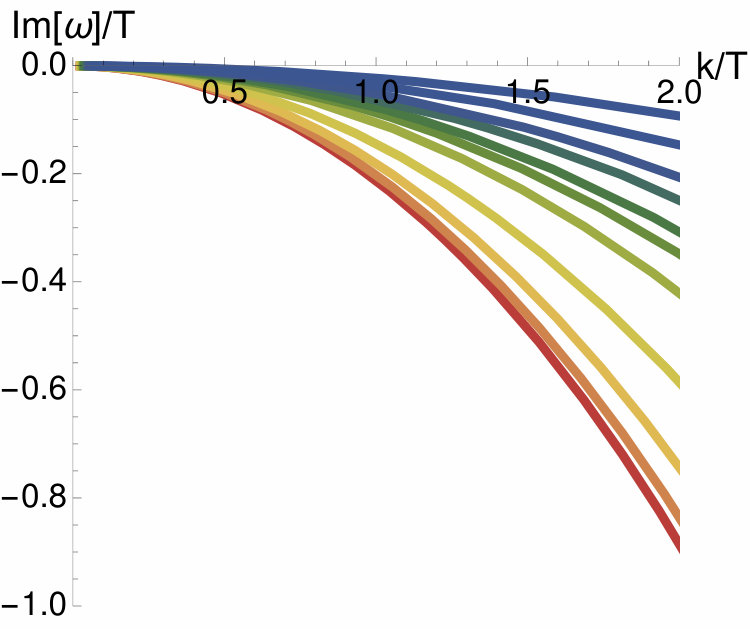 Figure 1
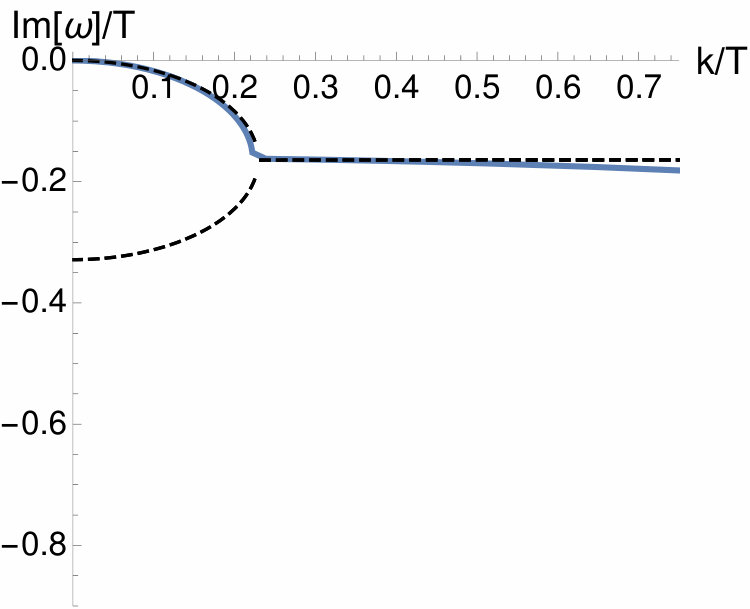 Figure 2
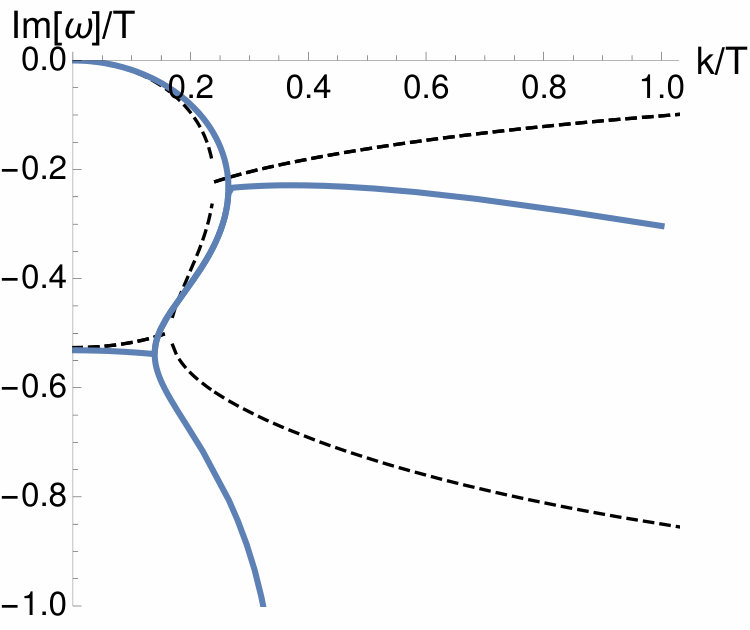 Figure 3
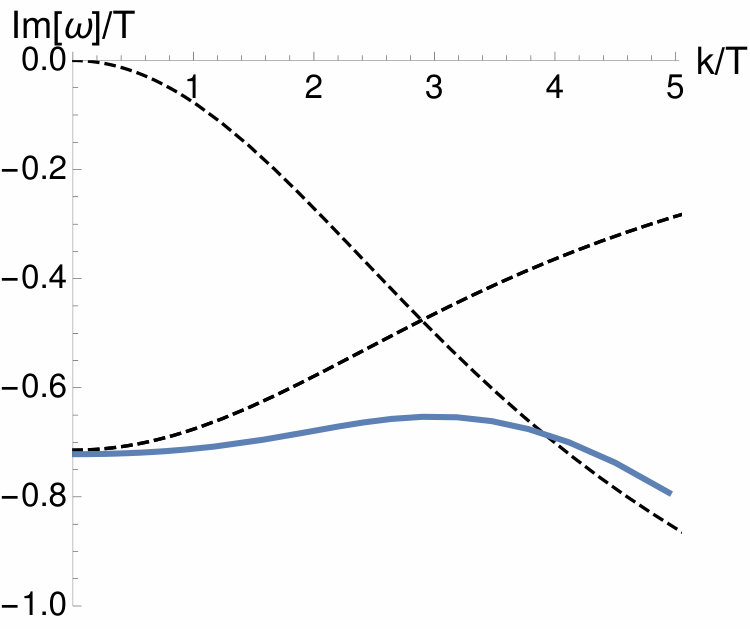 Figure 4
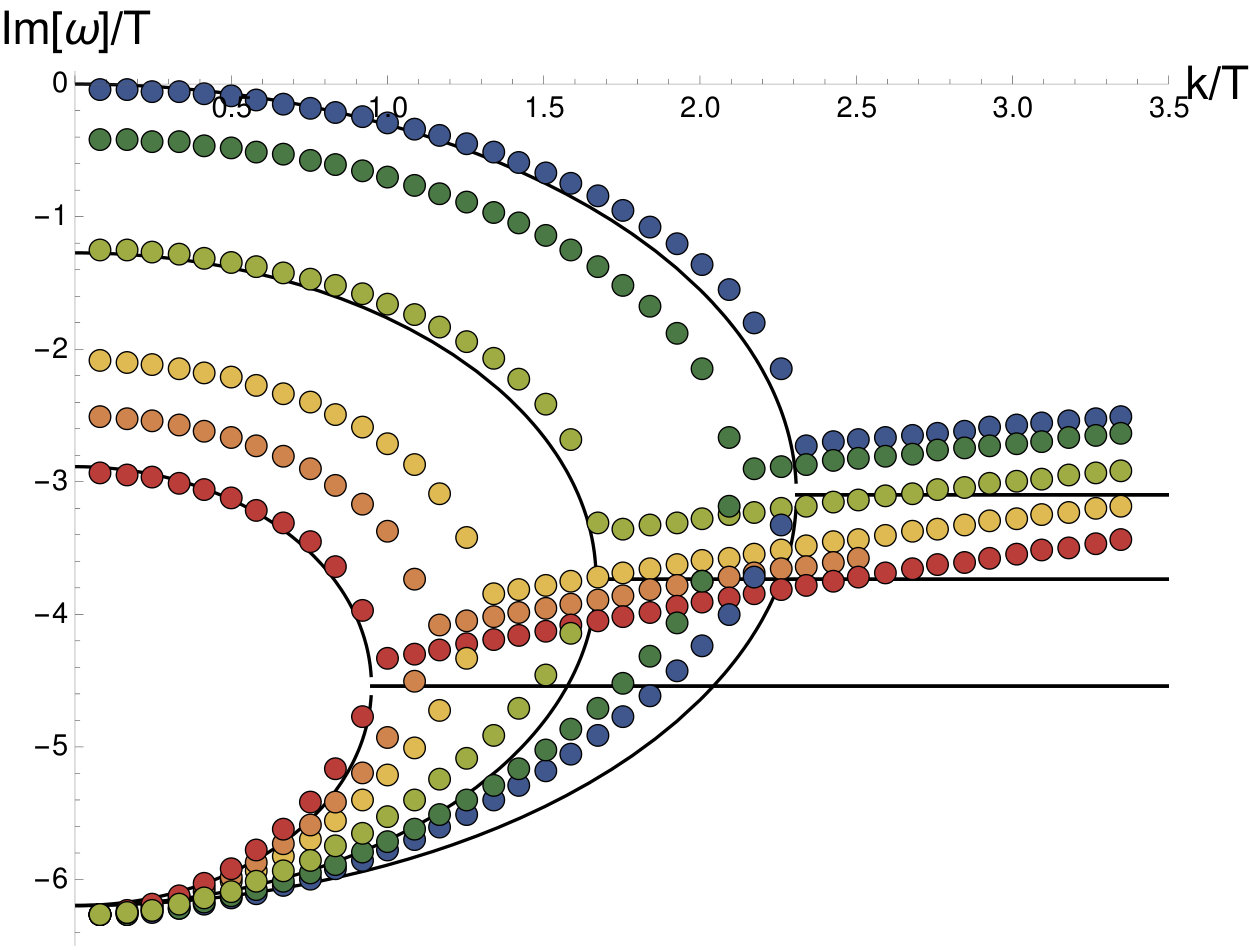 Figure 5
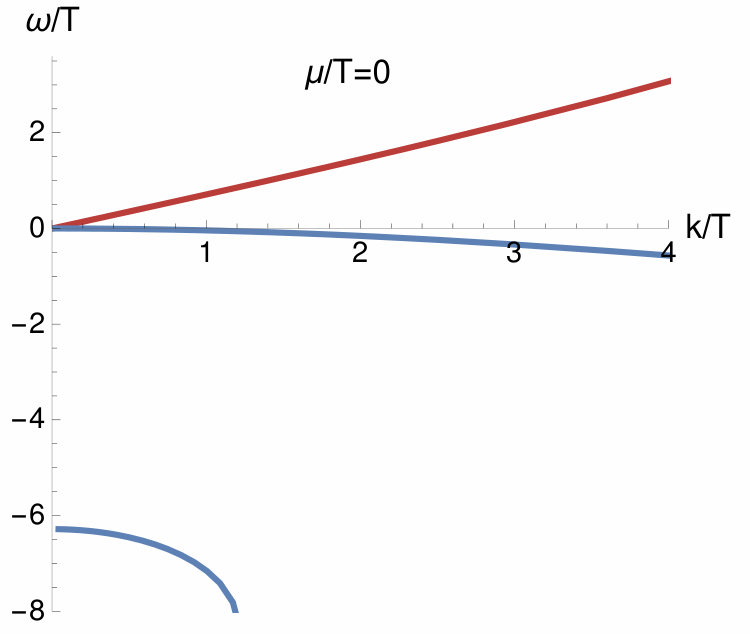 Figure 6
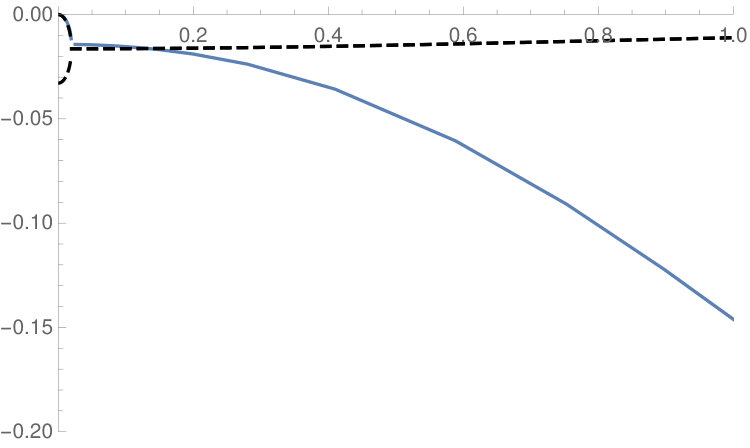 Figure 7
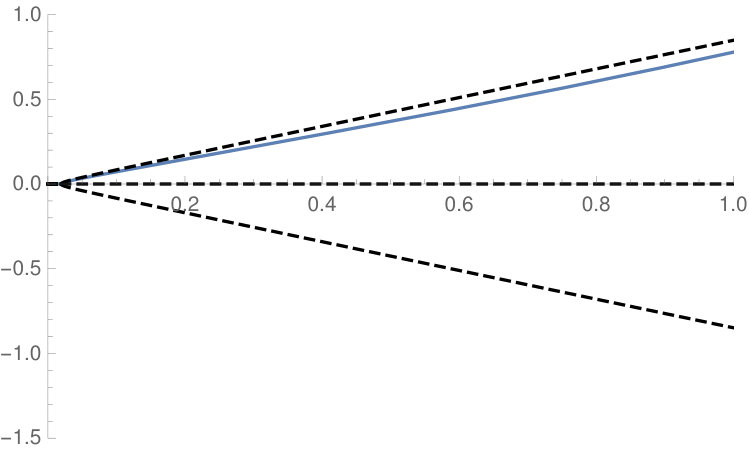 Figure 8
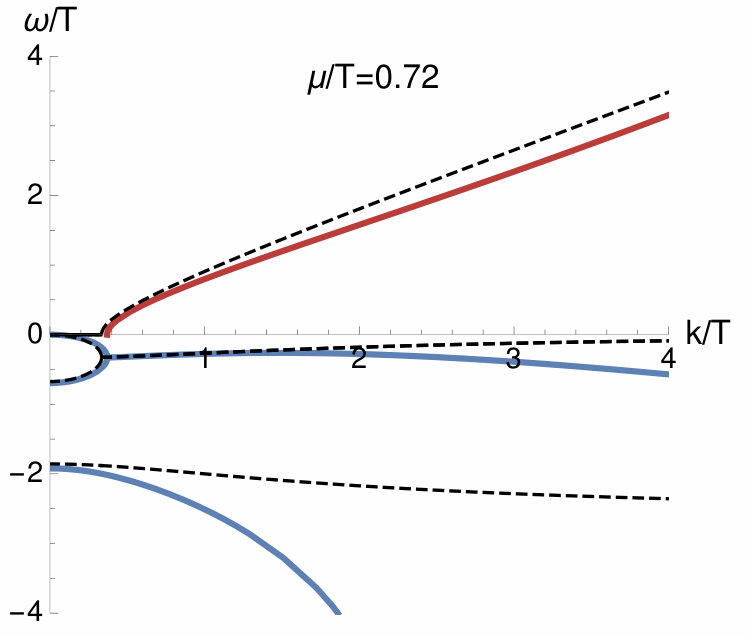 Figure 9
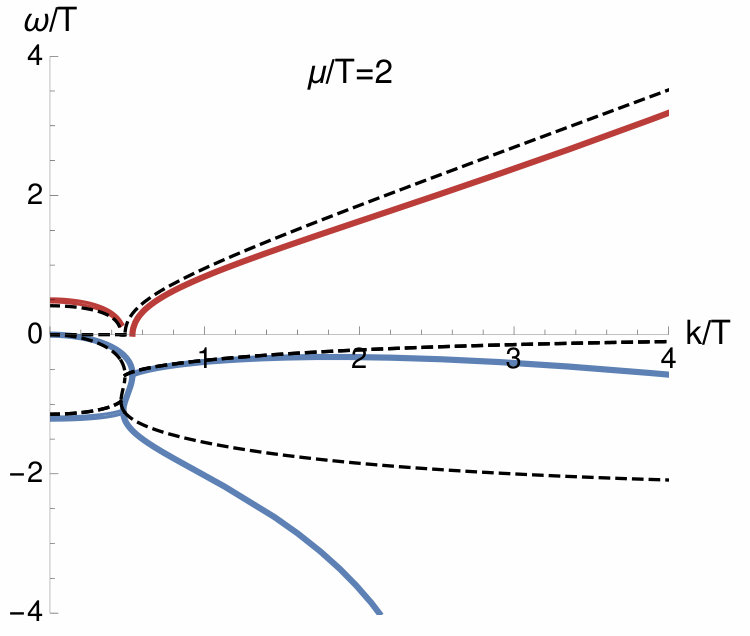 Figure 10
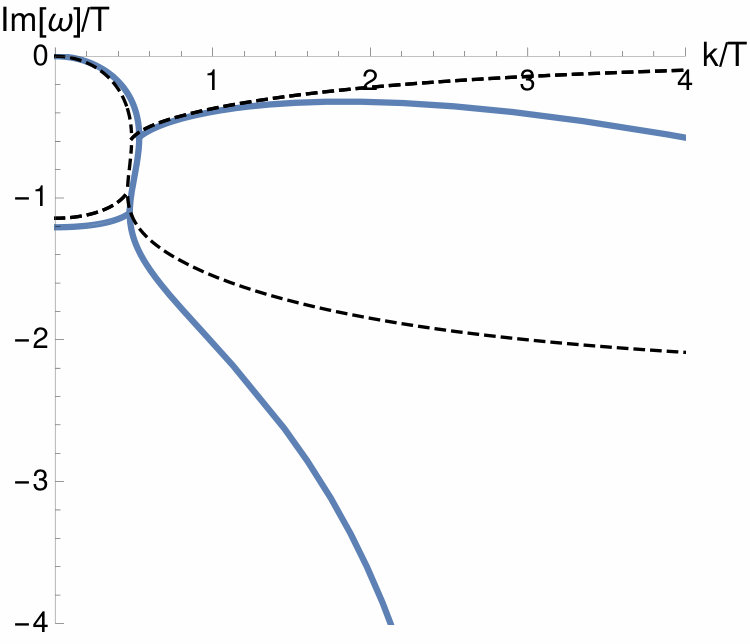 Figure 11
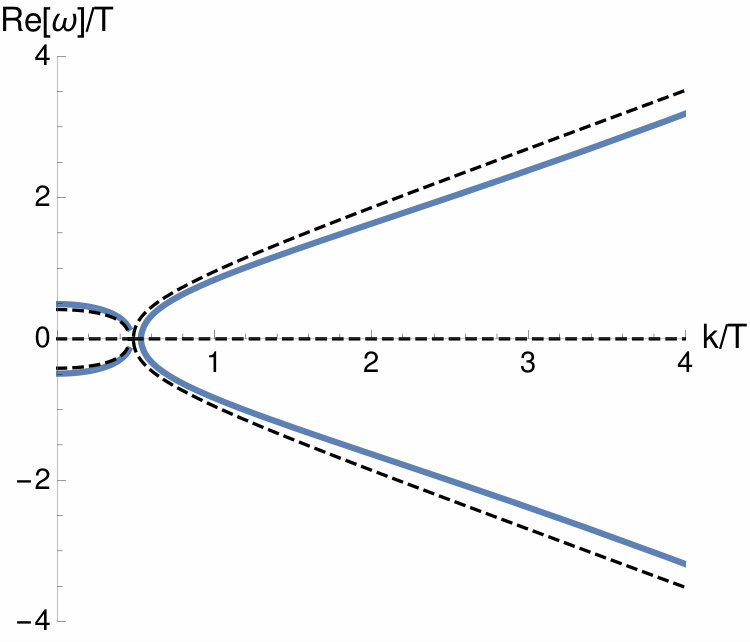 Figure 12
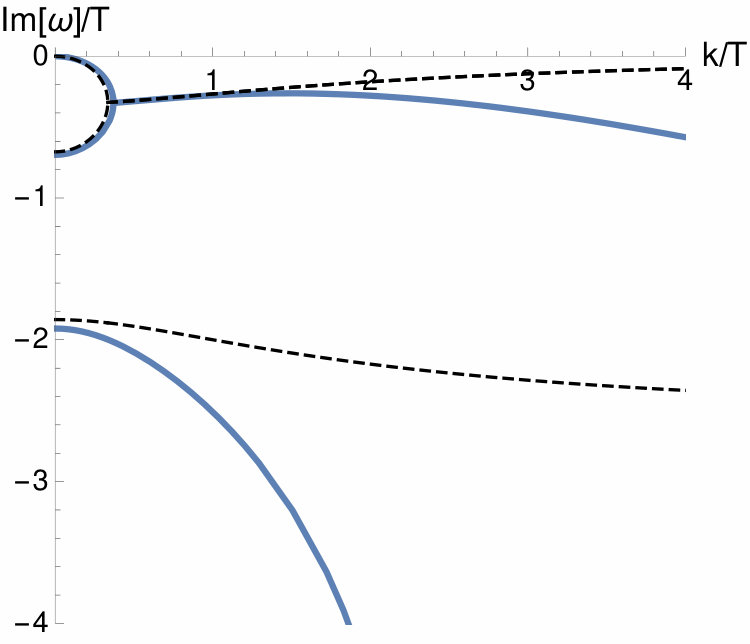 Figure 13
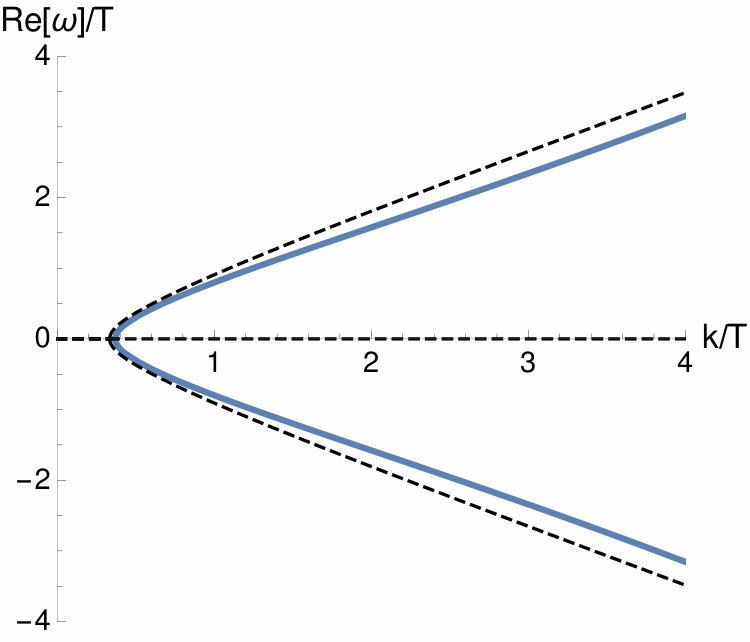 Figure 14
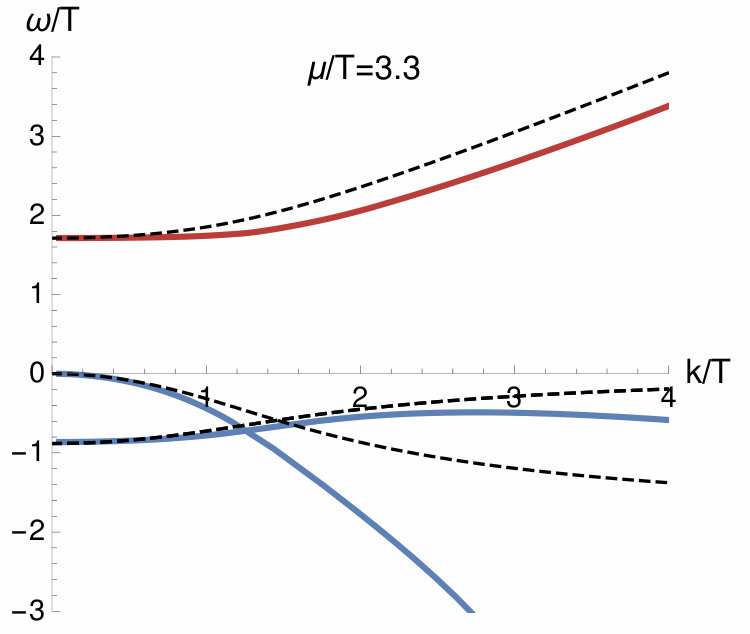 Figure 15
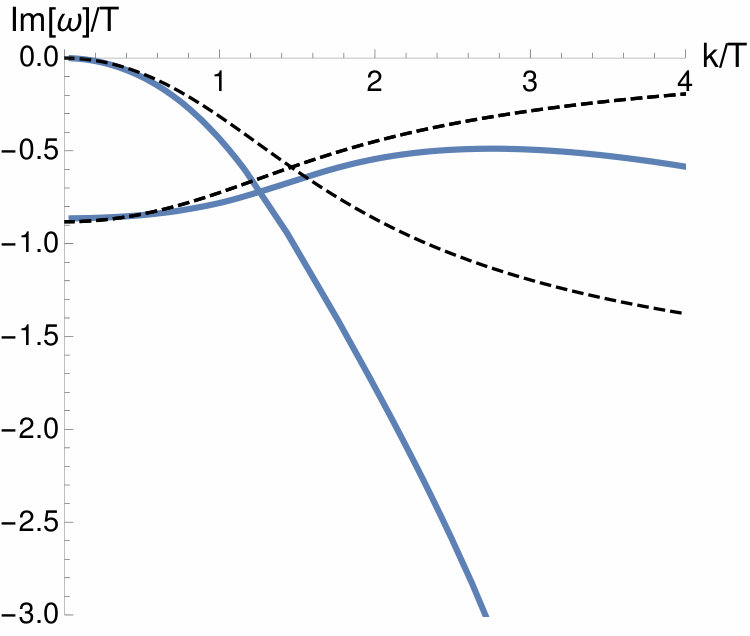 Figure 16
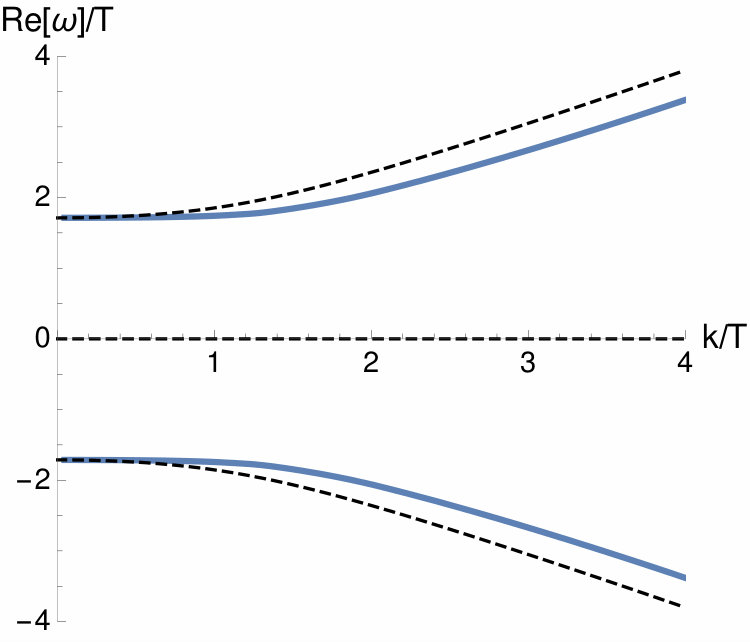 Figure 17
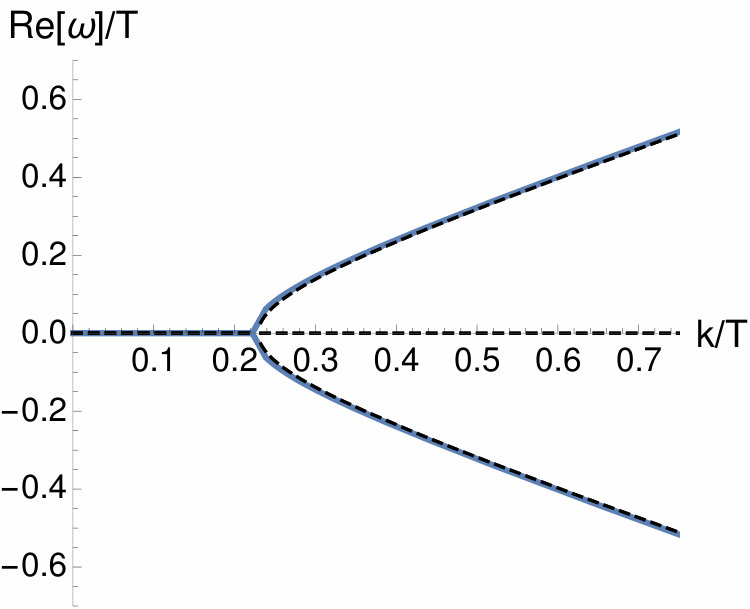 Figure 18
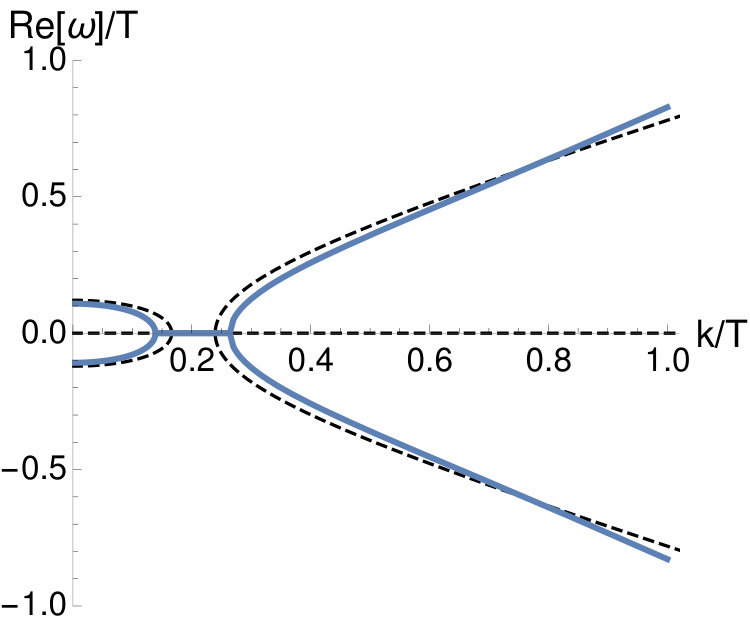 Figure 19
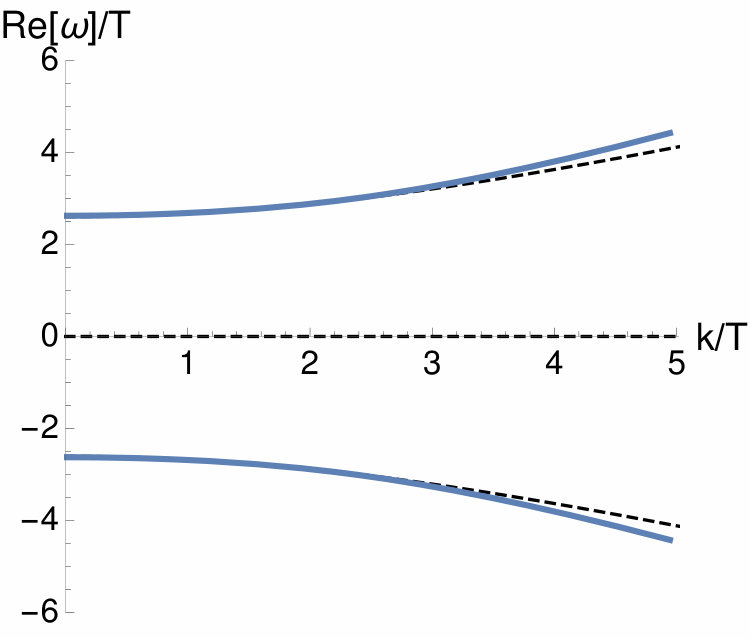 Figure 20
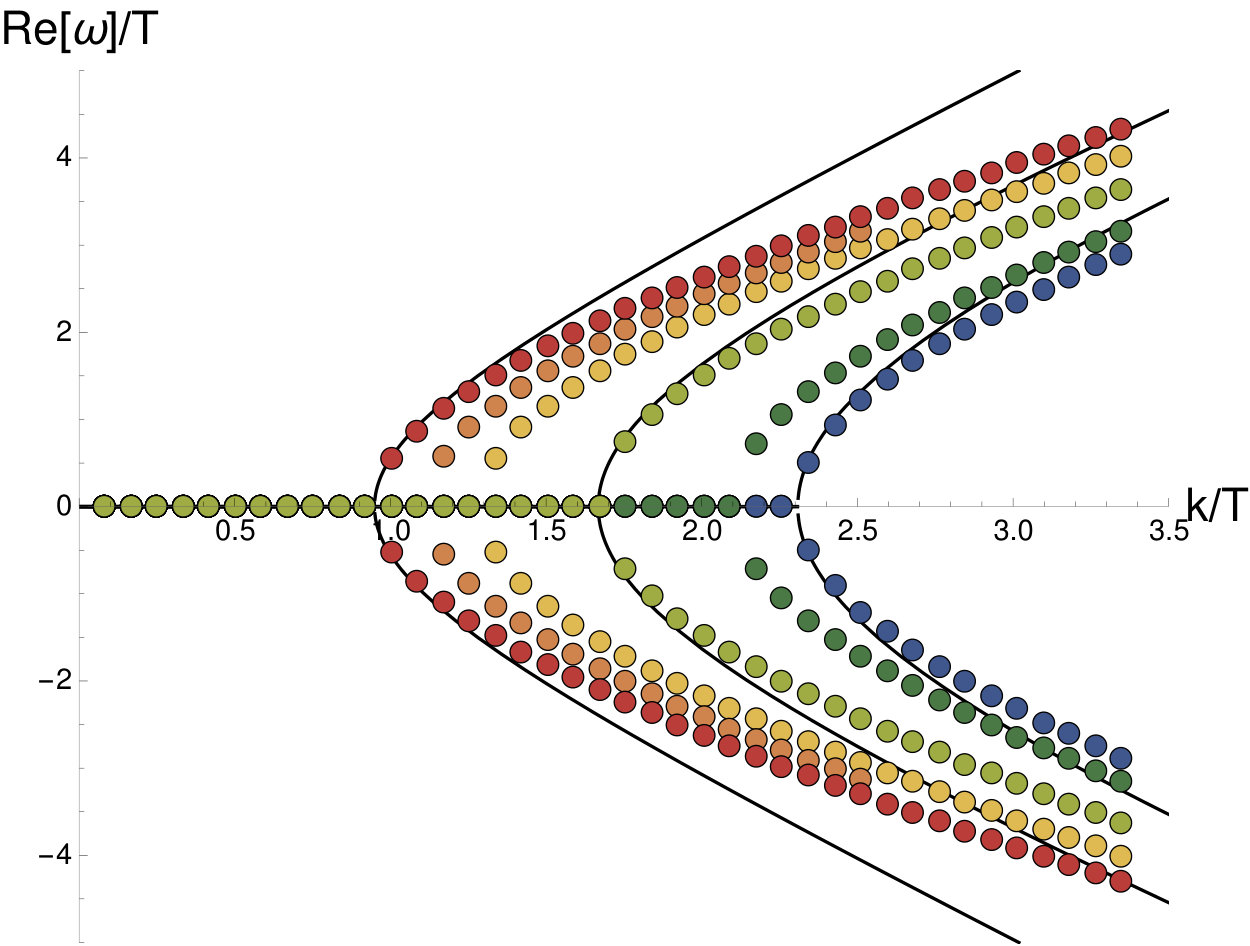 Figure 21
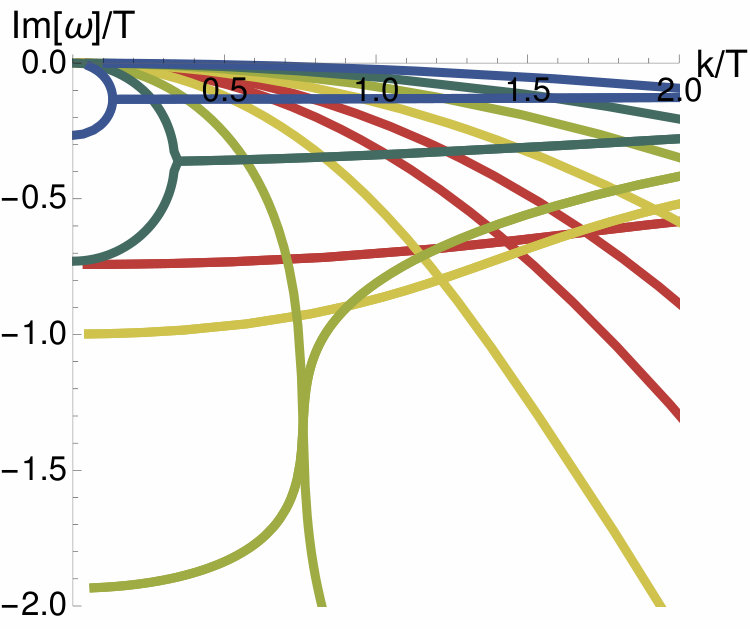 Figure 22
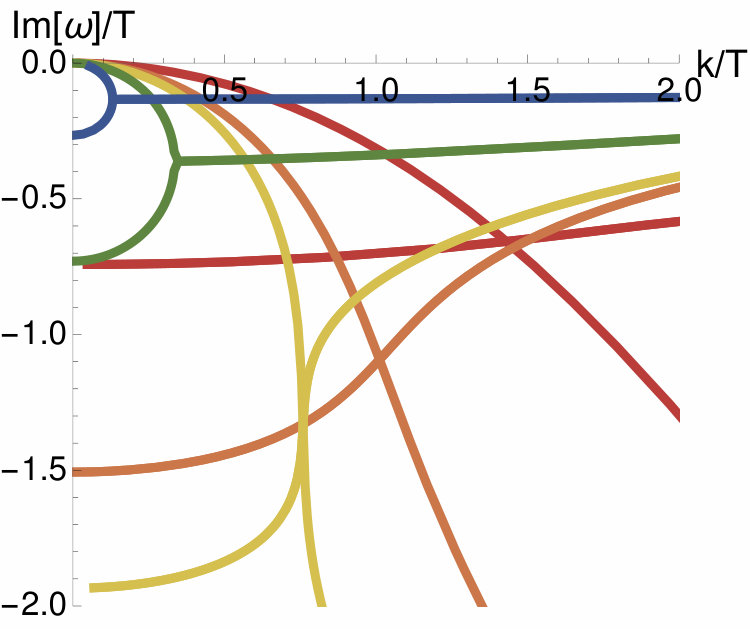 Figure 23
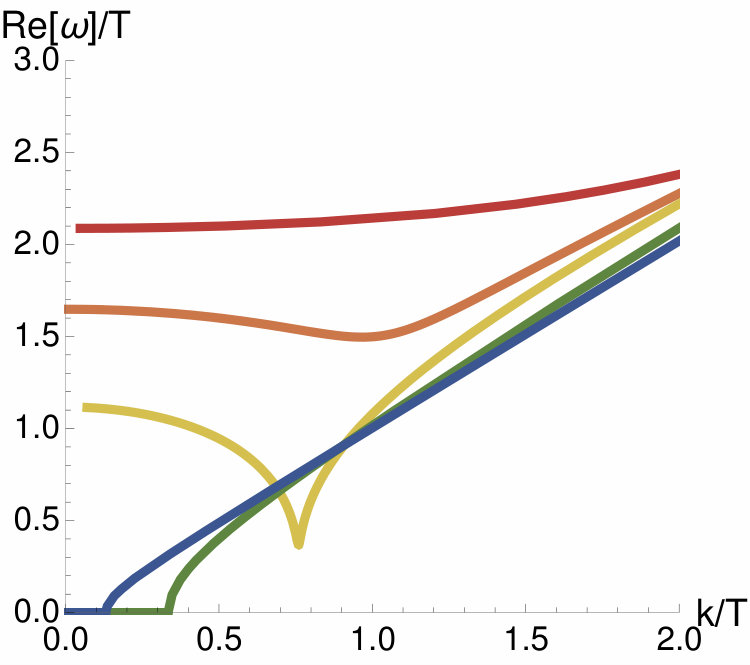 Figure 24
 Figure 25
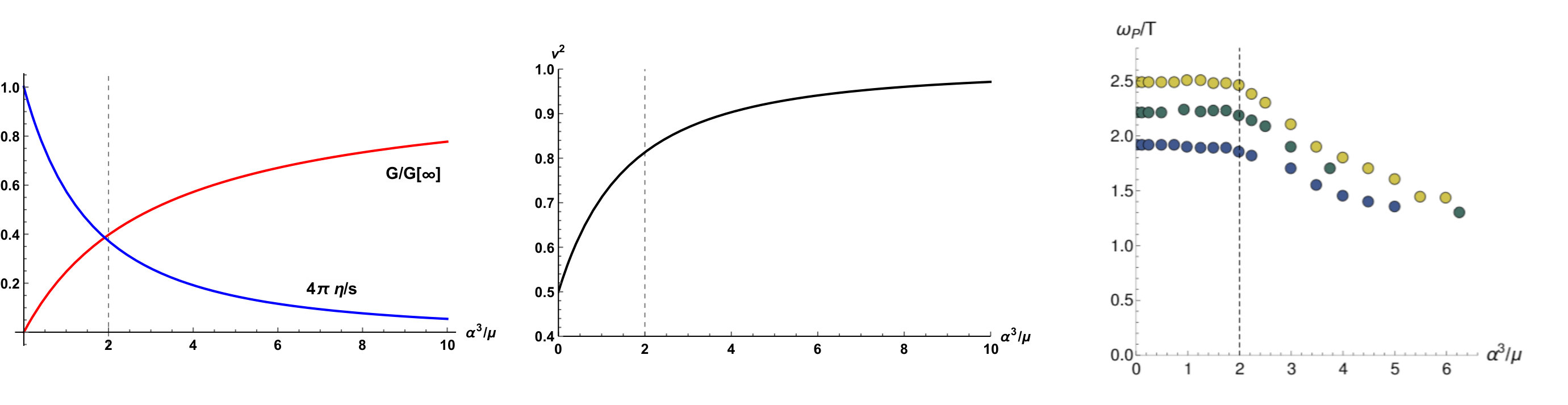 Figure 26
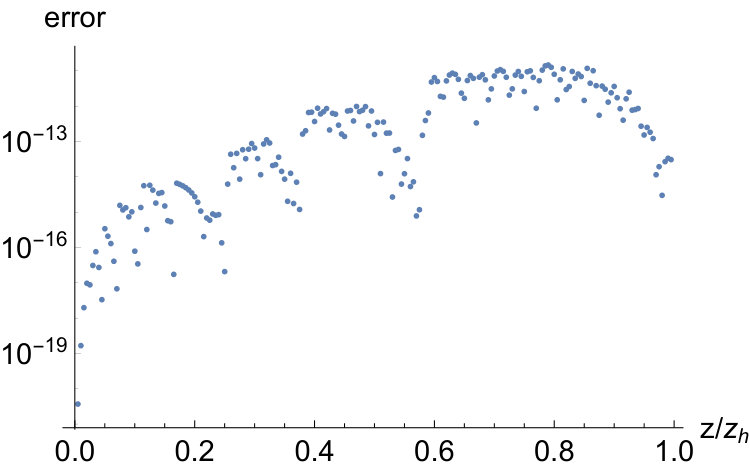 Figure 27
 Figure 28
 Figure 29
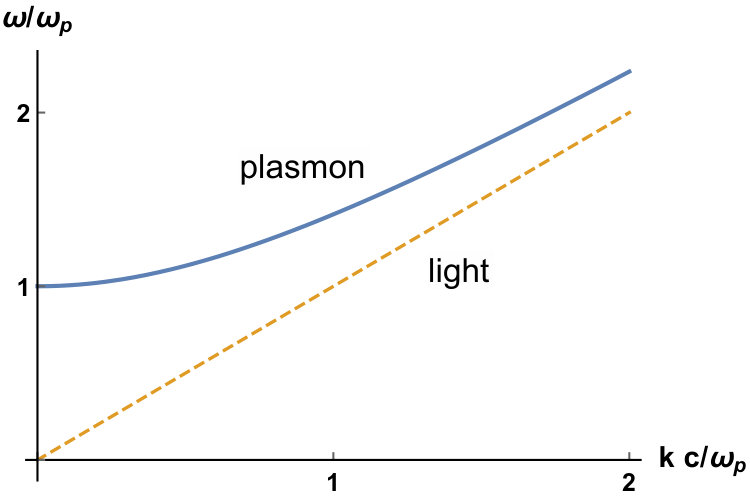 Figure 30
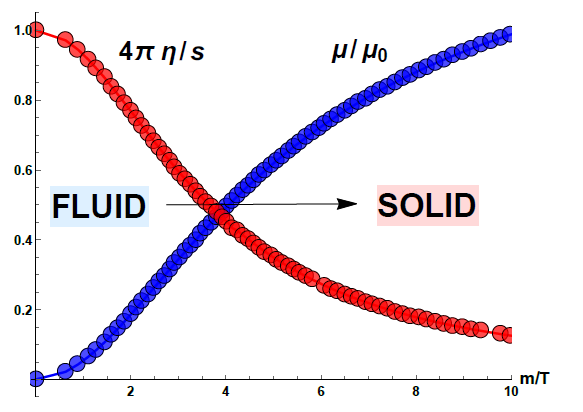 Figure 31
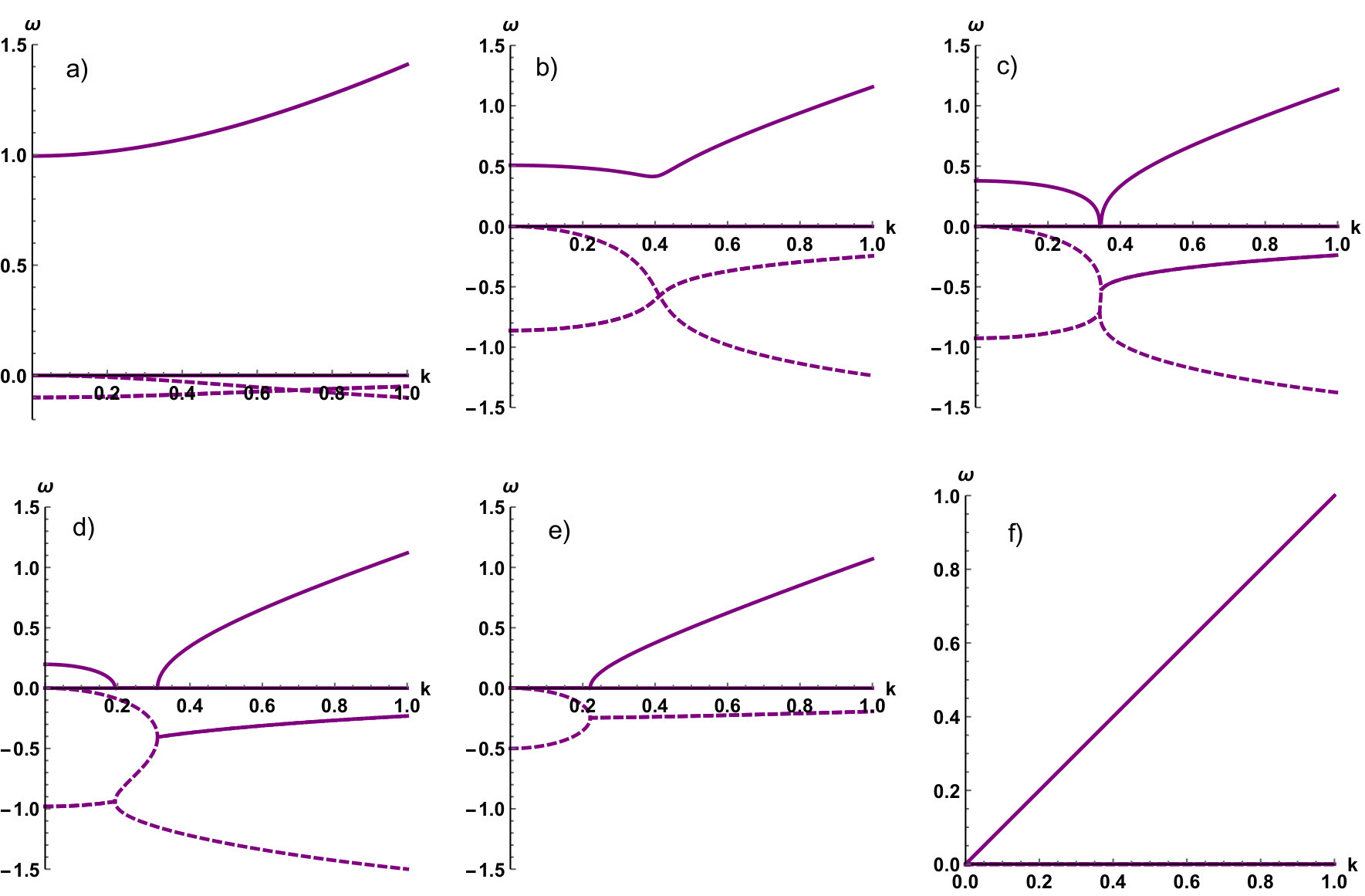 Figure 32
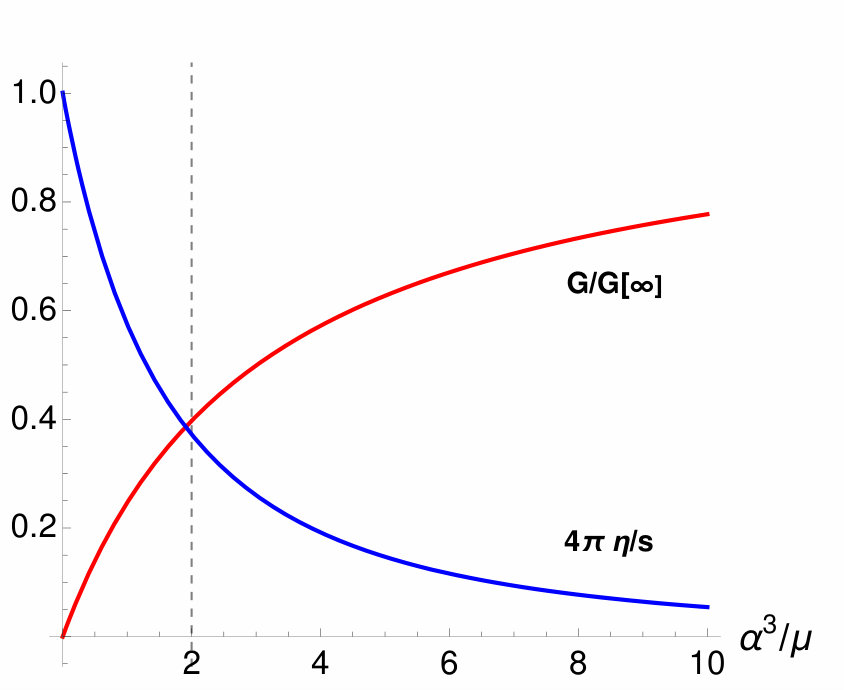 Figure 33
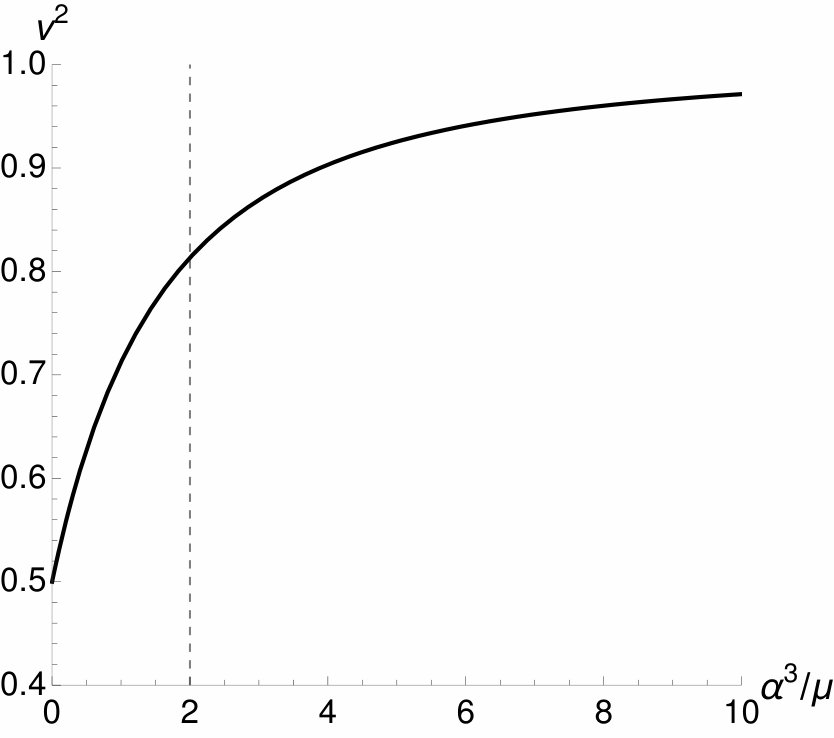 Figure 34
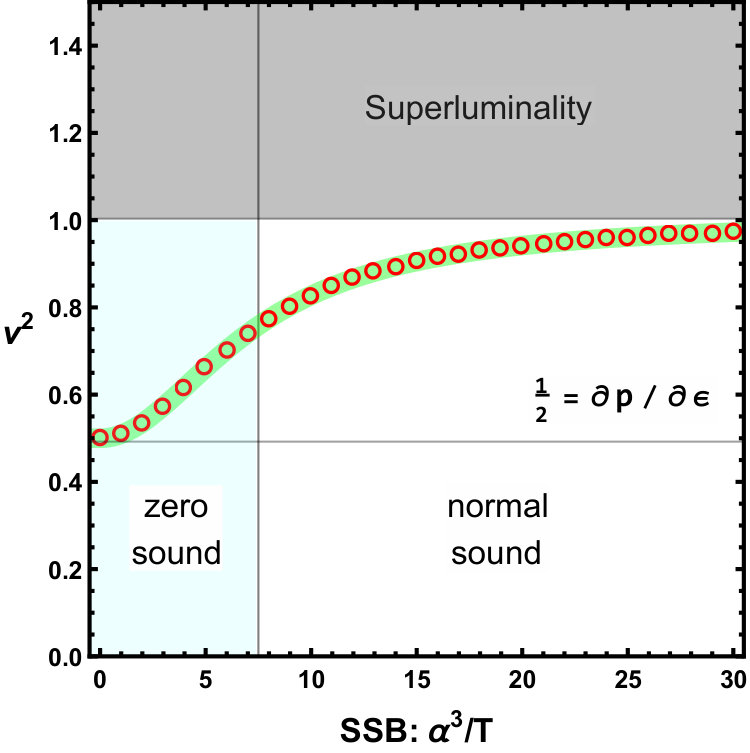 Figure 35
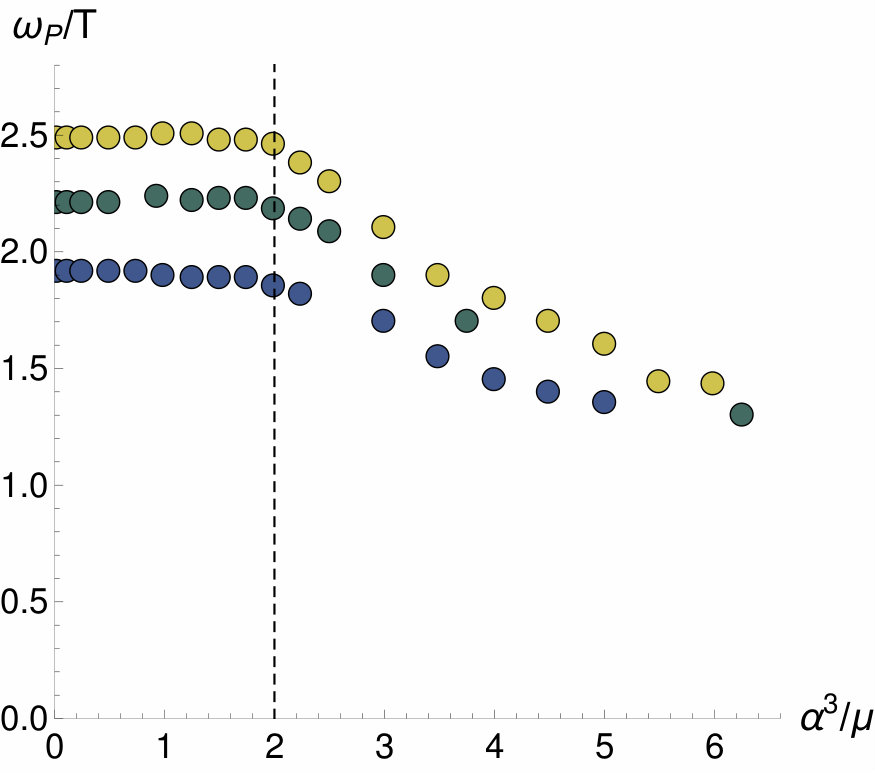 Figure 36
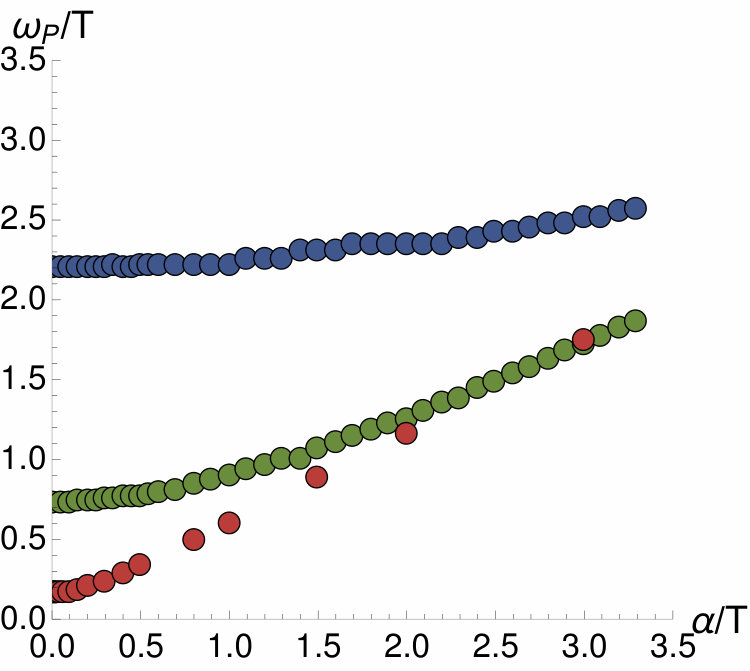 Figure 37
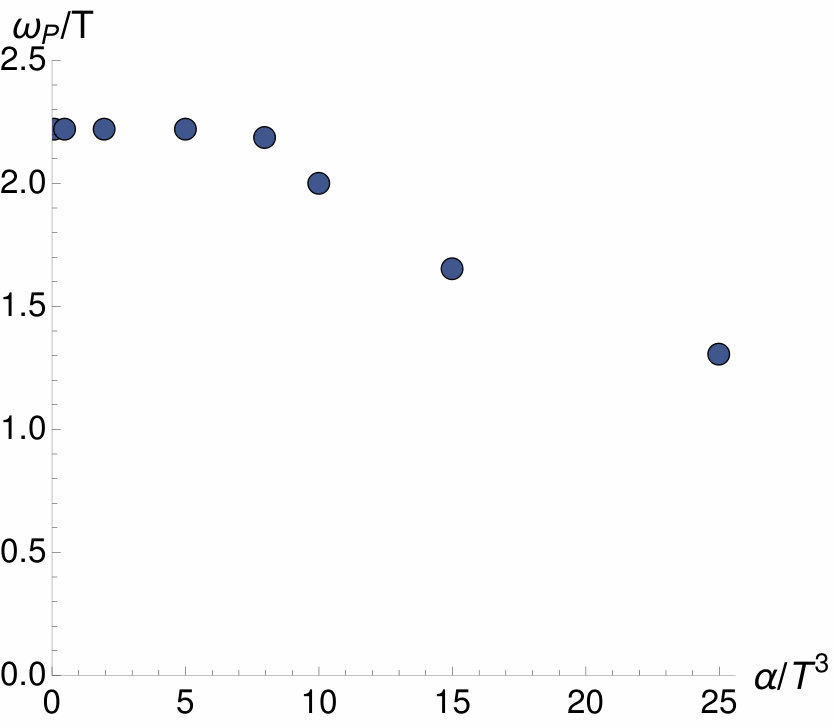 Figure 38
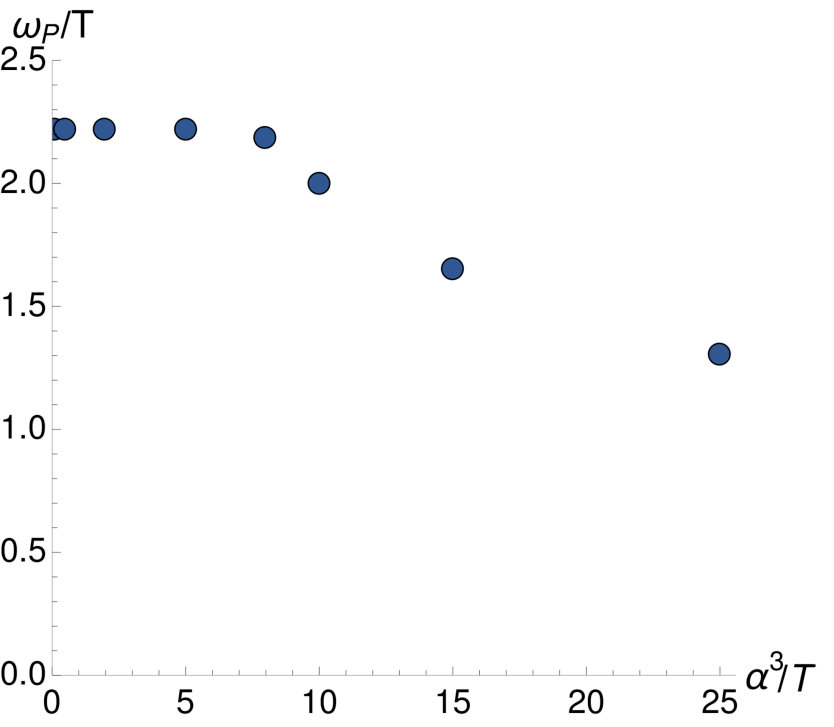 Figure 39
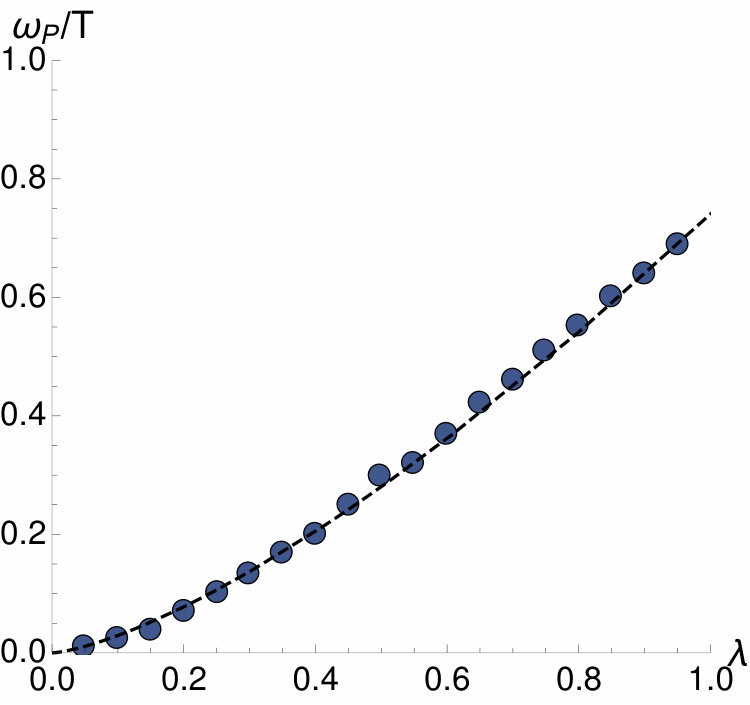 Figure 40
Peer Reviews
No public reviews on file for this paper yet. If you reviewed it on a platform where reviews are public (OpenReview, ICLR, NeurIPS, ICML), you can paste yours below so the community can read it here.
Videos
No videos yet. Explain this paper in a talk, walkthrough, or lecture? Add one.
aainstitutetext: Instituto de Fisica Teorica UAM/CSIC, c/ Nicolas Cabrera 13-15, Cantoblanco, 28049 Madrid, Spainbbinstitutetext: Department of Physics, Division for Theoretical Physics, Chalmers University of Technology SE-412 96 Göteborg, Swedenccinstitutetext: Nordita, Stockholm University and KTH Royal Institute of Technology Roslagstullsbacken 23, SE-106 91 Stockholm, Sweden
Holographic plasmon relaxation with and without broken translations
Matteo Baggioli b
, Ulf Gran a
, Amadeo Jimenez Alba b
, Marcus Tornsö c
, Tobias Zingg
Abstract
We study the dynamics and the relaxation of bulk plasmons in strongly coupled and quantum critical systems using the holographic framework. We analyze the dispersion relation of the plasmonic modes in detail for an illustrative class of holographic bottom-up models. Comparing to a simple hydrodynamic formula, we entangle the complicated interplay between the three least damped modes and shed light on the underlying physical processes. Such as the dependence of the plasma frequency and the effective relaxation time in terms of the electromagnetic coupling, the charge and the temperature of the system. Introducing momentum dissipation, we then identify its additional contribution to the damping. Finally, we consider the spontaneous symmetry breaking (SSB) of translational invariance. Upon dialing the strength of the SSB, we observe an increase of the longitudinal sound speed controlled by the elastic moduli and a decrease in the plasma frequency of the gapped plasmon. We comment on the condensed matter interpretation of this mechanism.
††preprint: IFT-UAM/CSIC-19-54
1 Introduction
Plasma oscillations, whose quanta are called plasmons, are collective electronic oscillations in metals. Their history is an incredible and successful connubium between art and technology. Already in the 4th century, Romans manufactured dichroic glass, used for example in the Lycurgus Cup, where plasmon effects from gold and silver particles dispersed in the glass matrix interplay with transmitted and reflected light at certain wavelengths. These techniques in staining glass where later refined and became one of the major artistic techniques in the Middle Ages schedula , where stunning artworks with stained glass were created, c.f. figure 1. Although plasmonic effects have been known for over a millennium, a complete understanding of the underlying physics of these phenomena was not accomplished until the 1970s, which marks the beginning of modern plasmon-based applications. The technological uses of plasmons have been motivated by the attempt to overcome the diffraction limit of light and by their ability to highly enhance the electric field intensity. The modern applications are limitless, from solar cell and cosmetics to a completely new branch of science known as plasmonics szunerits2015introduction ; Maier:2007:10.1007/0-387-37825-1 .
Plasmons appear as a result of interaction processes between electromagnetic radiation and conduction electrons and their main features can be understood with classical electromagnetism jackson1975classical . The dispersion relation of the longitudinal plasmon modes is characterized by the longitudinal part of the (tensorial) dielectric function – see e.g. nozieres1999theory for details. More precisely, the condition that a plasmon excitation leads to an oscillation in polarization without the influence of a change in external field leads to the condition
[TABLE]
which we therefore will call ‘plasmon condition’ in the following. Using Maxwell’s equations in a medium and basic definitions, the dielectric function can also be shown to be related to other elementary properties, like the conductivity of the material
[TABLE]
where is the vacuum dielectric constant and the spatially resolved longitudinal conductivity. Over a wide range of frequencies, the optical properties of metals can be explained using the free electrons gas approximation. This model idealizes the physics of a metal considering it as a gas of free electrons with number density moving against a fixed background of positive ion cores. The electrons are driven by an applied external electromagnetic field, and their motion is damped with a characteristic collision frequency . The timescale is labelled as the relaxation time of the free electron gas. For a free electron gas it is then a standard calculation to derive the dielectric function111Here, for simplicity, we omit the sub-index indicating that the dielectric function we are after relates to the longitudinal collective modes of the system. nozieres1999theory ,
[TABLE]
where, crucially, we define the quantity
[TABLE]
as the plasma frequency of the metal. Here we use the symbol to denote the effective mass of the electronic quasi-particles, which can differ significantly from the microscopic electron mass222Let us already mention that no quasi-particles are present in the holographic picture we discuss in this paper. Therefore, this weakly coupled logic is a good guidance but it should not be taken too seriously..
For large frequencies , we can neglect the damping effects and the dielectric function is purely real:
[TABLE]
i.e. the known result for the underdamped free electron plasma (without taking into account interband transitions). In the other limit, , the imaginary part of the dielectric function cannot be discarded and the physics is very different. In this last regime, the metals are mainly absorbing and the fields fall off inside the sample following Beer’s law , where is known as the skin-depth. As we will see later, these features can be linked to the so-called -gap dispersion relation Baggioli:2019jcm which will appear in our model as well.
The nature of plasmons in ordinary, and weakly coupled, metals (Fermi liquids) can be understood using rather simple classical models nozieres1999theory and it can be summarized simply as the presence of a sound mode dressed by electromagnetic interactions. It is important to clarify that the sound mode we are discussing is the electronic sound, usually denoted as zero sound. Strictly speaking, this term refers to the sound mode related to the zero temperature shape deformations of the Fermi surface. This hydrodynamic mode can be obtained using Fermi liquid theory PhysRev.159.161 and it is just a manifestation of the elastic property of the electronic liquid PhysRevB.60.7966 . Here, we use the term “zero sound“ in a broader sense, to simply define the collective sound mode of the quantum critical soup both at zero and finite temperature. Despite the similar nature, it is not the normal sound associated with the vibrational modes of the ionic lattice, i.e. the standard phonons. We will discuss this point further in section 6.
The underlying picture is less clear when more “exotic” phases are considered. In particular, recent experiments KNUPFER1994121 ; PhysRevLett.59.2219 ; PhysRevB.43.3764 ; PhysRevB.39.12379 ; 1991PhRvB..44.7155N examined the dynamics of the collective plasmon modes in strongly correlated and quantum critical materials. The results are quite different from the weakly coupled paradigm, in the sense that the plasmon modes display an anomalously strong damping. Not only that, but there are recent observations Mitrano5392 ; husain2019crossover which indicate that when increasing the momentum, plasmons stop existing as well-defined quasi-particles and get smoothed out in the collective and incoherent “quantum soup” losing a characteristic momentum scale. The strong damping of plasmons, even at zero momentum, is expected for strongly coupled quantum critical systems and was first observed in a holographic model in Aronsson:2017dgf . This was later elaborated on in Krikun:2018agd , which promoted the idea that the plasmons are no longer kinematically protected, since the electron-hole (Lindhard) continuum is now substituted by a continuum of modes typical of quantum critical systems. As a consequence, the plasmons can easily decay into such incoherent set of states and therefore display an anomalous and new damping mechanism (even at zero momentum).
The previous discussion leads us to an important point of this paper which is the identification and the analysis of the dielectric relaxation and plasmons damping mechanisms in a strongly coupled medium, as e.g. in a quantum critical phase of matter. Working with linear response, and assuming zero momentum for simplicity, the complex dielectric function controls the relation between the electric field and the polarization ,
[TABLE]
Writing this relation in position space,
[TABLE]
it becomes manifest that a non-trivial dielectric function implies a delay, i.e. relaxation mechanism, between the electric field and the polarization in the material.
The simplest phenomenological model for the dielectric constant is the well-known Debye model. It relies on a single relaxation time approximation for the polarization:
[TABLE]
where the timescale is denoted as the Debye relaxation time. Within this model, the dielectric function can be written simply as:
[TABLE]
where is its value at infinite frequency. The Debye model is justified by a basic molecular framework doi:10.1002/9780470142806.ch5 , but it still clearly represents an approximation and will be insufficient when more involved processes are involved Hill_1985 . It thus stands to reason that particularly in presence of strong coupling and collective dynamics the Debye model has to be extended, and one of the main goals of this paper is to provide further insight into how this extension has to be established. Moreover, along the lines of Aronsson:2017dgf ; Krikun:2018agd , it is important to mention that in the quantum critical systems considered, e.g. strange metals, the electric conductivity displays very peculiar features. In particular, it differs from the standard wisdom (Drude model) and it reads schematically:
[TABLE]
The first term is an important new contribution, denoted as the incoherent conductivity Davison:2015taa , which is not present in Galilean invariant systems and is definitely not considered in the Drude model for free electrons. It is completely insensitive to momentum dissipation and it can be thought of as a quantum critical contribution. From a more microscopic perspective, it can be generated from the production of particle-hole excitations carrying charge but no net total momentum. As a matter of fact, given the relation between the electric conductivity and the dielectric constant (2), it is not suprising that this new term can induce new relaxation phenomena and therefore new contributions to the damping of the plasmons.
In summary, in this manuscript, we aim to investigate in details the relaxation mechanism and the damping of the quantum critical plasmons using simple holographic bottom-up models. We will first discuss the effects of polarization and the similarities/differences with the simple Debye relaxation model. Then, we analyze carefully the dispersion relation of the quantum critical plasmons and in particular their possible overdamped nature. We will discover a peculiar transition between a standard plasmon dispersion relation and a propagating sound wave which in the intermediate regime displays a -gap dispersion relation Baggioli:2019jcm ; Grozdanov:2018fic 333This behavior is quite general for the longitudinal fluctuations, but it has recently discussed also for the transverse sector in specific models Baggioli:2018vfc ; Baggioli:2018nnp ; Grozdanov:2018ewh . One of them is, for example, the linear axions model we consider in section 5.. The -gap simply refers to a dispersion relation of the type:
[TABLE]
where a propagating mode appears beyond a certain cutoff value (see Baggioli:2019jcm ).
Finally, we investigate the role of broken translational invariance on the plasmon dynamics. This last part is entirely new and it is motivated by several recent experimental observations principi2013impact ; viola2018graphene ; doi:10.1063/1.348957 ; doi:10.1021/jp504467j and by the need of making the holographic models more realistic. More precisely, we analyze two different situations:
- •
The introduction of momentum dissipation.
- •
The introduction of phononic degrees of freedom via the spontaneous symmetry breaking of translations.
In order to realize these two patterns we will use a simple holographic massive gravity model introduced in Baggioli:2014roa ; Alberte:2015isw and studied in several directions in e.g. Baggioli:2015zoa ; Baggioli:2015gsa ; Baggioli:2015dwa ; Baggioli:2016oqk ; Alberte:2016xja .
One very important point is to better understand the nature of the longitudinal sound in holography. Even in absence of spontaneous symmetry breaking of translations, the longitudinal sector of the fluctuations display a sound mode which has been identified as the strongly coupled version of the zero sound of Fermi liquids Karch:2008fa ; Kulaxizi:2008kv ; Edalati:2010pn ; Karch:2007pd ; HoyosBadajoz:2010kd . Once SSB of translations is introduced in the model, the nature of that sound mode changes. In particular, the SSB provides a normal sound contribution which is going to be added to the original “zero sound” mode. This can be directly seen in the value of the speed of such a mode. It gets an additional contribution which is proportional to the elastic moduli which becomes more and more dominant at strong SSB. In other words, dialing the strength of the SSB the sound mode crosses over from a “zero sound” nature to a normal sound one (see figure 2). By studying the effects of the electromagnetic interactions on this sound mode we can indeed confirm this picture. While at small SSB, the sound mode gets gapped by the polarization effects, at large SSB it does not. This is indeed the indication that the sound mode becomes the normal sound of the elastic phonons, which, as we know, is not affected by the electromagnetic interactions. Our findings provide new insights on the nature and the dynamics of bulk plasmons and sound modes in the realm of strongly coupled and quantum critical metals.
**Note added: ** As this work was in the final stages, we became aware of Romero-Bermudez:2019lzz which also studies plasmon attenuation in a different holographic model with pseudo-spontaneous breaking of translations.
2 The model
We consider the elementary class of holographic models introduced in Baggioli:2014roa ; Alberte:2015isw and described by the following action:
[TABLE]
where is the Planck energy scale and the AdS radius444Both these quantities are fixed to unit in the computations.. Additionally, we define and the field strength of the bulk field, . We study 4D asymptotically AdS black hole geometries whose metric reads:
[TABLE]
where is the radial holographic direction spanning from the boundary to the horizon, defined through . The are the Stückelberg scalars which admit a radially constant profile with (see Alberte:2015isw for more details) and is the background solution for the gauge field encoding the chemical potential and the charge density as
[TABLE]
where the parameter plays the role of the electromagnetic coupling , determining the strength of the long range Coulomb interactions Aronsson:2017dgf . The blackening factor takes the simple form
[TABLE]
and it vanishes at the horizon location . The corresponding temperature of the dual QFT reads
[TABLE]
while the entropy density is simply . Due to the symmetries of the system only dimensionless quantities are meaningful. For simplicity, without loss of generality, we fix and always refer to dimensionless quantities e.g. , along the paper.
Depending on the choice of the potential , the model defined in (12) realizes different translational symmetry breaking patterns Alberte:2017cch ; Alberte:2017oqx ; Ammon:2019wci . In this manuscript we consider the following cases:
: Section 3.
This corresponds to a Schwarzschild black hole geometry. In this case the dynamics of the gauge and gravitational sectors decouple. 2. 2.
: Section 4.
This scenario reduces to the Reissner–Nordström (RN) background solution. 3. 3.
and : Section 5.
This corresponds to the well-known linear axions model Andrade:2013gsa . 4. 4.
and : Section 6.
For this choice of potential the model exhibits spontaneous symmetry breaking (SSB) of translational invariance and a finite elastic response Alberte:2017oqx .
We consider the longitudinal sector of the fluctuations (see appendix A for more details). In order to take into account the effects of Coulomb interactions and polarization, we follow closely the method introduced in Aronsson:2017dgf ; Aronsson:2018yhi . More precisely, we observe that the fluctuations of the gauge field behave close to the UV AdS boundary () as:
[TABLE]
We can now convert the ‘plasmon condition’ (1) into a modified boundary condition for the gauge field at , by using the relation to the conductivity in (2). This is straightforward to express in terms of the bulk fields using the holographic dictionary, c.f. Aronsson:2017dgf ; Aronsson:2018yhi . This results in the following boundary condition
[TABLE]
assuming, without loss of generality, that momentum is in -direction, and Dirichlet boundary conditions for the other components. The original idea can be found in Aronsson:2017dgf and it has been used extensively in the successive studies of plasmons in holography Aronsson:2018yhi ; Mauri:2018pzq ; Gran:2018vdn ; Gran:2018jnt ; Krikun:2018agd ; Romero-Bermudez:2019lzz . In the rest of the manuscript we will use the boundary condition (18) for the gauge field fluctuations and the standard Dirichlet boundary conditions for the other bulk field fluctuations.
We are interested in the density response of the holographic model which is encoded in the density-density correlator:
[TABLE]
where is identified with the time component of the current operator , dual to the bulk gauge field .
Introducing the deformed boundary conditions (18) corresponds to gauging the U(1) symmetry of the boundary field theory Witten:2003ya . From a technical point of view, this procedure is equivalent to a double trace deformation of the boundary field theory Witten:2001ua ; Mueck:2002gm ; Aronsson:2017dgf ; Mauri:2018pzq ; Krikun:2018agd .
Taking an alternative view, we obtain the physical response function by dressing the density-density correlator via the electromagnetic interactions induced by the, now dynamical, photon. The physical response function can be defined as:
[TABLE]
where , with the electromagnetic coupling appearing in the boundary condition (18). This last result reproduces correctly the outcomes of the RPA approximation nozieres1999theory ; Zaanen:2015oix . In this language, the plasmons are simply the poles of the physical response function, or dressed density-density correlator, and they can be substantially different from the poles of the screened response function (19), which by definition are the quasinormal modes of the system, see e.g. Kovtun:2005ev for more details.
In summary, the main object of our discussion will be the physical response encoded in eq. (20) and the collective excitations appearing therein.
3 The effects of the electromagnetic interactions
We start by considering the model described in eq. (12) in absence of a background charge density, , and in absence of the translations breaking scalar sector, . This choice corresponds to a vanishing background profile for the bulk gauge field . We will study the effects of the electromagnetic interactions through the modified boundary conditions (18) with .
Before proceeding, let us remind the reader about the result for zero charge density and standard Dirichlet boundary conditions, i.e. . Importantly, in this limit the gauge and the gravitational sectors decouple and their dynamics are completely independent. In the gravitational sector, the only hydrodynamic pole in the longitudinal spectrum is a sound mode:
[TABLE]
The sound speed can be computed from the standard thermodynamic relation with the pressure and the energy density of the system. As a consequence of the conformal invariance of the system, the speed is constrained to take the simple value . At the same time, the sound attenuation reads Policastro:2002se ; Policastro:2002tn ; Kovtun:2012rj . On the other hand, the decoupled gauge sector displays a single hydrodynamic diffusive mode which arises from the conservation of the electric current. More specifically, the charge diffusion mode reads:
[TABLE]
where is the electric conductivity and the charge susceptibility. For the background considered here we have and . Therefore we find that:
[TABLE]
which is in perfect agreement with our results in figure 3. Notice how this diffusion constant does not depend on the electromagnetic coupling at zero charge density.
If we extend the analysis to the first non-hydrodynamic mode555We use the standard definition of a hydrodynamic mode, namely a mode satisfying . , we find the presence of a second pole:
[TABLE]
The dynamics of the two modes appearing in eqs. (22) and (24) can be described by the simple equation:
[TABLE]
which gives rise to the recently discussed -gap phenomenon Baggioli:2019jcm . Schematically, the charge diffusion mode collapses at a specific wavelength with the first non-hydro mode and produces a propagating mode at low frequencies and large momenta666This behaviour appeared already in Arias:2014msa ..
In order to compute the QNMs of the system we search for the zeroes of the determinant of the matrix valued bulk-to-boundary propagator Kaminski:2009dh , see appendix 15 for a more explicit discussion. This corresponds to the blue dotted data shown in figure 3. Once we introduce the electromagnetic interactions, by turning on , the picture changes as shown in figure 3. The diffusive mode (22) acquires a finite damping at . The two modes now satisfy a slightly different equation:
[TABLE]
where is the damping of the pseudo-diffusive mode and the asymptotic speed of the propagating mode. Let us remark that these are not the standard quasinormal modes Kovtun:2005ev . It is important to notice that in this sector there is no hydrodynamic mode. The appearance of attenuation (at k=0) for the collective modes Andrade:2017cnc is associated to the non Fermi-liquid nature of the system (see Krikun:2018agd for a thorough discussion on this). The damping coefficient appearing in (26), modelling the “gapping” of the diffusive mode, plays the role of a relaxation rate related to the effects of the electromagnetic interactions and the consequent polarization dynamics of the quantum critical sector. In some sense, this is a built-in feature of the holographic dictionary; as discussed in Aronsson:2017dgf ; Mauri:2018pzq , the modified boundary conditions Aronsson:2017dgf ; Aronsson:2018yhi correspond to a double trace deformation from the dual field theory point of view. In presence of a double trace deformation, the corresponding operator (which is not anymore the U(1) conserved current) acquires an anomalous conformal dimension Marolf:2006nd and it is not conserved. Let us emphasize that the total charge density remains conserved. Formally, we expect that the presence of this relaxation time could be also understood in terms of the global symmetry formulation of dynamical electromagnetism introduced in Grozdanov:2016tdf ; Grozdanov:2018fic ; Hofman:2017vwr .
We are now interested in studying the dependence of the various parameters () as functions of the electromagnetic coupling and the temperature . The first observation, which is already evident in figure 3, is that the damping parameter does not depend on the electromagnetic coupling. From our numerical data (see figure 4) we observe that
[TABLE]
which is a natural outcome since the temperature is the only dimensionful scale available. This frequency is just the first Matsubara frequency in a bosonic theory:
[TABLE]
where . We indeed find evidence for the higher Matsubara frequencies in our numerical data.
On the contrary, the other relaxation scale shown in figure 4, is proportional to the electromagnetic coupling . This means that the associated relaxation mechanism is a direct effect of the long range Coulomb interactions parametrized by . Finally, let us spend a few words about the -gap appearance and the momentum scale at which the two modes collide, i.e. . As is evident in figure 5 its value becomes smaller by increasing the electromagnetic coupling . As shown also in figure 3, at higher values of the collision appears at smaller values of the momentum. Nevertheless, this last feature does not imply that this collision becomes more and more hydrodynamic and relevant at late time. At large values of both the modes are strongly damped and the collision appears at very large and negative imaginary values of the frequency.
In summary, we have noticed that, even in the simple case of zero charge density, the holographic results go beyond the standard weakly coupled picture.
4 Holographic plasmons at finite density
In this section we extend the computations of the previous part to the case of finite charge density, . At this stage, we still have and the system is still translational invariant. In this scenario, the gravitational and gauge sectors are no longer decoupled. The limit is subtle. We emphasize that the analysis of the previous section 3 pertains to the gauge field sector and it does not take into account the decoupled gravitational dynamics.
In absence of Coulomb interaction, i.e. , the longitudinal excitations of the standard Reissner–Nordström background have been intensively studied in the literature Edalati:2009bi ; Edalati:2010hk ; Matsuo:2009yu . In this setup, there are two hydrodynamic modes in the longitudinal spectrum: the sound mode and the charge diffusion mode. As shown in Matsuo:2009yu , their dispersion relations depend non-trivially on the dimensionless ratio .
We now introduce the effect of long range electromagnetic interactions parametrized by the coefficient , c.f. (18). The numerical results of this section were originally presented by some of the authors in Gran:2018vdn ; here we interpret them in terms of a simple effective model.
We proceed by giving a phenomenological but analytic picture of what we expect, which is inspired by Baggioli:2019jcm and references therein.
Assuming a single relaxation time approximation, we can write the coherent part of the conductivity777It is important to notice that we are thinking about the electric conductivity in presence of Coulomb interactions. For a more detailed discussion see e.g. Mauri:2018pzq . as:
[TABLE]
where is the density of charge carriers, their effective mass, their charge and a characteristic relaxation timescale. The ellipsis indicate possible corrections which are subleading in the low frequency/momentum limit. Let us emphasize that the relaxation time is a phenomenological parameter and its nature cannot be identified by any momentum dissipation mechanism. At this stage, momentum is a perfectly conserved quantity. This relaxation time is tied to the presence of electromagnetic interactions and possible polarization mechanisms and it is present even at zero charge density. Technically it is simply a consequence of the double trace deformation encoded in the modified boundary conditions (18). Moreover, at this stage, formula (29) is written in terms of quasi-particles, which are definitely absent in our system. We will amend this flaw later on.
Now, to make progress, we consider the fundamental equation for the longitudinal plasmons
[TABLE]
which was already introduced in the introduction (see nozieres1999theory ; Aronsson:2017dgf for more details about its derivation). At zero momentum, we can simply relate the dielectric function to the frequency dependent electric conductivity:
[TABLE]
where momentum dependent corrections are not taken into account yet. The simplest form for the conductivity can be derived assuming a single relaxation time , in analogy with the Drude model, and more specifically:
[TABLE]
where is the plasma frequency. At this point, the equations are written in terms of the plasma frequency and they do not rely on the existence of well defined quasi-particles. Now, we want to extend the expression (31) to finite momentum. Given the invariance of the system under , the first momentum correction has to be quadratic. More specifically, using dimensional analysis, we can write:
[TABLE]
where is a parameter with the dimensions of a velocity and the minus sign is chosen such that at one recovers a standard sound wave .
All in all, at leading order in momentum, we obtain the final phenomenological expression888A similar formula was suggested in Gran:2018vdn .:
[TABLE]
which derives from two natural assumptions:
- •
A single relaxation time approximation for the momentum independent electric conductivity . This choice displays strong analogies with the Debye relaxation model for dielectric materials doi:10.1002/9780470142806.ch5 .
- •
Considering only the first and quadratic momentum corrections to the longitudinal dielectric function .
Given the order of the polynomial, we will have three different and interacting modes, which give rise to a quite complicated pattern. Let us analyze further the qualitative trend. At , where dissipation is infinite, there is no screening and the dispersion relation is that of a simple propagating wave with speed . In the limit we obtain the simple equation:
[TABLE]
at leading order in . This is the well known expression producing the so-called -gap dispersion relation (11). In particular, the real part of the dispersion relation becomes non-zero only above a certain cutoff momentum, usually called -gap , which can be easily derived as:
[TABLE]
Increasing further the relaxation time , the situation becomes more complicated and all the three modes interact creating a non-trivial interplay. Finally, in the limit of , the dispersion relation becomes simply:
[TABLE]
which is the well-known gapped plasmon mode.
The main result of this section is shown in figure 6 where the numerical data are compared with the analytic predictions. The simple phenomenological expression (34) captures successfully the dispersion relation of the three lowest modes and the complicated interplay between them at low frequency and momentum. Moreover, as shown in figure 7 we find that both the plasma frequency and the effective relaxation scale increase with the dimensionless parameter . More precisely, the plasma frequency goes to zero with following a power-law, while the relaxation time approaches a finite value at . The dependence of and on is shown in figure 8. We find that the relaxation time diverges and the plasmon frequency vanishes as the Coulomb interaction is taken to zero. The behavior of is in agreement with the weakly coupled logic: it grows with the net charge of the system and with the strength of the Coulomb interaction , vanishing in the limit .
We emphasize that in the system under investigation momentum is conserved, so cannot be thought of as the Drude relaxation time. As already mentioned in the previous section, the effective relaxation scale appearing in the model (34) is not derived microscopically and it is understood as an effect of the quantum critical sector of the theory, Krikun:2018agd . It would be desirable to find a more quantitative understanding of the microscopic phenomena governing this effect and its relation to the polarization of the underlying degrees of freedom.
Despite of the surprising success of the simple analytic model (34) in fitting the numerical data, there are several open questions. First, the choice of the model was purely phenomenological. Second, the nature of the relaxation time and the definition of the conductivity (29) is still obscure. Finally, the role of the incoherent conductivity has not been discussed. Our observation is that the introduction of an additional incoherent term in the definition of eq. (34) spoils the agreement with the numerical data.
Before proceeding with the introduction of translational symmetry breaking, let us summarize the dynamics of the modes discussed in this section in a schematic picture (see figure 9).
At finite and zero chemical potential the two sectors are completely decoupled at linear order in the perturbations. The gravitational sector contains a hydrodynamic sound mode and the gauge sector, analyzed in section 3, displays two damped non-hydrodynamic modes. The most damped one does not depend on (to first order in momentum) and will not play any relevant role in the final picture. In contrast, the smallest damping, , increases linearly with . As a consequence, for small coupling this damping is very small and it enters in the hydrodynamic window .
Now, let us switch on a small chemical potential . The chemical potential couples the two sectors and, together with finite electromagnetic coupling , produces the transition of the sound mode into a low momenta diffusive mode. This mode then collides with a second non-hydro mode and produces the -gap picture we see in figure 9. Moreover, due to conservation of momentum, there is always a hydrodynamic mode in the spectrum. Now, at large , the modes stemming from the gauge sector are strongly damped and they do not play any role in the combined dynamics. This is shown in the blue region in figure 9. As discussed in the case, for a small electromagnetic coupling one of the modes of the gauge sector becomes long-living, giving rise to the standard charge diffusion mode in the extreme limit. On the other hand, the modes in the gravitational sector approach each other as decreases and give rise to the sound mode of RN. When the chemical potential is large enough, the two sectors are strongly mixed; the first mode from the gauge sector enters the “hydrodynamic” regime and causes the interplay between the three complex modes discussed in the text, first observed in Gran:2018vdn . In the limit of very large we recover the standard (bulk999Also called a volume or co-dimension zero plasmon, in contrast to surface or interface plasmons. Hence, ‘bulk’ here should not be confused with the bulk spacetime.) gapped plasmon dispersion relation .
5 Plasmons with broken translations
So far, we have considered a holographic background which enjoys translational invariance. Momentum, as an operator of the dual field theory, is a conserved quantity. The momentum conservation equation produces several effects on transport, including an unnatural divergent contribution to the electric conductivity. In realistic condensed matter systems translation (and rotation) invariance is generally broken because of the presence of impurities, disorder or more complicated mechanisms. In this section, we make use of a generalization of the holographic picture that allows to break translational invariance, retaining the simplicity of the framework Vegh:2013sk ; Davison:2013jba . More specifically, we consider the additional scalar sector in action (12) and, without loss of generality, set . The explicit breaking of translational invariance introduces a finite relaxation rate for momentum , related to the mass of the graviton fluctuations, which in our case is determined by the dimensionless parameter . The stress tensor (or at least its spatial component) is not conserved anymore and the corresponding hydrodynamic modes get strongly affected. There is a vast literature on the topic; for more details we refer to Baggioli:2016rdj .
We make use of the linear axions model of Andrade:2013gsa to relax momentum in the dual field theory. The Ward identity for the momentum operator is broken and at linear order101010The linear order approximation corresponds to the limit of slow momentum dissipation . From the bulk perspective it corresponds to consider the graviton mass small compared to the temperature of the system . it reads:
[TABLE]
where the ellipsis indicate higher order corrections relevant for fast momentum dissipation. In the limit of slow momentum relaxation , the relaxation rate is defined (see Davison:2013jba ), by the analytic expression
[TABLE]
where , and are the entropy density, the energy density and the pressure of the system and the graviton mass111111More precisely the mass of the helicity-1 component of the graviton. Notice that the massive gravity theory considered is not Lorentz invariant and therefore the various components of the graviton can acquire different masses Dubovsky:2004sg ; Alberte:2015isw .. At this point, we can investigate the effects of momentum dissipation on the dispersion relation of the plasmons.
Firstly, it is important to remark that we still find the expression obtained in (34) to be a good approximation for the dynamics of the three lowest collective modes in the presence of momentum dissipation. The effect of a finite is simply to renormalize the effective parameters entering in eq. (34). The numerical results are shown in figure 10. Increasing momentum dissipation, the relaxation time entering in eq. (34) becomes smaller. This can be simply understood by introducing a new contribution to the relaxation rate via the inverse Matthiessen’ rule:
[TABLE]
This formula, combined with the momentum relaxation rate defined in (39), approximates correctly at slow momentum dissipation rates as shown in figure 10.
Secondly, we observe that the plasma frequency increases with the momentum dissipation parameter . From a weakly coupled perspective, where the plasma frequency is related to the inverse of the effective mass of the charge carriers , this result is surprising. It suggests that momentum dissipation decreases the effective mass of the charge carriers, while at weak coupling the more scattering events the heavier the charge carriers’ effective mass becomes. However, given the absence of well-defined quasi-particles in the strongly coupled holographic framework arguments using weak coupling are not expected to be applicable. Moreover, we can notice that in the transverse spectrum of the linear axions theory, at , an analogous phenomenon happens. More specifically, at very strong momentum dissipation, a mode with a massive particle dispersion relation appears in the spectrum Baggioli:2018vfc ; Baggioli:2018nnp .
Finally, let us notice that, even in presence of strong momentum dissipation, i.e. , a hydrodynamic mode is present in the longitudinal spectrum. As already shown in Davison:2014lua , such a mode simply corresponds to the conservation of energy and at very strong momentum relaxation, i.e. the usually called incoherent limit, it simply encodes the energy diffusion mode.
6 The effects of the spontaneous breaking of translational invariance
In this last section we consider a different symmetry breaking pattern; the spontaneous breaking (SSB) of translations. We assume121212As shown in Alberte:2017oqx , this concrete choice of the potential does not affect the generality of the picture. Similar results can be obtained using potentials of the form with .:
[TABLE]
and we fix for simplicity . The nature of this second mechanism is very different. The SSB of translations does not introduce any relaxation mechanism but it does give new and dynamical degrees of freedom, which are identified as the Goldstone bosons for translational invariance, i.e. the phonons Leutwyler:1996er . As a physical consequence, the SSB of translations is directly responsible for the elastic properties of the medium landau7 . The strength of the SSB is parametrized by the dimensionless parameter . We will provide more details in the following (see Ammon:2019wci for a recent discussion about the explicit versus the spontaneous breaking of translations in this context).
Importantly, we consider the longitudinal sector of the system and therefore what we discuss is the longitudinal sound131313For a discussion on transverse sound in the same model see Alberte:2017oqx ; Ammon:2019wci .. In contrast to the transverse sound, the longitudinal counterpart is present in both liquids and solids and it usually relates to the compressibility of the material. From a very broad perspective, derived in details in landau7 ; PhysRevA.6.2401 ; PhysRevB.22.2514 , the speed of longitudinal sound in generic systems, displaying the spontaneous breaking of translations, is given by:
[TABLE]
where and are the shear and bulk elastic moduli, and the momentum susceptibility. Just using thermodynamics, the bulk modulus , which is the inverse of the compressibility, can be defined as:
[TABLE]
where is the volume and the mechanical (not the hydrodynamic) pressure, . Importantly, the total compressibility can divided into two contributions:
[TABLE]
where this time is the hydrodynamic pressure , and is the contribution to the bulk modulus which comes directly from the SSB of translational invariance.
Consider a system where translations are not broken, not even spontaneously. It follows that:
[TABLE]
Therefore, the speed of longitudinal sound drastically simplifies into:
[TABLE]
in agreement with hydrodynamics Kovtun:2012rj ; Policastro:2002tn . Moreover, in a conformal field theory, where , the speed takes the constant value , with the number of space-time dimensions. It is illustrative to rewrite the total speed of longitudinal sound as:
[TABLE]
Defining the spontaneous breaking scale as , the first term is , while the second one is . See Ammon:2019apj ; oriolfuture ; Baggioli:2019abx for more details.
This analysis indicates that, even in the presence of SSB of translational invariance, only one sound mode appears in the longitudinal spectrum and its speed is determined by two different contributions:
[TABLE]
as discussed in Delacretaz:2017zxd ; Ammon:2019apj ; Baggioli:2019abx . We will denote the first contribution, , which is finite in absence of SSB, as “zero sound”. The naming and the identification are clearly a stretch, because the presence of a Fermi surface in these systems is far from obvious Kulaxizi:2008kv ; Kulaxizi:2008jx ; HoyosBadajoz:2010kd ; Davison:2011ek . Moreover, such sound mode appears also for bosonic holographic systems Davison:2011uk . Additionally, the label “zero sound” usually refers to zero temperature; here we extend it to finite, but small, temperatures without introducing any further distinction. All in all, for simplicity, we keep the name. In simple terms, we can think of that contribution as the one coming from the “fluid” soup provided by the strongly coupled CFT, the critical continuum of our holographic setup. In our setup, this sector is charged under a U(1), introduced via the Maxwell field of the holographic bulk theory.
The second term in (48), denoted with , is given by the elastic response of the material; it is directly related to the existence of longitudinal Goldstone bosons and it vanishes in the limit of no SSB of translations. We will denote for simplicity this second term the “normal sound” contribution. This second term is tightly connected to the presence of the scalar sector . Importantly, the scalar fields are not charged under the symmetry of the system.
In our holographic setup, we have a dimensionless parameter which determines the strength of the SSB of translations. We can now quantify the speed of longitudinal sound as a function of this parameter. The numerical results, supporting these statements, are found in figure 11. Our results are thus consistent with those from recent preprints Ammon:2019apj ; Baggioli:2019abx . The speed of sound interpolates between two regimes:
For vanishing or small SSB (), the sound is mainly governed by what we called “zero sound” and it is given by the hydrodynamic formula (46). 2. 2.
For large SSB, on the contrary, the sound is mainly controlled by the ordered structure (“lattice”) and its speed is dominated by the elastic contribution, the second term in eq. (47).
This mechanism has been already directly observed in Andrade:2017cnc . Let us notice that this transition between a solid like behaviour, where longitudinal sound is controlled by the elastic moduli as in ordered crystals, and a fluid type regime where sound behaves more like the electron sound of a Fermi liquid, is also evident in several other observables. We can mention for example the shear elastic modulus and the dynamics of transverse shear waves analyzed in Alberte:2017oqx ; Ammon:2019wci . In the limit of large temperatures, compared to the graviton mass governing the SSB, the system loses the elastic properties in a continuous way similar to a glass transition. This observation was already present in several previous works in the literature Andrade:2017cnc ; Alberte:2017cch ; Alberte:2017oqx ; Baggioli:2018bfa ; Andrade:2019zey .
Before switching on the Coulomb interactions, i.e. letting , let us just point the reader to the known results in absence of them. The analysis of the hydrodynamic modes can be found in standard textbooks such as Lubensky ; landau7 or in more modern works such as Delacretaz:2017zxd and it was recently tested in holography in Ammon:2019apj .
Now, we study the behaviour of the system when long range Coulomb interactions are taken into account. A comment regarding our setup is in order here. In some cases in the literature Amoretti:2018tzw , this kind of models have been referred to as Wigner Crystals. Here we argue that there is no concrete indication that this is the case, at least in our particular model. Let us remark that what we mean here with Wigner Crystal is the canonical scenario of a lattice of strongly coupled electrons typical of systems at very low density and temperature PhysRev.46.1002 ; RevModPhys.71.87 . On the contrary, our system is to be understood as follows. The neutral scalar sector, which sets the elastic properties of the material, encodes the phononic degrees of freedom, i.e. the Goldstone modes for the breaking of translational invariance. One can think here of the neutral, acoustic, phonons of a regular rigid structure. Notice that this is an effective field theory (EFT) description of these modes which does neither attempt to describe any microscopic feature of the underlying lattice nor its dynamical formation. On top of that, the charge sector, encoded in the Maxwell fields in the bulk, is coupled to the phonon sector only indirectly via gravity. The long range Coulomb interactions are implemented in the charged sector via modified boundary conditions and they do not affect directly the neutral scalar sector. Importantly, the effect of the charged sector on the system is mediated by the chemical potential and the strength of the Coulomb interactions , while the effect of the neutral sector is governed by the SSB strength . Let us remark that, as we show below, our system has only one mode stemming from the hybridization of the would-be plasmon of the charged sector and the phonon, in contrast to the weakly coupled picture. Qualitatively, our system is more similar to the models used to address the problem of acoustic polarons sumi ; fantoni . This is further supported by our results as we will argue now.
We investigate the low temperature regime as we increase the strength of the SSB, . We already know, from the previous discussion, that in absence of SSB the “zero sound” mode gets gapped at low temperature and it shows the typical plasmonic dispersion relation:
[TABLE]
The main question we address here is how the previous dispersion relation is modified in presence of SSB of translations. The results are shown in figure 12. Increasing continuously the strength of SSB, the gap of the plasmon mode in eq. (49) decreases and the dispersion relation eq. (49) becomes the one of normal, gapless, sound. This is consistent with our picture; the longitudinal sound (phonons) originating from the long range, uncharged, order structure. Within our model, there is a competition between the effects of the spontaneous symmetry breaking and the electromagnetic interactions. The first tends to keep the sound mode gapless and propagating, while the second tends to gap this mode and transform it into a plasmon. It would be interesting to compare to the situation in which the “holographic lattice” is directly charged under the U(1) in the bulk, (as in the case of Aprile:2014aja ).
Finally, let us notice the SSB of translational invariance introduces a new additional diffusive mode in the longitudinal sector, known as “crystal diffusion” Delacretaz:2017zxd . This mode has already appeared in Andrade:2017cnc and it is evident in our spectrum as well. It does not couple to the other modes and it is therefore not qualitatively influenced by the electromagnetic coupling ; it depends on the SSB strength as shown in the bottom panel of figure 12.
In order to make this discussion more quantitative, we plot in figure 13 the dependence of the plasma frequency and the effective relaxation scale as functions of the dimensionless SSB parameter by fitting the data presented in figure 12. We observe that before a certain “critical” is reached, the plasma frequency remains constant and independent on the elastic moduli. After this, the plasma frequency sharply decreases, by increasing the amount of SSB as discussed previously. Only in the low limit, where is independent of , can it be thought of as the sound of a charged fluid. Notice that the critical value at which the plasma frequency starts to decrease is independent of the electromagnetic coupling and in this sense it is rather connected with the property of the background. Interestingly, the transition in the plasma frequency appears to be much sharper than in other observables, see fig 14. In particular, we numerically observe a robust correlation between:
- (I)
The value of at which the dissipative fluids effects (related to the viscosity ) and the elastic effects (governed by the shear modulus ) become comparable. This point qualitatively signals the transition from a viscous fluid to a rigid material.
- (II)
The crossover value of the longitudinal speed of sound between its value typical of a conformal fluid and its maximum value obtained in the limit of where dissipation becomes subleading and the system a perfect solid.
- (III)
The critical value at which the plasma frequency stops to be constant and starts to decrease rapidly in function of .
This correlation is highlighted in figure 14 and it confirms our interpretation of the model at hand. Furthermore, the effective relaxation time seems to decrease with the translational symmetry breaking as well. This feature is slightly counter-intuitive because one does not expect the SSB of translations to contribute to the relaxation of the system. Anyway, let us first remind the reader that the relaxation scale is completely phenomenological and has no direct microscopic interpretation. Moreover, let us notice that in the deep SSB regime, at large , where the physics is more and more that of an ordered crystal141414Despite translations are broken no characteristic lattice length scale is present in this class of models. The background metric remains homogeneous. In this sense, these models, are more similar to amorphous solids or glasses rather than standard crystals with a long-range ordered structure. This was empirically confirmed in Baggioli:2018qwu ., the relaxation time becomes indeed independent of the SSB breaking scale as expected. At the same time, in the same regime, the plasma frequency drops very fast. That said, this is a valuable direction to get a better understanding of these phenomena.
7 Conclusions
In this work we study the effect of the electromagnetic interactions on the density response of simple holographic bottom-up models with and without broken translational invariance. We analyze the dispersion relations of the collective longitudinal modes and their dynamics. We introduce the dynamics of the gauge field and Coulomb interactions using a modified set of boundary conditions Aronsson:2017dgf , corresponding to a double trace deformation in the dual field theory Witten:2003ya ; Mueck:2002gm ; Mauri:2018pzq ; Krikun:2018agd . We focus on the relaxation mechanisms affecting the plasmon modes, relevant for the study of quantum critical and strongly coupled materials.
We review the dynamics of a Maxwell gauge field on the uncharged Schwarzschild background in presence of electromagnetic interactions in the dual theory. There, we observe the appearance of a relaxation time scale proportional to the electromagnetic coupling. Our results suggest this relaxation mechanism should be related to the polarization of the holographic medium and it could be thought of as a quantum critical correction to Debye-type relaxation. It is tempting to associate it to the breaking of the global EM symmetry of Grozdanov:2018fic . The dynamics of the associated mode is indeed in agreement with the quasi-hydrodynamic predictions of Grozdanov:2018fic and the -gap phenomenon of Baggioli:2019jcm . The connection between double trace deformations Marolf:2006nd , the global symmetries picture of Grozdanov:2016tdf and the effects of polarization and screening surely deserves further investigation.
At finite charge density, and linear order in the perturbations, the gauge field couples to the gravitational sector and the dynamics becomes much richer. We discuss a simple phenomenological model (34), which successfully describes the qualitative dynamics of the lowest three modes. Using such a framework, we find that both the plasma frequency and the total effective relaxation time increase with the dimensionless parameter .
We extend the previous results in the literature Aronsson:2017dgf ; Gran:2018vdn by introducing the breaking of translational invariance. This makes the holographic models closer to realistic experimental setups. We consider the introduction of momentum dissipation via a simple effective model known as the linear axions model Andrade:2013gsa . The numerical results confirm that momentum dissipation decreases the relaxation time of the collective modes. In other words, the damping of those modes becomes larger and larger the faster momentum is dissipated, which agrees with the naive intuition. Concretely, we find that the two contributions add up satisfying an inverse Matthiessen’s rule:
[TABLE]
Moreover, we check that for slow momentum dissipation the relaxation time follows indeed the analytic formulas derived previously in the literature Davison:2013jba and obtained using hydrodynamics. We find that the plasma frequency increases with the momentum dissipation rate.
Finally, we analyze the longitudinal collective modes of the system in presence of the SSB of translational invariance. The qualitative results are very interesting. First, we confirm the appearance of the crystal diffusion mode already observed and discussed in the literature PhysRevA.6.2401 ; PhysRevB.22.2514 . More importantly, we identify a crossover between a fluid regime at small SSB and a “crystal” regime at large SSB. In the first limit, the sound propagation is driven by the strongly coupled CFT collective fluid. In this regime the plasma frequency , obtained from the fit to the formula (34), is independent of the parameter . In the second case, however, the sound is given by the elastic moduli of the system and we find that decrease with . In other words, we find a competition between the SSB of translations and the formation of the gap due to long range Coulomb interactions. At infinite , the gap of the sound mode vanishes and the dispersion relation is that of the normal longitudinal sound of systems with spontaneous long-range ordered structures. In that limit, sound is just given by the vibrational modes of the “lattice” and its dynamics is controlled by the elastic properties of the latter. This sound mode effectively does not get affected by electromagnetic interactions and it does not acquire any plasma gap. Our results highlight the qualitative difference between this system and a Wigner Crystal.
Despite the amount of papers on the topic, several important questions have not yet been addressed. An interesting future direction would be to understand the role of our results in relation to the recent experiments performed in strange metals and quantum critical materials Mitrano5392 ; husain2019crossover . Finally, similar dispersion relations have been discussed in the hydrodynamic description of collective modes in Weyl semimetals Gorbar:2018nmg . A -gap dispersion relation for plasmons in type II Dirac semimetals has been suggested in 2019arXiv190410137S and it is possibly measurable. Similar results have also been discussed and experimentally observed in the transverse spectrum of Yukawa fluids PhysRevLett.97.115001 ; doi:10.1063/1.5088141 . Our results can clearly be of help in this direction. We plan to come back to these issues in the near future.
Acknowledgements
We thank Daniel Arean, Aurelio Bermudez, Oscar Henriksson, Niko Jokela, Sasha Krikun, Karl Landsteiner, Koenraad Schalm, Jan Zaanen and Alessio Zaccone for several discussions and helfpul comments. M.B. thanks Martin Ammon, Sean Gray, Sebastian Grieninger, Victor Castillo and Oriol Pujolas for their collaboration on related projects. M.B. acknowledges the support of the Spanish MINECO’s “Centro de Excelencia Severo Ochoa” Programme under grant SEV-2012-0249. M.B. thanks NORDITA for the hospitality during important stages of this project. U.G. and M.T. are supported by the Swedish Research Council. A.J. is supported by the “Atracción del Talento” program (Comunidad de Madrid) under grant 2017-T1/TIC-5258.
Appendix A Equations of motion
We consider the longitudinal fluctuations defined by the following set of fields:
[TABLE]
and we assume the radial gauge . In the following we provide the equations of motion, given the model and the ansatz discussed in section 2.
A.1 Linear axions
For the linear axions potential of section 5 we have:
[TABLE]
[TABLE]
[TABLE]
[TABLE]
[TABLE]
[TABLE]
and
[TABLE]
A.2 SSB model
For the SSB breaking potential of section 6 we have:
[TABLE]
[TABLE]
[TABLE]
[TABLE]
[TABLE]
[TABLE]
and
[TABLE]
Appendix B Numerical techniques
The numerics are carried out in Mathematica, with the packages xAct xAct and xTras Nutma:2013zea .
The seven background equations of motion provide seven linearly independent solutions. Three are found numerically by imposing in-falling boundary conditions at the horizon, and can be characterized by the starting values of , and after factoring out their oscillating behaviour. To simplify the numerics, an analytic expansion is made from the horizon to a small offset, before numerically integrating to the boundary, where a similar expansion is made. The remaining four solutions are found analytically as pure gauge solutions.
A mode is characterized as a non-trivial solution to the set of equations of motion, together with a set of boundary conditions. Six of these boundary conditions are Dirichlet conditions on the metric fluctuations, and . The last condition is (18). As the system is linear, if there is a non-trivial solution to the boundary value problem, it is a linear combination of the seven solutions found above. That means that the sets of boundary values for each of the seven solutions are linearly dependent, and the -matrix formed by them has a vanishing determinant,
[TABLE]
This provides a convenient way of verifying if a choice of and lie on a particular mode, up to chosen numerical precision.
The numerical precision is chosen to be overly strong, as to eliminate potential numerical artifacts, an example of the error in the equations of motion is shown in figure 15.
The reference list from the paper itself. Each links out to its DOI / PubMed record.
- 1(1) T. Presbyter, Schedula diversarum artium . ca. 1100-1120.
- 2(2) S. Szunerits and R. Boukherroub, Introduction to Plasmonics: Advances and Applications . Pan Stanford Publishing, 2015.
- 3(3) S. Maier, Plasmonics: Fundamentals and applications . Springer US, 2007, 10.1007/0-387-37825-1 . · doi ↗
- 4(4) J. Jackson, Classical electrodynamics . Wiley, 1975.
- 5(5) P. Nozieres and D. Pines, Theory Of Quantum Liquids . Advanced Books Classics. Avalon Publishing, 1999.
- 6(6) M. Baggioli, V. Brazhkin, K. Trachenko and M. Vasin, Gapped momentum states , 1904.01419 .
- 7(7) N. D. Mermin, Existence of zero sound in a fermi liquid , Phys. Rev. 159 (Jul, 1967) 161–164 . · doi ↗
- 8(8) S. Conti and G. Vignale, Elasticity of an electron liquid , Phys. Rev. B 60 (Sep, 1999) 7966–7980 . · doi ↗