Is the magnitude of the Peccei-Quinn scale set by the landscape?
Howard Baer, Vernon Barger, Dibyashree Sengupta, Hasan Serce, Kuver, Sinha, Robert Wiley Deal

TL;DR
The paper investigates whether the string landscape influences the Peccei-Quinn scale, suggesting it is set around 10^{11}-10^{12} GeV due to SUSY breaking considerations, with implications for dark matter abundance.
Contribution
It proposes a landscape-based explanation for the PQ scale within a SUSY axion model, linking it to soft SUSY breaking terms and dark matter constraints.
Findings
PQ scale likely around 10^{11}-10^{12} GeV due to SUSY considerations
Anthropic setting of PQ scale is unlikely because of dark matter overproduction
Preferred f_a value aligns with intermediate scale dark matter abundance
Abstract
Rather general considerations of the string theory landscape imply a mild statistical draw towards large soft SUSY breaking terms tempered by the requirement of proper electroweak symmetry breaking where SUSY contributions to the weak scale are not too far from m(weak)~ 100 GeV. Such a picture leads to the prediction that m_h~ 125 GeV while most sparticles are beyond current LHC reach. Here we explore the possibility that the magnitude of the Peccei-Quinn (PQ) scale f_a is also set by string landscape considerations within the framework of a compelling SUSY axion model. First, we examine the case where the PQ symmetry arises as an accidental approximate global symmetry from a more fundamental gravity-safe Z(24)^R symmetry and where the SUSY mu parameter arises from a Kim-Nilles operator. The pull towards large soft terms then also pulls the PQ scale as large as possible. Unless this is…
Click any figure to enlarge with its caption.
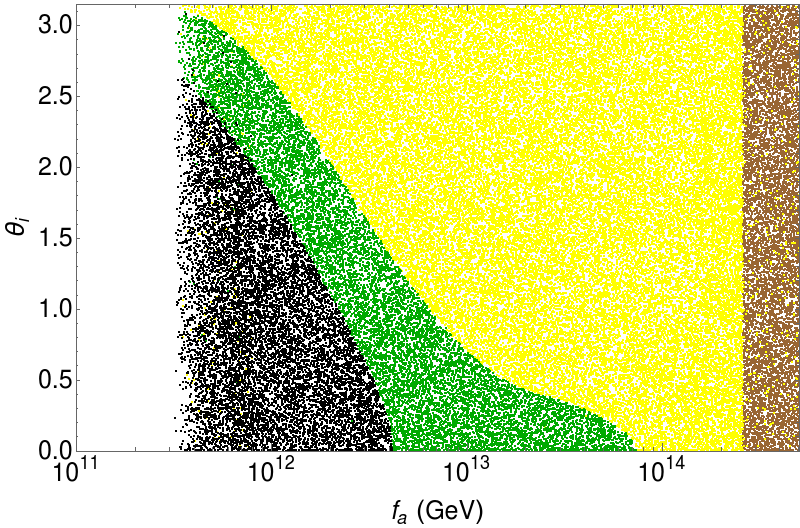 Figure 1
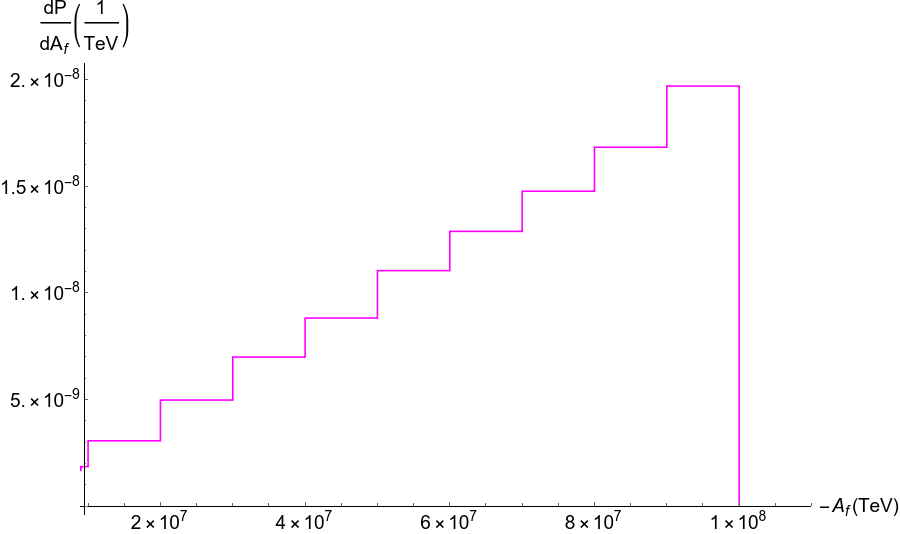 Figure 2
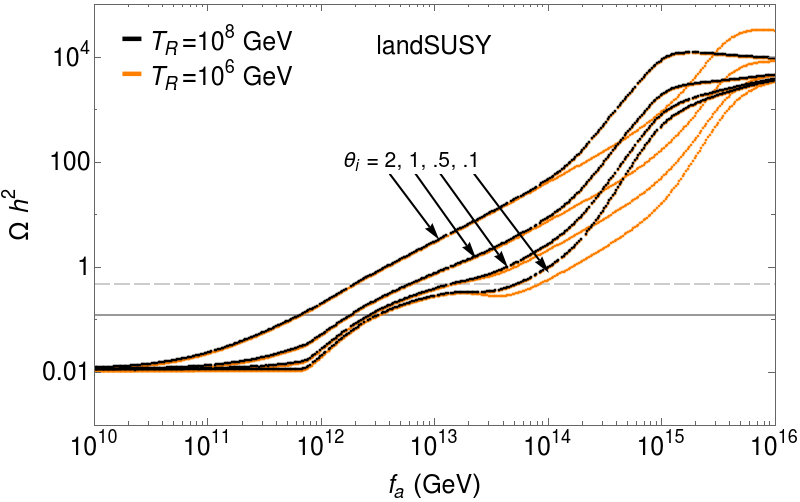 Figure 3
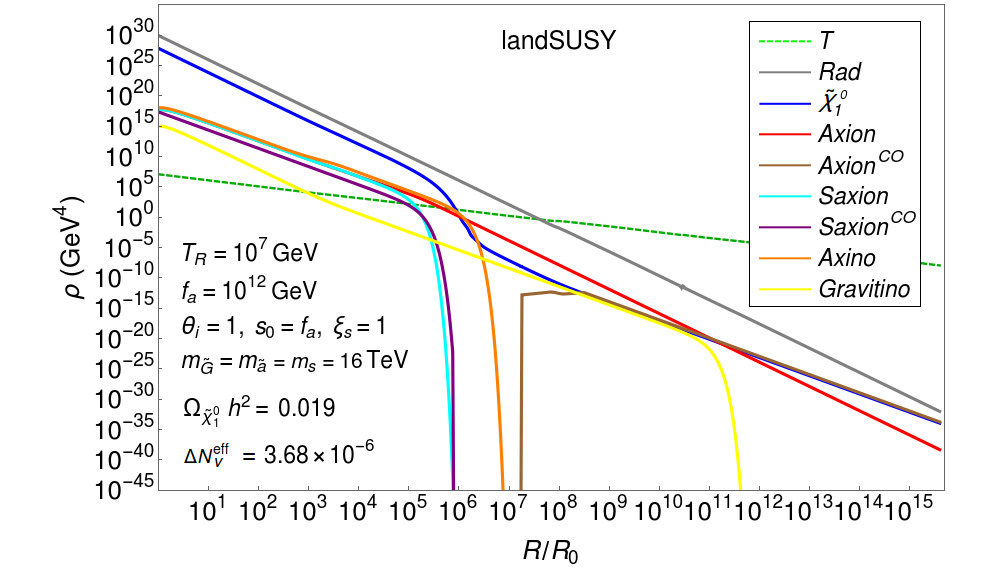 Figure 4
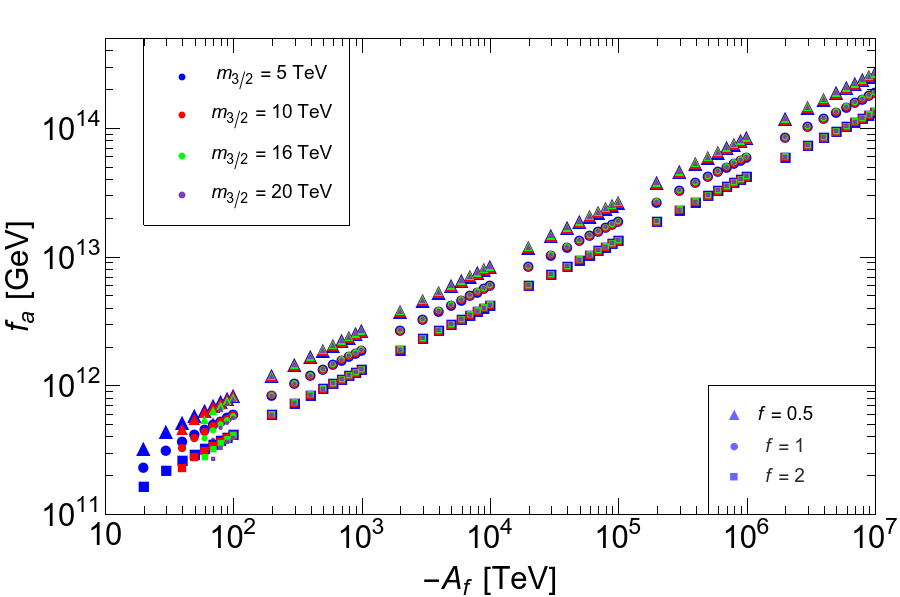 Figure 5
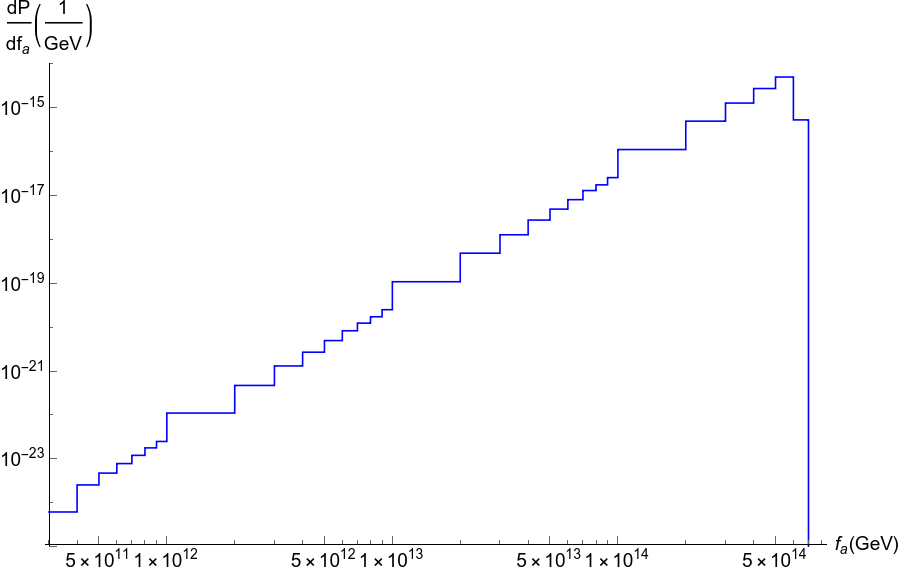 Figure 6
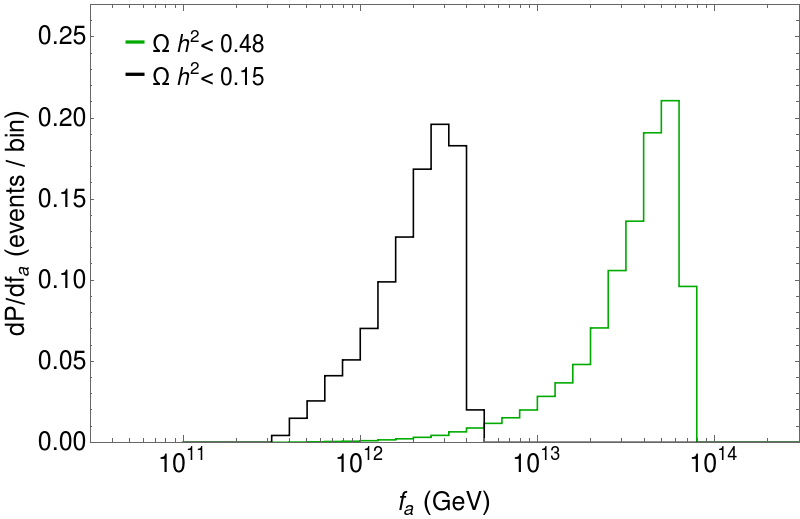 Figure 7
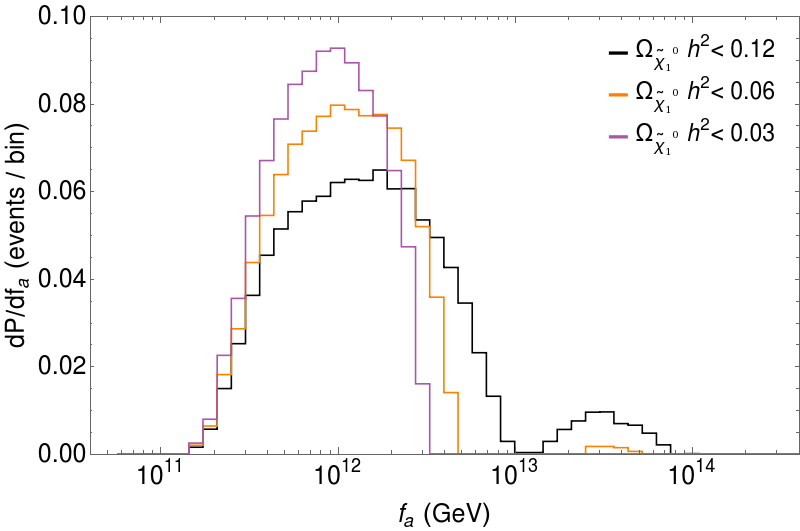 Figure 8
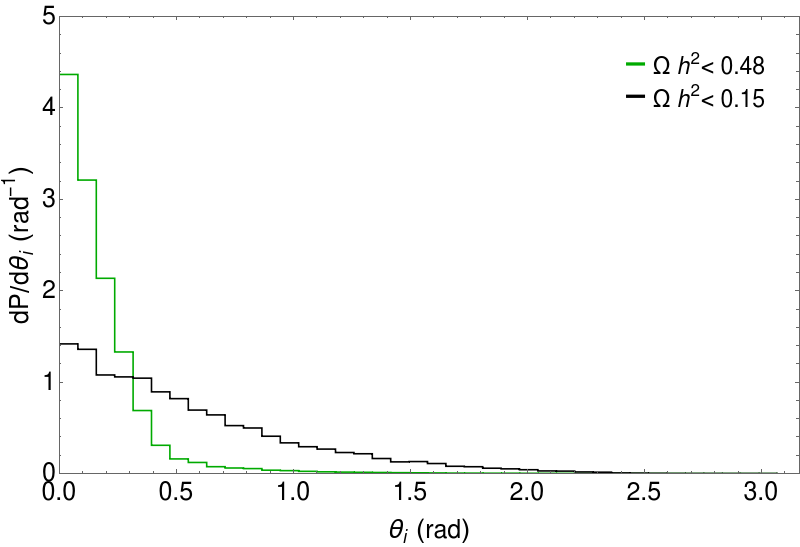 Figure 9
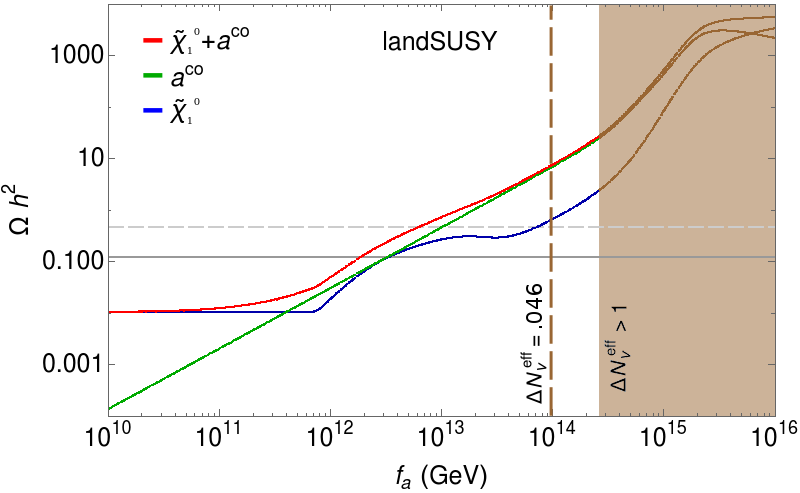 Figure 10
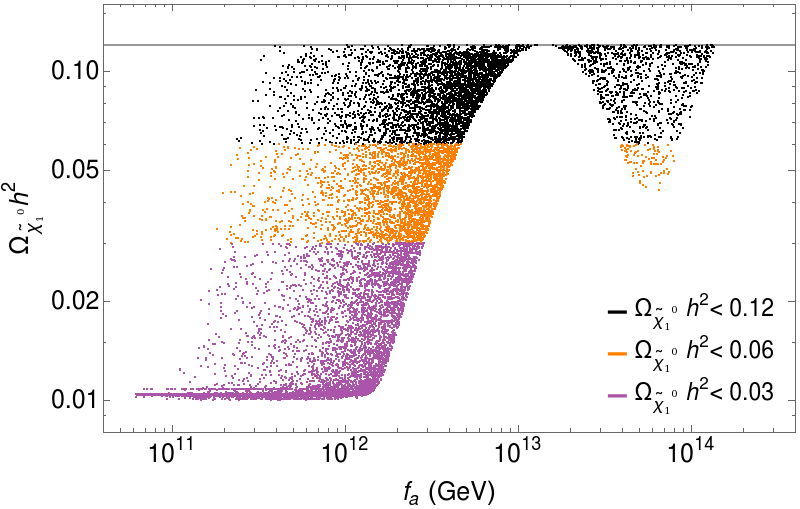 Figure 11
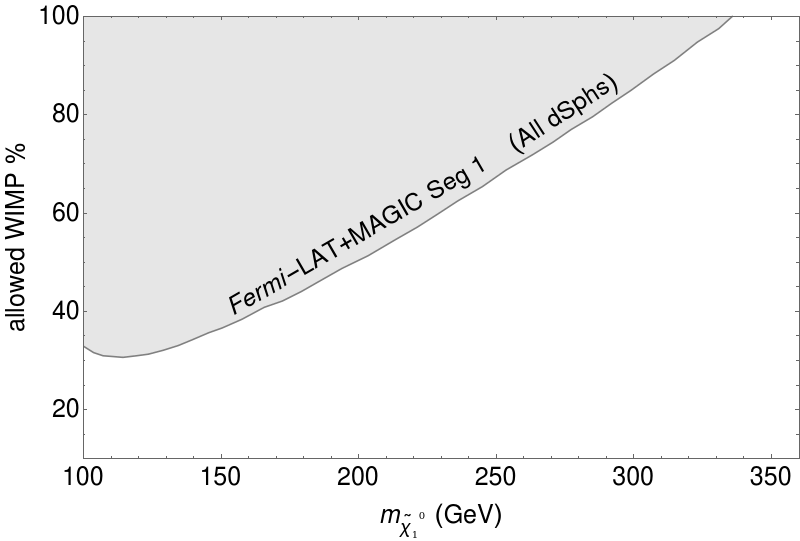 Figure 12
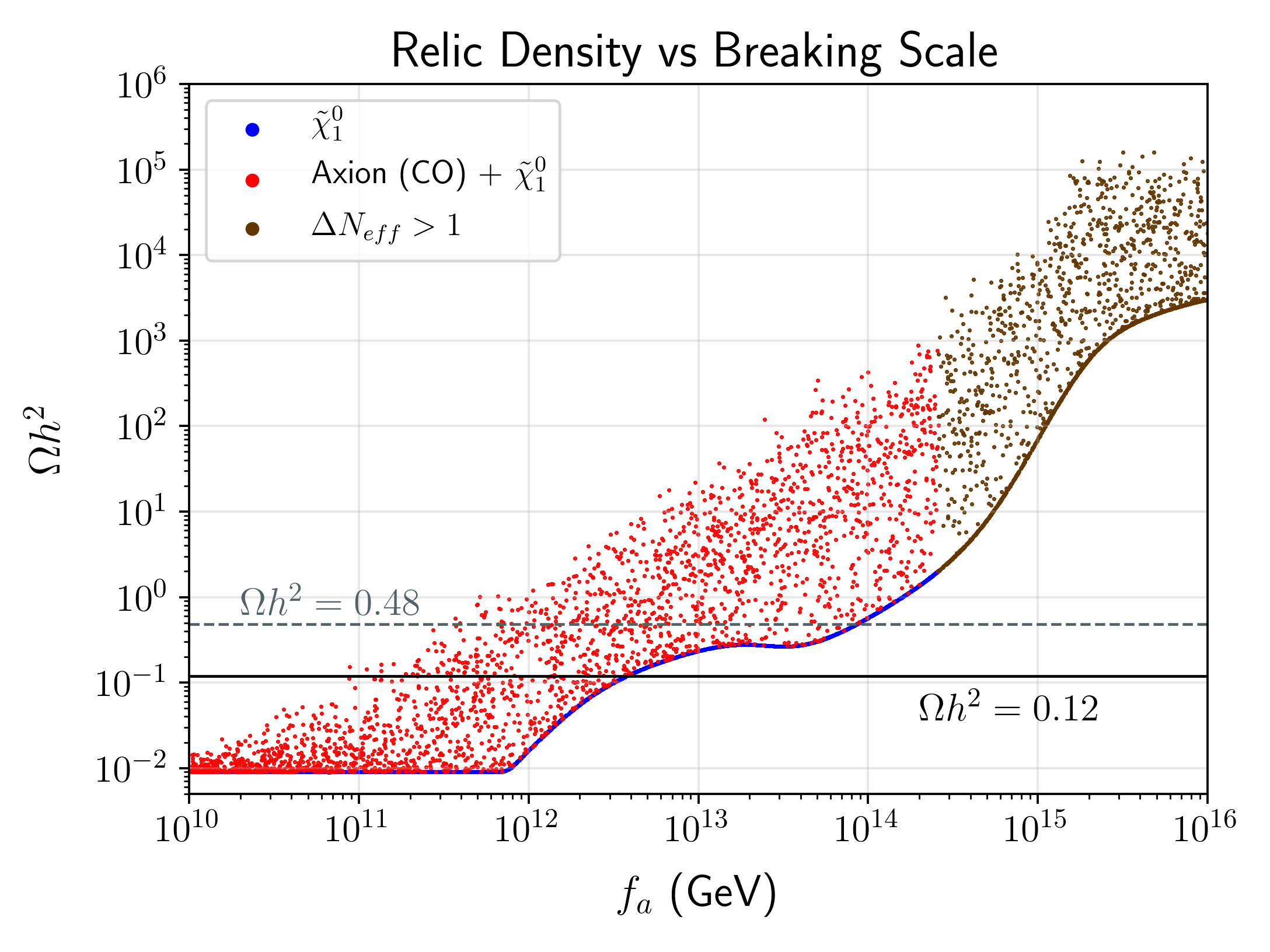 Figure 13
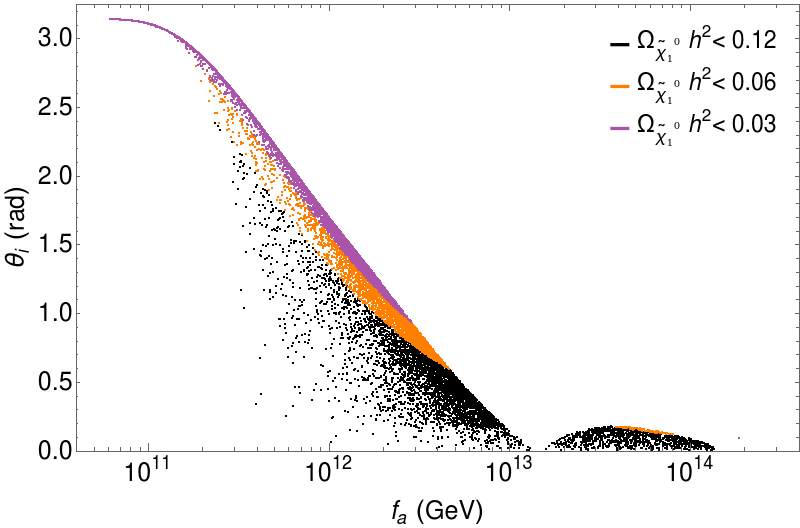 Figure 14
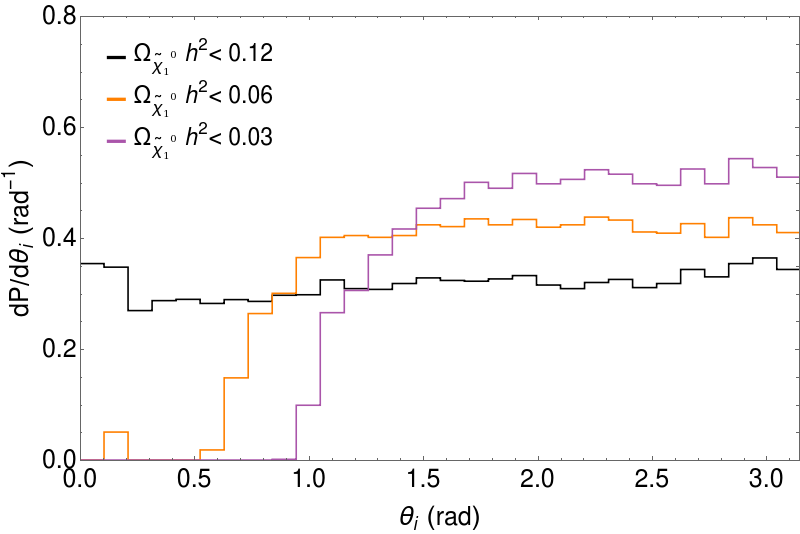 Figure 15
| parameter | landSUSY |
|---|---|
| TeV | |
| TeV | |
| 1.5 TeV | |
| -7 TeV | |
| 10 | |
| 0.2 TeV | |
| 3 TeV | |
| 3619 GeV | |
| 16211 GeV | |
| 16264 GeV | |
| 15956 GeV | |
| 1294 GeV | |
| 3561 GeV | |
| 3605 GeV | |
| 4999 GeV | |
| 4749 GeV | |
| 4982 GeV | |
| 4951 GeV | |
| 210 GeV | |
| 1312 GeV | |
| 200 GeV | |
| 207 GeV | |
| 688 GeV | |
| 1320 GeV | |
| 125 GeV | |
| 0.01 | |
| (pb) | |
| (pb) | |
| (cm3/sec) | |
| 23.3 |
| multiplet | X | Y | ||||||||
| charge | 16 | 12 | 5 | 9 | 5 | 9 | 5 | 1 | -1 | 5 |
| PQ charge | -1 | -1 | 1 | 1 | 0 | 0 | 0 | 0 | 1 | -3 |
Peer Reviews
No public reviews on file for this paper yet. If you reviewed it on a platform where reviews are public (OpenReview, ICLR, NeurIPS, ICML), you can paste yours below so the community can read it here.
Videos
No videos yet. Explain this paper in a talk, walkthrough, or lecture? Add one.
OU-HEP-190501
**Is the magnitude of the Peccei-Quinn scale
set by the landscape?
** Howard Baer1111Email: [email protected] , Vernon Barger2222Email: [email protected], Dibyashree Sengupta1333Email: [email protected]
Hasan Serce2444Email: [email protected], Kuver Sinha1555Email: [email protected] and Robert Wiley Deal1666Email: [email protected]
1*Dept. of Physics and Astronomy, University of Oklahoma, Norman, OK 73019, USA
2*Dept. of Physics, University of Wisconsin, Madison, WI 53706 USA
Rather general considerations of the string theory landscape imply a mild statistical draw towards large soft SUSY breaking terms tempered by the requirement of proper electroweak symmetry breaking where SUSY contributions to the weak scale are not too far from GeV. Such a picture leads to the prediction that GeV while most sparticles are beyond current LHC reach. Here we explore the possibility that the magnitude of the Peccei-Quinn (PQ) scale is also set by string landscape considerations within the framework of a compelling SUSY axion model. First, we examine the case where the PQ symmetry arises as an accidental approximate global symmetry from a more fundamental gravity-safe symmetry and where the SUSY parameter arises from a Kim-Nilles operator. The pull towards large soft terms then also pulls the PQ scale as large as possible. Unless this is tempered by rather severe (unknown) cosmological or anthropic bounds on the density of dark matter, then we would expect a far greater abundance of dark matter than is observed. This conclusion cannot be negated by adopting a tiny axion misalignment angle because WIMPs are also overproduced at large . Hence, we conclude that setting the PQ scale via anthropics is highly unlikely. Instead, requiring soft SUSY breaking terms of order the gravity-mediation scale TeV places the mixed axion-neutralino dark matter abundance into the intermediate scale sweet zone where GeV. We compare our analysis to the more general case of a generic SUSY DFSZ axion model with uniform selection on but leading to the measured dark matter abundance: this approach leads to a preference for GeV.
1 Introduction
The Standard Model (SM) is beset with several fine-tuning problems that call for new physics beyond the SM. These include:
The gauge hierarchy problem[1] wherein the weak scale GeV (where GeV). 2. 2.
The cosmological constant (CC) problem[2] wherein the measured value of the cosmological constant (where naively it is expected that with being the reduced Planck mass). 3. 3.
The strong CP problem[3] wherein the coefficient of the CP-violating QCD Lagrangian term is times its expected value from the ’t Hooft theta vacuum solution to the problem[4].
The most elegant solution to problem #1 is to extend the Poincare’ group of spacetime symmetries to include weak scale broken supersymmetry (WSS)[5, 6] wherein all quadratic divergences to necessarily cancel. WSS is in fact supported by four sets of measurements:
- •
The measured values of the gauge couplings actually unify under Minimal Supersymmetric Standard Model (MSSM) evolution whereas they do not under SM evolution[7].
- •
The measured value of the top quark mass is just right to generate a radiative breakdown of EW symmetry in the MSSM (assumed valid up to scales )[8].
- •
The measured value of GeV falls squarely within the narrow window of MSSM required values where GeV[9] and
- •
the measured value of GeV favors heavy WSS over the SM assuming the measured value of GeV[10].
Early concern over the non-appearance of SUSY particles at LHC Run 2 has been allayed by renewed scrutiny of naturalness measures[11, 12]: updated analyses now require only TeV and TeV[12, 13, 14] as compared to present LHC limits that TeV and TeV. In the MSSM, only higgsinos are required by naturalness to have weak scale masses, and these particles are very difficult (but not impossible) to see at LHC[16, 15].
Some understanding of the magnitude of the cosmological constant has emerged from the string theory landscape of vacua solutions[17]. In a discretuum[18] of vacua states with all possible values for , then one expects as large as possible subject to the requirement that galaxies be able to condense, which is a seeming precondition for a pocket universe containing sentient observers. Indeed, Weinberg[19] used such reasoning to predict the value of to within a factor of several of its value which was measured more than a decade later. Such an anthropic solution to the CC problem emerges naturally from string theory incuding a vast landscape of flux vacua, estimated as such possibilities[20].
The most elegant solution to the strong CP problem involves the introduction of a new global PQ symmetry[21] which is spontaneously broken (SSB) at some scale GeV.111In accord with the PDG[22], we take where is the domain-wall number which is for the DFSZ axion model assumed here. The (pseudo-)Goldstone boson which emerges from SSB, the axion [23], allows for a dynamical relaxation of the QCD Lagrangian terms to zero thus solving the strong CP problem. A remnant of the PQ procedure is the existence of a physical axion particle which also turns out to be a solid candidate for cold dark matter (CDM) in the universe[24]. Remnant axion CDM is being searched for at a variety of experiments, the most sensitive of which are the microwave cavity searches[25]. While the PQ axion solution to the strong CP problem is indeed compelling, it is beset by two problems of its own.
- •
Global symmetries are not respected by gravitational interactions and thus the PQ symmetry is not expected to be fundamental[26, 27]. Instead, PQ symmetry is expected to emerge as an accidental, approximate symmetry from some more fundamental gravity-safe symmetry. To be gravity-safe, the resulting PQ symmetry must be of exceptionally high quality: the PQ breaking contributions to the axionic potential must be suppressed by at least eight powers of [26] in order for : (where stands for generic scalar fields). This is a very high bar to hurdle!
- •
In string theory, many candidate axions can emerge, but with a PQ scale to [28, 29]. Meanwhile, cosmological (dark matter) constraints seem to require GeV[24]. A further problem then is: what accounts for the apparent suppression of the PQ breaking scale?
The goal of this paper is to examine the second of these axionic concerns in the context of the string theory landscape: can the magnitude of the PQ breaking scale be understood from landscape considerations within a well-motivated model for axion (and WIMP) dark matter? A number of previous works have also addressed this question and these will be briefly reviewed in Subsec. 1.1. The first of the PQ concerns–gravity safety– was recently addressed within the context of anomaly-free (up to a Green-Schwarz term) discrete symmetries which forbid the SUSY term while respecting grand unification conditions[30]. It was found in Ref. [31] that two closely related SUSY axion models– dubbed hybrid CCK[32] (hyCCK) and hybrid SPM[33] (hySPM)– were found to be gravity-safe under a discrete -symmetry which also led to
- •
suppression of the SUSY term,
- •
suppression of the various renormalizable -parity violating terms and
- •
suppression of the dangerous dimension-5 proton decay operators,
all while allowing for see-saw neutrinos. In such a setting, the symmetry (and resulting accidental approximate symmetry) are broken as a consequence of SUSY breaking. Thus, the PQ scale emerges as a derived value depending on the soft SUSY breaking terms. We will assume the hyCCK model in Sec. 2 and derive a probability distribution for the resulting magnitude of the PQ scale for an assumed upper bound on the allowed dark matter abundance in pocket universes. Requiring a (pocket) universe without overproduction of mixed axion-WIMP dark matter by a (arbitrary) factor four excess beyond its measured value then leads to a most probable value of GeV. We also derive a probability distribution for the initial axion misalignment angle which tends to favor smaller values of its expected range. Typically this leads to a large overproduction of dark matter beyond its observed value. If one assumes axion-only dark matter, then one may compensate for the large value of by allowing for a small value of the initial axion misalignment angle [34]. In our approach, where SUSY stabilizes the weak scale and the symmetry yields gravity-safety, then WIMPs are also overproduced and a tiny value of cannot save the day for GeV.
Some motivation for our approach comes from earlier analyses by Douglas which explored a statistical approach to the magnitude of the SUSY breaking scale. In Ref’s [35] and [36], it is assumed that all real-valued SUSY breaking scales are equally likely in a fertile patch of the landscape which contains the MSSM as the low energy effective theory. In the case of -term SUSY breaking, since the terms are complex-valued fields and the magnitude of SUSY breaking depends on the modulus of , then one expects the magnitude of soft terms to enjoy a linearly increasing statistical distribution in the landscape. For a variety of hidden sector and -term fields contributing to SUSY breaking, then one expects instead where and where is the number of contributing -term SUSY breaking fields and is the number of -term SUSY breaking fields.
Naively, the increasing soft term prior would suggest soft terms most probably at energy scales far beyond the weak scale. However, Agrawal et al.[37] have computed that if the weak scale is increasing by a factor of 2-5 beyond its measured value, then nuclear physics is modified in ways that are unlikely to lead to a livable universe (as we understand it). Requiring SUSY contributions to the weak scale to be within a factor of a few (four) of its measured value is the same as requiring the naturalness measure[11, 12] [38]. By requiring that the weak scalar potential is properly broken to and no contribution to the weak scale exceeds a factor four beyond the weak scale (in the presence of a natural value of GeV which emerges from our assumed solution to the SUSY problem), then the distribution of soft terms becomes bounded from above. For the case of a mild statistical draw on soft terms, then there is large mixing in the top-squark mass matrix leading to enhanced Higgs mass radiative corrections and hence GeV whilst the gluinos and squarks are pulled beyond LHC search limits[39, 40]. An exception is the SUSY-preserving term which directly contributes to the magnitude of the weak scale and thus must be of order GeV. The parameter leads to a rather light set of four higgsinos whose parameter space is only now beginning to be explored at LHC via the soft dilepton plus jet plus signature[16]. Thus, in the SUSY landscape picture with a mild statistical draw towards large soft terms, the prediction is that the LHC will see exactly that which it does see: a light Higgs of mass GeV with as yet no sign of sparticles[40].
1.1 Review of some previous work
Here, we briefly review some previous related works to give context for our directions.
- •
In Ref. [34], Linde assumes a scenario where inflation continues past the PQ phase transition (which alleviates the axion domain wall problem) giving rise to a uniform axion field strength throughout the observable universe. He argues that an increased value of initial axion field strength by a factor ten in pocket universes leads to an increase in matter content of galaxies by a factor likely leading to conditions hostile to life as we know it. Since , then small values of are favored and hence values of GeV can be accommodated.
- •
In Hellerman and Walcher Ref. [41], the authors examine axion CDM and galaxy formation in a multiverse setting where all other parameters of CDM models are fixed at the values of our pocket universe. By requiring structure formation before the onset of cosmological constant domination, the authors derive upper bounds on the ratio of dark matter-to-baryons which are typically of order while our universe sits at the lower edge of allowed values . They conclude that anthropic constraints are unlikely to explain our observed value of .
- •
In Wilczek and in Tegmark et al. Ref’s. [42, 43], a model with axion-only CDM is assumed where PQ breaking occurs before the end of inflation. For uniform sampling of , then the prior distribution of axion CDM is the mild distribution . Imposing anthropic limits from galaxy formation, star and black hole formation, solar system stability and stiff upper limits on the density of habitable halos, then it is found that the measured DM density is comparable to expectations from the multiverse.
- •
Freivogel in Ref. [44] adopts the same axion-only CDM model as in Ref [43] but then uses Bousso’s causal diamond measure to provide selection constraints. He fixes to its observed value, fixes GeV and allows only the misalignment angle to vary uniformly and calculates the probability of observing a particular value of which is allowed to vary. He finds 68% of observers see and 95% of observers see . In our pocket universe with , he concludes that the observed value of is then reasonable. However, it is not completely improbable to observe values different from our universe.
Some related papers[45, 46, 47, 48] argue that comparable values for and should emerge from the multiverse.
In these works, a particularly parsimonious approach– of the SM amended with a simple axionic extension– is adopted. While admittedly simple, it contains two problems which make them likely unrealistic. First, there is nothing in them to stabilize the weak scale, and thus we would expect a value for the weak scale far beyond its measured value. The inclusion of WSS solves this problem. Second, it is well known that the global needed for an axionic solution to the strong CP problem is intrinsically incompatible with the inclusion of gravitation and with embedding in string theory in particular. In the following, we adopt a particular SUSY axion model based upon a more fundamental discrete -symmetry which may arise from compactification of extra space dimensions in string theory. For a strong enough discrete symmetry, in this case , then the emerging accidental, approximate global PQ symmetry is sharp enough such as to allow for the PQ solution to the strong CP problem.
2 Probability distributions for the PQ scale and
from a SUSY axion model based upon a gravity-safe symmetry
In this Section, we first introduce the gravity-safe hyCCK SUSY axion model where the global PQ symmetry emerges as an accidental, approximate global symmetry from a more fundamental symmetry. Next, we review calculation of the mixed axion-WIMP dark matter abundance using eight coupled Boltzmann equations. Then, we combine statistical selection of the PQ scale with the requirement against overproduction of dark matter within pocket universes which populate an eternally-inflating[49] multiverse to derive probability distributions for the magnitude of the PQ energy scale and also for the initial axion misalignment angle .
2.1 MSSM augmented by gravity-safe PQ sector based on discrete -symmetry
In Ref. [39], probability distributions for Higgs and sparticle masses were derived from the string landscape assuming Douglas’[35, 36] (with ) soft term prior coupled with a veto on non-standard vacua or too large of SUSY contributions to the weak scale. The sampling generates a probability distribution for which peaked at GeV while sparticle mass predictions were characterized by
TeV, 2. 2.
TeV, 3. 3.
TeV, 4. 4.
GeV and 5. 5.
TeV.
In accord with these results, we will adopt for illustrative purposes a SUSY benchmark point from the NUHM3 model[50] with parameters TeV, TeV, TeV, TeV, with GeV and TeV. We generate sparticle mass spectra using Isajet 7.88[51] and find the spectra provided in Table 1 and labelled as landSUSY (landscape SUSY). The spectra lie well within the landscape SUSY predictions for an mild draw to large soft terms[39]. Our final results will hardly depend on significant deviations from the landSUSY benchmark model which mainly sets a natural value for the parameter and the saxion and axino branching fractions which enter into the relic density calculation.
We will augment the landscape SUSY spectra with a PQ sector from the hybrid CCK[32] model where the superpotential is given by
[TABLE]
where we have introduced MSSM singlet fields and with PQ charges listed in Table 2. The hyCCK model is thus a particular example of a SUSY DFSZ axion model where PQ field couples to the two Higgs doublets thus providing a solution to the SUSY problem222When the PQ field couples to the two Higgs doublets, the resulting model is hySPM model which is also an example of a gravity-safe model that solves strong CP problem and the SUSY problem. This model gives values similar to those obtained in the hyCCK model[31].. The model assumes an underlying discrete symmetry which forbids
- renormalizable RPV terms, 2. the usual term and
- dimension-5 proton decay operators while allowing the required Yukawa couplings and see-saw neutrino terms[30].
The lowest order PQ breaking superpotential terms are , and leading to lowest order scalar potential terms suppressed by powers of : thus, the underlying symmetry renders the model gravity-safe according to the KM-R requirements[26]. The required symmetry arises as an accidental approximate global symmetry which arises from an underlying more fundamental discrete symmetry.
The scalar potential for hyCCK, augmented with the corresponding soft SUSY breaking terms, is given by
[TABLE]
Minimization conditions for the hyCCK model can be found in Ref. [52]. The scalar potential develops a non-zero minimum at and for a sufficiently large soft term , thus breaking the underlying and accidental, approximate symmetries. The PQ breaking vev is given by where then . In accord with expectations from supergravity models, we will assume [53]. Thus, in this model, the PQ scale is a derived consequence of SUSY breaking.
The calculated value of is given in Fig. 1 as a function of the soft term assuming various values of and three different values of . From Fig. 1, we see that has a monotonically increasing value with increasing . For a particular value of and if the value of is reduced by a factor of 2, then increases by approximately and if the value of is increased by a factor of 2, then decreases by approximately . Since doesn’t contribute directly to the determination of the weak scale, then there is no (anthropic) upper bound on its value and one might expect and hence to lie far beyond the well-known cosmological sweet spot where GeV[24].
2.2 Relic density of mixed axion-WIMP dark matter
The evaluation of mixed axion-WIMP dark matter from SUSY axion models is more complicated than simply adding the WIMP thermal abundance to the coherent-oscillation-produced axions. To evaluate the mixed neutralino-axion relic density, we apply the eight-coupled-Boltzmann equation computer code developed in Ref’s [54, 55]. For brevity, we will not reproduce here the eight coupled Boltzmann equations which can instead be found in Ref. [54]. The code relies on the IsaReD[56] calculation of which is a crucial input to the coupled Boltzmann calculation. Starting from the time of re-heat with temperature at the end of the inflationary epoch, the computer code tracks the coupled abundances of radiation (i.e. SM particles), neutralinos, axinos, gravitinos, saxions and axions (the latter two consists of both thermal/decay-produced and coherent oscillation-produced (CO) components).
The CO-produced abundance of axions is determined in part by the axion field initial misalignment angle [24, 57]. For numerical analyses, we adopt a simple formula
[TABLE]
where is the anharmonicity factor [57] and is the domain wall number ( for the DFSZ model). In previous work the initial misalignment angle is adjusted to gain the measured value of the relic abundance. In the current work, we will allow for a uniform distribution of values since we are scanning over many pocket universes which arise as subuniverses of the more vast multiverse.
In Fig. 2 we show the energy densities of various species vs. scale factor that influence the ultimate dark matter abundance for the landscape SUSY benchmark point landSUSY in Table 1. Here, is the reference scale factor at the beginning of re-heat and the corresponding temperature is shown by the dashed green line (where instead the -axis is interpreted as temperature in GeV). We take GeV 333This value of is in accord with well-motivated baryogenesis mechanisms such as non-thermal or Affleck-Dine leptogenesis [58]. and GeV and where denotes the initial saxion field value. We also take TeV. The blue curve denotes the neutralino abundance which freezes out at or GeV. The saxion and axion contributions are split into their thermally- and decay-produced components and their coherent-oscillation (CO) produced components. Saxions decay around ( GeV) whilst axinos decay around ( or GeV). The saxion decays depend on a model dependent coupling which governs the saxion decay rate and [54]. We take so these decays are turned on. (Of course, for our case the decay is not kinematically open so decays mainly to but also to other MSSM particles). CO-produced axions (brown curve) start to oscillate around GeV and become the dominant component of dark matter as one enters the era of entropy conservation on the right-hand-side of the plot. Due to late decays of axinos, which occur after neutralino freeze-out, the neutralino abundance increases to
To gain some perspective on the expected relative abundances of mixed axion-WIMP dark matter, in Fig. 3 we show the relic density of mixed axion-WIMP dark matter vs. for the landSUSY benchmark point and with GeV and TeV and where 444Here, the saxion field strength .. The green curve corresponds to the axion relic density while the blue curve corresponds to the WIMP relic density. The red curve shows the total relic density. We see that for low values of , the axion relic density– arising here from coherent oscillations corresponding to Eq. 3– is highly suppressed. Also, the thermally-produced WIMP dark matter is highly suppressed due to the higgsino-like nature of the LSP which enhances its annihilation rate. The WIMP relic density is also highly suppressed by co-annihilations with the slightly heavier higgsinos and . Thus, for GeV, we expect typically an under-production of mixed axion-higgsino DM. As increases, the CO-produced axions steadily increase while WIMPs remain at their thermally-produced level. By GeV, the axino and saxion decay rates are sufficiently suppressed (by ) that they begin decaying into higgsinos after WIMP freeze-out, thus augmenting the WIMP abundance with a non-thermal, decay-produced component. By GeV, then the mixed axion-WIMP abundance saturates the measured value , and where at this point CDM consists nearly equally of axions along with a comparable thermal and non-thermal WIMP component. In this region, the non-thermal WIMP component arises mainly from thermal axino production followed by late decays in the early universe. As increases further, the thermal axino production rate falls off rapidly so that the WIMP abundance levels off. For even higher values of GeV, saxion production via COs becomes large and so saxion-decay produced WIMP production rapidly rises. In addition, the decays sharply increase the already over-produced axions. These relativistic axions also lead to violation of limits on relativistic species present in the early universe characterized in terms of the effective number of neutrinos parameter which we take (very conservatively) to be (brown curve).555 In the Particle Data Book[22], it is tabulated that . For GeV, then entropy dilution of all relics from CO-produced saxions can suppress the mixed axion-neutralino relic abundance.
In terms of the string theory landscape, we see that allowing values of could lead to dark matter overproduction by a factor of compared to its measured value. As noted by Linde and others, it might be hard to visualize the existence of observers in a universe with such an overabundance of dark matter. Precisely how much of an overabundance of dark matter is anthropically too much is an open question. But clearly, if such a limit exists, then it would place an upper limit on the value of . Even requiring a modest factor of four overabundance, indicated by the dashed gray horizontal line, would already require a value GeV. This upper bound is well below the expected magnitude for from string theory where instead GeV is typically expected[59]. The bound on from the axion abundance may be considered a softer bound since it is possible to lower the axion abundance with a smaller value of (although if scans on the landscape, then is to be expected). However, we see that a bound on still obtains from the WIMP contribution to , although this bound on WIMP overproduction occurs at over an order of magnitude higher values: in Fig. 3, GeV occurs from just overproduction of the WIMP component of dark matter.
In Fig. 4, we show the total mixed WIMP plus axion dark matter abundance but this time assuming GeV and GeV with and 2. For GeV, thermal production and late decay of gravitinos can lead to conflict with bounds from late-decaying neutral particles in the early universe: in this case, the gravitino problem[60, 61]. We see that for different values the upper limit on can move around by typically an order of magnitude: nonetheless, an upper bound on from overproduction of dark matter should obtain which is still much less than the the string/GUT scale. We also show variation in the dark matter relic density versus varying . For the DFSZ axion model, the axino and saxion production rates in the early universe hardly depend on [62] (unlike the case of the KSVZ axion model[63]). Some variation in relic density is seen for GeV where gravitino production, which does depend on [64], becomes important and augments the non-thermal WIMP abundance.
2.3 PQ scale from the landscape
In this Subsection, we investigate whether landscape considerations can determine the magnitude of the PQ scale . We assume an statistical draw towards large soft terms which in turn leads to large PQ scales along the lines of Fig. 1 where the PQ scale is related to the breakdown of supersymmetry. For our landscape benchmark point landSUSY, the magnitude of is determined by the quartic soft term . However, since is not connected with EWSB, then it need not be susceptible to the same bounds on MSSM soft terms that emerge from requiring an appropriate breakdown of electroweak symmetry with independent contributions to not more than a factor of a few from its value GeV. Instead, the PQ scale is intimately related to the production of both axion dark matter and (natural) higgsino-like WIMP dark matter.
Since we are working within a multiverse scenario wherein each pocket universe may have different laws of physics, and the multiverse is an expression of the universe emerging from a spacetime continuum characterized by eternal inflation, then of course inflationary cosmology is an essential component of our overall scheme. In inflationary cosmology, the universe has an early exponential expansion phase which drives the universe to flatness, which requires an overall energy density teetering on the boundary between an open or a closed universe. Such a universe is characterized by the overall energy density lying at its critical closure density:
[TABLE]
and where for an inflationary universe which gives rise to a flat geometry. For our pocket universe, the measured value of the Hubble constant is km/s/Mpc with but for other pocket universes then will be different depending on the various constituencies. We will adopt as usual equal to the value of our universe since we are assuming a “friendly” fertile patch of the multiverse where the SM remains as the low energy effective theory.666 Anthropic arguments usually depend on a so-called “friendly” landscape wherein one focuses on most parameters asuming their SM values so as to retain predictivity[65]. Sometimes these are called fertile patches of the landscape of vacua since they should lead to the standard cosmological and particle physics models aside from just the few mass scales which may scan in the multiverse. Thus, in the fertile patch of multiverse assumed here, only , and are assumed to scan. The scanning of the soft term sets the value of for otherwise fixed values of scalar masses as expected for our landSUSY benchmark point: i.e. we assume a common value of all scalar masses . We allow smaller values of as occurs in the mini-landscape picture wherein third generation fields lie on the bulk of the compactified orbifold whilst first/second generation fields lie near orbifold fixed points[66].
The generated probability distribution for is shown in Fig. 5a), which is seen to rise linearly as expected. For a given value of , then the value of is determined by the minimization conditions arising from Eq. 2. In frame b), we show the derived distribution . Here, the probability distribution is seen to favor the highest values of possible, which would be generated from very large values of .
At this point, our prior distribution for is set, but we will also need some selection criterion to avoid exploding up to huge values, leading to perhaps a gross overproduction of dark matter. Thus, the question now is: how much dark matter is too much dark matter for our fertile patch of pocket universes within the greater multiverse? Some of the papers of Subsec. 1.1 have entertained values of as high as 25-100.
For illustrative purposes, we will consider the effect of limiting pocket universes to a modest bound of four times greater dark matter density than in our universe: suppose . Such a bound would saturate the case where we maintain our measured value of but allow the dark matter abundance to nearly saturate at the expense of a dark energy component. Such models were commonly contemplated before the discovery of a non-zero dark energy component.
In Fig. 6(a)), we show the resulting probability distribution which results from an draw on coupled to an anthropic/cosmological selection bound (green curve). Even with our proposed modest selection bound, we see that the value of is driven to its nearly maximal value such as to avoid overproduction of dark matter. From the plot, we would expect that a value of GeV or only somewhat lower, with a rather sharp cutoff GeV. For comparison, we also show the black histogram where we instead require that the upper bound on dark matter abundance is only slightly beyond our measured value: . This case would prefer GeV.
Let us compare the results of Fig. 6(a)) with those of Fig. 7 which shows the allowed mixed axion-WIMP dark matter abundance for our landSUSY benchmark point in the generic SUSY DFSZ axion model while scanning uniformly over and uniformly over . From Fig. 7, we see that for GeV, we are already overproducing dark matter compared to our universe with . There is only a miniscule probability to obtain from Fig. 6(a)) values low enough to match the measured value, which occurs for – GeV. In the references from Subsec. 1.1, large values of GeV could be compensated for by selecting on small values of . For our case of natural mixed axion-WIMP dark matter, this compensation is not permitted because large also leads to large (non-thermal) overproduction of WIMP dark matter via delayed axino and saxion decays in the early universe. From Fig. 6(a), we would expect that if the landscape is involved in determining the PQ scale , then its value should be very near the maximally allowed abundance of DM in pocket universes such as to allow observers to exist. But it is hard to believe that our pocket universe’s value of dark matter abundance is nearly anthropically maximal (as depicted by the black curve of Fig. 6(a)).
In Fig. 6(b)), we show the corresponding distribution from the pull on soft terms coupled with our modest anthropic veto that . The plot shows a probability that is peaked around its smallest allowed values. This is easy to understand in that while the landscape prior strongly favors large values of , from Eq. 3 we see that overproduction of axions can be avoided by selecting only those vacua with correspondingly tiny values of . This effect is easily understood from Fig. 8 where we show regions of the vs. plane for our landSUSY benchmark point which lead to (green points) or (yellow points). The brown points denote where also . From the figure, we see that for large GeV, only a small range of allows for non-overproduction of dark matter. And once GeV, then no value of is possible which allows one to avoid DM overproduction.
3 Prediction of PQ scale from generic SUSY DFSZ
axion model with uniform scan on
In Sec. 2, we adopted a particular gravity-safe SUSY axion model based on a discrete -symmetry and the hyCCK superpotential Eq. 1 to show that a statistical draw towards large soft terms also yields a draw to large PQ breaking scale . The value of gains an upper bound by requiring no overproduction of dark matter. For the modest assumption of less than a factor four times the measured abundance of dark matter, then we found GeV which is well below the values expected from pre-landscape string theory but which typically leads to much more dark matter production than we observe in our universe.
In this Section, we try to be more general by eschewing a particular SUSY axion model and instead assume a generic SUSY DFSZ axion model[54] where is an input instead of an output parameter. In this case, we will adopt a uniform distribution in in accord with expectations from the landscape, but then require that the dark matter abundance lie at its measured value: . From this, we can then determine the necessary value of such that, for scanned values of , and , the measured abundance of mixed axion-neutralino dark matter is obtained. We will scan uniformly over each of and TeV.
For a SUSY benchmark point within a two-component dark matter framework, direct and indirect WIMP dark matter searches can put a stringent upper limits upon the neutralino density which are more severe than the measured value, . In many cases, indirect DM detection (IDD) offers the most contraining limits on the non-thermal, decay-produced neutralinos for models with thermally underproduced higgsino-like neutralinos. In natural SUSY models from the landscape, thermally produced neutralinos typically make up 5-20% of the total CDM density which renders them safe from Fermi-LAT+MAGIC[67] limits on overproduction of gamma rays in dwarf spheroidal galaxies[68]. In Fig. 9, we show the allowed percentage of WIMP dark matter compared to along with the Fermi-LAT+MAGIC IDD limit for our landSUSY benchmark point. If we increase GeV, then GeV and all generated points would be Fermi-LAT+MAGIC allowed. The gray-shaded region shows the excluded WIMP composition for all landSUSY points within a good approximation.
In Fig. 10, we work within the SUSY DFSZ axion model using again our landSUSY benchmark point but with input parameters and . Here, we fix GeV and but allow , and to scan over the range given above with a uniform scan on and a log prior scan on . We only accept solutions with . We show the parameter space with augmented neutralino densities and 0.03 with black, orange and purple colors respectively. We impose an upper limit on () so that the highly fine-tuned region is not present in our analysis.
In Fig. 10 frame a), the resulting abundance of neutralino dark matter is shown while the remainder of DM is made of DFSZ axions. The horizontal line around GeV is just the expected thermal abundance of 200 GeV higgsino-like WIMP dark matter. For higher GeV, then non-thermal LSP production begins to occur where axinos can be produced in the early universe and decay to LSPs after neutralino freeze-out. There is a gap around GeV where axino decays are still contributing to the neutralino density. For GeV, points again become allowed due to diminished thermal production of axinos in the early universe. The WIMP abundance increases for GeV due to increasing CO-production of saxions which then decay (in part) to WIMPs[54]. An upper limit of GeV ensues in this case since for large , the DM is always overproduced. There is no conflict here with Fig. 7 since in this case with random values of and , then relative axino and saxion production and decay rates can vary which leads to allowed points for GeV.
The corresponding correlation of with the required value of to make is shown in frame b). Here, large values of are correlated with low values of to boost the axion production to gain accord with the measured relic abundance. For very large , then consequently small values of are required to allow for .
In frame c), we show the resulting probability distribution versus . Including all points with the measured abundance, then one obtains the black histogram which peaks around GeV but with a tail extending to over GeV. For the cases in which neutralino makes less than half of the measured DM density, the peak shifts to lower values of (orange and purple histograms) with a small probability at high .
In frame d), we show the probability distribution for the three cases considered. Here, the black histogram is almost uniform across its range whilst the orange histogram displays a gap at small where no allowed solutions occur. The high region does not show up for and can only take values greater than 1 when the neutralino makes less than 25% of the total DM abundance (purple).
4 Conclusions
In this paper we have sought to answer the question: is the magnitude of the PQ scale set by the landscape, or by something else? To address this question, we have adopted the scenario advocated by Douglas wherein the soft terms are statistically favored by a prior distribution and where we take the value (i.e. a linear distribution favoring large soft SUSY breaking terms). Along with this prior distribution, we invoke a selection criteria that vetos models with inappropriate EW breaking (CCB minima or no EWSB) and vetos models with contributions to the weak scale (corresponding to ) in accord with nuclear physics constraints derived by Agrawal et al. on anthropically allowed values for the weak scale. Such an approach receives support in that previously it has been shown that (or 2) has a most probable Higgs mass of GeV whilst lifting sparticle masses beyond the reach of Run 2 of the LHC.
We implement this approach within a highly motivated SUSY axion model labeled as hyCCK. We feel this is an improvement upon previous work in that the model
- stabilizes the weak scale via SUSY, 2. solves the strong CP problem via a gravity-safe discrete symmetry which gives rise to an accidental, approximate global , 3. solves the SUSY problem[69] via the presence of a Kim-Nilles superpotential[70] and 4. explains -parity conservation and proton stability as consequences of the more fundamental which could arise from compactification of extra space dimensions in string theory. By choosing a MSSM benchmark point in accord with landscape predictions and allowing for the PQ soft term to scan linearly and to set the magnitude of the PQ scale , then we find that as large as possible values of are statistically prefered. In this approach, typically both WIMP and axion dark matter are overproduced. Axions are overproduced via vacuum misalignment at GeV unless the large value of is compensated for by a small value of . However, since WIMPs are also overproduced at large , due to axino and saxion production coupled with delayed decays to SUSY LSPs after neutralino freeze-out (i.e. non-thermal WIMP production), then even with small one cannot avoid overproduction of mixed axion-WIMP dark matter. From this approach, using even a modest DM overproduction bound of a factor four, then there is only a tiny probability to gain the measured value of dark matter density in our own pocket universe. Thus, the answer to the question posed in the title is: No, in our well-motivated landscape SUSY model based upon gravity-safe, electroweak natural hyCCK SUSY axion model, the magnitude of the PQ scale is highly unlikely to be set by the landscape.
Instead, an alternative but perhaps underappreciated mechanism is available to set the magnitude of the PQ scale. This is that in generic supergravity models with hidden sector SUGRA breaking via the superHiggs mechanism, then soft terms arise from SUGRA breaking with magnitudes of order the gravitino mass . For a well-specified hidden sector, then the soft terms are all calculable and correlated. For our landscape SUSY model with , we would also expect TeV. This places us from Fig. 1 into the zone where GeV which is the sweet spot for generating a thermal underabundance of higgsino-like WIMP dark matter but with mainly SUSY DFSZ axion dark matter.
In Sec. 3, we implemented instead a uniform scan over and a scan over independent , and values with the corresponding value such that . In this case, we are pushed to the cosmological sweet spot where GeV.
From our overall approach, we understand why WIMPs haven’t yet been detected: it is because they make up only a small portion of the total dark matter. In addition, even though the non-thermal decay-production of WIMPs is allowed for, more than 40% of the points in Fig. 10a) (Sec. 3) still have the same neutralino abundance as the thermally-produced value. Nonetheless, WIMP discovery should be possible at multi-ton noble liquid direct WIMP detection experiments[71]. Axions– while likely to make up the bulk of dark matter– are much more difficult to detect since the presence of higgsinos in their coupling diagram suppresses their detection rate compared to KSVZ or non-SUSY DFSZ axion models[68]. Meanwhile, sparticle detection may be possible at HL-LHC via the soft OS dilepton+jet+MET channel which arises from direct higgsino pair production[16]. Detection of gluinos, top squarks or winos might be possible at HL-LHC if we are lucky, but otherwise may have to await construction of higher energy colliders[14].
Acknowledgements: This work was supported in part by the US Department of Energy, Office of High Energy Physics. The computing for this project was performed at the OU Supercomputing Center for Education & Research (OSCER) at the University of Oklahoma (OU).
The reference list from the paper itself. Each links out to its DOI / PubMed record.
- 1[1] E. Witten, Nucl. Phys. B 188 (1981) 513; R. K. Kaul, Phys. Lett. 109B (1982) 19.
- 2[2] S. Weinberg, Rev. Mod. Phys. 61 (1989) 1.
- 3[3] R. D. Peccei, Adv. Ser. Direct. High Energy Phys. 3 (1989) 503.
- 4[4] S. Weinberg, Phys. Rev. D 11 (1975) 3583; G. ’t Hooft, Phys. Rev. Lett. 37 (1976) 8.
- 5[5] S. Dimopoulos and H. Georgi, Nucl. Phys. B 193 (1981) 150; S. Dimopoulos and H. Georgi, Phys. Lett. 117B (1982) 287.
- 6[6] H. Baer and X. Tata, “Weak scale supersymmetry: From superfields to scattering events,” Cambridge, UK: Univ. Pr. (2006) 537 p.
- 7[7] S. Dimopoulos, S. Raby and F. Wilczek, Phys. Rev. D 24 (1981) 1681; U. Amaldi, W. de Boer and H. Furstenau, Phys. Lett. B 260 , 447 (1991); J. R. Ellis, S. Kelley and D. V. Nanopoulos, Phys. Lett. B 260 (1991) 131; P. Langacker and M. x. Luo, Phys. Rev. D 44 (1991) 817.
- 8[8] L. E. Ibanez and G. G. Ross, Phys. Lett. 110B (1982) 215; K. Inoue et al. Prog. Theor. Phys. 68 , 927 (1982) and 71 , 413 (1984); L. Ibañez, Phys. Lett. B 118 , 73 (1982); H. P. Nilles, M. Srednicki and D. Wyler, Phys. Lett. B 120 (1983) 346; J. Ellis, J. Hagelin, D. Nanopoulos and M. Tamvakis, Phys. Lett. B 125 , 275 (1983); L. Alvarez-Gaumé. J. Polchinski and M. Wise, Nucl. Phys. B 221 , 495 (1983); B. A. Ovrut and S. Raby, Phys. Lett. B 130 (1983) 277; for a review, see L. E