Higher Arity Self-Distributive Operations in Cascades and their Cohomology
Mohamed Elhamdadi, Masahico Saito, Emanuele Zappala

TL;DR
This paper explores higher arity self-distributive operations, their cohomology, and geometric interpretations, extending classical binary operations to n-ary cases with applications in topology and algebra.
Contribution
It introduces mutually distributive n-ary operations and a corresponding cohomology theory, generalizing binary cases and linking algebraic structures to geometric link invariants.
Findings
Defined mutually distributive n-ary operations
Established relations between cohomology groups of different arities
Provided examples from Lie algebras, coalgebras, and Hopf algebras
Abstract
We investigate constructions of higher arity self-distributive operations, and give relations between cohomology groups corresponding to operations of different arities. For this purpose we introduce the notion of mutually distributive -ary operations generalizing those for the binary case, and define a cohomology theory labeled by these operations. A geometric interpretation in terms of framed links is described, with the scope of providing algebraic background of constructing -cocycles for framed link invariants. This theory is also studied in the context of symmetric monoidal categories. Examples from Lie algebras, coalgebras and Hopf algebras are given.
Click any figure to enlarge with its caption.
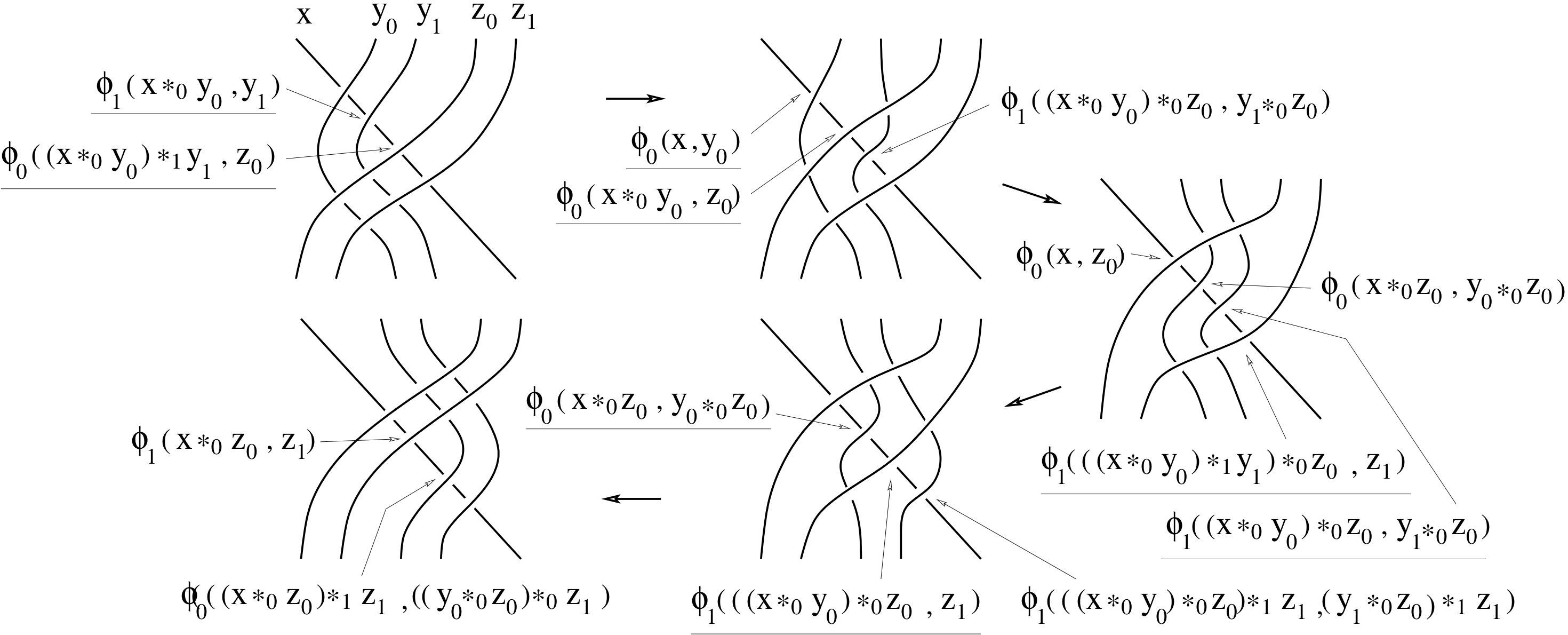 Figure 1
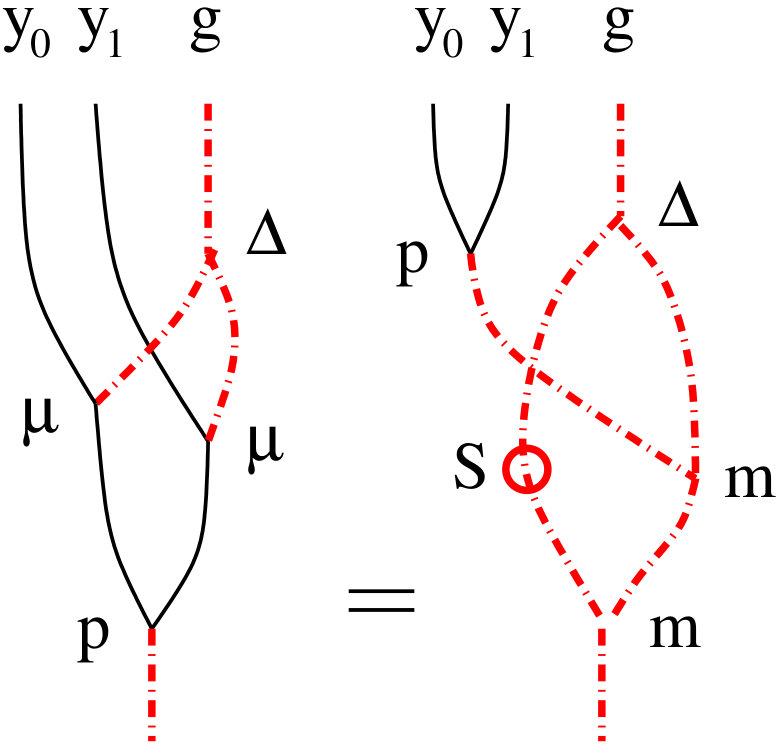 Figure 2
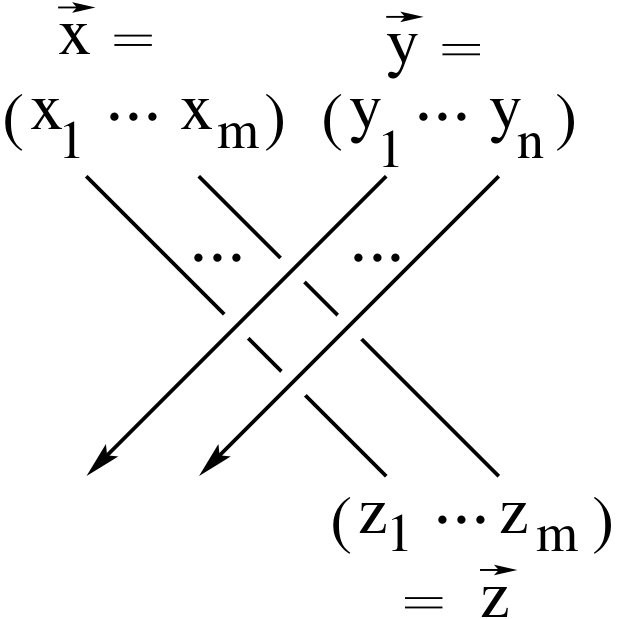 Figure 3
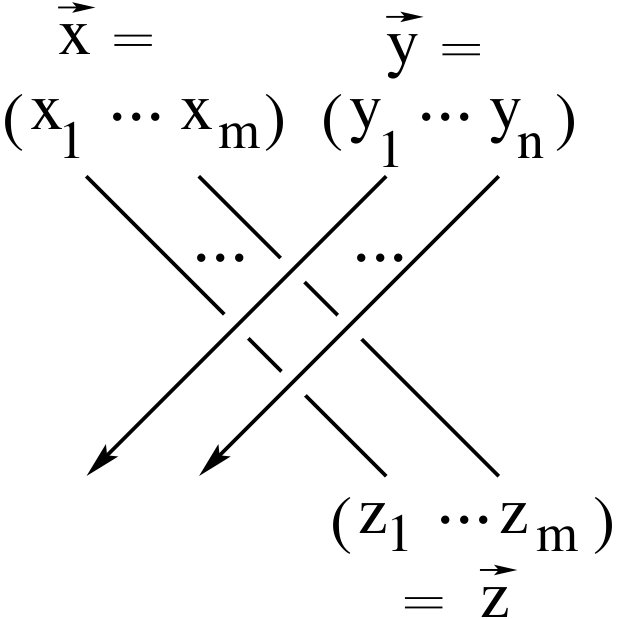 Figure 4
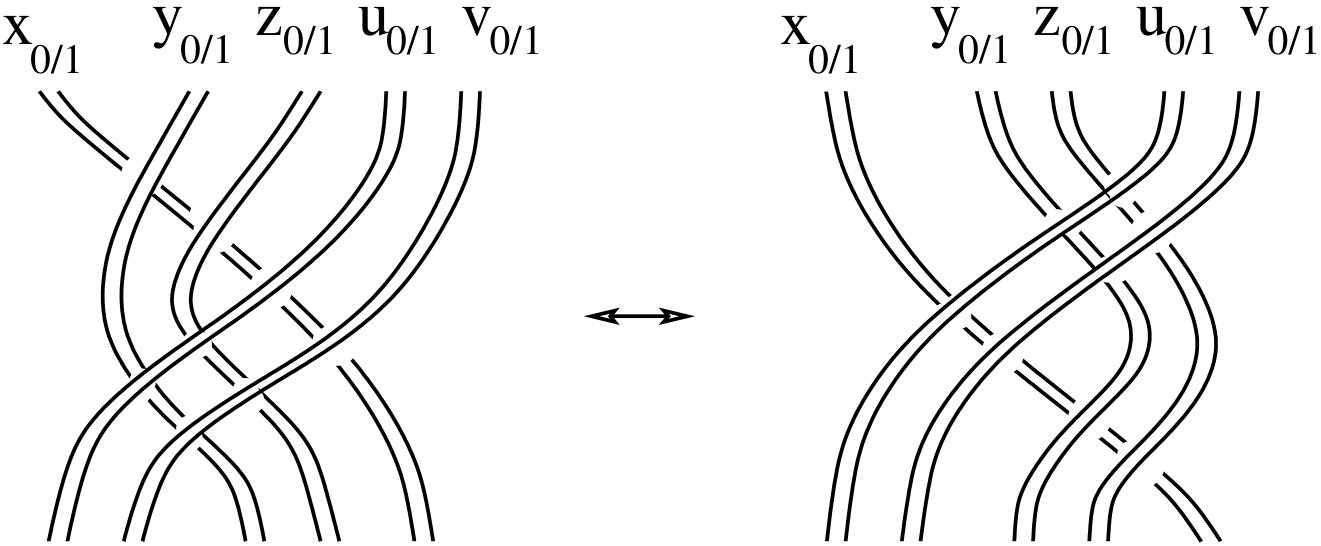 Figure 5
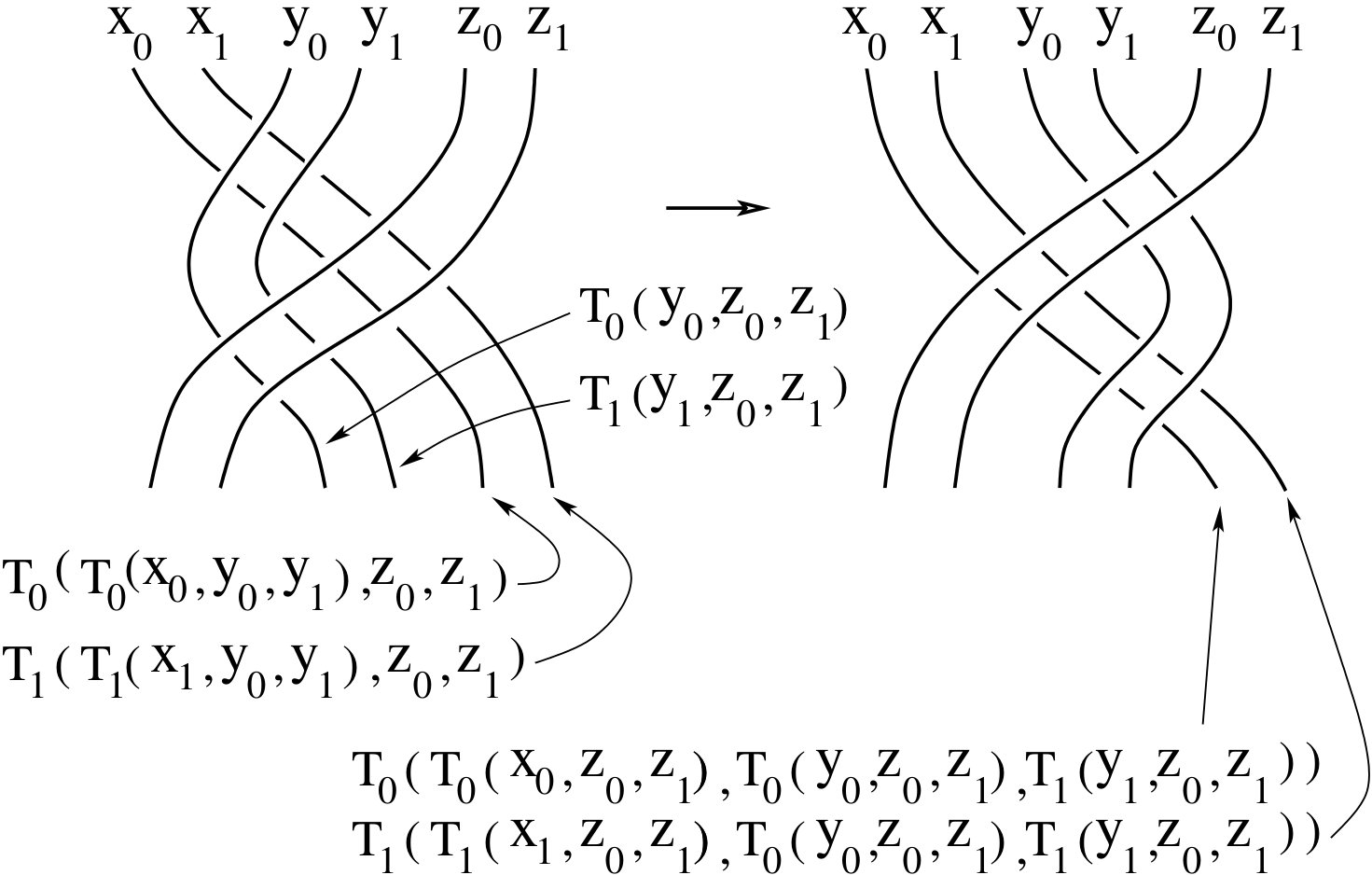 Figure 6
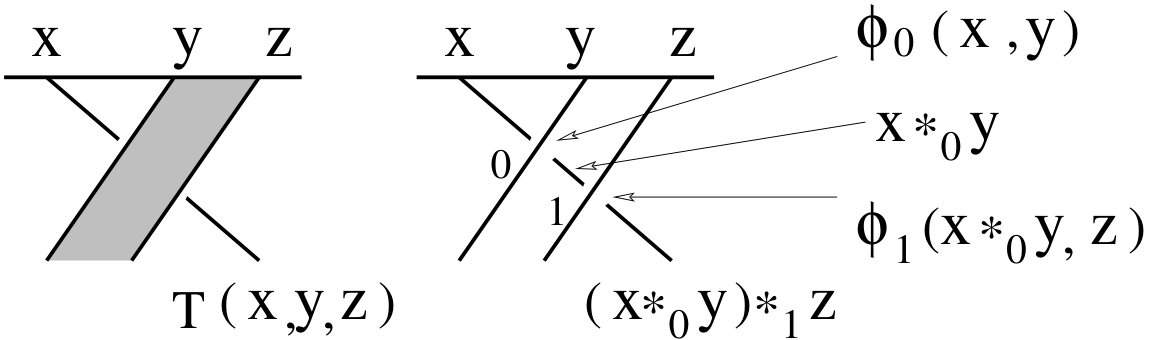 Figure 7
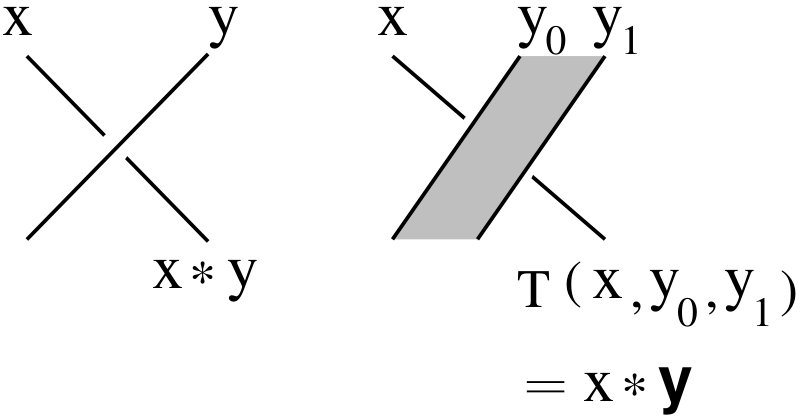 Figure 8
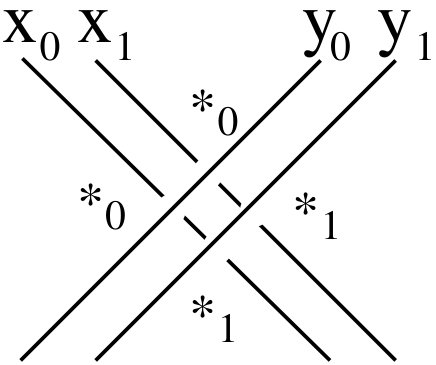 Figure 9
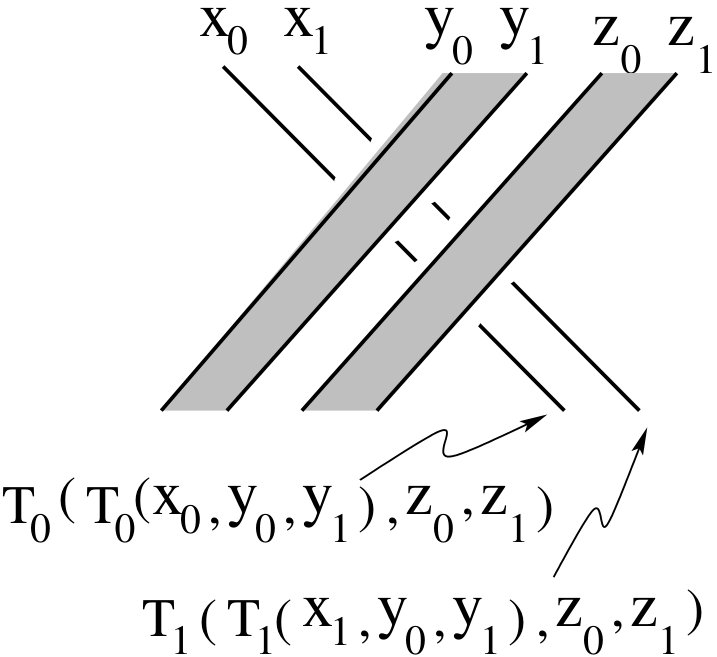 Figure 10
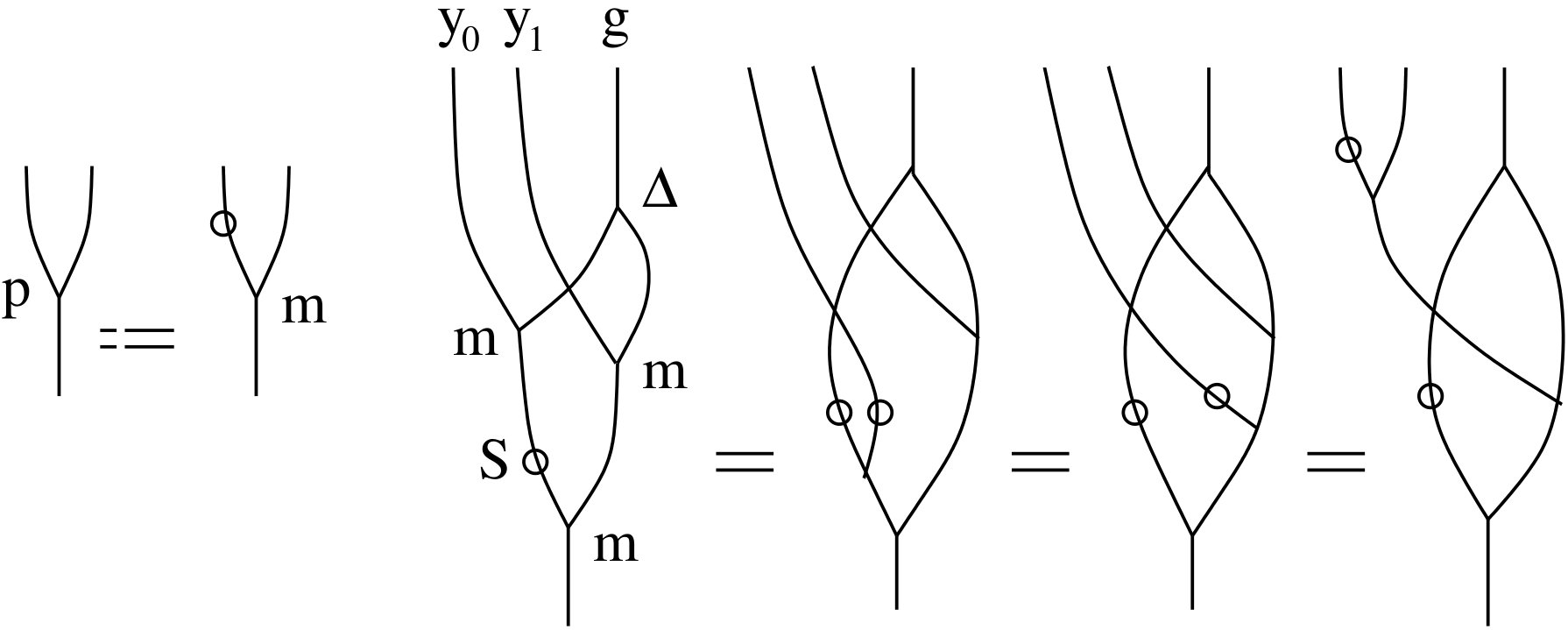 Figure 11
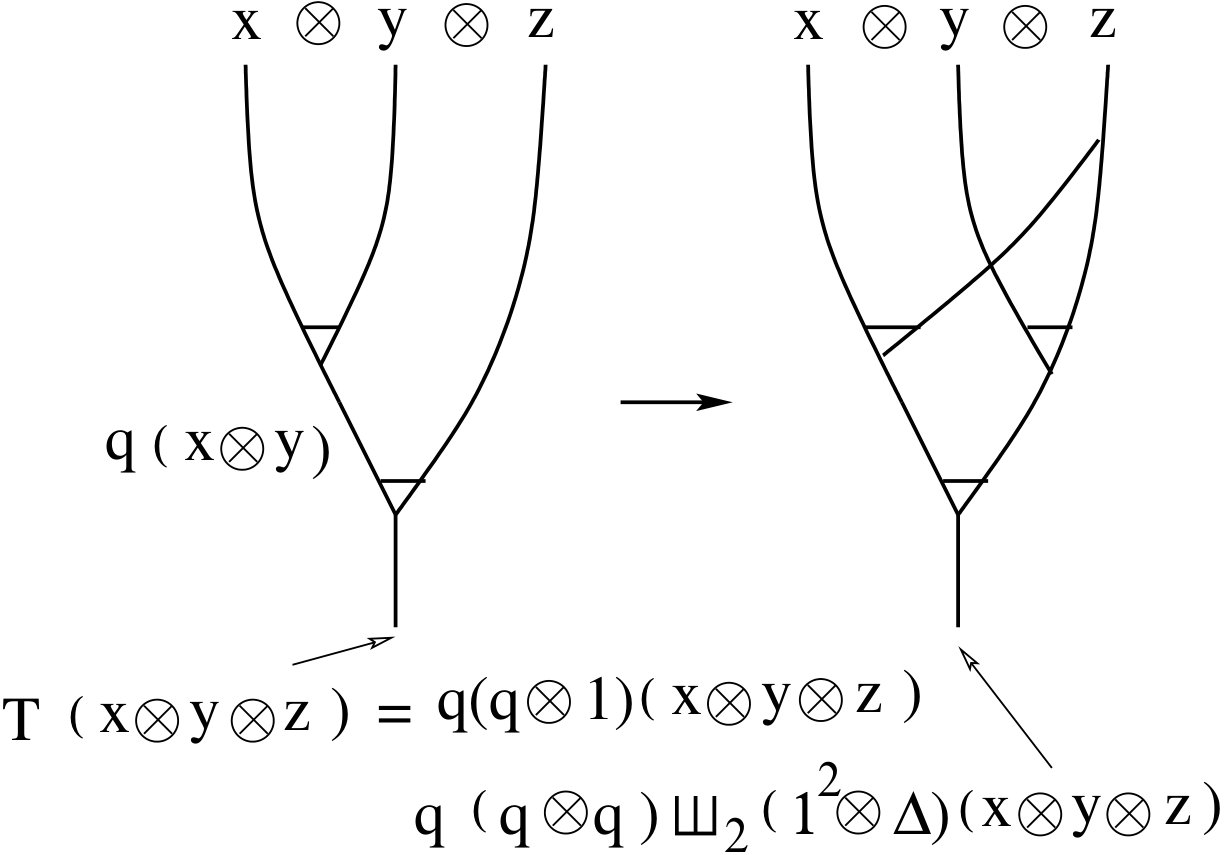 Figure 12
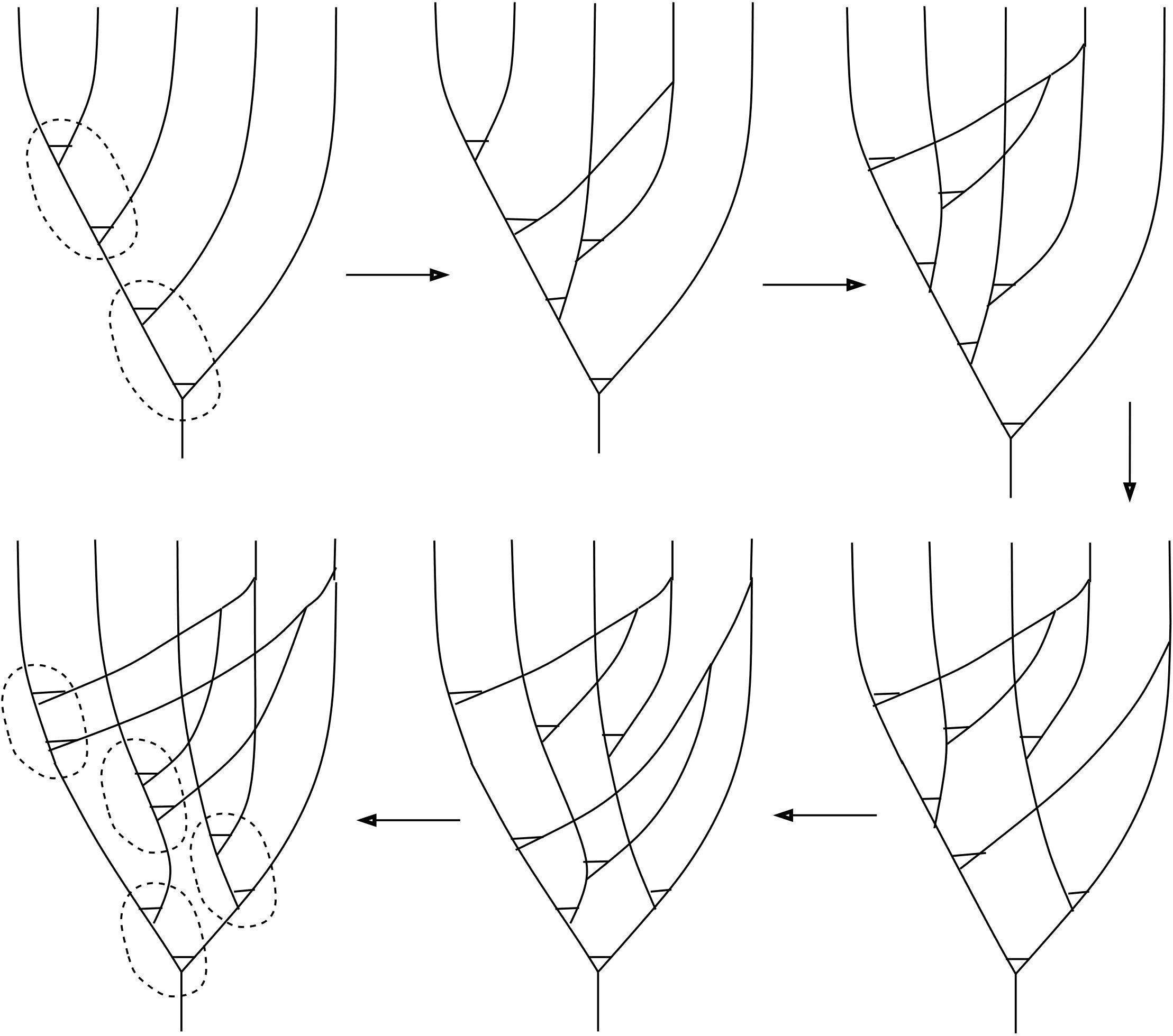 Figure 13
 Figure 14
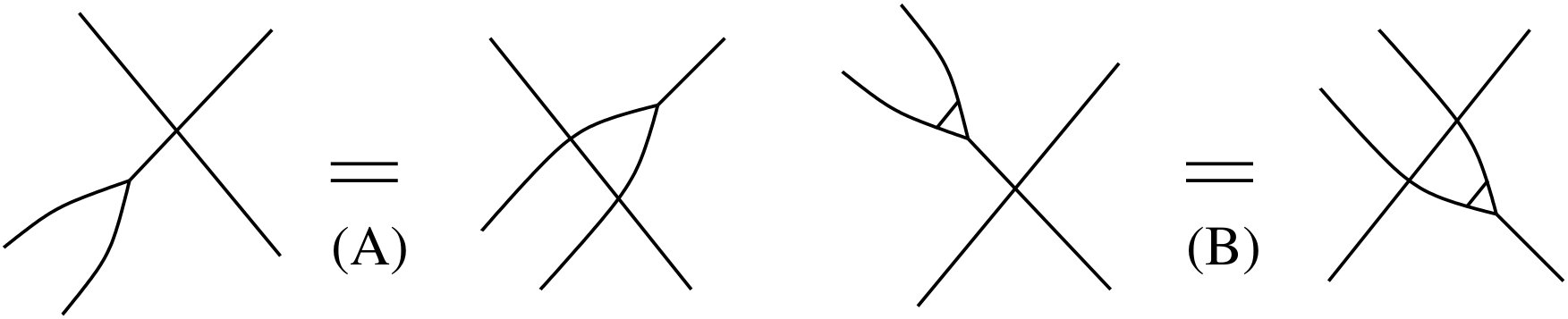 Figure 15
Peer Reviews
No public reviews on file for this paper yet. If you reviewed it on a platform where reviews are public (OpenReview, ICLR, NeurIPS, ICML), you can paste yours below so the community can read it here.
Videos
No videos yet. Explain this paper in a talk, walkthrough, or lecture? Add one.
Higher Arity Self-Distributive Operations in Cascades and their Cohomology
Mohamed Elhamdadi
Department of Mathematics, University of South Florida, Tampa, FL 33620, U.S.A.
,
Masahico Saito
Department of Mathematics, University of South Florida, Tampa, FL 33620, U.S.A.
and
Emanuele Zappala
Department of Mathematics, University of South Florida, Tampa, FL 33620, U.S.A.
Abstract.
We investigate constructions of higher arity self-distributive operations, and give relations between cohomology groups corresponding to operations of different arities. For this purpose we introduce the notion of mutually distributive -ary operations generalizing those for the binary case, and define a cohomology theory labeled by these operations. A geometric interpretation in terms of framed links is described, with the scope of providing algebraic background of constructing -cocycles for framed link invariants. This theory is also studied in the context of symmetric monoidal categories. Examples from Lie algebras, coalgebras and Hopf algebras are given.
Contents
1. Introduction
Self-distributivity of binary operations and its cohomology theories, motivated by knot theory, have been studied extensively in recent years, see for example [CES, CEGS, CJKLS, CKS, EN, NosakaBook]. In particular, in [CJKLS] the authors have introduced a (co)homology theory of quandles and utilized the -cocycles with abelian coefficients to define a link invariant, called cocycle invariant. In [CEGS], it has been given a non-abelian version of these results, and it has been shown that the cocycle invariant is a quantum invariant, based on previous work of Graña, see [Gra]. Mutually distributive binary operations were investigated in [Jozef] in which the author proposed a general framework to study homology of distributive structures. Ternary self-distributivity, which is a natural generalization of the binary case, and its cohomology theory have been studied in [EGM, Maciej]. In this article we consider higher arity self-distributivity and its cohomology, which provide an algebraic background suitable to the definition of -cocycle framed link invariants.
We generalize the notion of mutual distributive operations given in [Jozef] to -ary operations. We show that composing mutually distributive operations results in new higher arity self-distributive operations (Proposition 3.6). Specifically, for -ary and -ary self-distributive operations and on , respectively, under the condition called mutual distributivity defined in Section 3, the composition defined by
[TABLE]
is shown to be an -ary self-distributive operation. This procedure, in the specific, although important, case of mutually distributive binary operations, is particularly proficuous to describe colorings of framed link diagrams by means of ternary operations, paving the way for the possibility of introducing an analogue of the cocycle invariant in the context of framed links. We defer the study of such an invariant to a subsequent work.
We generalize both the -ary distributive homology [EGM] and homology of distributive sets [Jozef] to mutually distributive sets of general -ary operations (Definition 4.1). The relation between this chain complex and the -ary operations that result from mutually distributive sets by composition as in Definition 5.1, is given in the form of a chain map.
We also present constructions, called doubling, for mutually distributive sets, that are similar to the composition introduced in Section 3 but defined on the product . A geometric interpretation, uses parallel strings and allows us to relate colorings of diagrams of links and colorings of diagrams of framed links. The cohomological counterpart of this procedure, also described in this paper, is expected to provide the algebraic context for the definition of a framed link cocycle invariant. The relation between the doubling and the composition in Section 3, as well as its implications to cohomology are discussed.
Higher arity self-distributivity is also investigated in the context of symmetric monoidal categories. We define the notion of -ary self-distributive object in a symmetric monoidal category, providing therefore a higher arity version of the work in [CCES]. In particular, we show how to produce ternary self-distributive objects in the category of vector spaces, starting from binary self-distributive objects (Theorem 8.6). Specifically, let be a comonoid in a (strict) symmetric monoidal category (e.g. a coalgebra in the category of vector spaces). Let be a morphism such that is a binary self-distributive object in . Then the pair , where , defines a ternary self-distributive object in . The construction defines a functor , from the category of binary self-distributive objects in , to the category of ternary self-distributive objects in . This procedure of internalization of higher order self-distributivity indeed produce interesting examples of self-distributive objects among coalgebras. Examples from Lie algebras, coalgebras and Hopf algebras are given. As in [CCES] this categorical version is expected to be related to the Yang-Baxter equation in tensors of vector spaces through Hopf algebras.
The article is organized in the following manner. Section 2 gives the basics of binary and ternary racks with examples. In Section 3 we introduce the higher arity case and show that composing mutually distributive operations results in new higher arity self-distributive operations. In Section 4 we define a cohomology theory that generalizes those given in [EGM] and [Jozef] to mutually distributive operations in various arities. A chain map that relates this chain complex and the one for the operation resulted from composition is given in Section 5. In Section 6 we introduce functors (which we call doubling) in the binary and ternary mutually distributive rack categories. Section 7 shows the passages between binary mutually distributive racks and ternary self-distributive racks. We exhibit a direct construction of ternary cocycles from binary cocycles. We close the circle of functors relating binary and ternary operations by introducing a construction that brings back from ternary to binary. The relations among these functors are also discussed and a geometric interpretation is given. Section 8 is devoted to the development of a categorical point of view of -ary self-distributivity, extending the previous results of [CCES]. We define self-distributive objects in symmetric monoidal categories and construct examples in the category of vector spaces. We describe a procedure to obtain higher order self-distributive operations from Lie algebras. Appendix A deals with some detailed computations related to Lie algebras. In Appendix B we introduce a higher order analogue of augmented rack that enables us to produce Hopf algebra versions of group theoretic examples, such as the heap operation.
2. Preliminary
2.1. Basics of Racks
We review, for the convenience of the reader, some basic definitions of shelves, racks and quandles and give a few examples. This material can be found, for example, in [Jozef, CKS, FR, EN, NosakaBook].
Definition 2.1**.**
A *shelf * is a set with a binary operation such that for any , we have
If, in addition, the maps are bijections of , for all , then is called a rack.
A quandle is an idempotent ( for all ) rack.
Example 2.2**.**
The following are typical examples of quandles:
- •
A group with conjugation as operation: , denoted by Conj, is a quandle.
- •
A group with the operation is a quandle called the core quandle.
- •
Any -module is a quandle with , for , and is called an Alexander quandle.
- •
For any group , and an automorphism , the operation defines a quandle structure on , usually referred to as generalized Alexander quandle.
A rack homomorphism is a map satisfying for all . The category of racks is denoted by .
Let be a rack and be an abelian group. A function is said to be a (rack) -cocycle if for all , the following holds
[TABLE]
Lemma 2.3** ([CENS]).**
Let be a rack, be an abelian group, and be a -cocycle. Define an operation on by
[TABLE]
Then is a rack.
Rack and quandle 2-cocycles have been constructed from extensions [CENS], polynomial expressions [AmeSai, Mochi], determinants [Nosaka], and computer calculations [Vend].
2.2. Ternary distributive structures
Ternary racks and quandles were investigated in [EGM, Green, Maciej] and generalized further in [CEGM]. Here we review the basics of ternary racks and give some examples.
Definition 2.4**.**
Let be a set equipped with a ternary operation . The operation is said to be (right) distributive if it satisfies the following condition for all ,
[TABLE]
In this paper we will consider distributivity from the right.
Definition 2.5**.**
Let be a ternary distributive operation on a set . If for all , the map given by is invertible, then is said to be ternary rack.
Example 2.6**.**
The following constructions are found in [EGM].
- •
Let be a rack and define a ternary operation on by , for all . It is straightforward to see that is a ternary rack. Note that in this case . We will say that this ternary rack is induced by a (binary) rack.
In particular, if is an Alexander quandle with , then the ternary rack coming from has the operation
[TABLE]
- •
Let be any -module where . The operation defines a ternary rack structure on . We call this an affine ternary rack.
In particular, consider with the ternary operation . This affine ternary rack given in [EGM] is not induced by an Alexander quandle structure as described in the preceding item since is not a square in .
- •
Any group with the ternary operation gives a ternary rack. This operation is well known and called a heap (sometimes also called a groud) of the group .
A morphism of ternary racks is a map such that
[TABLE]
A bijective ternary rack endomorphism is called ternary rack automorphism. We denote by the category of ternary racks.
Let be a ternary rack and be an abelian group. A function is said to be a ternary -cocycle if for all , the following hold
[TABLE]
This equation is motivated by the following lemma, which is verified by calculations.
Lemma 2.7**.**
Let be a ternary rack and be an abelian group. Let be a map. The set with the ternary operation given by
[TABLE]
is a ternary rack if and only if the map satisfies the following ternary -cocycle condition
[TABLE]
For a ternary distributive operation on , we also use the notation
[TABLE]
where . Although strictly speaking is not equal to , no confusion is likely to arise by this convention. Furthermore, for , we use the notation to represent
[TABLE]
In this notation the ternary distributivity can be written as
[TABLE]
in analogy to the binary case.
Figure 1 depicts diagrammatic representations of binary and ternary operations, on the left and on the right, respectively. See [CKS], for example, for more details on diagrammatics for racks and their knot colorings.
We also recall the definition of homology of ternary racks [EGM]. Define first to be the free abelian group generated by -tuples of elements of a ternary rack . Define the differentials as:
[TABLE]
Definition 2.8**.**
The homology group of the ternary rack is defined to be:
.
By dualizing the chain complex given above, we get a cohomology theory for ternary racks.
Remark 2.9**.**
Similar definitions give a homology and a cohomology theory for higher arity self-distributive operations. **
3. Compositions of -ary self-distributive operations
In this section we generalize the notion of mutual distributive operations found in [Jozef] to -ary operations. The vector notation for ternary operations is directly generalized to the -ary ones: Let be an -ary distributive set. Let . Then the operation is denoted by . An -ary operation is also denoted by . Here the extra parentheses caused by the vector notation is ignored, i.e., for and , the concatenation or simply denotes . Furthermore, for and , denote by or .
Definition 3.1**.**
Let and be -ary and -ary distributive operations on , respectively. The two operations and are called mutually distributive if they satisfy
[TABLE]
for all , and . **
Example 3.2**.**
Let , be racks. Define on , respectively, by and . Then computation shows that are mutually distributive. **
Example 3.3**.**
The following construction appears in [IshiiIwakiri] and provides examples of mutually distributive rack operations. Denote by the rack operation on defined by -fold leftmost product . Then and are mutually distributive for positive integers and .
More generally, the following appears in [IIJO, Jozef]. Let be a group, and let be mutually commuting group automorphisms. Let be the generalized Alexander quandles with respect to for . Thus , where the action is denoted in exponential notation. Then computations show that and are mutually distributive.
There are mutually distributive operations with different arities, as the following example shows.
Example 3.4**.**
Let be a module over and , be affine binary and ternary rack operations, respectively, defined by
[TABLE]
Then computations show that and are mutually distributive. **
Remark 3.5**.**
We note that for a group , the core binary operation () and the ternary operation heap () satisfy but not .
Next, we show that composing mutually distributive operations results in new higher arity self-distributive operations.
Proposition 3.6**.**
Let and be mutually distributive -ary and -ary distributive operations on . Then defined by
[TABLE]
is an -ary distributive operation.
Proof.
We establish the equality
[TABLE]
We replace by the notation . Thus we have
[TABLE]
Then we compute
[TABLE]
where the second and the fifth equalities follow from the mutual distributivity of and . This concludes the proof. ∎
Remark 3.7**.**
Let be mutually distributive binary operations. Let be the TSD operation defined in Proposition 3.6. Then it is written as for . We note that the two ternary structures and may not be isomorphic in general as the following example shows.
Consider the set with the two binary operations and . The induced ternary structures and are not isomorphic. In fact, if is an isomorphism then for all in , we have Then . One obtains then a contradition, for example, by setting .
Definition 3.8**.**
Let , , be distributive -ary operations on that are pairwise mutually distributive. Then we call a mutually distributive set. **
4. Homology of mutually distributive sets
We generalize both the -ary distributive homology [EGM] and homology of distributive sets [Jozef] to mutually distributive sets of general -ary operations as follows. The relation between this chain complex and the -ary operations that result from mutually distributive sets as in Proposition 3.6 will be given in the next section in the form of chain map.
Definition 4.1**.**
Let be a mutually distributive set. Let be a vector such that for . Let chain groups be defined by the free abelian group generated by tuples . Define where the direct sum ranges over all possible vectors . Define the differential by
[TABLE]
and let
[TABLE]
Lemma 4.2**.**
Let be a mutually distributive set. Then the sequence defines a chain complex.
Proof.
We define, for each vector and , linear maps
[TABLE]
Therefore by definition, . It is enough to show now that the maps satisfy the pre-simplicial complex relation: for each whenever .
Fix a vector and consider an element . Then we have:
[TABLE]
On the other hand we have:
[TABLE]
where we have used the vector notation introduced in Section 3. The two quantities are equal, in virtue of the property of mutual distributivity of the set . ∎
Definition 4.3**.**
The chain complex defined by Definition 4.1 and the homology that it induces will be called labeled chain complex and labeled homology and will be denoted and , respectively. **
Remark 4.4**.**
The chain complex in Definition 4.1 has a diagrammatic interpretation as in Figure 2. In particular, the mutual distributivity condition takes the same form as in the curtain homology of [PW]. **
Remark 4.5**.**
We observe that if is a mutually distributive set, then contains the standard self-distributive complexes relative to each as subcomplexes. **
Remark 4.6**.**
The multiplication on binary operations considered in [Jozef] can be directly generalized to -ary operations as follows. Given a nonempty set , let denotes the set of all -ary mutually distributive operations on . Define the following multiplication on :
[TABLE]
for all and . Then it is straightforward to see that the multiplication defined above makes into a monoid with identity given by for all and .
For example, let be a ternary rack. Define, inductively,
[TABLE]
Then is a ternary distributive set for all positive integer .
Remark 4.7**.**
For a given abelian group , we obtain a labeled cochain complex with coefficients in , upon dualizing the chain complex in Definition 4.1. We will write and to indicate the labeled cochain and cohomology groups with coefficients in , respectively. **
5. Chain maps under -ary compositions
In this section we show that the cohomology of an operation obtained by composing mutually distributive operations as in Proposition 3.6 and the cohomology of the operations themselves are related to the labeled cohomology of Definition 4.1 via chain maps as follows. The algebraic and geometric motivations and significance of the chain maps are explained later in this section.
Definition 5.1**.**
Let be a distributive set, where and are operations of arity and , respectively. Call the -ary corresponding self-distributive operation. We define chain maps , from the -ary cochain complex relative to , to the chain complex defined by Lemma 4.2 for . Explicitly:
[TABLE]
where we put the labels as a subscript and , are vectors of appropriate lengths, according to the conventions explained in Section 3. **
Definition 5.2**.**
Let be a mutually distributive racks and be an abelian group. Let for be the maps obtained from by dualization. **
Theorem 5.3**.**
For the maps define chain maps. Therefore they define induced homomorphisms in homology and in cohomology.
Proof.
We prove the statement in the case of two binary mutually distributive operations and , resulting in a ternary self-distributive operation . The general case being an application of the same procedure with vector notation. For a ternary -chain we have:
[TABLE]
By direct computation, we also have:
[TABLE]
On the other hand, the following holds:
[TABLE]
The two quantities can be seen to be equal, making use of the identity:
[TABLE]
Therefore we obtain , which concludes the proof of the first statement. The second statement follows easily from the first one by standard arguments in homological algebra. ∎
Remark 5.4**.**
Let be a mutually distributive rack and let be the second labeled cochain group with coefficients in , then the labeled -cocycle conditions corresponding to and take the following form
[TABLE]
Definition 5.5**.**
We call a pair satisfying the preceding equations mutually distributive. **
Observe that being a labeled -cocycle means that it is mutually distributive, is a -cocycle for the operation and is a -cocycle for .
Remark 5.6**.**
Let be mutually distributive binary operations and be the ternary self-distributive operation defined in Proposition 3.6. Let be an abelian group. By Theorem 5.3, is a ternary -cocycle in for a labeled 2-cocycle . The explicit form of the ternary -cocycle
[TABLE]
Remark 5.7**.**
The case of mutually distributive binary operations whose composition gives a ternary operation is of particular interest to us since this is the algebraic counterpart of a diagrammatic doubling procedure particularly adapt to interpret colorings of framed tangles by ternary racks. The ternary -cocycles resulting from Theorem 5.3 can therefore be used to define cocycle invariants for framed tangles. This construction of cocycles corresponds to those in [IshiiIwakiri] for handlebody-links.
From this geometric point of view, we present a direct, geometric proof that in Remark 5.6 satisfies the ternary 2-cocycle condition. We show
[TABLE]
The computations below are aided by diagrams shown in Figure 3, where each equality is represented by a type III Reidemeister move. In the figure and the computations below, underlines highlight those terms to which the cocycle condition is applied.
[TABLE]
Example 5.8**.**
Let , be racks, and be mutually distributive operations defined on in Example 3.2. Let and be 2-cocycles of and , respectively. Define 2-cocycles of corresponding to , , respectively, by and . Then computations show that are mutually distributive. **
Example 5.9**.**
The following construction, found in [IshiiIwakiri], provides examples of mutually distributive 2-cocycles. Let be a rack, be a 2-cocycle, and be the corresponding extension. Recall that denotes the -fold leftmost product . Then the function defined by
[TABLE]
is a -cocycle.
Let be the mutually distributive rack defined in Example 3.3, and let , be 2-cocycles defined above. Then and are mutually distributive. This is seen by the diagrammatic interpretation of parallel strings.
6. The doubling functor
In this section we describe a construction called doubling, that is similar to the composition defined in Section 3 but defined on the product . A diagrammatic interpretation is to take parallel strings and provides a method of producing cocycle invariants for framed links by means of ternary cohomology. The relation between the doubling and the composition in Section 3 as well as implications to cohomology are discussed in the next section.
6.1. Doubling binary operations
Lemma 6.1**.**
Let be mutually distributive racks. Define the operation for by
[TABLE]
Then is a rack.
A diagrammatic representation of the preceding lemma is depicted in Figure 4, and the computations in its proof are facilitated by the corresponding type III Reidemeister move with doubled strings.
Definition 6.2**.**
Let be the category defined as follows. The objects consist of , where is a set and is mutually distributive. For objects and , a morphism is a map that is a rack morphism for both and . **
We observe that if is a morphism in the sense of this definition, then will automatically respect the mutual distributivity. Specifically, simple computations imply the following.
Lemma 6.3**.**
If is a morphism in , then it holds that
[TABLE]
Computations also show the following.
Lemma 6.4**.**
Let and be two mutually distributive racks, and and be racks as in Lemma 6.1. If is a morphism in , then the map defined by is a rack morphism.
Definition 6.5**.**
The functor from to the category of binary racks defined on objects by through Lemma 6.1 and on morphisms by through Lemma 6.4, is called the doubling functor. **
Remark 6.6**.**
The functor is injective on objects and morphisms, but not surjective on either. **
A direct computation gives the following lemma.
Lemma 6.7**.**
Let be a mutually distributive rack, and be mutually distributive rack 2-cocycles. Let be abelian extensions of with respect to ,
[TABLE]
for . Then is a mutually distributive rack.
Theorem 6.8**.**
Let and be as described in Lemma 6.1. Let be rack 2-cocycles of and , respectively, that satisfy the mutually distributive rack 2-cocycle condition. Then
[TABLE]
is a rack 2-cocycle of . This assignment induces a well defined map , where the subscript indicates the binary rack cohomology.
A proof will be given at the end of Section 7. The right-hand side corresponds to Figure 4. We call the doubled rack 2-cocycle.
6.2. Doubling ternary operations
In this subsection, we give a doubling construction for ternary racks. The condition required for this construction differs from the mutual distributivity and defined as follows.
Definition 6.9**.**
Let and be two ternary operations on a set . We say that and are compatible if they satisfy
[TABLE]
A diagrammatic representation of the compatibility is depicted in Figure 5. Observe that it corresponds to type III Reidemeister move for ribbons.
Example 6.10**.**
Consider a -module where . The following two ternary operation and are compatible if and only if the following conditions hold
[TABLE]
For example, one can choose with and . **
Definition 6.11**.**
The category of compatible ternary distributive racks is defined as follows. The objects consist of triples where is a set and are compatible ternary operations on . A morphism between two objects and is a map which is morphism in the ternary category for both and . **
We observe that if is a morphism in the sense of Definition 6.11, then it will automatically respect the mutual ternary distributivity. Specifically, computations imply the following.
Lemma 6.12**.**
If is a morphism in , then it holds that
[TABLE]
Theorem 6.13**.**
Let be compatible ternary distributive operations on . Then defined by
[TABLE]
is a ternary distributive operation on .
Proof.
It is enough to establish
[TABLE]
A diagrammatic representation of this equality is depicted in Figure 6. This diagrammatic equality follows from a sequence of moves depicted in Figure 5. Thus calculations are obtained by applications of defining relations of compatibility accordingly. ∎
The following is analogous to Lemma 6.4 and is shown by direct computations.
Lemma 6.14**.**
Let and be sets with mutually distributive ternary operations, and and be ternary distributive racks constructed in Theorem 6.13. If is a morphism in , then defined from by is a morphism of .
Definition 6.15**.**
We denote the functor from to the category of ternary racks defined on objects by and on morphisms by , and call it doubling. **
Remark 6.16**.**
The functor is injective on both objects and morphisms, but is not surjective on either. **
Definition 6.17**.**
Let be compatible ternary distributive operations on . Let , be -cocycles with respect to and , respectively. Then the following are called the compatibility conditions for and :
[TABLE]
Theorem 6.18**.**
Let be compatible ternary distributive operations on . Let be the doubled ternary operation defined in Theorem 6.13. Let , be -cocycles with respect to and , respectively, that satisfy the compatibility condition defined in Definition 6.17. Then
[TABLE]
is a ternary rack 2-cocycle of .
A proof will be given at the end of Section 7. We call the doubled ternary rack 2-cocycle.
7. From binary racks to ternary racks and back
In this section we provide relations among constructions of self-distributive operations discussed so far. To simplify the arguments, we focus on binary and ternary operations. Specifically, we observe that the doubling functors of binary (resp. ternary) operations factor through ternary (resp. binary) operations. This main result of the section is stated in Proposition 7.7. Furthermore corresponding constructions of 2-cocycles are given, and proofs of Theorems 6.8 and 6.18 are provided at the end of the section. We start with defining a functor for the construction given in Proposition 3.6.
Definition 7.1**.**
The assignment of objects defined by Proposition 3.6 when and are binary operations (hence the obtained is ternary), is denoted . This assignment on objects can be extended on morphisms as the identity, to define a functor , from the category of mutually distributive binary racks (see Section 6), to the category of ternary racks, using Lemma 6.3. **
By definition is injective and surjective on morphisms. Computations give the following.
Lemma 7.2**.**
Let be a mutually distributive binary set. Let . Then are mutually distributive.
Next we define the opposite construction of binary from ternary operations.
Lemma 7.3**.**
Let and be a two compatible ternary rack operations. Then the binary operation on the cartesian product defined by
[TABLE]
gives a rack structure .
Definition 7.4**.**
The functor defined by Lemma 7.3 is denoted by , where on objects, and on morphisms.
Observe that is injective on objects and on morphisms.
Proposition 7.5**.**
The functor is not surjective on objects.
Proof.
Consider the binary rack structure on defined by
[TABLE]
This rack is not in the image of since the first entry depends on both and . ∎
Theorem 7.6**.**
*Let be an object in , and be as in Lemma 7.3. Suppose and are compatible ternary -cocycles of respectively and . Then *
[TABLE]
defines a 2-cocycle of .
Proof.
We check that satisfies the following equation
[TABLE]
We have
[TABLE]
The compatibility conditions of and show that LHS and RHS coincide. ∎
The constructions are summarized as follows.
Proposition 7.7**.**
It holds that and .
Proof.
Let be a set with mutually distributive rack operations. Let . Then by definition . Lemma 7.3 implies that is a rack, since is mutually distributive over itself. One computes
[TABLE]
as desired.
Let be a set with mutually distributive ternary rack operations. Let . Then by definition . Since is mutually distributive over itself, we have that is a rack, as in Definition 7.1. One computes
[TABLE]
as desired. ∎
Proof of Theorem 6.8.
Let be mutually distributive rack operations on . Let . We have that is a ternary rack. Let be mutually distributive rack -cocycles of and , respectively. Then by Theorem 7.6,
[TABLE]
is a ternary rack -cocycle of . Since is compatible over itself,
[TABLE]
is a rack operation by Theorem 6.13. Then Theorem 7.6 applied to with mutually distributive cocycles implies that
[TABLE]
as desired. To show that the assignment passes to cohomology, it is enough to show that if , we have that , for some -cochain . It is easy to see that the map does indeed serve the purpose. ∎
Proof of Theorem 6.18.
Let be compatible ternary distributive operations on , and . By Lemma 7.3, is a rack. Let be compatible ternary -cocycles of and , respectively. Then by Theorem 7.6,
[TABLE]
is a rack -cocycle of . Since is mutually distributive over itself,
[TABLE]
is a ternary rack operation by Lemma 6.3. Then Theorem 5.3 applied to with mutually distributive cocycles implies that
[TABLE]
as desired. ∎
8. Internalization of higher order self-distributivity
We begin this section with the definition of -ary self-distributive object in a symmetric monoidal category, providing therefore a higher arity version of the work in [CCES]. We will use the symbol to indicate the tensor product in the symmetric monoidal category , not to confuse the general setting with the standard tensor product in vector spaces, to be found in the examples. We remind the reader first, that a symmetric monoidal category is a monoidal category together with a family of isomorphisms , natural in and , satisfying the following conditions (Section 11 in [MacL]). The hexagon:
[TABLE]
is commutative for all objects , and in , where indicates the associator of the monoidal category. We further have the following identity for all objects and :
[TABLE]
For the sake of simplicity, we work on a strict symmetric monoidal category for the rest of the paper and therefore do not keep track of the bracketing. We recall also that a comonoid in a symmetric monoidal category is an object endowed with morphisms , called comultiplication or diagonal, and , called counit, where is the unit object of the monoidal category. The comultiplication and the counit satisfy the usual coherence diagrams analogous to the coalgebra axioms. In virtue of the coassociative axiom we can inductively define an -diagonal by the assignment: , for all . Let us define the isomorphism as . It is easy to verify that the morphisms satisfy the relations of the transposition in , the symmetric group on letters. We therefore obtain, for every object , an action of on , by mapping to , and extending to a homomorphism of groups between and , the automorphism group of . In particular we will make use of the automorphism of , corresponding to the permutation
[TABLE]
We are ready now to define -ary self-distributive objects in a symmetric monoidal category .
Definition 8.1**.**
An -ary self-distributive object in a symmetric monoidal category is a pair , where is a comonoid object in and is a morphism making the following diagram commute:
{X^{\boxtimes n^{2}}}$${X^{\boxtimes(2n-1)}}$${X^{\boxtimes n^{2}}}$${X^{\boxtimes n}}$${X^{\boxtimes n}}$${X}$$\scriptstyle{\shuffle_{n}}$$\scriptstyle{\mathbbm{1}^{\boxtimes n}\boxtimes\Delta_{n}^{\boxtimes(n-1)}}$$\scriptstyle{W\boxtimes\mathbbm{1}^{\boxtimes(n-1)}}$$\scriptstyle{W\boxtimes\cdots\boxtimes W}$$\scriptstyle{W}$$\scriptstyle{W}
Example 8.2**.**
Clearly, any -ary rack is an -ary self-distributive object in the symmetric monoidal category of sets, with and defined in the obvious way.
In the rest of this section we will make use of Sweedler notation in the following form: .
Example 8.3**.**
Let be an involutive Hopf algebra, i.e. . Define a ternary operation by the assignment , extended by linearity, where we use juxtaposition as a shorthand to indicate the multiplication of and is the antipode. By direct computation on tensor monomials we obtain, for the left hand side of ternary self-distributivity:
[TABLE]
The right hand side is:
[TABLE]
Note that we have used the fact that is involutive in the sixth equality, to obtain . This ternary structure is the Hopf algebra analogue of the heap operation in group theory, which is known to be ternary self-distributive. We also observe that being involutive is a parallel to the operation of taking inverses, obviously involutive as well.
In Figure 7, a diagrammatic representation of categorical distributivity is depicted. It is read from top to bottom, where the top 3 end points of both sides represent , a trivalent vertex with a small triangle represents a self-distributive morphism , and the left-hand side represents .
Given a symmetric monoidal category , we define categories , for each , as follows. The objects are -ary self-distributive objects in , as in Definition 8.1. Given two objects and , we define the morphism class between them to be the class of morphism in , such that . In particular we define and , and standing for binary and ternary, respectively.
We will make use of the following results in Theorem 8.6.
Lemma 8.4**.**
Let be a strict symmetric monoidal category. Suppose is a comonoid in . Then the switching morphism and the comultiplication commute. More specifically, we have: .
This lemma is represented in Figure 8 (A) below.
Proof.
Consider the following diagram:
[TABLE]
The outmost diagram commutes by naturality of switching map with respect to and . The lower right triangle commutes by the hexagon axiom:
[TABLE]
The assertion now follows. ∎
Lemma 8.5**.**
Let be a binary self-distributive object in a strict symmetric monoidal category . Then the switching morphism and the self-distributive operation commute. More specifically, we have: .
This lemma is represented in Figure 8 (B) below.
Proof.
Similar to Lemma 8.4 and left to the reader. ∎
In general, the following result is useful to produce ternary self-distributive objects in the category of vector spaces, starting from binary self-distributive objects (see also [CCES]). Compare it to the construction of Section 3.
Theorem 8.6**.**
Let be a comonoid in a (strict) symmetric monoidal category (e.g. a coalgebra in the category of vector spaces). Let be a morphism such that is a binary self-distributive object in . Then the pair , where , defines a ternary self-distributive object in . The construction defines a functor .
Proof.
We define on objects as and as the identity on morphisms. To show that the map is ternary self-distributive, we can proceed as in Figure 9. In the left column of the figure, the part of the diagram representing each are indicated by dotted circles. At each step we are using the definition of , the binary self-distributivity of and Lemmas 8.4 and 8.5. If is a morphism in , we can show that is also a morphism in between and via the following diagram:
[TABLE]
where the commutativity of the left and right squares is just a restatement of the fact that is a morphism in . The consequent commutativity of the outer rectangle means that is a morphism in as well. It is also clear that preserves composition of morphisms. ∎
The following is a rephrased version of Lemma 3.3 in [CCES], adapted to our language in the present article.
Lemma 8.7**.**
Let be a Lie algebra over a ground field . Define and endow it with a comultiplication , defined by , and a counit , defined by . Then is a comonoid in the symmetric monoidal category of vector spaces. The morphism defined by turns into a binary self-distributive object.
Proof.
By direct computation making use of the Jacobi identity. This is done explicitly in Lemma 3.3 in [CCES]. ∎
Example 8.8**.**
Let be a Lie algebra and let be as in Lemma 8.7. The map defined by
[TABLE]
and extended by linearity, is such that is a tenrary self-distributive object in the category of vector spaces by an easy application of Theorem 8.6. An explicit, and tedious, computation that shows the self-distributivity of directly, is postponed to Appendix A.
If is a Hopf algebra, we can use the adjoint map to produce a ternary self distributive map, as the following example shows:
Example 8.9**.**
The map defined by is ternary self-distributive, as an easy direct computation shows. This is the Hopf algebra analogue of the iterated conjugation quandle.
Remark 8.10**.**
It is possible, a priori, to develop the theory of higher self-distributivity in braided monoidal categories, where the switching morphism satisfies the hexagon axiom but we do not require . Similarly as above we have an action of the braid group on strings on every object and the shuffle map takes now into account over passing and under passing of the strings.
Appendix A Example 8.8 revisited
In this appendix we explicitly show that the map in Example 8.8 is indeed self-distributive. Each equality is obtained by applying the Jacobi identity as in the proof of Lemma 3.3 in [CCES]. In fact, each step corresponds to one of the diagrams in the proof of Theorem 8.6 (cf. figure 9). Recall also the definition of the diagonal , from Lemma 8.7, and the inductive definition for at the beginning of Section 8. Explicitly, we have for :
[TABLE]
To make the steps easier for the reader, we declare the terms that are going to be replaced according to the Jacobi identity, and underline the replacing terms in the subsequent equality. We obtain therefore:
[TABLE]
Applying the Jacobi identity to the terms , , and we obtain:
[TABLE]
We now apply the Jacoby identity to the term , , and to obtain:
[TABLE]
Next, we use the Jacoby identity on the terms , , , , , and .
[TABLE]
Lastly, making use of the Jacobi identity on the terms , , , , , and we obtain:
[TABLE]
This last term can be seen to coincide with the right-hand side of the self-distributivity equation:
[TABLE]
It follows therefore, that the map turns into a ternary self-distributive object in the category of vector spaces.
Appendix B Augmented ternary racks for sets and Hopf algebras
It is of an independent interest how the concept of augmented racks generalize to ternary racks for both sets and monoidal categories in general. In this section we propose such generalization and provide key motivational examples in heaps and Hopf algebras.
An augmented rack [FR] is a set with a right group action by a group and a map satisfying the identity for all , . An augmented rack has a rack operation defined by for . The following definition can be considered a ternary analogue of an augmented rack [FR].
Definition B.1**.**
Let be a set with a right -action denoted by . Let act on the right of diagonally, for and . An (double) augmentation of is a map satisfying the condition
[TABLE]
for all and . **
The following is a direct analogue of binary augmented rack and, therefore, the proof is omitted.
Lemma B.2**.**
Let be a set with an augmentation . Then the ternary operation defined by
[TABLE]
is ternary self-distributive.
Definition B.3**.**
Let be a set with an augmentation and be a ternary operation defined in Lemma B.2. Then is called an augmented ternary shelf. **
Example B.4**.**
Heaps can be endowed with augmentation as follows. Let be a group, with the TSD operation . Consider the right multiplication as the right action of on itself. Then consider the diagonal right action of on , by . Let be defined by . Then we readily check the condition
[TABLE]
Although more study on augmented ternary racks are desirable, we focus on the following further generalization to Hopf algebras. The point of interest is that the comultiplication plays the role of the diagonal map.
Definition B.5**.**
Let be a coalgebra, and let be a Hopf algebra such that is a right -module, therefore is also a right -module via the comultiplication in . The map of coalgebras is a ternary augmented shelf if, for all and , we have:
.
This axiom is depicted diagrammatically in Figure 10, where solid lines refer to , and dashed lines refer to . We have used , and to indicate comultiplication, multiplication and antipode in the Hopf algebra , while stands for the action of on .
We have the following result:
Theorem B.6**.**
Let be a ternary augmented shelf. Then the ternary operation defined on monomials via , and extended by linearity, is self-distributive.
Proof.
By direct computation we have, for the right hand side of self-distributivity axiom:
[TABLE]
where we have used the fact that is a coalgebra morphism in the third equality, the defining axiom for augmented ternary shelf in the fourth equality, the antipode and the counit axioms to obtain the fifth and sixth equations respectively. It is easy to see that it coincide with the left hand side of self-distributivity. ∎
Example B.7**.**
Let be an involutive Hopf algebra and let . Then, acts on via multiplication. Define to be the map given by and extended by linearity. The ternary rack structure obtained is the one in Example 8.3. A diagrammatic proof that the given satisfies the augmented ternary rack axiom is shown in Figure 11.
Acknowledgment. M.S. was supported in part by NIH R01GM109459 and NSF DMS-1800443.
The reference list from the paper itself. Each links out to its DOI / PubMed record.
- 1[1]
- 2[3]
- 3[5]
- 4[7]
- 5[9]
- 6[11]
- 7[13]
- 8[15]