Type Ia supernovae from dark matter core collapse
Ryan Janish, Vijay Narayan, and Paul Riggins

TL;DR
This paper explores how the formation and collapse of dark matter cores in white dwarfs can trigger type Ia supernovae, extending constraints on dark matter properties down to masses of 10^5 GeV.
Contribution
It introduces a new mechanism for supernova ignition via dark matter core collapse, including black hole formation and annihilation effects, broadening existing constraints on dark matter.
Findings
Dark matter core collapse can ignite supernovae through black hole formation or annihilation.
Constraints on dark matter mass extend down to 10^5 GeV.
Collapse processes provide new pathways for supernova ignition.
Abstract
Dark matter (DM) which sufficiently heats a local region in a white dwarf will trigger runaway fusion, igniting a type Ia supernova (SN). In a companion paper, this instability was used to constrain DM heavier than GeV which ignites SN through the violent interaction of one or two individual DM particles with the stellar medium. Here we study the ignition of supernovae by the formation and self-gravitational collapse of a DM core containing many DM particles. For non-annihilating DM, such a core collapse may lead to a mini black hole that can ignite SN through the emission of Hawking radiation, or possibly as a by-product of accretion. For annihilating DM, core collapse leads to an increasing annihilation rate and can ignite SN through a large number of rapid annihilations. These processes extend the previously derived constraints on DM to masses as low as GeV.
Click any figure to enlarge with its caption.
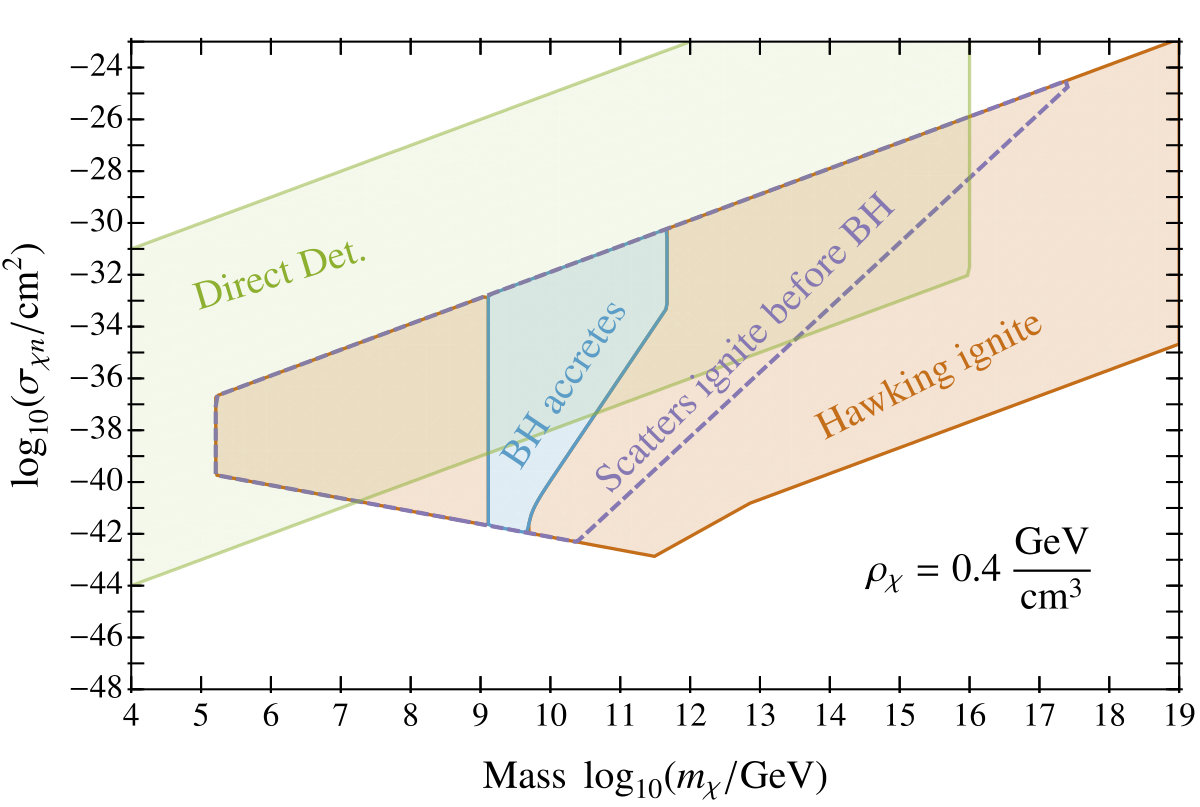 Figure 1
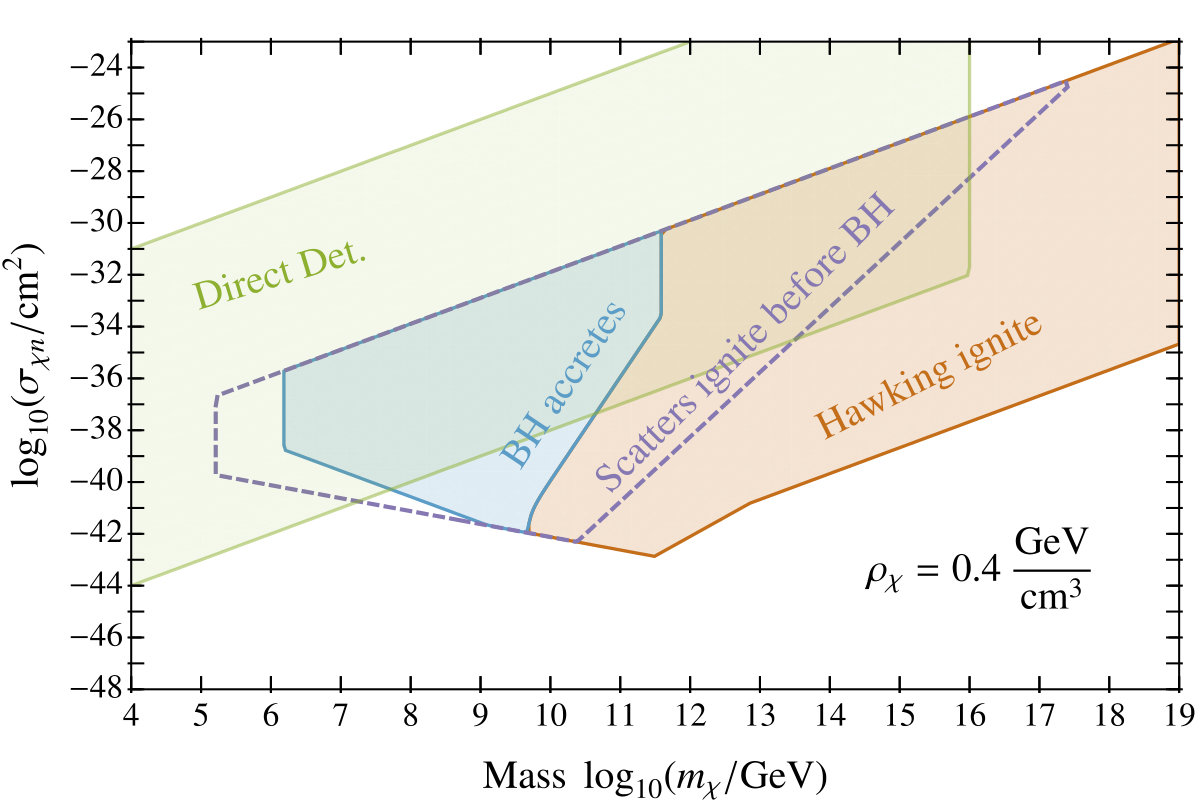 Figure 2
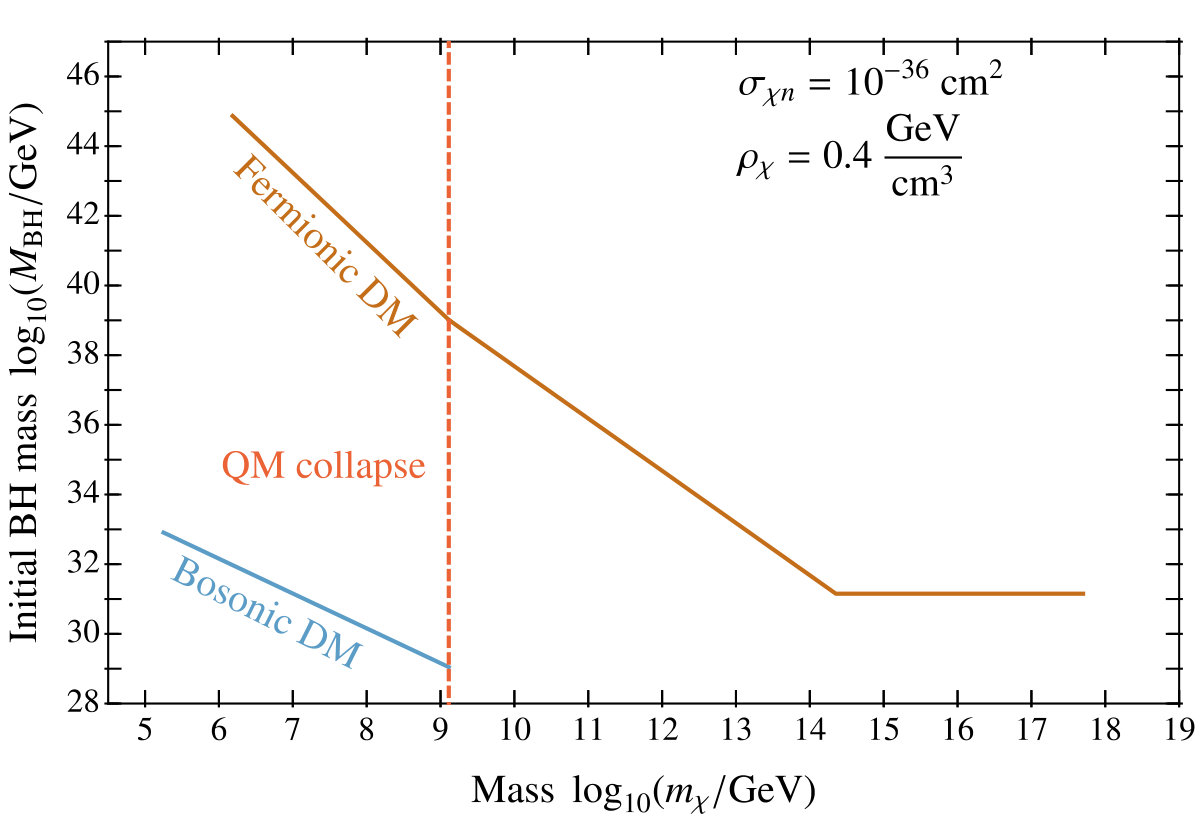 Figure 3
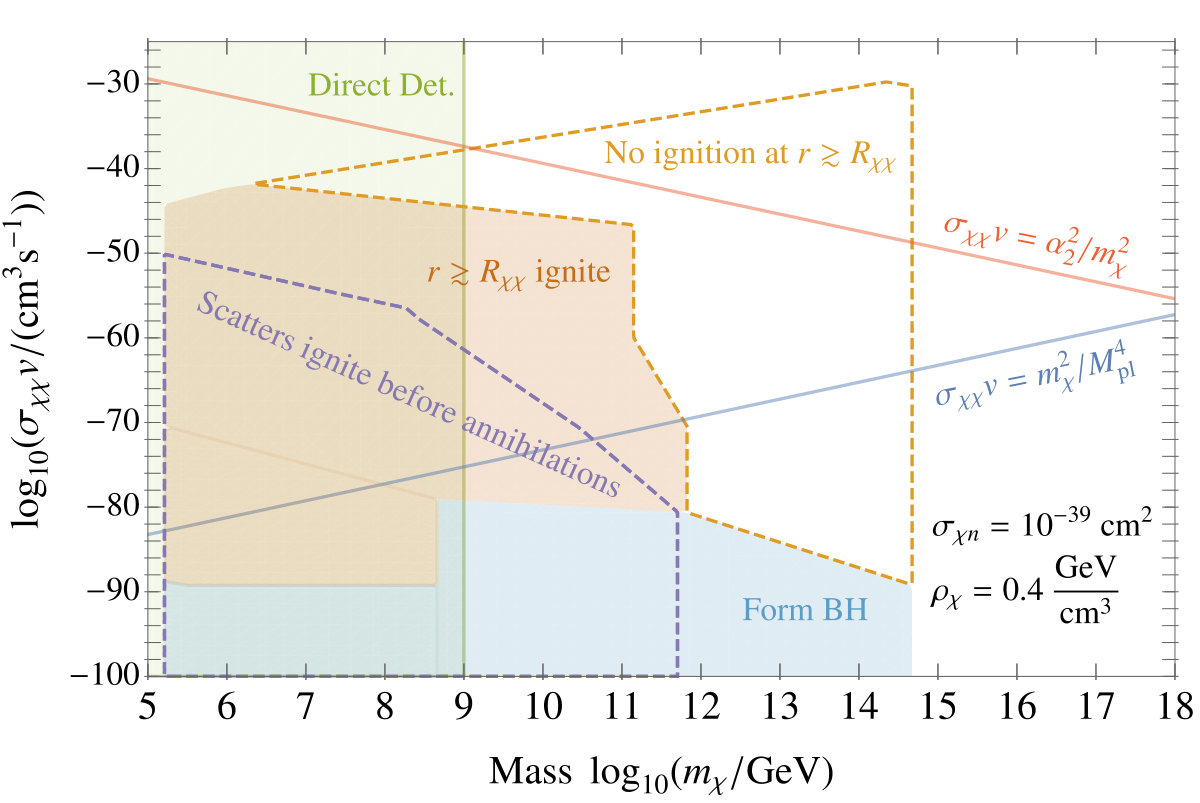 Figure 4
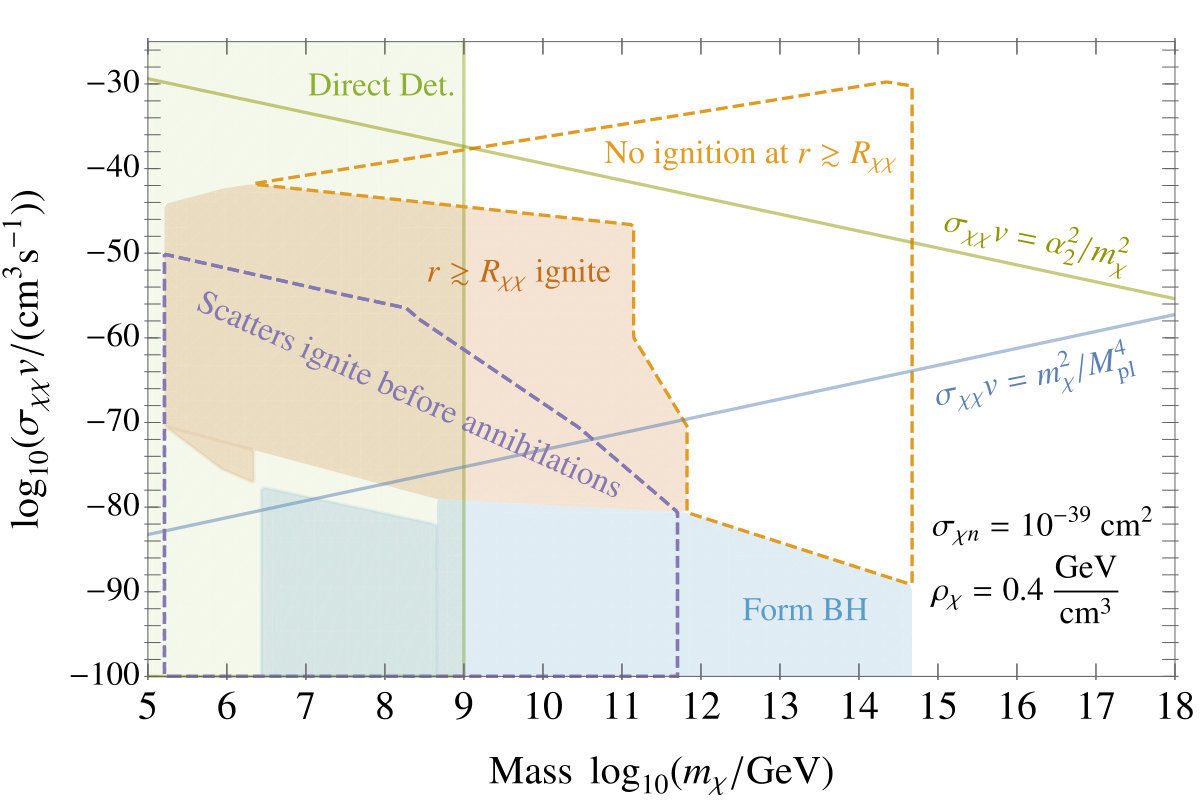 Figure 5
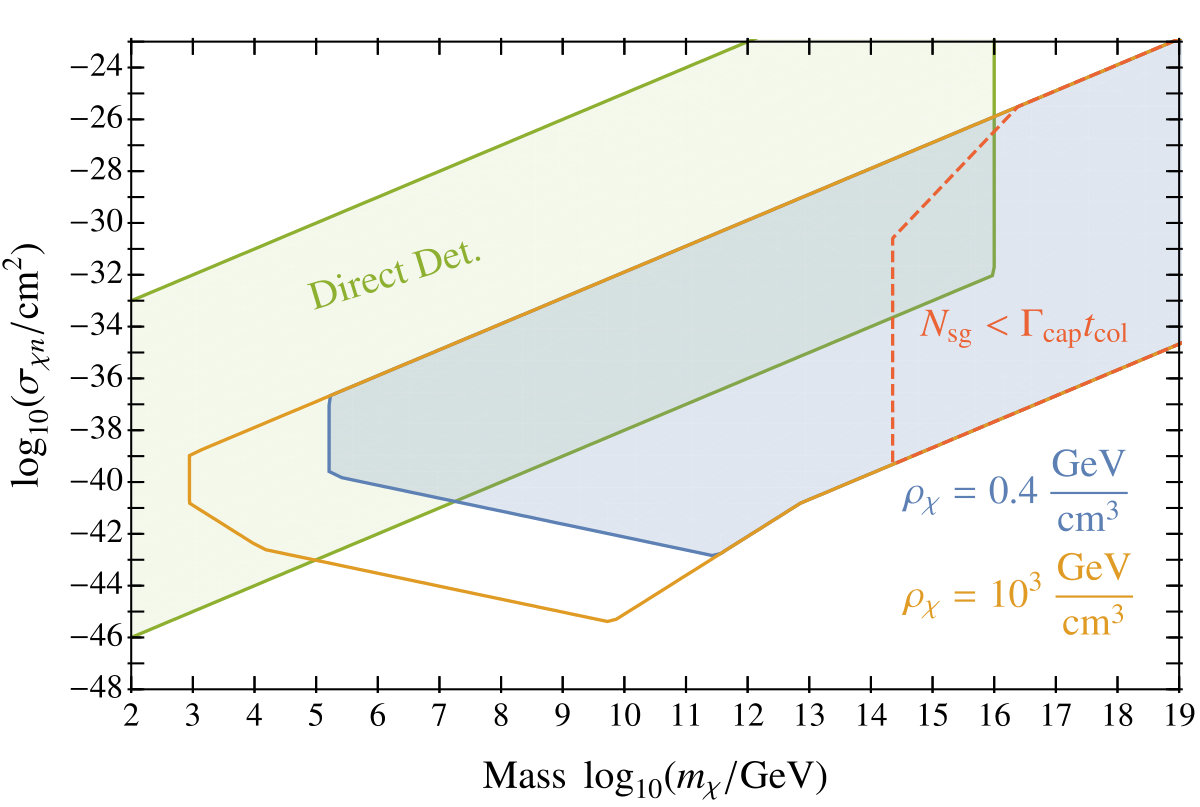 Figure 6
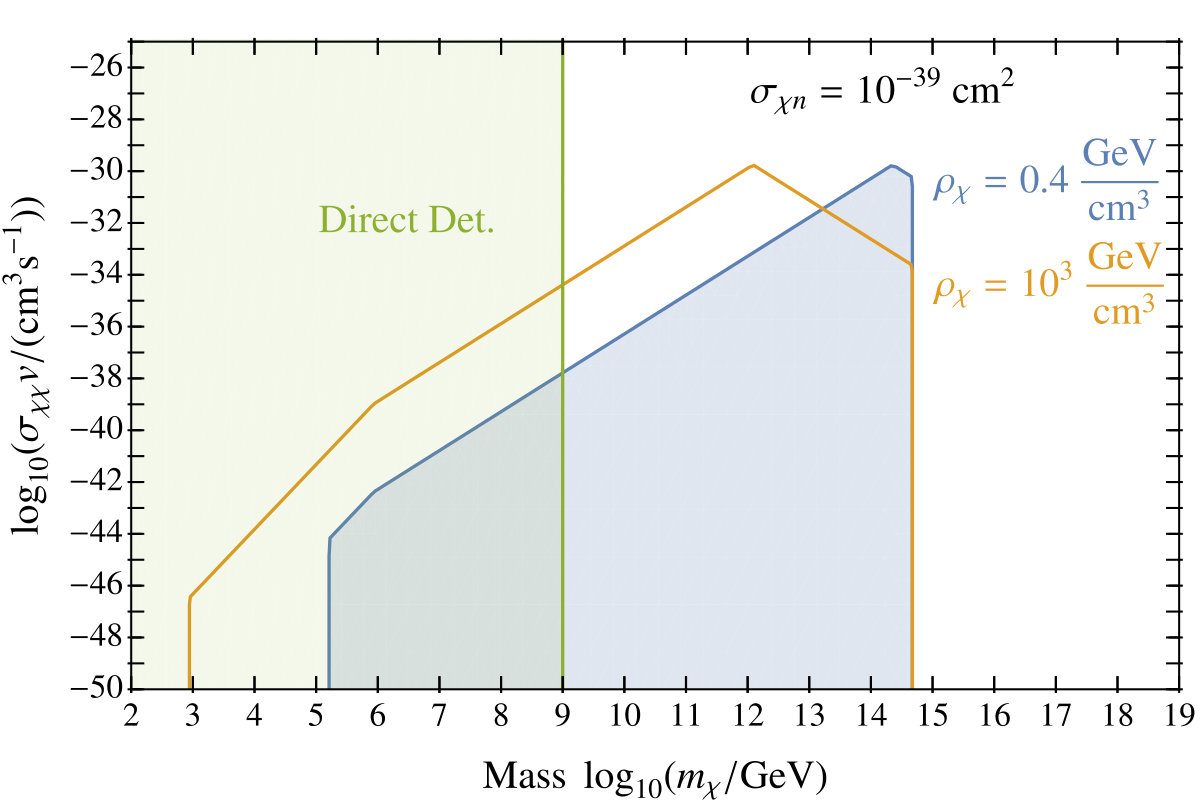 Figure 7
Peer Reviews
No public reviews on file for this paper yet. If you reviewed it on a platform where reviews are public (OpenReview, ICLR, NeurIPS, ICML), you can paste yours below so the community can read it here.
Videos
No videos yet. Explain this paper in a talk, walkthrough, or lecture? Add one.
Type Ia supernovae from dark matter core collapse
Ryan Janish
Berkeley Center for Theoretical Physics, Department of Physics, University of California, Berkeley, CA 94720, USA
Vijay Narayan
Berkeley Center for Theoretical Physics, Department of Physics, University of California, Berkeley, CA 94720, USA
Paul Riggins
Berkeley Center for Theoretical Physics, Department of Physics, University of California, Berkeley, CA 94720, USA
Abstract
Dark matter (DM) which sufficiently heats a local region in a white dwarf will trigger runaway fusion, igniting a type Ia supernova (SN). In a companion paper, this instability was used to constrain DM heavier than GeV which ignites SN through the violent interaction of one or two individual DM particles with the stellar medium. Here we study the ignition of supernovae by the formation and self-gravitational collapse of a DM core containing many DM particles. For non-annihilating DM, such a core collapse may lead to a mini black hole that can ignite SN through the emission of Hawking radiation, or possibly as a by-product of accretion. For annihilating DM, core collapse leads to an increasing annihilation rate and can ignite SN through a large number of rapid annihilations. These processes extend the previously derived constraints on DM to masses as low as GeV.
I Introduction
Dark matter (DM) accounts for over 80% of the matter density of the Universe, but its identity remains unknown. While direct detection Aprile et al. (2018) is a promising approach to identifying the nature of DM, searches for indirect signatures of DM interactions in astrophysical systems is also fruitful, particularly if the unknown DM mass happens to be large.
It was recently suggested Graham et al. (2015) that white dwarfs (WD) act as astrophysical DM detectors: DM may heat a local region of a WD and trigger thermonuclear runaway fusion, resulting in a type Ia supernova (SN). DM ignition of sub-Chandrasekhar WDs was further studied in a companion paper Graham et al. (2018), where we showed that generic classes of DM capable of producing high-energy standard model (SM) particles in the star can be constrained, e.g., by DM annihilations or decay to SM products. As an illustrative example, Graham et al. (2018) placed new constraints on ultra-heavy DM with masses greater than for which a single annihilation or decay is sufficient to ignite a SN.
Here we examine the possibility of igniting SN by the formation and self-gravitational collapse of a DM core. We study two novel processes by which a collapsing DM core in a WD can ignite a SN—these were first pointed out in Graham et al. (2018), and are studied here in more detail. If the DM has negligible annihilation cross section, so-called asymmetric DM, collapse may result in a mini black hole (BH) that can ignite a SN via the emission of energetic Hawking radiation or possibly as it accretes. If the DM has a small but non-zero annihilation cross section, collapse can dramatically increase the number density of the DM core, resulting in SN ignition via a large number of rapid annihilations. Both of these processes extend the previously derived constraints on DM in Graham et al. (2018), notably to masses as low as .
A number of potential observables of DM cores in compact objects have been considered in the literature. These include: (1) gravitational effects of DM cores on the structure of low-mass stars Bottino et al. (2002); Cumberbatch et al. (2010); Frandsen and Sarkar (2010); Lopes and Silk (2012); Casanellas and Lopes (2013), WDs Leung et al. (2013), and neutron stars (NS) Sandin and Ciarcelluti (2009); Ciarcelluti and Sandin (2011); Li et al. (2012); Goldman et al. (2013), (2) BH formation and subsequent destruction of host NSs Goldman and Nussinov (1989); Gould et al. (1990); Kouvaris and Tinyakov (2011a, b); McDermott et al. (2012); Jamison (2013); Kouvaris and Tinyakov (2013); Bramante et al. (2013); Kouvaris and Tinyakov (2014); Bell et al. (2013); Kouvaris (2012); Bramante et al. (2014); Bramante and Linden (2014); Bramante et al. (2018), and (3) anomalous heating from DM annihilations or scatters in WDs and NSs McCullough and Fairbairn (2010); Hooper et al. (2010); Kouvaris (2008); de Lavallaz and Fairbairn (2010); Kouvaris and Tinyakov (2010); Bertone and Fairbairn (2008); Baryakhtar et al. (2017); Raj et al. (2018). See also Brito et al. (2015, 2016) for unique astroseismology signatures of possible low-mass bosonic DM cores. We emphasize that the signature of a DM core igniting a type Ia SN is distinct from these, and thus the constraints derived here are complementary. For instance, while it has been known that DM cores which form evaporating mini BHs are practically unobservable in a NS, this is decidedly not the case in a WD where (as we show) such BHs will typically ignite a SN. Note that Bramante (2015) considers DM cores in WDs which inject heat and ignite SN through elastic DM-nuclear scatters—we discuss this process in more detail later as it pertains to our new constraints.
The paper is organized as follows. In Sec. II, we review the triggering of runaway fusion by localized energy deposition in a WD. In Sec. III, we summarize the necessary conditions for DM core collapse and discuss the generic end-states of such collapse. In Sec. IV and Sec. V, we derive constraints on DM cores which would ignite SN by the processes described above, namely black hole formation and DM-DM annihilations. We conclude in Sec. VI.
II Triggering thermonuclear runaway
Thermonuclear runaway in a carbon WD generally occurs when the cooling timescale of a hot region exceeds the fusion timescale. Cooling is dominated by the thermal diffusion of either photons or degenerate electrons, while the highly exothermic fusion of carbon ions is unsuppressed at temperatures greater than their Coulomb threshold . Crucially, the diffusion time increases with the size of the heated region while the fusion time is independent of . This defines a critical trigger size and temperature for ignition:
[TABLE]
was numerically computed in Timmes and Woosley (1992) and is at a number density .
One can also consider, as in Graham et al. (2018), the critical energy required to heat an entire trigger region to an MeV. for and sharply increases at lower WD densities—this agrees with the expectation that WDs grow closer to instability as they approach the Chandrasekhar mass. Of course to trigger runaway fusion, an energy in excess of must also be deposited sufficiently rapidly. The relevant timescale is the characteristic diffusion time across a region of size at a temperature . This diffusion time is also computed in Timmes and Woosley (1992) to be at densities . Therefore a total energy , specifically deposited within a trigger region and a diffusion time , will ignite a SN if:
[TABLE]
One possibility is that the necessary energy (2) is deposited directly to carbon ions, e.g., by a transiting primordial BH Graham et al. (2015). It is also possible to deposit this energy indirectly, e.g., by DM interactions releasing SM particles into the stellar medium Graham et al. (2018). To this end the stopping distances of high-energy () particles in a WD was calculated in Graham et al. (2018), where it was shown that hadrons, photons and electrons all transfer their energies to the stellar medium within a distance of order (the sole exception being neutrinos). We thus safely presume that any released into these SM products inside will be efficiently deposited and thermalized within this region as well.
In summary, the rate of any process which deposits an energy (defined to be localized spatially within and temporally within ) that satisfies (2) can be constrained. This is done by either demanding that a single explosive event not occur during the lifetime of an observed heavy WD111For instance, the Sloan Digital Sky survey has cataloged such heavy WDs Kepler et al. (2007)., or that the occurrence of many such events throughout the galaxy in predominantly lower mass WDs not affect the observed SN rate. For simplicity we just utilize the former here and the existence of a WD with properties:
[TABLE]
Here and refer to the central density of the WD, and we relate this to its mass and radius using the equation of state formulated in Timmes . While the average density is smaller by a factor , only changes by from the central value out to distances Chandrasekhar (1939). For such a WD, the relevant trigger scales are of order:
[TABLE]
These values are approximate, but we expect they are accurate at the order of magnitude level, as are the ensuing constraints. Finally, we assume the WD has a typical interior temperature and lifetime Kippenhahn and Weigert (2007).222The age of a WD is typically estimated by measuring its temperature and modeling the cooling over time.
III Dark matter core collapse
Here we review the conditions for DM capture, collection, and self-gravitational collapse in a WD. As much of this discussion is already present in the literature, in what follows we simply quote the relevant results. We assume throughout that the DM loses energy primarily by short-range nuclear scatters. While other dissipation mechanisms are certainly possible (such as exciting dark states or emitting radiation) we will not treat these here.
Consider DM with mass and scattering cross section off ions . For spin-independent interactions, is related to the DM-nucleon cross section by
[TABLE]
where is the Helm form factor Helm (1956), and is the momentum transfer between the DM at velocity and a nuclear target. Currently the most stringent constraints on come from Xenon 1T Aprile et al. (2018):
[TABLE]
It is also possible for DM to have spin-dependent interactions (e.g., Majorana DM) which does not benefit from a coherent enhancement and is less constrained by direct detection Aprile et al. (2019). WDs predominantly consist of spin-zero nuclei (12C, 16O), though as pointed out by Kouvaris and Tinyakov (2011a) DM capture/thermalization can proceed by scattering off a lower density of non-zero spin nuclei (e.g., a small fraction of 13C). For simplicity, we will restrict our attention here only to spin-independent interactions.
III.1 Core formation
DM capture in compact objects has a long history Press and Spergel (1985); Gould (1987), though the usual formulae must be modified to account for heavy DM requiring multiple scatters to be captured (e.g., see Graham et al. (2018)). DM transits the WD at a rate
[TABLE]
where is the escape velocity and is the virial velocity of our galactic halo. is the DM density in the region of the WD—we may consider either nearby WDs Kepler et al. (2007) with or WDs close to the galactic center Perez et al. (2015) where it is expected that Nesti and Salucci (2013). Meanwhile, DM is captured by the WD at rate that is parametrically
[TABLE]
is the average number of DM scatters during a single transit, and is roughly the number of scatters needed for DM with velocity asymptotically far away from star to become gravitationally bound, though with a necessary minimum of . More properly, should be numerically calculated Bramante et al. (2017), though the expression in (8) is parametrically correct. Based on the assumed WD parameters (II), we find for DM masses ; in this regime, the capture rate scales as as opposed to the usual result that is often used.
We now turn to DM thermalization. For sufficiently small , captured DM will follow gravitational orbits which gradually shrink as the DM dissipates energy and eventually reaches velocities and settles at a radius where its kinetic energy balances the gravitational potential of the enclosed WD mass:
[TABLE]
Considering dissipation due to elastic nuclear scattering, the evolution to is predominately orbital if the gravitational dynamical timescale is shorter than the time over which a DM particle is deflected from its orbital trajectory by ion scatters. For , this deflection is the result of a Brownian process whereby many small momentum transfers due to individual ion-DM scatters add incoherently to produce a net deflection. This requires a number of scatters
[TABLE]
and occurs over a time . We find exceeds at a critical cross section
[TABLE]
For , the thermalization time depends on the rate at which DM orbits dissipate their energy and decay. For elastic nuclear scatters,
[TABLE]
where is the thermal ion velocity and is the velocity of the “in-falling” DM. It is important to distinguish the rate of energy loss in the regimes of inertial and viscous drag, with the latter being relevant once drops below .
Thermalization proceeds in three stages (e.g., see Kouvaris and Tinyakov (2011a) for a detailed derivation). First, the DM may pass through the star many times on a wide elliptic orbit of initial size set by the number of scatters during the first stellar transit:
[TABLE]
The time for the DM orbital size to become contained within the WD is then:
[TABLE]
Subsequently the DM completes many orbits within the star, losing energy according to (13). The DM first slows to in a time
[TABLE]
and then thermalizes at in a time that is logarithmically greater:
[TABLE]
The process of thermalization is qualitatively different if . In this scenario, it firstly happens that of the DM kinetic energy is lost in the first pass through the star. Subsequently, elastic deflection will become important before a DM particle reaches , and its motion will thus be Brownian with an inward gravitational drift. Since the DM now scatters frequently with ions, it becomes thermal even outside of and equilibrates with the stellar medium at temperature . The DM then settles into a Boltzmann distribution, in this case a Gaussian density profile of size in the center of the star. The timescale to develop this profile is set by the rate at which thermal DM drifts inward to , which is given by the local terminal speed of free-falling DM due to the collisional drag force ,
[TABLE]
Conservatively taking deflection to be relevant to the very edge of the star, we find
[TABLE]
In summary, for DM with , a core will form in a WD if
[TABLE]
whereas for , a core forms if
[TABLE]
Note that the first condition (20) sets a lower threshold on at a given for the formation of a core, while the second condition (21) sets an upper bound roughly . This gives the full range of elastic cross-sections over which DM cores form.
III.2 Asymmetric DM Collapse
First consider the evolution of a core of non-annihilating DM, herein referred to as asymmetric DM Nussinov (1985); Zurek (2014). Upon formation, the DM core will steadily collect at at a rate . If its density ever exceeds the WD density , then the core will become self-gravitating. The critical number of DM particles needed for the onset of self-gravitation is
[TABLE]
while the total number of DM particles that can possibly be collected within is simply:
[TABLE]
Thus self-gravitational collapse requires
[TABLE]
This sets an upper limit on the DM mass that can form a self-gravitating core (or ), taking the maximum possible capture rate and .
Of course, this assumes that the DM core obeys Maxwell-Boltzmann statistics throughout the collection phase. In general, the quantum statistics of DM with velocity in a core of size becomes important once the de Broglie wavelength of individual DM particles exceeds their physical separation in the core . For the thermal DM population at , this occurs after it has collected a number:
[TABLE]
which is greater than for all DM masses . In the case of bosonic DM, if the core reaches before the onset of self-gravitation it will begin populating a Bose-Einstein condensate (BEC). A more compact BEC could then self-gravitate earlier, as considered by Goldman and Nussinov (1989); McDermott et al. (2012); Kouvaris and Tinyakov (2011b) in a NS. We find this is not possible in a WD, namely even for light bosonic DM . Thus the condition for core collapse is indeed (24).
For simplicity, we focus on DM which scatters infrequently with the medium, , see (12). The gravitational dynamical timescale of a collapsing core is always decreasing, so orbital motion would dominate over Brownian at some point during the collapse. In the opposite regime a collapse will still occur, however its evolution qualitatively differs as it begins with an initial phase of inward Brownian motion in which the DM velocities may be parametrically smaller than in the orbital case.
In summary, the conditions (20) and (24) on parameter space for which a DM core forms and collapses in a WD are depicted in Fig. 1. We also show a rough amalgamation (e.g., see Mack et al. (2007)), extending to large DM masses and cross sections, of the constraints from underground direct detection experiments including Xenon 1T Aprile et al. (2018).
We now turn to the dynamics of collapse. In order for a self-gravitating DM core to shrink, it must lose the excess gravitational potential energy. The “cooling” timescale (leading to gravitational heating of the DM) is initially independent of DM velocity but hastens once the DM velocity exceeds . For a collapsing DM core with a number of particles , the velocity and characteristic collapse time at size is:
[TABLE]
where we have used elastic scatters (13) as the dominant dissipation mechanism. This should be modified once and the momentum transfer becomes . At this point the interaction is not described by elastic scattering off nuclei, but an inelastic scattering off constituent quarks. This is a non-perturbative QCD process that will result in the release of pions. Here the typical energy transfer is so the rate of energy loss is instead given by:
[TABLE]
We assume that is also roughly of order the cross section for this inelastic interaction (with the form factor (5) set to ). At these velocities the collapse time is , with the lower limit assuming a cross section saturating (12). One can also check that is always greater than the (decreasing) dynamical time .
We emphasize that while cooling by nuclear scatters during core collapse is the minimal assumption, other dissipation mechanisms (e.g., radiating as a blackbody) could become efficient due to the increasing DM density, as considered by Goldman and Nussinov (1989). However since this is more model-dependent, we do not consider any such additional cooling mechanisms here.
Actually, the initial number of collapsing particles can be parametrically greater than the critical self-gravitation number As discussed in Graham et al. (2018), this occurs when the time to capture a self-gravitating number is much less than the time for the DM core to collapse, i.e., when . We find this is relevant for DM masses . Here the collapsing core will inevitably “over-collect” to a much larger number until these two timescales become comparable , although the density profile of the core at this point is highly non-trivial. It is worth noting that the collapsing core would likely be non-uniform even in the absence of over-collection, as emphasized in Kouvaris and Tinyakov (2013)—realistically, the core might develop a “cuspy” profile similar to the formation of galactic DM halos. In either case, a precise understanding of the DM core density profile is beyond the scope of this work. For simplicity we will assume a core of uniform density with a number of collapsing particles
[TABLE]
However, this assumption of a uniform density core is likely a conservative one with regards to our constraints. For asymmetric DM, a density peak within the collapsing core (e.g. due to over-collection) would collapse to BHs of smaller mass than otherwise assumed and (as we show) would still ignite a SN. For annihilating DM, a density peak may have a greater rate of annihilations depending on the density profile which would ignite a SN sooner than otherwise assumed.
Though irrelevant prior to self-gravitation, QM effects may become important during the collapse itself. For a number of collapsing particles , this occurs once the core shrinks within a size:
[TABLE]
and has a density
[TABLE]
Of course this assumes that the core has not already formed a BH . This means that QM collapse is only relevant for DM masses:
[TABLE]
for which it is indeed the case that . Note that the extreme densities of the DM core (30) are not necessarily problematic as we always assume the DM is point-like with no substructure; however, with an explicit model one should be wary of higher dimension operators modifying the collapse dynamics by potentially triggering new interactions.
Fermionic DM
If DM is a fermion, (29) is precisely the radius of stabilization due to degeneracy pressure. A degenerate DM core will sit at until it collects an additional number of particles and subsequently shrinks as . Note that additional captured DM particles are still able to dissipate energy and decrease their orbital sizes below the thermal radius under the gravitational influence of the compact core. For DM masses (31) the collection time is always far greater than the cooling time (III.2), and thus the shrinking proceeds adiabatically at a rate .
Fermi pressure is capable of supporting a self-gravitating degenerate DM core until it exceeds the Chandrasekhar limit
[TABLE]
Thus the fermi degenerate core will collapse to a BH as long as
[TABLE]
which is the case for , assuming and . We note that the presence of attractive e.g., Yukawa-type DM self-interactions can drastically reduce the critical number required to overcome Fermi pressure (see Kouvaris (2012)), though we do not consider this possibility here.
Bosonic DM
If DM is a boson, once the DM core collapses to (29) it starts populating a BEC. Further collapse results in increasing the number of particles in the BEC, with the density of the non-condensed particles fixed at , see Kouvaris and Tinyakov (2013) for details. The size of the BEC is initially set by the gravitational potential of the enveloping self-gravitating sphere, and particles in the BEC have a velocity set by the uncertainty principle:
[TABLE]
The BEC sits at until it becomes self-gravitating at a number:
[TABLE]
A self-gravitating BEC will continue to add particles, and in the process shrink as . The rate at which DM particles are added to the BEC is set by the rate at which the non-condensed DM core sheds the excess gravitational energy. The time to condense a number of particles is:
[TABLE]
Note that the typical DM velocity in the non-condensed DM sphere at this stage is:
[TABLE]
The pressure induced by the uncertainty principle is capable of supporting the self-gravitating sphere of DM particles until it exceeds the so-called bosonic Chandrasekhar limit:
[TABLE]
which is far less than for all DM masses (31). Interestingly, this limit is dramatically affected by even the presence of miniscule DM self-interactions Colpi et al. (1986). These may be a generic expectation given the already assumed scattering cross section off nucleon, as emphasized in Bell et al. (2013). In the case of a repulsive interaction potential where , no stable configuration exists beyond a critical number
[TABLE]
We find that is still less than as long as . An attractive self-interaction could reduce the necessary critical limit, although this is highly model-dependent. From here on, we will use (38) as the relevant critical limit.
III.3 Annihilating DM Collapse
Now consider the case of DM with an annihilation cross section into SM products, e.g., quarks. We will restrict our attention here to DM masses such that multiple annihilations are necessary to ignite a SN. As in the asymmetric case, for simplicity we focus on DM which scatters infrequently, .
As described above, the thermalizing DM constitutes a number density of DM throughout the WD volume. Depletion of this in-falling DM is dominated by the total rate of annihilations near the thermal radius:
[TABLE]
Therefore a DM core at will steadily collect at a rate roughly as long as
[TABLE]
Of course this collecting DM core is also depleting via annihilations, and will at most reach an equilibrium number
[TABLE]
This results in a more stringent condition for self-gravitation:
[TABLE]
If or , the DM core has either saturated at a number or is still continuing to collect at a number , whichever comes first. In either case if the core does not reach self-gravitation (i.e. (43) is not satisfied), we found that the total rate of annihilations within a core subregion of volume is much too small to ignite a SN.
We thus turn to core collapse, during which annihilations become more rapid as the core shrinks. The conditions (20), (41) and (43) on the parameter space for which a collapse takes place are depicted in Fig. 2. Here we have taken a fixed fiducial value of the scattering cross section , though the allowed parameter space of collapse in the case of annihilating DM exists for any within the region shown in Fig. 1. We have checked that there are no existing constraints at these low DM annihilation cross sections, for instance from DM annihilations in the galactic halo contributing to the observed cosmic ray flux.
As before, a self-gravitating DM core shrinks at a rate set by cooling (III.2). However the core is also annihilating so that is decreasing from its initial value (28). When the DM core is at a radius , the total rate of annihilations is:
[TABLE]
The collapse will initially proceed unscathed, with the number of collapsing particles roughly constant , until the characteristic annihilation time is of order the collapse time . The size of the core at this stage is an important scale, which we denote as . Note that as defined is trivially smaller than if conditions (41) and (43) are satisfied. The expression for depends on whether this takes place during the viscous or inertial drag regimes, or in the inelastic scattering regime (27). Written in terms of the annihilation cross-section , this scales as:
[TABLE]
Note that is to be evaluated at in these expressions.
Once the DM core collapses to within , it begins depleting appreciably. We call this an annihilation burst. Once , the continued evolution of the DM core is driven by two competing effects: scatters with the stellar matter drive the core to collapse to smaller radii, as before, but at the same time annihilations drive the core to expand by weakening the gravitational potential. We do not work out this detailed evolution, but rather conservatively consider the constraints only for .
For DM masses (31), if then the core effectively annihilates before any quantum statistics become significant. On the other hand, if then the core remains roughly intact and can form a fermi degenerate core or BEC, as in the asymmetric DM case. We examine the subsequent evolution of the core in the case , but with the added presence of annihilations.
Fermionic DM
If DM is a fermion, a fermi degenerate core will continue to collect DM particles and shrink (and thus the rate of annihilations increases). During this stage, the degenerate DM core can saturate at an equilibrium when the annihilation rate is of order the shrinking rate set by DM capture . If , the fermi degenerate core saturates while still roughly at (29). If , the core substantially shrinks before saturating at a number:
[TABLE]
Of course, for sufficiently low annihilation cross section a saturated core may never form in the WD lifetime or before forming a BH .
Bosonic DM
If DM is a boson the core will condense particles into a BEC. As the non-condensed core collapse proceeds at constant density, it will never burst as the rate of annihilations in the enveloping sphere only decreases. However the BEC can saturate at an equilibrium number when the annihilation rate in the compact region becomes of order the condensation rate given by (36). We have checked that this saturation is never reached before the BEC self-gravitates at a number (35). Subsequently the BEC adds particles from the core and shrinks (and the rate of annihilations in the BEC increases). The self-gravitating BEC then either saturates at a number
[TABLE]
or first reaches when annihilations are negligible and forms a BH.
III.4 Endgame
There are many possible outcomes of the DM core collapse in a WD.333The number of possible outcomes may be Strange . For asymmetric DM the core can collapse to a mini BH, either directly or by first forming a fermi degenerate core or populating a BEC.444This can only take place after entering the Quantum Realm. As detailed in Sec. IV, such a BH can ignite a SN by emission of Hawking radiation or, as we motivate, possibly even during its accretion. For annihilating DM the core annihilates at an increasing rate until collapsing to , at which point it is effectively annihilating an fraction. As detailed in Sec. V, this large number of rapid annihilations can even ignite a SN before the core reaches .
It is also the case that the DM core is directly heating the WD via nuclear scatters. This may be sufficient to ignite a SN, as first calculated by Bramante (2015). We estimate the total energy deposited by a collapsing core of size inside a trigger region during a time as:
[TABLE]
In considering this process, Bramante (2015) additionally required that (1) the DM core be self-thermalized (e.g., due to DM-DM self interactions) and (2) the core must uniformly heat a trigger region , thus restricting the analysis to core sizes . Neither of these requirements are necessary, however. While a deposited energy well inside the trigger region may not immediately ignite a conductive flame as per Timmes and Woosley (1992), it will eventually if the energy is sufficiently large (2) once the heat has diffused out to a size (see Graham et al. (2018) for a more detailed discussion of this evolution). This observation allows the derived constraints of Bramante (2015) to be extended to larger DM masses: we simply require satisfies the condition (2) in order for scattering to ignite a SN.
We emphasize that the heat deposited in the stellar matter during a DM collapse would be drastically affected by the presence of an additional cooling mechanism which drives the collapse, e.g., emitting dark radiation. In particular, if such a cooling mechanism is present and efficient in a collapsing core, ignition due to heating by nuclear scatters as in Bramante (2015) might not occur. As we show in Sec. IV and Sec. V, however, most collapsing DM cores would still ignite a SN from BH formation or annihilations. For this reason, while we show the extended constraints on DM-nuclear scatters from (48), we will also consider and show the consequences of core collapse to smaller radii, below the size at which nuclear scatters (as the sole cooling mechanism) would deposit sufficient energy to be constrained.
IV Black hole-induced SN
As described in Sec. III.2, a BH formed by DM collapse will have an initial mass (shown in Fig. 3):
[TABLE]
Note that any such BH will necessarily have some angular momentum. The DM core initially inherits its angular velocity from the rotating WD, though loses angular momentum to the stellar medium as it cools and collapses. We find the dimensionless spin parameter of the initial BH is always small , assuming a WD angular velocity of . Thus the newly formed BH is approximately Schwarzschild, and has a radius:
[TABLE]
IV.1 Fate of a BH
It is generally believed Hawking (1975) that BHs have a temperature
[TABLE]
and lose mass by emitting particles at a rate
[TABLE]
where encodes the different particle emission rates, roughly increasing as the BH temperature exceeds the mass threshold of a new species. Detailed calculation Page (1976a) finds for , accounting for emission of photons, gravitons, and three neutrino species. Counting only experimentally verified SM degrees of freedom, the emission rate effectively asymptotes to for Ukwatta et al. (2016). Thus an evaporating BH (by this we mean a BH which only Hawking radiates without any accretion)555An evaporating BH loses angular momentum rapidly and has a decreasing spin parameter—thus rotation is negligible throughout the evaporation Page (1976b).
has a lifetime less than if:
[TABLE]
The BH primarily accretes nuclear matter and additional DM particles: which dominates depends on the BH mass, or more precisely the DM parameters. In the hydrodynamic spherical so-called Bondi approximation, the former is given by
[TABLE]
where is the sound speed (approximated from numerical calculations in Balberg and Shapiro (2000)), and Shapiro and Teukolsky (1983).
The accretion of DM potentially has two contributions. Under the influence of the BH gravitational potential, individual DM particles will continue reducing their orbit size below the thermal radius by scattering with the stellar medium. Once it crosses the angular momentum barrier , the DM will rapidly fall into the BH Shapiro and Teukolsky (1983). A steady state is soon achieved after the BH is formed where DM feeds the BH at a rate set by the capture rate:
[TABLE]
There may also be large overdensity of DM particles in the vicinity of the newly formed BH, which is likely if the DM core collapses with non-uniform density. In the collisionless spherical approximation Shapiro and Teukolsky (1983), a DM population with density and velocity far from the BH accretes at a rate:
[TABLE]
Such accretion is especially relevant for bosonic DM if the BH is formed from a compact BEC within an enveloping non-condensed DM core Kouvaris and Tinyakov (2013). For our purposes we will only consider (56) in this scenario, where is given by the very large density (30) and is given by (37).
The fate of a BH is determined by:
[TABLE]
We first consider BHs that are not formed from a BEC. Without DM accretion, we find Hawking evaporation beats Bondi accretion, i.e., at masses:
[TABLE]
Including the steady accretion of DM (55), we find Hawking evaporation beats the largest possible DM accretion, i.e., when at masses
[TABLE]
where Hawking also clearly beats Bondi. depends on the strength of the steady DM accretion (55), and for the relevant DM parameter space lies in the range:
[TABLE]
where the upper end of this range holds when Bondi dominates the accretion, and all lower values apply when steady DM accretion (55) dominates.
We now consider the timescales involved in accreting or evaporating, which can estimated by the characteristic time:
[TABLE]
If the BH is evaporating, and is set by the time spent at the largest BH mass, i.e. the initial BH mass. If the BH is dominantly accreting by Bondi then is set by the time spent at the smallest BH mass, If, however, the BH is dominantly accreting by DM (55) then is instead set by the time spent at the largest BH mass—this is the BH mass at which Bondi accretion takes over (depending on the capture rate ). Miraculously, we find for BH masses , coinciding with the upper end of (60) where Bondi accretion becomes of order the Hawking evaporation. This can also be seen from the fact that (60) lies just below the BH mass necessary to evaporate within in the absence of any accretion (53). Thus it is clear that whether the BH is evaporating or accreting, it will necessarily do so in a characteristic time less than a Gyr.
Returning to the case of BHs formed from a BEC, we find that the DM accretion of the non-condensed enveloping DM core (56) in fact beats Hawking evaporation over the entire DM mass range of interest. Note that this outcome is strikingly different from the analogous process in a NS, where it has been found that such BHs always dominantly evaporate Kouvaris and Tinyakov (2013). The difference arises from the fact that the density of the DM core (30) is significantly smaller at NS densities/temperatures and at the lower DM masses considered by Kouvaris and Tinyakov (2013).
We now briefly address the question: is Bondi always a valid estimate for the accretion of nuclear matter onto the BH? As is well-known, accretion could be in the Eddington-limited regime: this occurs when the radiation produced by in-falling matter exerts a significant pressure so as to back-react on the accretion. In the spherical approximation, this yields a maximum luminosity:
[TABLE]
where is the dominant interaction by which outgoing radiation transfers momentum to the in-falling matter. Assuming photon energies near the horizon , this is either set by hard Compton scattering off electrons or inelastic photo-nuclear interactions off ions (see Graham et al. (2018) for details). Accretion is Eddington-limited if exceeds , where is the radiation efficiency. If we conservatively take , we find Bondi accretion is not Eddington-limited for BH masses less than . Note that even if the accretion is Eddington-limited at larger BH masses, the timescale then becomes independent of and is still much less than a Gyr.
The accretion could also be stalled by the stellar rotation: this occurs when the in-falling matter possesses excess angular momentum that must be dissipated to accrete, e.g., by viscous stresses during a slow phase of disk accretion Shapiro and Teukolsky (1983). Kouvaris and Tinyakov (2014) examines the effect of rotations for mini BHs in NSs, concluding that kinematic viscosity can maintain Bondi spherical accretion as long as the BH mass is sufficiently small. Based on the analysis of Kouvaris and Tinyakov (2014), we crudely estimate that Bondi accretion would hold for , assuming a (conservative choice of) WD viscosity Dall’Osso and Rossi (2014). Even if the BH accretion is stalled beyond this point we suspect the accretion timescale is still much smaller than a Gyr, though a detailed understanding is beyond the scope of this work.
IV.2 Constraints
Hawking.
The Hawking radiation emitted by a BH will ignite a SN if
[TABLE]
satisfies the condition (2) . If the BH is evaporating, then is just its remaining lifetime (which is greater than for BH masses ). Even if a BH is technically accreting, it is possible to ignite a SN by the large amount of Hawking radiation emitted during its infancy. In this case, one can check that (63) still approximates the dominant contribution to the total energy emitted during a time .
Assuming , applicable for all starting BH masses we consider, Hawking is explosive at BH masses:
[TABLE]
Of course, any DM core that results in a BH initially less than ignites a SN upon formation. In addition, DM cores that result in a BH initially greater than but less than the critical threshold evaporate and eventually ignite a SN within a Gyr. Coincidentally, any BH initially greater than will not ignite a SN via Hawking but will instead accrete—this is evident from the fact that (64) lies just below the lower end of the critical threshold (60). However this is notably not the case for accreting BHs formed from a BEC: we have checked that all BHs formed from a BEC immediately ignite a SN by Hawking despite the large accretion rate from the large enveloping DM density.
Accretion.
Finally, we comment on the final outcome of an accreting BH. It is conservative to suppose that such a BH simply eats the star. However, it is plausible that accreting BHs in WDs ignite SN once they grow sufficiently large. We can think of at least two potential mechanisms for this:
(1) The flow of stellar matter into the BH leads to the formation of a sonic horizon , with supersonic flow as the matter enters free-fall near the BH. The kinetic energy of a carbon ion at the sonic horizon is , increasing as it falls inward. It is reasonable to suppose that the flow inside the sonic horizon is not perfectly radial, in which case this violent swarm of carbon ions may ignite thermonuclear fusion. BH masses have sonic horizons . Assuming substantial non-radial flow, such BHs may then have carbon ions colliding at large enough energies to overcome the coulomb barrier and initiate fusion over a large region. As this fusion is happening within the sonic horizon, a resulting fusion front would need to propagate out as a supersonic shockwave (e.g., a so-called detonation front Kippenhahn and Weigert (2007)) in order to ignite the rest of the star.
(2) Inflow onto the BH also increases the density of stellar matter near the BH, for instance by roughly a factor at the sonic horizon Shapiro and Teukolsky (1983). This increased density may be sufficient, even at low temperatures, to ignite the star outside the sonic horizon through pycnonuclear fusion without the need for a supersonic shockwave (or inside the sonic horizon, with an accompanying supersonic fusion front.) Runaway pycnonuclear fusion begins when a sufficiently large region of carbon achieves a critical density Kippenhahn and Weigert (2007), which is a factor greater than our chosen central density. Note that the corresponding pycnonuclear trigger size may be different from the thermonuclear trigger size as the rates of fusion and diffusion depend on density and temperature, and both may be modified by dynamics near the BH. However, if we simply assume , then large BH masses would have a sonic horizon , and could thus potentially ignite a SN via subsonic fusion front.
To confirm either of these mechanisms leads to ignition would require more detailed numerical calculations, which we do not attempt here. In any case, whether an accreting BH eats the star or ignites a SN, we are able to constrain any such BHs by the existence of observed WDs given that the accretion timescale is less than a Gyr.
To summarize, BHs formed by DM core collapse will either ignite a SN by Hawking radiation, or accrete and subsequently eat the star or ignite a SN. The resulting constraints on DM parameters are shown in Fig. 4 (fermionic DM) and Fig. 5 (bosonic DM). For fermionic DM these constraints extend well beyond those previously derived which consider BH formation/accretion in NSs, and are thus complementary. For bosonic DM these constraints are entirely new—in the DM mass range of interest, there are in fact no bounds due to BH formation in NSs (see Kouvaris and Tinyakov (2013) for details). We also show the constraints from DM-nuclei scatters igniting a SN during core collapse at any point before formation of a BH (or a fermi degenerate core or BEC).
V Annihilation-induced SN
A collapsing core of annihilating DM has an increasing annihilation rate, and effectively depletes (“bursts”) upon shrinking to a size . However, even while and the DM core roughly retains its initial number , the energy deposited by a small fraction of the core may be significant. We estimate the energy deposited in the large number of annihilations within a trigger region and diffusion time for :
[TABLE]
This is sufficient to ignite a SN if it satisfies (2).
As expected, the annihilating core deposits energy more and more rapidly as it shrinks to smaller radii. We can also evaluate the deposited energy (65) at the bursting point . Interestingly, scales inversely with annihilation cross section in the regime , i.e. the DM core is more explosive for lower annihilation cross section. This is basically a result of the collapsing core focusing and becoming more dense before annihilating , thus making this energy deposition at more violent. It is also interesting that scales inversely with DM mass—this is just a result of the greater number of collapsing particles at lower DM masses.
If the core has not yet ignited a SN by the time it collapses to , could it do so afterwards? Although the number of collapsing particles at this point is depleting appreciably, the shrinking of the core may still drive the total rate of annihilations to increase; if so, there is the possibility of igniting a SN at sizes . We have estimated that this is not the case. However, as described in Sec. III.3, the evolution of the annihilating DM core here is somewhat complicated and requires more detailed study—thus we only consider the constraints on annihilations while the DM core is still at sizes .
Of course, the DM core may never annihilate efficiently if it first collapses to a BH , though the energy deposited by annihilations before the core shrinks to within the Schwarzschild radius may still be sufficient to ignite a SN. Similarly, if the DM core first reaches the size at which QM effects become important before efficiently annihilating , then the energy deposited by annihilations at or before this point may still be sufficient to ignite a SN. We have included both of these constraints.
We now consider annihilations igniting SN after formation of a fermi degenerate core or a BEC. As shown in Sec. III.3, a fermi degenerate core shrinks by capturing additional DM and can saturate once the capture rate is of order the annihilation rate. If this saturation occurs before the core has a chance to shrink much below , then it does not ignite a SN. On the other hand if saturation occurs at a number (46) much greater than the initial collapsing number, then annihilations in the fermi degenerate core can ignite a SN at a number . The energy deposited in a trigger region and a diffusion time is:
[TABLE]
Thus a shrinking fermi degenerate core ignites a SN through annihilations if (V) satisfies (2). Of course this assumes that and that the core has not yet collapsed to a BH first .
Similarly, a self-gravitating BEC that is collecting particles from the enveloping non-condensed core will saturate at a number (47). This highly compact BEC can ignite a SN at any number . The energy deposited by annihilations in the BEC within a time (or (36), whichever is shorter) is simply:
[TABLE]
and will ignite a SN if it is satisfies (2). Of course this also assumes that the BEC has not yet collapsed to a BH . Note that the DM annihilation cross section must be extremely small for a shrinking BEC to have not ignited a SN before formation of a BH: the requirement implies cross sections as low as would ignite a SN through annihilations in the BEC.
To summarize, a collapsing DM core can ignite a SN by a large number of rapid annihilations. These constraints are valid regardless of the nature of the annihilation products as long as they deposit their energy within a trigger sized region. The resulting constraints on DM parameters are shown in Fig. 6 (fermionic DM) and Fig. 7 (bosonic DM), taking a fixed value of the scattering cross section . This roughly corresponds to the interaction strength for -boson exchange, i.e., heavy hypercharged DM (or “WIMPzilla”) Chung et al. (2001, 1998); Feldstein et al. (2014); Harigaya et al. (2016). We also show the constraint from DM-nuclei scatters igniting a SN during core collapse at any point before DM annihilations would have done so.
Note that for an explicit DM model is typically related to the DM mass in a calculable way, e.g. s-wave annihilation to electroweak gauge bosons in the case of hypercharged DM. As shown in Fig. 6 and Fig. 7, we constrain annihilation cross sections many orders of magnitude smaller than this naive estimate. However, this estimate is based upon annihilations of DM its antiparticle , with both existing in roughy equal abundances today. It is straightforward to imagine a scenario in which essentially no particles remain today, and yet is capable of annihilating itself through a parametrically suppressed interaction. To demonstrate, an explicit DM model of this sort is hypercharged DM with a large vector-like mass and an additional small dimension-5 Majorana mass term (as in the Weinberg operator). We emphasize though that any DM candidate which can annihilate itself through higher dimension operators may have small enough to be constrained by our results e.g., annihilation to SM fermions through a Planck-suppressed cross section .
VI Discussion
We have studied the possibility of DM core collapse triggering type Ia SN in sub-Chandrasekhar WDs, following up on previous work Graham et al. (2018). Collapse of asymmetric DM can lead to the formation of a mini BH which ignites a SN by the emission of Hawking radiation, and collapse of annihilating DM can lead to large number of rapid annihilations which also ignite a SN. Such processes allow us to place novel constraints on DM parameters, as shown in Fig. 4, Fig. 5, Fig. 6, and Fig. 7. These constraints improve on the limits set by terrestrial experiments, and they are complementary to previous considerations of DM capture in compact objects. It is interesting to contemplate that the ignition of type Ia SN through the evaporation of mini black holes represents a potential observable signature of Hawking radiation. Further, it also interesting that the extremely tiny annihilation cross sections constrained in this work, which to our knowledge have no other observable consequences, can nonetheless be capable of igniting a SN.
The processes studied here present a number of opportunities for future work. The DM constraints presented in this paper are based on the existence known, heavy WDs. It would also be interesting to calculate the constraints on DM core collapse scenarios arising from the observed galactic SN rate—these may depend more sensitively on the timescale to form a core, or in the case of BH formation, the evaporation time. In addition, we have restricted our attention here and in Graham et al. (2018) to DM candidates which interact with the SM through short-range, elastic nuclear scatters. It would be interesting to broaden our scope to relics with qualitatively different interactions, such as inelastic scatters or radiative processes. DM which can cool via emission of dark radiation will be more susceptible to collapse, and is likely to be more strongly constrained than models possessing only elastic cooling. Another particularly interesting case is electrically charged particles Fedderke et al. or magnetic monopoles. Ultra-heavy monopoles and anti-monopoles could be captured in a WD and subsequently annihilate, igniting SN—we estimate that such a process can be used to place constraints on the flux of galactic monopoles exceeding current limits Janish et al. .
Finally, though we have not touched upon it here, there are many puzzles in our understanding of the origin of type Ia SN and other WD events, such as Ca-rich transients. It is plausible (e.g., see the discussion in Graham et al. (2018)) that DM is responsible for a fraction of these events. To this end, it is important to identify the distinguishing features of SN that would originate from DM core collapse (e.g. the lack of a stellar companion) in order to observationally test such tantalizing possibilities.
Note added: While this paper was in the final stages of preparation, Acevedo and Bramante (2019) appeared which has some overlap with this work.
Acknowledgements
We thank Jeff Dror, David Dunsky, Michael Fedderke, Keisuke Harigaya, Chris Kouvaris, Jacob Leedom, Sam McDermott, Surjeet Rajendran, and Petr Tinyakov for useful discussions.
The reference list from the paper itself. Each links out to its DOI / PubMed record.
- 1Aprile et al. (2018) E. Aprile et al. (XENON), Phys. Rev. Lett. 121 , 111302 (2018) , ar Xiv:1805.12562 [astro-ph.CO] . · doi ↗
- 2Graham et al. (2015) P. W. Graham, S. Rajendran, and J. Varela, Phys. Rev. D 92 , 063007 (2015) , ar Xiv:1505.04444 [hep-ph] . · doi ↗
- 3Graham et al. (2018) P. W. Graham, R. Janish, V. Narayan, S. Rajendran, and P. Riggins, Phys. Rev. D 98 , 115027 (2018) , ar Xiv:1805.07381 [hep-ph] . · doi ↗
- 4Bottino et al. (2002) A. Bottino, G. Fiorentini, N. Fornengo, B. Ricci, S. Scopel, and F. L. Villante, Phys. Rev. D 66 , 053005 (2002) , ar Xiv:hep-ph/0206211 [hep-ph] . · doi ↗
- 5Cumberbatch et al. (2010) D. T. Cumberbatch, J. Guzik, J. Silk, L. S. Watson, and S. M. West, Phys. Rev. D 82 , 103503 (2010) , ar Xiv:1005.5102 [astro-ph.SR] . · doi ↗
- 6Frandsen and Sarkar (2010) M. T. Frandsen and S. Sarkar, Phys. Rev. Lett. 105 , 011301 (2010) . · doi ↗
- 7Lopes and Silk (2012) I. Lopes and J. Silk, Astrophys. J. 757 , 130 (2012) , ar Xiv:1209.3631 [astro-ph.SR] . · doi ↗
- 8Casanellas and Lopes (2013) J. Casanellas and I. Lopes, Astrophys. J. 765 , L 21 (2013) , ar Xiv:1212.2985 [astro-ph.SR] . · doi ↗