Constraints on Spin-Independent Nucleus Scattering with sub-GeV Weakly Interacting Massive Particle Dark Matter from the CDEX-1B Experiment at the China Jin-Ping Laboratory
Z. Z. Liu, Q. Yue, L. T. Yang, K. J. Kang, Y. J. Li, H. T. Wong, M., Agartioglu, H. P. An, J. P. Chang, J. H. Chen, Y. H. Chen, J. P. Cheng, Z., Deng, Q. Du, H. Gong, X. Y. Guo, L. He, S. M. He, J. W. Hu, Q. D. Hu, H. X., Huang, L. P. Jia, H. Jiang, H. B. Li, H. Li, J. M. Li

TL;DR
This paper reports new experimental limits on sub-GeV WIMP dark matter interactions using the CDEX-1B detector, incorporating the Migdal effect to extend sensitivity to lower masses and analyzing both time-integrated and annual modulation signals.
Contribution
It introduces the first constraints on sub-GeV WIMPs with Migdal effect included, expanding the detectable mass range and improving limits on spin-independent cross sections.
Findings
Set new upper limits on WIMP-nucleus cross sections for masses 50 MeV/c^2 to 3 GeV/c^2.
Demonstrated the effectiveness of incorporating the Migdal effect in low-mass WIMP searches.
Extended the sensitive mass window by an order of magnitude compared to previous results.
Abstract
We report results on the searches of weakly interacting massive particles (WIMPs) with sub-GeV masses () via WIMP-nucleus spin-independent scattering with Migdal effect incorporated. Analysis on time-integrated (TI) and annual modulation (AM) effects on CDEX-1B data are performed, with 737.1 kgday exposure and 160 eVee threshold for TI analysis, and 1107.5 kgday exposure and 250 eVee threshold for AM analysis. The sensitive windows in are expanded by an order of magnitude to lower DM masses with Migdal effect incorporated. New limits on at 90\% confidence level are derived as 1010 for TI analysis at 50180 MeV/, and 1010 for AM analysis at 75 MeV/3.0 GeV/.
Click any figure to enlarge with its caption.
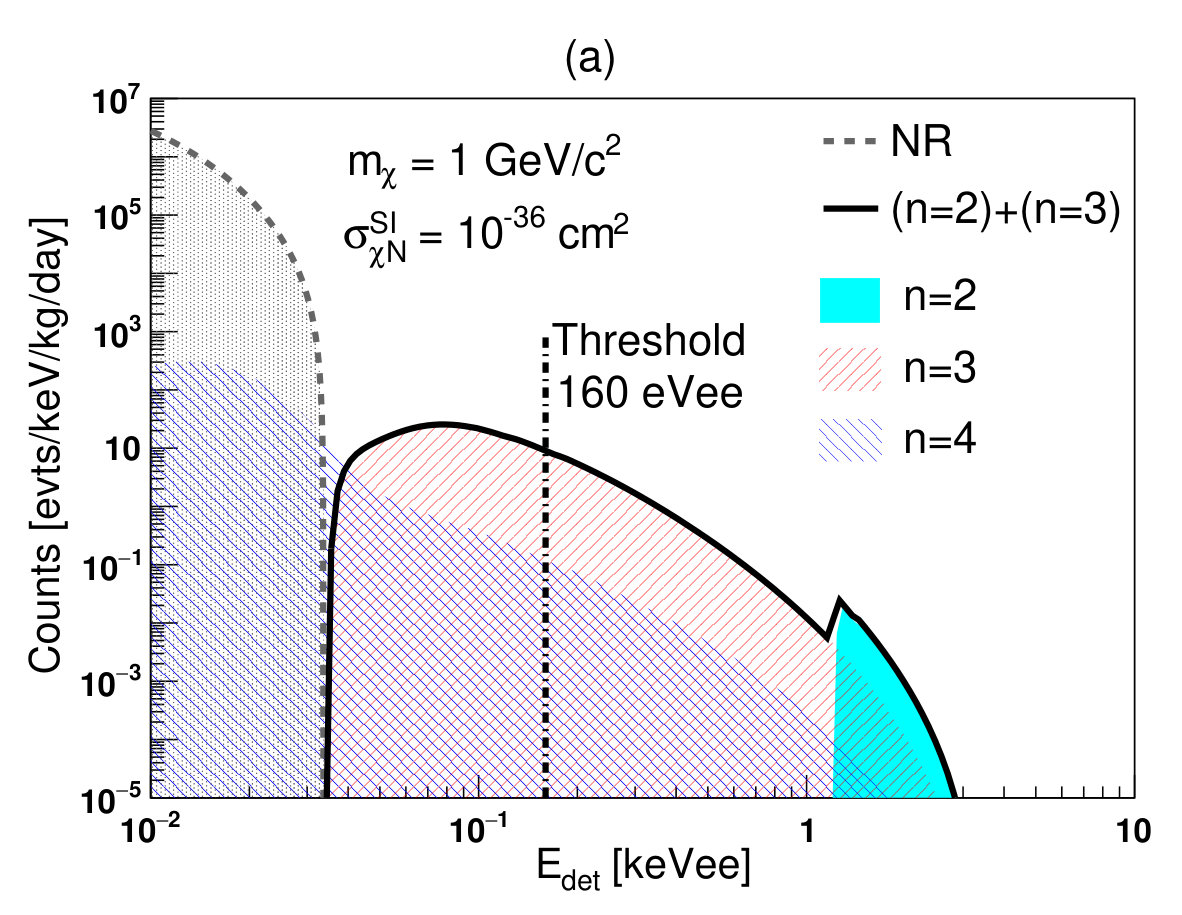 Figure 1
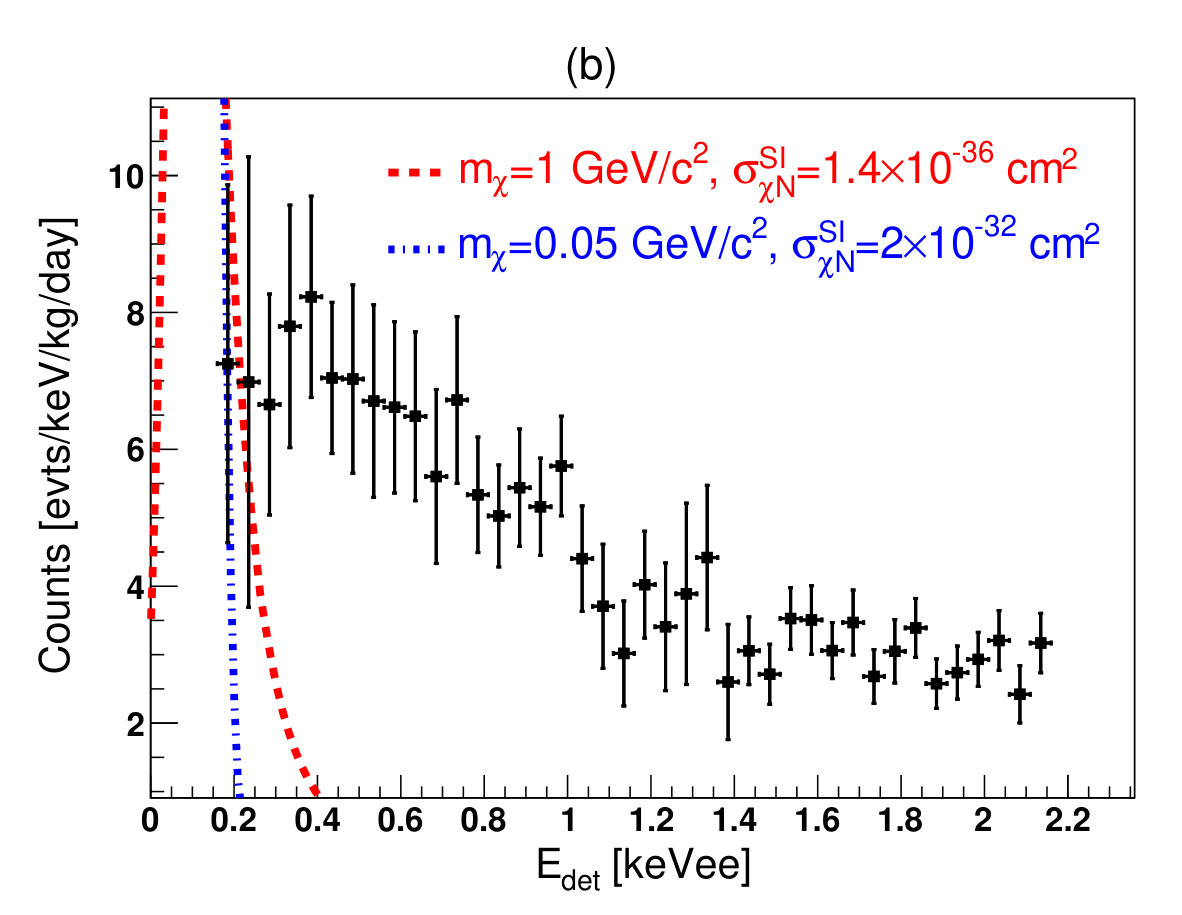 Figure 1
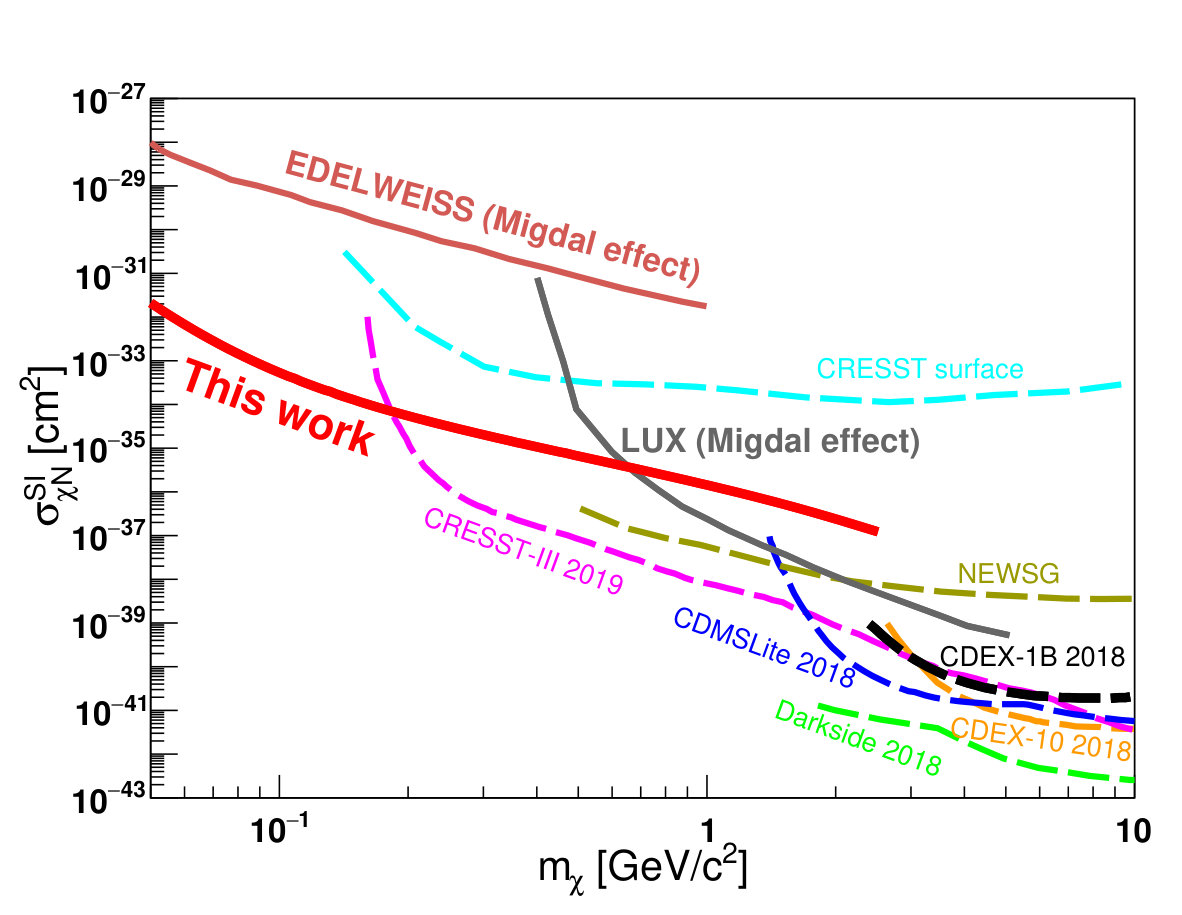 Figure 2
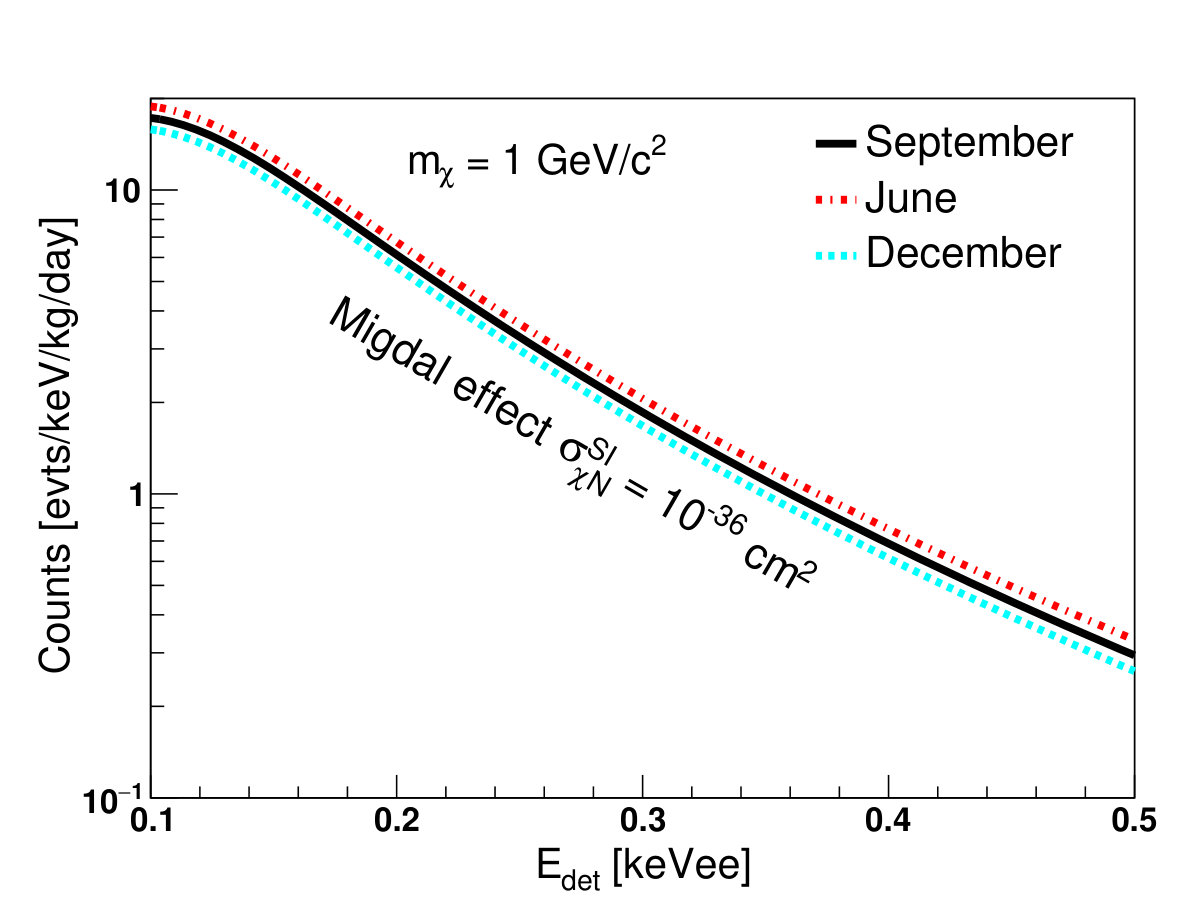 Figure 3
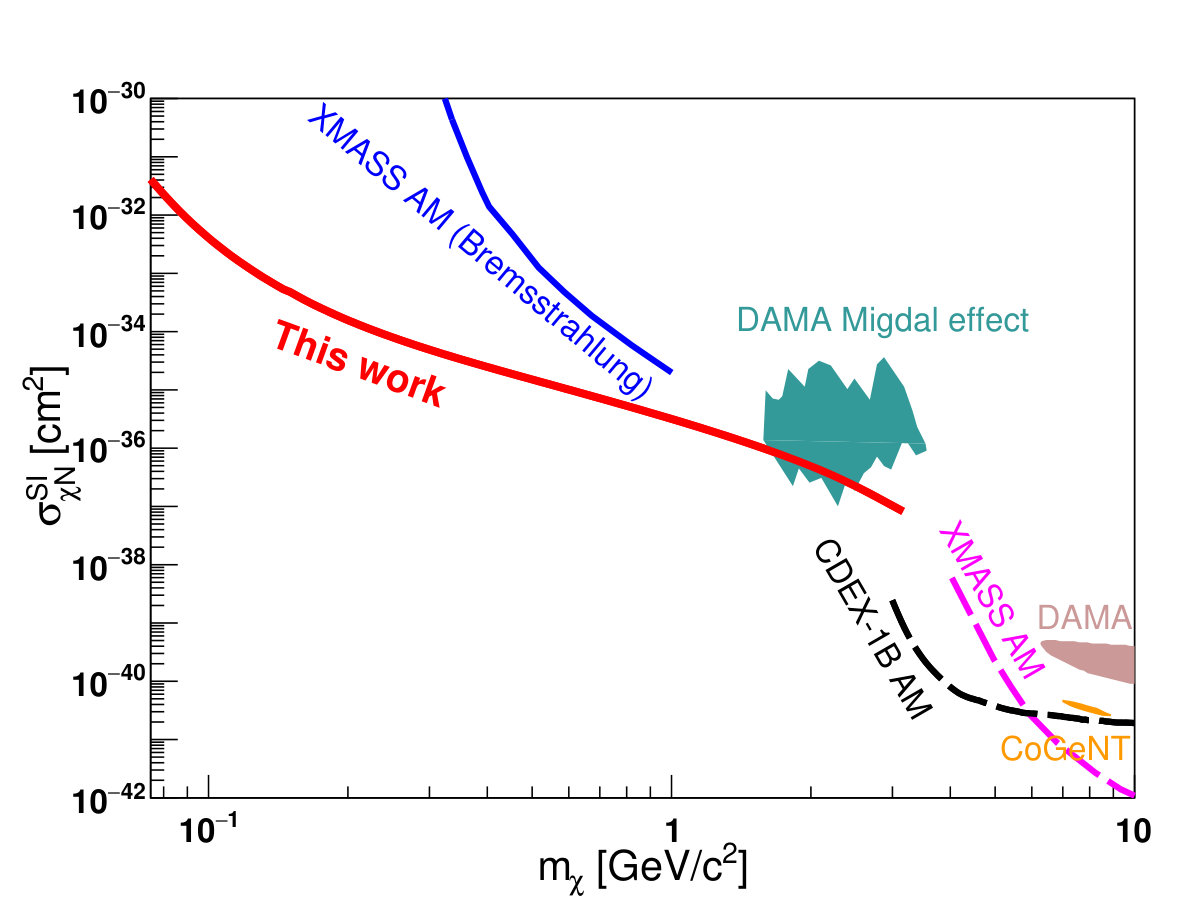 Figure 4
Peer Reviews
No public reviews on file for this paper yet. If you reviewed it on a platform where reviews are public (OpenReview, ICLR, NeurIPS, ICML), you can paste yours below so the community can read it here.
Videos
No videos yet. Explain this paper in a talk, walkthrough, or lecture? Add one.
Corresponding author: ][email protected]
Corresponding author: ][email protected]
Corresponding author: ][email protected]
CDEX Collaboration
Constraints on Spin-Independent Nucleus Scattering with sub-GeV Weakly Interacting Massive Particle Dark Matter from the CDEX-1B Experiment at the China Jin-Ping Laboratory
Z. Z. Liu
Key Laboratory of Particle and Radiation Imaging (Ministry of Education) and Department of Engineering Physics, Tsinghua University, Beijing 100084
Q. Yue
[
Key Laboratory of Particle and Radiation Imaging (Ministry of Education) and Department of Engineering Physics, Tsinghua University, Beijing 100084
L. T. Yang
[
Key Laboratory of Particle and Radiation Imaging (Ministry of Education) and Department of Engineering Physics, Tsinghua University, Beijing 100084
K. J. Kang
Key Laboratory of Particle and Radiation Imaging (Ministry of Education) and Department of Engineering Physics, Tsinghua University, Beijing 100084
Y. J. Li
Key Laboratory of Particle and Radiation Imaging (Ministry of Education) and Department of Engineering Physics, Tsinghua University, Beijing 100084
H. T. Wong
Participating as a member of TEXONO Collaboration
Institute of Physics, Academia Sinica, Taipei 11529
M. Agartioglu
Participating as a member of TEXONO Collaboration
Institute of Physics, Academia Sinica, Taipei 11529
Department of Physics, Dokuz Eylül University, İzmir 35160
H. P. An
Key Laboratory of Particle and Radiation Imaging (Ministry of Education) and Department of Engineering Physics, Tsinghua University, Beijing 100084
Department of Physics, Tsinghua University, Beijing 100084
J. P. Chang
NUCTECH Company, Beijing 100084
J. H. Chen
Participating as a member of TEXONO Collaboration
Institute of Physics, Academia Sinica, Taipei 11529
Y. H. Chen
YaLong River Hydropower Development Company, Chengdu 610051
J. P. Cheng
Key Laboratory of Particle and Radiation Imaging (Ministry of Education) and Department of Engineering Physics, Tsinghua University, Beijing 100084
College of Nuclear Science and Technology, Beijing Normal University, Beijing 100875
Z. Deng
Key Laboratory of Particle and Radiation Imaging (Ministry of Education) and Department of Engineering Physics, Tsinghua University, Beijing 100084
Q. Du
College of Physical Science and Technology, Sichuan University, Chengdu 610065
H. Gong
Key Laboratory of Particle and Radiation Imaging (Ministry of Education) and Department of Engineering Physics, Tsinghua University, Beijing 100084
X. Y. Guo
YaLong River Hydropower Development Company, Chengdu 610051
Q. J. Guo
School of Physics, Peking University, Beijing 100871
L. He
NUCTECH Company, Beijing 100084
S. M. He
YaLong River Hydropower Development Company, Chengdu 610051
J. W. Hu
Key Laboratory of Particle and Radiation Imaging (Ministry of Education) and Department of Engineering Physics, Tsinghua University, Beijing 100084
Q. D. Hu
Key Laboratory of Particle and Radiation Imaging (Ministry of Education) and Department of Engineering Physics, Tsinghua University, Beijing 100084
H. X. Huang
Department of Nuclear Physics, China Institute of Atomic Energy, Beijing 102413
L. P. Jia
Key Laboratory of Particle and Radiation Imaging (Ministry of Education) and Department of Engineering Physics, Tsinghua University, Beijing 100084
H. Jiang
Key Laboratory of Particle and Radiation Imaging (Ministry of Education) and Department of Engineering Physics, Tsinghua University, Beijing 100084
H. B. Li
Participating as a member of TEXONO Collaboration
Institute of Physics, Academia Sinica, Taipei 11529
H. Li
NUCTECH Company, Beijing 100084
J. M. Li
Key Laboratory of Particle and Radiation Imaging (Ministry of Education) and Department of Engineering Physics, Tsinghua University, Beijing 100084
J. Li
Key Laboratory of Particle and Radiation Imaging (Ministry of Education) and Department of Engineering Physics, Tsinghua University, Beijing 100084
X. Li
Department of Nuclear Physics, China Institute of Atomic Energy, Beijing 102413
X. Q. Li
School of Physics, Nankai University, Tianjin 300071
Y. L. Li
Key Laboratory of Particle and Radiation Imaging (Ministry of Education) and Department of Engineering Physics, Tsinghua University, Beijing 100084
B. Liao
College of Nuclear Science and Technology, Beijing Normal University, Beijing 100875
F. K. Lin
Participating as a member of TEXONO Collaboration
Institute of Physics, Academia Sinica, Taipei 11529
S. T. Lin
College of Physical Science and Technology, Sichuan University, Chengdu 610065
S. K. Liu
College of Physical Science and Technology, Sichuan University, Chengdu 610065
Y. D. Liu
College of Nuclear Science and Technology, Beijing Normal University, Beijing 100875
Y. Y. Liu
College of Nuclear Science and Technology, Beijing Normal University, Beijing 100875
H. Ma
[
Key Laboratory of Particle and Radiation Imaging (Ministry of Education) and Department of Engineering Physics, Tsinghua University, Beijing 100084
J. L. Ma
Key Laboratory of Particle and Radiation Imaging (Ministry of Education) and Department of Engineering Physics, Tsinghua University, Beijing 100084
Department of Physics, Tsinghua University, Beijing 100084
Y. C. Mao
School of Physics, Peking University, Beijing 100871
J. H. Ning
YaLong River Hydropower Development Company, Chengdu 610051
H. Pan
NUCTECH Company, Beijing 100084
N. C. Qi
YaLong River Hydropower Development Company, Chengdu 610051
J. Ren
Department of Nuclear Physics, China Institute of Atomic Energy, Beijing 102413
X. C. Ruan
Department of Nuclear Physics, China Institute of Atomic Energy, Beijing 102413
V. Sharma
Participating as a member of TEXONO Collaboration
Institute of Physics, Academia Sinica, Taipei 11529
Department of Physics, Banaras Hindu University, Varanasi 221005
Z. She
Key Laboratory of Particle and Radiation Imaging (Ministry of Education) and Department of Engineering Physics, Tsinghua University, Beijing 100084
L. Singh
Participating as a member of TEXONO Collaboration
Institute of Physics, Academia Sinica, Taipei 11529
Department of Physics, Banaras Hindu University, Varanasi 221005
M. K. Singh
Participating as a member of TEXONO Collaboration
Institute of Physics, Academia Sinica, Taipei 11529
Department of Physics, Banaras Hindu University, Varanasi 221005
T. X. Sun
College of Nuclear Science and Technology, Beijing Normal University, Beijing 100875
C. J. Tang
College of Physical Science and Technology, Sichuan University, Chengdu 610065
W. Y. Tang
Key Laboratory of Particle and Radiation Imaging (Ministry of Education) and Department of Engineering Physics, Tsinghua University, Beijing 100084
Y. Tian
Key Laboratory of Particle and Radiation Imaging (Ministry of Education) and Department of Engineering Physics, Tsinghua University, Beijing 100084
G. F. Wang
College of Nuclear Science and Technology, Beijing Normal University, Beijing 100875
L. Wang
Department of Physics, Beijing Normal University, Beijing 100875
Q. Wang
Key Laboratory of Particle and Radiation Imaging (Ministry of Education) and Department of Engineering Physics, Tsinghua University, Beijing 100084
Department of Physics, Tsinghua University, Beijing 100084
Y. Wang
Key Laboratory of Particle and Radiation Imaging (Ministry of Education) and Department of Engineering Physics, Tsinghua University, Beijing 100084
Department of Physics, Tsinghua University, Beijing 100084
Y. X. Wang
School of Physics, Peking University, Beijing 100871
S. Y. Wu
YaLong River Hydropower Development Company, Chengdu 610051
Y. C. Wu
Key Laboratory of Particle and Radiation Imaging (Ministry of Education) and Department of Engineering Physics, Tsinghua University, Beijing 100084
H. Y. Xing
College of Physical Science and Technology, Sichuan University, Chengdu 610065
Y. Xu
School of Physics, Nankai University, Tianjin 300071
T. Xue
Key Laboratory of Particle and Radiation Imaging (Ministry of Education) and Department of Engineering Physics, Tsinghua University, Beijing 100084
N. Yi
Key Laboratory of Particle and Radiation Imaging (Ministry of Education) and Department of Engineering Physics, Tsinghua University, Beijing 100084
C. X. Yu
School of Physics, Nankai University, Tianjin 300071
H. J. Yu
NUCTECH Company, Beijing 100084
J. F. Yue
YaLong River Hydropower Development Company, Chengdu 610051
M. Zeng
Key Laboratory of Particle and Radiation Imaging (Ministry of Education) and Department of Engineering Physics, Tsinghua University, Beijing 100084
Z. Zeng
Key Laboratory of Particle and Radiation Imaging (Ministry of Education) and Department of Engineering Physics, Tsinghua University, Beijing 100084
F. S. Zhang
College of Nuclear Science and Technology, Beijing Normal University, Beijing 100875
M. G. Zhao
School of Physics, Nankai University, Tianjin 300071
J. F. Zhou
YaLong River Hydropower Development Company, Chengdu 610051
Z. Y. Zhou
Department of Nuclear Physics, China Institute of Atomic Energy, Beijing 102413
J. J. Zhu
College of Physical Science and Technology, Sichuan University, Chengdu 610065
Abstract
We report results on the searches of weakly interacting massive particles (WIMPs) with sub-GeV masses () via WIMP-nucleus spin-independent scattering with Migdal effect incorporated. Analysis on time-integrated (TI) and annual modulation (AM) effects on CDEX-1B data are performed, with 737.1 kgday exposure and 160 eVee threshold for TI analysis, and 1107.5 kgday exposure and 250 eVee threshold for AM analysis. The sensitive windows in are expanded by an order of magnitude to lower DM masses with Migdal effect incorporated. New limits on at 90% confidence level are derived as 1010*-35* for TI analysis at 50180 MeV/, and 1010*-38* for AM analysis at 75 MeV/3.0 GeV/.
PACS numbers
95.35.+d, 29.40.-n, 98.70.Vc
††preprint: APS/123-QED
Introduction. Weakly interacting massive particles (WIMPs, denoted as ) are the most popular candidates of dark matter, the searches of which are of intense experimental interest Tanabashi et al. (2018). Direct detection experiments such as XENON Aprile et al. (2018), LUX Akerib et al. (2017), PandaX Cui et al. (2017), SuperCDMS Agnese et al. (2018), DarkSide Agnes et al. (2018), CDEX Liu et al. (2014); Zhao et al. (2013); Yue et al. (2014); Zhao et al. (2016); Yang et al. (2018); Jiang et al. (2018) are based on WIMP-nucleus (-) elastic scatterings through spin-independent (SI) and spin-dependent interactions. However, the nuclear recoil energy and hence the experimental observable rapidly diminishes with decreasing . Detectors with low threshold have to be used to study these light WIMPs. At the lowest achieved threshold of 30.1 eV in nuclear recoil energy, the CRESST Abdelhameed et al. experiment extends the low reach of to 160 MeV/, using the conventional - scattering detection channel.
It has been pointed out that finite amount of electrons or photons are produced in - inelastic scattering Moustakidis et al. (2005); Ibe et al. (2018); Dolan et al. (2018); Kouvaris and Pradler (2017). Two of the mechanisms that produce electro-magnetic final states in - scatterings are Migdal effect Ibe et al. (2018); Dolan et al. (2018) and bremsstrahlung emissions Kouvaris and Pradler (2017). The observable signals due to electron recoils or gamma rays are much larger than those of nuclear recoils at less than a few GeV. Taking these two effects into account, the lower reach of in direct detection experiments can be substantially extended to domains far below 1 GeV/.
-type point contact germanium (PPCGe) detectors have been adopted by CDEX Liu et al. (2014); Zhao et al. (2013); Yue et al. (2014); Zhao et al. (2016); Yang et al. (2018); Jiang et al. (2018) in light WIMP searches, exploiting their good energy resolution and ultralow energy threshold. Located in the China Jinping Underground Laboratory (CJPL) Cheng et al. (2017), CDEX-1B experiment Yang et al. (2018) has for its target a single-element PPCGe detector cooled by a cold finger, with an active mass of 939 g. A NaI(Tl) detector is used as active shielding to veto the gamma-ray induced background events. The detector has been under stable data taking conditions since March 27, 2014 and limits on - SI-scattering down to m_{\chi}$$\sim2 GeV/ are derived at an energy threshold of 160 eVee (“eVee” represents the electron equivalent energy) with an exposure of 737.1 kg-day Yang et al. (2018). The detector CDEX-1B has been working stably and the data obtained have good time stability, so the data are also used for annual modulation analysis Yang et al. . In this letter, taking Migdal effect into account, the CDEX-1B data is reanalyzed to derive new limits on WIMP-nucleon SI-interactions, cross section of which denoted by .
Migdal effect.— The conventional and simplified treatment of - scattering is that all the kinetic energy is transferred from to nuclear recoil via elastic scattering. Complexities arise in real physical systems, since the target nuclei in detectors, being part of the atoms, are coupled also to the electrons. There is finite probability that high-energy electrons are ejected via inelastic -N scattering processes. The electrons do not follow the motion of the nuclei such that the electrons of the target atom will be excited or ionized. The process, called Migdal effect Migdal (1941); Baur et al. (1983); Bernabei et al. (2007) was recently studied in the context of WIMP detection via - interactions Ibe et al. (2018); Dolan et al. (2018). According to Ref. Ibe et al. (2018), the ionization of a single electron is the dominant effect, whereas multielectron ionization and excitation as well as single-electron excitation can be neglected. Accordingly, only single electron ionization is considered in this analysis.
After an electron is ejected via ionization, the ionized atom will deexcite and emit new electrons or photons, whose total energy is the binding energy, denoted as . The total electronic energy, distinctive from the nuclear recoil energy, is given by , where is the kinetic energy of electron after ionization, while the cross section is given by
[TABLE]
where is the nuclear recoil energy, is the ionization probability, is equal to , is the atomic mass approximated to target nucleus mass, is equal to , and are the principal quantum number and orbital quantum number, respectively Ibe et al. (2018).
The maximum electronic energy is equal to , is the reduced mass between and target nucleus, is the relative velocity between and the target nucleus, while the maximum energy of nuclear recoil is equal to Ibe et al. (2018); Dolan et al. (2018). If , then , such that . For example, while MeV/ and GeV/ (the nucleus mass of Ge), for =776 km/s, the resulting eV and eV.
The - event rates due to Migdal effect can be expressed as:
[TABLE]
where is the number of target nuclei per unit detector mass, is the density of dark matter, is the mass of DM particle, is Earth’s velocity relative Galaxy.
As the CDEX PPCGe detectors do not discriminate nuclear recoils from electron recoils, the observable signals are the summation of nuclear recoil energy and electron recoil energy, denoted as , where is the quenching factor Soma et al. (2016). In this letter, the Lindhard formula Lindhard et al. (1963) is adopted for the evaluation of . There is no experiment data for of Ge below 0.2 keVnr, so the value (=0.22) in Lindhard formula is derived by fitting of experiment data Jones and Kraner (1971, 1975); Barbeau et al. (2007) under 2 keVnr with a conservative uncertainty of 30% adopted as systematic error.
Time-integrated (TI) analysis.— The expected energy spectra of -N SI scattering are shown in Fig. 1 (a), where the target nucleus is Ge, = 1 GeV/, and = . The standard WIMP galactic halo assumption and conventional astrophysical models Aalseth et al. (2013a) are used, with -density set to 0.3 GeV/(), Earth’s velocity at 232 km/s, -velocity distribution assumed to be Maxwellian with the most probable velocity km/s, the local Galactic escape velocity at 544 km/s, and the Helm form factor Jungman et al. (1996); Lewin and Smith (1996) is adopted. Smearing due to energy resolution is taken into account in this work. Only the ionization spectra from and shell (=2, 3) are considered in this work, while those of shell () cannot be ionized at 3 GeV/, and those of the valence electrons ( shell, =4) are not reliable, as they are easily affected by the germanium band structure due to the small binding energy.
Using Fig. 1 (a) as illustration, the expected rates in complete energy range for - elastic SI-scattering and Migdal effects at =1 GeV/ are in ratio of about (only the ionization of L and M shell electrons is considered here). However, at a threshold of 160 eVee where the - elastic scatterings are no longer observable, the Migdal effect can still produce signals above threshold and therefore open the sensitivity windows to lower .
Data used for the TI analysis are from March 2014 to July 2017, with a total exposure of 737.1 kgday Yang et al. (2018). The dead time ratio of the data acquisition (DAQ) system was less than 0.1% and remained stable. Energy calibration is performed with internal x-ray peaks and test pulser measurements and was linear with a deviation less than 0.4%. The candidate - events were selected by a series of data analysis criteria. The time coincidence of events in NaI(Tl) detector and Ge detector is used to veto the gamma-ray background events. Physical events were selected out from noise events with a combined efficiency of 17% at the analysis threshold of 160 eVee Yang et al. (2018). Surface events were rejected and bulk events were selected based the rise time of the signal pulses. The residual energy spectrum is shown in Fig. 1 (b).
Upper limits at 90% confidence level (C.L.) in are derived by Binned Poisson method Savage et al. (2009). The constraint results at =1 GeV/ and =50 MeV/ are shown in Fig. 1 (b) by dash and dash-dotted lines. The exclusion curve is shown in Fig. 2, in which several other experiments are superimposed for reference. New limits are achieved for MeV/, and the lower reach of is extended to 50 MeV/.
Annual modulation (AM) analysis.— Positive observations of AM would provide smoking-gun signatures for WIMPs independent of the astrophysics and background models. Compared to TI analysis, the AM effects are enhanced at low WIMP mass, related to the specific shape of the ionization probability spectrum, and the sub-GeV sensitivities of the Migdal analysis can further exploit the potentials of AM studies. The Earth’s velocity relative to the galactic WIMP halo is time-varying with a period of one year, and can be expressed as km/s, where is set to be 365.25 days, is set to be 152.5 days from January Smith et al. (2007). The expected measurable spectra at different time of the year are shown in Fig. 3, where obvious modulation effect can be observed.
We adopt in this AM analysis the same data as previously used to study AM effects in the conventional - nuclear recoil channel Yang et al. . There are two datasets, Run-1 with the the NaI(Tl) anti-Compton detector, and Run-2 without NaI(Tl), having 751.3 and 428.1 live days, respectively, and together spanning a total of 1527 calendar days (4.2 yr) and a total exposure of 1107.5 kgday. The background stability and environment parameters have been checked, and the time stability of the candidate - event rates at different energy ranges were demonstrated with Fig. 1 of Ref. Yang et al. . The Model-Dependent AM analysis Yang et al. is adopted in this analysis. The AM-amplitudes ( of the th energy bin of the th Run) are related and constrained by a known function () of and , such that , where and are the mean energy and its corresponding bin-size, respectively. The same analysis threshold of 250 eVee and minimization procedures are adopted Yang et al. .
Depicted in Fig. 4 are the 90% C.L. limits from AM analysis with Migdal effect. The only previous AM analysis at sub-GeV range was performed by XMASS-I Kobayashi et al. (2019) where threshold is higher (1 keVee). Its limits are also displayed. Superimposed for comparison are the AM nuclear recoils bounds from CDEX-1B Yang et al. and XMASS-I Kobayashi et al. (2019), as well as the AM-allowed regions of CoGeNT Aalseth et al. (2013b, ) and DAMA/LIBRA Bernabei et al. (2007, 2013); Savage et al. (2009); Baum et al. (2019). The lower reach of is extended to 75 MeV/.
Good time stability of the CDEX-1B data leads to comparable sensitivities among the results from the AM and TI analysis due to enhanced AM effects at low , despite the higher energy threshold of AM analysis. The measured ratios of to the averaged background rates are less than 10% at 1 keVee for this data set. These can be compared with the expected range from Halo model and Migdal effect, which increases from 10% to 40% as decreases from 5 GeV/ to 75 MeV/.
Summary.— In this letter, we incorporate a newly identified mechanism on - SI-interactions to the analysis of CDEX-1B data, based on the theoretical formula in Ref. Ibe et al. (2018). New windows are opened and new limits are derived. The exclusion region in can be extended down to 50 MeV/ with an energy threshold of 160 eVee in the TI analysis. The best sensitivity in is achieved for (50180) MeV/ via the Migdal effect. About 4.2 years time span of CDEX-1B data are used in the AM analysis. At an energy threshold of 250 eVee, the best sensitivity of for GeV/ via the Migdal effect is achieved, extending to 75 MeV/.
For completeness, we note that bremsstrahlung effects in - scattering were also recently derived in Ref. Kouvaris and Pradler (2017) which allow light WIMP of MeV-GeV mass range to be probed. The sensitivities, however, are expected to be orders of magnitude worse than those of Midgal effects, and in the parameter space where the earth shielding effect Emken and Kouvaris (2017); Hooper and McDermott (2018); Emken and Kouvaris (2018); Kavanagh (2018) would play a role in defining the exclusions. In addition, the excluded regions in this work have upper bounds due to earth shielding effect, detailed calculation of which is postponed to future work.
This work was supported by the National Key Research and Development Program of China (Grant No. 2017YFA0402200), the National Natural Science Foundation of China (Grants No. 11725522, No. 11675088, No.11475099) and the Tsinghua University Initiative Scientific Research Program (Grant No. 20197050007).
The reference list from the paper itself. Each links out to its DOI / PubMed record.
- 1Tanabashi et al. (2018) M. Tanabashi et al. , Phys. Rev. D 98 , 030001 (2018) . · doi ↗
- 2Aprile et al. (2018) E. Aprile et al. , Phys. Rev. Lett. 121 , 111302 (2018) . · doi ↗
- 3Akerib et al. (2017) D. S. Akerib et al. , Phys. Rev. Lett. 118 , 021303 (2017) . · doi ↗
- 4Cui et al. (2017) X. Cui et al. , Phys. Rev. Lett. 119 , 181302 (2017) . · doi ↗
- 5Agnese et al. (2018) R. Agnese et al. , Phys. Rev. D 97 , 022002 (2018) . · doi ↗
- 6Agnes et al. (2018) P. Agnes et al. , Phys. Rev. Lett. 121 , 081307 (2018) . · doi ↗
- 7Liu et al. (2014) S. K. Liu et al. , Phys. Rev. D 90 , 032003 (2014) . · doi ↗
- 8Zhao et al. (2013) W. Zhao et al. , Phys. Rev. D 88 , 052004 (2013) . · doi ↗