Limits on a population of collisional-triples as progenitors of Type-Ia supernovae
Na'ama Hallakoun, Dan Maoz

TL;DR
This study tests the collisional-triple progenitor model for Type-Ia supernovae by searching Gaia data for tertiary companions around double white dwarfs, finding the population too small to account for observed supernova rates.
Contribution
The paper provides the first observational constraints on the frequency of triple systems necessary for the collisional progenitor model of Type-Ia supernovae.
Findings
Zero tertiaries found around 27 double WDs within 120 pc.
Upper limit of 11% on the fraction of WDs in such triples.
Potential progenitor population is much smaller than needed for the model.
Abstract
The progenitor systems of Type-Ia supernovae (SNe Ia) are yet unknown. The collisional-triple SN Ia progenitor model posits that SNe Ia result from head-on collisions of binary white dwarfs (WDs), driven by dynamical perturbations by the tertiary stars in mild-hierarchical triple systems. To reproduce the Galactic SN Ia rate, at least ~30-55 per cent of all WDs would need to be in triple systems of a specific architecture. We test this scenario by searching the Gaia DR2 database for the postulated progenitor triples. Within a volume out to 120 pc, we search around Gaia-resolved double WDs with projected separations up to 300 au, for physical tertiary companions at projected separations out to 9000 au. At 120 pc, Gaia can detect faint low-mass tertiaries down to the bottom of the main sequence and to the coolest WDs. Around 27 double WDs, we identify zero tertiaries at such separations,…
Click any figure to enlarge with its caption.
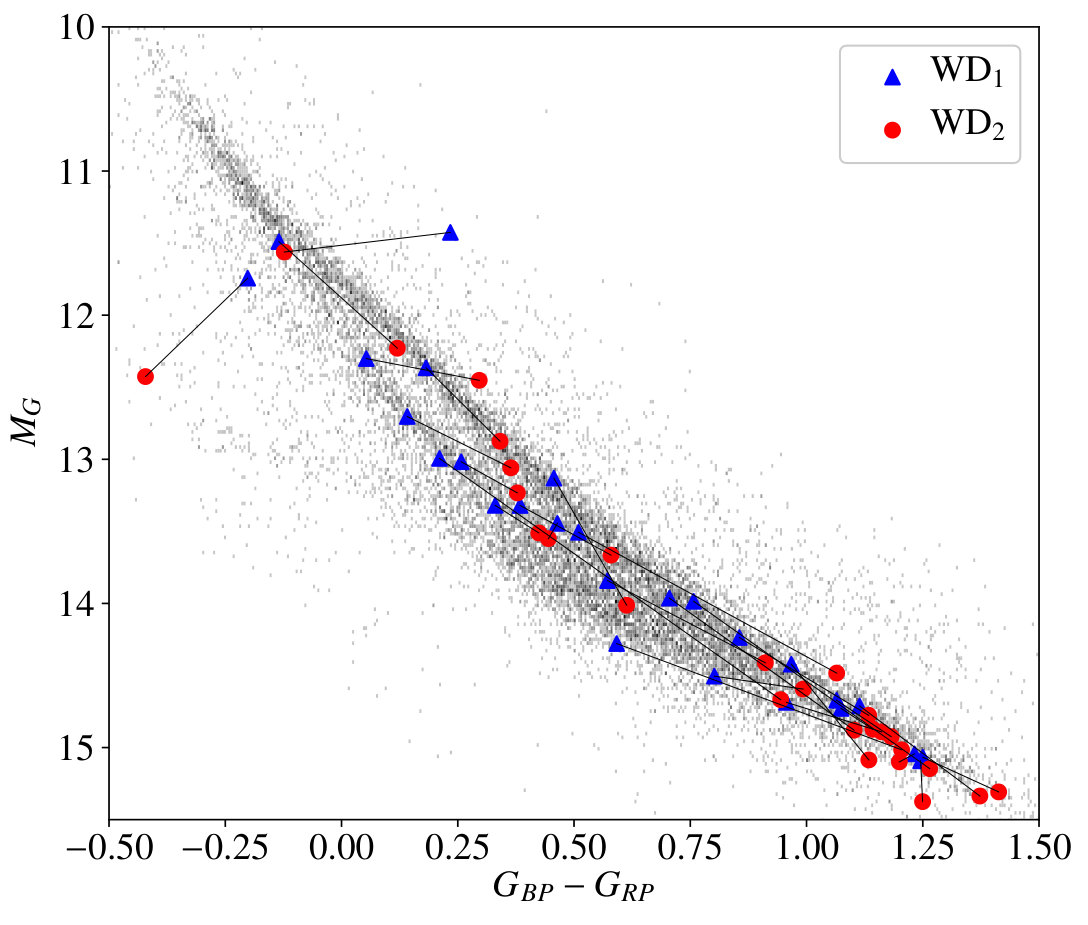 Figure 1
 Figure 2
| GaiaID | (mas) | (pc) | (mas yr-1) | (mas yr-1) | (km s-1) | (km s-1) |
|---|---|---|---|---|---|---|
| 4617812054836337536 | ||||||
| 4617812054837799168 | ||||||
| ″ | au | km s-1 | ||||
| 2482813425794003200 | ||||||
| 2482813430089468160 | ||||||
| ″ | au | km s-1 | ||||
| 4613612951211823616 | ||||||
| 4613612951211823104 | ||||||
| ″ | au | km s-1 | ||||
| 16166875378033664 | ||||||
| 16166875377576064 | ||||||
| ″ | au | km s-1 | ||||
| 3249479592235301376 | ||||||
| 3249479592234269056 | ||||||
| ″ | au | km s-1 | ||||
| 3404213863614488192 | ||||||
| 3404213863611804672 | ||||||
| ″ | au | km s-1 | ||||
| 3001062974507933952 | ||||||
| 3001062974507934080 | ||||||
| ″ | au | km s-1 | ||||
| 3144837318276010624 | ||||||
| 3144837112117580800 | ||||||
| ″ | au | km s-1 | ||||
| 1118460924702185088 | ||||||
| 1118460924703171584 | ||||||
| ″ | au | km s-1 | ||||
| 606938634805314944 | ||||||
| 606938634805314816 | ||||||
| ″ | au | km s-1 | ||||
| 798602271945568256 | ||||||
| 798602267650286464 | ||||||
| ″ | au | km s-1 | ||||
| 5436014972680358272 | ||||||
| 5436014972680358784 | ||||||
| ″ | au | km s-1 | ||||
| 3970693313784409344 | ||||||
| 3970693313782310656 | ||||||
| ″ | au | km s-1 | ||||
| 5874024774146311808 | ||||||
| 5874024769842933760 | ||||||
| ″ | au | km s-1 | ||||
| 5886778250054825344 | ||||||
| 5886777494107570176 | ||||||
| ″ | au | km s-1 | ||||
| 4450425359563998720 | ||||||
| 4450425359563998848 | ||||||
| ″ | au | km s-1 | ||||
| 1408135749896104192 | ||||||
| 1408135749896103936 | ||||||
| ″ | au | km s-1 | ||||
Peer Reviews
No public reviews on file for this paper yet. If you reviewed it on a platform where reviews are public (OpenReview, ICLR, NeurIPS, ICML), you can paste yours below so the community can read it here.
Videos
No videos yet. Explain this paper in a talk, walkthrough, or lecture? Add one.
Limits on a population of collisional-triples as progenitors of Type-Ia supernovae
Na’ama Hallakoun and Dan Maoz
School of Physics and Astronomy, Tel-Aviv University, Tel-Aviv 6997801, Israel E-mail: [email protected] (NH)
(Accepted XXX. Received YYY; in original form ZZZ)
Abstract
The progenitor systems of Type-Ia supernovae (SNe Ia) are yet unknown. The collisional-triple SN Ia progenitor model posits that SNe Ia result from head-on collisions of binary white dwarfs (WDs), driven by dynamical perturbations by the tertiary stars in mild-hierarchical triple systems. To reproduce the Galactic SN Ia rate, at least per cent of all WDs would need to be in triple systems of a specific architecture. We test this scenario by searching the Gaia DR2 database for the postulated progenitor triples. Within a volume out to 120 pc, we search around Gaia-resolved double WDs with projected separations up to 300 au, for physical tertiary companions at projected separations out to 9000 au. At 120 pc, Gaia can detect faint low-mass tertiaries down to the bottom of the main sequence and to the coolest WDs. Around 27 double WDs, we identify zero tertiaries at such separations, setting a 95 per cent confidence upper limit of 11 per cent on the fraction of binary WDs that are part of mild hierarchical triples of the kind required by the model. As only a fraction (likely per cent) of all WDs are in au WD binaries, the potential collisional-triple progenitor population appears to be at least an order of magnitude (and likely several) smaller than required by the model.
keywords:
binaries: visual – white dwarfs – supernovae: general
††pubyear: 2019††pagerange: Limits on a population of collisional-triples as progenitors of Type-Ia supernovae–2.1
1 Introduction
A major unsolved puzzle in astrophysics is the identity of the progenitors of Type-Ia supernovae (SNe Ia; see Maoz et al. 2014; Livio & Mazzali 2018; Wang 2018, for a review). A number of progenitor scenarios have been considered over the years. Among them, several have involved the collision of two white dwarfs (WDs) in a variety of configurations and environments (e.g. Benz et al., 1989; Thompson, 2011). In particular, Katz & Dong (2012) and Kushnir et al. (2013) have proposed that SNe Ia result from head-on collisions of WDs in “mild-hierarchical” triple systems. The triple system consists of an inner double-WD binary with separation au, orbited by a roughly solar-mass tertiary star in an orbit with pericentre separation times the inner-binary’s separation. Using numerical integration of the evolution of such 3-body systems and assuming a uniform distribution of inclinations, Katz & Dong (2012) found that, in about 5 per cent of all such systems (the 5 per cent within a small range around a high inclination between the inner and outer orbits), the outer tertiary stochastically drives a Kozai-Lidov perturbation of the inner pair’s orbital eccentricity. Within a few Gyr, the eccentricity lands on a high-enough value to send the inner pair on a head-collision. Given that the actual distribution of inclinations of the systems that survive as a wide double WD with a tertiary companion is unlikely to be uniform, this 5 per cent is most likely an upper limit of the fraction of systems that undergo a collision. Kushnir et al. (2013) showed that the compression undergone by the WDs upon collision could be effective both at igniting a thermonuclear carbon detonation, and in producing about 0.5 M⊙ of radioactive 56Ni in the explosion, as observed in typical SN Ia events. The range of masses of the WDs that collide could also reproduce the observed range of SN Ia luminosities and their correlation with light-curve evolution time. The asymmetry of the system at the time of explosion predicts double-peaked emission line profiles in SN Ia spectra during the nebular phase in a fraction of events, for which there may be some observational evidence (Dong et al., 2015, 2018; Kollmeier et al., 2019; Vallely et al., 2019).
However, a major challenge for the collisional-triple model is to produce a collision rate that can match the SN Ia rate in our Galaxy. The Milky Way, if it is a typical Sbc galaxy, has a SN Ia rate per unit stellar mass of yr*-1* M⊙-1 (Li et al., 2011; Graur et al., 2017).111For a total stellar mass of M⊙ (McMillan, 2011), the Galactic rate is yr*-1*, or a SN Ia every yr. This is broadly consistent with the four known Galactic events over the last millennium that were likely or certain SNe Ia (SN1006, SN1572-Tycho, SN1604-Kepler, and G1.9+03). The stellar mass density in the Solar neighborhood is M⊙ pc*-3* (McMillan, 2011), and the WD number density is pc*-3* (Hollands et al., 2018), giving a stellar-mass to WD number ratio of M⊙ WD*-1*. The SN Ia rate per WD is therefore yr*-1*, and the fraction of all WDs that explode as SNe Ia during the 10 Gyr-lifetime of the Galaxy is per cent. Considering then, that in the collisional-triple model at most 5 per cent of suitable triple systems undergo a SN Ia inducing collision, implies that at least per cent of all WDs need to be in suitable triple systems, if this mechanism is to explain all SNe Ia (see also Papish & Perets, 2016).
While the observational picture on stellar multiplicity is far from clear yet, and even more so the situation regarding the multiplicity of stellar remnants such as WDs, there are already question marks as to the plausibility of such a high frequency of triples with a specific architecture [ au, ]. The fraction of triple stars (of all configurations) among main-sequence A-through-K type stars has been estimated at per cent (Tokovinin et al., 2008; Duchêne & Kraus, 2013; Tokovinin, 2014; Leigh & Geller, 2013, and references therein), or per cent (Moe & Di Stefano, 2017), and likely only a fraction of those have the required architectures. Klein & Katz (2017) estimated the occurrence frequency of the inner binary WD component of the collisional-triple model, by analysing two published studies of stars (that will eventually evolve into WDs): an adaptive optics survey of A stars by De Rosa et al. (2014), in which M⊙ companions within 400 au were searched for; and a radial-velocity survey by Mermilliod et al. (2007) of M⊙ giants, which was searched for M⊙ companions within 3 au. Klein & Katz (2017) conclude that per cent of the intermediate mass stars that become WDs are in binaries that can constitute the inner component of collisional-triple systems, and therefore even if all such binaries had a mild hierarchical tertiary, there would still be a factor 2 shortage of collisional-triple progenitors for SNe Ia. Even if triple main-sequence systems are abundant, a challenge of the model that was already acknowledged by Katz & Dong (2012) is that triple systems with the suitable architecture and relative orbital inclination to induce to a collision of the inner binary will undergo such a collision already when the stars are on the main sequence (without an ensuing SN Ia), effectively eliminating all the SN Ia progenitor systems. This conclusion has emerged also from binary population synthesis calculations (Hamers et al., 2013; Toonen et al., 2018). Katz & Dong (2012) raised the possibility that angular momentum loss by the system due to asymmetric mass loss during the evolution to the WD stage, or perturbations by passing stars, could “reset” the relative orbital inclinations of the system, and thus solve the problem.
In this paper, we address more directly the subject of the putative triple-progenitor population of SNe Ia, by searching the Gaia DR2 database (Gaia Collaboration et al., 2016, 2018a) specifically for double WDs orbited by a tertiary star, as envisaged in the collisional-triple model.
2 Gaia search
We search for triple systems akin to those required by the collisional-triple model using two approaches: first, by identifying resolved WD binaries with projected separations au, and searching their surroundings for tertiaries with projected separations au; and, second, by searching for tertiaries projected within au of unresolved, double-WD, separation au, candidates identified via radial-velocity variations. Our search for triples is conservatively inclusive in several respects. First, by pre-selecting WD binaries, and then asking what fraction of those binaries have a tertiary, we obtain an upper limit on the fraction of all WDs in triples, since not all WDs are in binaries. Second, because of projection effects, some of the selected inner binaries will have physical separations au, and some of the counted tertiaries will be at physical separations beyond the tertiary separation range required by the model. By including all of these systems, we will obtain a conservative upper limit on the true fraction of of WDs that are in triples with the architecture required by the model.
2.1 Resolved Gaia triples
Following Gentile Fusillo et al. (2019), we start by identifying all WD candidates using an initial colour-magnitude cut in Gaia DR2 data:
[TABLE]
where is the absolute magnitude in the band. This results in sources. We further select only those within a distance of 120 pc:
[TABLE]
leaving sources. We follow Gaia Collaboration et al. (2018b) and remove astrometric artefacts by requiring:
[TABLE]
where is astrometric_chi2_al and is astrometric_n_good_obs_al in the Gaia database, leaving sources.
Since the and fluxes are calculated by integrating over low-resolution spectra, they are more prone to contamination from nearby sources, compared to the -band flux, which is measured by photometric profile fitting. Following El-Badry & Rix (2018) and Evans et al. (2018), we filter out sources that might be contaminated by nearby sources by limiting the total and excess compared to the band:
[TABLE]
leaving sources.
We further follow El-Badry & Rix (2018) by selecting only sources with high signal-to-noise ratio photometry, i.e., per cent flux uncertainty in the band, and per cent in both the and bands:
[TABLE]
leaving sources. These criteria assure that we only select sources that fall with high certainty within in the WD region of the colour-magnitude diagram.
Finally, we select only sources where the relative error on the parallax is smaller than per cent:
[TABLE]
resulting in sources.
We then choose all physical-double resolved WDs within 120 pc with projected separations au, by requiring
[TABLE]
where is the angular separation, au is the projected separation, and is the parallax. Following El-Badry & Rix (2018, eq. 2) we further select only pairs with consistent parallaxes:
[TABLE]
where pc, pc, and pc. Here and are the parallax of the th target and its standard error in arcsec, respectively, and the angular separation, , is in radians. This means that we inclusively count a system as a WD binary, even if its component distances differ at the level.
The search results in WD pairs, listed in Table 2.1, out of the WDs that are nearer than 120 pc. The relative projected velocity differences between the members of each pair, also listed in Table 2.1, are well below the km s*-1* maximum that is possible between bound solar-mass objects, indicating these are real, bound, pairs. Fig. 1 shows the WD-pair locations on the Gaia colour-magnitude diagram.
We note, following El-Badry & Rix (2018) and Arenou et al. (2018), that the above 27 resolved pairs are a small fraction of the actual number of WD pairs with separations au, which is likely to be at least 10 per cent (Maoz et al., 2018). First, Gaia is incomplete to binaries at angular separations ″, corresponding to 84 au at 120 pc. More importantly, the Gaia colour is not available, in most cases, for both components of doubles with projected separations ″ (240 au at 120 pc), selecting against the identification of one or both stars as WDs. We further note that extending the WD sample to 200 or 300 pc did not result in any additional au WD pairs, likely because of the limitations imposed by the resolution, which become more severe with distance. However, our strategy for testing the collisional-triple model does not require a complete census of WD binaries; to the contrary, we select only a small minority of double-WDs that Gaia can detect, but then perform a thorough search for tertiaries around these binaries.
By limiting our sample of WD pairs to 120 pc, we expect that, at the limiting Gaia magnitude , we are sensitive and largely complete to tertiary companions corresponding to the faintest, lowest-mass, main-sequence stars, as well as the coolest WDs. As shown by Gentile Fusillo et al. (2019, fig. 19), the 100 pc Gaia DR2 WD sample is complete up to , indeed corresponding to all but the coolest few percent of WDs with (Isern, 2019; Tremblay et al., 2019). This completeness likely applies also at the relatively brighter luminosities near the bottom of the main sequence (, K), corresponding to M⊙ M-dwarfs (Hillenbrand & White, 2004). However, a more thorough future assessment of the main-sequence completeness at 120 pc will place our conclusions, below, on a surer footing.
The reference list from the paper itself. Each links out to its DOI / PubMed record.
- 1Arenou et al. (2018) Arenou F., et al., 2018, A&A , 616, A 17 · doi ↗
- 2Astropy Collaboration et al. (2013) Astropy Collaboration et al., 2013, A&A , 558, A 33 · doi ↗
- 3Astropy Collaboration et al. (2018) Astropy Collaboration et al., 2018, AJ , 156, 123 · doi ↗
- 4Badenes & Maoz (2012) Badenes C., Maoz D., 2012, Ap J , 749, L 11 · doi ↗
- 5Benz et al. (1989) Benz W., Hills J. G., Thielemann F. K., 1989, Ap J , 342, 986 · doi ↗
- 6De Rosa et al. (2014) De Rosa R. J., et al., 2014, MNRAS , 437, 1216 · doi ↗
- 7Dong et al. (2015) Dong S., Katz B., Kushnir D., Prieto J. L., 2015, MNRAS , 454, L 61 · doi ↗
- 8Dong et al. (2018) Dong S., et al., 2018, MNRAS , 479, L 70 · doi ↗